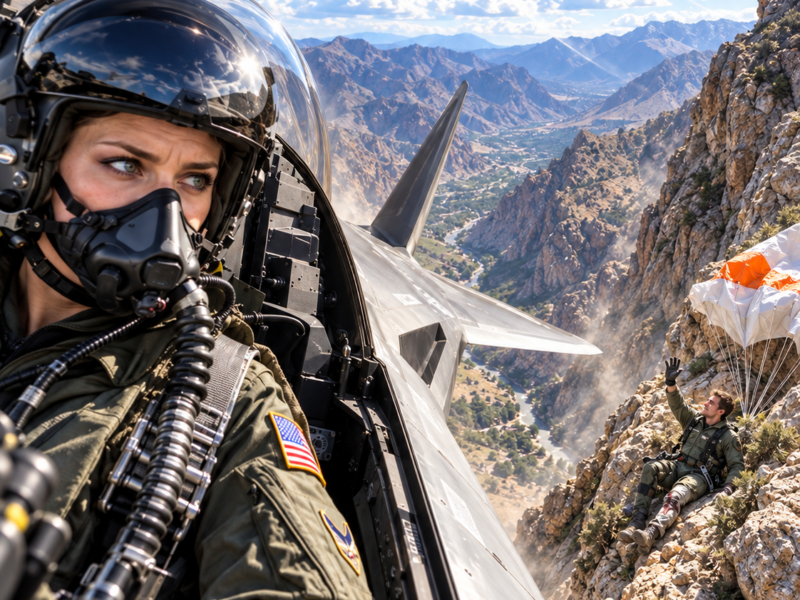
“With enemy fighters closing over the mountains of North Korea, I broke formation to rescue a downed American pilot my commanding officer had already written off
The radio crackled so violently that I pulled the headset away from my ear.
“Morgan, get out of that valley!” Major Hayes shouted again. “Climb immediately and return to base!”
I looked at the strange symbol painted behind my cockpit, then down at Jack Sullivan, who had reached the trees and was leaning against a pine trunk, struggling to stay upright.
“Sir, I need an explanation.”
“You need to obey an order for once in your life!”
That wasn’t an explanation. It was fear disguised as authority, and in the three years I’d flown under Major Hayes, I’d never heard him speak that way.
The unfamiliar voice returned on the emergency frequency.
“Captain Morgan, you have very little time. There is a road on the eastern side of the river. Follow it north for half a mile, and you will find a stone bridge. Your friend must reach that bridge before noon.”
“Who are you?”
“My name is Daniel Park. I served with the man who painted that symbol.”
“An American?”
Another pause.
“No, Captain. A man who wanted to become one.”
Before I could ask what that meant, the transmission faded into static.
I banked around the valley, scanning the snowy ridges. Nothing moved except the windblown snow and the thin smoke curling from Jack’s wrecked Sabre.
Then I spotted something that made my skin prickle.
A narrow track cut through the trees on the eastern bank. It was too straight to be a game trail, and fresh tire marks crossed the snow beside it.
Someone had been here recently.
I switched to the squadron frequency.
“Jack, can you hear me?”
His answer came faintly through the static.
“Unfortunately, Morgan. I was hoping you’d finally learned to follow orders.”
Relief loosened something in my chest.
“Can you walk?”
“Depends. Are you asking as a friend or as the person who just flew a fighter jet over my head at fifty feet?”
“Jack.”
He stopped joking.
“I can walk. My arm’s bad, and I think I’ve cracked a rib.”
“There’s a road east of the river. I need you to get to it.”
“Why?”
“Because an enemy pilot just told me to.”
For a moment, there was only static.
“That’s not funny.”
“I’m not laughing.”
I explained what had happened as quickly as I could, including the retreating MiGs and the symbol on my fuselage.
When I finished, Jack didn’t respond.
“Jack?”
“I’ve seen that mark before.”
I sat up straighter.
“Where?”
“Your aircraft. A few weeks ago, when we were doing that maintenance rotation at K-14. Remember when they kept your Sabre overnight?”
I remembered.
A ground crew had replaced a damaged panel behind my cockpit. I’d been told the work was routine, and I’d gone to the officers’ mess while they finished.
“Someone could have painted it then,” Jack continued. “I thought it was a maintenance stencil. I didn’t think anything of it.”
“Why didn’t you mention it?”
“Because I didn’t know it mattered.”
Neither of us spoke for several seconds.
Then Jack said something that chilled me more than the mountain air.
“Morgan, when I was coming down, I saw one of those MiGs flying alongside me. He had a clear shot. He could have finished me before I crossed the ridge.”
“But he didn’t.”
“No. He followed me down, circled once, and then disappeared behind the mountains.”
I looked toward the northern end of the valley.
“Can you reach that bridge?”
“I’ll try.”
“Don’t try. Do it.”
“There’s the Morgan I know.”
His signal faded as I climbed above the trees.
I needed a better view of the valley, but I also needed fuel. The warning light had been flickering for nearly five minutes, and the detour had cost me more than I’d planned.
If I returned to base, I could bring help.
If I stayed, I might find out why six enemy fighters had let me live.
I turned west, intending to climb above the ridge and make one last pass before heading home.
That was when I saw the second aircraft.
It was parked beneath a camouflage net in a clearing beyond the stone bridge, its wings dusted with snow and its fuselage almost entirely hidden by pine branches.
It looked like an old Soviet fighter, but something about its shape seemed wrong.
The nose was longer than it should have been, and the tail carried a faded American identification number.
I had never seen a plane like it.
As I circled, a small figure emerged from a wooden building beside the clearing.
He wore a dark winter coat and carried a metal case in both hands.
Even from above, I could see that he was looking directly at me.
Then he raised one arm and pointed toward the bridge.
I checked my watch.
11:37 a.m.
Whatever was supposed to happen at noon, I had twenty-three minutes to understand it.
I keyed the emergency frequency.
“Daniel Park, if you’re listening, I want answers.”
His voice returned almost immediately.
“Then listen carefully, Captain. Do not trust the orders coming from your own base.”
I almost laughed.
“That’s a serious accusation.”
“It is a serious situation.”
“Why did the MiGs retreat?”
“Because your aircraft carries a mark that was supposed to have disappeared three years ago.”
“Who painted it?”
“A pilot named Thomas Reed.”
The name meant nothing to me at first.
Then I remembered a photograph I’d seen in a classified briefing room at our base. It showed a young American officer standing beside a fighter aircraft, his face partly shadowed by the wing.
The caption beneath it read: Lieutenant Thomas Reed, missing in action, November 1950.
I’d been told he had probably been killed during an engagement near the Yalu River.
“Reed is dead,” I said.
“That is what your records say.”
“Are you telling me he’s alive?”
“I’m telling you that the last time I saw him, he was trying to get back to American territory with a list of names that could destroy several careers.”
The radio went silent.
I stared at the distant bridge, where the man with the metal case had disappeared into the building.
A list of names.
A missing pilot.
An unfamiliar symbol.
And my commanding officer, who suddenly seemed more frightened of what I might discover than of the six enemy fighters that had followed me into the valley.
I switched to the squadron frequency again.
“Major Hayes, I need permission to remain on station.”
His response came so quickly that I suspected he’d been waiting for me to ask.
“Negative. Return to base now.”
“Sir, I have visual evidence of an unidentified aircraft and a possible downed-pilot recovery site.”
“Captain, I am ordering you to disengage.”
“With respect, sir, there may be an American serviceman on the ground.”
“THERE IS NO AMERICAN SERVICEMAN IN THAT VALLEY!”
The sudden outburst made me flinch.
The frequency fell silent.
I stared at the radio.
Major Hayes had just told me something he couldn’t possibly know unless he’d already been briefed about what was happening below.
I eased the throttle back and began another slow circle.
Then the radio crackled again, but this time the voice was not Hayes’s.
It was a woman.
“Captain Morgan, my name is Evelyn Carter. I’m a civilian intelligence officer attached to your command. You need to leave that valley immediately.”
I blinked.
“I don’t know anyone named Evelyn Carter.”
“You weren’t supposed to.”
“That’s reassuring.”
“I’m serious. The man you spoke to is not working alone. There are people on both sides of this conflict who will do anything to keep the information in that valley from reaching Washington.”
I looked toward the stone bridge.
“Then tell me what’s in the case.”
“I can’t.”
“Won’t, or can’t?”
A long pause followed.
“Can’t. Not over this frequency.”
I was beginning to lose patience.
“Then give me one reason I should trust you.”
Her answer came quietly.
“Because I knew Thomas Reed. And because I was the last person who saw him alive before he disappeared.”
I gripped the controls.
“Where are you?”
“At your base.”
“Then why are you talking to me on an emergency channel?”
“Because Major Hayes has just ordered your squadron to return without you.”
I glanced at the sky.
Far above the ridge, two American Sabres were turning west. My wingmen had been recalled.
I was alone.
“Captain,” Evelyn continued, “I need you to do exactly what I say. Climb out of the valley, return to base, and say nothing about the symbol. Do not mention Daniel Park, the bridge, or the aircraft in the clearing.”
“You’re asking me to pretend I saw nothing.”
“I’m asking you to stay alive long enough to learn the truth.”
I thought of Jack crawling through the snow with a damaged arm.
“I left a man down there.”
“I know.”
“Then you know I’m not leaving without him.”
Her voice softened.
“That is exactly what Thomas Reed said.”
The transmission ended.
For several seconds, I couldn’t move my hands.
Then I saw Jack emerge from the trees.
He was moving slowly, one arm pressed against his side, but he was making progress toward the bridge.
A figure came out of the wooden building to meet him.
Daniel Park.
He was younger than I’d expected, perhaps thirty-five, with a narrow face and dark hair flattened beneath a wool cap. He helped Jack across the last stretch of snow and guided him inside.
At 11:46, I began another pass.
At 11:49, three vehicles appeared on the eastern road.
They were military trucks, moving quickly through the snow.
At 11:51, Daniel came out of the building and looked up at me.
He raised both arms.
I couldn’t hear him, but I knew he was trying to tell me something.
Then the first truck stopped at the bridge.
Soldiers poured out, spreading along the riverbank.
I rolled hard to the left, trying to see their insignia.
North Korean uniforms.
They weren’t approaching like a patrol that had stumbled upon a wreck. They were moving with purpose, surrounding the bridge and blocking the road.
A second truck stopped near the clearing.
A third remained on the road, its engine running.
I had six enemy fighters behind me less than fifteen minutes earlier. Now I had ground troops closing on the only building where Jack could be hiding.
My fuel light came on again.
This time it stayed on.
I could make it back to base if I turned west immediately.
I might not make it if I continued circling.
I checked the clock.
11:53.
Then Daniel appeared in the doorway, carrying the metal case.
He placed it on the snow and opened it.
Inside was a stack of papers, a small reel of film, and what looked like a flight log.
He removed one sheet and held it up toward me.
Even from the air, I could make out the large black letters at the top.
UNITED STATES AIR FORCE.
Beneath them was a line of handwritten names.
One of them was unmistakable.
Richard Hayes.
My commanding officer.
Before I could process what I was seeing, Daniel folded the paper and tucked it inside his coat.
Then he looked toward the soldiers advancing across the bridge.
He raised a flare pistol and fired.
A red flare streaked into the gray sky.
Every soldier stopped.
For one extraordinary moment, the valley was silent.
Then a North Korean officer stepped forward and shouted something I couldn’t hear.
Daniel answered him in Korean.
The officer stared at the symbol on my aircraft.
His expression changed.
He turned to his men and gave a sharp command.
They lowered their rifles.
Not all of them, but enough that I could see the hesitation spread through their ranks.
The officer walked toward the building alone.
Daniel met him halfway across the snow.
They spoke for less than a minute.
Then the officer removed his gloves and handed Daniel a small object.
Daniel looked down at it.
Even from above, I could see his shoulders sag.
He turned toward me and raised the object in his hand.
A silver dog tag.
I had seen hundreds of them during my service, but something about this one caught my attention.
A narrow black line had been scratched across the metal, dividing the stamped name from the service number.
The same three-line symbol marked the back.
I had no idea what it meant.
But Daniel did.
He pressed the tag against his chest, closed his eyes, and then pointed toward the building.
At 11:57, I heard Jack’s voice in my headset.
“Morgan, whatever you’re doing, do it fast.”
“Where are you?”
“Inside the building. There’s a man here who says he knows Reed.”
My throat tightened.
“Is he American?”
“That’s the problem.”
Jack paused, breathing hard.
“He says he was there when Reed died. He says Reed made him promise to find you.”
I stared down at the clearing.
“Find me? Jack, I’ve never met Thomas Reed.”
“That’s what I told him.”
“And?”
“He said Reed knew you would say that.”
The radio crackled.
Then Jack spoke again, more quietly.
“Morgan, there’s a photograph here. It’s old. A man standing beside your aircraft.”
My eyes shifted to the symbol on my fuselage.
“What does he look like?”
“I don’t know. The photograph is damaged.”
“Read the back.”
Jack went silent for a moment.
Then he said, “There’s a date. November 17, 1950. And a name.”
“What name?”
“Morgan.”
I felt the blood drain from my face.
“That’s impossible.”
“There’s more.”
His voice shook.
“The man in the photograph is wearing your flight jacket.”
I looked down at my own jacket, the leather collar pressed against my neck, the stitching on the left pocket worn thin from years of use.
It had belonged to my father.
He’d been a pilot during the Second World War, and after he died, I’d kept the jacket because it was the only thing of his I could still wear.
I had never told anyone at the squadron where it came from.
“Jack, get away from that photograph.”
“Why?”
“Just do it.”
I heard movement on his end of the radio, followed by a door opening.
Then a man’s voice spoke in the background.
“Captain Morgan?”
I recognized the voice.
Not from the radio.
Not from any briefing.
From a memory I hadn’t thought about in years.
A man standing in our kitchen in Ohio, speaking softly while my mother cried at the table.
A man who had handed me my father’s folded American flag and told me that some things were better left unexplained.
I had been twelve years old.
I’d never learned his name.
Now, through the radio, he said, “Your father asked me to find you when the time came.”
I stared at the valley below.
The soldiers had stopped advancing. Daniel stood beside the bridge, holding the dog tag, while the officer watched the sky.
My fuel gauge hovered near empty.
The clock read 11:59.
“Who are you?” I whispered.
The man answered.
“My name is Thomas Reed.”
A sharp burst of static swallowed the next few seconds.
When the signal returned, Reed was speaking quickly.
“Listen to me, Morgan. Your father didn’t die in the war you were told about. He was part of a mission that was erased from the official record. The symbol on your aircraft was his way of telling me the mission had not been forgotten.”
I looked at the white circle and three black lines on my fuselage.
My father had been dead for eleven years.
Or so I’d believed.
“That’s not possible,” I said.
“I know what your records say.”
“Then explain the photograph.”
“I will. But not over the radio.”
A sharp metallic sound echoed behind him.
Then Jack shouted.
“Someone’s coming!”
The transmission broke apart into overlapping voices.
I heard a door slam.
A chair scrape across the floor.
Then Reed’s voice returned, urgent and strained.
“Morgan, there is one thing you must understand. Your father did not disappear because he betrayed his country. He disappeared because he discovered who had betrayed him.”
I looked toward the bridge.
Major Hayes’s name was on that list.
The soldiers were moving again.
Daniel was running toward the building.
And Jack was somewhere inside, injured and unable to defend himself.
I pulled the throttle back and began descending.
“Morgan!” Hayes’s voice exploded through the headset. “Do not land! That is a direct order!”
I ignored him.
“Captain, if you land in that valley, you will be court-martialed!”
I kept descending.
“You will lose your commission!”
The trees rushed toward me.
“You will be charged with abandoning your mission!”
I leveled the wings just above the frozen river and searched for a stretch of snow flat enough to make an emergency landing.
My fuel light glowed steadily.
I had no room for another pass.
Then the North Korean officer stepped into the open and raised both hands.
The soldiers behind him lowered their rifles.
Daniel emerged from the building, dragging Jack by the good arm.
They were moving toward the riverbank, away from the bridge.
I saw why when the first truck began crossing.
Its tires broke through a thin crust of ice, and the vehicle lurched sideways. The soldiers scattered as the driver fought to regain control.
The officer shouted for them to stop.
Daniel seized the moment, pulling Jack behind a cluster of rocks.
I brought the Sabre down hard.
The landing gear struck the frozen ground with a bone-jarring impact. The aircraft bounced once, skidded sideways, and finally stopped less than a hundred yards from the river.
The engine sputtered.
Then died.
For a moment, I sat motionless in the cockpit, listening to the ticking of cooling metal.
I’d landed in enemy territory with almost no fuel, an injured pilot to recover, and a mystery involving a dead man, a missing aircraft, and my own father.
I unfastened my harness and reached for the canopy release.
Before I could pull it, a shadow fell across the cockpit.
A man stood beside the wing.
He wore a North Korean winter uniform, but his face was familiar in a way I couldn’t explain.
He looked at me for a long moment, then held out a gloved hand.
“Captain Morgan,” he said in careful English. “Your father would be proud of you.”
I stared at him.
“Who are you?”
He removed his cap.
A thin scar ran from his left temple to the corner of his mouth.
“My name is Daniel Park,” he said. “And I am the man who helped your father escape.”
I looked past him toward the building.
Jack was sitting against the rocks, pale but conscious, while Thomas Reed emerged from the doorway.
He was older than the man in my memory, his hair gray at the temples and his face lined by years of hardship.
But his eyes were the same.
I knew them.
I’d seen them in a photograph my mother kept in a locked drawer.
They were my father’s eyes.
I stepped down from the cockpit, my legs trembling beneath me.
“Where is he?” I asked.
Reed lowered his gaze.
“Your father died in 1951.”
The words struck harder than any impact I’d survived in the air.
“Then why did you tell me he disappeared?”
“Because his death was never officially recorded. He was working with men who had evidence of a secret operation, and the people responsible wanted that evidence destroyed.”
I looked at the case in Daniel’s hands.
“The list.”
Reed nodded.
“Names, flight logs, orders, and photographs. Proof that American aircraft were used to carry out missions that never appeared in official records. Some involved rescuing prisoners. Others involved moving people across the border. A few ended in deaths that were blamed on enemy fire.”
“And Major Hayes?”
Reed’s face tightened.
“His name appears in the records. He was a junior officer then, but he helped coordinate the flights.”
“Why would he order me away?”
“Because he recognized your aircraft. He knew the mark, and he knew that if you found the case, you might uncover the rest.”
I turned toward my Sabre.
“Who painted the symbol?”
“Your father. He used it to identify aircraft involved in the operation. It meant that the pilot carrying it could be trusted to protect the people on the ground.”
I looked at the three black lines.
A simple mark, hidden beneath grime and years of maintenance.
Something my father had left behind without ever telling me why.
“Why did the MiGs retreat?”
Daniel answered.
“Because some of their pilots knew about the operation. They had been told that any aircraft carrying that symbol was not to be attacked unless it fired first.”
“Why?”
“Because your father saved their people, too.”
I stared at him.
Daniel opened the case and removed a photograph.
It showed my father standing beside a damaged fighter, his flight jacket open, one hand resting on the shoulder of a young Korean boy.
The boy was Daniel.
On the back, in my father’s handwriting, were four words.
No one gets left behind.
I swallowed hard.
“My mother never told me any of this.”
“She may not have known,” Reed said. “Your father believed the safest thing he could do for you was to keep you away from the operation.”
I looked at the photograph again.
“Then why bring me into it now?”
Reed glanced toward the ridge.
“Because the men who erased the records have begun looking for the people who survived. The operation is no longer a secret, and the evidence is the only thing keeping them from rewriting it again.”
A distant engine sounded from the road.
Daniel closed the case.
“We have to move.”
Jack struggled to stand.
I went to him and helped him up, careful not to pull his injured arm.
“You came back,” he said.
“Of course I did.”
He gave me a tired smile.
“Hayes is going to have your hide.”
“He’s welcome to try.”
For the first time since the valley, Jack laughed.
It was a weak, painful sound, but it was enough to remind me that we were still alive.
We moved toward the stone bridge, following Daniel along a narrow trail that ran behind the trees. Reed carried the case, and I supported Jack as best I could.
Behind us, the North Korean officer was directing his men away from the clearing.
He did not try to stop us.
At the far end of the trail, a second aircraft waited beneath a camouflage net.
It was an old transport plane, its markings faded almost beyond recognition.
Daniel helped Jack aboard while Reed secured the case beneath a canvas bench.
I climbed into the rear compartment and looked back toward the valley.
My Sabre sat alone on the frozen riverbank, its wings silver beneath the pale winter sun.
I knew I would never fly it again.
By the time we reached friendly territory, the story had already begun to unravel.
Evelyn Carter met us at a remote airfield with two military police officers and a medical team. She examined the case, checked Jack’s injuries, and then turned to me.
“Captain Morgan, you have no idea how much trouble you’ve caused.”
I looked at her.
“That makes two of us.”
She almost smiled.
“Major Hayes has been relieved of command pending an investigation. The records you recovered have been sent to Washington.”
“And my father?”
Her expression softened.
“His name will be restored to the official record. So will the names of the others who disappeared.”
I waited for the relief I thought I would feel.
It never came.
Instead, I felt the weight of eleven years of unanswered questions settling into place.
My father had not abandoned us.
He had not died in the way I had been told.
He had made a choice, and that choice had cost him everything.
I could be angry about the years we’d lost.
I could resent the silence, the secrecy, and the fact that I’d grown up believing a lie.
But when Evelyn handed me the photograph of my father and Daniel, I found myself tracing the familiar shape of his smile.
For the first time in years, I didn’t have to wonder whether he’d been afraid when he died.
I knew he had been afraid.
He had simply done what he believed was right anyway.
Three months later, I stood in a quiet office in Washington while a review board read the findings into the record.
Major Hayes was not convicted of every accusation made against him. Some evidence was incomplete, and several witnesses had died before they could testify. But the investigation confirmed that he had participated in the operation and later helped conceal its existence.
He resigned his commission before the proceedings concluded.
Thomas Reed testified for two days.
Daniel Park provided the names of the families his unit had helped evacuate.
And the symbol that had once been painted on my aircraft became part of the official record, no longer a mark that had to be hidden.
Jack recovered slowly.
His arm healed, though he never regained all the strength in his left hand. He returned to flying several months later, but he stopped joking about being shot down.
When he finally went home to Ohio, he sent me a photograph of his daughter sitting on his lap.
On the back, he’d written, “She knows you brought her daddy home.”
I kept it beside my father’s photograph.
Years later, people would ask me why I’d broken formation that morning.
Some assumed I had been reckless. Others said I had disobeyed orders for personal reasons.
They were partly right.
I had disobeyed an order.
I had risked my aircraft, my career, and my life for a friend.
But the truth was simpler than any official report could explain.
When Jack’s voice came over the radio, I didn’t hear a call sign or a damaged aircraft.
I heard a man who trusted me to come back for him.
And when I looked down at that valley, I understood that the decision wasn’t really about the mission or the orders.
It was about the kind of person I wanted to be when someone needed me.
I still have the old photograph of my father and Daniel.
The edges have softened with age, and the ink on the back has faded, but the words remain clear.
No one gets left behind.
I used to think those words were a promise made between pilots.
Now I know they were a promise made to everyone who had ever been forgotten.
THE ENd.









