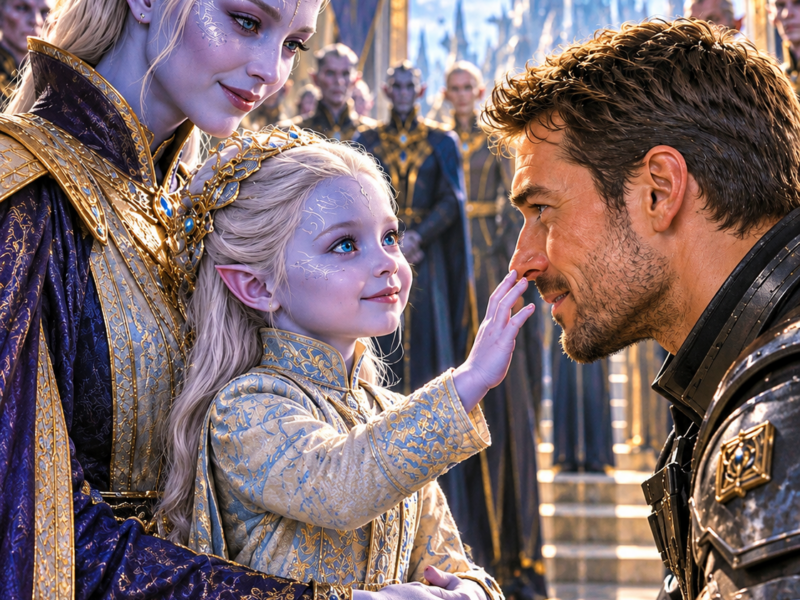
“I was standing in the middle of the Vellarian Emperor’s throne room when the six-year-old princess suddenly ran through hundreds of nobles, grabbed my human hand, and declared, ‘He’s mine!
The Empress did not speak immediately.
She looked past me toward the tall windows overlooking Ashara, where the festival lights drifted across the city like slow-moving stars.
Then she turned to the guards.
“Close the doors. No one leaves this hall until I have finished.”
A low murmur passed through the nobles.
Princess Lyrian pressed herself against my side, still holding my hand.
I could feel the small tremor in her fingers.
“Mother?” she whispered.
The Empress knelt in front of her daughter.
For a moment, the ruler of an empire looked like nothing more than a grieving mother trying to find the right words.
“Sweetheart, you remember what I told you about your father’s last voyage?”
Lyrian nodded.
“You said his ship was lost in the storm.”
“That is what I told you.”
The child’s violet eyes moved between us.
“Was it not true?”
The Empress took a slow breath.
“No. It was not the whole truth.”
Valeth stepped forward.
“Your Majesty, perhaps we should move this discussion to the private chamber.”
“No,” the Empress said. “For eighteen months, this court has hidden behind silence. I will not ask another child to carry the weight of that silence.”
She rose and faced the assembled nobles.
“On the night of the Imperial Consort’s death, his vessel was not caught in an ordinary navigational accident. Someone aboard that ship deliberately disabled its emergency beacon.”
A noble near the front lowered his head.
Another shifted toward the exit before remembering the guards had sealed the doors.
I looked at Valeth.
“You knew?”
Her amber eyes glistened.
“I knew something had happened. I didn’t know everything.”
“How long?”
“Since the night the ship returned without him.”
Her answer hurt more than I expected.
Before I could respond, the Empress raised one hand.
“Valeth was the last member of our family to speak with my husband before he departed. She was also the person who brought me the first evidence that his death was not an accident.”
I turned toward her.
Valeth looked as if she wanted to reach for me, but the watching court held her in place.
The Empress continued.
“His final message contained a warning. He believed someone inside this palace had been feeding information to a faction that wanted to end our diplomatic negotiations with Earth.”
The room seemed to contract around us.
“Earth?” I asked.
“Your world was not the only civilization he feared would be harmed,” she replied. “He believed the conspiracy was designed to provoke a war between our peoples.”
Kael’thas Tel’Ravan stepped forward.
“Your Majesty, this is an outrageous accusation. The Imperial Consort’s death was investigated by the highest authorities. The findings were conclusive.”
The Empress looked at him.
“Those findings were written by people who reported directly to you.”
His red markings brightened.
“That is a lie.”
“No,” Valeth said quietly. “The lie was the report.”
She moved to the center of the hall.
“Uncle, I kept my silence because I was afraid. Not for myself. For Lyrian.”
The princess looked up at her cousin.
“Why would someone hurt Father?”
Valeth’s face tightened.
I knelt beside Lyrian.
“Sometimes people do terrible things because they’re afraid of losing power,” I said gently.
She looked down at our joined hands.
“That doesn’t make it right.”
“No,” I told her. “It doesn’t.”
The Empress gave a small nod, as though those words had settled something in her.
Then she turned to the royal archivist.
“Bring the sealed voyage record.”
The archivist hesitated.
Kael’thas noticed.
“Do not,” he warned.
That single word changed the room.
The archivist looked at the Empress.
“Your Majesty, the record is protected under the Imperial Mourning Decree.”
“I issued that decree,” she replied. “I am revoking it.”
The archivist bowed and hurried toward a narrow door behind the dais.
Kael’thas watched him go.
I had spent years studying diplomacy, and I knew the difference between anger and fear.
The nobleman’s face showed both.
When the archivist returned, he carried a small black case.
Its surface was covered in silver lines, interrupted by a single empty circle.
He placed it before the Empress.
She touched the circle.
A faint pulse passed through the case.
Then a holographic image appeared above it.
A Vellarian vessel floated against a field of stars.
Its hull was damaged.
A warning light flashed along its side.
And beside the image appeared a time stamp.
The final hour of the Imperial Consort’s voyage.
“Play the last transmission,” the Empress ordered.
A voice filled the hall.
It was deep, warm, and unmistakably Vellarian.
“Ilendra, if this reaches you, do not trust the official report. The beacon was disabled from inside the ship.”
The Empress’s face crumpled for a fraction of a second.
Then the recording continued.
“Someone knew our route. Someone knew we were carrying the diplomatic proposal. They wanted the negotiations to fail.”
A burst of static swallowed the next few words.
Then the voice returned.
“Tell Lyrian I kept the little blue stone she gave me. Tell her I was thinking of her.”
The recording ended.
Lyrian’s hand slipped from mine.
She stared at the empty space above the case.
“My blue stone?”
The Empress closed her eyes.
“Yes, darling.”
“I gave it to him before he left.”
“I know.”
“He promised to bring it home.”
The Empress knelt again, but Lyrian took a small step backward.
“Why did you say he died in a storm?”
No one answered.
The child’s voice grew smaller.
“Did you think I would forget?”
I had no answer either.
And that was when I understood the cost of the secret.
The court had not simply hidden the cause of a death.
It had allowed a little girl to believe her father had broken a promise, then left her alone with that belief.
Valeth finally approached.
“Lyrian, your father never forgot you.”
“Then why didn’t you tell me?”
Valeth’s lips parted, but no words came.
Lyrian turned away.
The Empress reached for her, then stopped herself.
I wanted to comfort the child, but I knew that stepping between her and her family would only make the moment harder.
So I stayed where I was.
A human with no glow, holding no royal title, and suddenly aware that understanding someone’s language was not the same as knowing what to say.
The Empress rose.
“Kael’thas, you will surrender your council seal while this matter is investigated.”
He laughed once.
It was a dry, humorless sound.
“You think a recording will bring your husband back? You think a child’s grief gives you the right to dismantle the council?”
“It gives me the right to stop using her grief as an excuse for your silence.”
His eyes moved toward me.
“And you believe this human will help you? He has been here only a few months. He knows nothing of our history.”
“Perhaps,” I said.
I hadn’t planned to speak.
But the recording had left me with a question.
“May I hear the transmission again?”
Kael’thas gave a dismissive wave.
“Your little language tricks will not change the facts.”
I ignored him.
The archivist replayed the recording.
This time, I listened to the pauses rather than the words.
The Consort’s voice was strained, but the background contained something else: a repeating sequence of three low tones, followed by a short burst of static.
I had heard that pattern before.
Not in a Vellarian distress call.
In an old diplomatic archive.
“Stop,” I said.
The archivist froze the recording.
“Go back four seconds.”
The sound repeated.
I leaned closer.
“That isn’t random interference. It’s a secondary channel.”
The Empress looked at me.
“Can you identify it?”
“Not yet. But the tones resemble an old navigation handshake. If I can compare them with the ship’s original records, I may be able to determine where the signal came from.”
Kael’thas’s expression changed.
Only slightly.
But I saw it.
So did Valeth.
The Empress turned to her archivist.
“Give him access.”
Kael’thas stepped forward.
“I object.”
“Your objection is noted.”
“Those records are restricted.”
“Then it is fortunate that I am still Empress.”
The guards moved closer to him.
For the first time that evening, he did not answer.
And I realized the truth about the voyage was only the beginning.
The archives were beneath the oldest wing of the palace.
Unlike the bright corridors above, the lower levels were quiet and dim, their walls made from dark stone threaded with thin lines of blue light.
The archivist led us to a sealed chamber.
The Empress came with us.
So did Valeth, two royal guards, and a very unhappy Kael’thas.
Lyrian had been taken to her private rooms with First Keeper Sevian.
Before she left, she had looked back at me.
“Will you find out why Father didn’t come home?”
I had knelt to meet her eyes.
“I’ll find out what happened. I promise.”
I hadn’t meant to make another promise that evening.
But I couldn’t let her carry another unanswered question.
Inside the archive chamber, the archivist placed the voyage record on a circular table.
A holographic map appeared above it.
The vessel’s route traced a pale line through the outer system.
The final section ended near a small moon called Orath.
“That is where the official report says the ship lost power,” the archivist explained.
I studied the route.
“Was there a relay station nearby?”
“Three,” he replied. “All civilian.”
“Could one of them have transmitted a navigation handshake?”
“Not without authorization.”
“Who had authorization?”
The archivist glanced at Kael’thas.
“Senior members of the Imperial Navigation Council.”
Kael’thas folded his arms.
“An impressive way of saying half the government.”
“Then let’s narrow it down,” I said.
I asked the archivist to isolate the three tones from the recording.
He separated them from the static and projected the waveform.
At first, it looked meaningless.
Then I recognized the pattern.
It was a request for confirmation, followed by a location marker.
I had seen the same structure in a set of Vellarian navigation protocols that had been retired more than a century earlier.
“Someone was trying to identify the vessel’s position,” I said.
Valeth stepped closer.
“Could it have been an ordinary tracking signal?”
“Possibly. But the sequence was transmitted on a private emergency frequency. It was designed to be invisible to the ship’s regular communication system.”
The Empress looked toward the archivist.
“Can you trace its origin?”
He worked at the table for several minutes.
A second map appeared.
One of the three relay stations began glowing.
“Relay Seven,” he said. “It was the closest to the vessel at the time.”
“Who operated it?” Valeth asked.
The archivist’s answer came slowly.
“The station was under the authority of the Imperial Navigation Council.”
Kael’thas gave a contemptuous laugh.
“Again, that proves nothing.”
“No,” I said. “But it gives us somewhere to look.”
The Empress ordered the archivist to retrieve the relay’s maintenance records.
He hesitated.
“Your Majesty, those files were transferred to the central security office after the incident.”
“By whose order?”
The archivist checked the record.
His expression changed.
“Lord Kael’thas.”
No one moved.
Kael’thas’s red markings pulsed.
“I ordered the transfer because the station was part of an active investigation.”
“Then you won’t mind showing us the files,” Valeth said.
“They are classified.”
The Empress stepped toward him.
“Your authority to classify evidence does not exceed my authority to examine it.”
For several seconds, Kael’thas stared at her.
Then he looked at me.
“You are making a mistake, human. You have no idea what you are interfering with.”
I met his eyes.
“Then help me understand.”
He turned away.
The archivist opened the transferred files.
Most were routine maintenance reports.
Power fluctuations.
Communication delays.
Replacement parts.
Then I noticed a gap.
“Where is the final maintenance entry?”
The archivist checked again.
“There is no entry for the last twelve hours before the voyage.”
“That is impossible,” Valeth said.
“Not necessarily,” Kael’thas replied. “A station can operate without a maintenance entry.”
“Not if its emergency relay has been manually disabled,” I said.
The archivist looked up.
“How did you know that?”
“I don’t. But the ship’s transmission suggests the relay was involved. And if someone wanted to hide the signal, they would have needed access to the relay’s power controls.”
I pointed to the missing entry.
“Someone erased the record of that access.”
The Empress’s eyes narrowed.
“Can it be recovered?”
The archivist’s tendrils dimmed.
“Perhaps. The station keeps a secondary record in its local memory. But that memory was never returned to the palace.”
“Where is it now?”
He hesitated.
“At Kathara Orbital Station.”
The name meant little to me then.
I would soon learn how important it was.
Kathara was the Ascendancy’s primary communications and defense hub.
It controlled the outer relay network, coordinated the imperial fleet, and maintained the emergency channels connecting dozens of inhabited worlds.
It was also the station where the original navigation records had been stored.
The Empress looked at Valeth.
“Prepare a diplomatic transport.”
Kael’thas stepped forward.
“You cannot send a delegation to Kathara while the investigation is active.”
“Why not?”
“Because the station’s command authority is currently under review.”
Valeth looked sharply at him.
“By whom?”
“The Navigation Council.”
“Which you control,” she replied.
He ignored her.
“Sending a human officer into that environment could be interpreted as an act of interference.”
I glanced at the Empress.
“If I go, I won’t go as a human representative. I’ll go as a language specialist examining a historical transmission.”
“That distinction may not protect you,” she said.
“I understand.”
Valeth moved closer.
“Then I am going with you.”
“No,” the Empress said immediately.
Valeth’s shoulders stiffened.
“Mother’s death has already taken enough from this family. I will not let another secret decide what I am allowed to do.”
The Empress looked at her niece for a long moment.
Then she nodded.
“You may go. But you will take a royal security escort.”
Kael’thas’s expression hardened.
“Your Majesty, this is reckless.”
The Empress turned toward him.
“Then I suggest you hope we find nothing.”
We left the archive chamber before dawn.
The journey to Kathara took several hours.
Valeth sat across from me in the transport cabin, watching the stars slide across the window.
For a long time, neither of us spoke.
Finally, she said, “You should be angry with me.”
I looked up from the navigation records.
“I am.”
She lowered her eyes.
“I thought you would be.”
“But I’m also trying to understand why you stayed silent.”
Her fingers tightened around the edge of her seat.
“After the voyage, I found a damaged recording in my father’s private quarters. It showed him speaking with someone before departure. I couldn’t identify the person.”
“Why didn’t you tell the Empress?”
“I did. She asked me to wait until the investigation was complete.”
“And you agreed.”
“I was twenty-four, Cole. I had just watched my family fall apart. The court was full of people telling me that one wrong accusation could start a civil conflict.”
She looked toward the stars.
“I thought if I waited, the truth would become clearer. Instead, the records disappeared, the people who questioned the official report were reassigned, and Lyrian stopped speaking.”
Her voice caught.
“I told myself I was protecting her.”
I closed the file on my tablet.
“Did you ever consider that she might have needed the truth more than protection?”
Valeth looked at me.
“Every day.”
I wanted to tell her that I understood.
But I didn’t.
I understood grief.
I understood fear.
I didn’t know what it was like to watch a child lose a parent and then help conceal the circumstances.
“I should have told you about the recording,” she said.
“Yes.”
“I was afraid you would think my family was capable of murder.”
I looked at her.
“I think every family is capable of hiding something terrible when it believes the truth will destroy it.”
She turned away.
“That doesn’t make it easier.”
“No. It doesn’t.”
After a while, she reached across the space between us.
I looked at her hand.
For weeks, I had been afraid of what that gesture meant.
Now I was afraid of what refusing it would mean.
I took her fingers.
“I don’t need you to have been fearless,” I said. “I need you to stop being alone with this.”
She rested her forehead against our joined hands.
For the first time since the throne room, her light began to steady.
Kathara Orbital Station appeared beyond the transport window.
It was enormous, a ring of silver structures surrounding a central command tower.
Cargo vessels moved through its docking lanes.
Defense platforms rotated slowly against the darkness.
But as our transport approached, I noticed something unusual.
There were no civilian ships leaving.
The station’s outer communication lights were dark.
“Is that normal?” I asked.
Valeth leaned toward the window.
“No.”
The royal security officer checked his console.
“Kathara is operating under restricted access. Our arrival clearance has been delayed.”
“By whose order?” Valeth asked.
The officer examined the authorization.
“Station Commander Rethan.”
I recognized the name from the navigation records.
Rethan had been the senior officer assigned to Relay Seven on the night of the voyage.
I looked at Valeth.
She had noticed it too.
“Tell them we are entering under direct imperial authority,” she ordered.
The clearance came through after another minute.
It was not a welcome.
It was permission.
When we stepped onto the station, a group of security officers was waiting.
Their commander was tall, with dark green markings running along his jaw.
“Princess Valeth. Officer Maddox. I am Commander Rethan.”
His voice was calm.
His eyes were not.
“We have come to examine the original relay records,” Valeth said.
“Those records are unavailable.”
“That wasn’t a request.”
Rethan gave a small bow.
“Of course, Your Highness. But the station is currently undergoing a security audit. Certain archives have been sealed.”
“Under whose authority?”
“Lord Kael’thas.”
Valeth’s face went still.
“Lord Kael’thas is not the Empress.”
“No, Your Highness.”
“Then take us to the records.”
Rethan hesitated before turning toward the central corridor.
We followed him through the station.
As we walked, I noticed security officers stationed at every junction.
Some watched us openly.
Others pretended to be occupied with their consoles.
The station felt less like a place preparing for an inspection and more like a place expecting an attack.
Rethan led us into a control chamber.
A large display showed the station’s internal systems.
“Where is the secondary memory from Relay Seven?” I asked.
He pointed toward a sealed archive.
“Inside.”
“Open it.”
“I cannot.”
Valeth stepped forward.
“You have just told me it is here.”
“It is, but the archive requires two authorization keys.”
“One belongs to the station commander,” I said.
Rethan nodded.
“And the other?”
He looked at Valeth.
“The Imperial Navigation Council.”
Valeth understood immediately.
“Kael’thas.”
Rethan said nothing.
I studied the access panel.
There were two authorization slots, but the second had been covered with a thin layer of protective material.
I leaned closer.
“This panel has been opened recently.”
Rethan moved between me and the console.
“Please step back.”
I looked at his hands.
His right hand was trembling.
Not much.
But enough.
“Commander, when was the last time the archive was accessed?”
“That information is restricted.”
“Then why are you afraid to answer?”
His face hardened.
“Watch your words, human.”
Valeth stepped beside me.
“Answer him.”
Rethan looked at her.
For a moment, something like regret crossed his expression.
Then the station lights flickered.
A warning tone sounded.
The display turned red.
“Unauthorized system access detected,” the station announced.
Rethan spun toward the control panel.
“Seal the archive!”
The security officers raised their weapons.
Valeth moved in front of me.
“Stand down!”
But the officers didn’t obey her.
One of them struck a control.
A heavy door slammed across the chamber entrance.
The display changed again.
A countdown appeared.
SECURITY LOCKDOWN: 09:59
I looked at the numbers.
“What happens when it reaches zero?”
Rethan didn’t answer.
The station announcement did.
“Emergency isolation protocol initiated. External communication and command access will be suspended.”
Valeth stared at the display.
“If the station isolates itself, the imperial fleet loses its central network.”
“And every ship beyond the inner system will be operating without coordination,” I said.
The countdown continued.
Nine minutes.
Eight.
Rethan backed away from the console.
“This was not supposed to happen.”
Valeth turned on him.
“What did you do?”
“I didn’t activate it.”
“Then who did?”
He looked toward the sealed archive.
“The system received a command from the council.”
“Kael’thas?”
Rethan’s silence was enough.
I moved toward the display.
The countdown wasn’t following a normal security sequence.
It was repeating the same three-tone pattern I’d heard in the Consort’s final transmission.
The old navigation handshake.
Only now, it was being used to shut down the station.
“Commander, I need the emergency protocol.”
“You cannot access it.”
“Then tell me what the system is waiting for.”
Rethan looked at me.
“It requires confirmation from the imperial authority.”
“Whose confirmation?”
“The station commander and a member of the royal house.”
Valeth raised her hand toward the panel.
“I am here.”
The panel flashed.
“Authorization incomplete.”
A new message appeared.
SECONDARY AUTHORITY REQUIRED.
Valeth tried again.
The same warning returned.
I examined the sequence.
There was a third line beneath the message, almost hidden by the countdown.
It contained an old Vellarian phrase.
I translated it aloud.
“Shared recognition.”
Rethan’s eyes widened.
“What did you say?”
“The system doesn’t recognize Valeth’s authority alone. It requires another recognized party.”
“That is impossible.”
“Why?”
“Because the protocol was written before foreign representatives were permitted inside the station.”
I looked at the panel.
“Then perhaps it doesn’t require a royal bloodline. Perhaps it requires someone outside the imperial command structure.”
Valeth understood before I finished.
“A human.”
Rethan shook his head.
“No. That system would never accept it.”
“Let’s find out.”
I placed my hand against the authorization surface.
The panel remained dark.
Then Valeth placed her hand beside mine.
A faint line of blue light appeared between our fingers.
The countdown paused.
For one second, the station was silent.
Then a new message appeared.
IDENTITY RECOGNIZED. SHARED AUTHORITY PENDING.
The system was waiting for a declaration.
I knew the old word from the archive.
It was not a command.
It was a promise.
I spoke it in Vellarian.
“Vael’thari.”
The panel brightened.
But the countdown did not stop.
A second message appeared.
DECLARATION INCOMPLETE. INTENT MUST BE CONFIRMED.
I looked at Valeth.
“What does it want?”
She studied the symbols.
Then she understood.
“It needs both of us to say what we are protecting.”
Rethan stared at us.
“That is a ceremonial requirement. It has never been used in an emergency.”
“Then today seems like a good day to start,” I said.
Valeth placed her free hand over the panel.
“For the people of the Ascendancy,” she said.
I followed.
“For everyone who depends on this station.”
The blue light spread across the control surface.
The countdown stopped at three minutes and twelve seconds.
For a moment, I thought it had worked.
Then the archive door opened.
Two armed officers entered.
Behind them stood a familiar figure.
Kael’thas.
He was not on the station’s official visitor list.
He was not supposed to be there.
And he was carrying the second authorization key.
“Step away from the console,” he ordered.
Valeth turned toward him.
“You caused this.”
“I am preventing a disaster.”
“By shutting down the imperial network?”
“By preventing a human from gaining access to the Ascendancy’s defense systems.”
I stared at him.
“You activated the lockdown because you knew I could read the original signal.”
Kael’thas’s eyes narrowed.
“You know nothing.”
“Then explain why the same navigation handshake appears in the Consort’s final transmission and this station’s emergency shutdown.”
His expression hardened.
“That is enough.”
He raised the authorization key.
Rethan stepped forward.
“Lord Kael’thas, you said the lockdown would be temporary.”
Kael’thas didn’t look at him.
“Return to your post, Commander.”
“You told me no one would be harmed.”
“Do as you are ordered.”
Rethan looked at Valeth.
Then at me.
Something inside him seemed to break.
“The relay record wasn’t destroyed,” he said.
Kael’thas turned sharply.
“What?”
Rethan swallowed.
“I kept a copy.”
He reached beneath his uniform and removed a small data crystal.
Kael’thas lunged.
One of the royal guards intercepted him.
The two collided against the control table.
The crystal slipped from Rethan’s hand and skidded across the floor.
I reached for it.
An officer grabbed my shoulder.
Valeth struck his arm aside.
“Take it!”
I caught the crystal just before it disappeared beneath the console.
The station alarm grew louder.
Two minutes.
I inserted the crystal into the nearest reader.
The display filled with records.
A maintenance log.
A security override.
And a transmission authorization.
The name attached to the override was not Kael’thas.
It was Rethan.
I looked at him.
He stared at the floor.
“Why?” Valeth asked.
Rethan’s voice shook.
“Because he promised my family would be protected.”
Kael’thas struggled against the guard.
“Silence!”
Rethan continued.
“My younger brother was stationed aboard the Consort’s vessel. Kael’thas told me the ship was carrying evidence that could destroy the Ascendancy. He said the emergency beacon would only be disabled long enough to force the vessel back.”
Valeth’s face drained of color.
“Your brother was on that ship?”
Rethan nodded.
“He died with the others.”
For a moment, I thought Valeth might strike him.
Instead, she asked the only question that mattered.
“Did you know the ship would be destroyed?”
“No,” he whispered. “I swear I didn’t.”
The record on the display began to play.
A second voice emerged from the old transmission.
It was quieter than the Consort’s, distorted by interference.
But I recognized the name in the opening line.
Kael’thas.
“Once the vessel loses its beacon, the council will have no choice but to suspend the Earth negotiations. The Empress will blame the navigators. The navigators will blame the diplomats. By the time they understand what happened, the alliance will be finished.”
The recording continued.
“Do not allow the Consort to return.”
The room went still.
Kael’thas stopped struggling.
Valeth stared at him.
“You knew he was aboard.”
He said nothing.
“You knew my uncle was on that ship.”
His red markings flickered.
“He would have destroyed our traditions.”
“By speaking with Earth?”
“By opening our borders to a species that had barely learned to govern itself.”
I felt anger rise, but I kept my voice steady.
“You killed him because he wanted peace.”
Kael’thas turned toward me.
“I preserved the Ascendancy.”
“No,” Valeth said. “You preserved your own position.”
The countdown continued.
One minute.
The crystal had revealed the truth, but the station was still locked.
I looked at the authorization panel.
The old word had opened the first layer.
The recording had exposed the sabotage.
But the system still required the final confirmation.
I studied the text beneath the countdown.
It was not asking for another identity.
It was asking for the surrender of unilateral control.
I understood then why the protocol had been designed that way.
No single commander could save the station by claiming authority over everyone else.
The system required two parties to share responsibility.
And someone had to release the second authorization key.
I looked at Kael’thas.
“Give me the key.”
He laughed bitterly.
“You think I would surrender control to you?”
“Not to me. To the station.”
He looked toward the panel.
“You don’t understand what happens if the system releases.”
“Then explain it.”
“The defense network will be restored, but every active council override will be exposed. The entire fleet will receive the original authorization records.”
I glanced at the crystal.
“That is why you wanted the lockdown.”
He had not only been trying to stop us from finding the truth.
He had been trying to keep the evidence from reaching the fleet.
Valeth stepped toward him.
“Give it to us.”
Kael’thas looked at her for a long time.
Then he looked at the guards holding him.
The key remained in his hand.
“You have no idea what the council will do when it learns what happened.”
Valeth’s voice softened.
“Then let them decide with the truth.”
For a moment, his expression changed.
Not remorse.
Something closer to exhaustion.
His hand opened.
The key fell to the floor.
I picked it up and placed it in the panel.
Valeth set her hand beside mine.
The system asked for the final declaration.
I spoke first.
“No one owns the truth.”
Valeth followed.
“No one stands above the lives we are sworn to protect.”
The panel flashed.
Then the station lights returned.
The countdown vanished.
Across the display, one message appeared.
EMERGENCY NETWORK RESTORED.
A second message followed.
ALL COUNCIL OVERRIDES TRANSMITTED TO IMPERIAL AUTHORITY.
The station’s communication channels opened.
The royal guards secured Kael’thas.
Rethan surrendered his command seal without resistance.
For several seconds, nobody spoke.
Then a voice came through the station speakers.
It was the Empress.
“Kathara, this is the Imperial Throne. We have received your transmission.”
Valeth stepped toward the console.
“Mother, the evidence is secure.”
“I know.”
The Empress’s voice trembled.
“Is Kael’thas there?”
Valeth looked toward the guards.
“Yes.”
“Then keep him alive. He will answer for what he has done.”
Kael’thas lowered his head.
For the first time, he looked less like a powerful noble and more like an old man who had finally run out of excuses.
The Empress continued.
“And Valeth?”
“Yes, Your Majesty?”
“Bring Cole home.”
Valeth looked at me.
I smiled faintly.
“That sounds like an order.”
“It is,” she replied.
For the first time that day, she laughed.
The journey back to Velaris Prime felt longer than the journey out.
The station had been saved.
The evidence had been recovered.
The conspiracy had been exposed.
But none of that could restore the people who had died.
And I knew the hardest conversation was still waiting for us.
When we returned to the palace, the Empress was waiting in the private garden.
Lyrian stood beside her.
She ran toward us as soon as the transport doors opened.
I crouched, and she wrapped her arms around my neck.
“Did you find out what happened to Father?”
I looked at the Empress.
She stepped forward.
“Would you like to hear it from me, sweetheart?”
Lyrian nodded.
The Empress knelt beside us.
“Your father discovered that some members of the council were trying to stop the peace agreement with Earth. He believed that if he could prove what they were doing, he could protect both our people and the humans.”
Lyrian listened without moving.
“One of the people he trusted helped disable his ship’s emergency beacon. The ship could not call for help when it was damaged.”
“Did Father know?”
The Empress’s eyes filled.
“He knew something was wrong. But he did not know who had betrayed him.”
Lyrian looked down at her hands.
“Was he scared?”
The Empress’s voice broke.
“Yes, darling. I believe he was.”
“Did he think about me?”
The Empress took the little girl’s hands.
“His last message was about you. He remembered the blue stone you gave him. He wanted you to know he was thinking of you.”
Lyrian’s lips trembled.
“Why didn’t you tell me?”
The Empress bowed her head.
“Because I thought keeping the truth from you would protect you from more pain. I was wrong.”
Lyrian looked at her mother for a long time.
Then she asked, “Were you lonely too?”
The Empress’s face crumpled.
“Every day.”
Lyrian leaned forward and placed her forehead against her mother’s shoulder.
The Empress held her daughter and finally allowed herself to cry.
I stood nearby with Valeth.
Neither of us tried to interrupt.
Some moments did not need translation.
Later that evening, the Empress summoned the Imperial Council.
Kael’thas was formally stripped of his authority and charged with conspiracy, sabotage, and the deliberate destruction of an imperial vessel.
Commander Rethan was also detained.
His cooperation would be considered during the investigation, but his role in disabling the beacon could not be erased.
The court learned the truth in full.
There were no public celebrations.
No speeches about victory.
Only a long silence as the names of the dead were read aloud.
Among them were the Imperial Consort, twelve crew members, and three navigators who had never known why their ship had lost power.
The Empress ordered a memorial built in the central garden.
Not a monument to the royal family.
A place for every person lost on that voyage.
She also reopened the diplomatic negotiations with Earth.
This time, the agreement included a shared communications authority, transparent navigation records, and an independent review of imperial security.
The old Vellarian word became part of the treaty.
Vael’thari.
Not as a slogan.
As a commitment that neither civilization would make decisions about the other’s future without allowing the other to speak.
Weeks passed.
The palace slowly returned to its ordinary rhythm.
Lyrian resumed her lessons.
She still had difficult days.
Sometimes she sat in the garden and asked questions about her father that no one could answer.
I never tried to fill those silences with comforting stories.
I told her what I knew.
And when I didn’t know, I said so.
One afternoon, she brought me a small object wrapped in silver cloth.
It was a smooth blue stone.
The surface glimmered faintly beneath the garden light.
“I found it in Father’s room,” she said.
I held it carefully.
“He kept it?”
She nodded.
“Mother said he always carried it when he traveled.”
I turned the stone over in my palm.
A tiny mark had been carved into one side.
It was the same symbol that had appeared in the final transmission.
A small circle surrounded by three lines.
“What does this mean?” I asked.
Lyrian leaned closer.
“It means home.”
I looked at her.
“Are you sure?”
“Father told me.”
She placed my fingers around the stone.
“I want you to keep it until I am old enough to carry it.”
I felt my throat tighten.
“That’s a very important thing to trust someone with.”
“I know.”
She smiled.
“You came back.”
I closed my hand around the stone.
“Yes, I did.”
Valeth was waiting at the garden entrance.
She had heard the exchange, and her golden markings glowed softly.
When Lyrian ran off to show Sevian her latest drawing, Valeth came to stand beside me.
“Do you still think this was a mistake?” she asked.
I looked toward the palace.
At the windows where the council had once watched me like an unwelcome visitor.
At the garden where a grieving child had first asked me whether humans were lonely without light.
“No,” I said. “But I think we both underestimated what it would cost.”
Valeth took my hand.
“I don’t want to hide from that cost anymore.”
“Neither do I.”
She rested her head against my shoulder.
The silence between us felt different now.
Not like the silence that had hidden the truth.
Like the kind that allowed two people to stay beside each other without needing to explain every thought.
The Empress eventually gave her blessing to our relationship.
Not because she believed love could solve every political problem.
She had learned too much about loss to believe that.
She gave her blessing because she saw that Valeth and I were willing to face those problems honestly.
I remained with the Terran Diplomatic Corps, but my assignment changed.
I became the first permanent liaison between Earth and the Vellarian Ascendancy.
The work was difficult.
There were still arguments over trade, security, and the meaning of old traditions.
There were still people who believed our worlds would never truly understand one another.
But whenever negotiations became tense, I remembered the station.
I remembered two hands resting on the same panel.
And I remembered that the most important agreement had not been written in a treaty.
It had begun with a little girl who had reached for someone she trusted.
A year after the Festival of Ascending Light, the palace held another ceremony.
This time, Lyrian stood beside her mother by choice.
She was still small, still curious, and still occasionally stubborn.
But she spoke to the nobles again.
She told them about Earth.
About oceans.
About rain.
About the strange human habit of smiling when words were not enough.
Then she looked toward me.
“Cole taught me that people can be different and still understand each other.”
The court listened.
She lifted the blue stone in her palm.
“And Father taught me that when someone makes you feel less alone, you should reach for them.”
Her little hand found mine.
I knelt beside her.
Across the hall, Valeth smiled through shining eyes.
The Empress watched us from her throne.
This time, there were no frightened whispers.
No angry protests.
No one stepped backward.
The court simply made room for us.
And as Lyrian’s fingers curled around mine, I finally understood what her father had meant.
Sometimes the bravest thing a person can do is reach across the distance.
And sometimes, the person on the other side reaches back.
The end.









