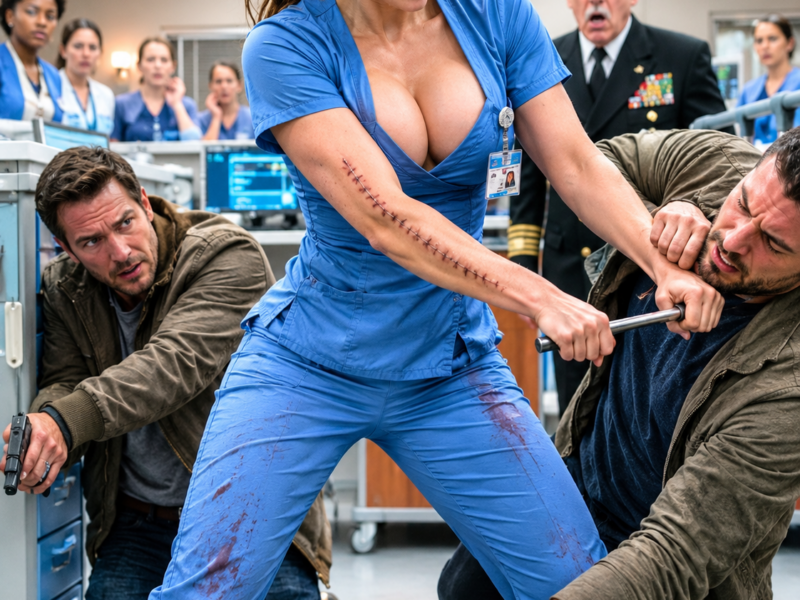
“When the SEAL admiral called me ‘just a lowly nurse’ in front of two dozen decorated officers at Naval Medical Center San Diego
For several seconds, neither of us spoke.
Admiral Hayes stood across my desk, one hand resting on the yellowed personnel file, waiting for an answer.
I could hear the ventilation system humming above us and the distant squeak of a cart moving through the hallway.
“Where did you get that?” I finally asked.
He didn’t answer immediately.
“From an old classified personnel archive. Your name appeared in a report connected to a failed extraction operation in Afghanistan.”
I looked at the photograph.
Seventeen years had passed, but I still recognized every face.
Lieutenant Daniel Mercer stood behind me, one hand resting on my shoulder. He was twenty-nine in that picture, with a crooked smile and a small scar above his left eyebrow.
He had been the first person to call me Doc.
Not Nurse Bennett.
Not civilian support.
Doc.
And he had been the last person I saw before the helicopter disappeared into a dust storm.
“Tell me what happened to Mercer,” Hayes repeated.
I slowly closed the file.
“That’s a question you should have asked seventeen years ago.”
His expression tightened.
“I was told he died during an extraction attempt.”
“So was I.”
“Then why does your report say he abandoned his position?”
I stared at him.
For a moment, I thought I had misheard.
“My report doesn’t say that.”
Hayes opened the folder again and pointed to a paragraph near the bottom.
“According to the official record, Lieutenant Mercer left the designated casualty collection point without authorization, resulting in the loss of two personnel and the failure of the mission.”
I leaned forward.
“That report is a lie.”
He studied my face.
“That’s a serious accusation.”
“Then perhaps you should ask the people who wrote it why they needed a dead man to take the blame.”
Hayes pulled out a chair and sat down.
For the first time since I’d met him, he looked less like an admiral and more like a man who had stumbled into something he didn’t understand.
“Start from the beginning.”
I looked at the photograph again.
And the memories I had spent seventeen years keeping behind locked doors began returning.
It was June 2009.
Our unit had been deployed to a remote region of eastern Afghanistan, supporting a joint operation that had gone wrong before sunrise.
I was thirty-one years old then.
I wasn’t a hospital nurse.
I was a combat medic assigned to a special operations support team, trained to treat gunshot wounds, blast injuries, and casualties under conditions where the nearest surgical facility could be hours away.
My team consisted of six people.
Lieutenant Daniel Mercer was our commander.
Staff Sergeant Owen Brooks handled communications.
Corporal James Ellis was our youngest operator.
And I was the medical specialist responsible for keeping everyone alive long enough to get home.
We had been in the field for eleven days when the call came.
A small American patrol had been pinned down near an abandoned compound. Their radio transmissions were broken, and two men were reported wounded.
Mercer received the order to move.
But something about the intelligence bothered him.
The coordinates didn’t match the terrain described in the briefing.
He asked for confirmation.
The response came back almost immediately.
“Proceed as directed.”
Mercer looked at the map.
Then he looked at me.
“Claire, what do you think?”
I studied the coordinates.
“Something’s off.”
“How off?”
“Off enough that I wouldn’t send anyone through that valley without another look.”
He nodded.
“That’s what I thought.”
We requested updated intelligence.
Instead, we received another order.
Move now.
We went anyway.
The first explosion hit less than twenty minutes after we entered the valley.
The vehicle in front of us flipped onto its side. Dust and metal fragments filled the air.
I remember hearing someone scream for a medic.
I remember the smell of burning rubber.
And I remember Mercer pulling me behind the wreckage as another round struck the ground nearby.
“Doc, get down!”
I crawled toward the nearest casualty.
Owen had a piece of metal lodged in his thigh. James was bleeding from a wound near his shoulder.
I treated them both while Mercer and the others returned fire.
We had three wounded men and one functioning vehicle.
The radio was barely working.
Then another transmission came through.
It wasn’t a request for help.
It was an order to move away from the extraction point.
Mercer grabbed the radio.
“Negative. We have casualties. We need immediate evacuation.”
The response was distorted, but I heard enough.
“Maintain current position. No further movement.”
Mercer looked at me.
“They’re leaving us here.”
I didn’t answer.
I was too busy trying to keep Owen conscious.
A few minutes later, the second explosion hit.
This time, the vehicle caught fire.
Mercer ordered everyone toward a drainage ditch that ran along the compound wall.
We carried the wounded as far as we could.
Then James collapsed.
His shoulder wound was worse than I had realized.
I pressed gauze against it.
“Stay with me, James.”
He tried to smile.
“You’re going to have to do better than that, Doc.”
“Save your energy.”
Mercer crouched beside us.
“Claire, I need you to take the wounded toward the northern ridge.”
“What about you?”
“I’m going back for the radio.”
“Daniel, no.”
He gripped my shoulder.
“Listen to me. If I don’t get that transmission out, nobody is coming.”
I wanted to argue.
But he was already moving.
The last thing I saw was his silhouette disappearing behind the smoke.
Minutes passed.
Then ten.
Then twenty.
The radio finally crackled.
“Extraction is inbound.”
I nearly cried with relief.
But the next transmission was different.
“All personnel, withdraw immediately. Do not wait for additional recovery.”
I looked at the two wounded men.
“We’re not leaving them.”
I heard Mercer’s voice through the radio.
“Claire, take them home.”
Then the signal disappeared.
We were eventually recovered by a second team.
Mercer was not among us.
Neither was another operator, Sergeant Daniel Price, who had gone back to cover our retreat.
The official report arrived several weeks later.
It claimed Mercer had abandoned the extraction point.
Price was listed as killed in action.
Mercer was listed as missing and presumed dead.
I refused to sign the final statement.
I submitted a separate account describing the orders, the contradictory coordinates, and the communications failure.
Two days later, I was informed that my report had been incorporated into the investigation.
Then I was told the investigation had been closed.
My requests for further information went unanswered.
A senior officer advised me to accept the findings and move on.
I didn’t.
But I also didn’t have the authority or evidence to fight a system that had already decided what happened.
Eventually, I left operational service.
I trained as a civilian nurse, moved to California, and built a life that didn’t require me to explain why I sometimes woke up hearing radio static.
Hayes listened without interrupting.
When I finished, he remained silent for a long time.
“Who signed the final report?” he asked.
“Colonel Robert Vance.”
His face changed.
“Vance?”
“You know him?”
Hayes slowly leaned back.
“Robert Vance was my commanding officer during that period.”
I watched him carefully.
“Then you understand why I don’t trust this investigation.”
He looked down at the photograph.
“I was told the communications failure was caused by Mercer.”
“Of course you were.”
“Claire, I never saw your statement.”
“Perhaps you should ask why.”
He closed the file.
“Do you still have a copy?”
I nodded.
“One copy. Locked away at home.”
“Can you bring it tomorrow?”
I studied him.
“Why should I trust you now?”
He didn’t become defensive.
He didn’t raise his voice.
Instead, he looked at the scars on my arm.
“Because I have spent twenty-five years telling young operators that accountability begins with the person giving the orders. If someone used my command to bury the truth, I need to know.”
I looked away.
“That sounds noble, Admiral.”
“It isn’t meant to.”
He stood.
“Tomorrow morning. I’ll bring the original archive.”
He paused at the door.
“And Claire?”
“Yes?”
“I owe you an apology for what happened this morning.”
I didn’t respond.
He nodded once and left.
That night, I drove home through the coastal traffic with both hands gripping the steering wheel.
My apartment was quiet.
I placed my keys on the kitchen counter and went straight to the bedroom closet.
Behind a box of old photographs and winter clothes was a small metal lockbox.
Inside were my discharge papers, several letters, a folded map, and a sealed envelope.
I hadn’t opened it in years.
The envelope contained a handwritten note from Mercer.
He had given it to me two nights before the operation.
At the time, I thought it was an ordinary reminder to take care of the team.
But now I noticed something I had never paid attention to.
The final sentence.
“If anything happens, don’t trust the first version of the story.”
I sat on the floor for a long time.
Then my phone rang.
Marcus Reed.
“Claire, sorry to call this late.”
“Is something wrong?”
“I was reviewing the medical readiness schedule. Admiral Hayes asked me to locate some old unit records.”
“Why?”
“He didn’t say. But he asked specifically about the 2009 operation.”
I closed my eyes.
“Marcus, stay out of it.”
There was a pause.
“Ma’am, I think somebody else already got involved.”
My stomach tightened.
“What do you mean?”
“Someone accessed your personnel file this afternoon. The request came through a retired officer’s credentials.”
“Who?”
Marcus hesitated.
“Colonel Robert Vance.”
I looked at Mercer’s letter.
The man whose name appeared on the final report had just requested my file.
“Don’t tell anyone you called me,” I said.
“Understood.”
After we hung up, I checked the lockbox again.
There was one more item beneath the folded map.
A small memory card inside a plastic evidence sleeve.
I had almost forgotten it existed.
It had been recovered from the radio equipment after the operation, but its contents were corrupted when I first tried to access it.
I had kept it because I couldn’t bring myself to throw away anything that might belong to Mercer.
The following morning, I arrived at the hospital before seven.
Hayes was already waiting in the conference room.
He had brought two thick folders and a laptop.
“I found the original communications log,” he said.
I placed my envelope on the table.
“And I found something else.”
He looked at the memory card.
“What is it?”
“Recovered equipment from the operation.”
His expression became serious.
“Does it contain anything?”
“I don’t know. But I want it examined independently.”
Hayes nodded.
“Agreed.”
He opened his laptop and displayed a scanned document.
It was the original mission authorization.
The coordinates were different from the ones Mercer had questioned.
I leaned closer.
“That’s not the route we were given.”
“No,” Hayes replied. “It isn’t.”
He brought up another page.
This one contained a series of radio transmissions.
The timestamps were visible, but several lines had been blacked out.
“These were excluded from the final report,” he said.
“Can you read them?”
“Not all of them. But there’s something interesting.”
He enlarged a section near the bottom.
A transmission had been sent from the command post nineteen minutes before the first explosion.
It read:
“Secondary team to remain at designated extraction point. Do not alter position pending confirmation.”
I felt my mouth go dry.
“That order never reached Mercer.”
Hayes nodded.
“According to the communications log, the message was transmitted.”
“Then someone needs to explain why we never received it.”
Before he could answer, the conference room door opened.
A man in a dark navy suit walked inside.
His hair was completely white now, but I recognized him immediately.
Colonel Robert Vance.
He looked older than the man in the photograph, but his eyes were unchanged.
Cold.
Calculating.
“Richard,” he said, ignoring me. “I hear you’ve been digging through old files.”
Hayes stood.
“Good morning, Colonel.”
Vance glanced at the folders.
“This matter was closed years ago.”
“Apparently, it was closed without all the evidence.”
Vance’s gaze shifted to me.
For a moment, his expression barely moved.
Then he smiled.
“Claire Bennett. I thought you’d left all this behind.”
I kept my hands on the table.
“I tried.”
He looked at the scars on my arm.
“Some people have trouble accepting what happened.”
Hayes stepped between us.
“We’re reviewing the original communications.”
“There’s nothing to review.”
“Then you won’t object to an independent examination.”
Vance’s smile disappeared.
“You have no authority to reopen a closed operational investigation without proper authorization.”
Hayes didn’t blink.
“Then I’ll obtain it.”
Vance turned toward me.
“You should be careful, Nurse Bennett. Memories become unreliable after seventeen years.”
I met his eyes.
“Documents don’t.”
For the first time, he looked uncomfortable.
Only for a second.
Then he straightened his jacket.
“Richard, I’d advise you to leave this alone.”
“Why?”
“Because some questions have consequences.”
Hayes gave him a steady look.
“So does refusing to answer them.”
Vance walked out.
The door closed.
I exhaled slowly.
Hayes returned to his chair.
“He’s worried.”
“He’s always been worried about something.”
I slid the memory card across the table.
“Let’s find out what.”
We sent the card to an independent digital forensics laboratory through the Navy’s authorized evidence review process.
The next three days were difficult.
Vance’s office filed a formal objection.
The hospital received inquiries about my employment history.
Someone requested copies of my medical credentials and deployment records.
And twice, I received calls from unknown numbers that disconnected before I could answer.
Hayes refused to discuss the investigation in the hospital corridors.
Instead, he made certain every document was logged and every request was documented.
On the fourth afternoon, he called me into his office.
The laboratory had recovered part of the memory card.
Not everything.
But enough.
He turned his monitor toward me.
A waveform appeared on the screen, followed by a transcript generated from the recovered audio.
The recording began with static.
Then I heard Owen Brooks.
“Command, this is Brooks. We’re receiving conflicting coordinates.”
A second voice answered.
“Maintain original position.”
Then Mercer.
“Negative. Our casualty count has increased. We need immediate extraction.”
A pause.
Then a voice I recognized, even after seventeen years.
Colonel Vance.
“Lieutenant Mercer, you are ordered to withdraw your team and leave the equipment.”
Mercer answered immediately.
“Sir, we have wounded personnel. We cannot leave them.”
Vance’s response was chillingly calm.
“That is an order.”
The recording continued.
Mercer asked for clarification.
Vance repeated the command.
Then the audio cut out for several seconds.
When it returned, I heard Mercer again.
“Claire, if you’re receiving this, get the men out. Don’t wait for me.”
I covered my mouth.
Hayes stopped the recording.
Neither of us spoke.
Then another section began.
It was faint, distorted, and barely audible.
But the words were unmistakable.
Vance speaking to someone else.
“Once the team is recovered, the report will state that Mercer abandoned the position. No one needs to know about the revised coordinates.”
The recording ended.
I stared at the screen.
For seventeen years, I had wondered whether Mercer had made a mistake.
Whether he had abandoned us.
Whether there had been something I could have done differently.
Now I knew.
He had followed orders until those orders became impossible to obey without abandoning wounded Americans.
And someone had decided that the truth was inconvenient.
Hayes stood and walked to the window.
“I approved the operational review,” he said quietly. “I never saw this recording.”
I looked at him.
“Why not?”
“Vance told me the evidence had been destroyed in the recovery process.”
He rubbed his forehead.
“I believed him.”
I didn’t know what to say.
Then Hayes turned around.
“I can’t undo what happened, Claire. But I can make sure the record is corrected.”
“That won’t bring Daniel back.”
“No.”
His voice was quiet.
“But it might give his family the truth.”
I looked down at the transcript.
“His mother is still alive.”
Hayes nodded.
“Do you know where she is?”
“Ohio. We exchanged Christmas cards for a few years. Then I stopped writing.”
“Why?”
I swallowed.
“Because I didn’t know how to tell her that her son had died trying to save us while the official record accused him of abandoning his men.”
Hayes didn’t try to comfort me.
He simply said, “Then perhaps it’s time she heard the truth.”
The investigation moved quickly after that.
The recovered recording was authenticated.
The original mission orders were compared against the transmitted coordinates.
The missing radio logs were located in a separate archive.
And an independent review found that critical evidence had been withheld from the original investigation.
Colonel Vance was placed under formal investigation for falsifying official records and concealing evidence.
He denied the allegations.
He claimed the recording had been taken out of context.
But the documents told a different story.
Three weeks later, I was asked to attend a closed hearing.
I almost refused.
Not because I was afraid of Vance.
Because I was tired of having the worst day of my life turned into paperwork.
But Marcus came to see me the night before.
He stood outside my office holding two cups of coffee.
“Thought you might need this.”
I took one.
“You’re becoming very familiar with my office.”
He smiled.
“Occupational hazard.”
Then he became serious.
“Ma’am, I heard about the hearing.”
I looked at him.
“News travels.”
“Some of us want you to know that we believe you.”
I lowered my eyes to the coffee.
“Thank you.”
He hesitated.
“Can I ask something?”
“Go ahead.”
“Why did you leave operational service?”
I watched the steam rise from the cup.
“Because I could treat wounds, Marcus. I could stop bleeding. I could keep a man breathing until help arrived.”
I paused.
“But I couldn’t make the people in charge tell the truth.”
He nodded slowly.
“I guess that’s why we need people like you in the hospital.”
I smiled faintly.
“Maybe.”
The hearing took place in a secure conference facility on the naval base.
Hayes sat at the front of the room.
Several senior officers and investigators were present.
Vance sat at the opposite end of the table, his lawyer beside him.
When I entered, he looked up.
His expression was unreadable.
I took the witness chair.
The lead investigator asked me to describe the operation.
I told them about the coordinates, the explosions, the wounded men, and Mercer’s final transmission.
I described the moment we were ordered to leave.
I described how Mercer stayed behind.
And I explained why I had refused to sign the original report.
When the investigator finished, Vance’s lawyer stood.
“Ms. Bennett, isn’t it true that you were suffering from severe physical and emotional trauma at the time?”
“Yes.”
“And your memory may have been affected?”
“Of course.”
“So your testimony is based on recollection from seventeen years ago.”
“Some of it.”
He raised his eyebrows.
“Some of it?”
I looked at the evidence folder in front of him.
“The rest is based on the original radio recording, the communications logs, and the mission authorization documents.”
He sat down.
Vance then requested permission to address the panel.
He looked directly at me.
“Claire, I understand that this has been difficult for you.”
I said nothing.
“Seventeen years is a long time. We all make decisions under pressure. Perhaps you should consider that the people in command were trying to protect the larger operation.”
I stared at him.
“By blaming a dead man?”
His jaw tightened.
“By making decisions that were necessary at the time.”
“Daniel Mercer was ordered to leave wounded Americans behind.”
Vance leaned forward.
“You weren’t in command.”
“No. I was the medic trying to keep those wounded men alive.”
The room became silent.
I continued.
“You had the authority to send us help. You had the authority to tell the truth afterward. You chose neither.”
Vance looked away.
For the first time, he had no immediate answer.
The hearing lasted several more hours.
When it ended, I walked outside with Hayes.
The late afternoon sun stretched across the parking lot.
He stopped beside my car.
“I owe you another apology.”
I looked at him.
“For calling you a lowly nurse?”
“For assuming your uniform, or lack of one, told me what you were capable of.”
I folded my arms.
“You didn’t know my history.”
“No. But I didn’t need to know it to treat you with respect.”
That answer surprised me.
I nodded.
“That’s true.”
He extended his hand.
I shook it.
Not because everything was forgiven.
Because I believed he understood what he had done.
Two months later, the official review was completed.
The Navy formally corrected the operational record.
Lieutenant Daniel Mercer was cleared of the allegation that he had abandoned his team.
His actions were recognized as an attempt to protect wounded personnel under compromised command instructions.
The investigation also found evidence that Colonel Vance had knowingly concealed material information and falsified the original account.
He was relieved of his advisory duties, and his case was referred for further administrative and legal proceedings.
But the most important part of the story happened far from the hearing room.
In a small house outside Columbus, Ohio.
I drove there on a cold Saturday morning.
Daniel’s mother, Margaret Mercer, opened the front door.
She was seventy-four years old, with silver hair and the same gentle eyes I remembered from the photographs Daniel used to keep in his locker.
For several seconds, she just looked at me.
Then she said, “Claire?”
I nodded.
“Hello, Mrs. Mercer.”
She reached for my hands.
“I wondered if you’d ever come.”
I looked down.
“I’m sorry it took so long.”
She stepped aside.
“Come in, sweetheart.”
Her living room was full of family photographs.
Daniel at graduation.
Daniel holding a fishing rod.
Daniel standing beside a Christmas tree with an awkward grin.
I recognized the photograph immediately.
It was the same one from the personnel file, but this version had been framed.
She had kept it all these years.
We sat at the kitchen table.
I told her everything.
Not only the official findings, but the small things.
How Daniel always checked everyone’s equipment twice.
How he gave away his last bottle of water to a younger operator.
How he called me Doc even when I told him my name was Claire.
And how, during the worst moments of that operation, he never once stopped trying to get his people home.
Margaret listened without interrupting.
When I finished, she wiped her eyes.
“Did he suffer?”
I took a breath.
“I don’t know everything that happened after I last heard his voice. I won’t pretend I do.”
She nodded.
“Thank you for not making up something to make me feel better.”
I reached into my bag and took out a copy of the corrected report.
She placed her hand on it.
“All these years, people told me my son had run away.”
Her voice trembled.
“I knew Daniel better than that. But after a while, I started wondering if a mother could be wrong about her own child.”
I moved my hand across the table and covered hers.
“He didn’t abandon anyone.”
She closed her eyes.
For the first time in seventeen years, I felt the weight of that sentence lift from my chest.
Before I left, Margaret gave me a small envelope.
“I found this among his things years ago. It was addressed to you.”
I stared at my name.
“Why didn’t you send it?”
“I didn’t know if you wanted to remember him.”
I carefully opened the envelope.
Inside was a short handwritten letter.
The paper had yellowed at the edges.
Claire,
If you’re reading this, I probably owe you an apology for stealing the last decent cup of coffee again.
You always say you hate the stuff I make, but you drink it anyway.
Take care of the team.
And when you get home, please remember that you deserve a life outside of this uniform.
Don’t let this job become the only thing you know about yourself.
You were always more than the medic, Doc.
Daniel.
I read it twice.
Then I pressed the letter against my chest.
Margaret sat beside me.
Neither of us tried to hide our tears.
When I finally returned to San Diego, the hospital was preparing for another special operations readiness evaluation.
The same conference room.
The same long table.
Different faces.
Admiral Hayes stood at the front.
When he saw me enter, he paused.
“Good morning, Claire.”
“Good morning, Admiral.”
He turned toward the room.
“Before we begin, I want to make something clear. Medical personnel are not support staff to be dismissed when their expertise becomes inconvenient. They are part of the team. Their judgment can be the difference between a casualty returning home and a family receiving a folded flag.”
Nobody moved.
He continued.
“During my career, I’ve commanded some of the finest operators in the Navy. But I’ve also made the mistake of judging people before understanding what they bring to the mission.”
His eyes briefly met mine.
“That mistake will not be repeated here.”
After the meeting, Marcus caught up with me in the hallway.
“Well, Nurse Bennett. Looks like the admiral has learned some manners.”
I laughed.
“Don’t get too excited. He still has a lot to learn.”
Marcus grinned.
“Fair enough.”
We walked toward the treatment area together.
My left sleeve had slipped up slightly, revealing the familiar scars along my forearm.
I didn’t pull it down.
For seventeen years, I’d hidden those marks because I didn’t want anyone asking about the worst day of my life.
Now I understood that they were not something I had to explain to earn respect.
They were simply part of the life I had survived.
And somewhere in Ohio, an old woman could finally tell people that her son had never abandoned his men.
That afternoon, I returned to my desk.
The old photograph was still there.
I turned it upright and placed it beside my computer.
Daniel stood in the middle, smiling at the camera.
I touched the corner of the frame.
“Made it home, Lieutenant,” I whispered.
For the first time, the memory didn’t hurt quite as much.
The scars remained.
The questions had not all disappeared.
But the truth had finally found its way home, and I no longer needed to hide the woman who had carried it.
The End.









