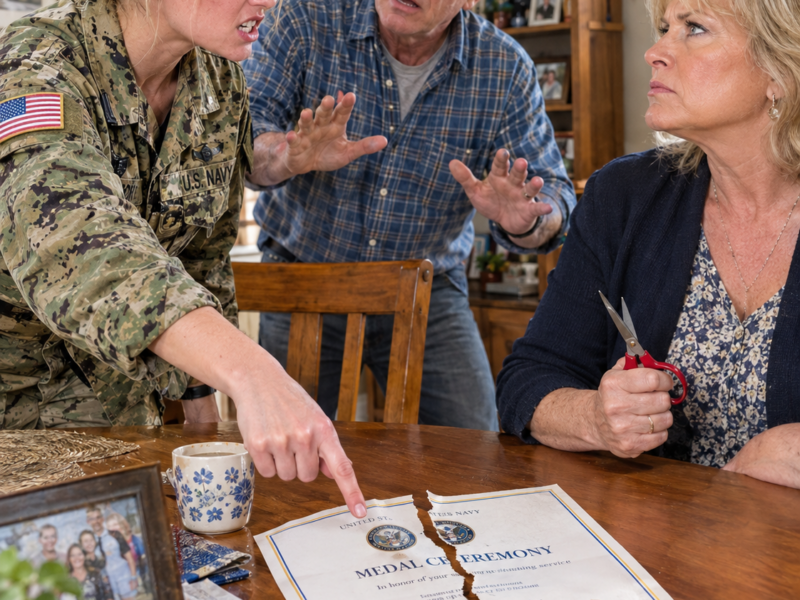
“When my family hid the invitation to my Army medal ceremony and told me the military had forgotten about me, I stood silently at our Thanksgiving table
The name on the sealed folder was Tyler Brooks.
My older brother.
For several seconds, I simply stared at the black letters printed across the white label, hoping that somehow I had misunderstood what I was seeing. Tyler had always been the golden child in our family. He was the one whose accomplishments deserved celebration, whose mistakes required understanding, and whose future was supposedly too important to be interrupted by anyone else’s success.
I had spent most of my life learning how to be proud of him without expecting him to be proud of me.
But standing on the front porch of my parents’ house, watching a brigadier general hold a folder containing my brother’s name, I began to understand that the problem had never been my inability to make my family appreciate me.
The problem was that my achievements threatened the roles they had assigned us.
My father stepped forward.
“That’s a private family matter,” he said sharply. “Whatever information you think you have, you can discuss it with me.”
Brigadier General Richard Hayes remained perfectly still.
“Sir, this matter involves an official inquiry. Staff Sergeant Brooks has every right to receive the information herself.”
My father laughed, but the sound was nervous and thin.
“Emma doesn’t understand how these things work. She’s been away too long. We handle our family business privately.”
I looked at him.
For years, those words had been used to silence me. Family business. Family loyalty. Family reputation. They were phrases my parents brought out whenever someone asked a question they didn’t want to answer.
When Tyler crashed his first car after drinking at a company event, I was told not to mention it because his future depended on keeping his record clean.
When Madison borrowed money from me and spent it on a vacation, I was told that sisters didn’t keep score.
When I returned from deployment and learned that my parents had forgotten the date of my homecoming, I was reminded that everyone had busy lives.
Every time I felt hurt, I was encouraged to become more understanding.
Every time Tyler made a mistake, he was given another chance.
Now, with the general standing on our porch and an official folder bearing Tyler’s name, my father wanted to make certain that the same old rules still applied.
Not this time.
“Give it to me,” I said.
General Hayes handed me the folder.
Inside were printed emails, delivery confirmations, and copies of documents related to my upcoming recognition ceremony at Fort Liberty.
The first document showed that my invitation had been delivered to my parents’ home four days earlier. My mother had signed for the envelope herself.
I recognized the signature immediately.
The second document was an email from Tyler to the civilian coordinator responsible for arranging the ceremony.
The message had been sent from his personal account.
*My sister will not be attending the event. Our family has already committed to another important engagement that weekend. Please withdraw her invitation and send any related materials to our home address.*
I read it again.
Then a third time.
My brother had attempted to cancel a ceremony honoring my military service without asking me a single question.
“Why would you do this?” I whispered.
Tyler appeared behind our father in the doorway.
He was wearing the navy quarter-zip sweater he had received as a gift from his company. His hair was neatly styled, and his expensive watch caught the morning light when he lifted his hand to adjust his collar.
Even now, even with an Army general standing outside our house, he looked more irritated than ashamed.
“Emma, you need to calm down.”
I turned toward him.
“Calm down?”
“You don’t know the entire situation.”
“Then explain it.”
He glanced at our father.
That small movement brought back a thousand memories. Tyler had always looked toward Dad whenever he needed someone to defend him. He had done it when he was twelve and blamed me for breaking a window. He had done it when he was twenty-two and needed money after making a series of reckless financial decisions.
And he was doing it now.
Dad folded his arms.
“Your brother was trying to protect the family from unnecessary embarrassment.”
I stared at him.
“My medal ceremony was embarrassing?”
“That’s not what I said.”
“Then what exactly are you saying?”
My mother appeared in the hallway behind Tyler. Her eyes were already wet, and she held a tissue in one hand.
“Please, sweetheart. We can talk about this inside.”
“No. We can talk about it here.”
For once, I didn’t lower my voice to make everyone else comfortable.
General Hayes waited patiently. He had clearly witnessed difficult family situations before, but he didn’t interrupt. He simply stood beside the folder, allowing the facts to speak for themselves.
I turned another page.
The email chain revealed that Tyler had contacted the event coordinator twice. The first message asked whether my recognition could be postponed. The second claimed that I had been reassigned and would be unable to attend.
Neither statement was true.
The coordinator had forwarded the messages to the Army’s administrative office because Tyler had no authority to make those requests. When the office attempted to confirm my attendance, my mother claimed the invitation had never arrived.
The contradictory accounts triggered a review.
That review uncovered something even more disturbing.
General Hayes spoke carefully.
“Staff Sergeant, the invitation issue brought another matter to our attention. Your brother appears to have used your military service in a business presentation without your authorization.”
I looked up.
“What presentation?”
Tyler’s face changed.
It was the first time that morning he looked genuinely frightened.
“That has nothing to do with this,” he said.
The general opened the folder to another document.
“Your brother’s company has been pursuing a contract with a defense-related supplier. A presentation prepared by Mr. Brooks included a photograph of you in uniform and language suggesting that his family had access to military personnel who could provide insight into procurement matters.”
My stomach tightened.
I remembered a photograph Tyler had taken during my last visit home. I had been standing beside my parents’ fireplace in my dress uniform, holding a framed certificate. Tyler had asked me to move closer to the Christmas decorations so he could get a better picture.
I had thought he wanted a family photograph.
I had never agreed to let him use my uniform or my service record to promote his career.
“Did you tell your company I could help you obtain a contract?” I asked.
Tyler shook his head too quickly.
“It wasn’t like that.”
“Did you tell them I could provide access to military officials?”
“I said you served in the Army. That’s all.”
General Hayes turned another page.
“The presentation used language describing a family connection that could be interpreted as suggesting privileged access. The appropriate officials are reviewing the circumstances. At this stage, I want to be clear that Staff Sergeant Brooks is not accused of any wrongdoing.”
I felt as if the porch had tilted beneath my feet.
My brother had taken something I had earned through years of discipline, sacrifice, and service, then used it as a decoration for his own professional ambitions.
And when my genuine recognition threatened to draw attention to the truth, he had tried to make sure I never received the invitation.
“Why?” I asked again.
This time, I looked directly at him.
Tyler’s mouth opened, but no answer came.
Dad stepped forward.
“Enough. Whatever happened, we can settle it as a family.”
“No,” I said. “You don’t get to call something a family matter after you have already decided that I don’t deserve to know about it.”
My mother began to cry.
“I never wanted you to get hurt.”
I looked at the woman who had raised me, the woman who had taught me to write thank-you notes, keep my promises, and never take credit for someone else’s work.
“Then why did you hide my invitation?”
She pressed the tissue against her mouth.
For several seconds, she said nothing.
Then she finally whispered, “Because Tyler asked me to.”
The admission was so quiet that the wind almost carried it away.
But I heard it.
Everyone heard it.
My father turned toward her with an expression of disbelief, not because she had admitted what she did, but because she had done it in front of the general.
“Linda,” he warned.
She flinched.
I looked at her and felt something inside me shift.
For years, I had imagined that there must be a complicated reason behind the way my family treated me. Perhaps they were worried about my safety. Perhaps they struggled to understand military life. Perhaps they believed I was strong enough to manage without their support.
I had invented explanations because the truth was too painful.
My mother had hidden the invitation because Tyler asked her to.
It was that simple.
My recognition had become inconvenient, and she had chosen his convenience over my achievement.
“What did he tell you?” I asked.
She wiped her face.
“He said the ceremony would cause problems at work. He said people might start asking questions about his presentation. He told me that if you attended, someone might connect the two things.”
“And you believed him?”
“I didn’t know what else to do.”
“You could have given me the invitation.”
Her face crumpled.
“I know.”
“You could have called me.”
“I know.”
“You could have told me the truth.”
“I know, Emma!”
Her voice broke across the porch.
For the first time, my mother looked at me without trying to explain my feelings away.
She looked frightened.
But I could no longer tell whether she was frightened because she had hurt me or because she had finally been caught.
General Hayes closed the folder.
“Staff Sergeant Brooks, you don’t need to resolve every aspect of this situation today. Your ceremony remains scheduled. The command has received confirmation of your nomination, and your place has not been affected by these events.”
I nodded.
“Thank you, sir.”
He gave me a small, respectful nod in return.
Then he turned toward my father.
“Sir, I recommend that no one attempt to interfere with the ceremony or contact the event staff on your daughter’s behalf. Any further communication should be handled through the appropriate official channels.”
My father stiffened.
“Are you threatening my family?”
“No,” General Hayes replied. “I’m explaining the boundaries.”
He returned to the SUV, leaving me with the folder and the truth.
For a moment, no one moved.
Then Tyler stepped toward me.
“Emma, listen to me. I know this looks bad, but I was under a lot of pressure.”
I looked at him.
“Pressure from whom?”
“My manager. The contract. Everything happening at work. You don’t understand what it’s like when your entire career depends on one opportunity.”
I almost laughed.
Not because it was funny, but because I suddenly understood how completely we had been raised to see the world differently.
Tyler believed pressure was something unique to him.
He believed his ambitions deserved protection because they mattered.
He had never considered that I also carried pressure, responsibility, fear, and uncertainty. He had never asked what it meant to be responsible for other people’s lives. He had never wondered what it cost to return from a deployment and pretend that the things I had witnessed no longer existed simply because I was standing in a familiar kitchen.
“I understand pressure better than you think,” I said.
He looked away.
“I didn’t mean for things to go this far.”
“But you meant to hide the invitation.”
He didn’t deny it.
“You meant to tell the coordinator I wasn’t attending.”
Silence.
“You meant to use my service in your presentation.”
“I was trying to get ahead.”
“And when you realized the attention might turn toward you, you decided I should disappear.”
“That’s not fair.”
I held up the email.
“It’s in your own words.”
He stared at the page.
For once, he had no quick explanation and no easy way to make himself the victim.
Dad finally spoke.
“Emma, you’re taking this too personally. Your brother made a poor decision. People make mistakes.”
I turned toward him.
“Would you say the same thing if I had done this to Tyler?”
He said nothing.
“If I had hidden his promotion letter, contacted his employer, and used his name to make myself look important, would you tell him to be understanding?”
Dad’s jaw tightened.
“That’s different.”
“Why?”
“Because it is.”
That was the answer I had heard all my life.
Because Tyler was Tyler.
Because I was Emma.
Because the rules had never been the same.
I put the documents back into the folder.
“I’ll be at the ceremony.”
Mom reached toward me.
“Please don’t leave like this.”
I stepped away before she could touch my arm.
“How would you like me to leave, Mom? Smiling? Telling you I understand? Promising not to embarrass Tyler?”
She shook her head helplessly.
“I just want my family back.”
I looked at her for a long moment.
“So do I.”
Then I walked down the porch steps.
I didn’t slam the door. I didn’t shout. I didn’t give them the dramatic scene they might later describe to relatives as proof that I had become cold and difficult.
I simply left.
And for the first time, I understood that walking away did not always mean abandoning someone.
Sometimes it meant refusing to abandon yourself.
***
The drive back to Fort Liberty was nearly two hours.
I kept the folder on the passenger seat and drove in silence, watching the trees pass beneath a pale autumn sky. Every few miles, I found myself remembering a different moment from my childhood.
Tyler at his high school graduation, standing between our parents while I took the photographs.
Tyler receiving his first job offer, with Dad opening a bottle of champagne.
Tyler announcing his engagement to a woman he later decided he wasn’t ready to marry, with Mom spending weeks consoling him.
I remembered my own graduation from basic training. I had sent my parents the date months in advance. Dad had promised to attend, but a last-minute opportunity to help Tyler move apartments had changed his plans.
Mom had called me the night before and said she was sorry.
“You know how your brother is,” she’d told me.
I had answered, “It’s okay.”
I had said those words so often that they had become automatic.
It’s okay when you forget.
It’s okay when you don’t come.
It’s okay when you interrupt.
It’s okay when my achievement is inconvenient.
It’s okay when I have to make myself smaller.
But it hadn’t been okay.
I had simply learned to survive the disappointment by pretending it didn’t matter.
When I arrived at the base, I parked outside my quarters and sat in the vehicle for several minutes. I took the invitation from my coat and smoothed the folded corner with my thumb.
The paper was ordinary. Cream-colored, with formal lettering and the Army insignia printed at the top.
Yet it had become a symbol of everything I had been taught to suppress.
My pride.
My effort.
My right to be recognized for work I had done honestly.
I placed it inside my desk drawer beside a photograph of my team.
Then I called my closest friend in the Army, Sergeant First Class Danielle Price.
She answered on the second ring.
“Brooks. Tell me you aren’t calling to ask me to help you move again.”
Despite everything, I smiled.
“I need to talk.”
Her voice changed immediately.
“What’s wrong?”
I told her about the invitation, the general, and the folder.
I expected her to be shocked.
Instead, she grew quiet.
When I finished, she asked, “What do you need right now?”
The question nearly undid me.
Not What did you do?
Not Why didn’t you stop it?
Not Are you sure you aren’t overreacting?
Just: What do you need?
“I don’t know,” I admitted.
“Then start there. You don’t have to decide what your relationship with your family looks like for the next twenty years today.”
I leaned back in my chair.
“I feel ridiculous. I’m twenty-nine years old, and my mother hid a letter from me like I was a child.”
“You’re not ridiculous. Someone you trusted betrayed you. Your age doesn’t make that hurt less.”
I closed my eyes.
“I keep thinking about how many times I’ve defended them.”
“That doesn’t mean you were stupid. It means you loved them.”
Her words settled over me more gently than any advice I had received from my family in years.
Danielle had served beside me long enough to know that I rarely talked about home. She knew I sent money to my parents when their bills became difficult. She knew I called my mother every Sunday, even when the conversations lasted only five minutes. She knew I made excuses whenever someone asked why my family rarely visited.
She had never forced me to explain.
Now, she listened without rushing me toward forgiveness.
“Are you still going to the ceremony?” she asked.
“Yes.”
“Good.”
I laughed softly.
“That’s all you have to say?”
“No. I have several other things to say, but most of them would get me reported to somebody.”
For the first time that day, I laughed for real.
Danielle waited until I had settled.
“Emma, you earned that recognition. Whatever your brother did, whatever your parents chose, none of it changes what happened overseas. None of it changes who you were when your team needed you.”
I looked at the photograph on my desk.
Three soldiers stood on either side of me, dusty and exhausted, their arms resting on one another’s shoulders. We had taken the photograph shortly after returning from a difficult operation. No one had been smiling very much, but all of us had insisted on keeping it.
That photograph reminded me of something my family had never understood.
The people who knew the most about what I had done had never demanded that I prove my worth.
They had simply trusted me to do my part.
“Thank you,” I said.
“Don’t thank me yet. You’re still helping me move next month.”
I smiled again.
After we hung up, I sat for a long time, thinking about the ceremony.
I had imagined the day would feel different. I had imagined calling my mother to tell her what time to arrive, discussing where everyone would sit, and hearing Dad complain about traffic.
I had imagined Tyler making a joke about how many photographs Mom would take.
Instead, I would walk into the room without them.
For a few minutes, the thought felt unbearable.
Then I reminded myself that being alone at a ceremony was not the same as being alone in life.
I had friends who cared about me. I had soldiers who trusted me. I had work that mattered, a future I could shape, and a version of myself I was only beginning to recognize.
I wasn’t going to let my family turn a moment of pride into another test of whether I deserved their approval.
***
The next several days were difficult.
My mother called repeatedly. At first, I didn’t answer. Then she left a message asking me to call her back because she couldn’t sleep.
My father sent a text telling me that the situation had become unnecessarily complicated.
Tyler sent nothing.
I eventually called my mother.
She answered immediately.
“Emma? Oh, sweetheart.”
Her voice sounded exhausted.
“Hi, Mom.”
“I’ve been so worried.”
I closed my eyes.
“About me?”
“Of course about you.”
I waited.
She began explaining that the family had been under pressure, that Tyler had been anxious about work, and that she had thought she could solve the problem before anyone got hurt.
“I made a terrible mistake,” she said. “I know that now.”
“What would you have done if the general hadn’t come to the house?”
She stopped.
“Emma—”
“Would you have given me the invitation?”
A long silence followed.
“I don’t know.”
It was the first honest answer she had given me.
And somehow, it hurt more than another excuse would have.
I swallowed.
“Mom, I need you to understand something. I don’t expect you to agree with every decision I make. I don’t expect you to understand every part of my work. But I need to be able to trust you.”
“I know.”
“When I tell you something important, I need to know you won’t hide it because Tyler feels uncomfortable.”
“I understand.”
“And I need you to stop asking me to forgive people before they’ve taken responsibility for what they’ve done.”
She began to cry again.
I let her cry.
For years, her tears had been the signal that I should soften my words, apologize for upsetting her, and reassure her that everything would be fine.
This time, I didn’t rush to comfort her.
I wasn’t being cruel. I was simply allowing her to experience the consequences of a decision she had made.
Eventually, she asked, “Will you still come home for Christmas?”
“I don’t know yet.”
The answer frightened her.
I could hear it in the sudden silence.
“You always come home.”
“I know.”
“Your father will be very upset.”
“That’s his choice.”
She took a shaky breath.
“You’re different.”
I looked out the window at the soldiers crossing the courtyard below.
“I hope I am.”
We ended the call without resolving anything.
It wasn’t a happy conversation. It didn’t produce an apology that fixed the past or a promise that guaranteed the future.
But it was honest.
For the first time, I had told my mother what I needed without immediately taking responsibility for how she felt about hearing it.
That was a beginning.
Not reconciliation.
Not forgiveness.
A beginning.
***
Three days before the ceremony, Tyler finally contacted me.
His message arrived late in the evening.
*We need to talk. Please don’t make this worse than it already is.*
I stared at the screen.
There it was again.
Not I’m sorry.
Not I was wrong.
Not I understand why you’re hurt.
Instead, he wanted me to take responsibility for the consequences of his own actions.
I typed a reply, deleted it, and started again.
*I’m willing to talk when you’re ready to take responsibility for what you did. I’m not willing to help you hide it.*
He called immediately.
I considered ignoring him, but eventually answered.
“What do you want, Tyler?”
He sounded angry.
“You sent me a message like I’m some criminal.”
“I told you I’m willing to talk.”
“You’re acting like I deliberately tried to ruin your life.”
“You tried to cancel my ceremony and used my military service in a business presentation without asking me.”
“I didn’t steal anything!”
“I didn’t say you did.”
“You keep making me sound like some terrible person.”
I leaned forward in my chair.
“Tyler, this conversation isn’t about whether you’re a terrible person. It’s about what you did.”
He fell silent.
For a moment, I hoped he might finally understand.
Then he said, “Do you have any idea what this could do to my career?”
I closed my eyes.
There it was.
Even now, he couldn’t see past himself.
“Yes,” I said. “I imagine there may be consequences.”
“You could explain that I never meant anything by it.”
“I wasn’t part of your presentation. I can’t explain what you meant.”
“You know I’m not a bad person.”
“Then you should be able to tell the truth about your own choices.”
He exhaled sharply.
“You’re really going to let this destroy everything I’ve worked for?”
“No. You made those decisions. I’m not going to lie to protect you from the consequences.”
His voice dropped.
“Mom says you’ve changed.”
“I have.”
“Well, I hope you’re happy.”
He ended the call.
I set the phone down.
My hands were shaking, but I didn’t feel guilty.
That surprised me most of all.
For years, I had treated Tyler’s disappointment as evidence that I had done something wrong. If he was angry, I searched for a way to fix things. If he felt overlooked, I made myself less visible.
Now I could recognize his anger without automatically accepting responsibility for it.
I couldn’t control what happened at his company. I couldn’t determine how his presentation would be reviewed. I couldn’t make him tell the truth.
I could only refuse to participate in the lie.
And that was enough.
***
The morning of the ceremony arrived beneath a clear blue sky.
I woke before my alarm and lay still for a moment, listening to the quiet sounds of the base coming to life.
Today, I would receive formal recognition for the work my team had done during an operation overseas.
The thought filled me with pride, but there was sadness beside it.
I wished my family could have been there.
I wished my mother had been the person who opened the invitation and called me with excitement.
I wished my father had been the person standing on the porch, telling the general how proud he was of his daughter.
I wished Tyler could have celebrated my success without feeling that it diminished his own.
Those wishes didn’t disappear simply because I had finally learned to protect myself.
But they no longer controlled my choices.
I dressed carefully, checking every button and crease. I polished my shoes, adjusted my ribbons, and stood before the mirror.
The uniform reflected years of work.
Early mornings.
Long nights.
Training exercises that left my body aching.
Phone calls home made from places where I couldn’t explain what I was doing.
The faces of people who had trusted me when circumstances became frightening.
I thought about the night our extraction route had collapsed.
The operation had begun with a clear plan. We knew our assignments, understood our routes, and had rehearsed the procedures repeatedly. But events changed quickly, as they often do in the field.
Communications became unreliable. Our route was no longer safe. Two members of our team were injured, and the transport window began to close.
There was no moment when I felt heroic.
I felt frightened.
I felt tired.
I felt responsible.
I remember looking at the soldiers around me and realizing that fear could be present without being allowed to make the decision.
We adjusted the plan, coordinated with the remaining unit, and moved toward the available extraction point. I helped the wounded soldiers forward and remained with the last group until we could confirm that everyone who could be evacuated had reached the transport.
When it was over, I was too exhausted to think about what it might mean.
I thought about the people who had made it back.
I thought about the ones who would need medical care.
I thought about the fact that we had completed the mission together.
That was why the nomination mattered.
Not because I needed a medal to prove I was valuable, but because it recognized a moment when a team had trusted one another under pressure.
I fastened the final button on my uniform.
Then I placed the invitation in my pocket.
I wasn’t going to let anyone else’s shame make me ashamed of being proud.
***
The ceremony was held in a formal auditorium on base.
Rows of chairs filled the room. Flags stood at the front, and uniformed personnel moved quietly between the aisles. Several soldiers had families sitting beside them, taking photographs and whispering excitedly.
I arrived early.
For a few minutes, I stood near the entrance, watching people greet one another.
A young private hugged his grandmother. A captain adjusted his daughter’s collar. A woman in a dark blue dress wiped tears from her eyes as her husband took his place near the front.
I felt the familiar ache of wishing my family were there.
Then Danielle appeared beside me.
She wore her dress uniform and carried two cups of coffee.
“I brought you one,” she said.
“You’re a lifesaver.”
“I know. It’s in my personnel file.”
I laughed.
She studied my face.
“You ready?”
I looked toward the stage.
“No,” I admitted. “But I’m here.”
“That’s usually how courage works.”
She handed me the coffee.
We stood together until the doors opened and the audience began taking their seats.
A few of my teammates had managed to attend. They greeted me with the kind of easy affection that comes from shared experience. No one asked why my parents weren’t there. No one demanded an explanation.
They understood that not every absence needed to become a public story.
When the ceremony began, I sat straight in my chair and listened as the host welcomed the audience.
Names were called.
Soldiers stood.
Citations were read.
Families applauded.
I clapped for every person who walked forward, feeling the quiet joy of witnessing people receive recognition for work that had often gone unseen.
Then I heard my name.
“Staff Sergeant Emma Catherine Brooks.”
For one brief moment, my body seemed to forget how to move.
I stood.
The auditorium rose into a blur of faces and uniforms. I walked toward the stage, keeping my eyes forward.
General Hayes waited beside the presentation table.
He had attended dozens of ceremonies like this one. He had likely forgotten many of the names he had announced over the years.
But when I reached him, he looked directly at me.
“Staff Sergeant Brooks,” he said.
“Sir.”
He presented the medal and read the citation describing my role in helping coordinate the evacuation of our injured soldiers and ensuring that the remaining team reached safety.
As he spoke, I remembered the people beside me that night.
I remembered the uncertainty.
I remembered how small I had felt in the moment, how ordinary my decisions had seemed.
Then I heard the audience applauding.
The sound filled the room.
For a second, I imagined my mother in the front row, holding a tissue and smiling through her tears.
I imagined Dad standing beside her, clapping with the pride he had always shown Tyler.
I imagined Tyler looking at me without resentment.
Those were only imagined scenes.
The seats reserved for my family remained empty.
And yet, as I stood beneath the flags, I realized the empty seats did not make the moment incomplete.
I had earned this recognition before my mother hid the invitation.
I had earned it before Tyler sent the email.
I had earned it before my father called my achievements inconvenient.
Their choices could hurt me, but they could not travel backward in time and erase what I had done.
General Hayes shook my hand.
“Well done, Staff Sergeant.”
“Thank you, sir.”
I returned to my seat.
Danielle leaned toward me.
“See?” she whispered. “Still here.”
I looked at her and smiled.
“Still here.”
For the first time that week, the tears in my eyes were not the result of betrayal.
They were tears of relief.
I had made it to the ceremony.
I had stood in the room.
I had accepted the recognition.
And I had done it without apologizing for the space I occupied.
***
After the ceremony, people gathered in the reception area for photographs and refreshments.
My teammates insisted on taking pictures with me. Danielle stood beside me in one, grinning broadly and holding up two fingers behind my head.
“That picture is going to look ridiculous,” I told her.
“Good. You need at least one photograph in which you don’t look like you’re preparing to inspect the entire room.”
We laughed.
A young soldier approached me a few minutes later.
“Staff Sergeant Brooks?”
I turned.
“Yes?”
“I wanted to congratulate you, ma’am.”
“Thank you.”
He hesitated.
“My squad leader told us about the operation. He said you stayed with the last group until everyone was accounted for.”
I wasn’t sure what to say.
He continued, “I’m still pretty new, but I hope I can be the kind of soldier people trust when things go wrong.”
His words reached a place in me that the medal itself hadn’t touched.
I smiled.
“You don’t become that kind of soldier in one moment. You become that person by doing the right things when nobody is watching. You keep training. You look after your team. And when you make a mistake, you own it and learn from it.”
He nodded seriously.
“Yes, ma’am.”
After he left, I stood quietly for a moment.
I had spent days thinking about the family I wished I had.
I hadn’t spent enough time thinking about the people who were already part of my life.
They weren’t replacements for my parents or my siblings. They couldn’t erase the history we shared.
But they reminded me that love was not supposed to be a competition, and loyalty was not supposed to require silence.
The people who stood beside me that day didn’t ask me to diminish my achievement so they could feel important.
They were simply happy that I had done well.
That kind of support felt unfamiliar.
It also felt right.
Before leaving, I asked Danielle to take one final photograph of me beneath the flags.
I stood straight, my medal visible against my uniform, and looked directly into the camera.
I didn’t smile because I wanted to prove that I was happy.
I smiled because, for once, I didn’t feel the need to prove anything at all.
***
My mother called that evening.
I was sitting in my quarters, carefully placing the medal in its case, when her name appeared on my phone.
I let it ring twice before answering.
“Hello, Mom.”
For a moment, I heard only her breathing.
“How did it go?”
“It went well.”
“Did you receive the medal?”
“Yes.”
She began to cry.
“I’m so sorry I wasn’t there.”
I looked at the medal case.
Part of me wanted to say that it was okay.
The old response rose automatically, ready to smooth the conversation and make her feel better.
But I stopped myself.
“I wish you had been there too,” I said.
She cried harder.
“I should have given you that invitation the moment it arrived. I should have been excited for you. I should never have listened to Tyler.”
I closed my eyes.
“Yes. You should have.”
The words felt strange in my mouth.
Not cruel.
Not angry.
Just honest.
She took a breath.
“I don’t expect you to forgive me right away.”
That was new.
I waited for her to add a condition, to explain why I should understand, or to remind me how difficult the situation had been for her.
She didn’t.
“I know I hurt you,” she continued. “And I know that saying I’m sorry doesn’t fix it.”
“No, it doesn’t.”
“I want to do better.”
I looked down at my hands.
“I hope you do, Mom. But I need time.”
“Of course.”
“And I need you to understand that I won’t cover for Tyler. I won’t tell anyone his actions were harmless, and I won’t pretend that what happened was a misunderstanding.”
“I understand.”
“If he wants to repair things with me, he has to do that himself.”
She was quiet for a moment.
“Your father thinks you’re being too harsh.”
I felt the familiar tightening in my chest.
There it was. The attempt to bring Dad’s feelings into the conversation, to make me responsible for another person’s discomfort.
I took a breath.
“Mom, I’m not asking Dad to agree with me. I’m telling you what I need.”
She was silent.
Then she said, “You’re right. I’m sorry.”
We talked for another few minutes. The conversation was awkward, and neither of us knew how to end it.
Before hanging up, she asked whether I had eaten.
I told her I had.
She reminded me to get enough sleep.
I thanked her.
It was an ordinary exchange, almost painfully ordinary.
But perhaps healing did not begin with a dramatic reconciliation. Perhaps it began with two people learning to speak honestly, even when the truth made their familiar roles uncomfortable.
I didn’t know whether my mother would follow through on her promise.
I didn’t know whether my father would ever admit that he had defended the wrong person.
I didn’t know whether Tyler would apologize.
For the first time, I accepted that I could not make those decisions for them.
I could only decide what I would do next.
***
The inquiry involving Tyler’s presentation continued after the ceremony.
I didn’t seek information about it, and I didn’t try to influence the process. When officials asked whether I had authorized the use of my photograph or offered to help Tyler obtain access to military contacts, I answered honestly.
I explained when the photograph had been taken and what I understood about the presentation.
I provided the information requested and made it clear that I had never authorized anyone to represent me as a source of privileged access.
That was all.
I did not contact Tyler’s employer to demand that he be fired.
I did not call relatives to tell them what he had done.
I did not publish the emails or share the story online.
I wanted the matter handled through the proper channels, not turned into a public spectacle.
For a while, I worried that my refusal to defend Tyler would be interpreted as an attempt to punish him.
Then I reminded myself that honesty was not punishment.
Consequences were not revenge.
And protecting my own integrity did not make me responsible for whatever happened to his career.
Several weeks later, Tyler sent me a long email.
I read it once.
Then I read it again.
He wrote that his company had questioned the presentation. He had been asked to explain the claims he made and the basis for suggesting that his family connection could provide an advantage.
He admitted that he had exaggerated.
He also admitted that he had contacted the ceremony coordinator because he feared the recognition would lead people to examine the presentation more closely.
For the first time, he used the words I had been waiting to hear.
*I knew what I was doing was wrong, and I tried to keep you from receiving recognition because I was afraid of what people would discover.*
I sat very still.
The email continued.
*I convinced myself that I was protecting my career. I told myself the ceremony was just one day and that you wouldn’t care that much. I thought you would get over it because you’ve always been the strong one.*
I swallowed.
There it was.
The role I had played in our family for so long.
The strong one.
The understanding one.
The one who could survive being disappointed.
Tyler wrote that he had assumed I would forgive him eventually because I always had before.
He said he was sorry for using my service without permission, for trying to interfere with the ceremony, and for allowing Mom to become involved in his decision.
He didn’t ask me to call his employer.
He didn’t ask me to tell our parents that everything was fine.
He didn’t ask me to forgive him immediately.
At the end, he wrote:
*I don’t know how to fix this. I don’t expect you to tell me how. I just wanted to admit that I did it, and that you didn’t deserve it.*
I placed the phone on my desk.
I read the message again that evening, and once more the following morning.
Part of me wanted to believe that everything could return to normal.
Another part of me knew that returning to normal was not necessarily a good thing.
Normal had been a family where I swallowed my disappointment, where Tyler’s needs came first, and where Mom and Dad called my silence maturity.
If we were ever going to have a healthier relationship, we couldn’t simply return to that arrangement.
I wrote back.
*Thank you for acknowledging what happened. I appreciate that you have taken responsibility. I am not ready to pretend things are normal, and I need you to understand that rebuilding trust will take time. I hope you continue being honest, even when the truth is difficult.*
I read the message twice before sending it.
Then I put my phone away.
It wasn’t forgiveness.
Not yet.
But it was a door left unlocked, without a promise that I would open it before I was ready.
***
Winter arrived slowly.
The trees around the base lost their leaves, and the mornings became colder. Work continued, as it always did. There were training schedules to manage, reports to complete, and younger soldiers who needed guidance.
I returned to my routines.
I exercised before sunrise. I checked in with my team. I called Danielle when I needed to talk, and I began making plans for a short vacation that I had postponed for too long.
For the first time in years, I stopped automatically sending money whenever my parents mentioned a bill.
I didn’t announce the change.
I simply began asking questions.
When Dad told me that the house needed repairs, I asked whether they had obtained estimates and planned a budget.
When Mom mentioned that Tyler was struggling financially, I told her I hoped he would find a solution.
I did not offer to solve it for him.
The first time I declined to send money, my father accused me of becoming selfish.
I listened until he finished.
Then I said, “I love you, Dad. But I can’t be the family’s emergency plan every time someone else makes a decision.”
He told me I had changed.
I answered the same way I had answered my mother.
“I hope I have.”
We ended the call without agreement.
It hurt.
But the hurt no longer convinced me that I was doing something wrong.
I began to notice how much energy I had spent anticipating everyone’s reactions. Before making a decision, I had always imagined how Tyler might feel, how Dad might respond, and whether Mom would become upset.
I had treated their possible disappointment as a warning signal.
Now I was learning to ask a different question.
Was I acting honestly?
Was I being fair?
Was I taking responsibility for my own choices without taking responsibility for everyone else’s?
Those questions were harder than simply giving in.
But they were helping me build a life that belonged to me.
***
In January, I received a letter from a young soldier who had attended the ceremony.
He wrote that he had been struggling with the feeling that his work went unnoticed. His family did not understand his career, and he had begun to wonder whether the sacrifices were worth it.
He said that hearing my name announced at the ceremony had reminded him that meaningful work mattered even when the people closest to you didn’t understand it.
I read the letter twice.
Then I wrote him a reply.
I told him that recognition was valuable, but it could never be the only measure of his worth. I told him to seek out people who would challenge him, support him, and tell him the truth. I reminded him that he didn’t have to become bitter simply because someone had failed to appreciate him.
Before sealing the envelope, I added one final sentence.
*Don’t spend your entire life waiting for someone else to give you permission to be proud of yourself.*
I stared at those words for a long time.
Then I realized I had written them for myself, too.
***
My mother visited the base in early spring.
She called first and asked whether I would be willing to meet her for lunch.
I nearly said no.
Not because I wanted to punish her, but because I was afraid that one pleasant afternoon would become evidence that everything had been repaired.
Still, I agreed to meet.
We chose a small restaurant outside the base, somewhere quiet enough to talk without raising our voices.
When she arrived, she looked older than I remembered. There were new lines around her eyes, and she held her purse with both hands as she approached the table.
“Hi, sweetheart.”
“Hi, Mom.”
We hugged briefly.
The first few minutes were awkward. We talked about the weather, the drive, and the restaurant’s menu.
Then she looked at me.
“I brought something.”
She reached into her purse and removed a cream-colored envelope.
For a moment, I couldn’t breathe.
It was not the original invitation. That one remained in my desk drawer.
This envelope contained a photograph from my ceremony.
I was standing beneath the flags, wearing my dress uniform and holding the medal case. Danielle stood beside me, grinning at the camera.
My mother had obtained the photograph from a public ceremony album.
“I wanted to give this to you,” she said.
I looked at it carefully.
“Thank you.”
She placed both hands on the table.
“I’ve spent a lot of time thinking about what happened.”
I waited.
“I told myself I was helping Tyler because he was under pressure. I told myself you were strong enough to handle the disappointment. I convinced myself that because you didn’t complain, you weren’t being hurt.”
She paused.
“But I was wrong. I made your strength an excuse to neglect you.”
The words landed gently, but they landed.
I had wanted to hear something like this for years.
Now that I was hearing it, I discovered that an apology could bring relief without instantly removing the pain.
“I was proud of you before the ceremony,” she continued. “I should have shown you that. I should have been proud loudly enough that you never had to wonder.”
I looked down at the photograph.
“Why didn’t you?”
She swallowed.
“Because I was afraid of upsetting your father, and I was afraid Tyler would fail. I spent so much time trying to keep everyone comfortable that I stopped asking whether I was being fair.”
For once, she wasn’t asking me to understand her.
She was explaining her choices without using them as excuses.
I took a slow breath.
“Mom, I love you.”
Her eyes filled with tears.
“But I need you to know that things can’t go back to how they were.”
“I know.”
“I’m not going to keep pretending that I’m fine when I’m not. And I’m not going to let anyone make my accomplishments into a problem.”
She nodded.
“I understand.”
We talked for nearly two hours.
There were difficult moments. She admitted that she had often compared Tyler’s progress with mine, assuming that because my career was stable, I needed less encouragement. She acknowledged that Dad’s expectations had influenced her more than she wanted to admit.
I told her about the years I had spent trying to be the easy child, the one who never needed anything.
I told her how lonely it had felt to come home after difficult assignments and realize that nobody wanted to hear about the parts of my life that mattered to me.
I didn’t describe every painful memory. I didn’t need to.
For once, my mother listened without interrupting.
When we stood to leave, she hugged me.
“I’m sorry, Emma.”
I rested my cheek against her shoulder.
“I know.”
I did not say that everything was forgiven.
But I did not pull away, either.
Sometimes, progress was not a dramatic declaration.
Sometimes, it was a quiet conversation in a small restaurant, followed by a hug that neither person tried to turn into a promise.
***
My father took longer.
For months, he continued to describe the incident as an unfortunate misunderstanding. He insisted that Tyler had been under pressure and that I had allowed an administrative issue to become a family crisis.
I stopped arguing.
Not because I agreed, but because I finally understood that I could not force him to see what he didn’t want to see.
In the summer, he called to ask whether I would attend a family gathering.
I told him I would consider it.
He sighed.
“Your mother says you’re still upset about the invitation.”
“I’m still hurt by what happened.”
“How long are you going to hold on to it?”
I looked out the window.
“Until it no longer hurts, perhaps. But I’m not going to pretend it didn’t happen just because you’re tired of discussing it.”
He became quiet.
Then he said something I had not expected.
“I suppose I didn’t help.”
It was not a full apology.
It was not an admission of everything he had done.
But it was the first time he had acknowledged any responsibility.
“No,” I said gently. “You didn’t.”
He exhaled.
“I thought I was keeping the family together.”
“I know.”
“I didn’t realize how much I was asking you to give up.”
I swallowed.
“I wish you had asked me.”
He didn’t answer immediately.
Then he said, “I’m sorry, Emma.”
I sat very still.
Those two words did not repair twenty-nine years of unequal expectations. They didn’t erase the empty seats at my ceremony or the memory of standing on the porch with the folder in my hands.
But they mattered.
I told him I appreciated the apology.
We agreed to speak again.
I didn’t promise that everything would be fine.
For the first time, I didn’t need to.
***
Tyler and I met in person several months after the ceremony.
He suggested a coffee shop halfway between his apartment and the base. I arrived early and chose a table near the window.
When he walked in, he looked tired.
He had lost the confident ease he usually carried into a room. His company had completed its review, and he had been removed from the contract team while the matter was resolved. He had also been required to complete additional compliance training.
He told me he had accepted the consequences.
“I don’t expect you to feel sorry for me,” he said.
“Good. I don’t.”
He nodded.
“I deserved that.”
We sat quietly for a moment.
Then he said, “I keep thinking about what you told me. About the pressure you understand.”
I waited.
“I never asked what your life was actually like. I knew you were in the Army, but I treated it like a job you went to. I didn’t think about what you carried home with you.”
I looked at him.
“Did you ever want to know?”
He rubbed his hands together.
“Sometimes. But I was afraid of what I might hear. I didn’t know how to talk about things I couldn’t control.”
It was not a perfect explanation.
But it was more honest than anything he had said before.
“I used to think you were trying to make me feel small,” he continued. “Maybe sometimes you were. But I think I also made your achievements into a competition because I didn’t know how to feel good about myself without being the best at something.”
I studied his face.
For the first time, Tyler seemed less interested in defending his image than in understanding his behavior.
“I can’t tell you that I trust you the way I used to,” I said.
“I know.”
“And I won’t let you use my name or my service to help your career again.”
“I won’t.”
“If you ever need help, you can ask me. But I won’t lie for you.”
He nodded.
“That’s fair.”
We talked for another hour.
We didn’t solve everything. We didn’t suddenly become the kind of siblings who shared every secret or called each other every day.
But we began speaking as two adults instead of returning automatically to the roles we had occupied as children.
Before leaving, Tyler stood beside the table.
“I am proud of you, Emma.”
I looked at him.
He seemed uncomfortable saying it, which somehow made it feel more sincere.
“I should have told you that years ago,” he added.
“Yes,” I said. “You should have.”
He nodded.
I didn’t rush to make him feel better.
Then I hugged him.
It was brief and awkward, but it was real.
For the first time, we were not pretending that the past had been different.
We were deciding whether the future could be better.
***
A year after the ceremony, I took the medal case from my desk drawer and placed it beside the photograph of my team.
The invitation was still there, its folded corner softened from being handled so many times.
I had considered throwing it away.
I had considered putting it in a box and never looking at it again.
Instead, I kept it where I could see it.
Not because I wanted to remember the day my mother betrayed me.
Not because I needed to keep evidence against Tyler.
I kept it because it reminded me of a choice I had made.
When the invitation was hidden, I could have allowed my family’s decision to determine how I saw myself. I could have skipped the ceremony, told everyone I didn’t care, and continued pretending that their approval mattered more than my own sense of worth.
Instead, I went.
I stood beneath the flags.
I accepted the medal.
I allowed myself to feel proud.
The experience changed my relationship with my family, but it changed my relationship with myself even more.
I began to understand that love did not require endless accommodation.
Loyalty did not mean accepting dishonesty.
Forgiveness did not mean pretending that consequences were unnecessary.
And being strong did not mean being the person who could endure the most pain without complaining.
Strength could mean telling the truth.
It could mean asking for help.
It could mean saying no.
It could mean leaving a conversation when someone tried to make you responsible for their choices.
Most of all, strength could mean allowing yourself to be seen.
My family was still imperfect. My father still struggled to understand parts of my life. My mother sometimes slipped into old habits, though she was learning to recognize them. Tyler and I were rebuilding our relationship slowly, one honest conversation at a time.
There were still awkward holidays and difficult phone calls.
There were still moments when I wished things had been different.
Healing did not turn our family into a perfect one.
It gave us a chance to become a more honest one.
And I learned that I could love people without handing them the authority to define my worth.
The medal on my desk was not proof that I was better than my brother.
It was not proof that my parents had been wrong about everything.
It was simply recognition for work I had done, responsibility I had carried, and decisions I had made when other people were depending on me.
I had earned it.
That truth had been there all along.
The invitation had never created my worth. Hiding it had never erased my worth. The general’s arrival had not given me permission to be proud.
It had merely forced me to confront a truth I had avoided for years.
I did not need my family to agree that my accomplishments mattered before I could celebrate them.
I did not need to become smaller so Tyler could feel important.
And I did not need to keep proving my loyalty by accepting treatment I would never encourage another person to tolerate.
Sometimes, the people closest to us hurt us not because they don’t know what we have accomplished, but because they have become accustomed to a version of us that asks for very little.
When we finally ask for fairness, they call us different.
When we establish boundaries, they call us selfish.
When we stop covering for them, they say we have changed.
Maybe we have.
Maybe change is exactly what happens when we stop confusing being loved with being useful.
On the anniversary of the ceremony, Danielle sent me the photograph she had taken beneath the flags.
I printed it and placed it in a simple frame.
In the picture, I stood straight in my dress uniform, the medal resting against my chest. My face was calm, and my eyes were bright.
I looked like someone who had finally stopped waiting for permission.
I placed the photograph beside the invitation.
Then I called my mother.
We talked about ordinary things. Her garden. My work. A recipe she wanted to send me. She asked whether I might visit during the next holiday, and I told her I would check my schedule.
Before we hung up, she said, “I’m proud of you, Emma.”
I closed my eyes.
“Thank you, Mom.”
This time, I didn’t need those words to repair the past.
I could appreciate them for what they were.
A beginning.
After the call, I sat quietly in my room and looked at the photograph one last time.
I thought about the young soldier who had written to me, the teammates who had stood beside me, and the family members who were slowly learning that love could not survive on silence alone.
Then I thought about the invitation that had once been hidden in my own home.
A small envelope.
A few lines of formal lettering.
A door my family had tried to close before I even knew it was there.
They had believed they could decide whether I deserved to walk through it.
They were wrong.
I had walked through it anyway.
And if there is one thing I hope someone reading my story remembers, it is this:
You can love your family and still tell them when they have hurt you.
You can forgive someone without pretending the damage never happened.
You can wish that the people you love had supported you while refusing to let their disappointment dictate your future.
You can be compassionate without becoming responsible for every mistake another person makes.
And you can stand proudly in the life you have built, even when the people who should have celebrated you are still learning how to do so.
My family hid my medal ceremony invitation because they believed my success would create problems for them.
In the end, the ceremony did not destroy our family.
The lies, the favoritism, and the fear of accountability had already done the damage.
What changed everything was my decision to stop protecting those lies at the expense of myself.
I still love my family.
I still hope we will continue to grow.
But I no longer measure my worth by whether they approve of me.
The medal belongs to me.
The choices belong to them.
And my future belongs to me, too.
If you’ve ever been told to stay quiet, make yourself smaller, or sacrifice your happiness to keep someone else comfortable, I hope you remember that your life is not a competition you must lose in order for another person to win.
You are allowed to succeed.
You are allowed to be proud.
You are allowed to set boundaries with the people you love.
And you are allowed to walk toward the future you have earned, even if the people standing behind you are not ready to applaud.
Sometimes, the most important recognition doesn’t come from a ceremony, a commander, or a medal.
Sometimes, it comes from the moment you finally look at yourself and say:
**I know what I have done. I know what I am worth. And I will never again allow someone else’s fear to make me ashamed of my own light.**
THE END.









