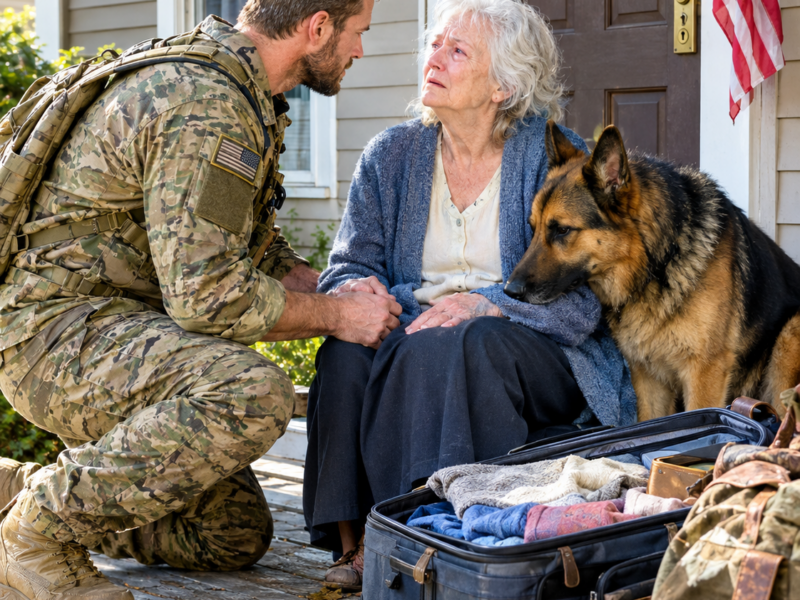
“When I pulled into my mother’s driveway in rural Virginia, my Navy SEAL uniform still dusty from the flight home
Michael’s face changed when he saw me looking through the peephole.
“Daniel, please open the door,” he said. “This is getting out of hand.”
Behind him, the man in the dark suit glanced at his watch as though my family’s crisis were an appointment running late.
I kept the chain fastened and opened the door just wide enough to see them clearly.
“What does that photograph mean?”
Michael’s eyes moved toward the picture in the man’s hand.
For one brief second, he looked genuinely frightened.
Then the expression disappeared.
“That’s why we need to talk,” he said. “But not out here.”
“Start talking.”
The man in the suit stepped forward. “My name is Richard Hale. I’m an attorney representing your mother in a property matter.”
“Representing her?” I asked. “She was sleeping outside her own house six hours ago.”
Hale’s expression remained polite, but his eyes sharpened.
“I’m afraid you’re working with incomplete information.”
“Then complete it.”
Michael rubbed both hands over his face.
“Mom signed the papers, Daniel. She agreed to move out. I didn’t throw her out.”
I thought about the bruises on her wrist, the garbage bags, and the deadbolt installed on the outside of the screen door.
“Did she sign them willingly?”
He didn’t answer.
That silence told me more than his explanation had.
I looked at Hale. “I want to speak with my mother before I discuss anything with you.”
“Of course. But the documents involve a time-sensitive transfer, and your interference could create unnecessary legal complications.”
“Then you should have no problem waiting until she can review them with independent counsel.”
For the first time, Hale’s professional smile faltered.
Michael grabbed his sleeve.
“Come on,” he muttered. “This isn’t what we agreed.”
Hale turned toward him slowly.
“Perhaps you should be careful about what you say in front of your brother.”
I heard the warning in his voice.
Michael heard it too.
They exchanged a look that lasted only a second, but it carried the weight of a conversation I’d missed.
I shut the door and locked it.
Then I called the local police nonemergency number and explained that my mother might be the victim of financial exploitation. I gave them the names on the documents and asked how to preserve the evidence.
The dispatcher advised me to avoid confrontation and contact an attorney experienced in elder abuse and property disputes.
It wasn’t the dramatic answer a younger version of me might have wanted, but it was the right one.
When I turned around, Rex was standing beside the desk.
The blue folder lay open beneath the lamp.
I checked the time on my phone. It was nearly midnight.
Mom was still asleep, her face turned toward the wall, one hand curled beneath her cheek.
I couldn’t bring myself to wake her.
Instead, I sat beside the window and examined Dad’s letter again.
The paper was yellowed at the folds. He had written it in the careful block letters he used whenever something mattered enough that he didn’t want his handwriting misunderstood.
“Don’t trust anyone who tells you your mother has agreed to leave the house. The truth is in the blue folder.”
He had known something was coming.
But why hadn’t he told me?
And what had happened during the months between his death and my deployment that had left my mother so afraid?
At six thirty the next morning, Emily arrived at the motel with two coffees and a face that looked as though she’d spent the entire drive fighting tears.
She hurried into the room and went straight to Mom.
“Mom?”
Mom woke with a start, then relaxed when she recognized her daughter.
“Oh, honey.”
Emily knelt beside the bed and hugged her.
For a long time, neither of them spoke.
I stepped into the hallway to give them privacy. When Emily came out ten minutes later, her eyes were red.
“She won’t tell me everything,” she said.
“She doesn’t have to tell us everything at once.”
“Daniel, she said Michael told her we were both too busy to take care of her. He told her you were ashamed of how confused she’d become.”
I felt a hot, immediate anger rise through me.
“Mom isn’t confused.”
“I know that now.”
Emily lowered her voice.
“He also told her I wanted the house sold so I could pay off my debts. I’ve never asked her for money. You know that.”
I did.
My sister had been a nurse for twelve years. She worked long shifts, raised a teenage daughter, and sent Mom groceries whenever she could.
Michael had always been the one who needed help.
After his divorce, Dad had let him move into the house. Then Dad died, and the arrangement simply continued.
I’d sent money when Michael said the roof needed repairs. I paid the electric bill twice when he claimed his bank account had been frozen. Once, I’d even wired him three thousand dollars because he said Mom needed an urgent dental procedure.
I’d never asked for receipts.
I had trusted him because he was my brother.
“There’s something else,” Emily said.
She pulled a folded sheet of paper from her purse.
“It’s a letter Mom sent me last spring. I found it in my glove compartment after she called me that night. I thought I’d lost it.”
The letter was brief, written in Mom’s familiar slanted script.
“Emily, if anything happens to me, please remember that your father wanted the house to stay in the family. Michael says he is taking care of the paperwork, but I don’t understand what he keeps asking me to sign. He says I will lose everything if I don’t cooperate. I don’t want to cause trouble between you and your brother.”
At the bottom, Mom had added one more sentence.
“Please don’t tell Michael I wrote to you.”
I read it twice.
“Why didn’t you show me this sooner?”
Emily flinched.
“Because I thought she was frightened and Michael was being insensitive. I didn’t understand how serious it was. I told myself I’d talk to him when I visited.”
She wiped her cheeks.
“I kept putting it off.”
I wanted to blame her. For a moment, it was easier than admitting I had done the same thing from thousands of miles away.
We had all accepted the explanation that required the least effort.
Mom was getting older. Michael was stressed. The house was expensive. Family problems were complicated.
Each excuse had been small enough to live with.
Together, they had left our mother outside in the cold.
When Mom finally joined us at the table, she looked at the blue folder and folded her hands in her lap.
“I suppose you found your father’s letter.”
“Yes.”
She stared at the table.
“Your father knew Michael was in trouble before he died.”
“What kind of trouble?”
“Money.”
She spoke quietly, as if the word itself might bring someone through the door.
“Michael had borrowed money from people. At first, he said it was for the house. Then he said it was for his business. Your father helped him pay some of it back, but he made Michael promise he wouldn’t use the house as collateral.”
“Did Dad tell you that?”
“He told me everything after he found the first loan papers.”
She rubbed her thumb over the edge of her sleeve.
“He was angry, but he still loved Michael. He said your brother had made a terrible mistake and needed help getting out of it.”
“Was that when Dad wrote the letter?”
Mom nodded.
“He put papers in a safe deposit box at the bank. He said if anything happened to him, I should go there and ask for the blue folder. But after the funeral, Michael said he’d already taken care of everything.”
“Did you ever go to the bank?”
“No.”
“Why not?”
Her eyes filled.
“Because he told me your father had changed his mind. He said the house was supposed to belong to him eventually, and that I was making things difficult by asking questions.”
She paused.
“He sounded so much like your father sometimes. He knew what your father would have said, what he would have wanted. I thought perhaps I had misunderstood.”
I reached across the table and took her hand.
“You didn’t do anything wrong by trusting your son.”
She squeezed my fingers, but she didn’t look convinced.
“I signed things I shouldn’t have signed.”
“Then we’ll find out what they mean.”
For the first time since I’d arrived, she looked directly at me.
“Promise me you won’t destroy your relationship with Michael because of this.”
I couldn’t give her the answer she wanted.
“I’ll promise not to do anything reckless. But I won’t let anyone take advantage of you.”
She closed her eyes.
“That may be the same thing.”
It was the first time I understood that protecting my mother wouldn’t simply mean confronting my brother. It would mean helping her face the possibility that the person she’d spent years protecting had become the person she needed protection from.
By eight thirty, I had found an attorney named Laura Bennett, who specialized in elder financial abuse and property disputes. Emily recommended her after a coworker had used her services.
Laura agreed to meet us that afternoon.
Before we left, I called the bank listed on the statement and asked about the key marked 214.
The representative wouldn’t discuss the account over the phone, but she confirmed that my father had maintained a safe deposit box at that branch.
The box had been accessed twice since his death.
Once, three months after the funeral.
The second time, six days earlier.
“Who accessed it?” I asked.
“I’m sorry, sir. We can’t release that information without proper authorization.”
“Understood.”
I ended the call and stared at the brass key.
Six days earlier, someone had gone back to my father’s safe deposit box.
The same day my mother signed the document surrendering her right to live in the house.
I didn’t know whether those events were connected, but I knew we needed to find out.
At the bank, Mom presented her identification and the key. A manager escorted us into a private room where the safe deposit boxes were kept.
The clerk checked the record, then returned with a small metal box.
Mom held it in both hands.
For a moment, she simply stared at it.
“Your father used to say that the truth doesn’t become less true just because people are afraid of it,” she whispered.
She opened the box.
Inside were three sealed envelopes, a leather notebook, and a flash drive.
The first envelope contained a copy of the deed to the house. It showed that my parents had established a revocable trust years earlier, naming Mom as trustee during her lifetime and identifying their children as beneficiaries under specific conditions.
The second contained financial records documenting loans Michael had taken out using forged signatures and false representations.
The third was addressed to Mom.
She opened it with shaking fingers.
“Margaret,” Dad had written, “I don’t know whether Michael will find his way back before he causes damage that cannot be repaired. If he asks you to sign anything involving the house, please speak to an independent attorney first. Loving him does not require you to give him everything he asks for.”
Mom pressed the letter to her chest.
I looked away.
Dad had known his son was in trouble. He had tried to build safeguards around the family, but he couldn’t have predicted how far things would go.
Laura arrived at the bank shortly afterward. She reviewed the documents and asked the manager to provide copies of the access records through the proper legal process.
Then she examined the deed.
“This is important,” she said. “Your mother has not necessarily lost any rights to the house just because she signed a document. We need to determine whether the document was legally valid, what it actually transferred, and whether any fraud or coercion occurred.”
She looked at Mom.
“Did anyone explain this document to you before you signed it?”
“Michael said it was a temporary arrangement so he could negotiate with the bank.”
“Did you understand that it might affect your right to live in the house?”
Mom shook her head.
Laura made a note.
“Then we need to preserve every original and avoid signing anything else until we’ve reviewed the entire history.”
She also told us that the transactions in the bank statement warranted a formal investigation.
We spent the next several hours making copies and organizing records.
By late afternoon, Laura had identified enough discrepancies to request an emergency review of the property transfer and advise Mom on steps to protect her assets.
But one question remained.
Who had accessed the safe deposit box six days earlier?
The bank could not give us an answer that day.
I returned to the motel with Mom and Emily while Laura began preparing the necessary legal notices.
Michael called seventeen times.
I didn’t answer.
On the eighteenth call, he left a voicemail.
“Daniel, please. I know you’re angry, but you don’t understand what’s happening. If you keep digging, people are going to get hurt. I’m trying to fix this.”
I played it for Laura.
She listened without changing expression.
“Save it,” she said. “Don’t respond. A threat doesn’t have to be explicit to be relevant, but we shouldn’t assume what he means without more evidence.”
That evening, I sat with Mom while she folded the same handkerchief over and over.
“Do you think he’ll go to jail?” she asked.
“I don’t know.”
“He’s your brother.”
“I know.”
“He wasn’t always like this.”
I looked at the family photograph on the nightstand. Michael was twelve in it, grinning with a missing front tooth while I held a fishing pole over his head. Dad stood behind us, one hand on each of our shoulders.
“I remember,” I said.
Mom’s voice broke.
“I keep thinking if I’d done something differently, he wouldn’t have become this person.”
I set the handkerchief down.
“You didn’t make his choices, Mom.”
She looked at me for a long time.
“Neither did you.”
I wasn’t sure what she meant until she reached for my hand.
“You think you should have known. You think because you’re trained to see danger, you should have seen this coming.”
I didn’t answer.
She squeezed my fingers.
“You’re allowed to be my son, Daniel. You don’t have to be my rescuer every minute of every day.”
For the first time since returning home, I let myself lean back in the chair.
I was exhausted.
Not from the flight or the long drive, but from the realization that I’d spent years believing distance was the only thing separating me from my family.
Sometimes it was easier to protect strangers because they couldn’t disappoint you in the ways people you loved could.
The next morning, Laura called.
She had received preliminary confirmation that the document Michael had presented to the county recorder was not consistent with the trust’s terms. She had also discovered that the attorney listed on the document had no record of witnessing Mom’s signature.
That did not prove fraud by itself, but it gave us grounds to challenge the transfer and seek a closer examination.
Then she asked me to come to her office alone.
“I’ve received a message from someone who says he has information about the financial transactions,” she said. “He asked to speak with you privately.”
“Who?”
“Richard Hale.”
The man who had stood outside my motel room with Michael.
I didn’t trust him, but Laura assured me she would be present and that we would not discuss anything without documenting it.
When Hale arrived, he looked less polished than he had the night before. His tie was loose, and he carried a thick folder instead of his briefcase.
“I need to clarify my involvement,” he said.
Laura folded her hands.
“Then clarify it.”
Hale explained that Michael had approached him several months earlier, claiming their mother was cognitively impaired and needed assistance transferring the property into a structure that would protect it from creditors.
He said he had been asked to prepare preliminary paperwork, not to force anyone out of the house.
“Did you verify the claims about her mental capacity?” Laura asked.
“No formal evaluation was provided.”
“Did you meet with Mrs. Carter privately?”
Hale hesitated.
“No.”
“Did you explain the consequences of the document she signed?”
“I believed Mr. Carter had explained them.”
Laura’s expression hardened.
“An attorney cannot simply assume that when a vulnerable person’s property rights are at stake.”
Hale lowered his eyes.
“I understand that now.”
He opened his folder and slid a photocopy across the desk.
It was a draft agreement dated six days earlier.
Unlike the document Michael had shown us, this version contained a clause requiring Mom’s informed consent and independent legal advice before any transfer could proceed.
The final page had been replaced.
The replacement removed that protection.
“Who changed it?” I asked.
Hale swallowed.
“Michael brought the final version to my office. He told me your mother had already reviewed it with another attorney.”
“Who?”
“He wouldn’t give me a name.”
“Then why did you allow it to be used?”
Hale looked at Laura rather than me.
“Because I made a mistake. I should have refused to proceed.”
He admitted he had received a payment from Michael for preparing the paperwork, but he denied knowing that the final document would be used to force Mom from the house.
Laura took copies of everything and warned him that his conduct might be subject to professional review.
Before leaving, Hale turned toward me.
“Your brother isn’t the only person involved. He’s been borrowing money from someone who doesn’t care about property law or family disputes. He thinks if he can sell the house, he can make the debt disappear.”
“Who is he borrowing from?”
Hale shook his head.
“I don’t know the person’s full identity. I only know the name Michael used in the messages.”
“What name?”
“Franklin.”
Laura asked whether Hale had any evidence.
He handed her printed messages and a copy of a payment receipt. She told him to preserve the originals and cooperate with the appropriate authorities.
When he left, I sat silently for several seconds.
Michael hadn’t simply been trying to get the house.
He had been trying to get money quickly enough to satisfy someone who was pressuring him.
That didn’t excuse what he’d done. But it meant the situation might be more dangerous than a family property dispute.
Laura contacted the local police and provided the information. She advised us not to approach anyone named Franklin ourselves.
That evening, Emily and I returned to the house with a deputy to collect Mom’s medication and a few personal belongings.
Michael wasn’t there.
The living room looked almost untouched, except for the photographs that had disappeared from the mantel and a stack of unopened mail on the kitchen counter.
Mom stood in the doorway of her bedroom.
“I don’t recognize this room anymore,” she said.
Her clothes were gone from the closet. The drawers had been emptied, and the quilt Dad had bought her on their twentieth anniversary lay crumpled on the floor.
I picked it up and folded it carefully.
Then Rex, who had been accompanying us, walked toward the kitchen and stopped beside the pantry.
He sniffed the floor, circled once, and pawed at the bottom cabinet.
I crouched beside him.
“What is it, boy?”
He nudged the cabinet again.
Inside were cleaning supplies, old cans, and a stack of cardboard boxes. Behind them sat a small metal cashbox.
Mom stared at it.
“I’ve never seen that before.”
The deputy photographed its location before I moved it.
It wasn’t locked.
Inside were loan agreements, copies of Mom’s identification, and several pages printed from an email account.
One message, dated three weeks earlier, caught my attention.
Michael had written to someone identified only as F.
“Once the transfer is recorded, I can access the equity and settle the balance. She won’t have to worry about anything anymore.”
The reply read:
“You have until Friday. After that, I come to the house myself.”
The date on the message was almost a month old.
A second email was more recent.
“She hasn’t left willingly,” Michael had written. “My brother came home early. I need another few days.”
The response was short.
“You promised me the house.”
I felt the anger return, but this time it came with something colder.
Michael had not been acting alone in his own mind, even if he had made the choices himself.
Someone had been waiting for the house.
We photographed the messages and gave copies to the deputy and Laura. The original documents were secured for review.
Before we left, I walked through the rooms where I’d grown up.
The marks on the hallway wall where Michael and I had measured our heights were still there. Dad’s old recliner remained beside the window, one arm worn smooth from years of use.
I could almost hear him asking whether I’d checked the back door before bed.
I had always thought home was the place where I could finally stop looking for danger.
Now I understood why Dad had worried so much about keeping this house safe.
It wasn’t the building he wanted to protect.
It was the people inside it.
Two days later, the authorities located Michael at a motel outside town. Laura told us that investigators wanted to speak with him about the property documents and the money transfers.
He agreed to meet with us at her office before giving a formal statement.
I didn’t know whether he wanted to apologize, bargain, or ask for help.
When he entered the room, he looked as though he hadn’t slept.
Mom sat beside Laura. Emily sat on her other side.
I remained near the window with Rex lying quietly at my feet.
Michael looked at our mother.
“Mom, I never wanted you to be out on the porch.”
She didn’t answer.
“I thought I could fix everything before Daniel came home.”
“Fix what?” I asked.
He rubbed his hands together.
“The business failed. I borrowed money to keep it going. Then I borrowed more to pay the first loans. When Dad died, I thought I could sell some of the property and start over.”
“You knew the house was protected by the trust.”
“I thought I could change it.”
“You knew Mom didn’t understand what you were asking her to sign.”
His eyes filled.
“At first, I told myself it was temporary. I thought if I could get the money, I’d pay everything back and nobody would ever know.”
“Then why did you put her outside?”
He looked down at the table.
“Because she found the messages. She asked me about Franklin, and I panicked. I told her she had agreed to leave. I thought if she stayed with a friend for a few days, I’d have time to sort things out.”
“She had nowhere to go.”
“I know.”
His voice cracked.
“I know that now.”
I wanted to believe the pain in his face meant something. I wanted the boy from the fishing photograph to reappear, the brother who once stayed awake all night beside me when I had a fever.
But the man sitting across from me had watched our mother carry garbage bags onto a porch and had closed the door.
“What happened to the money I sent you?” I asked.
He closed his eyes.
“Some went to the business. Some went to the loans. Some went to keep Franklin from coming after me.”
“And the money you took from Mom?”
“I was going to put it back.”
“That isn’t an answer.”
He finally looked at me.
“I spent it.”
The words sat between us.
Mom made a small sound beside Laura, but she didn’t cry.
Michael continued, speaking more quickly now.
“Franklin lent me money after the bank refused. He said he knew people who could help me sell the house quickly. I didn’t understand how far it had gone until he started threatening me.”
“Did he threaten Mom?”
Michael hesitated.
“He said he’d come to the house if I didn’t pay.”
“Did he tell you to put her outside?”
“No. That was my decision.”
It was the first honest thing he’d said that morning.
Laura reminded him that the property transfer remained under review and that the authorities would determine what happened next. She also told him not to contact Mom about money or property outside the appropriate legal process.
Michael turned to our mother.
“Please tell them I didn’t mean to hurt you.”
Mom looked at him for a long time.
“I believe you didn’t wake up one morning planning to become someone who hurt me,” she said. “But you hurt me anyway.”
He began to cry.
She didn’t reach for him.
“I spent months wondering what I had done to make my own son ashamed of me. I wondered whether I was losing my mind. I sat outside that house and tried to remember whether I’d signed something, whether I’d misunderstood you, whether I was the reason you couldn’t look me in the eye.”
Michael covered his face.
“I am sorry.”
“I know you are.”
She paused.
“But being sorry cannot be the only thing you do.”
He looked up.
For a moment, I thought she might tell him to leave and never return.
Instead, she said, “You need to tell the truth. All of it. You need to accept whatever happens because of what you did. And you need to stop asking me to protect you from the consequences.”
Michael nodded.
It wasn’t forgiveness.
It was a boundary, and for the first time, he didn’t argue with it.
Over the following weeks, the investigation moved slowly. Financial records were examined, the disputed property document was challenged, and the authorities looked into the loans and the people connected to them.
The evidence supported our concerns about unauthorized transactions and the circumstances surrounding the attempted transfer. Michael was required to cooperate with investigators, and the matter proceeded through the legal system.
I learned that justice rarely arrives with a dramatic knock on the door. It comes through statements, records, hearings, and the patient work of people who refuse to let a lie become the official version of events.
Hale cooperated with the review of his conduct. He provided additional records and acknowledged that he had failed to ensure Mom received independent advice before the document was used.
Franklin’s involvement was examined separately. We left that work to the authorities rather than trying to confront him ourselves.
With Laura’s help, Mom challenged the transfer and took steps to secure the property under the trust. She moved temporarily into Emily’s home while repairs were made and the legal questions were addressed.
For the first time in months, she slept without worrying that someone would tell her she had to leave.
I stayed in Virginia longer than I’d planned.
My commanding officer had approved the leave I needed, and I arranged the necessary care for Rex while attending meetings with Laura and helping Mom sort through her belongings.
One afternoon, I found her sitting at Emily’s kitchen table with Dad’s letter beside a cup of tea.
“Do you think your father would be disappointed in Michael?” she asked.
I considered the question.
“I think he’d be disappointed by what Michael did. I don’t know whether he’d stop loving him.”
Mom nodded slowly.
“That’s what I keep thinking.”
She folded the letter and placed it in the envelope.
“I used to think loving someone meant finding a way to make everything all right for them.”
“Sometimes loving someone means letting them face what they’ve done.”
She looked toward the window, where Rex was lying in a patch of sunlight.
“Your father tried to teach us that. I suppose I wasn’t ready to learn it.”
A month later, Michael sent Mom a letter through Laura.
It was several pages long, but he didn’t ask her to withdraw the complaint or help him with his debts. He admitted that he had lied about her health, misused her money, and used the house as leverage because he had convinced himself that he could fix everything before anyone discovered what he’d done.
He wrote that he had begun meeting with a counselor and was working with legal advisers to understand the consequences of his actions.
Mom read the letter twice.
Then she put it in a drawer.
“Are you going to answer him?” I asked.
“Not today.”
She returned to her tea.
“Maybe someday. But I don’t owe him an answer just because he’s finally telling the truth.”
I was proud of her in a way I couldn’t explain.
She had spent so much of her life making room for everyone else’s needs that she had almost disappeared from her own home.
Now she was learning to take up space again.
When the legal process finally established that the disputed transfer could not stand, Mom was able to return to the house under the protection of the trust. The financial losses still had to be addressed, and not every dollar could be recovered immediately, but the home itself was no longer hanging over her like a threat.
I drove her back on a clear Saturday morning.
The porch had been repaired. The loose shingles were replaced, and Emily had planted new flowers along the walkway.
Mom stood in the yard for several minutes before climbing the steps.
“I thought I’d never see this place again,” she whispered.
I unlocked the front door and stepped aside.
She walked into the living room, touched Dad’s recliner, and opened the curtains.
Sunlight spilled across the floor.
Rex wandered into the kitchen, checked the familiar corners, and settled near the pantry as if he had completed an inspection and found the house acceptable.
Mom laughed.
It was the first unguarded laugh I’d heard from her since coming home.
That evening, we ate dinner at the old kitchen table. Emily brought a pie, and I grilled chicken in the backyard while Mom fussed over the salad.
For a few hours, the house felt like the place I’d remembered.
Then Mom reached into the drawer beside her chair and took out Dad’s letter.
“I want to put this somewhere safe,” she said. “Not because I’m afraid anymore. Because I don’t want to forget what he was trying to tell us.”
We placed it inside a small wooden box beside the family photographs.
Later, as the sun sank behind the oak trees, I stood on the porch with Rex beside me.
The cold air smelled of damp earth and woodsmoke. Somewhere down the road, a dog barked, and a truck rumbled past.
I thought about the first moment I’d seen Mom sitting outside with her belongings at her feet.
I had come home expecting to be the one who protected everyone.
Instead, my mother had taught me something I had never learned in uniform: you can love someone without lying for them, and you can offer them another chance without handing them the keys to hurt you again.
Michael still had a long road ahead. I didn’t know whether our relationship would ever resemble the one we’d had as boys, and I no longer believed that sharing a childhood guaranteed a future together.
But the truth was finally out in the open.
Mom was home.
And when I turned toward the living room, I saw her sitting beneath the photograph of my father, one hand resting on Rex’s head, the porch light shining through the window behind her.
For the first time in a long while, nobody was asking her to leave.
THE END.









