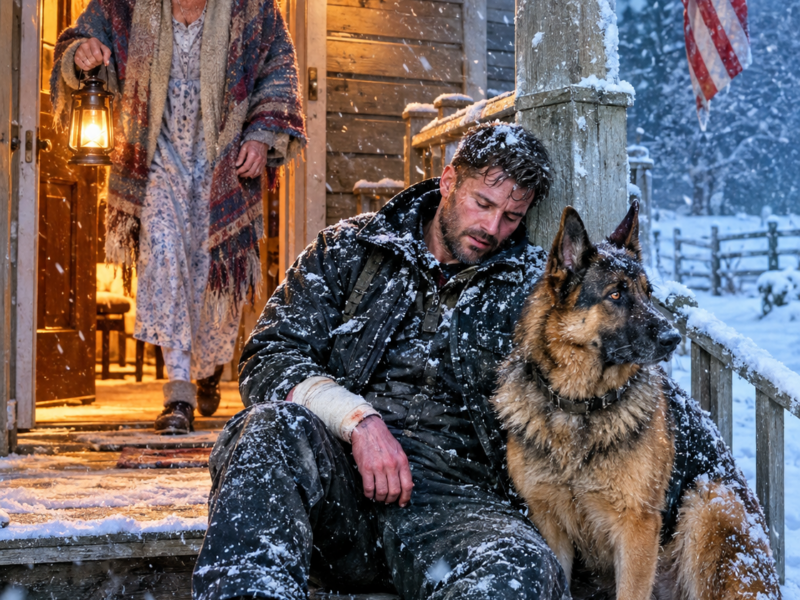
“When I opened my farmhouse door during a whiteout in rural Montana, a half-frozen former Marine stood on my porch with a wounded German Shepherd
I unfolded the paper with hands that had suddenly forgotten how to work.
The handwriting was unfamiliar, but the words beneath my name were unmistakable.
YOUR HUSBAND KNEW THE TRUTH.
For several seconds, I could hear nothing but the wind pressing against the windows.
Walter had been dead for six years. Whatever Daniel Hayes was running from, whatever those men wanted with his dog, I couldn’t understand how my husband could possibly be part of it.
Unless the note was a lie.
I looked up at Daniel.
“Who wrote this?”
He shook his head. “I don’t know.”
“Then how did you know to bring it to me?”
“I didn’t. I found it in a place I was told never to look.”
The man outside struck the door with the flat of his hand.
“Ma’am, this is your last chance to make this easy.”
I folded the paper and slipped it into the pocket of my cardigan.
Then I did something I hadn’t done in years.
I straightened my back, walked to the front door, and opened it just wide enough to see the man standing on my porch.
He was tall, perhaps fifty, with a neatly trimmed beard and a dark winter coat. He wore no badge that I could see, and his hands were bare despite the temperature.
Behind him, another man stood beside the black SUV.
“Can I help you?” I asked.
The first man gave me a polite smile that didn’t reach his eyes.
“Mrs. Margaret Wilson?”
“That’s right.”
“I’m Thomas Reed. We’re searching for a military working dog that was reported stolen. German Shepherd, black and tan. His handler may be injured.”
“That’s a terrible thing to happen in weather like this.”
“It is. Have you seen anyone come through here?”
I glanced at the road, then back at him.
“Nobody.”
His eyes moved past my shoulder, taking in the warm living room and the fire glowing behind me.
“You don’t mind if we take a look around?”
“I do, actually. I’m seventy-two, it’s freezing outside, and I’ve just sat down to my dinner.”
His smile tightened.
“Ma’am, this animal may be dangerous.”
“Then you should have brought someone who knows how to handle dogs.”
For a moment, he said nothing.
Then his gaze settled on my cardigan pocket.
It was a small movement, barely noticeable, but I saw it.
“Have you recently spoken with anyone connected to a man named Walter Wilson?”
My fingers curled around the edge of the door.
“My husband has been dead for six years.”
“I know.”
The words came too quickly.
I stared at him.
“Then why are you asking me about him?”
Reed lowered his voice.
“Because your husband was involved in something that never should have happened. And if Daniel Hayes is inside your house, you’re in more danger than you realize.”
The way he said Daniel’s name confirmed everything I had feared.
This man hadn’t come looking for a lost dog.
He had come looking for Daniel.
I began to close the door.
Reed put his hand against it.
“Please don’t make this difficult.”
I looked down at his hand.
“Remove it.”
Something in my voice must have surprised him, because he hesitated before stepping back.
“I’ll give you a few minutes to reconsider,” he said. “But I wouldn’t trust the man inside your house if I were you.”
He walked toward the SUV.
Before getting in, he turned and called over the wind.
“Ask him what happened at Red Creek.”
Then the vehicle backed away from my gate and disappeared into the snow.
I locked the door and leaned against it.
Daniel was standing beside the fireplace, his face drawn and gray.
Ranger pressed against his leg.
“What happened at Red Creek?” I asked.
Daniel didn’t answer.
“That man knew my husband’s name. He knew my husband was dead. He knew yours.”
Daniel rubbed both hands over his face.
“I was hoping I could get you through the night without telling you any of this.”
“Well, your hope has expired.”
For the first time since he arrived, a faint, exhausted laugh escaped him.
Then he sat down.
“Red Creek was a training facility in Wyoming,” he began. “I was stationed there with Ranger before I left the Marines.”
“Left?”
“I was medically discharged.”
He glanced at his injured shoulder.
“Officially, I was injured during a training exercise. That’s what the paperwork says, anyway.”
“And unofficially?”
He stared into the fire.
“Three years ago, I was assigned to a security operation involving military equipment that was supposed to be decommissioned. Some of it was being moved through a private contractor. My unit was told the paperwork was clean.”
He paused.
“Ranger found something during a night patrol. A storage building had been opened, and someone had left behind a case that wasn’t on the inventory.”
“What was inside?”
“Documents. Photographs. Records of equipment transfers. Names of people who had approved shipments that were never supposed to leave government custody.”
I thought of the men outside.
“Did you report it?”
“Yes.”
He gave me a look that told me how foolish that decision had been.
“The officer who took my report told me to forget what I’d seen. Two days later, my supervisor accused me of stealing classified material. My security clearance was suspended. Then there was an accident during a field exercise.”
His fingers tightened around the edge of the chair.
“Ranger pulled me out of a vehicle before it caught fire. I survived, but the injuries ended my career. The investigation blamed me for the equipment discrepancy.”
“And the documents?”
“I kept copies of some of the records. Not because I wanted money. I wanted proof that I hadn’t made the whole thing up.”
He looked down at Ranger.
“He was the only one who knew where I’d hidden them.”
I glanced at the dog’s harness.
“Inside there?”
Daniel nodded.
“There’s a compartment beneath the lining. Ranger was trained to carry small equipment, but I modified the harness after I realized people were searching my apartment.”
My eyes moved toward the window.
“And now they’re searching for him.”
“They want the records back. I think they believe I still have everything.”
“Do you?”
Daniel was silent long enough for the answer to become clear.
“Some of it.”
I pulled the folded note from my pocket.
“Then explain my husband.”
Daniel looked at the paper as though it might burn him.
“I found your name in one of the files. Walter Wilson was listed as an independent transport contractor. He handled emergency deliveries for the company that supplied equipment to Red Creek.”
I sat down slowly.
“That doesn’t make sense. Walter repaired farm machinery. He drove a delivery truck for the county for a few years, but he never worked for a military contractor.”
“Maybe not under his own name.”
I wanted to tell him he was wrong.
I wanted to remind him that Walter had been the kindest man I had ever known, the man who had spent his last healthy summer building a ramp for our neighbor’s wheelchair-bound wife.
But then I remembered something.
A winter morning, fourteen years earlier.
Walter standing in our mudroom with a cardboard box under his arm.
When I asked what it was, he’d told me he was returning an old set of tools to a friend.
I had believed him because I had never had a reason not to.
“How did you get this note?” I asked.
Daniel leaned forward.
“Three days ago, I went to a storage unit in Billings. Someone had left an envelope inside a toolbox I’d inherited from my former commanding officer. It contained a list of names and a handwritten note.”
“From my husband?”
“I don’t know. The handwriting wasn’t his, at least not the sample I found in the files.”
He looked at me carefully.
“But the note said that if anything happened to me, I was supposed to bring the message to Margaret Wilson.”
I stared at him.
“Why?”
“Because Walter had made a copy of something important before he died.”
My mouth went dry.
“What did he copy?”
Daniel shook his head.
“I don’t know. That’s why I came here.”
A sudden thump sounded from the back of the house.
Ranger turned sharply, his ears forward.
Daniel was on his feet before I could stand.
“Stay here,” he whispered.
He moved through the kitchen toward the back door, placing each foot carefully on the old wooden floor.
I followed him despite his warning.
Outside, the wind swept snow across the porch. The yard was empty, the fence barely visible through the white.
But something lay beside the woodpile.
A small, rectangular object wrapped in a plastic bag.
Daniel opened the door just enough to reach it.
When he brought it inside, snow clung to his sleeves.
The bag contained a black leather notebook.
I recognized it immediately.
Walter had carried that notebook for years. He kept addresses in it, along with measurements for repairs, phone numbers, and little lists of things he wanted to do around the house.
I had searched for it after he died because I thought it might contain the instructions for fixing the old tractor.
It had vanished.
I reached for it with trembling hands.
“Where did you find this?”
“It was on the porch.”
“That’s impossible. That notebook disappeared six years ago.”
Daniel looked toward the back door.
“Someone must have left it.”
I opened the cover.
The first pages contained the ordinary details I remembered: the name of a hardware store, a list of bolts, the measurements for a replacement barn hinge.
Then, halfway through, I found a page that had been cut out.
The paper had been removed so neatly that only a narrow strip remained near the binding.
On that strip, in Walter’s handwriting, were four words:
If they come, trust nobody.
My knees weakened.
I lowered myself into the nearest chair.
For the first time that evening, I wasn’t afraid of the men outside.
I was afraid of the man I had buried six years ago.
Because if Walter had known something dangerous, then he had carried it into our home and kept it from me.
And if someone had been watching our house all these years, perhaps his death hadn’t been as simple as I had believed.
Daniel crouched beside the table.
“Margaret, there’s something else.”
I looked at him.
“The records mention a woman who helped your husband move the documents. Her initials were E.W.”
My thoughts immediately went to our son, Edward, who had died at thirty-one in a car accident on an icy highway.
But the initials didn’t match.
Then I remembered our granddaughter, Emily Wilson.
“Emily?” I whispered.
Daniel shook his head.
“I don’t know. The file only gives initials and an address.”
He pulled a small folded sheet from his jacket.
The address was in Helena.
And beneath it was a date.
The date was six days before Walter died.
I stood so quickly my chair scraped the floor.
“Emily was here that week.”
Daniel looked up.
“Here?”
“She was twenty-two. She’d just finished college and was staying with us while she looked for work. She said she was helping her grandfather organize some old paperwork.”
I pressed my fingers to my lips.
“I remember Walter telling her to leave a box alone. He was upset with her, and they argued in the garage. I thought it was about money.”
“Did you hear what they said?”
“No. When I walked in, they stopped talking.”
I turned the page of the notebook again, hoping for something that would make sense of the last ten minutes.
A loose piece of paper slipped from the back cover.
It was a photograph.
The image showed three men standing outside a metal building in the snow. One wore a military uniform. Another stood beside a truck.
The third man was Walter.
He looked younger, perhaps in his late forties, and he was holding a document folder beneath one arm.
On the back, in faded blue ink, someone had written:
Red Creek, November 2012.
I stared at my husband’s face.
I had never seen that photograph before.
Daniel took it gently from my hand.
“That’s the facility.”
“How could Walter have been there?”
“That’s what I need to find out.”
Ranger suddenly barked once.
The sound was so sharp that we both turned.
A vehicle was approaching through the storm.
This time, the headlights were moving slowly, searching the property.
Daniel extinguished the living room lamp.
I stood beside him in the darkness, listening to the engine approach the gate.
Then it stopped.
A car door opened.
Footsteps crunched through the snow.
Someone came up the porch steps and knocked.
Three times.
Daniel’s face went rigid.
But when the voice came through the door, I recognized it immediately.
“Grandma?”
It was Emily.
I hurried forward, but Daniel caught my arm.
“Wait.”
I turned on him, furious.
“That’s my granddaughter.”
“Listen to me. If she’s connected to those records, we don’t know what she might be bringing with her.”
“She’s twenty-eight years old. She used to sleep in that room upstairs.”
“And somebody knew exactly where to leave Walter’s notebook.”
I wanted to argue, but the knock came again.
“Grandma, please. I know you’re awake. I saw the lights.”
I opened the door.
Emily stood on the porch in a red parka, her dark hair tucked beneath a wool hat. Snow clung to her eyelashes, and she looked as though she’d been crying.
The moment she saw me, she threw her arms around my shoulders.
“Oh, Grandma.”
I held her tightly.
She smelled of cold air and peppermint, the same way she had when she was a little girl coming in from playing outside.
For a moment, I forgot the note, the men, and the photograph.
Then Emily looked past me and saw Daniel.
Her embrace loosened.
“He’s here,” she whispered.
Not a question.
A statement.
I stepped back.
“Emily, what do you know about this?”
She looked toward the window, where the black SUV had returned to the road beyond the gate.
“I came to get you out.”
“Out of my own house?”
“Grandma, you have to trust me.”
I thought of the note in my pocket.
Your husband knew the truth.
I thought of the men who had come looking for Ranger and the way they had spoken my husband’s name.
Then I looked at Emily’s face.
“Did you know Walter was involved with Red Creek?”
Her eyes filled with tears.
She glanced at Daniel, then at Ranger, and finally at the notebook on the table.
“I knew Granddad had taken something from them,” she said. “I didn’t know what it was until after he died.”
My hands began to tremble.
“Why didn’t you tell me?”
“Because I promised him I wouldn’t.”
The words struck harder than I expected.
“You let me spend six years believing I knew everything about my own husband.”
“I was trying to protect you.”
“From what?”
Emily took a breath that shook her whole body.
“From the people who killed him.”
No one moved.
The fire cracked in the stove.
Outside, the wind pushed snow against the windows in long, dry whispers.
I stared at my granddaughter.
“Your grandfather died of a heart attack.”
“That’s what the report said.”
“That’s what the doctors said.”
“Grandma, he was terrified during the last month of his life. He kept checking the locks. He made me promise that if anyone ever came asking about a black notebook, I would take you somewhere safe.”
I looked at the notebook on the table.
“Why didn’t you come sooner?”
“Because I thought it was over.”
Emily wiped her cheeks.
“Three weeks ago, I received an envelope with no return address. Inside was a photograph of Granddad at Red Creek. Someone had circled his face and written, ‘The last witness is still alive.'”
She looked at Daniel.
“Then I saw the report about Ranger’s disappearance. I recognized the name Hayes from the documents Granddad kept.”
Daniel’s expression changed.
“You’ve seen the documents?”
“Not all of them. Just the copies he made before he died.”
“Where are they?”
Emily hesitated.
Then she looked at me.
“Grandma, I need to tell you something about the night Granddad died.”
My throat tightened.
“Tell me.”
“He called me that evening. He said someone had been inside the house while you were at the grocery store. He thought they’d taken something from his desk.”
“Why didn’t he tell me?”
“He didn’t want you to be afraid.”
I remembered that evening. Walter had been unusually quiet at dinner, but he had kissed my forehead before bed and told me everything was going to be fine.
The next morning, he complained of chest pain.
By noon, he was gone.
I had spent six years remembering his last words as a promise that our life together would continue, somehow, even after death.
Now those words sounded like a warning he’d been too afraid to explain.
Emily reached into her coat and took out a small brass key.
“I found this taped beneath the bottom drawer of Granddad’s desk after the funeral. I think it opens the lockbox he kept in the barn.”
I stared at the key.
“The barn?”
She nodded.
“I’ve been back twice, but I couldn’t get inside without you. The lock was changed after the funeral, and I thought someone might be watching.”
I looked at Daniel.
He had gone very still.
“What’s in the lockbox?” he asked.
Emily’s answer was barely audible.
“The original records from Red Creek.”
Daniel closed his eyes.
For the first time, I saw something other than fear on his face.
Hope.
But it lasted only a second.
A bright beam of light swept across the living room wall.
Then another.
Someone had parked a vehicle at the gate.
Emily turned toward the window.
“They found me.”
Daniel moved toward Ranger.
I caught Emily’s hand.
“How?”
She looked at me with an expression I had never seen on her face before.
“Because I didn’t come alone.”
The sound of a car door slamming echoed through the storm.
I could hear voices outside, indistinct but urgent.
Then a loudspeaker crackled.
“Daniel Hayes, come out with the dog. We know you’re inside.”
Daniel reached for his jacket.
I stepped between him and the door.
“No.”
He stared at me.
“Margaret, they won’t leave until they have Ranger and the records.”
“Then they’ll have to explain themselves to the sheriff.”
Emily shook her head.
“They already have someone at the sheriff’s office.”
I looked at her.
“How do you know?”
“Because I called him three days ago, and he told me to stop asking questions.”
She swallowed.
“He said Granddad’s death was an accident and that digging up old files could get me arrested.”
The loudspeaker sounded again.
“Mrs. Wilson, we don’t want to hurt anyone. Please send Daniel Hayes outside.”
I walked to the kitchen and opened the drawer where Walter had kept his old emergency flashlight.
Beside it lay the heavy iron key to the barn.
I picked it up.
“If those people want the truth,” I said, “they can come and get it from the place where my husband hid it.”
Daniel looked at me as if he were seeing me for the first time.
“You’re going to the barn?”
“That is where the records are, isn’t it?”
Emily nodded.
I pulled on my boots and wrapped a thick scarf around my neck.
The barn stood about sixty yards behind the house, beyond the woodpile and the old apple trees. In summer, I could walk there in less than a minute.
That night, the snow reached nearly to my knees.
Daniel insisted on going first, carrying Ranger carefully when the dog’s injured leg began to buckle.
Emily followed with the flashlight.
I came last, clutching the key so tightly it pressed into my palm.
The wind made it difficult to see more than a few feet ahead.
Halfway across the yard, a figure emerged from the darkness near the barn.
I stopped.
Daniel lowered Ranger onto his feet and moved in front of us.
“Who is it?” he called.
The figure raised both hands.
“Don’t shoot. I’m not armed.”
It was Thomas Reed.
His coat was dusted with snow, and his face looked older than it had at the front door.
Behind him, I could see two other men approaching from the house.
Reed held up a hand to stop them.
“Mrs. Wilson, listen to me. You don’t understand what you’re walking into.”
I stepped forward.
“Then explain it.”
He glanced at Daniel.
“The documents you have contain information that could compromise an ongoing federal investigation. You can’t simply hand them to anyone.”
Daniel laughed without humor.
“That’s what they told me three years ago.”
Reed’s jaw tightened.
“I wasn’t at Red Creek when you were injured.”
“No, but you were there afterward, weren’t you?”
For the first time, Reed looked away.
I saw the hesitation.
The smallest crack in his certainty.
Emily noticed it too.
“You knew my grandfather,” she said.
Reed looked at her.
“I met him twice.”
“Did you threaten him?”
“No.”
“Did you know he was dead before the doctors arrived?”
Reed’s expression hardened.
“Your grandfather’s death was investigated.”
“By people who worked with the same contractor he was investigating.”
“That’s enough.”
“No,” I said.
The word came out louder than I expected.
All three men turned toward me.
I had spent most of my life avoiding arguments, smoothing over disagreements, and choosing silence when the truth seemed likely to hurt someone.
But I was tired of being told what I could and couldn’t know about my own family.
“My husband is dead,” I said. “My granddaughter has been frightened for three weeks, and this young man has been running through a blizzard with a wounded dog because somebody doesn’t want the truth found. You don’t get to stand in my yard and tell me that’s none of my business.”
Reed studied me for a long moment.
Then he lowered his voice.
“Walter Wilson was not the man you think he was.”
“Perhaps not,” I replied. “But I was married to him for forty-three years. I think I’ve earned the right to find out.”
Something shifted in Reed’s face.
He looked toward the barn.
“There’s a reason your husband hid those documents. He knew what they would do to people who had nothing to do with the original crime.”
“Then why not destroy them?”
“Because he believed the truth mattered.”
The words hung between us.
I stared at him.
“Did you just admit that my husband had the records?”
Reed said nothing.
Daniel stepped forward.
“Thomas, if you came here to help, help us. If you came to take the evidence, you’ll have to explain why.”
Reed looked at Ranger, who stood trembling beside Daniel.
Then he turned to the men behind him.
“Stay here.”
One of them protested.
“Sir, we were told—”
“I said stay here.”
He waited until the men stopped talking.
Then he looked back at me.
“Open the barn.”
I didn’t trust him.
But I trusted the key in my hand, and I trusted the fact that Walter had left something behind for us to find.
The lock turned with a metallic groan.
Inside, the barn smelled of hay, old wood, and cold earth. The flashlight beam swept over the tractor, a stack of feed bags, and the workbench Walter had built when we first moved to the farm.
Everything looked exactly as it had six years ago.
I moved toward the back wall.
Walter had always been particular about keeping his tools in order. Screwdrivers on the left, wrenches in the middle, and small boxes of bolts beneath the bench.
I ran my hand along the underside of the lowest drawer.
There.
A narrow wooden panel shifted beneath my fingers.
Emily crouched beside me and pulled it loose.
Behind it was a small steel lockbox.
She inserted the brass key.
The lid opened.
Inside lay a thick envelope, several photographs, a flash drive, and a stack of documents bound with a rubber band.
Daniel knelt beside the box.
His breathing had changed.
He looked as though he were afraid to touch anything.
I lifted the top document.
The first page carried the name of the private contractor responsible for the Red Creek shipments.
Beneath it were lists of equipment, transfer dates, and signatures.
Some names had been blacked out.
Others were still visible.
I recognized one immediately.
Thomas Reed.
He leaned over my shoulder, then stepped back.
“That isn’t what it looks like.”
Daniel gave him a cold stare.
“Then tell us what it looks like.”
Reed rubbed a hand over his mouth.
“I was a logistics officer. My signature appears on hundreds of documents. I didn’t authorize every shipment.”
“Your signature is beside a transfer marked as destroyed,” Daniel said. “But the equipment was sold to a private buyer.”
Reed stared at the page.
For several seconds, he didn’t speak.
Then he looked at Emily.
“Your grandfather copied everything?”
“Everything he could get his hands on.”
“Why?”
“Because he found out the equipment was being diverted, and when he reported it, someone threatened him.”
Reed closed his eyes briefly.
“I knew there were irregularities. I didn’t know how far it went.”
Daniel’s voice sharpened.
“You expect us to believe that?”
“No.” Reed looked directly at him. “I expect you to understand that some people involved in this were much more powerful than me.”
He reached into his coat and pulled out a small identification wallet.
He opened it just long enough for me to see the federal credentials inside.
“I’m not here on behalf of the contractor,” he said. “I’m with an investigative team that reopened the case six months ago. The black SUV belongs to the contractor’s security division. They followed me because they know I’ve been looking for the missing evidence.”
Daniel didn’t lower his guard.
“Then why did you come to the house pretending to be looking for a stolen dog?”
Reed’s eyes dropped to Ranger.
“Because I needed to know whether you had the records.”
“And if I did?”
“I wanted to get you somewhere safe before the people who actually stole the equipment found you.”
“By threatening an old woman?”
Reed looked at me.
“I made a mistake.”
It wasn’t much of an apology, but it was the first honest thing I’d heard from him.
A sharp cracking sound came from outside.
Then a gunshot split the night.
Emily screamed.
Daniel grabbed Ranger’s harness and pulled him behind the tractor.
Reed dropped to the floor, shouting for everyone to stay down.
Another shot struck the barn door.
Wood splintered above my head.
For a moment, the only thing I could hear was the roaring wind and the frantic pounding of my own heart.
Then Reed drew a radio from his coat.
“Shots fired at the Wilson property. We need immediate assistance.”
He gave the location and demanded backup.
Daniel crouched beside Ranger, his body shielding the dog’s injured leg.
I crawled toward them.
“Is everyone all right?”
Emily nodded, tears streaming down her face.
Daniel examined Ranger quickly.
The dog was shaking, but he was standing.
Outside, someone shouted.
“Send the box out, and nobody else gets hurt!”
Reed looked toward the door.
“That’s not my team.”
I understood then that whatever had happened at Red Creek, whatever Walter had discovered, the danger had followed us into the place where we had lived peacefully for decades.
The people outside weren’t interested in explanations.
They wanted the evidence destroyed.
And they were willing to shoot an old woman to get it.
I looked at the documents scattered across the floor.
Then I looked at Walter’s handwriting on the envelope.
He had written a single sentence on the front.
For Margaret, when the time comes.
I opened it.
Inside was a letter dated two days before his death.
My beloved Margaret,
If you are reading this, then I failed to keep the danger away from you.
I am sorry for that more than I can say.
I was asked to transport equipment for a company that promised it was all aboveboard. When I discovered that some of the equipment was being sold illegally, I tried to report it. Instead, I was threatened and told to keep quiet.
I made copies because I knew the original records would disappear.
I never told you because I believed ignorance would keep you safe.
I was wrong.
There is one thing I need you to understand. I did not take the money they offered me. I did not help them sell the equipment. I made one mistake: I trusted the wrong people for too long.
If I am gone before I can explain this to you, please don’t spend your life wondering whether you knew me at all.
You did.
I loved you every day of our marriage.
Walter.
The letter blurred in my hands.
I pressed it against my chest.
For six years, I had wondered whether Walter had been afraid of dying, whether there had been something he wanted to tell me and never found the courage.
Now I knew.
He had been afraid of losing me.
And in trying to protect me, he had left me alone with questions he should have trusted me to face.
Emily wrapped her arms around me.
“I’m sorry, Grandma.”
I held her close.
“I know.”
“No, you don’t. I should have told you.”
“Yes,” I whispered. “You should have.”
She cried against my shoulder.
I held her anyway.
There would be time for anger later.
Right now, we needed to survive the night.
Reed spoke into his radio again.
His voice was controlled, but I could hear the strain beneath it.
“Suspects are armed. We have civilians inside the barn. We need immediate extraction.”
Daniel looked at him.
“How long?”
“Ten minutes, if the roads haven’t been blocked.”
Daniel glanced at the door.
“That’s too long.”
He looked at Ranger.
The dog was staring at him, ears forward, waiting for a command.
Daniel knelt and rested his forehead against Ranger’s.
“You’ve done enough, buddy.”
Ranger licked his cheek.
I watched them, and suddenly understood that Daniel had not merely been protecting a working dog.
He had been protecting the last part of his life that still trusted him.
The military had taken his career. The investigation had taken his reputation. The people chasing him had taken his sense of safety.
Ranger was the one living thing that had never asked him to prove he was worth saving.
I looked at Daniel.
“What do you need?”
He glanced at me, surprised.
“There’s a back door,” I said. “It opens into the old pasture. The snow is deep, but the trees will give us cover. I know every inch of that ground.”
Reed shook his head.
“That’s dangerous.”
“So is staying here.”
I took the envelope, the documents, and the flash drive, then placed them inside a canvas feed bag.
Emily took the photographs.
Reed kept his radio and moved toward the back of the barn.
Daniel lifted Ranger carefully.
We slipped through the rear door into the darkness.
The snow reached my thighs in places, and every step felt like walking through wet cement.
I led the way toward the line of cottonwoods along the pasture fence.
Behind us, voices rose near the front of the barn.
A flashlight beam swept across the roof.
Then another.
We reached the trees just as headlights illuminated the barn doors.
I heard an engine rev.
Reed guided us farther into the woods, where an old service path led toward the county road.
After what felt like an hour, though it could not have been more than fifteen minutes, we saw blue lights flashing through the trees.
Two vehicles approached from the opposite direction.
Reed raised his identification and shouted to the officers.
The men who had attacked the barn tried to flee in the black SUV, but one vehicle blocked the road while another followed them toward the gate.
There were more shouts, then the sound of doors slamming.
I didn’t watch.
I was sitting in the snow beside Daniel, holding the canvas bag against my chest while Emily wrapped a blanket around my shoulders.
Ranger lay between us, exhausted but alive.
Daniel stroked the dog’s ears.
“It’s over,” he whispered.
I wanted to believe him.
But the look on Reed’s face told me there would be questions, investigations, and months of uncertainty before anyone could say what was truly over.
By dawn, we were inside the county emergency center, drinking coffee from paper cups and watching snowplows begin clearing the main road.
Ranger had been examined by a veterinarian who came in with the emergency team. His leg was badly cut, but there was no fracture. He would recover with treatment and rest.
Daniel sat beside the kennel, refusing to leave the dog’s side.
Emily and I sat together near the window.
For the first time that night, neither of us had anything to say.
Then she took my hand.
“Do you think you’ll ever forgive me?”
I looked at her.
“I love you. That doesn’t mean you didn’t hurt me.”
She nodded, crying quietly.
“I know.”
“Trust takes longer to rebuild than it does to break.”
“I’ll wait.”
I squeezed her fingers.
“Good. Because I’m not going anywhere.”
The investigation lasted almost a year.
The records from Walter’s lockbox led federal investigators to several shell companies that had been used to divert military equipment into private hands. The flash drive contained copies of shipping logs, internal emails, and recordings that supported Daniel’s account of what had happened at Red Creek.
Thomas Reed cooperated with the investigation and admitted that he had ignored warning signs because he believed the contractor’s executives were acting with proper authorization.
He was not innocent, but he had not been the person directing the operation.
The people who had arranged the illegal transfers were eventually charged. Several former officials lost their positions, and the company was forced to surrender its contracts.
Walter’s name was formally cleared of wrongdoing.
I received a letter from the investigative team explaining that he had tried to report the misconduct years before his death.
I read it three times.
Then I placed it beside his photograph on the mantel.
It didn’t erase the years he had kept secrets from me.
But it gave me something I had not realized how badly I needed.
The chance to remember him without wondering whether the man I loved had been a stranger.
Daniel’s name was also cleared.
The medical board reviewed his discharge, and his service record was corrected to reflect the circumstances of his injury. He was offered assistance finding civilian work, but he declined the first few positions because he wasn’t ready to return to a life that felt unfamiliar.
He and Ranger stayed at my farmhouse for several weeks while the investigation continued.
At first, Daniel insisted it was only temporary.
He slept on the couch, repaired the loose boards on the porch, and chopped wood whenever he thought I wasn’t looking.
Ranger followed him everywhere, limping less with every passing day.
One morning, I found Daniel in the kitchen making pancakes.
He looked embarrassed when I walked in.
“I figured I should earn my keep.”
“You can start by not burning my skillet.”
He glanced down.
A blackened pancake sat in the center of the pan.
I laughed so hard I had to hold the counter.
It was the first time I had laughed like that since Walter died.
Daniel looked at me for a moment, then began laughing too.
The sound filled the kitchen, warm and ordinary.
It felt like a beginning.
In the spring, Daniel found work training search-and-rescue dogs for a volunteer organization near Helena. He began helping veterans who struggled with the transition to civilian life, particularly those who had lost the routines and companionship that once made them feel useful.
Ranger became a familiar sight at the training grounds, his dark ears alert as he moved between handlers and their dogs.
His injured leg healed, though he occasionally limped when the weather turned cold.
Daniel never rushed him.
They had both learned that recovery wasn’t the same as returning to who you had been before.
Emily came to the farm every Sunday.
Sometimes we talked about Walter. Sometimes we argued about things that had nothing to do with him.
She stopped trying to protect me from every unpleasant truth.
I stopped pretending that forgiveness meant forgetting.
Slowly, we learned how to tell each other the things that were difficult to say.
One afternoon, nearly a year after the blizzard, Daniel came into the kitchen carrying a small wooden box.
“I found this in the storage compartment of Ranger’s old harness,” he said.
He set it on the table.
Inside lay a folded photograph of Walter standing beside a younger Daniel at Red Creek.
I recognized the same metal building from the photograph in the notebook.
On the back, Walter had written:
Sometimes the bravest thing a person can do is come home and tell the truth.
Daniel ran his thumb over the handwriting.
“I think he knew I would find you.”
I shook my head.
“I don’t know if he knew that. But I think he hoped someone would.”
Daniel looked toward the window.
Ranger was lying in the grass beneath the apple tree, watching Emily hang a bird feeder on a low branch.
For a long time, Daniel had believed that his life had ended on the day he was injured.
Now he had a job he cared about, a dog who still followed him from room to room, and a place where he could sit at the table without checking every window whenever a car passed.
He had become part of our small, imperfect family.
And I had discovered that opening a door to a stranger did not always mean inviting danger inside.
Sometimes it meant giving someone a chance to stop running.
That evening, Daniel helped me carry the last of the firewood indoors.
The air smelled of damp earth and new grass.
As we reached the porch, Ranger trotted ahead and settled beside the door, waiting for us.
Daniel paused with his hand on the railing.
“Margaret, I never properly thanked you for letting us in that night.”
I looked at the man who had arrived at my house half-frozen, carrying more pain than he could explain.
“You thanked me when you stayed,” I said.
He lowered his eyes, and for a moment I thought he might cry.
Then Ranger pressed his muzzle into Daniel’s hand.
Daniel smiled and scratched behind the dog’s ears.
I went inside to put the kettle on.
Behind me, the screen door closed softly, and the house no longer sounded quite so empty.
For six years, I had believed the worst thing that could happen to a person was losing someone they loved without getting the chance to say goodbye.
That winter taught me something different.
Sometimes the hardest loss is discovering that the person you loved kept part of their life hidden from you.
And sometimes the greatest gift is finding that the truth, even when it hurts, can still lead you back to the people who need you.
When the first snow returned the following December, I stood by the front window and watched it settle over the fields.
Daniel was in the barn, teaching a young rescue dog to follow a scent trail.
Emily was in the kitchen, arguing cheerfully with a pie crust.
Ranger lay at my feet, his head resting against my slipper.
I reached down and rubbed the soft fur behind his ears.
Outside, the snow kept falling.
But this time, when the wind rose and the old farmhouse creaked around me, I didn’t feel alone.
I had opened the door during a blizzard because a wounded dog needed shelter.
I hadn’t known that the man beside him needed it just as much.
And I hadn’t known that, in saving them, I would finally learn how to live with the truth about the man I had loved all my life.
THE END.









