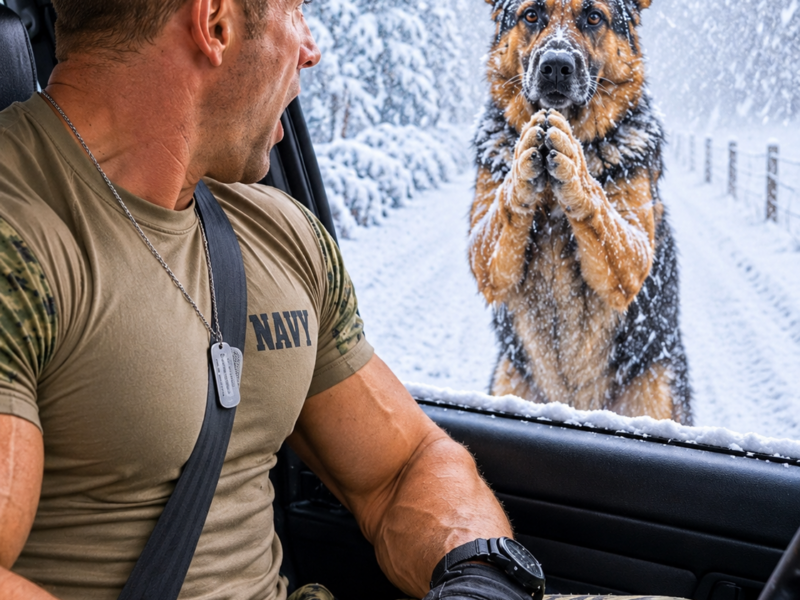
“Three years after the Navy told me my handler had died overseas, I watched my German Shepherd recognize a stranger walking through a Colorado snowstorm
The man in the gray coat stopped less than ten feet from us.
He was probably in his late fifties, clean-shaven, with silver hair and expensive leather gloves.
He looked like someone who belonged in a corporate boardroom, not in the middle of a snowstorm beside a wounded soldier.
“Michael,” he said calmly.
Michael’s grip tightened around Rex’s harness.
“Stay back.”
The man glanced at me.
“Daniel Brooks, I presume?”
I didn’t answer.
He smiled politely.
“My name is Richard Hale. I’m here to take Michael somewhere safe.”
I looked down at Michael.
His breathing was becoming increasingly shallow.
“He’s going to a hospital.”
“That’s unnecessary.”
The nurse who had knelt beside us immediately looked up.
“Sir, he’s clearly injured. The ambulance is already on its way.”
Richard ignored her.
He reached into his coat and produced a small identification card.
“I’m authorized to handle this matter.”
I barely glanced at it.
“Then you can explain yourself to the police when they arrive.”
His smile disappeared.
“You’re making a mistake.”
I moved between him and Michael.
“Take another step toward him, and we’ll have a problem.”
Rex rose from the snow.
His body was trembling, but he positioned himself directly in front of Michael.
Richard looked at the dog.
“That animal shouldn’t be here.”
Michael forced his eyes open.
“Don’t touch him.”
It was barely more than a whisper.
But Rex heard it.
The German Shepherd lowered his head and pressed his body against Michael’s legs.
Richard sighed.
“Three years, Turner. Three years, and you still haven’t learned when to stop.”
I looked at him.
“What happened to Michael?”
Richard adjusted his gloves.
“That’s classified.”
The ambulance arrived before he could say anything else.
Two paramedics rushed toward us.
Richard stepped aside, but he didn’t leave.
As they lifted Michael onto the stretcher, he reached for my wrist.
“Danny.”
“I’m here.”
He swallowed painfully.
“Locker.”
I leaned closer.
“What locker?”
“Fourteen.”
His eyes shifted toward Rex.
“Blue collar.”
Then his head fell back.
The paramedics hurried him into the ambulance.
I climbed in behind them.
Rex tried to follow, but one of the attendants stopped him.
I looked at my dog.
“Stay with me, buddy.”
He whined and put his front paws against the ambulance step.
For the first time in three years, I saw him refuse to let Michael go.
I asked the nurse from the rehabilitation center to keep him until I returned.
She nodded.
Richard Hale was still standing near the entrance when the ambulance pulled away.
He watched us leave.
He didn’t look concerned.
He looked annoyed.
And that told me more than anything he had said.
At the hospital, doctors discovered that Michael had severe dehydration, an infected wound in his left leg, and an old spinal injury that had never healed properly.
He was also dangerously underweight.
The physician told me that if we had found him a few hours later, the outcome might have been very different.
I sat beside his bed while the machines beeped softly.
For nearly two hours, he didn’t wake up.
I kept thinking about the last time I had seen him.
We had been standing beside a helicopter, laughing about something stupid one of the younger operators had said.
Michael had thrown a bottle of water at me.
“Try not to get yourself killed, Brooks.”
I had replied, “You first.”
It was supposed to be an ordinary joke between friends.
Instead, I had spent three years attending memorial ceremonies for him.
At 8:20 that evening, his eyes finally opened.
He looked around the room.
Then he saw me.
“Rex?”
“He’s safe.”
Michael closed his eyes.
“Good.”
I leaned forward.
“Now you’re going to tell me what happened.”
He stared at the ceiling.
“Not here.”
“Michael, you disappeared for three years. Someone just tried to take you away from an ambulance. I think we’ve passed the point where we can keep pretending this is normal.”
He turned his head.
“I know.”
“Who is Richard Hale?”
Michael’s jaw tightened.
“Someone who works for people we used to trust.”
“Who?”
He hesitated.
Then he said a name I hadn’t heard in years.
“Admiral Charles Whitmore.”
I sat back.
Whitmore had been one of the senior officers overseeing our operations.
He had attended Michael’s memorial.
He had personally delivered the folded flag to Michael’s parents.
I remembered shaking his hand.
I remembered him telling me that Michael had died serving his country.
“Why would an admiral want you dead?”
Michael looked at me.
“Because I found out what he was doing.”
He took a slow breath.
“During our last deployment, we were assigned to recover intelligence from a weapons trafficking network. We were told the information would help identify people supplying weapons to hostile groups.”
“I remember.”
“You remember the operation we were briefed on. You don’t remember what happened after we found the files.”
I frowned.
“What happened?”
“We discovered that the shipments weren’t going to the people we were told about.”
He paused.
“They were being redirected through a private defense contractor. Some of the weapons were being sold to groups we were supposed to be fighting.”
I stared at him.
“You’re saying someone inside our command was involved?”
Michael nodded.
“Whitmore was using the operation to cover the transfers.”
I rubbed my face.
“Why didn’t you report it?”
“I tried.”
“And?”
“Two days later, our location was compromised.”
I remembered the ambush.
The gunfire.
The confusion.
The extraction that never happened.
Michael looked down at his hands.
“You were sent to the northern landing zone with the rest of the team. I was ordered to remain behind with the intelligence package.”
“By whom?”
“Whitmore.”
I felt my stomach tighten.
“I thought you stayed behind because you were covering our withdrawal.”
“That’s what they wanted you to believe.”
Michael’s voice broke.
“They knew I’d found the records. They wanted the package, and they wanted me gone.”
I sat motionless.
“Did they capture you?”
He nodded.
“They held me at a private facility outside the country. No official records. No name. Just a number.”
“How did you escape?”
“I didn’t.”
I looked at him.
“What do you mean?”
Michael swallowed.
“Someone released me.”
“Who?”
“A guard who had been working there for years. He had a son serving in the military. When he learned what they were doing, he decided he couldn’t be part of it anymore.”
“Where is he now?”
Michael looked toward the window.
“Dead.”
I didn’t ask how.
His expression answered enough.
For a while, neither of us spoke.
Then I remembered his words outside the rehabilitation center.
“Why did you say they were going to take Rex again?”
Michael’s eyes moved toward mine.
“Because they already did.”
I leaned forward.
“What?”
He closed his eyes.
“Rex wasn’t just a dog I worked with. He was assigned to the mission because he could detect specific chemical compounds used to conceal weapons shipments.”
I remembered the strange training sessions.
The scent samples.
The containers we had been told not to discuss outside the unit.
Michael continued.
“He found something during that last operation. A hidden compartment inside one of the crates.”
“What was inside?”
“An encrypted storage device.”
I stared at him.
“Where is it?”
Michael looked toward the door.
“With Rex.”
I didn’t understand.
He gestured weakly toward the window.
“The blue collar.”
I stood.
Rex was still at the rehabilitation center.
And suddenly, I understood why Michael had been so desperate to keep the dog away from Richard Hale.
The next morning, I returned to the center.
The nurse who had taken care of Rex met me at the entrance.
“He hasn’t eaten,” she said.
I found him lying beside the glass doors.
His head lifted as soon as he saw me.
He came forward slowly.
I knelt and put my arms around his neck.
“Hey, buddy.”
He pushed his nose against my chest.
I examined his collar.
It was an old blue leather collar Michael had given him during our final deployment.
I had never replaced it.
There was a small metal plate beneath the buckle.
I had always assumed it contained his service identification.
But when I pressed the edges, a tiny compartment opened.
Inside was a thin black object, no larger than a fingernail.
My hands went cold.
A micro storage device.
I looked around the empty hallway.
The nurse was speaking with another employee near the reception desk.
I carefully removed the device and placed it inside my jacket.
Then I called Michael.
“You’re going to explain something to me.”
He sounded more awake than the night before.
“Did you find it?”
“Yes.”
“Good.”
“What is on it?”
“Everything.”
“Everything about Whitmore?”
“Names, payments, shipment records, communications. Enough to prove what happened.”
I looked down at Rex.
“Why didn’t you tell me before?”
“Because I didn’t know whether you were being watched.”
I almost laughed.
“Michael, I have been living in the same house, driving the same truck, and volunteering at the same center for years. If someone wanted to watch me, they had plenty of opportunities.”
“I know.”
“Then why?”
He was silent.
Finally, he said, “Because I couldn’t risk losing you too.”
I closed my eyes.
There it was.
The answer I had been afraid of.
He hadn’t been protecting only the evidence.
He had been trying to keep me out of the same nightmare that had swallowed him.
But he had made that decision for me.
And I wasn’t sure I could forgive him for it.
Before I could respond, I heard the center’s front door open.
A man walked inside.
Gray coat.
Silver hair.
Richard Hale.
I ended the call.
He looked directly at me.
“Mr. Brooks.”
I slipped my phone into my pocket.
“You’re a long way from wherever you belong.”
He smiled.
“Where is the device?”
I didn’t answer.
His eyes moved toward Rex.
“Michael was always sentimental about that dog.”
Rex stood.
A low growl rolled through his chest.
Richard took a step closer.
“That animal has something that doesn’t belong to him.”
I placed myself between them.
“Neither do you.”
His expression hardened.
“Listen carefully. You have no idea what you’re involved in.”
“I know enough.”
“Do you?”
He glanced at the blue collar.
“Michael Turner is a liability. He was given three years to disappear quietly. Instead, he decided to come back.”
I felt anger rise in my chest.
“Who gave him that choice?”
Richard didn’t answer.
Then he said something that made me realize the situation was even worse than I thought.
“Ask him why he didn’t come home when he had the chance.”
I stared at him.
“What?”
“Ask Michael what happened to the first man who tried to help him escape.”
Before I could respond, Richard turned and walked out.
I stood in the middle of the hallway, listening to the door close.
Then I called Michael again.
He answered immediately.
“What happened?”
“Richard was here.”
Michael went quiet.
“He knows about the device.”
“I figured.”
“He also said something about the man who helped you escape.”
There was a long silence.
Then Michael whispered, “His name was Thomas.”
“Who was Thomas?”
“The guard.”
“What happened to him?”
Michael took a shaky breath.
“He died because of me.”
I sat down beside Rex.
“Tell me.”
Michael explained that Thomas had helped him escape from the private facility.
But before they could reach the border, they were intercepted.
Thomas stayed behind to give Michael a chance to get away.
He was shot.
Michael had been forced to leave him.
For three years, he had carried the belief that if he had made a different decision, Thomas might still be alive.
“Why didn’t you tell anyone?” I asked.
“Because I was afraid they’d find his family.”
I looked down at Rex.
“Does he have a family?”
“A daughter. Her name is Sarah.”
I waited.
“She was twelve when her father died.”
I closed my eyes.
Another family had been left with questions.
Another child had been told a story that wasn’t true.
And I was beginning to understand how many lives had been damaged by the same people.
That afternoon, I contacted a former military investigator I trusted.
His name was James Porter.
He had retired from the Navy and now worked with a federal oversight team.
I explained the situation without giving him the details of the storage device.
He listened carefully.
When I finished, he asked one question.
“Do you have physical evidence?”
“Yes.”
“Then don’t hand it to anyone without a proper chain of custody.”
He gave me the number of an investigator with the Department of Justice.
Within hours, we arranged a secure meeting.
But before we could leave, Michael called again.
“Daniel, listen to me.”
“What?”
“Whitmore knows where you are.”
I looked toward the windows.
“How?”
“He has access to the old deployment records. Your name is in them.”
“That doesn’t tell him where I live.”
Michael hesitated.
Then he said, “Your rehabilitation center.”
I felt my stomach drop.
“How?”
“Because he’s been funding it.”
I looked around the building.
The veterans’ center had been a place I trusted.
A place where injured service members came to recover.
A place where I had brought Rex because I believed it was safe.
Michael continued.
“Whitmore has been using the center to identify former operators who might still know something about the operation.”
I looked toward the reception desk.
A photograph of Admiral Whitmore hung on the wall.
He was smiling beside the center’s director.
The caption read: COMMUNITY PARTNER OF THE YEAR.
I stared at it.
Then I understood why Richard had been so comfortable walking through the front doors.
He hadn’t been an outsider.
He had been coming here all along.
I called James Porter.
“Get the federal team here. Now.”
He didn’t ask questions.
Within twenty minutes, investigators arrived.
They secured the storage device and began examining the records.
The files were extensive.
They included payments to private contractors, shipping manifests, altered mission reports, and communications between Whitmore and several senior officials.
One message was particularly disturbing.
It contained an instruction to classify Michael Turner as deceased if he refused to surrender the intelligence package.
Another referred to Rex by name.
The dog had been listed as an asset to be recovered.
Not retired.
Not transferred.
Recovered.
I read that line several times.
They had never considered Rex an animal who deserved a peaceful life.
They had considered him property.
And that was why Michael had risked everything to come back.
Not simply to expose the operation.
To make sure Rex wasn’t taken from us again.
The federal investigators moved quickly.
Whitmore was placed under surveillance.
Richard Hale was arrested the following evening while attempting to leave the country.
The investigation eventually uncovered a network of illegal weapons transfers and fraudulent military contracts.
Several officials were arrested.
Others resigned before charges were announced.
Admiral Whitmore was taken into custody at his home.
He was still wearing his uniform when the agents arrived.
He denied everything.
But the records told a different story.
Michael gave a full statement.
He identified the facility where he had been held and provided details about the men involved.
His testimony helped investigators locate additional witnesses.
Thomas’s name appeared in the records too.
For the first time, his death was officially acknowledged as the result of an illegal detention operation.
His daughter Sarah was contacted by federal investigators.
Michael insisted on meeting her.
I drove him to a small café outside Colorado Springs.
He was still using a cane.
His leg had improved, but he wasn’t ready to walk long distances.
Sarah was waiting near the window.
She was fifteen now.
Her dark hair was tied back, and she wore a sweatshirt with her school’s name printed across the front.
When Michael approached, she stood.
“Are you Michael Turner?”
He nodded.
“Yes.”
She looked at his cane.
“You’re the man my dad helped?”
Michael swallowed.
“Yes.”
She studied him.
“Did he know he was going to die?”
Michael sat down slowly.
“I don’t know.”
“Did he ask about me?”
Michael’s eyes filled.
“Every chance he got.”
Sarah looked away.
“Then why did nobody tell us?”
Michael lowered his head.
“Because the people responsible wanted his death to stay hidden.”
She sat down.
For a moment, neither spoke.
Then Michael reached into his jacket and removed a small photograph.
It showed Thomas standing beside him outside a military transport aircraft.
Both men were laughing.
On the back, Thomas had written a message.
Tell Sarah I kept my promise. I’ll be home before her birthday.
Michael slid the photograph across the table.
Sarah touched it carefully.
“My dad hated being photographed,” she whispered.
Michael managed a small smile.
“He said photographs made him look like he owed someone money.”
Sarah laughed.
It was a tiny sound.
But it changed something in the room.
Michael looked at her.
“I’m sorry I couldn’t bring him home.”
Sarah shook her head.
“You didn’t make him stay.”
Michael looked down.
She continued.
“My dad chose to help you. I think he would want people to know that.”
Michael covered his face with one hand.
I sat quietly nearby.
Sometimes the strongest thing a person can do is let someone else have the space to grieve.
Sarah eventually asked if she could keep the photograph.
Michael nodded.
“Of course.”
Before we left, she reached across the table and touched his hand.
“Thank you for remembering him.”
Michael couldn’t speak.
On the drive home, he stared out the passenger window.
After a while, he said, “I spent three years thinking I had failed him.”
I kept my eyes on the road.
“Maybe you don’t have to carry that alone anymore.”
He nodded.
Rex was waiting at my house when we returned.
The moment Michael stepped through the door, the dog hurried toward him.
His tail moved slowly.
He pressed his nose against Michael’s hand.
Michael crouched with some difficulty and wrapped both arms around him.
“Hey, old friend.”
Rex gave a soft whine.
Michael rested his forehead against the dog’s head.
“I’m sorry I was gone.”
Rex licked his cheek.
I turned away for a moment.
I had seen men come home from war with wounds that never appeared on medical scans.
I had seen them struggle to sleep, struggle to speak, and struggle to believe that the world could still be safe.
But I had never seen a dog welcome someone back with such complete forgiveness.
Over the following months, Michael began rehabilitation.
He had a long recovery ahead of him.
His leg required additional surgery, and the doctors weren’t sure how much mobility he would regain.
But he attended every appointment.
Rex accompanied him whenever he could.
The veterans’ center also changed.
Its funding was reviewed.
The director resigned after investigators discovered he had knowingly accepted money from Whitmore’s network.
A new board took over, and the center began working with independent oversight organizations.
Michael eventually became a volunteer there.
Not as a soldier.
Not as a handler.
Just as someone who understood what it meant to come home carrying more than anyone could see.
One afternoon, I found him sitting outside with Rex.
Snow had begun falling again.
Michael was brushing the dog’s thick coat while Rex rested his head on his knee.
“You know,” Michael said, “I used to think I was the one who saved him.”
I sat beside him.
“Didn’t you?”
Michael shook his head.
“Not really. He kept me alive in places where I had stopped believing I’d make it out.”
He looked down at Rex.
“And when I disappeared, he still remembered me.”
I watched the snow gather on the dog’s back.
“Some bonds don’t need explanations.”
Michael smiled.
“Guess not.”
A few weeks later, we attended a small ceremony honoring the military working dogs who had served alongside our unit.
There were photographs, old handlers, and several retired dogs who had grown gray around the muzzle.
Rex was given a service recognition medal.
When the presenter placed it around his neck, Michael crouched beside him.
The dog seemed confused by all the attention.
Then Michael whispered the same words he had said in the snow three years earlier.
“Good boy.”
Rex leaned against his chest.
Everyone applauded.
But I noticed Michael wasn’t looking at the audience.
He was looking at the dog.
After the ceremony, he handed me a small envelope.
Inside was a photograph taken during our last deployment.
Michael stood beside Rex, one arm resting on the dog’s back.
I was standing behind them, smiling at something outside the frame.
On the back, Michael had written:
We made it home. All of us.
I looked at him.
“That’s not entirely true.”
He glanced toward the dog.
“No?”
I smiled.
“Rex still thinks he owns my couch.”
Michael laughed.
“Some things never change.”
That evening, we returned to my house.
Michael stayed for dinner.
Rex lay between us, his head resting across both our feet.
Outside, snow covered the yard.
For three years, I had believed that the man beside me belonged to a memorial photograph.
For three years, a dog had carried the memory of someone everyone else had given up on.
And for three years, Michael had been fighting to return to the only friend who had never forgotten him.
I looked down at Rex.
His eyes were closed.
His breathing was slow and peaceful.
Michael reached over and scratched behind his ears.
“Still got a lot of miles left in you, old soldier.”
Rex’s tail tapped the floor twice.
I leaned back in my chair and listened to the quiet sounds of the house.
For once, there were no radios crackling, no orders to follow, and no one waiting outside to take someone away.
Just an old friend, a loyal dog, and the people who had finally found their way back to one another.
And when the snow began falling harder against the windows, Rex didn’t get up to watch the door.
He knew we were all home.
The End.









