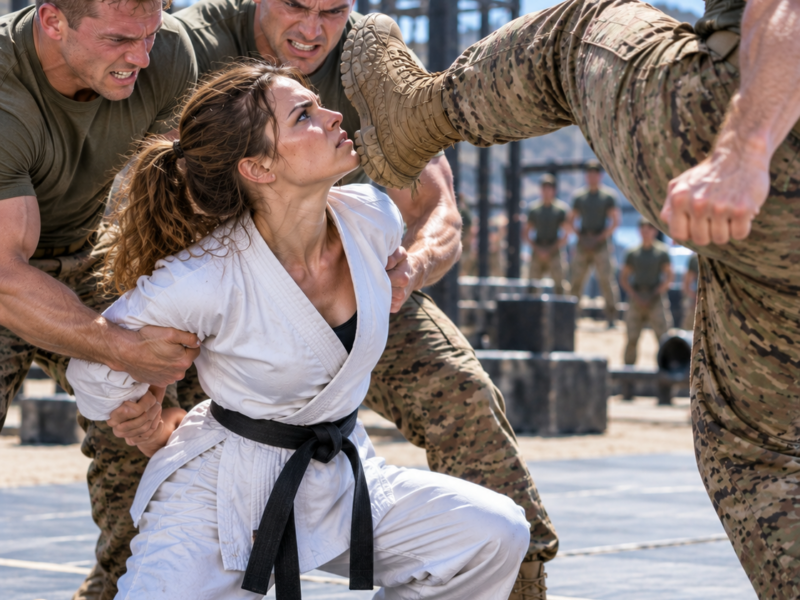
“Three sailors cornered me outside the Navy barracks at Norfolk, Virginia, shouting, ‘Get lost, new girl!’ before one of them shoved me against a brick wall
The officer carrying the sealed folder stopped three feet in front of me. “Natalie Brooks?”
“Yes.”
“Please come with us. We need to clarify something regarding your personnel file.”
Senior Chief Marcus Hale stepped between us—not aggressively, but with the kind of quiet authority that made everyone nearby pay attention. “Before she goes anywhere, I want to know who authorized this meeting and why she’s being approached outside her assigned workspace.”
The officer hesitated. “Senior Chief, we were instructed to deliver the file and escort Petty Officer Brooks to an administrative interview.”
“By whom?”
“I’m not authorized to disclose that.”
Hale’s expression hardened. “Then you’re not authorized to escort her anywhere.”
Behind him, Derek Vaughn stood with his arms crossed, his face no longer wearing the smug grin he’d had moments earlier. Mason Pike and Tyler Reed had gone silent. A few sailors had gathered near the barracks entrance, pretending not to watch while missing nothing.
I rubbed my wrist, trying to ignore the sting in my shoulder where Vaughn had shoved me against the brick wall. I had defended myself, but the moment I saw that sealed folder, I felt as if I were standing in the middle of a fight that had started long before I arrived in Norfolk.
“Senior Chief,” I said quietly, “what’s in that folder?”
He looked at me, and for the first time since he had intervened, his composure seemed to falter.
“Something that should have been explained to you four years ago.”
My stomach tightened. “About my father?”
Hale nodded once.
The officer holding the folder shifted his weight. “Sir, with respect, this is an official matter.”
“Then we’ll handle it officially,” Hale replied. “We’ll go to the command office, document everyone present, and contact the legal officer. Nobody opens that folder in a hallway.”
He turned to the three sailors. “Vaughn, Pike, Reed—you’ll remain here under supervision until the duty officer arrives. You will not contact witnesses, discuss statements, or attempt to coordinate your accounts.”
Vaughn scoffed. “For what? She threw a couple of moves and made us look bad.”
“No,” Hale said. “You cornered a sailor, initiated physical contact, and continued after she tried to disengage. That is what we’re investigating.”
“She attacked me!”
“Then your statement will reflect that, and the evidence will be reviewed.”
Hale didn’t raise his voice. He didn’t need to.
I followed him toward the administration building, accompanied by the two officers. As we walked, the folded photograph he had shown me earlier remained in my thoughts. I had recognized the man beside my father immediately. My father had been younger in the picture, his hair darker, his expression serious but warm. Hale stood beside him in a training uniform, one arm resting on a wooden practice post.
I had spent four years believing my father’s final assignment was classified because the Navy had nothing more it could tell me. I had received a short official notice, a carefully worded explanation, and a flag folded with solemn precision. I had been told that some operational details could not be released.
I had never been told that another person had been carrying a photograph of him.
Inside the command office, Hale requested a conference room and asked the officers to wait outside. He did not ask me to sit until he had checked the room and placed the sealed folder in the center of the table.
Then he sat opposite me.
“I owe you an apology,” he said.
I stared at him. “For what?”
“For recognizing your father’s insignia and not explaining immediately why it mattered.”
“You knew him?”
“I trained with him. Not in the same unit, but in a joint close-combat program years ago. Daniel Brooks was one of the most disciplined instructors I ever met. He taught people how to protect themselves without confusing skill with cruelty.”
My throat tightened at the sound of my father’s name. “That sounds like him.”
“He spoke about you often.”
I looked down at my hands. “Then why did I never hear from you?”
“Because after his death, the investigation surrounding his final assignment became complicated. Some people believed keeping his name out of certain reports would protect the program. Others wanted the entire matter buried. I was transferred before I could challenge the decision.”
“Buried?” I repeated. “My father died, and someone decided to bury something?”
Hale paused. “I don’t want to make promises before we examine the records. But I believe your father reported misconduct connected to a training program. His report disappeared from the official chain of review. A second report later appeared, suggesting he had approved procedures he had actually questioned.”
For a moment, I could hear only the hum of the fluorescent lights.
“My father wouldn’t have signed off on something dangerous just to protect his career.”
“I know.”
“You don’t know what he would have done.”
Hale accepted the rebuke without argument. “You’re right. I knew the officer and instructor he was. You knew the man who came home, burned dinner, and insisted that every scraped knee deserved proper cleaning. I can’t claim I knew all of him.”
That answer hurt more than a defense would have.
I looked at the sealed folder. “Why is this about me?”
“That is what we need to establish.”
He did not touch the envelope. Instead, he called the command legal officer and requested that the folder’s origin be verified before anyone opened it. Within twenty minutes, Lieutenant Commander Elise Warren arrived with a second officer from the personnel office. She examined the seal, the routing label, and the authorization number printed along the bottom.
Her expression changed.
“This authorization number was retired,” she said.
Hale leaned forward. “When?”
“Three years ago. It belonged to a review office that no longer exists under that designation.”
“Could someone have reused the number?”
“Possibly. But that would make the document’s chain of custody questionable.”
I felt cold all over. “So somebody made a fake file about me?”
“Not necessarily,” Warren replied carefully. “The folder may contain genuine documents routed under an invalid authorization. We need to determine which.”
She photographed the seal, documented who had handled the folder, and opened it only after the necessary witnesses had been called. Inside were copies of my service history, a brief summary of my father’s last assignment, and a personnel note recommending that I be monitored for “unusual combat proficiency and potential resistance to command direction.”
I read the sentence twice.
“Resistance to command direction?” I said. “I’ve been in Norfolk for less than a week.”
Warren examined the page. “This note was entered into the system before your arrival.”
“By whom?”
The signature at the bottom was partly obscured by a stamp, but the printed name was clear: Commander Adrian Mercer, former deputy director of the training review office.
I knew the name. I had seen it in the news several years earlier when an internal Navy review was announced. Mercer had retired before the review concluded. According to the public summary, the inquiry had found insufficient evidence to recommend further action.
Hale’s jaw tightened. “Mercer worked with the people who reviewed Daniel’s report.”
Warren turned another page. It contained a list of assignments I had held, courses I had completed, and an assessment of my hand-to-hand training. The final paragraph was more disturbing than the first.
“Subject may possess knowledge of undocumented instructional methods previously associated with Daniel Brooks. Recommend discreet observation and controlled assessment if assigned to an installation where relevant personnel remain active.”
I felt as though someone had reached into my past and turned it into a weapon.
“They weren’t just looking at my qualifications,” I said. “They thought I might know something.”
“Or they wanted to see whether you knew something,” Hale replied.
“By sending me here?”
“We don’t know who arranged your assignment. That needs to be verified.”
Warren closed the folder. “We will preserve these documents, compare them with the personnel system, and request an independent review. Until then, no one should treat this note as a valid order or a reliable assessment.”
I looked at Hale. “And Vaughn? Was he part of this?”
“I don’t know,” he said. “But what happened outside the barracks must be investigated on its own evidence. We won’t turn an assault inquiry into a conspiracy theory, and we won’t use the file to excuse anyone’s behavior.”
That was the first thing anyone had said that made me feel the ground beneath me might be solid again.
The investigation began the next morning.
I gave my statement in a quiet room with Warren present. I described how Vaughn had blocked my path, mocked me for being new, and shoved me into the wall. I explained that I had caught his wrist to stop him from grabbing my uniform and had used a defensive technique only after he swung at me again. I told them exactly when I had stepped back and how I had made no attempt to pursue him.
I did not embellish anything. I did not need to.
A security camera outside the barracks had captured part of the encounter. The footage showed Vaughn stepping into my path, pushing me backward, and moving toward me again after I disengaged. It also showed Pike and Reed closing the space around us.
The camera did not capture every movement clearly, but it supported the central facts of my statement. Two sailors who had been nearby also came forward. One had heard Vaughn call me “the new girl who thinks she’s special.” The other had seen him shove me.
Vaughn’s version changed twice before the end of the day.
At first, he claimed I had attacked without provocation. Later, he said he had only been joking and that I had overreacted. Pike said he had stepped between us to break up a fight, but the footage showed him blocking my route toward the barracks before I defended myself. Reed admitted that the three of them had approached me together, although he insisted they had intended only to “teach me how things worked around here.”
That phrase appeared in more than one statement.
Warren asked Reed what it meant.
He stared at the table. “Chief Vaughn said new people needed to understand the pecking order.”
“Was that an official training practice?”
“No, ma’am.”
“Did anyone authorize you to use physical intimidation as a lesson?”
“No, ma’am.”
By the end of the week, Vaughn and Pike had been removed from duties that placed them in supervisory contact with junior personnel while the investigation continued. Reed was reassigned temporarily. No final disciplinary decision had been announced, and Hale made it clear that the process would follow the evidence rather than his personal feelings.
But the barracks changed.
People stopped laughing when Vaughn walked into a room. Sailors who had watched the incident from a distance began offering information about other occasions when he had used humiliation to control newcomers. Some accounts were minor; others described a pattern of threats, unwanted physical contact, and pressure to keep quiet.
I was not asked to decide whether those accounts were true. Investigators did that. My responsibility was to tell the truth about what I had experienced.
Meanwhile, the sealed folder led to a separate inquiry.
The personnel office confirmed that the retired authorization number had been used to attach an unofficial assessment to my transfer record. The note had not come through the normal assignment process. It had been added several weeks before I received my orders to Norfolk.
The original routing data had been partially deleted, but the system retained an audit trail. One access credential belonged to a civilian contractor who had previously supported the training review office associated with Commander Mercer. The credential had been used after the contractor’s account should have been deactivated.
That did not prove Mercer himself had ordered the note. It did, however, give the investigators a real lead.
Hale met with me after the first preliminary findings came back. He brought the old photograph again, this time in a protective sleeve.
“I want you to have a copy,” he said.
I studied my father’s face. In the picture, he was standing beside Hale in front of a training facility, his hands resting loosely at his sides. He looked tired but happy, the way he often looked after a long day when he had decided the important work was finished.
“Why did you keep it?” I asked.
“Because Daniel gave it to me before his final assignment. He said that if anything happened to him, I should remember what we had promised each other.”
“What promise?”
“That we would never allow the program to become a place where rank protected people from accountability.”
I swallowed hard. “Did he know he was in danger?”
“I can’t say that. He knew his report would make powerful people uncomfortable. He told me he expected resistance. But he believed the formal process would work.”
“And it didn’t.”
“Not the way it should have.”
I turned the photograph over. There was handwriting on the back, faded but legible: *Teach them control. Teach them courage. Never teach them fear.*
My father’s handwriting.
For four years, I had carried anger I could never properly name. I was angry at the official notice that explained nothing. Angry at the closed doors and careful condolences. Angry at myself for sometimes wishing he had chosen an easier assignment, even though I knew he would have hated the thought of walking away from people who needed him.
Now I had another kind of anger: the knowledge that his work might have been deliberately misrepresented.
“Why didn’t you find me?” I asked Hale.
He lowered his eyes. “I tried to get access to the complete review. My request was denied. I was warned that discussing the case could compromise an ongoing matter. Then the review was closed, and I was reassigned. I should have continued pushing. I told myself I had no evidence strong enough to reopen it. That was true, but it was also an excuse to stop fighting.”
I wanted to blame him. Part of me did. But he was not asking me to forgive him, and he was not pretending that good intentions erased the years I had spent with unanswered questions.
“I can’t promise I forgive you,” I said.
“I wouldn’t ask you to.”
“But if you know something else, you tell me. Even if it’s uncomfortable.”
“I will.”
The next breakthrough came from an old training log recovered during the inquiry. It showed that my father had formally objected to a drill that allowed instructors to continue physical pressure after a trainee had disengaged. He had argued that the practice blurred the line between controlled stress and punishment. His recommendation was to suspend the drill until independent safety standards could be established.
A later version of the report stated that he had approved the drill after minor revisions.
The signature appeared to be his.
But the digital audit record showed that the final document had been amended after his last recorded login. The amendment was authorized through an administrative credential linked to the review office, not through my father’s account.
The difference mattered. It did not by itself identify who had altered the report, but it established that the official record could not be trusted as written.
When Warren explained the finding, I sat very still.
“So he did object,” I said.
“Yes,” she replied. “The original record supports that conclusion.”
“And someone made it look as if he agreed.”
“That is a reasonable interpretation of the evidence, though the inquiry must still establish responsibility.”
I pressed my palms against my knees. I had spent years wondering whether there was something about his final assignment he had never told me. Now I understood that the silence surrounding his death might not have been about protecting an operation. It might have been about protecting the reputations of people who had ignored him.
The investigators eventually interviewed the former contractor whose credential appeared in the audit trail. At first, he denied accessing the system. When shown the records, he said he had been instructed to upload a set of archived assessments and did not know that the credential remained active. He could not provide a written order, but he identified the person who had contacted him: a retired administrator who had worked under Mercer.
That administrator agreed to an interview only after being told the inquiry had recovered the original audit history.
His account did not answer every question. He denied that Mercer had personally directed the alteration, but admitted that the review office had been under pressure to close the matter quickly. He also acknowledged that my father’s objections had been discussed in meetings where senior officials worried the findings might expose failures in training oversight.
The investigation did not turn into the dramatic confession I had imagined during sleepless nights. There was no single villain who admitted everything. There were people who remembered different things, people who protected themselves, and people who had allowed a questionable record to stand because challenging it would have been inconvenient.
That was harder to accept than a simple story of good people fighting one bad man.
It was also more believable.
The final report took months. During that time, I continued working in logistics, attended every interview I was required to attend, and learned to let the process move at its own pace. I refused to become a rumor or a symbol. I was a sailor doing her job, and I expected the same standards of conduct from everyone around me.
The assault investigation concluded first.
The evidence established that Vaughn had initiated the confrontation and used physical intimidation against me. Pike had helped corner me and obstruct my exit. Reed had participated in the group’s harassment, although the evidence showed a lesser role in the physical contact. Their conduct violated command standards, and the command imposed disciplinary measures appropriate to each sailor’s actions and record. Vaughn lost his supervisory duties and received the most serious action of the three. Pike was formally disciplined, and Reed received a separate administrative penalty and mandatory corrective training.
Their careers did not end in a single cinematic moment. There were hearings, written findings, and decisions that took account of the evidence. But their ability to use rank and intimidation to control junior sailors ended.
Vaughn never apologized to me. I stopped waiting for him to.
The broader inquiry reached a more complicated conclusion. It found that my father’s original safety objections had been omitted from the final official summary and that a later amendment had been made without a valid authorization trail. It could not establish that Mercer personally ordered the alteration, but it found serious failures in oversight and record integrity within the review office. The relevant findings were referred for further administrative action, and the training guidance was revised to make clear that a trainee’s attempt to disengage could not be treated as permission to escalate a drill.
My father’s name was formally cleared of the implication that he had approved the disputed practice without reservation.
When Warren told me, I felt no sudden rush of triumph. I felt grief first. I imagined him sitting at our kitchen table, explaining that doing the right thing did not always mean you got to see the outcome. I wished he could have known that someone had finally read his report correctly.
Hale was there when I received the official notice.
He stood beside the window while I read the letter, giving me room to react. When I finished, I folded it carefully and placed it back in the envelope.
“He was right,” I whispered.
“About what?”
“Control isn’t the same as obedience. And courage isn’t the same as being unafraid.”
Hale nodded. “He taught me that, too.”
I looked at him. “You know, I used to think the hardest part of my father’s death was not knowing what happened. I was wrong. The hardest part was wondering whether he had been the man I remembered.”
“He was,” Hale said. “The records were wrong. Your memories weren’t.”
For the first time, I allowed myself to cry in front of someone who had known him. I did not apologize for it, and Hale did not try to stop it.
A few weeks later, I returned to the courtyard outside the barracks. The brick wall was still there, ordinary and unremarkable in the daylight. I had passed it dozens of times since the assault, but I had avoided looking directly at it.
That morning, I stopped.
I placed my hand against the rough surface and remembered the moment Vaughn had shoved me into it. I remembered the old instinct to keep my head down, to make myself smaller, to survive by giving people nothing they could use against me.
Then I remembered the decision I had made when he came at me again: I would protect myself, but I would not become him.
My father’s lessons had never been about winning every fight. They were about knowing when to stand, when to step away, and how to remain yourself when someone tried to take that choice from you.
Hale approached from the walkway, carrying two paper cups of coffee.
“Thought you might be here,” he said.
I accepted one cup. “Do you always show up when people are having dramatic moments?”
“Only when the coffee is decent.”
I laughed, surprising myself.
For a while, we stood without speaking. The base moved around us: boots on pavement, doors opening and closing, a distant announcement over the loudspeaker. Ordinary life had returned, though it no longer felt quite as simple as it once had.
“I’m going to keep training,” I told him.
“I assumed you would.”
“But I don’t want to spend my life proving I can fight.”
“Then don’t,” he said. “Train because it helps you understand what you’re capable of. Not because you owe anyone a demonstration.”
I looked at the three-line tattoo on my wrist, the circle crossing its center. For years, I had treated it as a private reminder of my father. Now I understood that it was also a promise—to use strength with restraint, and to refuse the idea that fear was a legitimate tool of leadership.
“I thought coming here would be a fresh start,” I said.
“Maybe it still can be.”
I turned toward the barracks entrance. A new sailor was standing near the door, looking lost while trying to read a posted schedule. I recognized the uncertainty in her posture. She glanced around as if expecting someone to laugh at her for not knowing where to go.
I walked over and asked if she needed help.
She looked relieved. “I’m supposed to report to logistics, but I think I took the wrong turn.”
“I can show you,” I said.
As we started down the path, I glanced back once. Hale remained by the wall, watching with a small, quiet smile.
For the first time since arriving in Norfolk, I did not feel as if I were walking into someone else’s story. My father’s legacy was no longer a sealed folder, a disputed signature, or a secret that powerful people could use to frighten me. It was something I could carry forward without allowing it to define every step I took.
I had been cornered, underestimated, and assaulted. I had defended myself. I had learned that the truth could take months to surface and that accountability was rarely as simple as one person being exposed. But I had also learned that standing up for myself did not require me to surrender my compassion.
My father had taught me how to fight.
The truth had taught me why I should choose my battles.
And the next time someone called me the new girl, I knew I would not hear an insult that defined me. I would hear only a reminder that every beginning gives us a choice: repeat the fear we inherited, or build something better.
The end.









