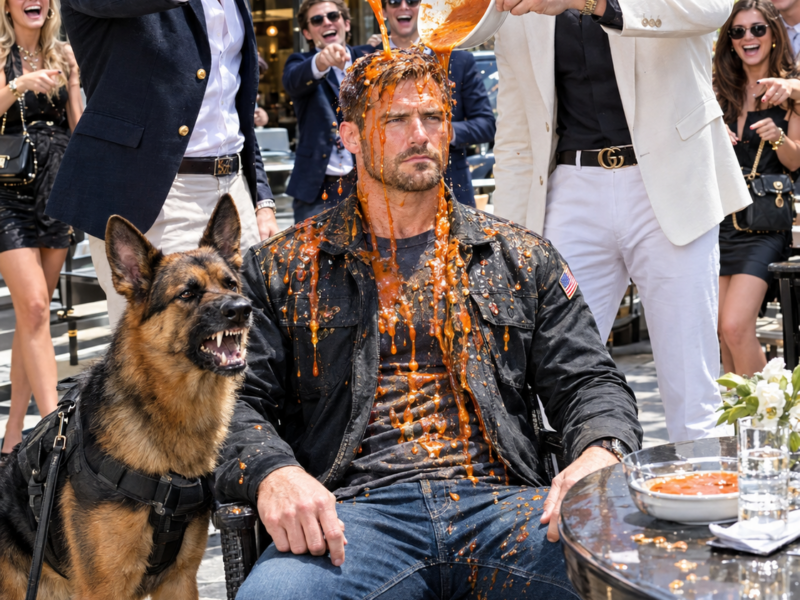
“THEY LAUGHED when they poured scalding food over a quiet man and his German Shepherd, certain their money made them untouchable
The bullet never came.
Daniel slammed into me, driving us both into the snow as a gunshot shattered the silence above our heads.
Ranger lunged forward, barking once—sharp and commanding—before I caught his harness and pulled him behind the wooden wall.
“DOWN!” I shouted.
Daniel rolled onto his side, clutching his injured shoulder. Blood spread beneath his jacket.
I drew him farther behind cover and pressed my hand against the wound.
“Stay with me.”
He gave a strained laugh.
“Eleven months without seeing you, and this is how you say hello?”
“You always were terrible at making an entrance.”
His smile disappeared as another gunshot struck the building.
Wood splintered above us.
I looked toward the doorway.
Commander Elias Ward was no longer standing beneath the trees.
He had disappeared into the darkness.
That frightened me more than if he’d stayed in plain sight.
Ward had trained me to recognize the difference between a man who wanted to scare someone and a man who had already decided to kill him.
The commander had never wasted ammunition.
And he had never missed a target he intended to eliminate.
“Can you move?” I whispered.
Daniel nodded, though his face had gone pale.
“Left leg’s good. Right shoulder’s a mess.”
“Then use the leg.”
I helped him crawl toward a narrow service door at the back of the building. Ranger stayed close, his ears rotating toward every sound outside.
The dog had spent years working in dangerous environments, but even he seemed unsettled.
He knew Ward.
I didn’t know how.
I had never brought Ranger near the commander after the operation.
Yet when Ward appeared, my dog had reacted as though he’d recognized a threat from a memory buried deep inside him.
We reached the service door.
I tested the handle.
Locked.
Daniel pointed toward a broken window.
“Maintenance room. There’s a crawlspace underneath.”
“Of course there is.”
“You remember what you taught me?”
“Never trust a building with only one exit.”
“Exactly.”
I used the butt of my flashlight to break the remaining glass, cleared the frame, and helped Daniel through.
Ranger followed with a single effortless jump.
Inside, the room smelled of rust, damp wood, and old machine oil. A dead fluorescent light hung from the ceiling. Shelves of abandoned tools lined the walls.
Daniel directed me toward a metal floor hatch.
I pulled it open.
A narrow staircase descended into darkness.
“Go,” I told him.
He shook his head.
“You first. I’ll cover you.”
“You’re bleeding.”
“And you’re arguing. Some things never change.”
Another round struck the exterior wall.
We stopped arguing.
I descended first, Ranger close behind, and Daniel followed with his good arm gripping the railing.
The hatch closed above us.
For a moment, the only sound was our breathing.
Then Daniel whispered, “Jack, there’s something you need to know.”
“If this is another surprise, save it until we’re somewhere safer.”
“It concerns your father.”
I turned.
“What about him?”
Daniel looked at the floor.
“He didn’t die because of an accident.”
The words struck harder than the gunfire.
“My father died five years ago.”
“I know.”
“His heart failed. That’s what the doctors said.”
“That’s what the report said.”
I grabbed Daniel’s jacket.
“Tell me exactly what you mean.”
He didn’t pull away.
“Your father discovered that military logistics records were being altered. He found shipments that didn’t match their manifests, equipment that disappeared between authorized depots, and transfers approved by officers who had no legitimate reason to be involved.”
I remembered my father’s basement.
The old radios.
The handwritten notes.
The way he would sometimes stop speaking when I entered a room.
“He never told me.”
“He was trying to protect you.”
“By keeping me ignorant?”
“By keeping your name out of the investigation.”
I released Daniel.
For years, I had carried the quiet regret of not visiting my father more often during his final months. I had been overseas, moving between deployments, promising myself I’d make up for the lost time when I came home.
I never got that chance.
Now Daniel was telling me that the man who taught me how to listen to a radio might have been murdered for something he discovered.
“Who killed him?”
“I don’t know.”
“Daniel.”
“I swear to you, Jack. I know what he found, but I don’t know who ordered his death.”
I wanted to hit something.
Instead, I took a slow breath and forced myself to focus.
Anger could wait.
Survival couldn’t.
“Where does this tunnel lead?”
“An old drainage channel that runs beneath the railway yard. There’s an access road on the other side.”
“How do you know?”
“I’ve been hiding here for three weeks.”
I stared at him.
“Three weeks?”
“It’s a long story.”
“We have about thirty seconds before Ward comes through that door. Give me the short version.”
Daniel swallowed.
“Someone arranged for me to be transferred after the explosion. I woke up in a private medical facility with two guards outside my room. They told me the military had declared me dead and that my family had already been notified.”
He paused.
“I escaped when one of the guards made a mistake.”
“What kind of facility?”
“A contractor’s site. No public name. No military insignia. They had medical equipment, secure communications, and people who knew more about classified operations than the officers who supposedly ran them.”
“Who was in charge?”
“I never saw the person giving the orders.”
“Then how did you know to contact me?”
“I didn’t.”
Daniel met my eyes.
“The photograph was sent to me. Someone wanted us together.”
That was the first piece of information that truly worried me.
Someone had arranged the billboard.
Someone had sent the photograph.
Someone had made sure I knew Daniel was alive.
And someone had predicted that I would come here.
We reached the bottom of the stairs.
A concrete passage stretched ahead, barely wide enough for two men to walk side by side. Water dripped from overhead pipes.
Ranger moved ahead, sniffing the air.
Then he stopped.
His body stiffened.
I raised my hand.
Daniel froze behind me.
A faint metallic click came from the darkness.
Not a gunshot.
A lock.
I turned off my flashlight.
A thin line of light appeared at the far end of the passage. A door opened, and a man’s silhouette filled the frame.
“Walker?” a voice called.
I recognized the voice, but not the face.
It belonged to Agent Laura Bennett.
The federal investigator who had questioned me about the operation months earlier.
She had been one of the few people who seemed genuinely troubled by the missing evidence.
“Bennett?” I whispered.
“Move toward my voice. Slowly.”
I didn’t move.
“Prove it’s you.”
She paused.
Then she said, “You told me that the first thing your father taught you was that a radio never lies. You also told me that you were beginning to doubt him.”
I had said those words in a secure interview room three months earlier.
Only Bennett had been present.
I lowered my flashlight enough to illuminate her face.
She stood in the doorway wearing a dark tactical jacket, her weapon pointed at the floor. Two federal agents were behind her.
“Thank God,” she said when she saw Daniel. “We’ve been searching for you.”
Daniel didn’t look relieved.
“Who sent you?”
“Commander Hayes.”
“Hayes is working with Voss.”
“No,” Bennett said. “He’s been trying to build a case against him for months.”
Daniel’s expression remained hard.
“Then why did he sign the report that declared us dead?”
“Because he was ordered to. And because he believed the classified review would eventually uncover the truth.”
I stepped between them.
“Enough. We can argue about who trusted whom after we’re safe.”
Bennett nodded toward the exit.
“There’s a vehicle waiting. We need to leave now.”
We moved through the passage and emerged beside an abandoned drainage channel. Beyond it, a black government SUV waited with its lights off.
As we approached, Ranger suddenly veered toward the vehicle’s rear wheel.
He sniffed once, then barked.
Bennett stopped.
“What is it?”
I crouched beside Ranger.
His attention was fixed on a small object attached to the underside of the vehicle.
A black box no larger than a matchbook.
I didn’t touch it.
“Everyone back.”
One of the agents approached cautiously, examined it from a distance, and swore under his breath.
“Tracking device.”
Bennett’s face hardened.
“How long has that been there?”
“Long enough.”
I looked toward the railway building.
Ward had known exactly where we would be.
He had known when we would arrive.
And someone had been tracking the people sent to help us.
I turned to Bennett.
“Your vehicle is compromised.”
She looked toward the road.
“Then we use the second one.”
“You brought two?”
“I expected trouble.”
“Next time, expect more.”
For the first time that night, she almost smiled.
We took a second vehicle and drove toward a secure federal facility outside Denver.
Daniel sat beside me in the rear seat, his injured arm wrapped in a temporary bandage. Ranger lay across the floor, his head resting against my boot.
I watched the highway disappear behind us.
Somewhere out there, Ward was still free.
And I had a growing suspicion that the man who had ordered my team into an ambush was only one part of something much larger.
By the time we reached the facility, the snow had become heavy enough to cover the road markings.
Bennett led us into a secure room containing a conference table, a wall of monitors, and a single computer terminal disconnected from the public network.
Commander Hayes was waiting.
He looked older than he had at the plaza.
His silver hair was damp from the snow, and deep lines had appeared around his eyes.
When he saw Daniel, he stood so quickly that his chair scraped backward.
“Petty Officer Mercer.”
Daniel stared at him.
“Don’t.”
Hayes stopped.
“Daniel, I—”
“You signed the report.”
“I did.”
“You told my mother I was dead.”
“I didn’t personally notify your family.”
“But you signed the report that made it possible.”
Hayes lowered his head.
“Yes.”
Daniel’s good hand curled into a fist.
I stepped between them before the conversation became something none of us could take back.
“We need facts.”
Hayes nodded slowly.
“You’re right.”
He placed a thick folder on the table.
“Eleven months ago, your team was assigned to intercept a shipment of restricted communications equipment being moved through a private logistics network. The shipment was suspected of containing stolen military encryption components and intelligence files.”
“Suspected?” I asked.
“The original intelligence report indicated a high probability. We were ordered to confirm the shipment and recover the material.”
“By whom?”
“General Marcus Voss.”
The name hung over the table.
Bennett opened the folder and displayed a map.
“Your team was initially assigned to a landing zone north of the target. Four hours before deployment, the coordinates were changed through an authorized command channel.”
I studied the map.
The revised landing zone placed us inside a narrow valley with limited escape routes.
It had always bothered me.
The position had been tactically indefensible.
At the time, we believed the change was based on updated intelligence.
Now I understood what it meant.
Someone had designed the operation to leave us trapped.
“Who authorized the change?” I asked.
Bennett brought up a digital record.
“The approval carries Commander Ward’s credentials.”
Daniel leaned forward.
“Ward was with us during the mission briefing.”
“Yes,” Hayes said.
“And he was supposed to be dead.”
“Yes.”
I looked at Hayes.
“Did you know he survived?”
“No.”
“Do you expect me to believe that?”
“I expect you to verify it.”
That answer surprised me.
Hayes slid a second document across the table.
“Ward was officially listed as having died during a separate transport incident two days before your deployment. But his death certificate was never supported by an independent identification.”
Daniel went still.
“Then who did we see at the briefing?”
“Possibly Ward. Possibly someone using his identity. We’re still investigating.”
I shook my head.
“I knew Ward. I worked with him for years. It was him.”
Hayes didn’t argue.
“Then the question becomes why a man officially declared dead was able to authorize a mission that later became the basis for declaring you dead.”
Bennett enlarged the map.
“There’s more. After the explosion, a private medical transport entered the area under a humanitarian evacuation authorization. Its flight plan was filed through a company linked to the logistics network.”
Daniel’s face drained of color.
“That’s the transport I was on.”
“Most likely.”
“They told me I was being taken to a military hospital.”
“They were lying,” Bennett said.
Daniel stared at the map.
For eleven months, he had believed he was the only person who knew what had happened after the explosion. He had spent weeks recovering in a room with no windows, listening to guards outside the door and wondering whether his family had received his final letter.
Now he knew his disappearance had been arranged.
“What did they want from me?” he asked.
Hayes answered carefully.
“They wanted to know what you had seen before the explosion.”
“I saw the convoy. I saw the signal flare. I saw the second team moving toward our position.”
“What second team?”
Daniel looked at me.
“Jack, remember the two trucks that appeared on the ridge before the extraction?”
I nodded.
We had spotted them through night-vision equipment shortly before the explosion.
At the time, we assumed they were enemy reinforcements.
Daniel continued.
“They weren’t hostile forces. They were carrying men in uniforms that looked like ours.”
Bennett leaned closer.
“Are you certain?”
“I saw the shoulder patches. I saw the weapons. They used our hand signals.”
“Then why didn’t you report it?”
“I tried. The radio went dead.”
I remembered the static.
The abrupt loss of communications.
The way our backup channel had gone silent just before the explosion.
I had assumed the blast had destroyed our equipment.
But what if the communications failure had begun before the blast?
“What happened to the second team?” I asked.
Daniel shook his head.
“I never found out. I was hit before I could get a clear view.”
Hayes looked toward Bennett.
“We need the original mission report.”
“That’s what my father was investigating,” I said.
I took the envelope from my jacket and placed the photograph on the table.
Bennett examined it carefully.
“Who is the man behind Commander Ward?”
“I don’t know. My father wrote that someone had used my identity, but he didn’t explain the rest.”
Hayes studied the photograph for several seconds.
Then his expression changed.
“Peter Lang.”
“Who is he?”
“A logistics contractor. He managed several transportation agreements connected to the operation.”
“Is he alive?”
“We don’t know.”
Daniel gave a bitter laugh.
“Everyone seems to be dead until they become inconvenient.”
Nobody answered.
Bennett returned to her computer.
“There’s something else. Two days ago, someone attempted to access the original mission archive using Jack’s credentials.”
I felt cold despite the warmth of the room.
“My credentials?”
“The access request originated from a terminal registered to a private contractor.”
“Which contractor?”
“Lang’s company.”
I looked at the photograph again.
The man my father had been investigating had tried to access the file that could explain why my team had been sacrificed.
Then someone had sent Daniel’s photograph to me.
Someone had wanted me to follow the trail.
I turned to Hayes.
“Who benefits if the original report disappears?”
“Anyone connected to the shipment.”
“Who benefits if the report becomes public?”
“Anyone trying to expose them.”
“And who would be willing to risk killing two SEALs to keep it hidden?”
Hayes held my gaze.
“Someone who believes the evidence could destroy them.”
I stood.
“Then let’s find the file.”
Bennett shook her head.
“Not so fast. The archive has been sealed. We need a legal authorization, and the only person who can release it is General Voss.”
“Then we’ll ask him.”
“He won’t cooperate.”
“Then we find another way.”
Hayes stepped forward.
“Jack, if Voss learns that Daniel is alive, he’ll move whatever evidence remains.”
“He already knows.”
I showed them the messages on my phone.
The threat.
The photograph.
The address.
Bennett read them twice.
“Someone has been monitoring you since you returned.”
“Maybe longer.”
She looked toward Ranger.
The dog had been lying beside my chair, but now he had lifted his head and was staring at the closed door.
His ears stood upright.
I followed his gaze.
A second later, the door opened.
A young agent entered carrying a sealed evidence bag.
“Agent Bennett, this was delivered to reception. The sender said it was for Jack Walker.”
Inside the bag was a small memory card.
No note.
No name.
Just a card that might contain the truth—or a trap designed to destroy the last remaining evidence.
Bennett placed it on the table.
“We’ll examine it in an isolated system.”
“No,” I said.
She looked at me.
“My father spent years working with radios and secure communications. If this came from him, I want to know what we’re looking at before anyone tries to open it.”
Bennett considered that, then nodded.
She gave the card to a digital forensics specialist, who connected it to a computer that had been disconnected from all external networks.
The screen remained black for several seconds.
Then a folder appeared.
Inside were three files.
One was a scanned document labeled ORIGINAL_MISSION_REPORT.
The second was an audio recording.
The third was a video file dated five years earlier.
My father’s death year.
I stared at the screen.
“Play the audio.”
The specialist checked the file and nodded.
A man’s voice emerged from the speakers.
It was Commander Ward.
“Shipment is confirmed. The material is being transferred tonight. General Voss has instructed us to close the investigation after the operation.”
A second voice answered.
Peter Lang.
“And the team?”
Ward paused.
“Cole and Mercer are not supposed to return with the evidence.”
The room became completely silent.
Daniel looked as though he had been struck.
I felt something inside me turn to ice.
The recording continued.
“What if they survive?” Lang asked.
Ward’s answer came quietly.
“Then we make sure their survival doesn’t become a problem.”
The audio ended.
For several seconds, nobody spoke.
Then I heard my own voice.
“Play it again.”
The specialist did.
Every word was clear.
Cole and Mercer are not supposed to return with the evidence.
I had spent eleven months trying to understand how my team had been betrayed.
Now I knew.
The operation had never been designed to recover stolen intelligence.
It had been designed to eliminate the people who could prove the theft had happened.
Daniel stood abruptly and walked toward the wall.
He braced himself against it with his good hand.
I followed him.
“Daniel.”
He shook his head.
“I trusted him.”
“So did I.”
“Ward trained us. He stood in our briefing room. He shook our hands before deployment.”
“I know.”
Daniel’s voice cracked.
“I sent him a message after the explosion. I told him where I was. I thought he would send help.”
I didn’t know what to say.
For eleven months, my teammate had been trapped in a world where the person responsible for his survival had been the same person who wanted him silenced.
I placed a hand on his shoulder.
“We’re here now.”
He closed his eyes.
“Yeah.”
He breathed out slowly.
“We’re here.”
The forensics specialist opened the scanned report.
The first page listed the mission objective.
The second contained the revised coordinates.
The third showed the authorization signatures.
General Marcus Voss.
Commander Elias Ward.
Peter Lang, civilian logistics liaison.
At the bottom of the final page was an additional approval.
My name.
Nathan Cole.
I stared at it.
“That isn’t my signature.”
Bennett leaned closer.
“Someone forged your authorization.”
“They used my credentials.”
“Which means they needed access to your identity verification records.”
Hayes looked troubled.
“Those records were stored in a restricted personnel system.”
“Who had access?”
“Command staff, authorized intelligence personnel, and certain security administrators.”
I thought about the missing-person billboard.
The false death report.
The altered shipment records.
Someone had been using my name long before I returned to Colorado.
And the person behind it had enough access to make the military believe I was dead.
The specialist opened the video file.
My father appeared on screen, sitting at the workbench in his basement. His hair was gray, and the room behind him was crowded with radios and electronic components.
He looked tired.
But his eyes were sharp.
“If this recording is being viewed,” he began, “then I was unable to deliver the evidence through the channels I trusted.”
My throat tightened.
I had not heard his voice in five years.
“Thomas Cole,” he continued. “Former communications engineer. I am documenting evidence of unauthorized transfers involving restricted military technology and falsified mission records. I believe the network reaches beyond the contractors directly involved.”
He paused and looked toward something off camera.
“I have identified three individuals connected to the altered records: General Marcus Voss, Commander Elias Ward, and Peter Lang. I cannot establish who is directing the entire operation. The available evidence suggests that someone higher in the chain of command is protecting them.”
He leaned closer to the camera.
“My son, Nathan, is not involved. If you are watching this because his identity has appeared in these records, understand that he may be in danger through no fault of his own.”
I lowered my head.
My father had known.
He had known that one day my name might become part of the conspiracy.
And he had spent his final years trying to protect me from it.
The video continued.
“I have kept copies of the original transfer records, but the most important evidence is not stored on this device. It is in the original radio logs, which identify the source of the altered extraction coordinates.”
He looked directly into the camera.
“Do not trust a report simply because it bears an official signature. Verify the transmission. Verify the time. Verify the voice.”
The recording ended.
I stood motionless.
Then I turned toward Bennett.
“Where are the original radio logs?”
She brought up the archive index.
“The mission’s primary communications data should be stored with the original operational record. But the archive was accessed and modified after the mission.”
“By whom?”
“Voss’s office.”
“Then we go to Voss.”
Hayes shook his head.
“He’ll deny everything.”
“Then we show him the recording.”
“And if he destroys the remaining evidence?”
Bennett closed the folder.
“Then we secure it before he has the chance.”
She made a series of calls. Within an hour, a federal judge had authorized the preservation of the relevant records, and a separate team was dispatched to secure the archive.
But the archive had already been compromised.
When the team reached the facility, they found the server room locked and the local administrator missing.
A technician had wiped portions of the storage system.
Not everything.
The original radio logs had been copied to an offline backup, but the backup had been removed.
The only remaining trace was a transfer receipt showing that the device had been transported to a private airfield outside Denver.
The same airfield where General Voss’s security detail had been seen earlier that evening.
Bennett looked at me.
“He’s moving the evidence.”
“Then we move faster.”
Hayes objected immediately.
“You are not going after a general on your own.”
“I’m not asking permission.”
“Jack, listen to me. This is a federal investigation now.”
“Then investigate.”
I pointed at the screen.
“Secure the records. Issue warrants. Get your agents ready. But don’t tell me to sit in a room while the man who tried to erase my life boards a plane.”
Hayes held my gaze for a long moment.
Finally, he nodded.
“We go together.”
The airfield was hidden behind a line of industrial warehouses. Snow blew across the runway, and a small private aircraft sat beside a hangar with its engines already running.
Federal agents surrounded the access road.
Bennett coordinated the operation from a mobile command vehicle while Hayes and I approached the hangar with the entry team.
Ranger remained beside a handler in the protected staging area. I hated leaving him behind, but I wasn’t going to put him in the middle of an armed confrontation.
Inside, a handful of workers were loading cases into the aircraft.
General Voss stood near the open cargo door, speaking to a man in a dark coat.
Peter Lang.
He was alive.
When he saw us, he froze.
Voss turned.
For a fraction of a second, surprise crossed his face.
Then it disappeared behind the practiced calm of a man accustomed to giving orders.
“Commander Hayes,” he said. “What is the meaning of this?”
Hayes stepped forward.
“General Voss, you are being detained pending investigation into the falsification of military records, unauthorized transfer of restricted intelligence, and conspiracy connected to a classified operation.”
Voss looked at me.
“Walker. I was told you were dead.”
“I was told the same thing.”
“You have no idea what you’re involved in.”
“I know what you did to my team.”
Voss’s expression hardened.
“Your mission failed. The report was classified to protect national security.”
“Then why did you forge my signature?”
“I did not.”
“Why were the extraction coordinates changed?”
“Operational necessity.”
“Why did Commander Ward say we weren’t supposed to return with the evidence?”
Voss’s eyes flicked toward Lang.
It was a small movement.
But it was enough.
Lang began backing away from the aircraft.
One of the agents blocked his path.
Voss raised his voice.
“You cannot arrest me on the word of a disgraced officer and a missing contractor.”
Bennett entered the hangar carrying a tablet.
“We have authenticated recordings, transfer receipts, altered mission records, and testimony from Petty Officer Daniel Mercer, who survived the operation you reported as fatal.”
For the first time, Voss looked afraid.
He quickly recovered.
“Those recordings can be fabricated.”
“Then you’ll have an opportunity to challenge them in court.”
He looked at Hayes.
“You know what this will do to the service. You know how many careers will be destroyed.”
Hayes’s voice was steady.
“That’s what happens when people use the service to hide their crimes.”
Voss turned toward the aircraft.
Two agents moved to intercept him.
He stopped.
Then he looked at me with an expression I would remember for the rest of my life.
“You think this is about money?” he asked quietly. “You think Lang and I are the whole operation?”
I didn’t answer.
He leaned closer.
“You have no idea who ordered the shipment. You have no idea why your father was killed. If you expose this, you’ll discover that the people you trust most are standing on the other side.”
“Then give us their names.”
Voss smiled without humor.
“I don’t have to.”
He looked toward Lang.
“Ask him.”
Lang’s face went white.
The agents separated the two men.
Voss was placed under arrest. Lang, after a brief attempt to flee through a service corridor, was detained without serious injury.
The cases on the aircraft contained encrypted storage devices, shipping manifests, and financial records tied to a network of private companies.
Among them was the missing offline backup.
The original radio logs were intact.
And they contained the evidence we had needed from the beginning.
The extraction coordinates had been changed through an authenticated command terminal assigned to Commander Ward. The order had been transmitted using credentials that should have been disabled after Ward’s reported death.
But the logs showed another detail.
The command terminal had been accessed remotely through an administrative account controlled by a senior intelligence official outside Voss’s direct chain of command.
Voss had been part of the conspiracy.
He had not been its highest authority.
The investigation widened overnight.
Financial transfers led to shell companies. Shipping records linked those companies to unauthorized movements of restricted technology. Witnesses began cooperating when they learned that Voss and Lang could no longer protect them.
Then the investigators found the final recording.
It was a conversation between Voss and Ward, made two days before our deployment.
Ward asked, “What about the team?”
Voss answered, “If they return with the material, we have a problem.”
“And if they don’t?”
“Then the report closes itself.”
The recording ended.
There was no ambiguity left.
They had sent us into an ambush because we were expected to die.
Ward had survived the operation by disappearing into the same network he had helped create.
For months, he had been moving between private facilities, using false identities and intermediaries to keep the evidence buried.
The man who had appeared in the snow had not been a ghost.
He had been a fugitive who believed he could still control the people who knew the truth.
But Ward was no longer the only person being hunted.
Three days after Voss’s arrest, federal agents located him at a remote property in Wyoming. He surrendered after a brief standoff, apparently realizing that the network was collapsing around him.
When I saw him in the interrogation room, he looked smaller than I remembered.
His uniform was gone.
His hair was unkempt.
The authority that had once made an entire briefing room fall silent had disappeared.
He sat across from me with his hands folded on the table.
“You’ve caused a lot of damage, Jack.”
I stared at him.
“You killed my friends.”
“I gave an order.”
“You changed our coordinates.”
“I followed instructions.”
“You told your men we weren’t supposed to come back.”
Ward looked down.
For several seconds, I thought he might deny it.
Instead, he said, “I believed the mission was necessary.”
I felt my hands tighten.
“Necessary for what?”
“To protect the country.”
“By sacrificing your own people?”
“You don’t understand the pressures involved.”
“Then explain them.”
He took a slow breath.
“The shipment contained intelligence that could have exposed a network of unauthorized transfers. Some of those transfers were connected to people who believed they were protecting national security by operating outside normal oversight.”
“People who were stealing military technology.”
“People who believed the system was too slow to deal with the threats we faced.”
I leaned forward.
“And you believed them?”
“I believed that if the network was exposed, classified operations would be compromised.”
“So you sent us to die.”
“I was told the situation could be contained.”
“By whom?”
Ward was silent.
I placed a copy of the radio logs on the table.
“Your credentials authorized the change. Your voice is on the recording. Your own words are on the file.”
He stared at the document.
“I know.”
“Then tell me who gave the order.”
He looked up.
“I never met the person who controlled the administrative account. Everything came through intermediaries. I received instructions through a secure channel, and I was told the account belonged to someone with authority to approve exceptional operations.”
“Name.”
“I don’t know.”
I wanted to believe him.
But after everything that had happened, belief was no longer enough.
“You expect me to walk out of here with that answer?”
“No.”
He looked exhausted.
“I expect you to keep looking.”
I stood.
“Why did you come to the railway building?”
“Because I wanted the storage device.”
“You could have sent someone else.”
“I needed to know whether you had found your father’s evidence.”
“Why?”
“Because Thomas Cole was the only person outside the network who understood how the records had been altered. I thought his evidence had died with him.”
I felt my pulse quicken.
“Did you kill my father?”
Ward’s expression changed.
“No.”
“Did you order it?”
“No.”
“Do you know who did?”
He hesitated.
Then he said, “I know who arranged the investigation into his death.”
“Who?”
“General Voss.”
The answer was not enough.
It did, however, give the investigators another lead.
My father’s death had originally been ruled a medical emergency. The case had never been treated as suspicious, and no independent review had been conducted.
After Ward’s statement, the authorities reopened it.
They examined his medical records, financial transactions, communications, and the final weeks of his life.
They discovered that a private security contractor had accessed my father’s home shortly before his death. The contractor had been paid through a company connected to Lang’s logistics network.
No evidence established exactly who had entered the house or what had happened there.
But the timing was impossible to ignore.
The investigation was still ongoing when I returned to Colorado.
For the first time in eleven months, I could sleep without wondering whether I had imagined the explosion, the missing radio signal, or Daniel’s final transmission.
I knew what had happened to us.
I knew who had altered the report.
I knew that the men who had tried to erase us were facing prosecution.
But the larger network had not been fully exposed, and my father’s death remained unresolved.
Justice, I was learning, was not always a single dramatic moment.
Sometimes it was a stack of documents, a witness willing to tell the truth, and a case that refused to close.
Sometimes it was a long wait for a phone call.
And sometimes it was simply the ability to wake up without believing that the people you trusted had forgotten you.
Daniel spent several weeks recovering from his injuries.
He stayed with me for part of that time, mostly because neither of us liked being alone with our thoughts.
We repaired my old pickup truck, argued about coffee, and watched football games we barely paid attention to.
Some nights, Daniel woke from nightmares and sat outside on the porch until sunrise.
I never asked what he had seen.
I just brought him coffee.
He did the same for me.
Ranger became his shadow, often settling beside Daniel whenever the nightmares came. The dog seemed to understand that some wounds couldn’t be reached with a bandage.
One evening, Daniel sat on the porch with his arm in a sling and watched the snow fall across the yard.
“You ever think about going back?” he asked.
“To the teams?”
He nodded.
I considered the question.
For years, I had believed that the only life I knew was the one I’d lived in uniform. The missions, the training, the brothers beside me—those things had shaped every decision I made.
But the operation had changed something.
Not because I had lost faith in service.
Because I had learned that loyalty without accountability could become another weapon in the wrong hands.
“I don’t know,” I said honestly.
Daniel took a sip of coffee.
“That’s the first sensible answer you’ve given me in years.”
I nudged his boot with mine.
“Keep talking and I’ll let Ranger steal your breakfast.”
He smiled.
For a while, we sat in comfortable silence.
Then he said, “Your father would have been proud of you.”
I looked toward the dark tree line.
“I should have listened to him more.”
“You were serving.”
“I could have called more often.”
Daniel shook his head.
“You can’t punish yourself for not knowing what someone was hiding from you.”
I didn’t answer.
He continued.
“Your father left you that evidence because he trusted you to do the right thing. Not because he expected you to save him.”
I felt the words settle slowly.
For years, I had treated grief like a debt I could repay if I thought about it long enough.
But there was no transaction that could return my father.
There was only the choice to carry what he’d taught me forward.
A week later, my mother invited Daniel and me to dinner.
She cooked too much food, as she always had, and insisted that Daniel take home enough leftovers for an entire squad.
Halfway through the meal, she placed a framed photograph on the table.
It showed my father standing beside me when I was seventeen, one arm around my shoulder, a radio held proudly in his other hand.
I barely recognized myself in the picture.
My hair was too long. My face was younger. I still believed that if you worked hard, told the truth, and followed the rules, the world would eventually reward you for it.
My mother touched the edge of the frame.
“He always said you were the one who listened.”
I swallowed.
“He taught me how.”
“He also said you were stubborn.”
Daniel laughed.
“He was right about that.”
My mother smiled, and for the first time in a long time, the house felt like a place where grief could sit at the table without taking every chair.
After dinner, I drove past the highway where the missing-person billboard had stood.
The structure was still there, but the sign had been removed.
A new advertisement was being installed, its bright colors replacing the photograph of my face.
I pulled over and stepped out.
The wind was cold.
For months, that billboard had represented everything I had lost: my identity, my family, my place in the world.
My mother had looked at that sign and refused to accept that I was gone.
She had turned her fear into a public promise that her son was still worth searching for.
I stood beside the road for a long time.
Then Ranger came to stand beside me.
I placed my hand on his head.
“We made it, buddy.”
He leaned against my leg.
I looked once more at the empty billboard.
Then I got back into the truck and drove home.
The legal proceedings lasted months.
Voss and Ward were charged in connection with the conspiracy, the falsified mission records, and the unauthorized transfer of restricted military information. Lang agreed to cooperate and provided records that helped investigators trace the logistics network.
The military corrected the official records for Daniel and me.
Our names were removed from the casualty list.
Our families received formal apologies, though no piece of paper could repay the months they had spent believing we were dead.
The inquiry into my father’s death continued separately.
Investigators found evidence that his work had been monitored, and that people connected to the network had tried to obtain his research after his death.
They did not immediately establish who had caused it.
I learned to accept that an honest investigation sometimes moved more slowly than anger demanded.
There were days when I wanted a single name, a single confession, a final answer that would let me close every door and never look back.
But the truth was not a locked room with one key.
It was a trail of decisions made by different people, each one leaving something behind.
My father’s work had helped us find the first pieces.
Daniel’s survival had exposed the false report.
The original radio logs had proved that the mission coordinates were changed.
And the evidence recovered from the airfield had shown that the operation was part of a larger scheme.
The remaining questions would have to be answered the same way.
Patiently.
Carefully.
Without allowing anyone to replace facts with convenient stories.
On the day Daniel returned to his own family, I drove him to the airport.
He stopped before entering the terminal and turned toward me.
“Do you think we’ll ever be the same?”
I knew he wasn’t asking about our injuries.
“No,” I said.
He looked at the ground.
I continued.
“But that doesn’t mean we can’t build something good out of what’s left.”
He nodded.
Then he reached out and clasped my shoulder.
“Thank you for coming after me.”
“You would have done the same.”
“Yeah,” he said. “I would.”
He walked through the doors without looking back.
I stood there until he disappeared into the crowd.
Then I returned to the truck, where Ranger waited in the passenger seat.
“Just us again,” I told him.
He wagged his tail once.
The drive home was quiet.
That evening, my mother called to ask whether I wanted to come over for Sunday dinner.
I said yes before she could finish the question.
For months, I had imagined what it would feel like to come home and be recognized.
I had thought the hardest part would be convincing people I was alive.
I had been wrong.
The hardest part was learning how to live after the truth had finally caught up with me.
It meant accepting that some people I had trusted had betrayed me.
It meant understanding that my father had carried a dangerous secret without being able to share it with his own son.
It meant forgiving myself for the things I couldn’t have known.
And it meant remembering the men who never made it home.
I kept a copy of the original mission photograph on my desk.
Daniel stood beside me in it, young and serious, with the same crooked smile he still wore when he thought he was right.
Commander Ward stood behind us.
I didn’t throw the photograph away.
I didn’t want to forget the man Ward had been before his choices destroyed so much.
But I refused to let that memory excuse what he had done.
Somewhere beyond the investigation, the person who controlled the administrative account remained unidentified.
I knew that.
The investigators knew that.
And I knew my father’s death might never be explained completely.
But for the first time, I wasn’t chasing the truth because I needed it to prove that I had survived.
I was pursuing it because the people who had been silenced deserved to have their names restored.
That was the difference.
I no longer needed revenge to tell me who I was.
I was Jack Walker.
I was a Navy SEAL, though the uniform no longer defined every part of me.
I was a son who had lost his father and a friend who had found his brother again.
I was a man who had once been declared dead by people who believed a signature could erase a life.
And I was still here.
One cold morning, I took Ranger to the trail behind my house.
Snow covered the ground, and the trees stood quiet beneath the pale winter sun.
We walked slowly, without a destination.
At the edge of the woods, Ranger stopped to sniff a patch of fresh snow.
I looked up at the sky and listened to the wind move through the branches.
For the first time in years, the silence didn’t sound like something waiting to explode.
It sounded like peace.
I crouched beside Ranger and rested my forehead briefly against his.
“Good work, old friend,” I whispered.
He licked my cheek.
I laughed, and the sound surprised me.
Then we continued down the trail, leaving two sets of footprints in the snow.
Behind us were the records, the investigations, the hearings, and the unanswered questions.
Ahead of us was a life I had never expected to get back.
It wouldn’t be perfect.
It wouldn’t erase the past.
But it was mine.
And after everything they had done to make me disappear, that was enough.
I was Jack Walker.
I was alive.
And this time, no one would get to write the ending for me.
THE END.









