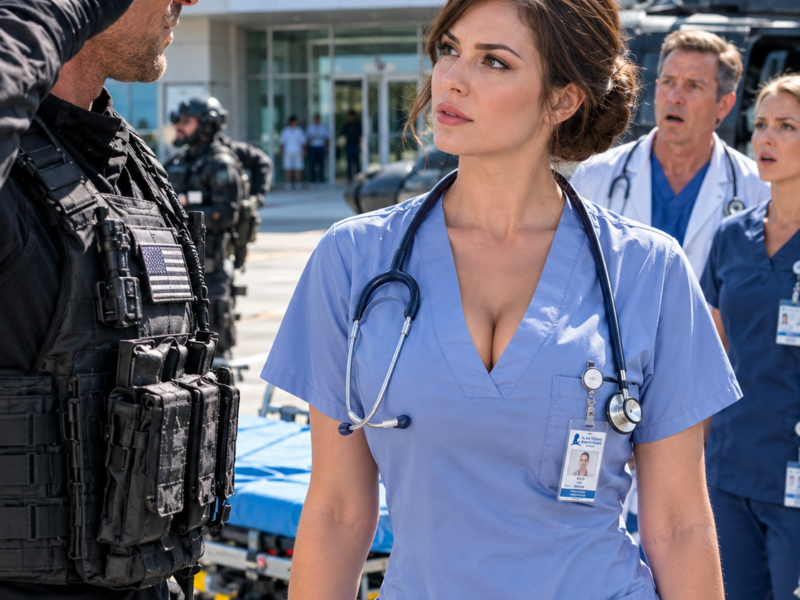
“They laughed when the new supply nurse was ordered to stay behind during the emergency evacuation at Fort Campbell
The colonel held the identification card between two fingers, waiting for me to say something.
I couldn’t.
For three years, I had trained myself not to say Daniel Cross’s name aloud.
Not because I had forgotten him, but because remembering him meant remembering the last night of Operation Iron Lantern.
I remembered the rain hitting the metal roof of a field hospital.
I remembered the smell of blood, diesel fuel, and burned wiring.
And I remembered Daniel gripping my wrist while I tried to keep him alive.
“Emily.”
The colonel’s voice brought me back.
I looked up.
“Who are you?”
He straightened.
“Colonel Marcus Hayes. Special Medical Operations Command.”
He glanced at the officers behind him.
“We need to speak somewhere private.”
Captain Reeves stepped forward.
“Sir, with respect, this is my medical station. I need to understand why your personnel have landed here without prior coordination.”
Colonel Hayes finally looked at him.
“Captain, your understanding is not required at this moment.”
Reeves stiffened.
Sergeant Morrison shifted his weight.
I noticed his right hand moving toward the pocket of his uniform.
It was a small movement.
But I had spent years learning to recognize small movements that meant trouble.
“Sergeant,” I said quietly.
He looked at me.
“Take your hand out of your pocket.”
His face turned red.
“Excuse me?”
“Your hand. Take it out.”
For a second, nobody moved.
Then he slowly withdrew it.
He was holding a small black flash drive.
Colonel Hayes noticed it immediately.
“Sergeant Morrison, place that on the table.”
Morrison tried to smile.
“It’s just personal property, sir.”
“Then you won’t mind leaving it where it is.”
The sergeant looked toward Captain Reeves.
That glance told me more than his explanation would have.
Reeves looked away.
The colonel gestured to two military police officers.
“Secure the device. Nobody leaves this station until we’ve completed the initial review.”
Morrison’s confidence disappeared.
“This is ridiculous. I’ve done nothing wrong.”
I looked at the medical case again.
Daniel’s handwriting was still visible.
Don’t let them bury the truth.
“Colonel,” I said, “where is Daniel?”
Hayes took a slow breath.
“He’s alive.”
The words landed harder than any explosion I had ever heard.
I gripped the edge of the table.
“Where?”
“At a secure medical facility outside Nashville. He’s stable, but his condition is complicated.”
“Why didn’t he contact me?”
“Because for the past three years, Daniel has been unable to safely identify everyone involved in what happened during Operation Iron Lantern.”
I stared at him.
“What happened?”
Hayes glanced toward the officers.
“That’s what we need your help understanding.”
He opened the medical case and removed a thin folder.
Inside were photographs, transport records, and copies of classified medical reports.
The first photograph showed an overturned military vehicle in a muddy ravine.
The second showed a field medical station.
The third showed Daniel lying on a stretcher.
His face was pale, his uniform soaked with blood.
I remembered that moment.
I remembered telling him to keep his eyes open.
I remembered him whispering something I couldn’t hear over the helicopters.
I had believed he died before reaching the evacuation aircraft.
“His official record says he was killed during extraction,” Hayes explained.
“It was a deliberate misclassification. He survived, but the medical team that received him was instructed to transfer him under a different identity.”
“Who gave that order?”
“We’re still establishing the chain of command.”
I turned another page.
A familiar name appeared.
Captain Daniel Reeves.
I read it twice.
Then I looked toward the man standing beside the supply tent.
Captain Reeves was watching me.
His expression had become unreadable.
“That’s you,” I said.
He swallowed.
“Emily, you need to understand something.”
“I understand that your name is on a classified transfer authorization connected to Daniel Cross.”
“It wasn’t what you think.”
“Then tell me what it was.”
Colonel Hayes raised one hand.
“Not here.”
But I wasn’t ready to let it go.
“Three years ago, I watched a man I loved disappear into a military transport. I was told he died. Now I find out someone signed paperwork to make that death official. I think I’ve earned an explanation.”
The colonel didn’t interrupt.
Reeves looked down.
Finally, he said, “I was ordered to sign it.”
“By whom?”
He hesitated.
“General Thomas Whitaker.”
I knew the name.
Whitaker had been the commanding officer responsible for the regional medical evacuation network during Operation Iron Lantern.
He had also been one of the last senior officers to review our casualty reports.
“Why would a general hide a surviving soldier?”
Reeves rubbed his forehead.
“Because Daniel discovered that medical supplies were being diverted before they reached field hospitals.”
I looked at the missing tourniquet report in my hand.
The same pattern.
The same careless paperwork.
The same missing equipment.
“How much was being diverted?”
“Enough to leave multiple units short during active operations.”
“Who was receiving it?”
Reeves didn’t answer.
The colonel did.
“A private logistics contractor called Meridian Tactical Solutions.”
The name sounded familiar.
I searched my memory.
During Iron Lantern, several supply shipments had arrived with altered manifests.
Some crates were marked as emergency trauma equipment but contained ordinary medical supplies.
Others never arrived at all.
Daniel had noticed the discrepancies.
He had started keeping copies of every shipment record.
Then the ambush happened.
I remembered his warning that night.
He had told me not to trust the evacuation paperwork.
At the time, I thought he was delirious.
Now I understood he had been trying to tell me something.
“Where are those records?” I asked.
Hayes closed the folder.
“Daniel kept a copy before the incident. We believe he hid it somewhere accessible to someone he trusted.”
I stared at the note.
“Me.”
The colonel nodded.
“That’s why we came.”
A gust of wind swept through the tent.
Behind us, soldiers were still standing near the helicopters, waiting for instructions.
I looked at Sergeant Morrison.
He had gone unusually quiet.
“Why was he carrying a flash drive?”
Hayes turned toward him.
“That’s one of the questions we’re investigating.”
Morrison suddenly spoke.
“I was following orders.”
The colonel didn’t respond.
The sergeant looked at me.
“You don’t understand how this works, Carter.”
I almost laughed.
For six months, he had treated me like someone who couldn’t lift a medical box without help.
Now he was trying to explain the military to me.
“Then help me understand.”
He looked toward Reeves.
Reeves said nothing.
Morrison lowered his voice.
“You think this is about two missing tourniquets? It’s bigger than that. People have been losing careers over this for years.”
“People have been losing their lives, too,” I replied.
He looked away.
For the first time, I saw something other than arrogance in his face.
Fear.
Colonel Hayes ordered the military police to take Morrison into temporary custody.
Then he turned to me.
“We need you to come with us.”
I looked at the folder.
“To see Daniel?”
“Yes.”
I didn’t hesitate.
But before I could leave, Captain Reeves stepped closer.
“Emily, please.”
I stopped.
He looked exhausted.
“There’s something else you should know.”
The colonel’s expression hardened.
“Captain, this is not the time.”
“She deserves to know.”
Reeves looked directly at me.
“The supply records you found this morning weren’t the first ones.”
I waited.
“Someone had been altering them for weeks. I noticed it, but I didn’t report it.”
“Why?”
“Because my signature was on several of the earlier inspections.”
I stared at him.
“Did you knowingly approve unsafe equipment?”
His eyes filled with shame.
“I thought the shortages were temporary. I thought the missing supplies were being replaced before anyone needed them.”
“And when you realized they weren’t?”
He couldn’t meet my eyes.
“I was afraid.”
The answer made me angrier than a denial would have.
I turned away.
“Then I hope you find the courage to tell the truth before someone else gets hurt.”
We left the station.
The ride to the medical facility took just over two hours.
I spent most of it looking out the window.
The colonel sat across from me.
He didn’t try to fill the silence.
Eventually, I asked the question I had been avoiding.
“Did Daniel know I thought he was dead?”
Hayes nodded.
“He did.”
“Then why didn’t he contact me?”
“Because the people who concealed his survival had access to military communication records. Any direct contact could have exposed his location.”
I looked down at my hands.
Three birthdays had passed.
Three Christmases.
I had stood beside a small memorial plaque bearing his name.
I had written letters I never sent because I couldn’t decide whether they were for him or for myself.
And all that time, he had been somewhere alive.
“Did he ask about me?”
The colonel paused.
“Every time he was able to speak.”
I turned toward the window again.
I didn’t want the colonel to see me cry.
When we arrived, a nurse met us at the entrance.
She led us through a quiet corridor to a private room.
A man sat near the window in a wheelchair.
His hair was shorter than I remembered.
There were scars along his neck and one side of his jaw.
His right hand rested on a blanket.
For a moment, I couldn’t connect the man in front of me with the soldier I had once known.
Then he turned.
His eyes were the same.
“Hey, Viper.”
I covered my mouth.
Daniel smiled weakly.
“Still terrible at saying hello?”
I crossed the room.
I wanted to hug him.
I wanted to hit him.
I wanted to ask why he had let me bury him in my mind for three years.
Instead, I stood beside his wheelchair and touched his shoulder.
“You were dead.”
His smile disappeared.
“I know.”
“I buried you.”
“I know, Emily.”
“Do you have any idea what that did to me?”
He lowered his eyes.
“No. Not completely. But I know I don’t have the right to ask you to forgive me.”
For several seconds, neither of us spoke.
Then I leaned forward and rested my forehead against his.
He smelled different.
There was antiseptic on his clothes and a faint trace of the coffee he had always hated.
But he was warm.
He was real.
And that was enough for one moment.
When I finally pulled away, he gestured toward a small cabinet beside the bed.
“There’s something I need you to see.”
He reached inside and removed a folded piece of paper.
It was an old shipping manifest.
The paper had yellowed around the edges.
At the bottom was a handwritten signature.
Mine.
I looked up.
“I never signed this.”
“I know.”
The document listed emergency trauma supplies scheduled for delivery to our field hospital during Operation Iron Lantern.
But the quantities had been changed.
A shipment containing 120 tourniquets had been reduced to 24.
The remaining equipment had supposedly been redirected to another facility.
The authorization carried my name.
My identification number.
And a signature that looked almost exactly like mine.
I felt cold.
“Who made this?”
“That’s what I spent three years trying to prove.”
Daniel opened another folder.
Inside were copies of several manifests.
Different dates.
Different facilities.
The same forged authorization.
My name appeared on every one.
“Why would they use my identity?”
“Because you were the medic who reported the missing supplies during the operation.”
He watched my face.
“They needed someone to blame if the investigation reached the medical team.”
I looked at the papers.
Suddenly, the reason I had been transferred to Fort Campbell became clearer.
My quiet assignment hadn’t been entirely a coincidence.
Someone had wanted me somewhere they could monitor.
“Who knew where I was?”
“Several people.”
He handed me a photograph.
It showed General Whitaker standing beside a civilian man in a dark suit.
I recognized the civilian.
He was the regional director of Meridian Tactical Solutions.
On the back of the photograph, Daniel had written a date.
The day before the ambush.
“Daniel, why were you investigating them?”
He took a breath.
“Because the missing supplies weren’t just being sold. Some were being redirected to facilities that didn’t exist.”
I looked at him.
“What?”
“Paper hospitals. Fake medical units. Entire supply destinations created on government records so the contractor could bill for equipment that never reached a real patient.”
He paused.
“Some of the equipment was then sold through private channels.”
The room seemed smaller.
I thought of the soldiers who had waited for tourniquets that never arrived.
The medics who had opened empty bags.
The people who had trusted that the supplies were there because somebody had signed a form saying they were.
“How many people knew?”
“Enough to make this dangerous.”
He looked toward the door.
“There’s something else.”
Before I could ask, Colonel Hayes entered with a tablet.
“We’ve received a preliminary update from the base.”
He placed the tablet on the table.
A photograph showed Sergeant Morrison being escorted into a military police vehicle.
Below it was a report.
The flash drive had contained copies of recent inventory records, personnel communications, and an encrypted file.
Hayes tapped the screen.
“The encrypted file was accessed remotely less than ten minutes ago.”
Daniel’s expression changed.
“From where?”
“Fort Campbell.”
I stared at the screen.
“Someone is still inside the base.”
Hayes nodded.
“And they know we’ve recovered the records.”
The colonel turned to Daniel.
“Can you identify the person who accessed it?”
Daniel studied the technical report.
Then he pointed to a name.
Captain Daniel Reeves.
I felt my stomach tighten.
“Reeves?”
Hayes looked at the time stamp.
“That account was used to access the file.”
“Could someone else have used his credentials?” I asked.
“Possibly.”
Daniel closed his eyes.
“Don’t assume Reeves was working alone.”
The colonel called his team.
Within minutes, the facility was placed under additional security.
But I couldn’t stop thinking about the captain.
His confession had sounded genuine.
His fear had seemed real.
Still, the evidence pointed toward him.
I remembered his eyes when I had told him people were losing their lives.
Maybe guilt wasn’t proof of innocence.
Maybe it was simply guilt.
That evening, Daniel asked me to sit with him.
The colonel had left to coordinate the investigation.
For the first time since our reunion, we were alone.
“I should have found a way to tell you,” Daniel said.
I looked at the window.
“Yes.”
“I thought keeping you out of it would protect you.”
“You don’t get to make that decision for me.”
“I know.”
He rubbed his injured hand.
“After the ambush, I woke up in a military hospital. The people treating me said my survival had to remain classified. They told me the operation was still active and that any contact could expose the investigation.”
“Did you believe them?”
“At first.”
“And later?”
He looked at me.
“Later, I realized I was being kept quiet because I knew too much.”
I swallowed.
“Then why didn’t you escape?”
He gave a tired smile.
“I could barely walk.”
That answer broke through some of my anger.
He had spent three years recovering from injuries I had never known existed.
He had missed birthdays, holidays, and ordinary mornings.
And I had spent those same years trying to learn how to live without him.
Neither of us had been given the truth.
But that didn’t erase the hurt.
“I don’t know what happens between us now,” I said.
Daniel nodded.
“Neither do I.”
For once, he didn’t try to promise something he couldn’t guarantee.
The next morning, Colonel Hayes returned with new information.
A federal investigative team had identified an active network of fraudulent supply orders connected to Meridian Tactical Solutions.
They had also discovered that several officers had approved transfers without proper documentation.
General Whitaker was no longer responding to official communications.
A search warrant had been issued for his residence and office.
But the most important discovery came from a file recovered from the black flash drive.
It contained an audio recording.
Hayes played it in the conference room.
At first, there was only static.
Then a man’s voice.
General Whitaker.
“The shipment has to be redirected before the audit.”
Another voice answered.
“That leaves the field hospital short.”
Whitaker replied, “The casualty report will reflect what we need it to reflect.”
The recording continued for another thirty seconds.
Then a familiar voice spoke.
Captain Reeves.
“I won’t sign another false report.”
There was a pause.
Whitaker said, “You’ve already signed enough to make yourself part of this.”
The recording ended.
I stared at the tablet.
Reeves had been involved.
But he had also tried to refuse.
“Where is he now?” I asked.
Hayes checked his phone.
“Military police are looking for him.”
Then another message appeared.
Captain Reeves had voluntarily reported to the federal investigative office.
He had requested legal counsel and offered to provide testimony.
I leaned back.
The story was becoming more complicated than I wanted it to be.
Reeves hadn’t been innocent.
But perhaps he wasn’t the person who had been pulling all the strings.
Two days later, the investigation reached a turning point.
Federal agents located General Whitaker at a private airfield outside Nashville.
He was preparing to leave the country.
His vehicle contained several hard drives, cash, and documents connecting him to Meridian Tactical Solutions.
The contractor’s offices were searched.
Investigators recovered duplicate shipping records, forged signatures, and payment schedules.
Among the documents was a list of military personnel whose identities had been used to approve fraudulent transactions.
My name appeared near the top.
So did Daniel’s.
The evidence established that the supply diversion had continued for years.
Several people had benefited financially.
Others had remained silent because they feared losing their positions or facing prosecution.
And some, like Daniel, had tried to expose it.
The truth didn’t arrive as one dramatic confession.
It came through hundreds of pages, recorded conversations, bank transfers, and testimony.
But it was enough.
General Whitaker and several executives were arrested.
Meridian Tactical Solutions lost its government contracts.
The military began a full review of its emergency medical supply system.
Captain Reeves agreed to cooperate with investigators.
He admitted signing false reports under pressure and failing to report the shortages when he first discovered them.
He was suspended pending disciplinary proceedings.
Sergeant Morrison was found to have knowingly altered inventory records and concealed shortages.
The black flash drive had contained copies of communications between him and a Meridian employee.
He had not been the mastermind.
But he had helped keep the system running.
When the investigation became public, I received a call from a military attorney.
They wanted me to testify about the missing equipment at Fort Campbell.
I agreed.
Not because I wanted revenge.
Because the next nurse who opened a medical bag deserved to find everything she needed inside.
The hearing took place several weeks later.
Daniel attended in a wheelchair.
He wasn’t required to testify that day, but he insisted on being there.
I sat before the panel and described the inventory discrepancies.
I explained how I had reported the missing tourniquets and the expired equipment.
I showed them the records I had found.
Then I explained that the same patterns had appeared during Operation Iron Lantern.
One officer asked why I had waited so long to challenge the official account.
I looked at him.
“Because I was told the man I was trying to save had died, and I had no reason to believe the paperwork was false.”
The room went quiet.
I continued.
“I trusted the system to tell me the truth. I trusted that a medical supply inspection meant someone had actually inspected the supplies. And I trusted that a casualty report meant someone had cared enough to record what happened accurately.”
I placed the forged manifest on the table.
“Those signatures were not mine.”
The panel accepted the document into evidence.
For the first time in three years, my name was no longer being used to hide someone else’s actions.
After the hearing, I found Daniel waiting in the hallway.
He held two paper cups of coffee.
I took one.
“Still hate hospital coffee?” I asked.
“Absolutely.”
I smiled.
It was the first time I had smiled without forcing it in weeks.
He looked at me carefully.
“Thank you for coming.”
“I wasn’t doing it for you.”
“I know.”
We stood together for a moment.
Then he said something I hadn’t expected.
“I’ve been thinking about going back to medical work.”
I turned toward him.
“You’re not even walking without assistance yet.”
“I know. I have a lot of physical therapy ahead.”
“Daniel.”
He laughed softly.
“Not tomorrow. Maybe someday.”
I looked at the man who had once carried injured soldiers through gunfire and had spent years learning how to lift a coffee cup without pain.
“Then start with getting stronger.”
He nodded.
“One day at a time.”
For the next few months, I continued working at Fort Campbell.
The supply department was reorganized.
Every emergency kit received a new inspection procedure.
No single person could approve a shipment and certify its arrival without independent verification.
The base also established a confidential reporting channel for medical personnel who discovered discrepancies.
The first time I saw a young nurse use it, I felt something loosen inside me.
The system wasn’t perfect.
But it was beginning to listen.
Sergeant Morrison eventually faced a military court.
He received a sentence that included confinement, loss of rank, and dismissal from service.
During the proceedings, he admitted he had altered records because he believed nobody would check them.
He also admitted he had underestimated the people responsible for checking them.
Captain Reeves received disciplinary action for his role in approving false records and failing to report the shortages.
He was removed from his position and barred from supervising medical logistics.
Before leaving Fort Campbell, he approached me outside the medical building.
“I owe you an apology.”
I didn’t answer immediately.
He looked older than he had a few months earlier.
“I knew some of those kits were incomplete,” he said. “I convinced myself the replacements were coming. When they didn’t, I signed another report because I was afraid of what the first one would reveal.”
I watched him struggle to find the next words.
“I let my career become more important than the people who depended on us.”
I nodded slowly.
“That’s what you did.”
He looked down.
“I don’t expect you to forgive me.”
“Good. Because I don’t know if I can.”
He accepted that without arguing.
Then he walked away.
I watched him disappear around the corner.
For a long time, I had thought justice would feel like anger finally finding somewhere to go.
Instead, it felt quieter.
It was the knowledge that the truth had been recorded, that the lies could no longer protect the people who made them, and that the next generation of medics might not have to fight the same battle.
Daniel’s recovery was slower than either of us wanted.
Some mornings, he needed help getting out of bed.
Other days, the pain made him cancel physical therapy.
We argued occasionally.
He hated being treated like a patient.
I hated watching him push himself too hard.
But we learned to talk about things before silence turned them into something bigger.
One afternoon, several months after the investigation began, I visited him at a rehabilitation center.
He was standing beside the parallel bars without assistance.
His legs shook.
His face was covered in sweat.
But he was standing.
When he saw me, he smiled.
“Don’t say anything.”
“I wasn’t going to.”
“You’re thinking it.”
“I’m thinking you should probably sit down before you fall over.”
He laughed.
Then he took one careful step.
And another.
I didn’t clap.
I didn’t make a speech.
I simply stayed beside him until he reached the end of the bars.
When he finally sat down, he looked at me.
“Remember when you used to tell me that a good medic doesn’t promise someone everything will be okay?”
I nodded.
“I told you that we just keep them alive long enough to find out.”
He smiled.
“I think I finally understand.”
I sat beside him.
For three years, I had believed the most painful thing about losing Daniel was that I never got to say goodbye.
Now I understood something else.
The hardest part had been learning to live inside a story that someone else had written for me.
They had given me a date, a report, and a name on a memorial plaque.
They had expected me to accept those things as the truth.
But the truth had been waiting in a handwritten note, a forgotten medical record, and a man who refused to let his silence become permanent.
About a year after the helicopters landed at Fort Campbell, I returned to the supply room where everything had begun.
The shelves were organized.
The emergency kits were sealed and inspected.
A young nurse named Sarah was checking the inventory clipboard.
She looked up when I entered.
“Morning, ma’am.”
“Morning. Everything ready for the field teams?”
“Yes. I checked every kit myself, and Sergeant Miller verified the count.”
I glanced at the supplies.
“Good.”
She hesitated.
“Can I ask you something?”
“Of course.”
“Is it true you were the nurse those helicopters came looking for?”
I looked at her.
The old nickname had traveled farther than I expected.
“Something like that.”
She smiled.
“I heard they called you Nurse Viper.”
I picked up a sealed trauma kit and checked the label.
“They did.”
“Why?”
I thought about Daniel.
About the people we had lost.
About the people who had survived because someone refused to give up.
Then I looked at Sarah.
“Because sometimes the quietest person in the room is paying attention to things everyone else has stopped noticing.”
She considered that.
Then she returned to her inventory sheet.
I left the supply room and stepped into the morning sunlight.
A helicopter passed high above the trees.
For a moment, I watched it disappear beyond the training field.
The sound no longer reminded me of the night I lost Daniel.
It reminded me of the morning I learned that being underestimated was not the same as being powerless.
My uniform still carried the same name.
Emily Carter.
My official job title still said nurse.
And I still spent part of every day checking boxes, counting supplies, and making sure every emergency bag was ready.
I didn’t need a different title.
I didn’t need another helicopter landing.
I had finally learned that the work mattered even when nobody was watching.
And somewhere down the hall, a young nurse was checking a tourniquet twice because she understood that one small detail could be the difference between a soldier coming home and a family receiving a phone call.
I smiled and continued down the corridor.
This time, nobody needed to ask where Nurse Viper was.
THe end.









