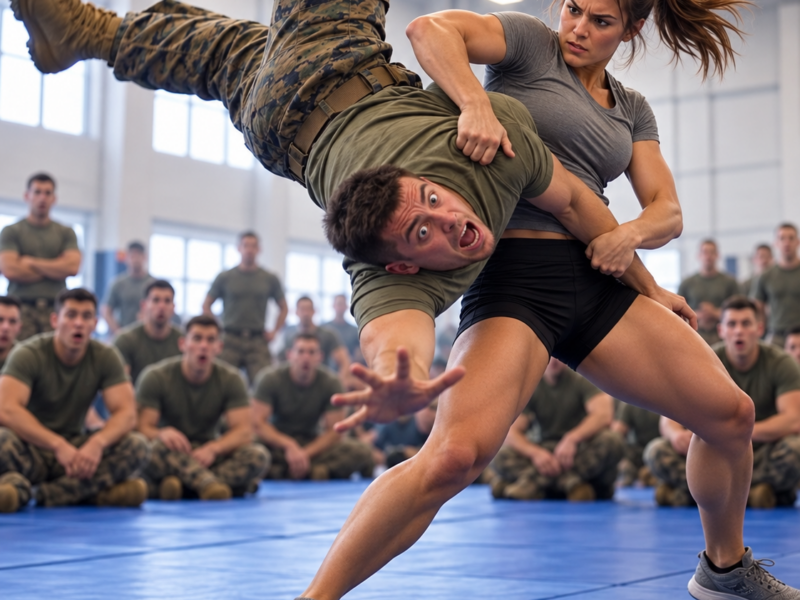
They called me the “weakest link” on the team three days before the mission. They laughed when I struggled through the final endurance drill
The eastern drainage cut was narrower than it had looked on the map.
Jagged rock pressed against both sides, and loose gravel shifted beneath our boots with every step. Behind us, gunfire echoed across the valley. Ahead, the darkness swallowed the route so completely that I could barely distinguish the ground from the walls around it.
“Tell me again why we’re following the intelligence specialist into a hole in the ground,” Staff Sergeant Logan Pierce muttered.
“Because the alternative is standing in the open while armed men close in on us,” I replied.
“Comforting.”
“You’re welcome.”
Corporal Mason Cole let out a short, nervous laugh. It was the first time I had heard him laugh without someone else being the target.
Chief Warrant Officer Daniel Mercer raised a hand, and the team stopped. He checked the slope behind us, then looked at me.
“How far to the maintenance track?”
“If the old survey is accurate, roughly six hundred meters.”
“And if it isn’t?”
“Then we’ll know when we reach the end.”
Pierce shook his head. “Outstanding plan.”
I ignored him and checked the handheld receiver clipped to my vest. The strange transmission I had detected at the communications site was still faintly visible, appearing in irregular bursts. It wasn’t a reliable beacon, but the timing suggested that the signal was being relayed from somewhere beyond the eastern ridge.
I had a theory. I needed evidence.
We continued.
At 0231, the drainage cut widened into a shallow ravine. I recognized a distinctive notch in the rock from the older topographic map. We were on the correct route.
“There,” I whispered, pointing toward a narrow opening on the far side.
Mercer moved beside me. “You were right about the route.”
“I hope I’m right about what comes next.”
He studied my face. “What do you mean?”
“The signal has stopped moving. It’s either coming from a fixed relay or someone has switched off the transmitter.”
“Could it be our communications equipment?”
“No. The pattern started before we left the site. And it was coming from the eastern side of the valley.”
Mercer nodded slowly. “Keep tracking it.”
Before I could answer, Shaw called from the rear.
“Movement.”
We froze.
A dark silhouette appeared above the ravine, then another. They were on the ridge line, scanning the ground below. We crouched behind a shelf of rock as a beam of light swept across the ravine mouth.
Pierce leaned close enough for me to hear him whisper.
“They found us.”
“Not yet,” I said. “They’re looking for the route we took, not our exact position.”
“How can you tell?”
“Their lights are following the ridge and the main trail. They’re checking the obvious exits first.”
“And when they finish?”
“Then we need to be somewhere else.”
Mercer gave a small hand signal. We moved deeper into the ravine, keeping low until the light disappeared behind the rocks.
For several minutes, nobody spoke.
Then Cole stumbled.
His knee struck a stone, and he caught himself against the wall with a sharp gasp.
“I’m fine,” he whispered immediately.
But when he tried to put weight on his leg, his face tightened.
Mercer crouched beside him. “How bad?”
“Twisted it. I can move.”
I examined the swelling beginning beneath his trouser leg. He could still walk, but not quickly.
The original plan had depended on speed. Now we had an injured teammate, a missing extraction aircraft, and an unknown number of hostile personnel searching the valley.
Pierce looked at me.
“Your route had better lead somewhere.”
“It does.”
“Then stop looking at that device and get us there.”
I met his gaze. “The device is the reason we know they’re searching the wrong side of the ravine.”
For once, he had no immediate reply.
We reached the end of the cut at 0246. Beyond it stood the remains of an old maintenance structure, half-buried in rock and brush. A narrow track curved around the hillside toward a ridge obscured by low cloud.
I recognized the structure from an engineering overlay I had reviewed before the mission. It had once housed a repeater station supporting a network of remote sensors.
The installation was supposed to have been decommissioned years ago.
I stepped inside.
The door hung crookedly from one hinge. Dust covered the floor, but beneath it were fresh boot prints. A cable ran along the wall to a metal cabinet, and a small indicator light blinked behind a cracked panel.
I stared at it.
“This place isn’t abandoned,” I said.
Mercer joined me. “Can you tell what it’s doing?”
“Not without checking the equipment. But if someone reactivated this station, they may be using it to relay communications through the valley.”
Pierce looked toward the entrance. “Can it call our helicopter?”
“No. The extraction aircraft was never going to come through this network.”
“Then what good is it?”
I turned toward him. “If the station is carrying the transmissions we detected, it might tell us why our radio went dead. It might also tell us who else is operating in this area.”
Mercer made his decision.
“Bennett, assess what you can. Shaw, watch the entrance. Pierce, help Cole settle in. Nobody transmits until we know what we’re dealing with.”
I opened the cabinet and checked the labels. Several had been removed. The equipment itself was old, but a newer module had been installed beside the original control unit. Its casing bore a serial number from a commercial communications supplier.
I photographed the number and compared it with the equipment reference files stored on my tablet.
The module had been purchased through a contracting company that had recently provided technical support to our forward base.
My pulse quickened.
“That’s not local equipment,” I said.
Mercer leaned over my shoulder. “How do you know?”
“The serial number belongs to a unit supplied through a contractor that supports our base. Someone brought this here recently.”
Pierce stepped closer. “Could be legitimate.”
“It could. But if it were part of an authorized installation, it should be listed in the equipment registry. It isn’t.”
I examined the connection logs stored in the module. Most entries were encrypted or incomplete, but one field remained readable: a repeating sequence of time stamps corresponding to brief communication windows.
The times matched the moments our primary radio had experienced interference.
I looked up.
“Chief, I think this station has been interfering with our communications.”
“Accidentally?”
“I can’t prove intent yet. But the timing is too consistent to ignore.”
Mercer studied the log. “Can you identify who activated it?”
“Not from this terminal. The access records have been cleared.”
Pierce swore under his breath.
Then the radio on Mercer’s vest crackled.
A burst of static, followed by a voice.
“Team, this is operations. If you can hear us, acknowledge.”
Mercer snatched the radio closer. “Operations, this is Mercer. We are alive, but our extraction is compromised. Request status and alternate pickup.”
The response broke apart, but we caught enough to understand that command had lost contact with the aircraft shortly after it departed the base.
The helicopter had reported an unexpected diversion. Its crew had not confirmed an arrival at the designated pickup zone.
No one knew where it had gone.
Mercer requested an alternate extraction plan. Operations acknowledged, but warned that they needed a clearer signal before they could coordinate further.
I glanced at the communications module.
“Chief, give me one minute.”
I moved to the opposite side of the cabinet and examined the external connections. The station was routing data through a narrow-band relay. I couldn’t restore the team’s communications from that alone, but I could isolate the local interference source long enough to test whether our radio would reach command.
I disconnected the auxiliary line.
The indicator light went dark.
Mercer tried the radio.
“Operations, this is Mercer. Radio check.”
A moment later, a clear reply came through.
“Mercer, we read you. Signal is improving. State your situation.”
For the first time that night, I heard relief in his voice.
“Operations, we have one injured team member and no confirmed extraction. Request alternate pickup at the eastern ridge. We will transmit our location when secure.”
“Understood. Stand by.”
Mercer lowered the radio and looked at me.
“You just gave us a lifeline.”
“Only temporarily. If that relay was deliberately interfering with us, someone may notice the interruption.”
As if the station had heard me, a small warning light flashed on the newer module.
Then another.
I stared at the panel.
“Everyone away from the cabinet,” I said.
Mercer moved immediately. Pierce grabbed Cole’s equipment case and pulled him toward the rear wall. Shaw took position near the entrance.
A few seconds later, a faint electronic chirp sounded from the module.
I couldn’t tell whether it was an alarm, a status notification, or a routine transmission. But I knew one thing: the system was active, and we had just interrupted it.
We couldn’t stay there.
Mercer ordered the team back onto the maintenance track. Cole leaned heavily on Shaw, his jaw clenched against the pain. I saved the equipment photographs and the recovered log fragments to two separate secure storage devices, then followed the others outside.
At 0304, operations came back on the radio.
“Mercer, we have a possible extraction window. Estimated arrival forty minutes. You must reach the eastern ridge and maintain a clear line of sight.”
“Copy. We are moving.”
I checked the terrain ahead. The maintenance track climbed toward the ridge, but the route narrowed where a rockfall had spilled across the path. Beyond it, the slope opened into a stretch of exposed ground.
It was a bad place to cross.
It was also the only route we had.
“Chief,” I said, “we need to stop before that exposed section.”
Pierce looked over his shoulder. “Of course we do.”
“Look at the ground.”
He followed my gaze.
Fresh tire marks crossed the dust near the rockfall. They were narrow and shallow, as if left by a small utility vehicle. The marks continued toward a cluster of rocks overlooking the track.
“Someone drove through here recently,” I said. “And they stopped above the route.”
Mercer crouched beside the marks. “Could be the people searching for us.”
“Or someone who knew we would use this track.”
The words hung between us.
I pulled up the old terrain image and compared it with the view ahead. There was a second path, barely visible on the eastern side, that curved behind the rocks and joined the ridge farther north. It would add distance and put us on uneven ground, but it would keep us out of the exposed section.
“Alternate route,” I said. “Longer, but safer from the ridge.”
Mercer nodded. “We take it.”
Pierce opened his mouth, then shut it again.
We were halfway along the alternate path when the first shot cracked across the hillside.
The round struck rock well above us.
“Move!” Mercer shouted.
We dropped behind cover. More shots followed, coming from a position beyond the rockfall. I couldn’t see the shooters, but their angle made one thing clear: they had been waiting for someone to use the maintenance track.
Someone had predicted our movement.
And if our route had been predictable, our extraction plan might have been predictable too.
I pressed my radio close to my mouth.
“Operations, this is Bennett. We are receiving fire near the eastern ridge. Do not approach the original pickup zone. Repeat, the original pickup zone is compromised.”
Mercer looked at me. “Can you get a signal from here?”
“Not reliably. But I can send a brief warning if we move higher.”
“Then we move higher.”
The team advanced in short bursts from one piece of cover to the next. Cole’s injured leg slowed us, but he refused to stop. Shaw stayed beside him. Pierce covered the rear, his earlier arrogance replaced by concentrated silence.
At 0322, we reached a shelf of rock overlooking the valley.
The clouds had begun to thin. Below us, small lights moved along the track we had abandoned. There were at least two vehicles and several figures, all converging on the maintenance structure.
I raised my binoculars.
One of the figures was carrying a handheld radio. Another stood beside a vehicle with a distinctive white panel on its door.
I recognized the logo.
It belonged to the same contracting company whose equipment module I had found inside the repeater station.
I lowered the binoculars.
“Chief, we need to report what we found at the station. The people searching this valley may be connected to the equipment.”
Mercer nodded. “Tell operations.”
I transmitted the information in a short burst, including the contractor’s name and the module’s serial number. Operations acknowledged and instructed us to remain concealed while they verified the information.
Then a new voice came over the radio.
It was calm, professional, and unmistakably local to our command network.
“Team Mercer, this is base operations liaison. We have received your report. You are ordered to return to the original pickup zone immediately. The extraction aircraft will meet you there.”
Mercer frowned.
“That contradicts the last instruction,” he said.
I checked the time stamp on the transmission.
“Chief, the message didn’t come through the normal operations channel.”
“How can you tell?”
“The routing code is wrong. It uses an outdated identifier.”
Pierce looked at me sharply. “Could it be a mistake?”
“Maybe. But the same kind of obsolete authorization appeared in the personnel record attached to my assignment.”
Mercer held the radio without answering.
I continued, keeping my voice low. “If someone is using an outdated credential to send us instructions, we cannot assume that message came from our command.”
The radio crackled again.
“Team Mercer, acknowledge your new orders.”
Mercer pressed the transmit button.
“Identify yourself and confirm the current mission authentication code.”
Silence.
Then the voice returned, slightly sharper.
“Mercer, you are delaying an authorized extraction. Proceed to the original pickup zone immediately.”
Mercer released the button.
“That’s not an answer,” he said.
A minute later, operations came through on our verified channel.
“Mercer, disregard the previous transmission. It was not authorized by this station. Maintain your current position. Security review is underway.”
The team fell silent.
Pierce slowly turned toward me.
“You were right.”
It wasn’t an apology, but it was the first time he had said those words.
Before I could respond, the radio carried another message.
“Mercer, we have confirmed an irregular access attempt involving a contractor credential. Do not transmit further sensitive details over open channels. An alternate extraction team is being prepared.”
I looked back toward the valley. The figures around the maintenance structure were no longer moving randomly. Two had taken positions along the track leading to the ridge. Another vehicle was heading toward the western route.
They were trying to close the remaining exits.
The trap wasn’t just a matter of bad intelligence or a missed helicopter. Someone had access to information about our mission, the extraction schedule, and the communications network.
But we still didn’t know whether the compromise had come from inside our command, from the contractor, or from a third party exploiting both.
Mercer gathered us close.
“We have an alternate extraction coming. Until then, we hold this position and protect the injured man. Bennett, keep monitoring the signal. No one acts on an unverified instruction.”
He looked around the group.
“Understood?”
Everyone answered.
Even Pierce.
The next twenty minutes were the longest of my life. We watched the valley as daylight crept over the ridgeline. The hostile figures below continued searching, but none had located our exact position. I tracked their movements and sent only brief, necessary updates through the verified channel.
At 0351, operations confirmed that an aircraft was approaching from the north. Its crew had been briefed on the compromised pickup location and would use a different approach.
We prepared to move.
Then the radio crackled one final time.
“Bennett,” a voice said. “If you want your team to survive, do not board that aircraft.”
My blood went cold.
The transmission used my name, not my rank. The voice was unfamiliar, and the message carried no authentication code.
Mercer looked at me.
“Do you recognize it?”
“No.”
“Could it be a warning from someone who knows what’s happening?”
“Possibly,” I said. “Or it could be another attempt to control where we go.”
Pierce stared at the radio. “So what do we do?”
I looked toward the northern sky, where the first faint sound of rotor blades was beginning to rise above the wind.
“We verify the aircraft through operations. We confirm the crew, the call sign, and the extraction details. Then we decide based on evidence—not fear.”
Mercer nodded. “Operations, confirm inbound aircraft identity.”
The response came quickly. The call sign and crew matched the authorized extraction plan. The aircraft had been dispatched through a separate channel and was approaching from a route that avoided the compromised valley.
“Confirmed,” Mercer said. “We move.”
We reached the designated pickup point shortly before dawn. The aircraft came in low over the ridge, its rotors whipping dust across the rocks. Shaw helped Cole aboard, followed by Pierce and the rest of the team. I climbed in last, keeping the equipment records secured against my vest.
As we lifted away, I looked down at the valley one final time.
The maintenance structure disappeared behind the ridge.
I had no idea who had sent the anonymous warning. I didn’t know who had altered the routing records or why the contractor’s equipment had been installed at a supposedly abandoned site. But I knew the evidence we had recovered could no longer be dismissed as a technical glitch.
When we landed at the forward base, the team was escorted directly to a secure debriefing room. Medical staff took Cole for treatment, and command personnel separated us for individual statements.
I spent nearly three hours documenting the mission, the interference, the unauthorized transmission, and the equipment we had found.
By the time I finished, sunlight had filled the windows.
Mercer waited outside the room.
“You did good work out there, Lieutenant.”
“Thank you, Chief.”
He hesitated, then added, “I should have listened more carefully during the briefing.”
“You listened enough to give us an alternate route.”
“After I let the argument go on too long.”
I considered that. “Next time, we won’t have time to prove who was right. We just need to make sure the best information gets heard.”
He nodded. “That’s fair.”
I thought that would be the end of it.
It wasn’t.
At 1100, command called us into a closed briefing. A senior officer from the investigative staff stood at the front of the room beside a display showing the equipment logs we had recovered. The initial technical review had confirmed that the repeater module was not listed in the approved installation registry. More concerning, a credential associated with a contractor support account had been used to access the system during the hours surrounding our mission.
The investigators were still working to establish who had used it and whether the interference had been deliberate. They made no claim that the contractor’s employees were responsible for the attack, and they warned us not to speculate beyond the evidence.
But one detail had already been verified.
The original extraction schedule had been accessed from an account that should not have had permission to view it.
Someone had crossed a boundary they were never supposed to cross.
The officer turned toward me.
“Lieutenant Bennett, your observations regarding the signal timing and the outdated routing identifier were critical. Without those details, we might not have connected the field equipment to the communications disruption.”
Pierce sat very still beside me.
The officer continued. “Your team’s actions preserved the evidence and allowed us to identify a serious security concern. The investigation remains open, but the information you provided has changed its direction.”
When the briefing ended, I stepped into the corridor. Pierce caught up with me near the stairwell.
“Bennett.”
I turned.
He looked uncomfortable, as if the words he needed to say weighed more than his equipment.
“I was wrong about you.”
I waited.
“I judged you by the endurance course and decided you weren’t cut out for the job. I treated your concerns like excuses because I didn’t understand what you were seeing.” He glanced toward the closed briefing room. “If we’d gone back to that original pickup zone, I don’t know what would have happened.”
“Neither do I.”
“I owe you an apology.”
“Yes,” I said. “You do.”
He nodded, accepting the answer.
“I’m sorry, Lieutenant. For the comments, for the way I treated you, and for making it harder for you to do your job.”
I studied him for a moment. “I accept the apology. But you need to remember something. The next person you dismiss might be the person who sees the danger before anyone else does.”
“I will.”
I left him standing there.
The investigation continued for weeks. The unauthorized account was traced to a compromised contractor credential, but investigators could not initially determine whether the account had been misused by an insider or accessed by someone outside the organization. Several contracts and system permissions were suspended while the review proceeded. The team was cleared of responsibility for the compromised extraction, and the communications procedures were revised to require independent verification when mission-critical instructions arrived through unusual routing paths.
No one announced that we had uncovered a grand conspiracy. There was no dramatic arrest in front of the entire base, no convenient confession, no single person who explained every unanswered question. The facts were serious enough without adding things we couldn’t prove.
The anonymous warning was never conclusively attributed. Investigators considered the possibility that it had come from someone trying to protect us, but they could not verify the sender’s identity. It remained an unresolved lead.
I returned to my work with a different understanding of the people around me. Cole, once he had recovered, thanked me for noticing his injury early and adjusting our pace. Shaw began asking more questions during intelligence briefings. Mercer made it a point to ensure that every team member could raise a concern without being mocked for it.
Pierce changed more slowly. He was still blunt, still demanding, and still convinced that preparation mattered more than comfort. But he stopped confusing physical toughness with judgment. During a later briefing, when a junior analyst raised a concern about a route, Pierce was the first person to say, “Let her finish.”
I noticed.
I also noticed that nobody called me the weakest link anymore.
A month after the mission, I returned to the endurance course. I ran it again, not because I needed to silence Pierce or prove that I belonged, but because I wanted to improve. I finished faster than before, though I still wasn’t the fastest in the group.
When I crossed the line, Mercer checked his watch.
“Better,” he said.
“Still work to do.”
“There’s always work to do.”
Pierce handed me a bottle of water. “For the record, I still hate running.”
“That makes two of us.”
He gave a reluctant smile.
For a brief moment, we were simply teammates—not a group divided into the strong and the weak, the fighters and the thinkers, the people whose skills were obvious and the people whose work went unnoticed until something went wrong.
That night in the valley had taught me something I wished I had understood earlier. Being underestimated hurts, but the greater danger is allowing someone else’s opinion to make you doubt the value of what you know. I had not saved the team because I was secretly the strongest person among them. I had helped them survive because I paid attention, questioned assumptions, and kept thinking when the original plan collapsed.
The extraction had gone wrong long before we reached the pickup zone. We simply hadn’t known it yet.
And when the moment came, the difference between a team that survived and a team that didn’t was not who could shout the loudest or run the fastest.
It was who could recognize the truth, speak up under pressure, and trust the evidence even when everyone else wanted an easier answer.
I still remember the moment Mercer turned to me in the darkness and said, “Then lead us.”
Not because it made me feel powerful.
Because it meant that, at last, the team was listening.
And that was the night I stopped trying to prove I wasn’t the weakest link—and started understanding that a team is only as strong as its willingness to hear every member before it’s too late.
The end.









