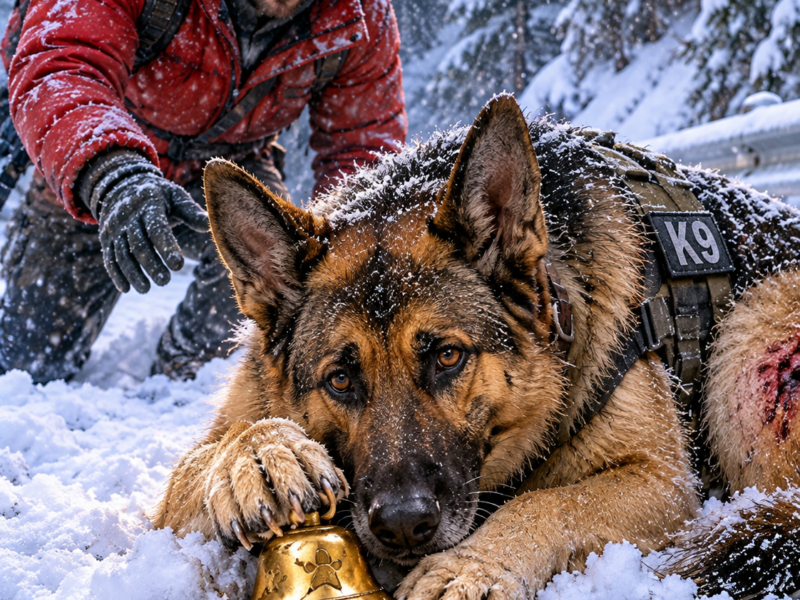
“The wounded K9 collapsed in the middle of a rain-soaked road in Afghanistan, and when I, a Navy SEAL, reached for the dying dog
The phone vibrated again in my hand.
Commander Hayes didn’t move, but his eyes followed the screen.
“Who sent that?” he asked.
“I was hoping you could tell me, sir.”
He extended his hand once more.
“Peterson, give me the phone.”
I slipped it into my pocket.
“With respect, sir, I’d like to know why someone knows what happened to that dog before the investigation has even started.”
Hayes stared at me.
For several seconds, neither of us spoke. Behind the glass doors, medical personnel moved quickly around the operating room where Rex was fighting for his life.
Then Hayes lowered his voice.
“You’re making a mistake.”
“Maybe. But I’m not handing over evidence without knowing what it is.”
His expression changed. It wasn’t anger exactly. It looked more like disappointment, as if he’d expected me to obey without asking questions.
“Go back to your quarters, Peterson. That’s an order.”
I gave him a brief nod.
“Yes, sir.”
I turned and walked away.
But I didn’t go to my quarters.
I went straight to the medical wing.
Miller was in intensive care, unconscious and connected to enough equipment to make the room look like a control station. A young nurse stood outside his door, checking his chart.
“Can I see him?”
“Family only, unless you’re assigned to his unit.”
“I’m the one who found him.”
She studied my face, then glanced at the chart.
“Five minutes. He’s not awake, and you can’t disturb him.”
I stepped inside.
Miller looked younger without his helmet. Maybe thirty, with a narrow face and a pale scar running from his left eyebrow toward his temple.
His uniform had been removed, but someone had placed his identification tags on the bedside table.
I leaned closer.
“Sergeant Miller? My name is Daniel Peterson. I found you and Rex.”
Nothing.
I waited.
“Your dog made it to surgery. He’s getting the best care we can give him.”
A faint movement crossed Miller’s fingers.
I looked at the monitor.
His heart rate had increased.
I leaned closer.
“Can you hear me?”
His lips moved.
I bent down until I could hear him.
“Don’t trust…”
He stopped to catch his breath.
“Don’t trust who?”
His eyelids fluttered.
“Hayes.”
Then the monitor began sounding faster, and the nurse hurried into the room.
“Sir, you need to step outside.”
I backed away, but Miller’s hand suddenly closed around my wrist.
His grip was surprisingly strong.
“Rex,” he whispered.
“He’s alive. I promise.”
Miller’s eyes filled with tears.
“Not just the dog.”
I looked at him.
“What do you mean?”
But the nurse was already guiding me toward the door, and Miller slipped back into unconsciousness.
I spent the next hour trying to understand those four words.
Not just the dog.
There was something else.
Something that had traveled with Rex, something important enough that men had been willing to shoot a military working dog to get it back.
At 02:17, my phone received another message.
This time, it was a video.
The footage was grainy, apparently recorded by a security camera inside a hangar.
I watched it twice before I understood what I was seeing.
Rex was walking beside a soldier wearing a dark tactical uniform. The dog was younger, healthier, and moving with the confidence of an animal who trusted the person holding his leash.
The soldier stopped near a table.
He placed a small black case on it.
Then he looked directly toward the camera.
It was Miller.
A second man entered the frame.
I couldn’t see his face clearly, but I recognized the way he walked.
Commander Hayes.
The two men spoke for nearly a minute.
Then Hayes placed a folder on the table.
Miller opened it, looked at the contents, and shook his head.
Even without sound, I could read the argument in his body language.
Miller was refusing something.
Hayes leaned forward.
A moment later, he pointed toward Rex.
The video ended.
I stared at the screen.
Why would someone send me this?
And how had they obtained footage from a restricted military facility?
I checked the message details, but the sender was still unknown.
Then I noticed a tiny number in the lower corner of the video.
Camera 04.
November 12.
Six weeks earlier.
The same date as the photograph.
I saved a copy and headed toward the operations building.
I knew I was walking into dangerous territory.
But I also knew that if I waited for permission, the evidence might disappear.
The security desk was empty when I arrived.
I used my credentials to access the records terminal and searched the equipment inventory number from Rex’s capsule.
The system returned a warning.
ACCESS RESTRICTED.
I tried the number again.
The same warning appeared.
Then I searched the operation’s name from the faded patch on Rex’s vest.
The result was stranger.
There was no operation.
Not in the current database.
Not in the archived mission records.
It was as if the entire unit had never existed.
I sat back.
A unit doesn’t simply vanish from military records.
Even classified operations leave administrative traces.
Someone had removed them.
I was still staring at the screen when a voice came from behind me.
“You’re looking in the wrong place.”
I turned.
A woman stood near the doorway wearing a civilian security badge.
She was in her early forties, with dark hair pulled into a tight bun and a folder tucked beneath one arm.
I recognized her from the intelligence briefing room.
Lieutenant Commander Sarah Whitmore.
She worked in military intelligence and had a reputation for being thorough, cautious, and extremely difficult to surprise.
“How long have you been standing there?”
“Long enough to know you shouldn’t be using that terminal.”
I closed the search window.
“Then perhaps you can tell me where I should be looking.”
She glanced at the empty hallway.
“Not here.”
She walked toward the exit.
I followed.
We stopped in a small conference room at the end of the corridor. Whitmore locked the door and placed her folder on the table.
“Did Hayes speak to you?”
“Yes.”
“What did he ask for?”
“The capsule from Rex’s vest.”
She closed her eyes briefly.
“Of course he did.”
I studied her.
“You know what it is.”
“I know what it might contain.”
“That’s not an answer.”
She opened the folder and removed a photograph.
It showed a military working dog standing beside a young woman in civilian clothes.
The dog was Rex.
The woman had one hand resting on his head.
I recognized the small scar near the dog’s left ear.
“Who is she?”
“Specialist Emily Carter. She was assigned to the unit that disappeared from the records.”
“Was?”
Whitmore hesitated.
“Officially, she died six weeks ago.”
I looked at the photograph again.
“Where?”
“During the operation that supposedly ended on November 12.”
“Then why is her name missing from the records?”
“Because her death was never properly reported.”
I stared at her.
“You’re telling me the military lost an entire unit’s personnel records?”
“I’m telling you that someone made sure those records couldn’t be found.”
She took a breath.
“Emily was a communications specialist. She discovered irregularities in mission reports and equipment transfers. At first, she thought it was a bookkeeping problem.”
“And then?”
“Then she found evidence that certain operations were being authorized under false identities. Missions were being conducted without the knowledge of the people whose names appeared on the paperwork.”
I thought about the photograph.
“And Miller?”
“He was her team leader. He tried to report it.”
“To whom?”
“His commanding officer.”
“Hayes?”
Whitmore nodded.
I leaned back in my chair.
“So Hayes knew.”
“He knew enough to understand what Emily had discovered.”
“Why didn’t she go public?”
“Because she believed the evidence needed to be authenticated first. She had copies, but the original files were stored on a secure device.”
I looked toward the photograph.
“The capsule.”
“Possibly.”
“Why put it on a dog?”
Whitmore gave a small, humorless smile.
“Because people search soldiers. They search vehicles. They search bags. They don’t always think to look beneath the vest of an injured working dog.”
I thought of Rex gripping my sleeve in the road.
He hadn’t been trying to stop me from leaving.
He had been trying to make sure I found the capsule.
“Where is Emily now?”
Whitmore looked down at the table.
“We don’t know.”
I waited.
“Her body was never recovered.”
The room seemed smaller.
I looked at the photograph again.
Rex’s ears were pointed forward, and Emily was smiling at the camera.
It was the kind of smile people gave when they believed the person taking the picture was someone they trusted.
“Why are you telling me this?”
Whitmore didn’t answer immediately.
“Because Miller asked for you.”
“When?”
“Twenty minutes ago. He woke up briefly.”
I stood.
“Why didn’t anyone tell me?”
“Because Hayes ordered the medical staff to report any visitors to his office.”
I felt the muscles in my jaw tighten.
“Is Miller safe?”
Whitmore looked toward the door.
“I don’t know.”
Neither did I.
We left the conference room separately.
I returned to the veterinary wing first.
Rex was still in recovery.
A veterinarian named Dr. Lewis met me outside the treatment area.
“He made it through surgery,” she said.
I let out a breath I hadn’t realized I was holding.
“How bad?”
“Two gunshot wounds, a fractured rear leg, and significant blood loss. He’s stable, but the next twenty-four hours will matter.”
“Can I see him?”
“Briefly. He’s sedated.”
I entered the room.
Rex lay beneath a warm blanket, an IV line running into his front leg. His injured leg was wrapped, and a small oxygen tube rested near his muzzle.
I pulled a chair beside him.
“Hey, buddy.”
His ears moved slightly.
I placed my hand near his shoulder.
“You did enough. You can rest now.”
For a moment, I forgot about Hayes, the capsule, and the strange messages.
There was only a wounded dog who had trusted me in the middle of a battlefield.
Then I noticed something on the table beside his medical chart.
A small paper envelope.
My name was written across it.
Not my rank.
Not my unit.
Just:
DANIEL.
I looked toward the doorway.
“Who left this?”
The technician shook his head.
“It was here when we changed his bandage.”
I opened it carefully.
Inside was a folded photograph and a handwritten note.
The photograph showed Miller, Emily Carter, and Rex standing outside a building.
On the back, someone had written:
IF REX TRUSTS YOU, YOU’RE THE ONLY PERSON WE HAVE LEFT.
The note contained just one sentence.
“Ask Miller what happened to the fourth member of the team.”
I read it several times.
The fourth member?
Whitmore had mentioned Emily and Miller, but not a fourth person.
I pulled out my phone and called her.
She answered on the second ring.
“Peterson?”
“There’s something you didn’t tell me.”
Silence.
“What’s that?”
“The fourth member of Miller’s team.”
Her breathing changed.
“Where did you get that?”
“Someone left me a note.”
“Don’t ask Miller about that.”
“Why?”
“Because the fourth member was my brother.”
I didn’t speak.
“His name was Lieutenant David Whitmore,” she continued. “He was listed as killed during the November operation.”
“Was he?”
Another silence.
“I never saw his body.”
Before I could ask anything else, she said, “Daniel, listen to me. Whatever happens, don’t let Hayes get that capsule.”
The call ended.
I looked at Rex.
His eyes were half open.
I sat beside him for several minutes, trying to understand how a single dog had become the center of a mystery involving missing soldiers, falsified records, and an officer who seemed determined to silence anyone who asked questions.
Then the security door opened.
Commander Hayes stepped inside.
“Peterson.”
I stood.
“Sir.”
He looked at Rex, then at the envelope in my hand.
“You’re becoming involved in matters you don’t understand.”
“Then help me understand.”
His expression hardened.
“Give me the capsule.”
“It’s evidence.”
“It’s classified property.”
“Then why was it attached to a wounded dog in the middle of an abandoned road?”
Hayes stepped closer.
“Because the people who put it there were desperate.”
“People like Miller?”
He didn’t answer.
“Or Emily Carter?”
His eyes narrowed.
That was the first time I had seen him lose control of his expression.
Only for a second.
But I saw it.
“Where did you hear that name?”
I looked at him.
“That’s what I’d like to know.”
He glanced toward the veterinary staff.
“Leave us.”
The technician hesitated.
“Sir, the dog is still under medical supervision.”
“I said leave.”
She looked at me.
I gave her a slight nod.
When the door closed, Hayes lowered his voice.
“You have a family, Peterson?”
The question caught me off guard.
“A wife. Two children.”
“Then you understand why some things are better left alone.”
I felt a cold pressure settle in my stomach.
“Are you threatening my family?”
“I’m reminding you that classified investigations have consequences.”
“Then perhaps you should be more concerned about the people who ordered an attack on a military working dog.”
For a moment, Hayes said nothing.
Then he looked at Rex.
“That animal has already caused enough damage.”
I stepped between him and the recovery table.
“He’s a wounded dog.”
“He’s evidence.”
“No. He’s a living creature who nearly died doing his job.”
Hayes stared at me.
Then he turned toward the door.
“You have until morning to turn over that capsule.”
He left without another word.
I waited until his footsteps disappeared.
Then I checked my phone.
A new message had arrived.
It contained a single address and a time.
03:30 A.M.
Underneath was another sentence.
MILLER ISN’T THE ONLY SURVIVOR.
I looked at the clock.
03:06.
I called Whitmore.
No answer.
I tried again.
Still nothing.
Then I received a call from the hospital.
It was Miller’s nurse.
“Peterson, Sergeant Miller is awake. He’s asking for you.”
I reached the intensive care unit in less than five minutes.
Miller was sitting upright, his face pale, one arm immobilized.
When he saw me, he tried to speak.
“Did you find the capsule?”
“Yes.”
“Good.”
I pulled a chair beside his bed.
“Who is the fourth member?”
Miller looked toward the door.
“Sarah told you?”
“She told me her brother was part of your team.”
He closed his eyes.
“David.”
“What happened to him?”
Miller swallowed.
“We were supposed to extract Emily after she secured the original files. David was our communications officer. He knew the route, the coordinates, everything.”
“And the operation?”
“Hayes changed the orders.”
“Changed them how?”
Miller’s hands tightened around the blanket.
“He told us the extraction point had been compromised. We were instructed to move to a secondary location. But the coordinates led us straight into an ambush.”
I leaned forward.
“Who attacked you?”
“I don’t know. They wore no insignia. Their equipment was American.”
My stomach tightened.
“American personnel?”
“Yes.”
Miller looked directly at me.
“They knew our call signs. They knew our positions. They knew when we would arrive.”
“Someone gave them the information.”
He nodded.
“David figured it out first. He recognized the voice on the radio.”
“Whose voice?”
Miller stared at me.
“Hayes.”
I sat back.
“You’re certain?”
“I heard him myself. He ordered the team to stand down, then told the other group to proceed.”
His voice cracked.
“David tried to get a message out. Emily took Rex and the capsule and ran. I stayed behind to cover them.”
“What happened to David?”
Miller looked toward the window.
“I saw him fall. But I never saw him die.”
“Why didn’t you report this?”
“I did. Three times.”
“And?”
“The reports disappeared. The witnesses were transferred. My commanding officer told me I was suffering from combat stress.”
He looked at me again.
“Then Hayes offered me a choice. Sign a statement saying Emily had stolen classified equipment, or face charges for abandoning my team.”
I stared at him.
“Why didn’t you sign?”
“Because Emily was still alive when I last saw her.”
His eyes filled.
“And because Rex was the only one who knew where she went.”
I looked down at the photograph.
“Where was she going?”
Miller shook his head.
“She told me she’d find someone outside the operation. Someone who could verify the original files.”
“Who?”
“I don’t know.”
He paused.
“But she gave Rex a scent marker. Something he was trained to recognize.”
I thought about the way Rex had pulled me toward the overturned vehicle.
“What scent marker?”
Miller looked at the door.
“David’s.”
The room fell silent.
Before I could ask another question, a nurse entered.
“Sir, visiting time is over. Sergeant Miller needs rest.”
I stood.
Miller caught my wrist.
“Peterson.”
I turned.
“If you find David, don’t bring him back here.”
“Why?”
Miller’s eyes were full of something I couldn’t identify.
“Because he may not be the man you remember.”
I left the room with more questions than answers.
At 03:25, I reached the address from the message.
It was an old maintenance building on the edge of the base, long since marked for demolition.
A single light glowed behind a dusty window.
I entered carefully.
“Hello?”
A chair scraped across the floor.
A man stepped out from behind a stack of metal cabinets.
He was tall, thin, and wore a civilian jacket.
His left arm was wrapped in a bandage.
I recognized his face from the photograph.
David Whitmore.
Sarah’s brother.
The man officially listed as dead.
He raised one hand.
“Don’t call anyone.”
I kept my hands visible.
“You’re supposed to be dead.”
He gave a tired smile.
“That was the idea.”
I studied him.
“You sent the messages?”
“Yes.”
“Why me?”
“Because Rex chose you.”
I shook my head.
“That’s not enough.”
David looked down.
“No. It isn’t.”
He walked toward a metal table and placed a small black case on it.
I recognized it immediately from the security footage.
“The original files,” I said.
He nodded.
“Everything Emily found. The real mission logs, the authorization records, the communications archive.”
“Why didn’t you go to the authorities?”
“I did.”
He looked at me.
“And the people I went to reported my location to Hayes.”
I glanced at his injured arm.
“Who shot you?”
“Someone I used to call a friend.”
He opened the case.
Inside was a compact data drive, several printed documents, and a photograph of a group of soldiers standing in front of a helicopter.
There were five people in the photograph.
Miller.
Emily.
David.
Rex.
And Hayes.
I looked at the date.
November 12.
“Why is Hayes in this photograph?”
“Because he was there when the operation began.”
David took a breath.
“He was also there when it ended.”
I studied the documents.
Several mission authorizations carried Hayes’s signature, but the dates did not match the official records.
Some operations had been recorded as training exercises even though they involved live deployments.
Others had been assigned to units that were nowhere near the locations listed.
I recognized a few names.
One belonged to a soldier who had been reported killed in a separate incident months earlier.
Another belonged to an officer who had retired.
“These people were used as cover identities,” I said.
David nodded.
“They were used to authorize missions they never knew about. When something went wrong, the paperwork made it look like they had approved it.”
“Who was responsible?”
David tapped the photograph.
“Hayes wasn’t working alone.”
He turned another page.
At the bottom was a signature I recognized from the command structure.
General Richard Caldwell.
I stared at it.
Caldwell had visited our base twice that year. He was respected, decorated, and widely considered a candidate for a senior leadership position.
“You have proof of this?”
David nodded toward the data drive.
“Every authorization. Every transmission. Every payment.”
“Then why are you hiding in a maintenance building?”
“Because the last time I tried to send the files, the people who received them were dead within forty-eight hours.”
I looked at him.
“What happened to Emily?”
His face changed.
For the first time, he looked less like a man hiding from danger and more like someone who had been carrying a terrible memory for too long.
“She got away.”
“Where is she?”
“I don’t know.”
He swallowed.
“She separated from us near the extraction route. Rex went with her. I was supposed to meet them at a second location, but I never made it.”
“Then how did Rex end up with the capsule?”
“Emily gave it to him.”
I looked down at the black case.
“What’s on it?”
“Not just the files. A recording.”
David reached into his jacket and pulled out a small digital recorder.
“Listen.”
He pressed play.
Static filled the room.
Then a voice came through.
“All units, this is command. Stand down and hold position.”
I recognized the voice immediately.
Hayes.
Another voice responded.
“Command, we have wounded personnel. Requesting immediate extraction.”
Miller.
Then Hayes spoke again.
“Negative. The operation is compromised. Secure the equipment and eliminate the remaining witnesses.”
I stopped breathing for a moment.
The recording continued.
A burst of gunfire.
Someone shouting.
Then another voice, quieter and closer to the microphone.
“Sir, that’s our own team.”
A pause.
Then Hayes:
“They are no longer our team.”
The recording ended.
I looked at David.
“Where did you get this?”
“Emily recorded the transmission. She knew the orders were wrong.”
I looked at the black case.
“Why not release it?”
“Because the recording alone can be challenged. They can claim it was edited, taken out of context, or recorded during a training simulation.”
He pointed to the files.
“The original authorization records connect the orders to the people who approved them.”
I understood.
The capsule wasn’t just carrying evidence.
It was carrying the missing piece of an entire operation.
“Then we need to get this to someone who can authenticate it.”
David nodded.
“Sarah.”
I reached for my phone.
Before I could dial, the building lights went out.
David grabbed the case.
“Down!”
A sharp crack shattered the window.
I dropped behind the table as glass scattered across the floor.
Another shot struck the metal cabinet beside us.
Someone was outside.
I pulled my sidearm and moved toward the rear exit.
“How many?” I whispered.
David shook his head.
“At least two.”
A voice came through a loudspeaker outside.
“Peterson, step away from the building. This is a security order.”
Hayes.
I looked at David.
He was already moving toward a narrow service corridor.
“Go,” he whispered.
We ran through the back exit and crossed the maintenance yard.
A second shot struck the wall behind us.
I heard footsteps.
Then an engine started.
A vehicle was waiting near the far fence.
David stopped.
“That’s not ours.”
A black SUV accelerated toward us.
I pushed him behind a concrete barrier as the vehicle swerved across the yard.
The passenger window lowered.
A man raised a weapon.
I fired once toward the vehicle’s front tire.
The SUV lurched, struck a drainage barrier, and spun sideways.
David grabbed my sleeve.
“Move!”
We reached a service road and kept running until we found an unoccupied storage building.
I called Sarah again.
This time, she answered.
“Daniel?”
“Your brother is alive.”
Silence.
Then I heard her breathing break.
“Where?”
“Not safe to say over the phone. We have the original files.”
“Are you hurt?”
“Not badly.”
“Listen to me. General Caldwell has ordered an emergency security lockdown. Hayes is authorized to seize all classified material on the installation.”
“Then we need someone above him.”
“I know.”
Her voice lowered.
“There’s one person who can help us.”
“Who?”
“Rear Admiral Thomas Reed. He’s arriving at the base at six. He’s leading an independent review of the November operation.”
“Can he be trusted?”
“I believe so.”
I glanced at David.
“Belief isn’t enough anymore.”
“I know,” Sarah said.
Then she gave me a secure meeting location and ended the call.
We had less than three hours.
David sat against the wall, pressing his bandaged arm.
I looked at him.
“Your sister doesn’t know you’re alive.”
“She thinks I died.”
“Why?”
“Because if Hayes knew I survived, he’d use her to find me.”
I understood why he’d stayed hidden.
But I also understood what that silence had cost Sarah.
“She deserves to know.”
David stared at the floor.
“After this is over.”
I didn’t argue.
Sometimes people delay the truth because they believe they’re protecting someone.
Sometimes they’re only postponing the moment when both people have to hurt.
At 05:40, we reached the secure meeting room.
Sarah was already there.
When she saw David, she stopped walking.
For several seconds, she didn’t move.
Then she crossed the room and slapped him.
The sound echoed through the empty hallway.
David lowered his head.
“Sarah…”
She hit his chest with both hands.
“You let me bury you.”
Her voice broke on the last word.
“I stood at your memorial. I listened to people tell me how brave you were. I went home and tried to explain to Mom why her son wasn’t coming back.”
David reached for her, but she stepped away.
“Don’t.”
He nodded.
“I’m sorry.”
Sarah wiped her face.
“You’re alive.”
“Yes.”
She looked at his bandaged arm.
“You’re really alive.”
Then she pulled him into an embrace.
I turned away.
I had seen men return from missions and struggle to tell their families what had happened.
But this was different.
Sarah had spent six weeks grieving someone who had been hiding a few miles away.
At 06:02, Admiral Reed entered with two investigators and a military attorney.
He was in his late fifties, with silver hair and a calm expression.
Sarah introduced us.
I placed the black case on the table.
“Sir, this contains evidence connected to the November 12 operation.”
Reed didn’t touch it immediately.
“Who recovered it?”
“David Whitmore. It was originally secured by Specialist Emily Carter and transported by K9 Rex.”
“Where is Carter?”
“Missing.”
He looked at David.
“Can you authenticate these files?”
David nodded.
“I can identify the original records, the recording equipment, and the authorization chain. The data includes verification signatures from the command server.”
Reed turned to the investigators.
“Secure the room. No network connections. No external transmissions until the files are copied and verified.”
The military attorney opened the case.
For the next hour, we watched as the evidence was examined.
The documents matched archived server records.
The recording matched the transmission logs.
The signatures matched the command authorizations.
And then the investigators found something none of us expected.
A final transmission had been scheduled for November 13.
It had never been delivered.
The recipient was listed as an external contact.
The name was Emily Carter.
The message contained coordinates.
A location outside the village where Rex had been found.
David leaned over the screen.
“That’s where she was supposed to meet us.”
Sarah looked at him.
“Why would the transmission be scheduled after the operation?”
“Because someone wanted her to believe we were still coming.”
I looked at the date.
November 13.
The day after the ambush.
The scheduled message had been canceled manually.
The cancellation authorization belonged to Hayes.
Reed’s expression hardened.
“Get me Commander Hayes.”
One investigator left immediately.
The other continued examining the files.
Then he stopped.
“Admiral, there’s another item.”
He opened a folder labeled PERSONNEL STATUS.
A single name appeared.
EMILY CARTER.
Status: ACTIVE.
Last verified location: Undisclosed.
I stared at the screen.
“She’s alive?”
David gripped the edge of the table.
“That’s impossible.”
The investigator enlarged the record.
“The status was updated three days ago.”
Sarah looked at her brother.
“Who updated it?”
The investigator checked the authorization field.
No name.
Only a temporary access code.
Reed turned to me.
“Peterson, where is the dog?”
“Veterinary recovery.”
“Can he be moved?”
“Not yet, sir.”
He nodded.
“Then nobody goes near him without authorization.”
For the first time since I had found Rex, I felt that someone in command was trying to protect him.
But the relief didn’t last.
The door opened.
Commander Hayes entered with two security personnel.
“Admiral, I understand there’s been an unauthorized seizure of classified material.”
Reed stood.
“You’re relieved of operational authority pending an investigation.”
Hayes looked at the case.
“That material is classified.”
“It is now evidence.”
“You don’t understand what you’re interfering with.”
Reed’s voice remained calm.
“Then explain it.”
Hayes looked around the room.
His eyes stopped on David.
For the first time, I saw something close to fear cross his face.
“You’re supposed to be dead.”
David stood.
“So were the others.”
Hayes looked at the recording equipment.
“Those files are fabricated.”
The investigator spoke.
“We’ve already verified the digital signatures against the archived command server.”
Hayes turned toward him.
“That server was compromised.”
“Then we’ll investigate that too.”
Reed stepped closer.
“Commander, you’re going to surrender your access credentials and remain available for questioning.”
Hayes shook his head.
“You have no idea how many people will be exposed if you release this.”
Reed answered quietly.
“Then perhaps you should have thought about that before ordering an operation against your own people.”
Hayes said nothing.
The security personnel escorted him from the room.
I watched until the door closed.
It should have felt like victory.
It didn’t.
Emily was still missing.
And somewhere, someone had updated her personnel record only three days earlier.
The investigation continued throughout the morning.
By noon, the evidence had been transferred to an independent review team.
General Caldwell had been contacted.
His office issued a statement denying all involvement.
But the documents showed otherwise.
Several officers were suspended.
Two contractors were detained for questioning.
And Commander Hayes was placed under formal investigation.
Miller was moved to a secure medical facility.
David gave a complete statement.
Sarah stayed beside him.
But the question that kept pulling at me was the one nobody could answer.
Where was Emily Carter?
Three days passed.
Rex slowly regained strength.
His leg was healing, although the veterinarian warned that he might never return to full operational duty.
I visited him every evening.
At first, he barely lifted his head.
Then one night, when I entered the recovery room, his tail moved against the blanket.
“Well, look at you.”
I sat beside him.
“You’re getting stronger.”
He pushed his nose into my palm.
I scratched behind his ears.
“Your handler would be proud.”
At the word handler, Rex turned toward the door.
I followed his gaze.
A woman stood in the hallway.
She wore civilian clothes, a gray jacket, and dark jeans.
Her hair was shorter than in the photograph.
There was a scar near her chin.
But I recognized her immediately.
Emily Carter.
I stood slowly.
“Emily?”
She looked at Rex.
The dog began struggling to rise.
“Easy, buddy,” I whispered.
Emily entered the room.
She knelt beside him.
“Hey, partner.”
Rex let out a soft sound and pushed his head against her chest.
She wrapped both arms around him.
For a long moment, neither of them moved.
Then Emily looked at me.
“You’re Daniel Peterson.”
“Yes.”
“Rex chose you.”
I gave a tired smile.
“He made it pretty clear.”
She laughed softly, but tears ran down her face.
“Thank you for bringing him home.”
I pulled a chair closer.
“Where have you been?”
She looked at the floor.
“Moving between safe locations. After the ambush, I couldn’t trust the extraction channels. I knew the capsule had to reach someone who wasn’t connected to the operation.”
“Why not contact David?”
“I tried.”
Her voice became quieter.
“His signal disappeared. I thought he’d been killed.”
“He’s alive.”
She closed her eyes.
“Sarah told me.”
“She’s with him now.”
Emily nodded.
Then she reached into her jacket and pulled out a folded piece of paper.
“There was one more thing I needed to deliver.”
I looked at it.
“What is it?”
“An original authorization.”
She unfolded the document.
It contained the final order from November 12.
The signature belonged to General Caldwell.
But beneath it was a second approval.
A name I hadn’t seen in the other files.
A civilian contractor.
“Who is this?”
“Someone who funded the operation and supplied the personnel who attacked us.”
“Do you know where he is?”
Emily nodded.
“He’s already been detained.”
I looked at her.
“Then why bring this here?”
She glanced down at Rex.
“Because the document proves something else.”
She pointed to the bottom of the page.
A handwritten note had been added beside the authorization.
RETURN THE DOG IF RECOVERED. DO NOT DESTROY.
I read it twice.
“Why would they want Rex alive?”
Emily stroked the dog’s head.
“Because he wasn’t only carrying the capsule.”
She looked at me.
“He was trained to remember a specific scent.”
“The scent marker Miller mentioned.”
She nodded.
“David’s scent.”
“Why?”
“Because David carried the original recording device during the operation. Rex was trained to locate him if the team became separated.”
I looked at the dog.
“So he was trying to find David all along.”
“Yes.”
“Then why did he come toward me?”
Emily gave a faint smile.
“Because you were the first person who helped him without trying to take the capsule.”
I looked down at Rex.
His eyes were closed now, his head resting on Emily’s knee.
For weeks, he had been moving through danger with one purpose.
He had lost his handler.
He had lost his team.
He had been wounded, abandoned, and hunted.
Yet he had kept going.
Not because he understood the conspiracy.
Not because he knew what the documents meant.
He had kept going because he was trained to find his people.
And because somewhere inside that training was something stronger than obedience.
Trust.
A week later, I visited Miller.
He was sitting in a wheelchair near the window, his arm still in a sling.
Sarah stood beside him.
David was there too.
The first time the brothers-in-arms saw each other again, neither said anything.
Miller simply reached out his good hand.
David took it.
“I’m sorry,” David said.
Miller shook his head.
“You’re here.”
That was all.
Sometimes the words people need most are the simplest ones.
The investigation lasted months.
Hayes was eventually charged with conspiracy, obstruction, and the unlawful use of military authority.
General Caldwell resigned before the formal proceedings concluded, though the investigation into his role continued.
The contractors involved were prosecuted.
The original mission records were restored.
Emily testified.
So did Miller and David.
The truth did not bring back the soldiers who had died.
It did not erase the nights their families had spent waiting for calls that never came.
But it gave those families something they had been denied.
An honest account of what happened.
As for Rex, the veterinarians made a decision after several evaluations.
His leg healed well enough for him to walk without pain, but he would never return to active combat duty.
Emily refused to leave him behind.
She requested his retirement and took him home.
A month later, I received an invitation to visit.
Their house was outside Virginia Beach, a modest place with a small fenced yard and a porch that looked out toward a quiet street.
Rex met me at the front door.
He walked with a slight limp, but his tail was moving so hard that his entire body seemed to follow it.
“There’s my guy.”
I knelt, and he pressed his head against my shoulder.
Emily stood behind him, holding two cups of coffee.
“He still waits by the door every afternoon,” she said.
“For you?”
She smiled.
“Sometimes. Mostly for the sound of David’s truck.”
David was helping repair the backyard fence.
Miller visited every weekend.
Sarah had returned to her intelligence assignment, although she now worked with the independent oversight team.
For the first time in months, they were beginning to look like people instead of survivors.
We sat on the porch while Rex lay at my feet.
I asked Emily whether she ever regretted keeping the evidence.
She watched the dog for a moment.
“I regretted the people we lost. I regretted not seeing what was happening sooner. But I never regretted trying to tell the truth.”
I nodded.
“Did you ever think Rex wouldn’t make it?”
She looked down at him.
“Every day.”
Rex lifted his head when he heard his name.
Emily scratched his ears.
“He kept looking for us even when he was hurt. I don’t think he ever understood why we were separated.”
I watched him settle back onto the porch.
Neither did I.
A few months after that visit, I received a package at my home.
Inside was a photograph.
It showed me kneeling beside Rex on the day we found him, my uniform covered in mud, one hand resting on his injured shoulder.
On the back, Emily had written:
SOMEONE HAD TO STOP AND LISTEN.
I placed the photograph on my desk.
My daughter later asked who the dog was.
I told her his name was Rex.
She asked if he was a hero.
I thought about the capsule, the investigation, the men who had tried to silence the truth, and the people who had finally been able to come home.
Then I looked at the photograph again.
“Yes,” I said. “But not because he carried something important.”
I paused.
“Because he never stopped trying to find the people he loved.”
And every time I hear a dog barking somewhere in the distance, I remember that rain-soaked road in Afghanistan.
I remember a wounded animal gripping my sleeve.
And I remember that the most important thing he carried was never hidden beneath his vest.
It was the trust he placed in the first person who stopped to help him.
The end.









