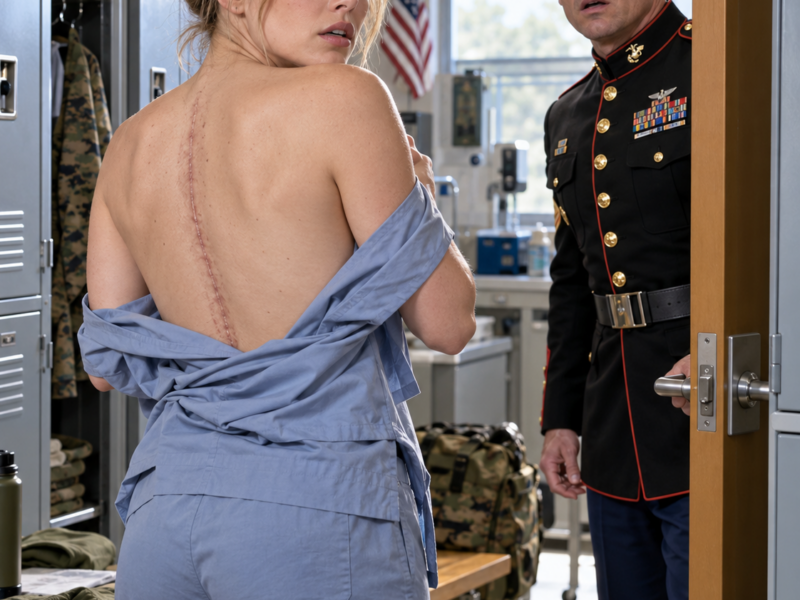
“The USMC commander stepped into the hospital changing room by mistake, and when I turned toward him, his face went completely pale
Daniel’s words stopped the hallway cold.
“Sir, don’t let her tell you I was the one who left them behind.”
For several seconds, nobody moved.
Colonel Nathan Cole stood beside Daniel’s wheelchair, his broad shoulders rigid beneath his uniform. I watched the colonel’s expression change as he looked from the wounded Marine to me, then back again.
Daniel’s face had gone pale.
Mine probably had too.
Six years earlier, I had crawled through dust and broken concrete to reach men who were screaming for help. I had held pressure against wounds I knew I couldn’t save. I had listened to radio calls disappear beneath gunfire.
And for six years, I had believed that the worst part of that day was the fact that I had survived.
Now Daniel Brooks, one of the men I had fought to save, was asking his commander to stop me from telling the truth.
I tightened my grip on the edge of the consultation room door.
“Emily,” Colonel Cole said carefully, “I think we need to sit down.”
“I’ve been sitting with this for six years, Colonel.”
The words came out sharper than I intended.
Cole didn’t react.
Daniel lowered his eyes.
“I’m not trying to hurt you,” he said.
I looked at him.
“You don’t get to decide whether you hurt me.”
He flinched.
For one terrible second, I saw the young Marine I remembered, crouched behind a shattered wall with blood running down his sleeve. I remembered the fear in his eyes and the way he had shouted for the others to move.
Then the image vanished, replaced by the older man sitting in front of me.
His right hand trembled against the armrest.
He had survived.
So had I.
But neither of us had ever really escaped that village.
“Tell me what you mean,” I said.
Daniel swallowed.
“I mean that if you tell Colonel Cole what happened, you need to tell him everything.”
“I intend to.”
“No.” He shook his head. “You need to tell him what happened before you found us. What you heard on the radio. What I did when the order came through.”
Cole stepped closer.
“Daniel, start at the beginning.”
Daniel stared at the floor.
“The beginning is the part I’ve spent six years trying to forget.”
“Then perhaps it’s time you stopped trying,” Cole said.
Daniel lifted his eyes.
“Sir, with respect, I don’t think you understand what you’re asking.”
“Then help me understand.”
For the first time, Daniel looked frightened of something other than his memories.
He glanced at me.
“I followed the withdrawal order.”
The words were quiet.
They were also familiar.
I had read them in the official report so many times that I could have recited the paragraph from memory.
The unit had withdrawn according to protocol after the evacuation route became compromised. Two Marines and a local interpreter had been declared unrecoverable. A civilian medical volunteer had subsequently entered the area and was presumed deceased.
The report had described everything in a language that made it sound inevitable.
No hesitation.
No mistakes.
No one responsible.
Just a mission that had gone wrong.
I had hated that report from the first time I read it.
Now I wondered whether I had hated it for the wrong reason.
“You said you followed the order,” I told Daniel. “I already know that.”
He shook his head.
“You know what they wrote.”
“Then tell me what they left out.”
His mouth opened, but no words came.
Cole pulled out a chair and sat across from him.
“We’re not conducting an interrogation in a hospital corridor,” he said. “You’re recovering from surgery, and Emily is entitled to decide how much of this conversation she wants to hear. We can stop whenever either of you needs to.”
Daniel nodded.
Then he looked directly at me.
“I need you to know that I went back for them.”
I felt something tighten beneath my ribs.
“You went back?”
“Not far enough.”
He closed his eyes.
“I heard them on the radio. I could hear Sergeant Miller calling for help. I knew Corporal Hayes was still inside the building with Samir. I knew they were alive.”
I remembered the names.
Miller.
Hayes.
Samir.
I had repeated them silently for years, afraid that if I stopped remembering them, the world would finish forgetting them too.
Daniel continued.
“Pierce ordered us to the extraction point. He said the route was compromised and that we had less than five minutes before the area was sealed off.”
“Major Harlan Pierce?” Cole asked.
“Yes, sir.”
Cole’s expression hardened.
“I’m familiar with his service record.”
“Then you know he was the one who signed the final report.”
“I do.”
Daniel nodded.
“He was also the one who pointed his weapon at me when I tried to turn back.”
The room went silent.
I looked at Daniel’s trembling hand.
“You never told me that.”
“You were unconscious when they brought you out.”
“I mean afterward. In the report. In your statement.”
“I tried.”
His voice cracked.
“I tried to tell them.”
Cole leaned forward.
“Who did you tell?”
“The first investigator who interviewed me. My medical officer. A captain who came to the rehabilitation center. Anyone who would listen.”
“And what happened?”
Daniel rubbed his palms against his trousers.
“They told me I was confused. They said the blast had affected my memory. Pierce claimed I had been concussed and that my recollection of the withdrawal order couldn’t be trusted.”
“Were you concussed?” I asked.
“Yes.”
He met my eyes.
“But I wasn’t confused about the gun pointed at my chest.”
I felt a chill move through me.
I remembered the noise of that day. The overlapping radio transmissions. The sharp crack of gunfire against stone. The dust that turned the afternoon light into a thick, dirty haze.
I remembered Daniel shouting something I couldn’t hear.
I had always assumed he was ordering his men to withdraw.
Now I wondered whether he had been begging them to stay.
“What happened after you reached the extraction point?” I asked.
Daniel stared at the window.
“We waited for the others.”
“Who?”
“Two Marines from another element. A vehicle crew. The people who had been sent to secure the road.”
“And did they arrive?”
“Eventually.”
He paused.
“But Miller, Hayes, and Samir didn’t.”
I felt the old ache rise inside me.
I had known that already.
I had spent six years imagining what their final minutes had been like, whether they had understood that no one was coming, whether they had been angry, whether they had been afraid.
There were questions no official report could answer.
There were questions I had never dared to ask another person.
“Why did you say you left them behind?” I whispered.
Daniel turned toward me.
“Because I did.”
He didn’t try to excuse himself.
“I followed the order. I got into the vehicle. I let them take me away while those men were still inside.”
His eyes filled with tears.
“I can explain why it happened, Emily. I can tell you what Pierce did. But I can’t change the fact that I left.”
For the first time, I saw the difference between the shame he carried and the story he had been told.
He had made a decision under pressure. He had been threatened. He had obeyed a superior officer who had controlled the information and the situation.
But he had also survived while three people remained behind.
No investigation could make that memory disappear.
And no one could take the decision away from him simply because the truth was complicated.
I pulled the chair closer.
“Did you know I went back?”
Daniel nodded.
“I heard you on the radio.”
My breath caught.
“What did you hear?”
“You told someone you were going to the building.”
“I was trying to reach Miller and Hayes.”
“I know.”
“Then why did the report say I entered the area after the evacuation?”
“Because that’s what Pierce needed it to say.”
Cole stood.
“Needed?”
Daniel looked up at him.
“Sir, the route was changed before we left. The eastern road was never secure. The original evacuation coordinates had been replaced.”
Cole’s face became very still.
“Who told you that?”
“The interpreter.”
“Samir?”
Daniel nodded.
“He found something on the radio operator’s desk. A handwritten warning. He told me someone had changed the route and that we were being sent toward a road that had already been reported as compromised.”
I remembered the road.
The broken wall.
The overturned truck.
The strange silence just before the first shots.
I had questioned the route at the time, but the team leader told me the coordinates had been confirmed. I had assumed the information was outdated.
Now I wondered whether the route had been wrong from the beginning.
“Do you still have the warning?” Cole asked.
Daniel reached into the pocket of his hospital trousers.
He withdrew a small plastic evidence sleeve.
Inside was a folded piece of paper, yellowed at the edges.
“I’ve kept it since that day.”
Cole didn’t take it immediately.
“Why?”
“Because I was afraid someone would destroy it.”
Daniel carefully removed the paper and placed it on the table.
The handwriting was cramped and hurried.
**ROUTE CHANGED. DO NOT USE EAST ROAD. ORIGINAL COORDINATES COMPROMISED.**
I recognized the writing.
Samir had written it.
He used to make notes like that on the backs of supply lists, folding them into his pocket so he could remember every detail.
I stared at the warning until the letters blurred.
“He knew,” I whispered.
Daniel nodded.
“He suspected something was wrong before we left.”
“And you kept this for six years?”
“Yes.”
“Why didn’t you give it to the investigators?”
Daniel looked at me with an expression I couldn’t bear.
“Because I was afraid they would use it against me. I thought if I handed it over, they would say I knew the route was compromised and had gone anyway.”
“So you kept quiet.”
“Yes.”
“You let them believe the report.”
“Yes.”
“And you let me believe you were simply following orders.”
His eyes closed.
“Yes.”
I stood abruptly.
The chair scraped against the floor.
“I need some air.”
Cole moved toward the door, but I raised a hand.
“Please don’t follow me.”
He stopped.
I walked out before either man could answer.
The hallway seemed brighter than it had before.
A nurse greeted me from the station, and I managed to nod without speaking. I went into the staff changing room and locked the door.
For several minutes, I stood in front of the mirror.
The scar beneath my left ribs was pale and uneven, a deep curve that disappeared toward my back. The injury had required surgery, followed by months of physical therapy. I had learned to work through the occasional pain and ignore the tightness that came when I twisted too quickly.
I had also learned how to hide it.
I chose uniforms that covered it. I avoided questions about my time overseas. When someone asked where the scar came from, I gave a short answer and changed the subject.
The scar was easier to explain than the memory.
I had thought that seeing Daniel alive would finally settle something inside me.
Instead, he had brought back a truth I had never known existed.
I had believed the men were abandoned because the mission had collapsed and everyone had made desperate choices.
Now there was evidence that someone might have changed the route before the mission even began.
Someone might have known that the road was dangerous.
Someone might have sent those men into an ambush.
And afterward, someone had turned a disastrous operation into an official story that protected the people responsible.
I pressed my fingertips against the scar.
For six years, I had blamed myself for not reaching the building sooner.
Now I had to confront a different question.
What if the failure had begun long before I arrived?
A soft knock sounded on the door.
“Emily?” Cole called.
I didn’t answer immediately.
“I won’t come in,” he said. “I just need to let you know that I’ve contacted the appropriate investigative office. The evidence will be secured, and neither Daniel nor I will handle it privately.”
I opened the door.
Cole stood several feet away, giving me room.
“Thank you,” I said.
“I’m sorry you were placed in this position.”
I almost laughed.
“Which position?”
He didn’t pretend to misunderstand.
“All of them.”
For a moment, I saw something in his expression that hadn’t been there before.
Not pity.
Recognition.
He understood that this wasn’t only about a wounded Marine or a disputed report. It was about the years I had spent building a life around something I couldn’t explain.
“Colonel,” I said, “I need to know something.”
“Ask.”
“If the report is wrong, how much of it is wrong?”
Cole considered the question.
“I don’t know yet.”
It wasn’t the answer I wanted.
It was the first answer I trusted.
“Then find out,” I said.
“We will.”
I returned to the consultation room after several minutes.
Daniel was still there, sitting quietly beside the table.
The note had been placed back inside its sleeve.
Cole stood near the window with his phone in his hand.
“I’ve requested a formal review of the original mission records,” he said. “I’ve also asked that all relevant communications, archived statements, and after-action documents be preserved.”
“Will they listen?” I asked.
“They’ll have to examine the evidence. I can’t promise what the final findings will be.”
I nodded.
“I don’t need a promise.”
I looked at Daniel.
“I need the truth.”
He nodded slowly.
“So do I.”
That afternoon, I returned to work.
I checked medication orders, helped transfer a patient, and sat beside an elderly veteran who kept asking when his daughter would arrive.
I did everything I normally did.
But beneath the ordinary rhythm of the hospital, my mind kept returning to that folded note.
By the time my shift ended, I had made a decision.
I would give a formal statement.
Not because I believed it would fix what had happened.
Not because I expected someone to apologize.
I would do it because I was tired of allowing the official version of my life to speak louder than my own memory.
The investigator arrived three days later.
She introduced herself as Special Agent Mara Bennett and explained that she had been assigned to review the records connected to the evacuation.
She was calm, direct, and careful with her questions.
She didn’t ask me to tell the story from the beginning and then interrupt whenever my memory failed to match a document.
Instead, she placed a blank timeline on the table and asked me to fill in what I remembered.
I described the clinic, the first wounded men, and the order to prepare for evacuation.
I explained that the route on the map did not match the road we encountered.
I described the collapsed wall and the vehicle that blocked the eastern approach.
I told her about the radio transmissions I had heard, including the warning that the route was compromised.
I admitted that I couldn’t identify every voice.
I also admitted that I had never seen the original orders.
“I can tell you what I heard,” I said. “I can’t tell you what someone intended unless there’s evidence for it.”
Agent Bennett nodded.
“That’s exactly the distinction we need.”
When I described going back for the men, my voice faltered.
I told her how I had reached the building, how I had treated Miller and Hayes, and how Samir had tried to help me move supplies through the damaged corridor.
I described the explosion that threw me against the wall.
Then I stopped.
I could still feel the impact.
I could still hear the ringing in my ears.
Agent Bennett waited until I was ready to continue.
“I remember waking up in a field station,” I said. “I remember asking about the others. I remember someone telling me the operation was over.”
“Did anyone tell you the men had been recovered?”
“No.”
“Did anyone tell you that you had been listed as deceased?”
“Not then.”
“When did you learn that?”
“Years later, when I tried to obtain my service-related medical records and discovered the report.”
She wrote something down.
“Did you challenge the designation?”
“I tried to correct it. I was told the record could not be amended without additional documentation.”
“Did you have any?”
“Medical records from the field station. A discharge summary. Nothing that could prove what happened before I was evacuated.”
“And the messages you received afterward?”
“I no longer have them.”
“Do you remember the dates?”
“Approximately.”
“That may still be useful.”
She asked me to describe each message as accurately as I could remember it.
When the interview ended, I felt exhausted.
Not because I had told the story.
Because I had finally told it without trying to make myself sound braver than I had been.
I had been terrified.
I had been angry.
I had wanted to survive.
And I had gone back anyway.
For years, I had believed that admitting my fear would somehow diminish what I had done.
It didn’t.
The second interview was with Daniel.
I wasn’t present, but Cole later told me that Daniel had provided a detailed account of the withdrawal order and the threat made by Major Pierce.
Daniel also explained how the original report had been prepared.
According to his statement, Pierce had insisted that the route change was a necessary response to new intelligence.
But the warning found by Samir suggested that the danger had been known before the team departed.
The question was no longer simply why the evacuation had failed.
It was whether the team had been deliberately sent into danger and whether the aftermath had been manipulated to hide that decision.
The investigation took months.
There were records to recover, witnesses to locate, and conflicting statements to compare.
Some documents had been archived under the operation number. Others were filed under the medical evacuation. A set of communications logs had been transferred during a system migration and required additional review before investigators could access them.
The process moved slowly.
At times, it seemed to stop altogether.
Whenever I asked for an update, Agent Bennett explained what she could without compromising the investigation.
I learned to live with not knowing.
That was harder than I expected.
I had spent six years trying to force a conclusion out of an incomplete story. Now I had to allow the evidence to determine what happened, even if the answer was less dramatic or less complete than I wanted.
Daniel called me once during that period.
I let the phone ring until it stopped.
He didn’t call again.
A week later, he sent a short message.
*I won’t contact you unless you want me to. I only wanted you to know that I’ve given them everything I have.*
I read it twice.
Then I put the phone away.
I wasn’t ready to forgive him.
I wasn’t even sure what forgiveness would mean.
But I believed he had finally stopped protecting the lie.
That mattered.
The first significant development came nearly four months after the investigation began.
Agent Bennett asked me to come in for another interview.
This time, she had a series of recovered communications records.
She placed several pages in front of me and explained that investigators had found a transmission sent before our team left the staging area.
The message identified the eastern road as compromised.
A second entry, recorded later, showed that the route coordinates had been changed.
The warning had not been passed to the team.
I read the entries carefully.
The language was technical and abbreviated, but the meaning was clear enough.
Someone had known that the road was unsafe.
Someone had changed the route anyway.
“Can you tell who authorized the change?” I asked.
“Not conclusively from this record alone,” Bennett said. “We’re comparing it with the authorization log and the statements of the personnel involved.”
“What about Pierce?”
“His account conflicts with the timestamps.”
I looked up.
“How?”
“He stated that the route was changed only after the team encountered unexpected resistance. The recovered entries suggest the change was made before deployment.”
I sat back.
For six years, I had wondered why the road had felt wrong before the first shots.
Now I had an answer to part of that question.
The danger hadn’t simply appeared.
It had been recorded.
And the warning had been withheld.
I left the interview room and sat in my car for almost an hour.
I didn’t cry.
I thought I would.
Instead, I felt an odd, hollow stillness.
The evidence was beginning to confirm what I had suspected, but confirmation didn’t bring relief.
It brought anger.
Not the explosive anger I had felt in the consultation room with Daniel.
This was quieter.
More durable.
I thought about Miller, who had joked with me at the clinic while I wrapped his wrist.
I thought about Hayes, who had asked whether I believed his wife would be angry if he came home with another scar.
I thought about Samir, who had carried a notebook everywhere because he was afraid he would forget something important.
They had trusted the people responsible for moving them to safety.
They had followed a plan that was supposed to bring them home.
I could not change what had happened to them.
But I could refuse to let their deaths be explained away by a report that omitted the warnings.
When I returned home, I opened the drawer where I kept my old medical papers.
At the bottom was a photograph I had not looked at in years.
It showed me standing outside the field clinic with Samir and two other volunteers.
I looked younger.
My hair was pulled back. My face was thinner. I was smiling at something outside the frame.
Samir stood beside me holding a paper cup.
On the back, in his uneven handwriting, were the words:
*For Emily. Remember that the truth is worth carrying, even when it is heavy.*
I sat on the floor with the photograph in my hands.
I couldn’t remember when he had written it.
I couldn’t remember whether he had meant it as a joke or something more serious.
But I could hear his voice.
I could see his smile.
And for the first time in six years, I allowed myself to remember him as more than a name on a casualty report.
The investigation’s next breakthrough came from a former communications specialist who had been assigned to the operation.
He had left the military shortly after the evacuation and was living several states away.
According to Agent Bennett, he initially refused to discuss the mission.
Then investigators showed him the recovered transmission logs.
He agreed to provide a statement.
He confirmed that a warning about the eastern road had been entered into the system before the team departed.
He also remembered being instructed to classify the warning as unverified and to remove it from the operational summary.
He couldn’t say who had given the instruction directly.
But he recalled that the message had been passed through Major Pierce’s office.
That statement did not prove that Pierce had deliberately intended for the team to be attacked.
It did establish that the warning had been suppressed before the mission and that the official timeline was inaccurate.
For the first time, the investigation had more than Daniel’s memory and Samir’s note.
It had records.
It had a witness.
It had contradictions that could no longer be explained away as the confusion of a wounded Marine.
Agent Bennett called me after the statement was reviewed.
“We’re expanding the inquiry,” she said. “I want to be careful about what I tell you, but the evidence supports your account that the route warning existed before the evacuation.”
I closed my eyes.
“Thank you.”
“You don’t need to thank me for doing the work.”
“I know. I just needed to hear someone say it.”
There was a pause.
“Emily, I also want you to understand that the investigation may not answer every question. We can establish that the warning was withheld. We can examine the decisions that followed. But we may never know exactly what every person believed at the time.”
“I understand.”
“And the report’s treatment of your status is being reviewed separately.”
That surprised me.
“My status?”
“Yes. You were listed as presumed deceased without a confirmed identification. The records show that the designation was carried forward from an incomplete field entry.”
“So no one actually confirmed I had died.”
“Not in the records we’ve reviewed.”
I looked at the scar beneath my shirt.
For six years, I had thought someone had looked at the evidence and decided that I was gone.
Instead, it appeared that a provisional entry had become an official fact because no one had taken the time to challenge it.
I had survived an explosion, been evacuated, and spent months recovering.
Then I had returned to a world where the paperwork said I was dead.
I had spent years correcting that mistake in small ways, explaining my history to administrators and employers, providing medical documents that did not tell the full story.
I had never understood how the error had happened.
Now I did.
It wasn’t a grand conspiracy by itself.
It was a series of decisions, omissions, and assumptions that had accumulated until they became a story no one wanted to reopen.
That did not excuse anyone who had knowingly exploited the mistake.
But it explained how an ordinary administrative failure could become part of a much larger injustice.
The formal findings were released several months later.
Major Pierce’s account of the route change was found to be inconsistent with the recovered communications records.
The review concluded that the warning had been available before deployment and had not been properly passed to the team.
It also found that the official after-action report had omitted material information about the route change and the attempts made to report it.
Investigators referred the evidence concerning the suppression of records and the pressure placed on witnesses for further review.
Pierce denied deliberately sending the team into danger.
He claimed that the route information had been incomplete, that the situation had changed rapidly, and that his decisions had been made under pressure.
I read his response.
I read it again.
I could not know what he had believed when he made each decision.
I could not look inside his mind and prove that he had intended the outcome.
But I could see the timestamps.
I could read the warning.
I could compare his statements with the recovered records.
And I could see that the men who had died deserved better than an account that concealed the information available before the operation.
The review also corrected the findings concerning Daniel.
It acknowledged that he had obeyed a withdrawal order while the men remained inside the building, but it also recorded his statement that Pierce had threatened him when he attempted to return.
His later attempts to challenge the account were documented.
The correction did not erase his decision.
It placed that decision in its proper context.
Daniel told me later that reading the revised report had been harder than he expected.
“I thought I’d feel free,” he said when we finally spoke in person again.
We were sitting in a quiet courtyard behind the medical center.
The weather was cold, and the trees had begun to lose their leaves.
“Do you?” I asked.
“Sometimes.”
He looked down at the cane resting beside his chair.
“Other times, I feel like the report has taken away the excuse I used to hide behind.”
“What excuse?”
“That I couldn’t tell the truth because nobody would believe me.”
He rubbed his thumb over a small mark on his hand.
“I was afraid they wouldn’t believe me. But I was also afraid they would. If they believed me, I’d have to admit that I had followed the order. I’d have to admit that I had left them there.”
I let him speak.
“I spent years telling myself that I was protecting the truth until I was strong enough to report it. But I was also protecting myself from what the truth would mean.”
He looked at me.
“I don’t want to do that anymore.”
I studied his face.
He wasn’t asking me to tell him he was a good man.
He wasn’t asking me to absolve him.
For the first time, he seemed willing to accept that he could have made a painful choice and still be responsible for what he did afterward.
“I believe you,” I said.
His eyes filled.
“But believing you isn’t the same as saying it didn’t matter.”
“I know.”
“And it doesn’t mean I can give you back the six years you spent believing the worst about yourself.”
“I know that too.”
I looked out at the trees.
“I spent those six years believing that I had failed because I couldn’t save everyone. I thought that if I had moved faster, if I had taken a different corridor, if I had ignored the order to wait for the evacuation team, maybe I could have reached them.”
Daniel remained silent.
“I replayed every decision. I tried to find the one moment when I could have changed everything. But there was always another possibility, another thing I could have done, another reason to blame myself.”
I turned toward him.
“I don’t want to live like that anymore.”
“Neither do I.”
We sat quietly for a while.
Then Daniel said, “I don’t expect you to forgive me.”
“I know.”
“But I hope someday we can remember that day without seeing only what we lost.”
I looked at him.
“Maybe someday.”
It was the most honest answer I could give.
He nodded as if he understood that it was enough.
The families of Miller and Hayes were notified of the revised findings.
Samir’s relatives were contacted through the appropriate channels, and the investigation provided them with the corrected account of his final hours.
I did not attend every meeting.
I did not need to be present for every document to be signed or every statement to be reviewed.
For the first time, I allowed other people to carry part of the work.
But when the family of Sergeant Miller asked to speak with me, I agreed.
His wife, Rebecca, came to Virginia with their adult daughter.
I had seen photographs of them in the years after the evacuation, though I had never met them.
Rebecca was smaller than I expected.
She wore a simple gray coat and held a folder against her chest.
Her daughter stood beside her, quiet and watchful.
We met in a private room at the medical center.
For several minutes, none of us knew how to begin.
Then Rebecca placed the folder on the table.
“I brought some pictures,” she said. “I thought you might want to see him when he wasn’t wearing a uniform.”
My throat tightened.
She opened the folder.
There was Miller holding a fishing rod beside a lake.
Miller standing in a kitchen with flour on his shirt.
Miller carrying a sleepy little girl on his shoulders.
In one photograph, he was laughing so hard that his eyes had nearly disappeared.
I had known him as a Marine who joked through pain and complained about the clinic’s coffee.
I had never known he could laugh like that.
“He talked about the people he served with,” Rebecca said. “He said there was a nurse who argued with everyone and never listened when someone told her to slow down.”
I laughed through my tears.
“That sounds like me.”
“He said you were stubborn.”
“He was not wrong.”
Rebecca smiled, but it faded quickly.
“For years, we were told the men had been left behind because the operation had failed. We were told the details were uncertain. We were told that no one could explain why the route had changed.”
She looked down at the photograph.
“I don’t know if knowing the truth makes anything better.”
“It doesn’t bring him back,” I said.
“No.”
She pressed her fingers against the edge of the paper.
“But at least now I know that people tried to reach him. I know he wasn’t forgotten the moment the vehicle left.”
I couldn’t speak.
Rebecca looked at me.
“I read your statement. You went back for them.”
“Yes.”
“You were hurt trying to reach my husband.”
“I wish I could have done more.”
“I know.”
Her answer was so gentle that it nearly broke me.
She wasn’t telling me that I had done enough.
She wasn’t pretending that the outcome didn’t matter.
She was simply refusing to let me carry responsibility for every part of a tragedy I had not created.
Her daughter finally spoke.
“My dad would have wanted you to know that he wasn’t afraid of dying.”
Rebecca closed her eyes briefly.
“He was afraid of leaving us,” the daughter continued. “He talked about that before he deployed. He worried about missing birthdays and school events. He worried about his mother getting older. He worried about everything except the things people assumed he worried about.”
She swallowed.
“I don’t want the last thing people remember about him to be a report.”
I reached across the table and held her hand.
“It won’t be.”
After they left, I stayed in the room for a long time.
I thought about the photographs.
The fishing rod.
The flour on Miller’s shirt.
The child on his shoulders.
I had remembered him as a body in a damaged building, a voice over a radio, a man I had failed to reach.
His family remembered him as a husband, a father, and a person who had lived an entire life beyond the worst day of it.
Both memories were true.
But one had nearly swallowed the other.
I decided then that I would no longer allow the evacuation to be the only story I told about those men.
I would remember the danger.
I would remember the loss.
But I would also remember their jokes, their habits, their hopes, and the lives that had existed before the final report reduced them to names.
The final administrative review of my status was completed shortly afterward.
The record was corrected to reflect that I had survived the evacuation and had been evacuated for medical treatment.
It was a simple change on paper.
A line amended.
A designation replaced.
Yet when I received the confirmation, I sat at my kitchen table and stared at the document for nearly twenty minutes.
For six years, I had lived with the knowledge that a report said I had died.
Now the record said what had actually happened.
I was alive.
I had been alive all along.
The world had simply failed to record it properly.
I put the document in a folder beside my medical records and Samir’s photograph.
Then I closed the drawer.
For once, I didn’t feel the need to check the papers again before going to bed.
I didn’t need to prove my survival to myself.
I knew I had survived.
The rest of my life could finally be about more than explaining why.
Several weeks later, Colonel Cole asked to speak with me.
He met me in his office at the medical center, where a framed map hung behind his desk.
I recognized the region immediately.
The village was marked near the edge of the map, beside a road that looked harmless when viewed from a distance.
Cole followed my gaze.
“I’ve spent a lot of time looking at this map,” he said.
“So have I.”
“From here, the route looks straightforward.”
“It didn’t look straightforward when we were there.”
“No,” he said. “It didn’t.”
He handed me a copy of the final review.
The findings were formal and restrained.
They did not assign motives where evidence was insufficient.
They did not pretend that every unanswered question had been resolved.
But they documented the withheld warning, the inaccurate account, and the failures that had prevented the truth from being established sooner.
“I wanted you to have this directly,” Cole said.
“Thank you.”
He hesitated.
“I also owe you an apology.”
I looked up.
“For what?”
“For what happened when I first saw your scar.”
I remembered the changing room.
The door opening.
His expression turning pale.
The sudden fear that my past had found me before I could decide whether to face it.
“You recognized it,” I said.
“I recognized the description from the report. I didn’t know who you were until I saw it.”
“You looked at me as if you had seen a ghost.”
“I thought I had.”
He lowered his eyes.
“I should have given you more privacy. I should have considered what it meant to confront you with that information without warning.”
I studied him.
At the time, I had been angry with him for looking at me as if I were a mystery to be solved.
Now I understood that he had been confronted with a case he thought was closed, a woman he believed had died, and a scar that connected the report to the living person standing in front of him.
That did not mean the moment had been easy for me.
But I no longer needed to turn it into another wound.
“I was frightened,” I admitted. “I thought you were going to tell everyone who I was.”
“I wouldn’t have done that without speaking to you.”
“I know that now.”
He nodded.
“I also want you to know that Daniel has been reassigned while he continues his recovery. He has requested further support, and he is cooperating with the remaining review.”
“Good.”
“He asked me to tell you that he intends to keep telling the truth, even if no one asks him to.”
A small, unexpected smile touched my face.
“That sounds like progress.”
“I think it is.”
Cole stood and offered his hand.
I shook it.
As I left his office, I realized something that would have seemed impossible six months earlier.
I no longer needed the colonel to tell me that I had done the right thing.
I no longer needed Daniel to admit that he had been afraid.
I no longer needed Pierce to confess that he had lied.
Those things mattered.
The investigation mattered.
The records mattered.
But the truth of what I had done did not depend on whether someone powerful approved of it.
I had gone back because people were hurt.
I had stayed because they needed help.
I had been injured because the building was dangerous.
And I had survived.
None of those facts changed because someone had written a different story.
A year after Daniel recognized me in the hallway, the hospital held a small remembrance ceremony for the men whose deaths had been reexamined.
There were no speeches about heroes being fearless.
There were no dramatic promises that everything had been made right.
The ceremony was quiet.
The families stood together.
A chaplain read the names.
When he reached Samir’s, his sister lowered her head and held a folded handkerchief to her face.
When he read Miller’s and Hayes’s names, I closed my eyes.
I could almost hear Miller complaining about the coffee.
I could almost hear Hayes asking whether I thought his wife would be angry about another scar.
And I could hear Samir telling me to remember what mattered.
After the ceremony, I stood outside beneath a pale afternoon sky.
Daniel approached slowly with his cane.
He had made progress in rehabilitation, though the injury still affected his balance and endurance.
He stopped beside me.
“Thank you for coming,” he said.
“I work here.”
“You know what I mean.”
I nodded.
For a moment, we watched the families gathering near the entrance.
“Do you ever think about what would have happened if the route had been different?” he asked.
“Every day.”
“What do you imagine?”
I considered the question.
“Sometimes I imagine we reached the building sooner. Sometimes I imagine the warning was passed along and the team never entered the road. Sometimes I imagine Miller and Hayes sitting at home, complaining about ordinary things.”
Daniel’s jaw tightened.
“I imagine that too.”
“But I can’t spend the rest of my life treating those imagined versions as the only lives that mattered.”
He looked at me.
“What do you mean?”
“I mean that the men who died were real. Their lives mattered. But the people who survived mattered too. Their families matter. The truth matters. And I don’t think we honor the dead by destroying every part of ourselves that managed to survive them.”
Daniel was quiet for a long time.
Then he nodded.
“I wish someone had told me that years ago.”
“Maybe someone did.”
He looked puzzled.
“Maybe you weren’t ready to hear it.”
He let out a slow breath.
“That sounds about right.”
We stood together until the families began to leave.
Then Daniel turned toward the parking lot.
“Emily?”
“Yes?”
“I don’t know whether I’ll ever forgive myself for following that order.”
“You may not need to forgive yourself all at once.”
He looked down at the cane.
“What if I never do?”
“Then you keep doing the next honest thing. You tell the truth. You help the people you can help. You stop pretending that suffering is the same as making amends.”
His eyes glistened.
“You make it sound simple.”
“It isn’t.”
I touched the scar beneath my ribs through the fabric of my blouse.
“I’ve just had six years to learn that carrying pain isn’t the same as honoring the people we lost.”
Daniel nodded.
Then he walked away.
I watched him until he reached the parking lot.
For the first time, I didn’t feel responsible for where he went next.
His choices belonged to him.
Mine belonged to me.
That evening, I went home and took the old photograph of Samir from the drawer.
I placed it on the bookshelf beside a picture of my parents and a photograph from my first year as a nurse.
I didn’t hide it in a folder.
I didn’t turn it facedown.
I let it become part of the room.
Then I stood in front of the bathroom mirror and looked at my scar.
The line beneath my ribs was still there.
It would never disappear completely.
Sometimes, when the weather changed, the tissue tightened. Sometimes, when I moved too quickly, a sharp reminder passed through my side.
And sometimes, even after a peaceful shift, I still heard the radio in my dreams.
I no longer expected those memories to vanish.
I no longer believed that healing required me to forget.
The scar was not a confession.
It was not a verdict.
It was not proof that I had failed.
It was a reminder that I had lived through something terrible and had continued to live afterward.
The next morning, I returned to the medical center.
I walked into the changing room, set down my bag, and changed into my scrubs.
I didn’t check the door twice.
I didn’t cover the mirror.
I didn’t rehearse an answer in case someone asked about the scar.
When I finished, I looked at my reflection and adjusted my collar.
For six years, I had believed that the truth was waiting somewhere behind me, ready to destroy the life I had rebuilt.
I had been wrong.
The truth had been waiting for me to stop running from it.
It had not restored the men we lost.
It had not erased Daniel’s decision or returned the years we had spent believing incomplete stories.
It had not made the world fair.
But it had given the dead their names back.
It had given the families a clearer account of what happened.
It had given Daniel the chance to accept responsibility without carrying blame that belonged to someone else.
And it had given me the freedom to remember that I had been more than a presumed-dead volunteer in a military report.
I was Emily Carter.
I was a nurse.
I was a survivor.
And I was still here.
As I stepped into the hallway, I passed the consultation room where Daniel had first spoken the words that changed everything.
For a moment, I stopped.
I remembered his frightened face.
I remembered Cole’s silence.
I remembered the note on the table, the warning that had arrived too late, and the terrible realization that the truth had been buried beneath a version of events that was easier for powerful people to accept.
Then I continued down the corridor.
There were patients waiting.
There were hands to hold, wounds to clean, and frightened people who needed someone to tell them what would happen next.
I couldn’t change the past.
I couldn’t promise every patient a happy ending.
But I could show up.
I could listen.
I could tell the truth when it mattered.
And when someone looked at my scar and asked what had happened, I no longer felt the need to turn away.
I would tell them that I had been wounded during an evacuation in Syria.
I would tell them that three people had not come home.
I would tell them that the official story had been wrong, and that it had taken years for the truth to emerge.
And I would tell them that surviving something does not mean you have to spend the rest of your life apologizing for being alive.
The scar beneath my ribs would always remind me of the day I went back.
But it would no longer be the only thing I remembered.
I would remember Samir’s handwriting.
Miller’s laughter.
Hayes’s questions about home.
Daniel’s trembling hands as he finally told the truth.
And I would remember the moment I stopped confusing guilt with responsibility.
Because the truth had never been that I could save everyone.
The truth was that I had tried.
And after six years of believing that my survival was the one thing I could never explain, I finally understood that I didn’t owe anyone an apology for it.
Tighten the middle investigation arcClarify Daniel’s initial accusation
THE END.









