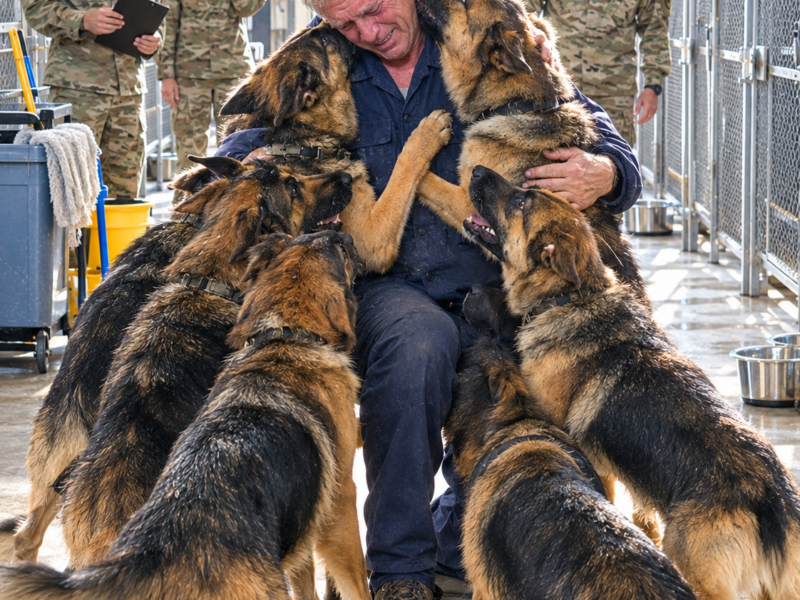
“The six military working dogs had ignored generals, trainers, and even their former handlers—but the moment the quiet janitor stepped into the kennel
The headlights stayed fixed on the memorial room window.
I stood beside Thomas Hale, holding the battered identification tag in my palm, while the six dogs barked from the kennel yard.
Thomas didn’t look surprised.
That frightened me more than anything else.
“Who is out there?” I whispered.
He reached for the canvas covering the brass plaque and pulled it down.
“Someone who should have come looking for me a long time ago.”
Outside, a car door slammed.
Thomas’s face changed. The quiet janitor I had known for three years disappeared, replaced by a man whose eyes seemed to measure every shadow and every exit.
“Daniel, listen carefully,” he said. “Whatever happens in the next few minutes, don’t let anyone take those dogs off this base.”
“Why?”
“Because they’re the only witnesses left who remember what really happened.”
Footsteps approached the memorial room.
A firm knock sounded against the door.
“Mr. Hale?” a man’s voice called. “It’s been a long time.”
Thomas closed his eyes.
Then he whispered something I would never forget.
“Not long enough.”
I moved toward the doorway, but Thomas caught my arm.
“Don’t open it until you know who you’re letting inside.”
I looked through the narrow window.
A tall man in a dark civilian coat stood outside. His hair was silver at the temples, and he carried a leather briefcase in one hand. Two military police officers stood behind him.
I recognized him immediately.
Major General Robert Vance, retired.
He had been the senior officer overseeing several special operations programs before his retirement. His name appeared in the archived Nightfall records I had tried to access that afternoon.
I opened the door.
“General Vance?”
His eyes moved past me to Thomas.
For a moment, neither man spoke.
Then Vance gave a small, humorless smile.
“You look older, Hale.”
Thomas remained beside the plaque.
“So do you.”
“I was beginning to think you had died.”
“You signed the paperwork saying I had.”
The general’s smile disappeared.
Behind him, one of the military police officers shifted uneasily.
Vance glanced at me.
“Sergeant Brooks, this is a classified matter. I need you to leave us alone.”
“With respect, sir, Mr. Hale is a civilian employee here, and this room is on my unit’s grounds. I’d like to know why a retired general is visiting him after hours.”
“Because I have authority to discuss classified operational matters with him.”
“Then you won’t mind showing me the authorization.”
Vance studied me for several seconds.
“You’ve been looking at files you don’t have clearance to access.”
“I found an old photograph in an archive.”
“Then you should stop looking.”
Thomas stepped forward.
“Don’t threaten him, Robert. He’s already done more than you have in fifteen years.”
Vance’s jaw tightened.
“I came here to offer you a way out.”
“A way out of what?”
“Whatever you think you’re going to accomplish.”
Thomas looked toward the window, where the dogs were still barking.
“I don’t need a way out. I need the truth.”
Vance lowered his voice.
“Then you need to understand what the truth will cost.”
Thomas didn’t answer.
The general opened his briefcase and removed a thick folder.
He placed it on a table beneath the plaque.
“Operation Nightfall was a classified mission. The team encountered an unexpected enemy force. Communications failed. The extraction route was compromised. Hale was separated from the team and presumed dead. The dogs were recovered later and reassigned.”
“That isn’t what happened,” Thomas said.
“It’s the official record.”
“The official record says I abandoned my team.”
“It says you were lost during the withdrawal.”
“And the report you buried says I was ordered to leave Sergeant Miller behind.”
Vance looked sharply at him.
I felt the metal tag grow heavier in my hand.
Sergeant Miller.
The name stamped into the tag was JAMES MILLER.
I remembered seeing it in the archive. Miller had been listed as killed in action during Nightfall, but the circumstances of his death had been redacted.
I looked at Thomas.
“Who was he?”
Thomas’s face softened.
“James was my second handler. He worked with Atlas before the mission, and he was the kind of man who’d give you his last bottle of water without telling you he was thirsty.”
He looked down at the tag.
“He was also the reason I came back alive.”
Vance shut the folder.
“This conversation is over.”
“No,” Thomas replied. “It started fifteen years ago. You just spent a long time pretending it didn’t happen.”
The general motioned to the military police officers.
“Mr. Hale, I’m asking you to accompany us for a formal debriefing.”
Thomas gave a tired laugh.
“You mean another room with no windows, another set of papers I can’t keep, and another promise that the truth will be handled internally?”
“I’m trying to prevent you from making a serious mistake.”
“You’ve had fifteen years to prevent that.”
Vance turned toward me.
“Sergeant Brooks, you are now involved in a classified security matter. You will surrender your tablet and the identification tag.”
I closed my fingers around the tag.
“No, sir.”
The general’s expression hardened.
“That’s an order.”
“I’m not under your command, sir.”
For a moment, I thought he might order the military police to arrest me.
Instead, Thomas stepped between us.
“Daniel, give him the tag.”
I stared at Thomas.
“Sir?”
“Give it to him.”
I didn’t understand, but something in his expression made me obey.
Vance took the tag and slipped it into his pocket.
Then Thomas said, “Now you have it. So let’s see what you do with it.”
The general looked almost relieved.
“Good. Come with me.”
Thomas shook his head.
“I’ll come when the dogs are secured, and when an independent investigator is present.”
“You don’t get to set the conditions.”
“Then you don’t get to take me anywhere.”
The two men stared at each other.
Finally, Vance picked up his folder.
“You have until tomorrow morning to reconsider.”
He turned and walked out.
The military police followed him.
I watched the headlights disappear beyond the kennel fence.
Then I turned to Thomas.
“What just happened?”
Thomas pulled a chair away from the wall and sat down.
For the first time, I noticed how exhausted he looked.
“Sit down, Daniel. There’s something you need to know about Nightfall.”
I sat opposite him.
He stared at the brass plaque.
It bore six names, each engraved beneath a small emblem representing a military working dog. The names matched the six animals now housed in our kennel.
Beneath them was another name.
James Miller.
And at the bottom, almost hidden by the edge of the plaque, were two words:
NEVER FORGOTTEN.
“Fifteen years ago,” Thomas began, “I led a specialized K9 team assigned to recover a missing intelligence officer from a remote compound overseas. The mission was supposed to be straightforward. Enter the area, locate the officer, secure the intelligence materials, and extract before sunrise.”
“Who was the officer?”
“A civilian analyst attached to our unit. Her name was Elena Ward. She had uncovered evidence that someone inside our own command structure was selling operational information to an enemy network.”
I leaned forward.
“Someone in our command?”
Thomas nodded.
“We didn’t know who. Elena had encrypted copies of communications, payment records, and mission schedules. She’d been instructed to bring them out, but the extraction plan was changed at the last minute.”
“By whom?”
“General Vance.”
I sat back.
Thomas continued.
“He said the original route had been compromised. He gave us a new rendezvous point and told us we had less than an hour to reach it. We followed his instructions.”
“And that’s when everything went wrong?”
“That’s when everything went exactly as someone intended.”
Thomas described a narrow road running between two ridgelines, a radio that went silent, and an explosion that destroyed the vehicle carrying their communications equipment.
The team was pinned down before they reached the rendezvous.
The dogs detected movement before the soldiers could see it. Rex and Atlas located a concealed approach through a drainage channel. Sable found a wounded team member in the dark. Mako and Duke held their positions while the others moved toward cover.
Ghost, the youngest dog, stayed close to James Miller.
The mission became a fight to survive.
“James was hit while helping Elena cross an exposed stretch of ground,” Thomas said. “I tried to reach him, but we were taking fire from two directions. Vance came over the radio and ordered me to withdraw with the intelligence officer and the dogs.”
“You left Miller behind?”
“I was ordered to leave him. He was still alive.”
Thomas’s hands tightened around each other.
“He told me to go. He said he would draw the enemy’s attention long enough for us to reach cover. I promised him I’d come back.”
He paused.
“I never got the chance.”
The extraction helicopter arrived at the wrong location. The remaining team members were separated during the withdrawal, and Thomas was injured when the ground collapsed beneath him near an abandoned building.
He lost consciousness.
When he woke, the team was gone.
He spent two days moving through rough terrain with a badly injured leg before local forces found him. Elena was alive, but the intelligence materials she had carried were missing.
The official report said Thomas had disobeyed orders, abandoned his team, and caused the mission to fail.
Then the report was amended.
Thomas Hale was listed as missing and presumed dead.
The dogs were recovered weeks later through a separate military operation. Their original handlers had been reassigned or discharged. The animals were transferred to different facilities, their deployment histories restricted.
Eventually, all six ended up at Fort Ridge.
I struggled to process what he was telling me.
“Why didn’t you challenge the report?”
“I did.”
“What happened?”
“They told me the investigation was classified. They said I was suffering from trauma and that my memory was unreliable. When I kept pushing, my security clearance was suspended. The records were sealed, and I was warned that any public disclosure could put surviving personnel at risk.”
“So you disappeared.”
“I tried to keep fighting for a while. I contacted lawyers. I contacted a veterans’ organization. I wrote letters to people who had promised to help me.”
He looked at his hands.
“Then my wife died, and the medical bills piled up. My son stopped speaking to me because he believed the reports. I lost my pension dispute. Eventually, I ran out of money and energy.”
He glanced toward the kennel yard.
“But I never forgot the dogs.”
I thought about the years I’d watched him mop floors and empty trash cans. Three years of quiet greetings. Three years of passing the same animals every morning.
“You took this job to be near them.”
“I took it because it was the only place I could work without someone asking too many questions about my past. When I learned the six dogs had been transferred here, I applied through the contractor.”
“Why didn’t you tell us who you were?”
“Would you have believed me?”
I had no answer.
He nodded as if that was enough.
“People believe the records they can see. They believe the uniform, the rank, the official statement. I had none of those things left.”
“Why did the dogs react like that today?”
Thomas smiled faintly.
“Because I trained them from the time they were young. Each dog had a different role. Rex was my lead search dog. Atlas was trained for tracking. Mako worked on explosive detection. Duke was good at locating people in collapsed structures. Sable specialized in area searches. Ghost was still learning when we deployed.”
He looked toward the door.
“They knew my voice, my scent, my movements. But more than that, we had a bond that came from working together under pressure. They weren’t just trained to follow commands. They learned to trust me.”
“And today?”
“Today they saw me, and they remembered.”
His voice faltered.
“I thought they’d forgotten.”
I shook my head.
“Dogs don’t forget people that way.”
Thomas gave a small, sad smile.
“Sometimes people do.”
For a long moment, neither of us spoke.
Then I asked the question that had been troubling me since I saw the photograph.
“Why did you say you were ordered to leave their handler behind?”
Thomas looked directly at me.
“Because James Miller wasn’t the only person Vance left behind.”
He stood, walked to a small cabinet, and removed an old envelope.
Inside were three photographs and a folded page of handwritten notes.
He placed them on the table.
The first photograph showed Thomas, James, and the six dogs outside a field tent.
The second showed a woman in civilian clothing standing beside a vehicle.
Elena Ward.
The third photograph showed a group of officers gathered around a table. Vance stood near the center.
Behind him, partly obscured by another man, was a face I recognized.
Colonel Hayes.
Our current base commander.
I stared at the photograph.
“Colonel Hayes was there?”
“He was a major at the time. He handled logistics and communications for the operation.”
“Does he know you’re here?”
“I don’t know.”
“Have you spoken to him?”
“Once, three years ago. He saw me in the kennel corridor. He recognized me immediately, but he said nothing. The next week, my employment file was updated, and I was assigned to this building permanently.”
A chill moved through me.
“You think he arranged for you to be hired?”
“I think someone wanted me where they could keep an eye on me.”
“Why would they do that?”
Thomas tapped the handwritten notes.
“Because Elena Ward may still be alive.”
I stared at him.
“The official report says she died.”
“The report says her identity was never confirmed after the mission. The body recovered at the site was identified through personal effects. There was no independent verification.”
“Do you have proof?”
“Not yet. But three months after I was discharged, I received a letter with a single sentence: The evidence survived, and so did the witness.”
He handed me the note.
There was no signature.
“Who sent it?”
“I never found out. The letter was postmarked from a town in Montana.”
“Why didn’t you give it to investigators?”
“I did. They told me it was probably a hoax.”
He looked at me.
“Then, last month, I received another one.”
He opened a small compartment in the envelope and removed a photograph.
It showed a woman standing outside a roadside diner. Her hair was shorter, her face older, but I could see the resemblance to Elena Ward.
On the back was a date and a location.
Tomorrow morning.
A diner on the highway, forty miles from Fort Ridge.
My pulse quickened.
“You think she’s going to meet you?”
“I think someone wants me to believe she will.”
“Could be a trap.”
“It could.”
“Then we should tell Colonel Hayes.”
Thomas shook his head.
“Not until we know whether he’s involved.”
I looked at the photograph again.
“What do you want me to do?”
“Nothing.”
“Thomas—”
“You’ve already put yourself in enough danger. I won’t ask you to risk your career because of a story you heard from a man who cleans floors.”
I stood.
“You don’t get to decide what I’m willing to risk.”
For the first time, he looked at me with something close to respect.
Then he nodded.
“Fair enough.”
We agreed to meet at the diner before sunrise. I would not bring any official documents, and Thomas would not go inside alone. We would keep our phones on and tell no one about the meeting until we knew who had sent the photograph.
I returned to my quarters that night and barely slept.
At 0430, I received a message from an unknown number.
Don’t go to the diner. Vance knows about the meeting.
A second message arrived moments later.
If you want the truth about Nightfall, bring the dogs to the old memorial building at 0600. Come alone.
I stared at the screen.
The memorial building had been closed for years. It sat beyond the main training grounds, a small brick structure used to store old equipment and retired plaques.
I immediately called Thomas.
He answered on the first ring.
“Did you get a message?” I asked.
Silence.
Then he said, “Yes.”
“What does it say?”
“That the person who sent the photograph wants us to bring the dogs.”
“Do you think it’s Elena?”
“I don’t know.”
“We need to notify security.”
“If Vance has someone inside the base, we need to be careful who we trust.”
I hated that he was right.
We agreed to meet outside the kennel before dawn. I told my immediate supervisor that I was conducting an urgent welfare check on a civilian employee and requested a second handler to remain nearby, without revealing the full reason.
I also sent the unknown messages to a secure address used for reporting potential security concerns.
If something happened to us, there would be a record.
At 0550, Thomas arrived at the kennel wearing his gray uniform and carrying no bag.
The six dogs were already restless.
Rex stood closest to him, tail moving slowly. Atlas watched the corridor. Ghost paced in a tight circle, then returned to Thomas’s side.
I had arranged for the dogs to be moved under the pretense of a routine environmental assessment. Their handlers accompanied us, though I instructed them to remain outside the memorial building until I gave the signal.
Thomas looked at me.
“You brought the team.”
“I brought witnesses.”
He almost smiled.
We approached the old building just as the sky began to lighten.
The front door stood open.
Inside, a single work light illuminated a table in the center of the room. On it lay a military radio, a folded map, and a small black case.
No one was visible.
Thomas stopped at the threshold.
Rex let out a soft whine.
Then Ghost moved forward and sniffed the floor near the table.
He froze.
His ears rose, and he turned toward a narrow storage corridor at the back of the building.
Thomas gave a quiet command.
“Show me.”
Ghost trotted down the corridor, followed by Atlas and Rex.
We hurried after them.
At the end of the hallway stood a metal door with a keypad. It was slightly ajar.
Beyond it, someone was breathing hard.
I raised my hand, signaling Thomas to stay behind me.
“Military police,” I called. “If anyone is inside, identify yourself.”
A woman’s voice answered.
“Thomas?”
He went completely still.
The voice came again, shaking.
“Thomas Hale, if that’s really you, tell me what James said when we reached the extraction point.”
Thomas’s eyes filled with tears.
He swallowed hard.
“He told you that if we made it home, he was going to learn how to cook something other than instant noodles.”
A broken laugh came from behind the door.
Then it opened.
A woman stepped into the light.
She was older than the photograph, with silver strands in her dark hair and a thin scar running along her cheek. But her eyes were unmistakable.
Elena Ward.
Thomas stared at her as if he were afraid she might disappear.
“You’re alive,” he whispered.
Elena nodded.
“I am.”
He took one hesitant step forward.
“Why didn’t you come back?”
Her expression crumpled.
“Because they told me you were dead.”
Thomas stopped.
“They told me you were dead, too.”
For a moment, neither of them could speak.
Then Elena looked at the six dogs gathered in the corridor.
“Are these all of them?”
Thomas nodded.
“Every one.”
Elena knelt slowly.
Rex approached first, sniffed her hand, then pressed his muzzle against her shoulder. The other dogs crowded around her, their tails moving cautiously.
Elena covered her face.
“I thought I’d never see you again,” she whispered.
Thomas knelt beside her.
“Neither did I.”
I gave them a moment.
Then I asked the question that had brought us there.
“What happened to James Miller?”
Elena’s expression changed.
She rose slowly and walked to the table.
“The official report was designed to make everyone believe the mission failed because Thomas disobeyed orders. But James discovered that the extraction coordinates had been changed before we deployed. He found a copy of the original mission plan in the communications vehicle.”
She opened the black case.
Inside were a small encrypted drive, a notebook, and several old documents sealed in plastic.
“James sent the original plan to me before the communications equipment was destroyed. It showed that the rendezvous point had been moved to a location already known to the enemy.”
“Who changed it?” I asked.
Elena looked at Thomas.
“Robert Vance approved the change. But he wasn’t acting alone.”
She removed a document from the case.
A list of names appeared beneath a classified heading. Several officers had signed off on changes to the mission plan, including the name of the logistics officer who had handled the final communications packet.
Major Christopher Hayes.
Our current colonel.
I felt my stomach tighten.
Elena continued.
“James realized that someone was selling operational information. He wanted to confront Vance, but Thomas ordered him to focus on getting us out alive. During the ambush, James was wounded while helping me reach cover. Vance’s final radio order was to withdraw without him.”
Thomas closed his eyes.
“I should have gone back.”
“You couldn’t,” Elena said. “The enemy had sealed the route, and the extraction window was closing. James knew that. He gave me the evidence and told me to get it out.”
She paused.
“He was captured before the second team could reach him. I later learned he died in captivity.”
Thomas bowed his head.
For fifteen years, he’d carried the belief that he’d abandoned a friend.
Now he had confirmation that James had been taken alive, but it didn’t bring him back.
“What happened to you?” I asked Elena.
“I escaped with help from local contacts. I spent months recovering in a remote clinic. When I finally reached a secure facility, I was told the operation had been compromised and that several people were under investigation.”
“Why didn’t you testify?”
“I tried. The first investigator I spoke to was replaced within a week. My travel authorization was revoked. Then I received a warning that my family would be in danger if I continued.”
She looked at the documents.
“I disappeared because I thought it was the only way to keep the evidence safe.”
“And now?”
“Now I have copies in three different places. One has already been delivered to an independent federal investigator. Another is held by a lawyer who doesn’t know my location. The third is here.”
Thomas stared at her.
“You’ve been carrying this alone all these years?”
Elena nodded.
“I didn’t know who I could trust.”
A noise sounded outside.
A car door slammed.
The dogs reacted instantly.
Rex moved in front of Elena. Atlas stood beside Thomas. The other four turned toward the entrance, their bodies tense but controlled.
I drew a breath and reached for my radio.
Before I could speak, Colonel Hayes’s voice came from the doorway.
“Step away from the table.”
He stood with two armed security personnel behind him.
His face was pale.
For a moment, he looked at Thomas, then Elena, then the evidence case.
“I hoped you would have the sense to leave this alone,” he said.
Thomas rose slowly.
“You knew I was here.”
“I knew you were working at Fort Ridge.”
“You knew the dogs were here.”
Hayes didn’t answer.
Elena stepped forward.
“You helped change the extraction coordinates.”
“I was following orders.”
“You knew the new route had been compromised.”
“I was told it was secure.”
“Then why did you sign the amendment three hours after the intelligence report warned that the route was exposed?”
Hayes flinched.
I looked at him.
“Sir, is that true?”
He turned toward me.
“Sergeant Brooks, this is beyond your clearance. You need to stand down.”
“No, sir. This is now a potential criminal investigation involving classified operations and the falsification of military records.”
One of the security personnel shifted his stance.
Hayes noticed.
“Don’t make this worse,” he told me.
I keyed my radio.
“Control, this is Sergeant Brooks. I need military police and an independent command representative at the old memorial building. Possible evidence tampering and unauthorized armed personnel. Request immediate response.”
Hayes lunged toward the table.
Thomas moved to block him, but his bad leg gave way. He stumbled, catching himself against the wall.
Elena grabbed the evidence case.
The security personnel moved forward.
The dogs erupted into a chorus of sharp barks.
Rex lunged between Hayes and the table, stopping just short of contact. Atlas stood beside him, growling. The remaining dogs formed a tight barrier around Thomas and Elena.
They didn’t attack.
They didn’t need to.
Their trained presence stopped the room cold.
“Call them off!” Hayes shouted.
Thomas steadied himself.
“Stay,” he commanded.
The dogs remained exactly where they were.
Then he looked at Hayes.
“They’re not your dogs to command.”
Hayes’s face twisted with anger.
“You have no idea what you’re doing. If those files are released, people will lose their careers. Operations will be exposed. Lives could be endangered.”
Elena held the case against her chest.
“Then let an independent investigator decide what can be released and what must remain protected.”
Hayes glanced toward the door.
Sirens sounded in the distance.
His security personnel stepped away from the table.
Within minutes, military police arrived, accompanied by a senior officer from outside Fort Ridge’s command structure. The officer ordered everyone to put their hands where they could be seen and secured the room.
Hayes was separated from the others.
The evidence case was documented and transferred under a formal chain of custody. Elena provided her statement. Thomas gave his account of the original mission and the years that followed.
I submitted the archived photograph, the messages I’d received, and the details of General Vance’s visit.
This time, no one told us to stop asking questions.
The investigation was transferred to an independent federal team with authority to examine the original Nightfall records, the altered mission plan, and the personnel files.
General Vance was interviewed within days.
At first, he denied changing the extraction coordinates. Then investigators showed him the original communications logs, preserved copies of the mission amendments, and financial records connecting a private intermediary to payments made around the time of the operation.
His story changed.
He claimed he had acted to protect national security. He said the route change had been based on intelligence he believed was reliable. He insisted that the subsequent cover-up had been an attempt to protect sources and methods.
But the investigators found evidence that he had concealed warnings about the compromised route and approved false statements about what happened to the team.
Colonel Hayes had helped process the amended records and had signed a report that omitted the warning.
Neither man had acted alone, and neither could explain away the documents Elena had preserved.
The case took nearly a year to reach its first major resolution.
Vance was charged with offenses related to conspiracy, obstruction, and falsification of official records. Hayes was removed from command pending proceedings and later faced disciplinary action and criminal charges tied to his role in concealing the altered mission plan.
Other personnel were investigated, but not everyone named in the documents was found to have acted knowingly. Some had relied on information they believed was accurate. Their involvement was assessed individually.
The authorities did not release every detail of Operation Nightfall.
Some information remained classified for legitimate security reasons.
But the false record about Thomas was corrected.
His service history was restored. The finding that he had abandoned his team was formally withdrawn. His disability and retirement claims were reopened, and the benefits he had been denied were reviewed.
The official correction was only a few pages long.
For Thomas, it meant fifteen years of being treated as a liar finally ended.
When the letter arrived, I found him sitting on the kennel floor with Rex’s head in his lap.
He read it silently.
Then he folded it and put it in his pocket.
“Does it feel different?” I asked.
He considered the question.
“I thought I’d feel lighter.”
“And?”
“I feel tired.”
I nodded.
“That’s fair.”
He rubbed Rex behind the ears.
“James should have come home, too.”
I had no words that could make that loss smaller.
So I sat beside him.
For a while, the only sound was the quiet movement of dogs settling around us.
Elena remained in protective custody while the case proceeded, then gradually resumed a private life under a different security arrangement. She testified in the proceedings that required her evidence and helped investigators reconstruct the mission timeline.
She visited Fort Ridge again after the most sensitive part of the inquiry had concluded.
This time, she came through the main entrance in daylight.
Thomas waited for her in the kennel yard.
The six dogs were lined up beside their handlers, but no one had ordered them to stand in formation. They had gathered there on their own, watching the gate.
When Elena walked in, Rex began to whine.
Atlas followed.
Then all six dogs moved toward her.
No one tried to stop them.
Elena knelt, laughing and crying at the same time, as the dogs crowded around her.
Thomas stood nearby, one hand resting on his cane.
I watched him for a moment before walking over.
“You know,” I said, “you could have told us who you were.”
He glanced at me.
“And what would you have done?”
“Probably asked too many questions.”
“Exactly.”
I laughed.
Then his expression softened.
“I wasn’t ready to be that man again.”
I understood more than I had a year earlier.
The past hadn’t been something Thomas could simply put away. It had followed him into every room, every job interview, every quiet morning when he pushed his cleaning cart past the kennel gates.
He hadn’t been hiding because he was ashamed of what he’d done.
He’d been trying to survive the years after other people decided what his story would be.
A few weeks later, Colonel Hayes’s successor approved a small ceremony to recognize the work of Thomas’s team and the dogs who had served with him.
Thomas initially refused.
“I don’t need a ceremony,” he told me.
“Maybe you don’t,” I said. “But the record needs correcting in front of the people who were taught to believe the wrong one.”
He looked at me for a long time.
Then he agreed.
The ceremony was held in the kennel yard on a clear Friday morning. There were no television cameras, no grand speeches, and no attempt to turn the event into a celebration of the investigation.
The base commander spoke briefly about the importance of accurate records, accountability, and the responsibility leaders had to protect the people under their command.
Then he read the corrected service summary.
Thomas stood in front of the six dogs wearing a clean uniform borrowed from the unit. It fit him awkwardly across the shoulders, and he kept tugging at the cuffs.
When the commander finished, he presented Thomas with a replacement service commendation reflecting his leadership during Nightfall and his efforts to protect the team.
Thomas accepted it with both hands.
He didn’t smile for the photographers.
He looked down at the medal and swallowed hard.
Then he turned toward the dogs.
“Good work, boys,” he whispered.
Rex wagged his tail.
The other five moved closer.
That was the moment everyone remembered.
Not the medal.
Not the speech.
Six military working dogs sitting at the feet of a man who had spent three years cleaning their kennels because he had nowhere else he felt he belonged.
I stood beside the formation and felt a lump rise in my throat.
I’d been proud of my own service for years, but that morning I understood something I hadn’t fully grasped before.
Uniforms could tell you a person’s rank.
Records could tell you where they’d served.
Neither could tell you what it had cost them to keep going after the world had decided they were no longer worth remembering.
Thomas eventually accepted a position helping train and rehabilitate military working dogs. He didn’t return to operational deployment, and no one expected him to. His leg remained damaged, and the years of carrying the past had left their own marks.
But he had a purpose again.
He taught younger handlers how to recognize stress in a dog before it became aggression. He showed them how to earn trust without forcing it. He explained that discipline wasn’t the absence of emotion, and that a working dog who trembled after a difficult exercise wasn’t weak.
“Fear is information,” he’d tell them. “Your job is to understand it, not punish it.”
He taught them to watch the small things: a dog turning away from a familiar hand, a sudden refusal to eat, the way an animal might search a room for someone who wasn’t there.
And he taught them that the bond between a handler and a dog was not built in one dramatic moment.
It was built every day.
Every command given fairly.
Every injury noticed early.
Every promise kept.
The six dogs were gradually retired from active duties as their health and age required. Rex was the first to leave the training rotation. Atlas followed several months later. The others remained in limited work until their veterinarians determined it was time to stop.
Thomas was there for each transition.
He helped find suitable homes and made sure the dogs were placed with people who understood their needs.
Rex stayed with Thomas.
The first evening the dog came home with him, Thomas called me from his small house outside the base.
“I think he’s confused,” he said.
“What makes you say that?”
“He keeps checking the doors.”
“New place. Give him time.”
Thomas was quiet for a moment.
“That’s what I keep telling myself.”
I smiled, though he couldn’t see me.
“Then you two have something in common.”
Over the next few months, Rex learned the rhythm of civilian life. He discovered that no one expected him to search a building at dawn. He learned to sleep through thunderstorms, to enjoy long walks without a harness, and to wait patiently beside Thomas while he made coffee.
Sometimes he still woke suddenly and paced the room.
Thomas never scolded him.
He sat on the floor, rested a hand against the dog’s shoulder, and waited until the trembling stopped.
I visited them one Sunday afternoon.
Thomas was sitting on the porch, a blanket over his knees. Rex lay with his head across Thomas’s boots, eyes half closed in the warm sunlight.
“You look different,” I told him.
“Older?”
“Less like you’re waiting for someone to tell you to leave.”
He considered that, then nodded.
“I suppose I’m learning that I’m allowed to stay.”
We sat quietly for a while.
Finally, he said, “I still dream about James.”
“I figured you might.”
“In the dream, I’m always running back for him. Sometimes I reach him. Sometimes I don’t.”
“What happens when you reach him?”
Thomas looked out toward the trees.
“He tells me to stop apologizing.”
I swallowed.
“Maybe it’s time you listened.”
Thomas rubbed Rex’s head.
“Maybe.”
The investigation eventually produced a fuller official account of Operation Nightfall, including the role of the altered extraction plan and the efforts made afterward to conceal what had happened. The report was not made entirely public, but a summary cleared for release acknowledged the failures of leadership and the damage caused by inaccurate records.
James Miller’s family received a formal explanation of his final actions.
They learned that he had helped protect Elena and preserve evidence of the compromised mission. His name was added to a memorial that recognized not only his death but also his courage.
Thomas attended the dedication.
He stood before James’s name for a long time, holding the old identification tag that had once been taken from him by General Vance.
When the ceremony ended, Thomas placed the tag in a small display case beside a photograph of James with Atlas.
“I promised I’d come back for you,” he whispered.
He paused, his hand resting on the glass.
“I couldn’t. I’m sorry.”
Then he drew a breath.
“But I didn’t forget you.”
I stood a few feet away and gave him the privacy he deserved.
The six dogs were not present at the dedication. They were too old for the long trip, and Thomas had refused to make them endure it just for a photograph.
Instead, he brought their old training collars and placed them beside James’s picture.
For Thomas, it was enough.
Months later, on a cold morning near the end of winter, I arrived at the kennel before sunrise.
Thomas was already there.
He wore his gray work jacket over his training clothes and stood beside Rex, who was resting comfortably on a thick mat near the heater.
The other five dogs were visiting for a routine check, their handlers gathered nearby.
I watched as Thomas walked slowly down the corridor, pausing at each kennel.
The dogs followed him with their eyes.
Some wagged their tails.
One let out a quiet whine.
Thomas touched the metal bars with his fingertips.
“Morning, boys.”
They answered with a chorus of soft barks and eager movement.
I remembered the first morning I’d seen them break formation.
I remembered the way Thomas had dropped his cleaning cart, the look of shock on his face, and the six dogs crying as if a lost part of their lives had suddenly returned.
Back then, I’d thought the dogs were recognizing a familiar handler.
I understood now that they had been doing something more.
They had recognized someone who had never stopped being theirs.
And Thomas, in turn, had finally been given back the part of himself that other people had tried to erase.
I walked beside him toward the yard.
“Do you ever miss the old days?” I asked.
Thomas considered the question.
“I miss the people,” he said. “I miss the work. I don’t miss the part where I thought I had to carry everything alone.”
He glanced at Rex.
“That’s the thing about dogs. They don’t care what your file says. They don’t care whether a general believes you. They remember how you treated them.”
He stopped near the gate and rested a hand on Rex’s head.
“And sometimes, when you’ve forgotten who you are, they remember for you.”
The morning light spread across the kennel yard.
Six dogs stood close to Thomas, calm and content, no longer waiting for him to disappear.
For three years, most of us had seen a quiet janitor pushing a cleaning cart through the corridors.
We had judged him by his uniform, his silence, and the work no one else wanted to do.
We hadn’t known that he was a decorated handler, a survivor of a mission that had been deliberately misrepresented, or a man who had carried the guilt of losing his closest friend for fifteen years.
We hadn’t known that the dogs we trained every day were keeping a memory alive that official records had tried to bury.
But the dogs had known.
They had recognized his footsteps.
They had remembered his voice.
And when he finally stood before them again, they broke formation without waiting for permission.
Not because they had forgotten their training.
Because they remembered the man who had taught them what trust meant.
I still think about that morning whenever I see someone being overlooked because they speak softly, move slowly, or work in the background.
Sometimes the person nobody notices is the one who has endured the most.
Sometimes the quietest person in the room has a story that powerful people have spent years trying to hide.
And sometimes, the most honest testimony doesn’t come from a witness stand or a classified report.
It comes from six old dogs who see the person they love, forget every command they have ever learned, and run straight toward home.
THE END.









