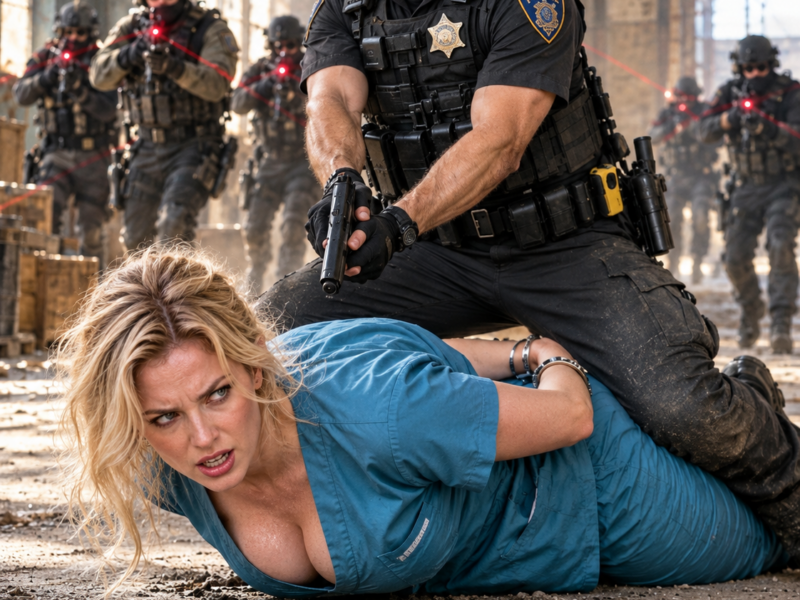
“The officer had just tightened handcuffs around my wrists in the middle of a hospital corridor when he announced that I was under arrest for interfering with a federal investigation
The black SUV stopped outside the hospital’s locked emergency entrance.
Nobody moved for several seconds.
Colonel Hayes stood beside me, holding the black folder against his chest. The woman in the dark suit was speaking quietly into her phone. Two men with military identification badges positioned themselves near the doors.
I could still feel the cold metal of the handcuffs around my wrists, even though Officer Brooks had removed them.
“Who is in that vehicle?” I asked.
Colonel Hayes looked at me.
“The man whose testimony could explain what happened to your mother.”
My stomach tightened.
“My mother is dead.”
“I know that’s what you were told.”
“Then stop talking around it. Tell me what happened.”
He glanced toward the SUV.
“Because the man inside that vehicle is the reason your mother disappeared.”
Before I could answer, the rear door opened.
A man stepped out.
He was in his late fifties, with gray hair, a slight limp, and a face that looked painfully familiar despite the fact that I had never seen him before.
He wore a dark coat over a plain shirt.
His eyes found mine immediately.
And then he stopped walking.
“Emily,” he whispered.
I took a step backward.
“How do you know my name?”
He swallowed.
“Because I held you when you were six years old.”
My breath caught.
The woman in the dark suit moved closer.
“Mr. Carter, we need you to come inside.”
He barely seemed to hear her.
He was looking at me as if he had spent twenty years rehearsing this moment and had suddenly forgotten every word.
“Your mother asked me to find you,” he said.
I shook my head.
“No. My mother died in a car accident.”
The man closed his eyes.
“That’s the story they gave you.”
Colonel Hayes stepped between us.
“Emily, this is Thomas Reed. He was a civilian intelligence contractor attached to a military recovery team twenty years ago.”
“Why does he have my last name?”
“Because Carter was his name before he entered witness protection,” the colonel answered. “He was your mother’s brother.”
I stared at him.
“My uncle?”
Thomas nodded slowly.
“I was your mother’s older brother.”
I wanted to believe him.
I also wanted to run.
The woman introduced herself as Special Agent Laura Mitchell. She explained that the raid at St. Mary’s had been part of a coordinated operation to locate a missing intelligence archive.
The archive was believed to contain evidence connected to an overseas military incident in which several American personnel had been killed.
One of the names in the file was Thomas Reed.
Another was my mother’s.
“Why would you search a hospital for an archive?” I asked.
“Because someone used a patient transfer record to move a piece of evidence,” Agent Mitchell said. “We had reason to believe the archive was connected to a person receiving treatment here.”
My eyes moved toward the ICU.
“Mr. Thompson?”
She nodded.
“Your patient was not the target of the investigation. But we believe he recognized a name connected to the case.”
I felt the blood drain from my face.
“Mr. Thompson is a retired Marine. He’s been struggling to breathe for three days. He’s not part of some intelligence operation.”
“No one is accusing him of being involved in a crime,” she said. “But he served with the unit that recovered your mother.”
I looked at Colonel Hayes.
“You said my mother died in an accident.”
He lowered his eyes.
“I said that was what you had been told.”
“Then tell me the truth.”
He took a breath.
“Twenty years ago, your mother, Claire Carter, worked as a civilian communications specialist supporting a military humanitarian mission overseas. During that mission, she discovered that someone was diverting medical supplies intended for displaced families.”
Thomas stepped forward.
“She found records proving that supplies had been sold through a private network. Some of the people involved had military access. Others had powerful connections outside the military.”
“And she reported it?”
“She tried,” Thomas said. “But before she could deliver the evidence, the convoy carrying the original records was attacked.”
He looked down at his hands.
“Your mother survived. Several others didn’t.”
I remembered the photograph in the folder.
A little girl in a blue jacket standing beside a military helicopter.
The scar beneath her ear.
Me.
“Why was I there?”
Thomas’s face crumpled.
“Because your mother had no one she trusted to look after you. She thought the mission would be safe. She was wrong.”
I pressed my fingers against the scar beneath my left ear.
“How did I get this?”
“A piece of broken glass,” he said. “When the convoy was attacked, the vehicle you were in overturned. Your mother pulled you out through a shattered window.”
I couldn’t breathe properly.
“She saved me?”
“She carried you for nearly two miles before the recovery team found you.”
The colonel nodded.
“I was part of that team.”
I turned toward him.
“You knew me?”
“I saw you that day. You were unconscious, but alive. Your mother refused to let anyone take you until she knew you were safe.”
“Then why didn’t you tell me?”
“Because the people responsible for the attack were still searching for her. They believed she had kept a copy of the records.”
Thomas looked at me.
“She had.”
The words seemed to change the temperature of the room.
“Where?”
He didn’t answer immediately.
Instead, he reached inside his coat and pulled out a small photograph.
It was old, faded around the edges, and folded twice.
He handed it to me.
My mother was standing in front of a modest house. She looked younger than I remembered her, with her dark hair pulled back and a smile I had spent twenty years trying not to forget.
I was sitting on her shoulders.
On the back, in handwriting I recognized from the few birthday cards I had kept, were the words:
For Emily. Wherever life takes us, you are my home.
My knees weakened.
I held the photograph against my chest.
“Where is she?”
Thomas looked toward the floor.
“I don’t know.”
The answer hurt more than I expected.
“You said she asked you to find me.”
“She did. Before she disappeared.”
“Disappeared where?”
“After the attack, your mother gave the evidence to a military medic. She told him to get you out of the country and keep you safe. She stayed behind to draw attention away from you.”
I looked at Colonel Hayes.
“Who was the medic?”
He answered quietly.
“Staff Sergeant Daniel Thompson.”
For a moment, the hallway went silent.
“Mr. Thompson?”
“Yes.”
I thought of the older man lying in ICU.
His weathered hands.
The way he had asked me about my family when I first introduced myself.
The way he had stared at the scar beneath my ear before quickly looking away.
I had thought he was confused because of his illness.
Now I wondered how many times he had recognized me.
“Why didn’t he tell me?”
“Because he made a promise to your mother,” Thomas said. “He was supposed to keep you safe without revealing your connection to her until the danger had passed.”
I shook my head.
“He’s been in my care for three days.”
“And he recognized you the first time he saw you,” Colonel Hayes replied.
I turned toward the ICU doors.
“I need to talk to him.”
Agent Mitchell stepped into my path.
“Not yet. We need to establish whether the person we’re looking for has access to the archive.”
“I’m his nurse. If he’s conscious, I can ask him questions.”
“You’re also now a potential witness.”
“I am not leaving him alone because your investigation suddenly involves my childhood.”
Colonel Hayes raised a hand.
“Agent Mitchell, let her speak to him. I’ll remain present.”
She hesitated, then nodded.
We entered the ICU.
The steady rhythm of monitors filled the room. Mr. Thompson lay beneath a white blanket, an oxygen cannula resting beneath his nose.
His eyes were open.
When he saw me, he looked first at my face, then at Thomas behind me.
He closed his eyes.
“I was hoping you’d never have to come here,” he whispered.
I pulled a chair beside his bed.
“You knew who I was.”
He nodded.
“From the moment you walked in.”
“Why didn’t you tell me?”
“Because I promised your mother.”
I felt tears gathering.
“You knew she was alive?”
His face tightened.
“I knew she was alive when I last saw her.”
“When was that?”
“Three days after the convoy attack.”
I leaned closer.
“Where?”
“An evacuation station near the border. She was injured, but she was alive. She made me promise to take you somewhere safe and never let anyone connect you to the evidence.”
I looked at Thomas.
He was standing near the doorway, staring at the floor.
“Why did you tell everyone I was an orphan?”
Mr. Thompson shook his head.
“I didn’t. Your mother’s brother arranged your new identity after the recovery team brought you home. The accident story was created to protect you. Your mother believed that if the people hunting her thought you were dead, they would stop looking.”
“But I wasn’t dead.”
“No. You were six years old, and you deserved a childhood.”
I stared at him.
“I deserved the truth.”
He nodded.
“You did.”
His breathing grew uneven. The monitor beside his bed changed rhythm, and I immediately reached for the call button.
He caught my hand.
“There’s something you need to know first.”
“Don’t strain yourself.”
“Your mother left something with me.”
He motioned toward the bedside cabinet.
I opened the drawer.
Inside was a small metal key taped beneath a folded piece of paper.
My name was written across it.
Not Emily Carter.
Just Emily.
I unfolded the paper.
My sweet girl, if you are reading this, then the people who kept you safe have finally found you. I am sorry that the truth took so long. I never stopped looking for you. I never stopped being your mother.
My vision blurred.
There was another line.
The key opens the place where I left the proof. Trust Daniel. Trust your uncle. And remember that none of this was ever your fault.
I looked up.
“Where does this key go?”
Mr. Thompson took a shallow breath.
“Storage locker 214. At the old naval station.”
Agent Mitchell immediately stepped forward.
“That’s the location we’ve been searching for.”
Colonel Hayes frowned.
“Why didn’t you tell us this earlier?”
“Because I didn’t know whether the people who attacked the convoy had been identified,” Mr. Thompson said. “I spent twenty years waiting for confirmation that the network was dismantled.”
Agent Mitchell looked at the key.
“The archive may still be there.”
I stood up.
“Then let’s go get it.”
“No,” Colonel Hayes said. “Not until we know the location is secure.”
“I’ve waited twenty years without knowing my mother might be alive. I’m not waiting another day.”
He looked at me for a long moment.
Then he nodded.
“We’ll do this properly.”
Before we left, I leaned down beside Mr. Thompson.
“Thank you for keeping me safe.”
His eyes filled.
“I wish I’d been able to give you more than safety.”
“You gave me the chance to grow up.”
He squeezed my hand.
“Your mother would be proud of you.”
I had to turn away before I started crying.
The old naval station was less than an hour away.
By the time we arrived, the sky had turned dark.
Agent Mitchell’s team secured the building while Colonel Hayes and Thomas accompanied me to the storage area.
Locker 214 stood at the end of a narrow corridor.
The key turned with a reluctant click.
Inside was a metal box, a stack of documents, and a small cassette recorder.
There were photographs, medical supply manifests, handwritten notes, and a sealed envelope with my name on it.
Agent Mitchell examined the documents first.
Her expression changed as she read.
“This is the original evidence,” she said. “Names, payments, shipment records. Everything.”
Thomas picked up one of the photographs.
“That’s the convoy.”
I looked over his shoulder.
Several soldiers stood beside a truck.
My mother was among them.
She had one hand on my shoulder.
I was wearing the same blue jacket from the photograph in the black folder.
I reached for the envelope.
Inside was a letter.
Emily,
I don’t know how old you will be when you read this. I don’t know whether you will remember my voice, or whether you will remember the way I used to brush your hair away from your eyes.
I hope you remember the good things.
The pancakes we made on Sunday mornings. The little seashells you collected. The way you insisted that every stray animal needed a name.
You were never a burden to me. Not for one second.
When the convoy was attacked, I thought I had lost everything. Then I heard you crying. I knew I had to get you out, no matter what happened to me.
Your uncle will tell you that I asked him to find you. I did. I also asked him not to let you spend your life waiting for me.
If I never return, I want you to live. Make friends. Fall in love. Find work that makes you feel useful. Laugh loudly. Don’t turn every birthday into a memorial for someone you think you lost.
And if you become a nurse, as you once told me you wanted to be, remember that caring for someone is never a small thing.
You have always had a brave heart, my little girl.
I love you beyond every distance.
Mom.
I lowered the letter.
I couldn’t speak.
Thomas placed a hand on my shoulder.
“She wrote that before the evacuation.”
I wiped my face.
“Did you know she wrote it?”
“No. She gave it to me in a sealed envelope and told me to deliver it when I found you.”
“Why didn’t you find me sooner?”
His eyes filled with regret.
“I tried. The people who arranged your new identity moved you several times. Then the case was classified, and every lead I followed ended in a locked door. I kept searching, Emily. I swear I did.”
I looked at him.
For twenty years, I had imagined my mother dying alone in a wrecked car.
I had imagined there was no one left to search for me.
Now I was standing in a storage room with an uncle I had never known, holding a letter written by a woman who had never stopped loving me.
It was almost too much to understand.
Agent Mitchell interrupted gently.
“There’s one more thing.”
She showed us a document attached to the bottom of the file.
It listed the names of the people who had authorized the diversion of medical supplies.
One name was highlighted.
A senior logistics officer who had later become a private security executive.
He had been the subject of a sealed investigation for years.
The evidence in the locker connected him directly to the convoy attack.
Agent Mitchell’s team had enough to reopen the case and obtain warrants.
But there was another page.
A handwritten note from my mother.
If they ever find this, look for the original witness. He knows who ordered the attack.
At the bottom was a name.
Thomas Reed.
I looked at my uncle.
“You were the original witness?”
He nodded.
“I saw the attack being planned. I heard the orders. I was supposed to testify, but the people responsible learned where I was. They threatened your mother and you.”
“That’s why you disappeared?”
“I agreed to a new identity so they couldn’t use me to reach you.”
Agent Mitchell closed the folder.
“Your testimony, combined with these documents, may finally be enough.”
Thomas looked at me.
“Your mother wanted the truth to come out. But she wanted you safe more than anything.”
I held the key tightly.
“Then let’s make sure both happen.”
The next morning, I returned to St. Mary’s.
I had barely slept.
Agent Mitchell had arranged for additional protection while the evidence was transferred and authenticated. Colonel Hayes had also made sure Officer Brooks was removed from the hospital operation pending an internal review.
I wasn’t interested in revenge.
But I wanted him to understand that a uniform didn’t give anyone permission to treat a nurse like a criminal without checking the facts.
When he approached me near the ICU, his expression was different.
“Ms. Carter.”
I stopped.
“I owe you an apology.”
I waited.
“I was given information that suggested someone in the hospital was obstructing the investigation. I acted too quickly. I should have verified your identity before putting you in handcuffs.”
“You should have listened when I told you I was caring for a patient.”
He nodded.
“You’re right.”
“I wasn’t hiding anyone. I was doing my job.”
“I understand that now.”
I looked at the hospital room behind him.
“Then remember it next time. A hospital isn’t a battlefield, and patients aren’t suspects just because someone has a file with their name in it.”
He lowered his eyes.
“I will.”
I walked away.
Mr. Thompson’s condition had improved enough for him to sit upright.
When I entered, he smiled faintly.
“Back to work?”
“Someone has to keep you out of trouble.”
He laughed, then coughed.
I checked his monitor and adjusted his oxygen.
For the first time since the raid, the room felt ordinary.
Then my phone rang.
It was Agent Mitchell.
“We have a development,” she said.
My heart began pounding.
“What happened?”
“The documents have been authenticated. Thomas has given his statement. The warrants have been issued.”
“And my mother?”
There was a pause.
“We found a record of a woman using your mother’s birth name at a medical clinic overseas six months ago. The photograph attached to the intake record is consistent with her age and appearance.”
I gripped the phone.
“Is she alive?”
“We can’t confirm that yet. But we’re following the lead.”
I closed my eyes.
For the first time in twenty years, hope felt like something more than a cruel trick.
Three weeks passed.
The investigation moved quickly once the original records were recovered.
Several people were arrested. The private security executive named in the archive was charged in connection with the conspiracy and the attack that had killed members of the convoy.
Thomas’s testimony became part of the case.
The military also began reviewing the way my identity had been changed and protected. Colonel Hayes apologized for the years of silence, though he never pretended that the decision had been simple.
I didn’t forgive everyone immediately.
Some wounds don’t close just because someone finally explains why they were made.
But I stopped feeling like my entire childhood had been stolen by a story I couldn’t question.
One afternoon, I was finishing my shift when Thomas called.
His voice sounded different.
Careful.
Almost afraid.
“Emily, I need you to sit down.”
I found an empty chair in the staff lounge.
“What is it?”
“We found her.”
The room seemed to tilt.
“Who?”
“Your mother.”
I pressed a hand against my mouth.
“Is she alive?”
“Yes.”
I couldn’t breathe.
“Where is she?”
“She’s in a rehabilitation center outside San Diego. She’s been living under another name. The people protecting her confirmed her identity after the evidence was recovered.”
“Why didn’t she contact me?”
“She believed the danger was still there. She was injured during the attack and spent a long time recovering. After that, she was moved repeatedly. Every attempt to contact you risked exposing your location.”
I stood up so quickly that the chair scraped the floor.
“Can I see her?”
“She’s asking for you.”
I don’t remember the drive.
I remember the sun shining through the windshield.
I remember Thomas sitting beside me, holding the old photograph.
And I remember being six years old again, waiting for my mother to come home.
The rehabilitation center was quiet.
A nurse led us down a hallway to a small room with a window overlooking a garden.
A woman sat in a chair beside the window.
Her hair was silver now.
Her shoulders were thinner.
But when she turned toward the door, I knew her.
I knew the shape of her eyes.
The small crease beside her mouth.
The way she lifted one hand when she was trying not to cry.
“Emily?”
I stopped.
For twenty years, I had imagined this moment in a hundred different ways.
I had imagined anger.
I had imagined questions.
I had imagined myself saying something powerful about the years we had lost.
Instead, all I could manage was one word.
“Mom?”
She covered her mouth.
Then she began to cry.
I crossed the room.
She reached for me with trembling arms, and I fell into them.
She held me like she had held me in the photograph.
Like she had held me before the convoy.
Like twenty years had been only a long, terrible afternoon.
“I thought you were dead,” I whispered.
“I know, sweetheart.”
“I thought you left me.”
She shook her head against my shoulder.
“Never. Not one day. Not one hour.”
I pulled back enough to look at her.
“Why didn’t you come back?”
Her eyes filled again.
“I tried. I wrote letters. I asked people to find you. But every time I got close, someone warned me that the people responsible were still watching. I thought staying away was the only way to keep you alive.”
“You could have told me.”
“I know.”
“You could have let me know you loved me.”
She took my hands.
“I thought you knew.”
I looked at her.
“I didn’t.”
She closed her eyes, and a sob escaped her.
“Then I’m sorry. I’m so sorry.”
I sat beside her and held her hand.
We didn’t fix twenty years in one afternoon.
There were too many questions.
Too many birthdays.
Too many ordinary days that neither of us could ever recover.
But we had something we hadn’t had the day before.
Time.
And the truth.
Before I left, she asked about my work.
I told her about St. Mary’s.
About the long shifts.
About the patients who frightened me and the ones who made me laugh.
About Mr. Thompson, who had kept his promise even when it meant carrying a secret for two decades.
My mother smiled through her tears.
“You became a nurse.”
“You remembered?”
“Of course I remembered. You used to wrap your dolls in towels and tell me they needed medicine.”
I laughed.
It was the first time in twenty years that the sound didn’t feel like it belonged to someone else.
A month later, Mr. Thompson was discharged.
His breathing had improved, and he was beginning a long course of rehabilitation.
My mother was doing better too.
She and Thomas met again after twenty years apart. They spent an entire afternoon talking, arguing gently about old family memories, and laughing over photographs.
Colonel Hayes visited once.
He brought no folders, no classified documents, and no military entourage.
Just flowers.
He apologized for the way the truth had been handled.
My mother accepted his apology, but she also told him something I never forgot.
“Protecting someone isn’t the same as deciding they don’t deserve to know their own life.”
He nodded.
“I understand.”
I wasn’t sure he did.
But I hoped he would remember.
On the anniversary of the raid, I returned to the same ICU room where everything had begun.
Mr. Thompson was sitting by the window, reading a newspaper.
He looked up when I entered.
“Still causing trouble, Nurse Carter?”
“Only for patients who refuse to follow instructions.”
He smiled.
I checked his chart, then pulled a chair beside him.
“Do you ever regret keeping the secret?”
He thought about it.
“Every day.”
“Then why did you do it?”
“Because your mother trusted me with the most important thing in her life.”
He looked at me.
“And because I knew that one day, if we were lucky, you’d get to ask me that question yourself.”
I looked down at my hands.
“I used to think my life started with the accident.”
He shook his head.
“No. Your life started long before that.”
I thought about the letter.
The photographs.
The key.
The woman who had carried me through broken glass.
And the uncle who had spent twenty years trying to find me.
The Marine who had kept a promise.
The colonel who had finally opened the folder.
The truth had arrived in handcuffs, tactical gear, and a black SUV.
But it hadn’t ended there.
It had led me back to the people who had loved me all along.
That evening, I visited my mother.
She was sitting by the window, watching the sun disappear behind the trees.
I placed the old photograph on her lap.
“Do you remember this?”
She smiled.
“You hated that jacket.”
“I loved that jacket.”
“You cried every time I tried to wash it.”
I laughed and leaned against her shoulder.
For a while, neither of us spoke.
Then she reached for my hand.
“Emily?”
“Yeah?”
“I’m sorry I missed so much.”
I squeezed her fingers.
“We can’t get those years back.”
“I know.”
“But we can start with tomorrow.”
She turned toward me, and her smile trembled.
“Tomorrow sounds wonderful.”
And for the first time in twenty years, I believed it.
The end.









