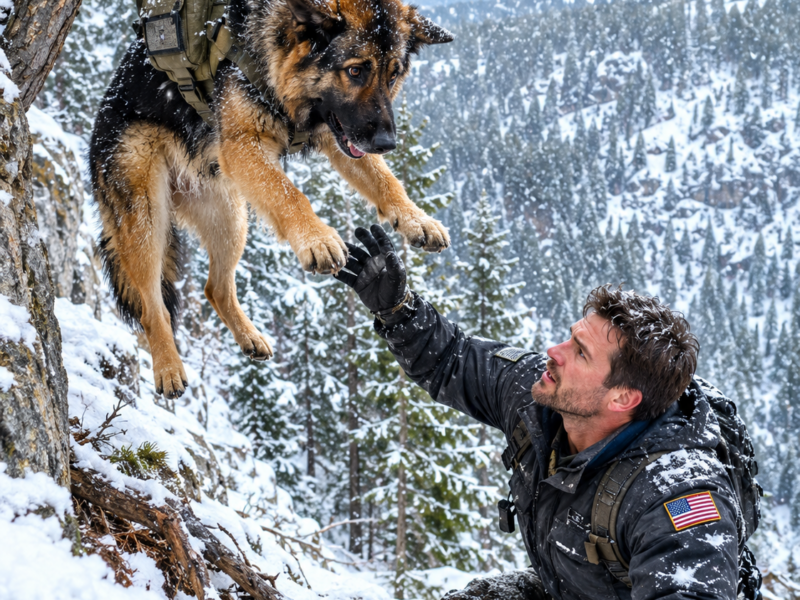
“The Navy SEAL had already decided he had nothing left to live for when a military dog fell out of a storm-darkened sky and crashed onto his frozen porch
The metal cover came free with a groan, revealing a narrow cavity beneath the floorboards.
At first, I saw only darkness.
Then my fingers brushed something cold and rectangular.
I pulled it out.
A black metal case, no bigger than a shoebox, wrapped in an old waterproof bag. A strip of military-grade tape sealed the lid. On top, someone had scratched three words into the metal.
OPERATION NIGHTFALL.
My hands stopped moving.
I had spent three years trying not to think about that operation.
Three years convincing myself that Marcus Reed was gone, that the men who had brought him home in a flag-draped coffin had told me everything, and that the nightmares were nothing more than the price of surviving when someone better than you didn’t.
Now his name was waiting for me beneath my own floor.
Outside, a fist struck the door.
“Cole! Last warning!”
Bear pushed himself upright beside the bookshelf.
His injured leg trembled, but he ignored it. His ears pointed toward the door, and a low growl rolled through his chest.
“Easy, buddy,” I whispered.
I set the case on the floor and looked for a latch.
There wasn’t one.
Just a small electronic keypad and a fingerprint scanner.
I tried the obvious combination first: Marcus’s birthday.
Nothing.
Then the date of our last deployment.
A red light flashed.
“Come on,” I muttered.
The pounding came again.
“You have no idea what you’re holding!”
That voice was closer now, right against the door.
I stared at the case, trying to remember Marcus’s habits. He used to say that people made their passwords too complicated because they forgot the most important thing about secrets.
The truth was usually hiding in plain sight.
I pressed the fingerprint scanner with my thumb.
A soft beep sounded.
The display changed.
IDENTITY NOT RECOGNIZED.
I almost laughed. I was an idiot.
Marcus had built his life around the people he trusted, not the people he wanted to imitate.
I pulled the photograph from my pocket.
It showed Marcus kneeling beside Bear in front of a transport aircraft. On the back, in Marcus’s unmistakable handwriting, were the words:
If Bear finds you, trust him.
I looked at the dog.
“Is this why you came here?”
Bear stepped closer, sniffed the case, then pushed his nose against the scanner.
The device beeped.
The light turned green.
For a second, neither of us moved.
Then a hidden mechanism clicked inside the case.
I lifted the lid.
Inside lay a ruggedized tablet, a small encrypted drive, several folded documents, and a sealed envelope bearing my name.
Not Lieutenant Cole.
Not Ethan.
Just:
For my brother.
My vision blurred.
Marcus had called me that only when things got bad enough that neither of us could pretend we were just colleagues.
I tore open the envelope.
Ethan,
If you’re reading this, Bear made it to you. That means the plan worked, or everything went wrong in a way I couldn’t predict.
I’m sorry I didn’t tell you the truth before I left.
Nightfall wasn’t what they told us it was.
I stopped reading.
A memory surfaced so sharply that for a moment I was back in Afghanistan, crouched behind a broken concrete wall with dust in my teeth and Marcus shouting over the radio.
We had been ordered to escort a small intelligence team through a remote valley. The briefing called it a recovery operation. Find a missing source, secure the information, get everyone out.
Simple words.
Nothing about it had been simple.
The convoy had taken fire before reaching the extraction point. Our communications failed. The route we’d been promised was clear turned into a killing ground.
Marcus had gone back for a wounded teammate.
I had tried to follow him, but a blast threw me against a wall. When I woke, my shoulder was shattered, my knee was barely holding together, and Marcus was gone.
They told me he died during the extraction.
They told me his body had been recovered.
They told me I should be grateful to be alive.
I had believed them because the alternative was unbearable.
I looked down at the letter again.
The team we were sent to recover had evidence that someone inside our own command was selling operational intelligence. The ambush wasn’t bad luck. Our route was given away before we ever left the base.
I found out after the mission. By then, the official report had already been written. Names were changed. Timelines were altered. The source disappeared from every record I could access.
I tried to report it. My messages were intercepted. I was warned to stop digging.
Then I found proof that the same people were preparing another operation using the same channels.
I couldn’t trust anyone around me. So I made copies and sent one to someone I knew would never sell it.
You.
I read that paragraph twice.
Then a third time.
Marcus hadn’t sent me anything.
Not that I remembered.
The letter continued.
If this reached you, I didn’t get the chance to explain. Don’t trust the people who come for Bear. He isn’t just a military working dog. During Nightfall, he helped locate the team after the extraction route collapsed. He found a survivor who was supposed to be dead.
That survivor knows who ordered the ambush.
The evidence is on the drive. But don’t open it on a connected device. The people looking for it can track more than the beacon on Bear’s harness.
A heavy impact shook the front door.
The frame cracked.
I folded the letter and slipped it into my jacket.
The men outside knew I had the dog. They knew my name. And if Marcus was right, they weren’t here to retrieve government property.
They were here to erase the last evidence of a crime.
I looked at the tablet.
Its screen was dark, but a small status light blinked steadily.
I reached for the power button.
Bear barked once.
It wasn’t a warning toward the door.
He was staring at the tablet.
“Not yet,” I told him.
I picked up the encrypted drive and shoved it into my pocket. Then I took the documents and the envelope and put them inside my old medical pack.
The front door shuddered again.
“Ethan!” the man shouted. “We don’t want to hurt you. Give us the dog and the case, and this ends tonight.”
I almost admired the effort.
Three men in the snow, a vehicle blocking the driveway, and a threat disguised as a reasonable offer.
I’d heard better lies in worse places.
I moved to the rear window and lifted the curtain a fraction.
Two black SUVs sat beyond the porch, engines running. A third man stood near the first vehicle, speaking into a radio. He wore a dark winter coat and gloves, but there was something about the way he held himself that I recognized.
Not a soldier.
Not a local deputy.
A contractor.
The kind of man who had learned to move like a professional without ever needing to wear a uniform.
He glanced toward the window.
I let the curtain fall.
My cabin had one back door, a narrow utility room, and a drainage trench that ran downhill toward the tree line. In summer, the trench carried rainwater away from the foundation. In winter, it was mostly hidden beneath snow and dead leaves.
It was the only route that didn’t cross the open yard.
I checked Bear’s injured leg.
He could stand, but not for long.
Leaving him wasn’t an option.
Neither was carrying him over my shoulder while three armed men waited outside.
I grabbed a blanket from the couch and wrapped it around his torso, careful to keep pressure off the wound.
“Listen to me, Bear. We’re going out the back. You stay close. If I stop, you stop.”
He looked at me as if he understood every word.
Maybe he didn’t.
Maybe he understood the only part that mattered.
We were going together.
A loud crash came from the front of the cabin.
The door gave way.
I heard boots cross the entryway.
“Clear the main room.”
I slipped into the utility room and opened the rear door just wide enough for Bear to squeeze through.
Cold air slapped my face.
The snow had deepened, and the wind drove it sideways through the trees. I pulled my hood tight and guided Bear into the drainage trench.
He limped behind me, leaving a broken line of paw prints that the storm would soon cover.
Inside the cabin, a man shouted.
“They’re gone!”
A second voice answered, calm and clipped.
“Find them. The dog is the priority.”
I kept moving.
The trench descended into a stand of fir trees about sixty yards from the cabin. At the bottom, I found the old hunting trail that led toward the county road. My truck was parked near the woodshed, but using it would put us directly in the open.
I needed help.
Not local help chosen at random. Not someone whose name might appear in the same compromised chain of command.
I needed a person who knew the system and had enough independence to act.
One name came to mind.
Special Agent Rachel Morgan.
Years earlier, Morgan had investigated a procurement scandal involving a private military contractor. I’d met her during a formal interview after a mission in which several pieces of equipment had mysteriously disappeared from our supply chain. She’d been direct, skeptical, and unwilling to accept convenient answers.
Marcus had liked her.
That alone made her worth considering.
I pulled my phone from my pocket.
No signal.
Of course.
The tracking beacon on Bear’s harness could lead the men straight to us, and the storm was swallowing every sound. I found a pocketknife in my pack and cut through the harness strap near the transmitter.
Bear flinched when the blade came close, but he stayed still.
“Sorry, buddy.”
The beacon came free.
I wrapped it in the waterproof bag that had held the case and buried it beneath a drift beside a fallen log.
If the device was transmitting, it would now point away from us.
I couldn’t know whether that would buy us minutes or hours.
We reached the county road shortly after midnight.
A mile down, a disused maintenance shed stood beside an abandoned gravel turnout. I had used it once during a storm when my truck had slid off the road. The shed had no electricity, but it had four walls, a roof, and an old landline junction box mounted on the outside.
I got Bear inside and shut the door.
He lowered himself onto a pile of canvas tarps, breathing hard.
I examined the wound on his leg by the light of my phone.
It was deeper than I’d hoped. The bleeding had slowed, but the surrounding fur was matted with blood and snow. He needed a veterinarian, antibiotics, and a proper examination.
He also needed to stay alive long enough to get them.
I used a field dressing from my pack to secure the wound, then gave him a little water.
“Hang on,” I whispered. “You didn’t come this far just to quit on me.”
He nudged my hand.
For the first time since the men reached my cabin, I allowed myself to think about the photograph.
Marcus had been smiling in it.
Not the forced grin he used for official pictures, but the crooked, tired smile that appeared when something had gone right and he was too exhausted to celebrate.
Bear had been beside him, younger then, his ears too large for his head.
I had been there that day.
I remembered the aircraft, the smell of hot metal, the joke Marcus made about my terrible coffee.
But I didn’t remember seeing Bear with him.
That bothered me more than it should have.
I opened the photograph again and examined the background. The aircraft’s tail number had been partly obscured by a shadow, but the last four digits were visible.
I knew those numbers.
They belonged to a transport aircraft listed in the Nightfall mission logs.
The photograph hadn’t been taken months before the operation, as I’d assumed.
It had been taken the morning we deployed.
I turned the picture over.
The message wasn’t simply a farewell.
It was a warning from a man who had known he might never return.
I found an old emergency phone in the maintenance shed, mounted beside the landline junction. It was meant for road crews and still had a faded instruction sticker beneath the receiver.
The line hummed when I lifted it.
I dialed the number I’d memorized years ago.
It rang six times.
Then a woman’s voice answered.
“Morgan.”
“Rachel, it’s Ethan Cole.”
Silence.
Then, “I thought you were off-grid.”
“I was.”
“What’s happened?”
“I need you to listen before you decide whether to believe me. Marcus Reed left me evidence connected to Operation Nightfall. Men with weapons just broke into my cabin trying to take it. I have his military working dog with me. He’s injured, and I think the tracking beacon on his harness was active.”
I heard her take a breath.
“Where are you?”
I gave her the location.
“Don’t move,” she said. “Don’t touch any electronic device you don’t need. And do not open that drive.”
“I’ve read the letter.”
“Then you already know someone may be monitoring this call.”
“Can they trace this line?”
“Possibly. Which is why I’m going to make this quick. I never closed the Nightfall file. The original inquiry was taken away from me before I could finish it. I was told the witnesses were unreliable and the evidence had been compromised.”
“Who told you?”
“People with more authority than me at the time.”
I tightened my grip on the receiver.
“Was Marcus one of the witnesses?”
“He was the reason I kept looking.”
For a moment, I couldn’t speak.
Morgan continued.
“Listen carefully. There was a survivor from that mission. An intelligence analyst named Noah Bennett. Officially, he died during the attack. But his death certificate was based on a body identification that never made sense. I found discrepancies in the medical report. Then the file disappeared.”
Marcus’s letter had said the same thing without giving me a name.
“Do you know where Bennett is now?”
“No. But if Marcus preserved evidence, it may tell us.”
“What do I do?”
“Stay where you are. I’m arranging a secure response with federal investigators who weren’t involved in the original inquiry. I won’t send anyone until I can verify the team independently.”
“How long?”
“An hour, maybe two.”
I looked at Bear.
He had lifted his head, watching me with exhausted eyes.
“He may not have two hours.”
“There’s a veterinary emergency clinic outside Red Valley. I’ll contact them through a separate line and arrange for a trusted transport. Don’t take him anywhere unless I confirm the vehicle and the people inside.”
The line clicked.
Then Morgan added, “Ethan, one more thing. Did the men identify themselves?”
“No.”
“Did you recognize anyone?”
“Not clearly.”
“If one of them is a man named Grant Mercer, don’t let him talk you into anything.”
The name landed with a strange familiarity.
“Who is he?”
“A security consultant. Former military. He worked with the contractor that supplied communications equipment for Nightfall. His company has been connected to several investigations, but nothing ever stuck.”
I thought of the man standing beside the SUV.
The way he’d watched my cabin.
The way the others had followed his instructions.
“Rachel, I think he’s here.”
“Then get away from the road. Now.”
The line went dead.
I hung up and stared at the receiver.
Outside, an engine approached through the snow.
Bear struggled to his feet.
I turned off my phone and moved to the narrow crack between the shed boards.
A black SUV rolled into the turnout.
It stopped less than twenty yards away.
The driver’s door opened.
A man stepped out wearing a dark coat and black gloves.
He looked directly at the shed.
“Cole,” he called. “I know you’re in there.”
I reached for the pistol I’d carried since leaving the service.
My hand shook.
Not from fear alone.
From the familiar, sickening realization that every path forward had narrowed to a few terrible choices.
The man raised his empty hands.
“My name is Grant Mercer. I don’t want a fight.”
“Then leave.”
“I can’t do that.”
“Try.”
He looked toward the shed door.
“The dog is injured. If you keep moving him through this weather, he’ll die.”
I hated that he was right.
“That’s not your concern.”
“Actually, it is. Bear belongs to a program I helped establish. He’s a classified asset, and he carries information that could endanger people who are still alive.”
“Marcus was alive when he gave you that dog?”
Mercer paused.
That tiny hesitation told me more than his answer would have.
“Marcus Reed was a brave man,” he said. “He made some very poor decisions.”
“You knew him?”
“I knew of him.”
“You’re lying.”
Mercer’s expression tightened.
“I’m trying to give you a way out. Hand over the drive. I’ll get the dog treated. You’ll walk away with no charges and no more people at your door.”
“No.”
“You don’t know what’s on that drive.”
“Then explain it.”
“I can’t.”
“Convenient.”
He lowered his hands.
“Cole, people died during Nightfall. Good people. The report was sealed because the mission involved intelligence sources who would be killed if their identities became public. Some details were altered to protect them.”
“Did you give our route to the people who ambushed us?”
“I didn’t plan the operation.”
“Did you know the route was compromised?”
Mercer didn’t answer.
Behind him, a second vehicle appeared through the storm.
Then a third.
Mercer glanced over his shoulder, and for the first time, he looked uncertain.
That was when I understood something.
He hadn’t come alone.
But he hadn’t expected company, either.
The first SUV’s headlights went dark.
A voice called from the road.
“Federal agents! Hands where we can see them!”
Mercer spun.
Two unmarked vehicles blocked the turnout. Doors opened, and armed agents moved into position behind them.
“Drop your weapon!” someone shouted.
Mercer lifted his hands.
I stayed inside the shed, pistol lowered but ready, until a woman approached the door.
“Ethan Cole? Special Agent Morgan. I need you to put the weapon on the floor and step out slowly.”
I did as she asked.
Her eyes moved over me, then past me to Bear.
The moment she saw him, her expression changed.
“Get the veterinary team here,” she called over her shoulder. “Now.”
Two agents secured Mercer. Another team moved toward the SUV, weapons raised. Morgan stepped inside the shed and shut the door against the wind.
“Are you hurt?”
“No.”
“Is the drive with you?”
I nodded.
“Good. Don’t hand it to me here. We have a forensic team waiting at a secure site. We’ll document everything, and you’ll stay with the evidence while they verify the chain of custody.”
I glanced at Mercer through the gap in the boards.
“He said the dog was a classified asset.”
“That’s not the question we need to answer tonight.”
“What is?”
Morgan looked at Bear.
“Why someone went to this much trouble to keep him quiet.”
The veterinary transport arrived twenty minutes later, escorted by two agents. The veterinarian was a middle-aged woman named Dr. Patel, who approached Bear slowly and let him smell her hand before examining the bandage.
“He needs surgery to clean this wound,” she said. “He’s lost blood, but his breathing is stable. We can help him.”
Bear looked at me as they prepared the stretcher.
I knelt beside him.
“You’ve done enough, buddy. Let them take care of you.”
He pressed his forehead against my chest.
For a second, the shed disappeared. There was only the weight of his head, the warmth of his breath, and the memory of Marcus leaning against a transport aircraft with that crooked smile.
“I’ve got you,” I whispered.
Then I let the veterinary team carry him away.
The federal site was a converted administrative building outside Red Valley. By dawn, the snow had eased, and the storm had become a pale curtain over the mountains.
I sat in a small interview room while agents photographed the case, cataloged the documents, and created forensic copies of the drive.
Morgan stood beside a monitor.
“We’ve isolated the system,” she said. “Nothing will be connected to an external network until the forensic team finishes its work.”
“Can you open it?”
“We can try.”
An hour later, the lead examiner entered carrying a printed report.
“The drive contains encrypted communications, mission files, financial transfers, and recorded audio. The encryption key was stored in the tablet, but the tablet also has a local authentication layer. We recovered part of the access sequence from the case’s internal memory.”
“Can you read it?”
“Some of it. Enough to establish that the records are authentic. We’re still validating individual files.”
Morgan sat across from me.
“Ethan, there’s something you should know before we go further. The evidence doesn’t just concern Nightfall. It suggests the operation was used to conceal the movement of intelligence funds through a private contractor.”
“Mercer’s company?”
“Several connected companies. The records show payments made before and after the ambush. Some were disguised as equipment purchases. Others went through shell vendors.”
“Who authorized them?”
“We’re checking that now.”
I leaned forward.
“Does it prove someone sold our route?”
“There’s a communication thread that appears to discuss a change in the extraction corridor shortly before deployment. The sender used a restricted command account. We haven’t authenticated the account owner yet.”
“Then we still don’t know who did it.”
“Not yet.”
She didn’t sugarcoat it.
I appreciated that.
For years, I had lived with an official explanation that left no room for questions. Now, at least, someone was willing to admit what remained unknown.
Morgan turned a page.
“There’s also a video file. It was recorded after the mission. It appears to show Marcus speaking with someone in an undisclosed location.”
My stomach tightened.
“Play it.”
“Not until the forensic team confirms it hasn’t been altered. We won’t risk contaminating the original.”
I stood and walked to the window.
The mountains were barely visible beyond the frosted glass.
I had wanted answers for three years.
Now they were coming, and I was discovering that answers could frighten you almost as much as uncertainty.
“What about Noah Bennett?” I asked.
Morgan looked up.
“We found a reference to him in a personnel record. His name was removed from the final report, but it appears in an earlier version. He was listed as recovered alive from the extraction zone.”
My heart thumped once, hard.
“Alive?”
“At least at the time that record was created.”
“Where did they take him?”
“We don’t know yet. But the file references a medical transfer under a different name.”
I looked at the case on the table.
Marcus hadn’t just been trying to clear his own name.
He had been trying to keep a witness alive.
And Bear had carried the only surviving trail to him.
That afternoon, the forensic team authenticated the first set of records. The evidence was stronger than anyone had expected.
An audio file contained a conversation between two senior personnel discussing the extraction route. One voice said the team would be “unavailable for further questions” if the operation proceeded as planned.
Another file showed that a route update had been issued from a command account shortly before our convoy departed. The change sent us through the exact valley where the ambush occurred.
A series of financial records connected the contractor to payments made through shell companies.
None of the files alone proved who had ordered the attack.
Together, they made the original investigation impossible to ignore.
Then the examiner opened the video.
Marcus appeared on screen in a bare room, wearing a plain T-shirt. His face was bruised. One eye was swollen, and he looked thinner than I remembered.
But he was alive.
I gripped the edge of the table.
Marcus leaned toward the camera.
“If this recording survives, the people who ordered Nightfall will claim I died in the ambush. They will say the evidence is fabricated. They will say the route was changed for operational reasons.”
He looked down, took a breath, and continued.
“Ethan, if you ever see this, I’m sorry. I know what they told you. I know you were left to believe I was dead.”
My throat closed.
“I tried to get back to you. I tried to send word. Every channel I used was compromised. If I had contacted you directly, they would have followed the message to you.”
Marcus rubbed his face.
“There’s a witness. Noah Bennett. He survived the ambush, but he saw who passed the route information. I got him out before the people running this operation could reach him. He is alive, and he knows the truth.”
He paused.
“Bear helped us find him. The dog stayed with Noah when I had to move away. He brought us through the mountains when every route we had was watched. If anything happens to me, Bear is the one link I can still trust.”
Marcus looked directly into the camera.
“Ethan, you didn’t fail me. You hear me? You did not fail me. You were wounded. You were trying to come back. I saw what you did, and I would never ask you to carry the blame for my choices.”
I couldn’t breathe.
He had known.
He had known the thing that had kept me awake night after night.
Marcus leaned back.
“If you ever get this message, don’t go looking for revenge. Find the witness. Get the truth into the hands of people who can act on it. That’s all that matters.”
The video ended.
For a long time, the room was silent.
I stared at the blank screen, waiting for another frame, another word, anything that might make the moment less final.
Morgan didn’t interrupt.
Finally, I sat down.
“He was alive after the mission.”
“Yes,” she said softly.
“And he never came back.”
“We don’t know what happened to him after this recording.”
I wiped my face with the heel of my hand.
I had spent three years grieving a man whose death had been declared certain. Now I had to confront something stranger: he had lived long enough to leave me a message, but he hadn’t been able to reach me.
I didn’t know whether that made the loss easier.
It made it real in a different way.
Two days later, the investigation uncovered Noah Bennett’s new identity in a protected witness file. He had been placed in a federal relocation program after the mission, then transferred again when someone compromised his original location.
He was alive.
He was living under a different name in a small town several states away.
The agents contacted him through the case officer who had managed his protection. After reviewing the authenticated evidence, Bennett agreed to speak with investigators.
He arrived under escort three days later.
He was older than I expected, with gray in his beard and a slight tremor in his left hand. He looked at Morgan first, then at me.
“You knew Marcus?” he asked.
“He saved my life more than once.”
Bennett lowered his eyes.
“He saved mine, too.”
We sat in a secure interview room while the recording equipment was checked.
Bennett described the mission in careful detail. He explained how he had been carrying intelligence about a network that diverted military information and equipment to private buyers. He had been ordered to meet the extraction team because he possessed records that could identify the people involved.
The route change came minutes before departure.
The new corridor was described as a routine adjustment.
It was not.
The ambush killed several members of the team and left Bennett wounded. Marcus found him in the wreckage and refused to leave him behind.
“He knew the route had been compromised,” Bennett said. “He told me that if we got out, we would have to assume the betrayal came from inside the command structure.”
“Did he know who was responsible?”
“He suspected a senior officer named Colonel Adrian Shaw. Shaw had access to the route planning system. But Marcus never said he had definitive proof.”
Morgan made a note.
“Did you see Shaw communicate with the contractor?”
“No. But I saw a message on the operations terminal. It included the revised route and a confirmation code. Marcus photographed it before the system was wiped.”
“Was that photograph on the drive?”
Bennett nodded.
“I believe so. He told me he had made several copies.”
The next question came from me.
“What happened to Marcus?”
Bennett looked at his hands.
“He got me to a safe location. He planned to return for the remaining evidence, but someone found our first hideout. He sent me away with a contact who could arrange protection. He stayed behind to draw them off.”
“Did you see him again?”
“No.”
“Did you hear that he died?”
“Months later. Through an intermediary. I was told not to contact anyone from the unit because doing so could expose my location.”
I stared at the table.
The story was becoming clearer, but not kinder.
Marcus had saved Bennett, preserved the evidence, and sent Bear to me because he believed I could be trusted.
He had made the decision to stay behind without knowing whether he would ever come home.
It was the kind of decision Marcus had always made.
The kind that made him brave.
The kind that had finally cost him everything.
The investigation moved quickly after Bennett’s testimony.
Colonel Shaw was placed on administrative leave and then arrested after investigators recovered messages linking his account to the route change. Grant Mercer was charged with evidence tampering, conspiracy, and obstruction after forensic analysis connected his company to the payments and the effort to recover Bear.
Other officials were questioned. Some cooperated. Others invoked their rights.
The case would take months, perhaps years, to finish.
But the official story had broken.
The Nightfall report was reopened. The families of those killed were notified that the original findings were unreliable. A formal review began to restore the missing details to the record.
I gave my statement three times.
Each time, I described what I remembered, what I had been told, and what I had only recently learned.
I didn’t exaggerate.
I didn’t fill in gaps.
I had spent too long living with a story that other people had written for me.
I wasn’t going to make the same mistake.
Bear remained at the veterinary clinic for five days.
The wound was serious, but the doctors were optimistic. He needed surgery, antibiotics, and a long period of rest. When I visited, he was lying on a padded bed with a bandage around his leg and a plastic cone that made him look deeply offended by the entire world.
The moment I entered, his tail began to thump.
“Hey, soldier.”
I sat beside him.
He pushed his nose under my hand, then rested his head against my knee.
I hadn’t realized how much I needed that simple weight until it was there.
The veterinarian told me Bear would probably never return to active duty. His injury, combined with the stress of the mission and his age, made another deployment impossible.
I told her that was fine.
“He’s done enough.”
She smiled.
“That’s what I thought you might say.”
The military initially wanted Bear transferred to a secured facility while his status was reviewed. Morgan intervened, arguing that he was a critical witness in the investigation and that his care should remain under independent veterinary supervision.
After the evidence was authenticated and his medical status clarified, the authorities approved his retirement into my custody.
The paperwork took longer than the decision.
When I finally signed the last document, I sat in my truck outside the clinic and stared at the page.
Bear was no longer government property.
He was no longer a piece of evidence to be moved between agencies.
He was a dog who had crossed a storm to find a man who had stopped believing he had anything left to offer the world.
And now he was coming home with me.
The drive back to the cabin took nearly two hours.
I kept the radio off.
Bear slept in the passenger seat, his injured leg resting on a folded blanket. Every few minutes, he lifted his head to check that I was still there.
“I know,” I told him. “I’m not going anywhere.”
The cabin looked different when we arrived.
The front door had been replaced. The broken frame was repaired. The bookshelf stood against the wall again, though the floor vent remained open while the investigators finished documenting the hidden compartment.
The place still felt violated.
But it was mine.
I carried Bear inside and settled him near the woodstove. He sniffed the room, then lowered himself onto his old blanket as if he had lived there for years.
I put the photograph of Marcus on the mantel.
For a long time, I stood looking at it.
I still didn’t know exactly what had happened to him after the recording. Investigators were following leads, reviewing old travel records, and searching for any sign that he had survived longer than the official timeline suggested.
There was no guarantee they would find him.
No promise that the truth would give me the ending I wanted.
But for the first time in three years, I wasn’t chasing a story designed to make me stop asking questions.
I was helping uncover the truth.
That mattered.
The weeks that followed were difficult in ways I hadn’t expected.
Once the immediate danger passed, the old grief returned. Not the numb, distant pain I’d lived with before, but something sharper. I found myself remembering conversations I’d forgotten, small promises Marcus had made, and plans we’d laughed about because neither of us believed we would ever have enough time to carry them out.
Some days, I was angry with him for leaving me in the dark.
Other days, I was grateful he had trusted me enough to send Bear.
Most days, I felt both things at once.
Bear seemed to understand when I was struggling.
He never demanded attention. He simply settled near my chair, his ears shifting whenever I moved. If I stayed up too late, he would nudge my hand. If I woke from a nightmare, he would stand beside the bed until I sat up and took a breath.
He wasn’t a cure.
He didn’t make the past disappear.
He gave the present a reason to keep moving.
I began taking him outside each morning, slowly at first. We walked only as far as the trees and back. When his leg hurt, we stopped. When my knee hurt, we stopped then, too.
Neither of us liked admitting our limits.
We learned anyway.
One morning, as the snow melted into thin streams along the path, Bear paused beside the old fence line.
His ears lifted.
He looked toward the mountains.
I followed his gaze.
The sky was pale blue, and sunlight rested on the ridges where the last storm clouds had broken apart.
I thought about Marcus’s final message.
You did not fail me.
For years, I had believed survival was something I had stolen from him. That if I’d been faster, stronger, less injured, or less afraid, I could have changed the outcome.
Now I understood that grief had been turning an impossible moment into a trial I kept forcing myself to lose.
Marcus had made his choice.
I had made mine.
Neither of us had known how the story would end.
I knelt beside Bear and scratched behind his ears.
“We’re still here,” I said.
He leaned into my hand.
“That’s got to count for something.”
Three months later, I was invited to attend a formal review of the Nightfall operation.
The hearing room was full of officials, investigators, and families who had spent years waiting for answers. Some were angry. Some were exhausted. Some looked as if they had stopped expecting anything at all.
I sat near the back with Morgan.
Bennett testified first. He described the compromised route, the hidden financial network, and Marcus’s efforts to preserve the evidence.
Then it was my turn.
I spoke about the mission, the injury, the report I had been given, and the guilt I had carried afterward.
I told them how the official account had shaped my life.
I told them about the cabin, the hidden case, and the men who had come to take Bear.
I did not describe Marcus as a saint.
He was stubborn. He could be reckless. He had a terrible habit of pretending he was fine when he was hurt.
He was also loyal, brave, and unwilling to leave someone behind.
I wanted the record to show the whole man.
When I finished, the chair of the review panel thanked me.
It wasn’t justice.
Not yet.
But it was the first official acknowledgment that the truth had been buried.
Outside the building, Morgan caught up with me.
“The investigation is expanding,” she said. “There will be more charges. The department is reviewing the original casualty findings, and the families will receive corrected reports.”
“Will they ever know everything?”
“I don’t know.”
I appreciated the answer.
She glanced toward the parking lot.
“How’s Bear?”
“Learning to hate physical therapy.”
“That sounds like a good sign.”
“It sounds like him.”
She smiled.
Then her expression grew serious.
“We found one more thing on the drive. A handwritten note in a file Marcus labeled For Ethan. It wasn’t part of the encrypted archive. I wanted to give it to you in person.”
She handed me a small evidence envelope.
Inside was a folded sheet of paper.
The handwriting was Marcus’s.
Ethan,
If you made it this far, then Bear did his job, and you did yours.
I know you. You’re probably trying to turn this into another reason to blame yourself. Don’t.
You can’t save everyone. You can’t go back and change a moment that already happened. But you can decide what you do with the life you still have.
I wanted to come home. I wanted to sit on your porch, drink your awful coffee, and listen to you complain about the weather. I wanted one more chance to tell you that the best part of every deployment was knowing I had someone beside me who would never leave me behind.
If I don’t get that chance, then let this be enough: you were my brother, Ethan. Not because we wore the same uniform, but because you kept showing up when it mattered.
Take care of Bear. Let him take care of you.
And when you’re ready, start living again.
Marcus.
I read the letter once.
Then I folded it carefully and put it in my jacket.
I didn’t cry in the parking lot.
I didn’t need to.
The grief was still there, but it no longer felt like a locked room with no door.
It felt like a place I could enter, remember him, and leave when I was ready.
That evening, I drove home through the mountains.
Bear was waiting at the cabin door when I arrived, his tail sweeping slowly across the floor.
I set my keys down, hung Marcus’s letter beside the photograph, and knelt to greet him.
“Good news, buddy,” I said. “The truth is finally getting out.”
Bear gave a soft bark.
“I know. It’s about time.”
Outside, the wind moved through the fir trees. The last patches of snow were melting beneath the porch, revealing the dark earth underneath.
I opened the door and let in the cold, clean air.
For the first time in years, the cabin didn’t feel like a place where I had come to disappear.
It felt like a place where I could begin again.
I made coffee.
Bear settled beside the stove.
And when the sun dropped behind the mountains, I sat on the porch with Marcus’s photograph in my hand and watched the sky turn gold.
I couldn’t bring my friend home.
I couldn’t give the dead back their futures or undo the choices that had taken them away.
But I could tell the truth about him.
I could refuse to let his courage be buried beneath a lie.
And I could care for the dog who had carried his final message through a blizzard to find me.
Bear lifted his head and rested his chin on my knee.
I put my hand on his back.
“I’m still here,” I whispered.
This time, it wasn’t a confession.
It was a promise.
THE END.









