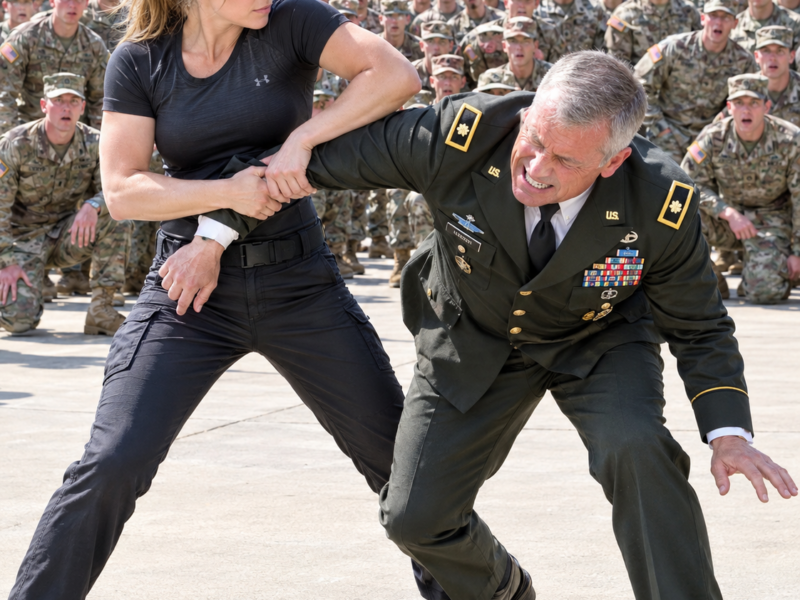
The morning sun blazed over Fort Redstone as eight hundred soldiers stood in perfect formation on the parade ground
For five days, Captain Elena Brooks had waited for the military investigation to determine whether she would keep her career or lose everything she had worked for. She had defended herself when Colonel Richard Hayes attempted to strike her, and the defensive movement had left his arm fractured. Although the evidence supported her account, Elena knew that being cleared of an accusation did not mean everyone would accept the truth.
And she was right.
Colonel Hayes had spent decades building a reputation as a powerful commander. He could not bear the thought that eight hundred soldiers might remember him not as a respected leader, but as the officer who had lost control and tried to hit a subordinate. Rather than acknowledge his behavior, he decided to make Elena pay for what had happened.
Two days after the inquiry cleared her of the principal allegation, Elena received a new assignment order. She was to be transferred to a remote logistics facility several hundred miles away, effective immediately. The order offered no detailed explanation, and it arrived before the command had completed its review of the leadership concerns raised during the investigation.
Elena read the document twice.
She had expected resentment from Hayes. She had expected uncomfortable conversations and suspicious looks. But a sudden transfer, without a clear operational reason, felt like a punishment disguised as routine administration.
She took the order directly to Major Samuel Reed.
He read it carefully, then looked up.
“Did anyone explain why this transfer is necessary?”
“No, sir. The order says the move is required to support operational priorities.”
“Were you consulted?”
“No, sir.”
Reed leaned back in his chair. “That is unusual, especially given the timing.”
“I don’t want special treatment,” Elena said. “If the army needs me somewhere else, I’ll go. But I don’t want an official record to suggest that I did something wrong when the investigation found otherwise.”
“You’re entitled to ask for clarification through the proper channels.”
Elena nodded. “Then that’s what I’ll do.”
Reed watched her for a moment.
“Captain, you should understand that challenging an assignment can create more conflict. Hayes may interpret it as another attempt to undermine him.”
“With respect, sir, I’m not challenging the army. I’m asking the command to explain its decision.”
“That’s a fair distinction.”
Reed promised to review the order and contact the personnel office. Elena returned to her quarters, packed the few belongings she had unpacked since arriving at Fort Redstone, and prepared herself for the possibility that she would have to leave anyway.
Meanwhile, Hayes was meeting privately with two senior officers.
His injured arm remained in a brace, and his frustration had become impossible to conceal.
“Brooks cannot remain here,” he said. “Every time she walks onto the parade ground, soldiers will think they can question their commanding officers.”
One of the officers, Brigadier General Thomas Whitaker, looked across the table.
“Colonel, the investigation did not substantiate the allegation that she initiated an unprovoked assault. Your own conduct was also raised during the review.”
Hayes stiffened.
“She broke my arm.”
“The injury is documented. So is her statement that she acted to prevent you from striking her.”
“She should have known better than to put her hands on a superior officer.”
Whitaker’s expression hardened.
“Military rank does not remove a person’s right to defend themselves from an imminent physical attack. We have procedures for reviewing the evidence. We cannot substitute personal resentment for those procedures.”
Hayes looked away.
Whitaker continued, “If you believe the transfer is operationally necessary, provide the supporting rationale. If it is intended to punish Captain Brooks for an incident in which she was cleared of the principal allegation, that is a serious concern.”
The colonel’s face darkened.
“I am trying to preserve discipline.”
“Then demonstrate discipline yourself.”
The meeting ended without the agreement Hayes wanted.
But the colonel was not finished.
He believed that if he could not remove Elena quietly, he could at least damage her reputation enough that nobody would trust her again. He began telling selected officers that she was physically aggressive, difficult to supervise, and unsuitable for positions requiring respect for the chain of command.
He never mentioned the damaged vest.
He never mentioned the argument in his office.
And he certainly never admitted that he had raised his hand toward her.
For several days, his version of the story spread through the officers’ mess. Some people accepted it without question. Others remained silent, unwilling to risk their own standing by challenging a colonel.
Elena heard the rumors but did not confront anyone. She had learned that responding to every accusation could become a trap, consuming her time and turning her into the center of a conflict she had never wanted.
Instead, she continued her duties and waited for the command’s response.
Then, on Friday morning, Major Reed called her into his office.
“I have an update,” he said.
Elena sat down.
“The personnel office has requested a written justification for your transfer. The command has not provided one that adequately explains why you must leave immediately.”
“So what happens now?”
“The order is being reviewed. Until that review is complete, you are to remain at Fort Redstone.”
Elena released a breath she had not realized she was holding.
“Thank you, sir.”
“Don’t thank me yet. This isn’t over.”
He placed a folder on the desk.
“Several officers have also raised concerns about the way Hayes has been discussing the incident. They’re worried that the rumors could influence witnesses or interfere with the review.”
Elena looked at the folder but did not open it.
“Are they willing to make formal statements?”
“Some are. Others are afraid.”
“Then they should be given a safe way to report what they know.”
Reed nodded. “That’s exactly what I’ve recommended.”
For the first time, Elena began to understand that the situation was larger than her own career. If a commanding officer could turn a safety concern into a personal confrontation and then use his position to punish the person who challenged him, the problem would not end when she left the base.
Other soldiers would learn the wrong lesson.
They would learn to keep quiet.
And one day, that silence could have consequences far worse than a damaged vest or a fractured arm.
That afternoon, Elena was called to a meeting with Brigadier General Whitaker and several senior officers. She entered the conference room, saluted, and took the seat indicated to her.
Whitaker spoke first.
“Captain Brooks, the command has reviewed the circumstances surrounding your transfer order. We have found insufficient justification for its immediate execution. The order has been suspended pending further review.”
“Yes, sir.”
“We have also received reports that statements about the incident may have been circulated without regard for the findings of the investigation. We intend to address that.”
Elena remained silent, allowing him to finish.
“However,” Whitaker added, “this meeting is not an invitation to attack Colonel Hayes. The command will evaluate his conduct through the proper procedures, just as it evaluated yours.”
“I understand, sir. I am not asking for retaliation. I am asking for a fair process.”
“Good. That is what we expect from every officer.”
One of the senior officers opened a folder.
“We also want to discuss the equipment issue that began the confrontation. Our review indicates that the damaged fastening was reported before the inspection but was not replaced in time. We need to understand why.”
Elena looked up.
“The private told me he had reported it to his sergeant, sir. I directed him to have the defect documented and arranged for a replacement.”
“Was the equipment shortage recorded?”
“I made a note in my inspection report.”
“Do you have that report?”
“Yes, sir. I submitted it on the morning of the inspection.”
The officer checked the folder, then nodded.
“We have it.”
Whitaker folded his hands.
“This is important. The original concern should have been addressed through the safety process. Instead, the disagreement escalated into a personal confrontation. We need to ensure that neither part of the problem is ignored.”
Elena answered carefully.
“Sir, I believe officers should be able to disagree professionally without fear of punishment. I also believe soldiers should be able to report unsafe equipment without worrying that they will be blamed for causing a delay.”
“That is a reasonable expectation,” Whitaker said. “And it is one this command must uphold.”
The meeting lasted nearly an hour. The officers asked Elena about reporting procedures, the pressure junior personnel sometimes felt when raising concerns, and the steps she believed could prevent similar situations.
She offered practical suggestions rather than personal accusations. Safety reports should be documented. Supervisors should acknowledge receipt of a concern. Unresolved equipment problems should be escalated to someone authorized to act. And when disagreements became heated, leaders should have clear procedures for ending the conversation before it became threatening.
By the time she left the room, Elena realized that something meaningful might finally come from the incident.
But the greatest test was still ahead.
On Monday morning, Fort Redstone held a special formation for all eight hundred soldiers. Word had spread that Brigadier General Whitaker would address the entire command. No one knew whether he would announce disciplinary action, a new assignment, or a change in leadership.
Elena stood near the front of the formation, her face calm.
Hayes was absent. He had been instructed to remain away from command duties while the separate review of his conduct continued.
Whitaker stepped to the microphone.
“Soldiers, this command has recently experienced an incident that has raised serious questions about leadership, safety, and professional conduct.”
The parade ground fell silent.
“I will not discuss private investigative details in front of this formation. Those matters will be handled through the appropriate channels. But I want to make one thing clear: discipline does not mean blind obedience to every personal demand. Discipline means following lawful orders, maintaining standards, and having the courage to report a problem before it harms someone.”
Several soldiers exchanged glances.
Whitaker continued.
“Every soldier has a responsibility to respect the chain of command. Every leader has an equal responsibility to exercise authority fairly. Rank is not a license to intimidate, humiliate, or threaten the people under your command.”
A deep silence settled over the formation.
“If you observe unsafe equipment, report it. If a problem is not addressed, escalate it through the proper channels. If you witness misconduct, tell the truth. You are not helping your unit by hiding a problem that could put someone in danger.”
He paused and looked across the hundreds of faces.
“And if you are a leader, remember this: a soldier who brings you bad news may be doing you a greater service than one who tells you only what you want to hear.”
Elena felt her throat tighten slightly.
Those were the words she had wanted to hear when she first arrived at Fort Redstone. Not because she needed public vindication, but because the message belonged to every person standing on that field.
Whitaker then announced that the command would introduce revised equipment-reporting procedures, review outstanding safety concerns, and establish clearer guidance for addressing professional disagreements. The command would also strengthen its process for handling allegations of misconduct without allowing rank or personal influence to predetermine the outcome.
When the briefing ended, the soldiers were dismissed.
The private whose damaged vest had started the confrontation approached Elena cautiously.
“Captain Brooks?”
She turned toward him.
“Yes, Private?”
“I wanted to thank you.”
“For what?”
“For not telling me to keep quiet that morning.”
Elena looked at him for a moment.
“You did your part by reporting the problem. I did mine by making sure it was addressed.”
He hesitated.
“People are still talking about what happened in the colonel’s office.”
“They probably will for a while.”
“Doesn’t that bother you?”
“Of course it does,” she admitted. “But I can’t control every story people tell. I can control whether I remain honest about what happened.”
The private nodded.
“I think I’ll remember that, ma’am.”
“Good. And remember something else. If you report a problem, make sure you document it. If you don’t receive an answer, follow the proper chain until someone addresses it. Don’t assume that staying silent is always the safest choice.”
“Yes, Captain.”
He saluted and returned to his unit.
For the first time in weeks, Elena felt that the incident was no longer simply a story about a broken arm. It had become a lesson about responsibility, fear, and the difference between genuine leadership and the misuse of authority.
Still, there was one final matter to resolve.
Several days later, Elena received an official letter from the command. It confirmed that her transfer order had been withdrawn because the immediate reassignment had not been adequately justified. She would remain at Fort Redstone and return to her regular duties.
A separate notice informed her that Colonel Hayes’s conduct was being addressed through the appropriate administrative process. The notice did not promise a dramatic punishment, nor did it offer details that were not hers to know. It simply confirmed that the concerns raised by the investigation would not be dismissed.
Elena read both documents, signed the required acknowledgment, and placed them in her personnel folder.
She did not cheer.
She did not rush to tell everyone that she had won.
She simply returned to work.
Over the following weeks, the command began implementing the new reporting procedures. Equipment defects were tracked more carefully, supervisors were required to acknowledge unresolved safety concerns, and officers received additional guidance on maintaining professional boundaries during difficult conversations.
The changes were not perfect, and Elena knew that a few new rules could not instantly transform an entire organization. But the first steps had been taken, and the soldiers could see that their concerns were being heard.
Major Reed visited her office one afternoon.
“You’ve been busy,” he observed, looking at the training materials spread across her desk.
“Trying to make sure the new procedures actually work, sir.”
“You could have asked for a quieter assignment after everything that happened.”
Elena smiled faintly.
“I considered it.”
“Why didn’t you?”
She thought for a moment before answering.
“Because leaving would have solved my immediate problem, but it wouldn’t necessarily have solved the problem that caused it.”
Reed nodded slowly.
“That’s the answer I was hoping to hear.”
He pulled a chair closer.
“The command wants you to help develop a leadership workshop next month. It will cover safety reporting, de-escalation, and how officers should respond when someone challenges a decision.”
Elena looked surprised.
“Me, sir?”
“You understand the consequences of getting those things wrong. More importantly, you’ve shown that you can discuss them without turning the whole matter into a personal revenge campaign.”
She considered the offer.
“I’ll help.”
“Good. But remember, this isn’t about teaching people how to win arguments.”
“I know, sir. It’s about preventing the arguments from becoming dangerous in the first place.”
“Exactly.”
As Reed left, Elena looked out the window toward the parade ground.
She remembered the morning the colonel had confronted her in front of eight hundred soldiers. She remembered the fear in the young private’s eyes, the sudden movement in the office, and the sound of the injury that changed everything.
She would never be proud of the fact that someone had been hurt.
But she was proud that she had refused to lie about what happened.
The leadership workshop began three weeks later. Officers from different units attended, expecting a routine presentation on military procedures. Instead, Elena asked them to consider a simple question.
“What do you do when someone under your command tells you that you are wrong?”
Some officers answered that they would hear the person out. Others said they would ask for evidence. One admitted that being challenged in front of subordinates could feel humiliating.
Elena did not criticize him.
“That feeling is real,” she said. “But your responsibility is to manage it. If the concern is valid, address it. If it is mistaken, explain why. You don’t protect your authority by making people afraid to speak. You protect your authority by showing that it can withstand an honest question.”
The room became quiet.
She continued.
“And if you are the junior person in that conversation, remember that professional disagreement does not give you permission to become disrespectful. You still have responsibilities. You still need facts. You still need restraint. The goal is not to defeat the person across from you. The goal is to solve the problem without creating a bigger one.”
By the end of the workshop, several officers approached her with questions about their own units. Some admitted that they had overlooked equipment concerns because they were under pressure to meet deadlines. Others wanted advice on how to correct a senior colleague without turning the issue into a public confrontation.
Elena answered each question with the same patience she had shown on the day the trouble began.
She was not trying to become a symbol of defiance.
She was trying to help people become better leaders.
Months later, Fort Redstone had not become a perfect place. There were still disagreements, demanding schedules, and difficult decisions. But soldiers had clearer ways to report problems, and officers had been reminded that authority carried obligations as well as privileges.
Elena remained at the base, continuing her service and helping train the next group of leaders. Her career was no longer defined solely by the incident in Hayes’s office. It was also defined by what she did afterward: refusing to spread rumors, cooperating with the investigation, and helping turn a painful experience into a practical lesson.
One afternoon, she passed the private from the third battalion on the training field. He was now helping a new recruit inspect protective equipment.
Elena stopped nearby.
“Everything working properly?”
The private checked the fastening on the vest and smiled.
“Yes, ma’am. We checked the equipment before the exercise and recorded the inspection.”
“Good. Keep doing that.”
He nodded, then added, “Captain, I think I understand something now.”
“What is that?”
He looked at the soldiers around him.
“Being disciplined doesn’t mean pretending nothing is wrong. It means taking responsibility when something is wrong.”
Elena felt a quiet warmth in her chest.
“That’s a lesson worth remembering.”
She continued toward her office, leaving the soldiers to their work.
Colonel Hayes had once believed that making an example of Elena would restore his authority. Instead, his attempt to intimidate her had exposed a weakness in the command and forced an uncomfortable conversation about leadership.
Elena had not won because she broke his arm. She had not won because eight hundred soldiers watched the aftermath. And she had not won because every person on the base suddenly agreed with her.
She had moved forward because she told the truth, accepted the investigation, and refused to turn self-defense into revenge.
The broken arm was the most dramatic part of the story, but it was not the most important.
The most important part was what happened afterward.
A private learned that reporting a safety problem was worth doing. Officers learned that disagreement could be handled without intimidation. The command began examining its own failures instead of blaming the person who had exposed them.
And Elena learned that courage did not always look like a dramatic act in a crowded room.
Sometimes courage was a calm statement made under pressure.
Sometimes it was a report filed when everyone else wanted silence.
And sometimes it was the decision to keep serving with integrity after the whole world had begun telling your story for you.
At Fort Redstone, eight hundred soldiers had witnessed the moment a colonel tried to strike a captain and ended up with a broken arm.
But the lesson they carried forward was far greater than that single moment:
**Rank can demand obedience, but only character can earn respect. True leadership is not measured by how many people fear you. It is measured by how many people can trust you to do what is right—even when doing what is right challenges your authority.**
And Captain Elena Brooks had proved that the hard way.
THE END.









