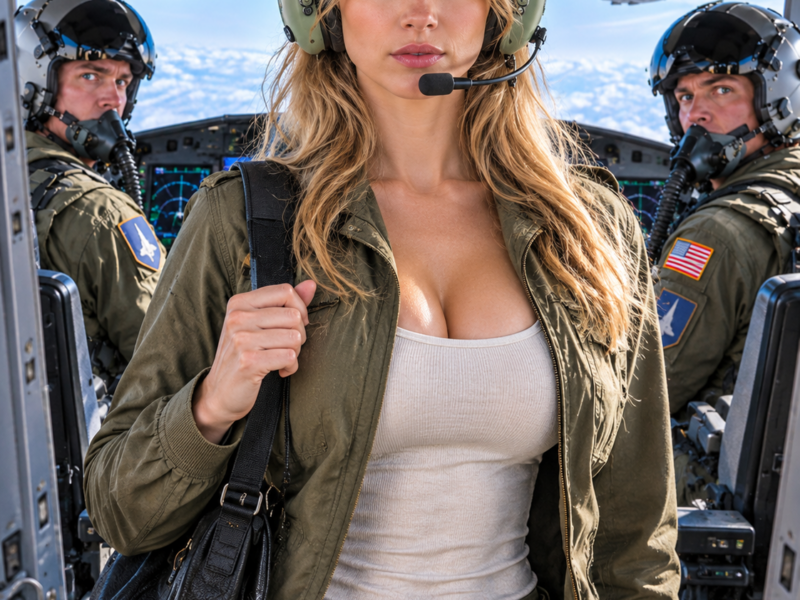
“The moment I stepped onto the military airbase wearing an ordinary passenger jacket, one of the F-22 pilots laughed and asked if I was lost
The voice came through the speakers again.
“Claire?”
I gripped the edge of the communications desk.
Nobody in the room moved.
I knew that voice. I knew the slight rasp at the end of the man’s sentences, the way he pronounced my name, and even the faint hesitation before he spoke.
I’d heard it in my dreams for eleven years.
“Claire, if that’s really you, get everyone away from the northern sector.”
I leaned toward the microphone.
“Who is this?”
A burst of static swallowed the answer.
Then three words came through.
“Daniel. It’s me.”
My throat tightened.
Daniel Reed.
My former wingman.
My closest friend.
The man whose aircraft had vanished over the North Atlantic eleven years earlier.
The man whose funeral I’d attended with an empty coffin.
I pressed the transmit button so hard my finger hurt.
“Daniel, where are you?”
“Not much time. They’re listening.”
Colonel Whitaker stepped closer.
“Claire, do you know this person?”
I couldn’t take my eyes off the radio.
“Yes, sir.”
“Who?”
I swallowed.
“Captain Daniel Reed. He was declared dead eleven years ago.”
A murmur moved through the room.
Captain Miller stared at me.
“That’s impossible.”
I understood why he said it.
I’d said the same thing when they told me Daniel’s aircraft had disappeared during a classified mission over international waters.
Back then, I’d been a young Air Force captain, flying under the callsign Eagle One.
Daniel had been my wingman.
We’d trained together, eaten together, and spent enough nights talking in empty hangars to know when the other was hiding something.
He was the kind of friend who could tell I was worried just by the way I held my coffee.
On the night of his disappearance, our mission had changed without warning.
We were supposed to escort a surveillance aircraft through a designated corridor.
Instead, a new set of coordinates appeared in our system.
The instructions came from command.
I questioned them.
Daniel didn’t.
He trusted the people giving the orders.
I followed him into the altered flight path.
Then our communications began failing.
A flash appeared on my right.
Daniel’s aircraft dropped from the tracking screen.
I called his name until my throat hurt.
No response.
I returned to base with an empty second position beside me.
Three days later, I was told Daniel had been killed.
The investigation was classified.
His remains had not been recovered, but the Air Force held a memorial service anyway.
I attended in dress uniform, standing beside a flag-covered empty casket.
Afterward, I resigned from operational flying.
I never gave interviews.
I never discussed the mission.
And I never told anyone that, during our final transmission, Daniel had said something that made no sense.
“Claire, the coordinates are wrong.”
Now, eleven years later, he was speaking through my headset.
“Daniel,” I said again. “I need you to tell me where you are.”
His answer was barely audible.
“Inside the northern relay facility. They know I’ve contacted you.”
Colonel Whitaker signaled to Major Brooks.
“Find that transmission source. Immediately.”
Brooks moved toward the technical station.
“Sir, the signal is bouncing through several military relays. I can’t establish a direct location yet.”
Daniel’s voice returned.
“Claire, listen carefully. The interference isn’t coming from outside the exercise.”
I looked at the large display.
“What do you mean?”
“The system is generating it. Someone has inserted an old flight-control sequence into the network.”
The colonel turned sharply toward the technician.
“Can you verify that?”
The technician began typing.
“Sir, we’re seeing unauthorized commands appearing in the exercise management system.”
Captain Miller stood.
“Then terminate the exercise.”
“Already attempting it,” Brooks replied.
A few seconds later, he looked up.
“Sir, the termination command isn’t being accepted.”
The room grew tense.
I looked at the tracking display.
Viper Two and Viper Three were still in the northern training sector.
“How much fuel do they have?”
“Approximately twenty-two minutes, depending on their current configuration,” the technician replied.
“Can they navigate using independent instruments?”
“Yes, but their tactical displays are receiving conflicting data.”
I turned to Colonel Whitaker.
“We need to get them away from the affected sector.”
He nodded.
“Do it.”
The communications officer opened a channel.
“Viper Two, Viper Three, this is control. Disregard all simulated tactical instructions. Maintain safe separation and prepare to return to base.”
Miller’s voice came through.
“Control, Viper Two. We’re attempting to disengage, but our navigation display is showing a route that doesn’t match our instruments.”
I picked up the microphone.
“Viper Two, this is Claire Bennett.”
There was a pause.
“Ms. Bennett?”
“Captain Miller, listen to me. Do not follow the route displayed on your tactical screen. Use your independent navigation instruments and confirm every instruction with control.”
“Understood.”
His voice sounded different now.
The joking confidence was gone.
“Ms. Bennett, what exactly is happening?”
I glanced at the old signal pattern.
“Someone is trying to make you believe you’re somewhere you’re not.”
For several seconds, nobody spoke.
Then Miller answered.
“Copy that.”
Major Brooks suddenly called out.
“Colonel! I’ve got a location.”
A red marker appeared on the screen.
“An abandoned communications facility near the northern boundary. The signal is being routed through a relay system there.”
Whitaker leaned over the display.
“That facility was decommissioned years ago.”
I looked at the coordinates.
“Apparently, not completely.”
Daniel’s voice came through again.
“Claire, you need to get the archive.”
“What archive?”
“The original mission recording. The one they told you didn’t exist.”
My stomach tightened.
“Where?”
“Inside the facility. Lower-level server room. Look for the number seventeen.”
The transmission weakened.
“Daniel, wait. Why are you there?”
A long pause.
Then he said something I would remember for the rest of my life.
“Because I was never the one who disappeared.”
The radio went silent.
***
Colonel Whitaker ordered the exercise terminated and initiated an emergency response.
The two F-22s returned safely under independent navigation guidance, while security personnel were dispatched to the northern facility.
Miller was the first pilot back.
When he entered the operations center, he removed his helmet and looked straight at me.
“Who are you, Ms. Bennett?”
I glanced at the coffee cup I’d abandoned on the table.
“Someone who used to fly.”
“That’s not what I meant.”
“I know.”
He waited for an explanation.
I didn’t have one I was ready to give.
Colonel Whitaker approached us.
“General Harris is on his way. Until he arrives, nobody leaves this building.”
“Sir,” I said, “I want to go to that facility.”
“No.”
“Colonel—”
“Absolutely not. We don’t know what’s waiting there.”
“Daniel knows I’m here. If he’s telling the truth, he may not have much time.”
Whitaker rubbed his forehead.
“Claire, you haven’t been on an operational flight line in eleven years. You’re not walking into a potentially compromised military facility.”
I held his gaze.
“Then send people who know what they’re looking for. But I need to see the archive.”
He considered it.
Finally, he nodded toward Major Brooks.
“You’re going with the security team. Ms. Bennett will identify the relevant records remotely.”
I accepted that compromise.
It wasn’t what I wanted, but there were two F-22 pilots who had nearly been placed in danger by someone using a system that should have been secure.
They came first.
***
Forty minutes later, a secure video connection opened from the northern relay facility.
The building looked abandoned.
Dust covered the hallway floor, and several ceiling lights flickered as the security team moved inside.
Major Brooks led them down a concrete staircase.
“Lower level,” he said. “We’re approaching the server room.”
A heavy metal door appeared on the screen.
There was a faded sign beside it.
17.
My hands went cold.
“That’s it,” I whispered.
Brooks examined the lock.
“Access panel is active.”
“Try the emergency authorization code in the envelope I gave security.”
He looked at the camera.
“You knew this place existed?”
“I knew it was part of the original communications network.”
“How?”
I didn’t answer.
The door unlocked.
Inside, rows of old server cabinets stood beneath a layer of dust.
One monitor remained illuminated.
A single folder appeared on the screen.
REED — INCIDENT 17.
“Open it,” I said.
Brooks looked toward the security officer.
The officer nodded.
The folder contained dozens of documents, but one audio file stood out.
NORTH ATLANTIC — FINAL MISSION RECORDING.
I stared at the filename.
For eleven years, I’d been told that recording had been destroyed in the communications failure.
“Play it,” I whispered.
The audio began with the familiar sound of aircraft communications.
Then my younger voice came through.
“Viper One to Viper Two. Confirm new coordinates.”
Daniel answered.
“Viper Two copies. These coordinates don’t match the approved route.”
Another voice interrupted.
It was a command officer.
“Proceed as instructed. This is an authorized mission revision.”
My younger voice sounded uncertain.
“Requesting confirmation from operations.”
The command officer repeated the instruction.
Then Daniel spoke.
“Claire, don’t follow that heading.”
I closed my eyes.
I remembered that moment.
I remembered the confusion.
But there was something else I hadn’t remembered.
A second voice.
Quiet.
Almost buried beneath the static.
“Terminate the original flight plan. Ensure both aircraft remain inside the designated corridor.”
The technician in the control room leaned forward.
“That’s not an ordinary flight instruction.”
“No,” I said.
“It sounds like someone is deliberately changing the route.”
The recording continued.
Daniel’s voice became urgent.
“Viper One, I’m getting a second set of coordinates. Someone’s overriding our navigation.”
My younger self answered.
“I see it.”
Then came a sharp electronic tone.
And a command from operations.
“Viper Two, break formation. Continue alone.”
Daniel replied immediately.
“Negative. I have a navigation discrepancy.”
The command officer’s voice hardened.
“That’s a direct order.”
The recording ended with Daniel saying my name.
“Claire, if I don’t make it back, don’t let them bury this.”
I covered my mouth.
For eleven years, I’d carried the belief that I had abandoned my wingman.
Now I was hearing evidence that he’d tried to warn me.
But the most disturbing part wasn’t the recording.
It was the file attached beneath it.
A document labeled:
FLIGHT AUTHORIZATION — GENERAL HARRIS.
I read the signature twice.
Then a third time.
General Harris had personally approved the altered flight instructions.
And according to the document’s timestamp, he’d approved them three hours before the mission began.
***
The door to the operations center opened.
General Robert Harris walked in with two aides.
He was in his late fifties, impeccably dressed, with a calm expression that made people instinctively lower their voices.
“Colonel Whitaker,” he said. “I understand we had an issue during today’s exercise.”
Whitaker stood.
“An issue that nearly put two pilots in danger.”
Harris glanced toward the screens.
“Electronic interference?”
“Unauthorized commands,” Brooks replied. “And a transmission from someone believed to be dead.”
For the first time, Harris looked at me.
His expression barely changed.
“Claire Bennett.”
“General.”
“I haven’t seen you in a long time.”
“Eleven years.”
He nodded slowly.
“I heard you were observing today.”
“Then you knew I was coming.”
“I approved your visit.”
I looked at the document on the screen.
“Did you also approve the revised flight coordinates eleven years ago?”
His eyes moved toward the monitor.
For a moment, he said nothing.
Then he turned to Whitaker.
“Where did this file come from?”
“The northern relay facility.”
Harris took a step closer.
“This material is classified.”
“So was the mission that nearly killed me,” I replied.
“Claire, I suggest you be careful.”
“I’ve been careful for eleven years.”
My voice was quieter than I expected.
“That’s why nobody knows what happened.”
Harris motioned toward his aides.
“Clear this room.”
Whitaker didn’t move.
“General, this is now a potential criminal investigation.”
Harris’s jaw tightened.
“You’re making a serious mistake.”
“No, sir,” Whitaker said. “We’re trying to understand one.”
The general looked back at me.
“You don’t know what you’re reopening.”
I took a step toward him.
“Then explain it.”
He looked at the screen again.
Finally, he spoke.
“The original mission involved intelligence that could not be allowed to fall into the wrong hands.”
“That doesn’t explain why you changed our flight path.”
“There was a security concern.”
“Why wasn’t that disclosed during the investigation?”
“Because the investigation was conducted under national security restrictions.”
I stared at him.
“Was Daniel alive when you declared him dead?”
Harris didn’t answer.
And that silence was enough to make the room feel smaller.
***
A new transmission interrupted us.
The communications officer turned toward the speaker.
“Incoming from the northern facility.”
I moved toward the desk.
“Daniel?”
A weak voice answered.
“Claire.”
I grabbed the microphone.
“Are you safe?”
“For now.”
“Did you hear the recording?”
“Yes.”
His voice was thinner than before.
“There’s something else you need to know.”
I leaned closer.
“Tell me.”
“The mission wasn’t about protecting intelligence.”
A pause.
“It was about protecting the people who had stolen it.”
I looked at General Harris.
He had gone completely still.
Daniel continued.
“They were using a military surveillance program to track private aircraft and collect communications data. The program was never approved for the purpose they were using it for.”
Major Brooks looked at Whitaker.
“Unauthorized surveillance?”
“More than that,” Daniel replied. “They were selling information.”
Harris shook his head.
“That’s a lie.”
Daniel’s voice sharpened.
“Then why did you order the flight path changed, General?”
No answer.
I closed my eyes for a second.
The pieces were beginning to fit.
The unexplained coordinates.
The interference.
The missing recording.
The empty coffin.
The years of silence.
“Daniel,” I said, “why didn’t you come home?”
There was a long pause.
“Because I was captured after the aircraft went down. I survived the crash, but someone recovered me before the rescue team arrived.”
My grip tightened around the microphone.
“Who?”
“I don’t know all their names. I was held at a remote facility and questioned about the surveillance program. They wanted to know what I’d recorded.”
“Why didn’t you escape?”
“I tried.”
His voice broke.
“Once. I got close enough to a communications terminal to send a short message. They traced it before it could be delivered.”
I swallowed.
“And the last eleven years?”
“I spent most of them moving between facilities. I was eventually transferred to the relay site when the people holding me decided the old network was safer than the newer systems.”
He paused.
“Three weeks ago, I found a maintenance terminal that still had an outside connection. I’ve been trying to reach someone who would recognize the old signal.”
“Why didn’t you contact me directly?”
“I didn’t know if you were still being watched.”
I looked at the old recording.
“Daniel, I thought you were dead.”
“I know.”
There was something painfully gentle in those two words.
“I’m sorry, Claire.”
I couldn’t speak.
He continued.
“I heard about your resignation. I heard you stopped flying.”
“Don’t.”
“I should have found a way to tell you.”
“You should have come home.”
The radio went quiet.
Then he answered.
“I wanted to.”
***
Colonel Whitaker moved toward the communications officer.
“Can we establish his exact location?”
The officer nodded.
“We have a signal trace. Security is narrowing it down.”
Harris stepped toward the door.
“I am ending this briefing.”
Two security personnel moved in front of him.
“General, please remain here.”
His face reddened.
“Do you understand who you’re speaking to?”
“Yes, sir.”
Whitaker stood between him and the door.
“Until we establish the facts, nobody is leaving.”
Harris looked at me.
“You think bringing this recording into the open will make everything better?”
“No.”
I shook my head.
“But hiding it hasn’t made anything better either.”
He lowered his voice.
“Some operations exist because the world isn’t as simple as you want it to be.”
I looked at the empty space on the screen where Daniel’s aircraft had disappeared eleven years earlier.
“Neither are the people you leave behind.”
For a moment, he looked older.
Not remorseful.
Just tired.
The general was escorted to a secure room while investigators were notified.
His aides were separated and questioned.
The recordings, authorization documents, and electronic logs were copied and placed under independent custody.
For the first time in eleven years, the truth had somewhere to go besides a locked archive.
But Daniel was still out there.
And that was all I could think about.
***
The rescue team reached the northern relay facility shortly after sunset.
The security camera showed them entering through a side door.
Their voices came through in short, controlled updates.
“Ground floor clear.”
“Stairwell clear.”
“Approaching lower-level corridor.”
I stood beside the communications desk, unable to sit.
Major Brooks remained nearby.
“Ms. Bennett, the team knows what they’re doing.”
“I know.”
“You’ve done everything you can.”
I looked at him.
“Not yet.”
A few seconds passed.
Then a voice came through.
“Control, we have an individual.”
The camera feed shook as the team entered a small room.
A man sat against the wall.
His hair was almost completely gray.
His face was thinner than the one I remembered.
A dark beard covered his jaw, and one arm rested awkwardly against his side.
But when he looked up at the camera, I knew him.
Daniel.
He blinked at the light.
Then he smiled.
Not the confident smile from our younger days.
Something smaller.
Something exhausted.
“Claire?”
I pressed the microphone.
“I’m here.”
He looked toward the camera.
“I told you I’d find a way.”
I laughed once, though tears were already running down my face.
“You took your time.”
“I know.”
The security team moved carefully around him.
A medic knelt beside him.
Daniel winced as he tried to stand.
“Don’t move,” the medic said.
“I’m fine.”
“You’re absolutely not fine.”
I heard Daniel laugh.
It was the first familiar sound I’d heard from him in eleven years.
The team helped him onto a stretcher.
Before they carried him out, he looked toward the camera again.
“Claire?”
“Yes?”
“Did you keep the old flight jacket?”
I glanced down at the faded jacket I’d worn that morning.
The one I’d kept in the back of my closet for years.
“I did.”
He smiled.
“Good.”
***
Daniel was taken to a military medical center.
Doctors later confirmed that he was severely malnourished and had several untreated injuries, but he was expected to recover.
I wasn’t allowed to see him until the following morning.
When I finally entered his room, he was sitting upright in bed, staring at a television with the sound turned off.
He looked toward the door.
For several seconds, neither of us spoke.
Then he said, “You look different.”
I placed my overnight bag on the chair.
“So do you.”
He glanced at my jacket.
“Still wearing that?”
I looked down.
“It’s comfortable.”
He smiled faintly.
We sat in silence.
There were a thousand things I wanted to say.
Why hadn’t you found a way?
Did you think I stopped looking?
Did you know what happened after you disappeared?
But none of those questions seemed fair to ask a man who had spent eleven years trying to survive.
Instead, I pulled a chair beside his bed.
“I went to your memorial.”
“I know.”
“I stood beside an empty coffin.”
His eyes lowered.
“I’m sorry.”
“I kept thinking I should have ignored the order to continue.”
Daniel shook his head.
“Claire, listen to me. You didn’t leave me behind. You got us both as far as you could.”
“But I came home.”
“Because someone needed to tell the truth.”
I looked at him.
He continued.
“I heard the recording of our final flight. I heard you asking for confirmation. I heard you trying to stop the change.”
His eyes filled.
“You were the only one who questioned it.”
I wiped my cheek.
“I should have done more.”
“Maybe.”
He looked toward the window.
“But we can’t spend the rest of our lives measuring ourselves against a decision we made with incomplete information.”
I didn’t answer.
After a while, he reached toward the bedside table.
There was a small, worn metal object there.
A military identification tag.
Mine.
I stared at it.
“Where did you get that?”
Daniel turned it over between his fingers.
“It was in the wreckage. I kept it.”
I remembered losing it during the final flight.
I’d assumed it had fallen somewhere in the ocean.
He handed it to me.
“I thought if I ever got home, I’d give it back.”
I closed my fingers around the cold metal.
For eleven years, I’d believed the past was something I had to carry alone.
Now, for the first time, someone else remembered it exactly as I did.
***
The investigation lasted several months.
The original mission records were authenticated, and the unauthorized surveillance operation was exposed.
Investigators identified a network of former contractors and military personnel who had diverted classified technology for private use.
General Harris was removed from command pending prosecution.
Several other individuals were charged with conspiracy, unlawful surveillance, falsification of military records, and obstruction of justice.
The investigation also uncovered the effort to conceal Daniel’s survival and the deliberate destruction of evidence surrounding his disappearance.
Not every person involved was identified.
Some records were still missing.
But enough evidence existed to establish what had happened.
Daniel’s official death determination was overturned.
His service record was corrected.
And the memorial that had once honored a man who was supposedly dead was replaced by a ceremony welcoming home a man who had survived.
I attended in uniform.
Not because I had returned to active flying.
I hadn’t.
I wore it because I wanted to stand beside Daniel as the person I’d been before everything happened.
Captain Miller was there too.
He approached me after the ceremony.
“Ms. Bennett.”
I turned.
“Captain.”
He hesitated.
“I owe you an apology.”
“For what?”
“For assuming you didn’t belong here.”
I smiled slightly.
“You weren’t the first.”
“I’ve been thinking about what happened during the exercise.”
He glanced toward the aircraft outside.
“When you said Eagle One, I thought it was some kind of mistake.”
“I understand.”
He looked down at his hands.
“My instructor used to tell us that the best pilots weren’t always the loudest people in the room.”
I smiled.
“Sounds like a good instructor.”
“He was.”
Miller paused.
“Would you ever consider speaking to the younger pilots? Not about the technical side. About what happened.”
I considered it.
For eleven years, I’d avoided talking about that mission.
I’d convinced myself silence was the only way to live with it.
But perhaps I’d been wrong.
“I’ll think about it,” I said.
He nodded.
“That’s all I can ask.”
***
Six months later, Daniel was strong enough to walk without assistance.
He still had difficult days.
Some nights he woke from dreams he wouldn’t describe.
Other days, he sat quietly by the window, watching aircraft pass overhead.
I never forced him to talk.
I had learned that surviving something didn’t mean a person was ready to explain it.
One afternoon, we returned to Langley together.
The air smelled of jet fuel and fresh rain.
A group of young pilots stood near the hangar, preparing for a training session.
Captain Miller approached us.
“Glad you could make it.”
Daniel shook his hand.
“How are the rookies?”
“Confident. Maybe too confident.”
Daniel laughed.
“That sounds familiar.”
Miller looked at me.
“We have a question from the briefing room.”
“What is it?”
“One of the new pilots asked why the old callsign Eagle One was retired.”
I looked toward the runway.
A gray fighter jet moved slowly toward the taxiway.
For a moment, I remembered the young woman who had once sat in a cockpit believing that following every order was the same as doing the right thing.
Then I looked at Daniel.
He was standing beside me, alive.
“Tell them it wasn’t retired because the pilot was afraid to fly,” I said.
Miller waited.
“It was retired because some stories deserve to be remembered before they’re repeated.”
Daniel placed a hand on my shoulder.
We watched the aircraft lift into the afternoon sky.
A few minutes later, the control tower announced the next training flight.
Then a young voice came through the radio.
“Viper One, ready for departure.”
Daniel smiled.
“Sounds like they’re getting started.”
I looked at the runway one last time.
For eleven years, I’d thought hearing the name Eagle One again would mean returning to the worst day of my life.
I had been wrong.
It meant I had finally stopped running from it.
I wasn’t the pilot who had lost her wingman anymore.
I was the woman who had found him, brought the truth home, and learned that courage sometimes meant stepping away from the cockpit.
Daniel and I walked toward the parking lot together.
For the first time in eleven years, there was no empty space beside me.
The end.









