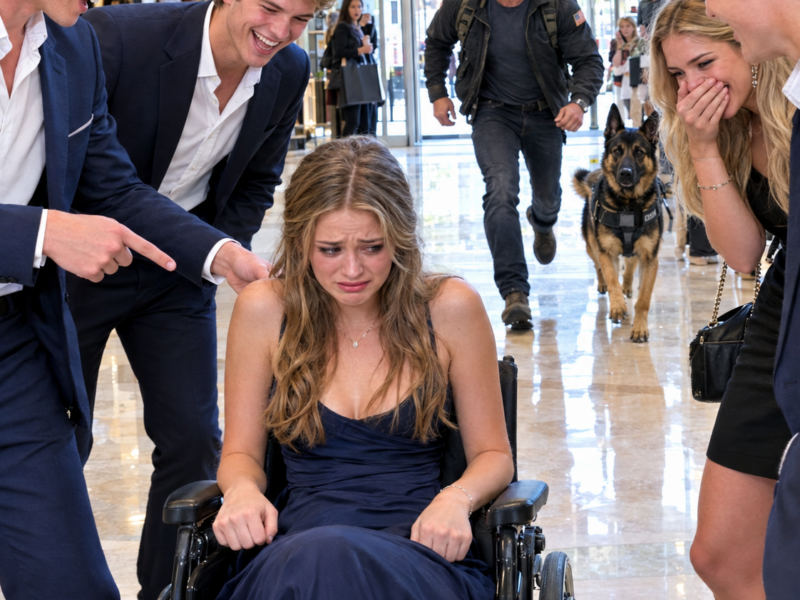
The first time they laughed at my wheelchair, I pretended I couldn’t hear them
For several seconds, nobody moved.
The chairman of the foundation funding Westbridge Academy stood beside the ruined art table, staring at Madison, Chase, and Tyler as though he could hardly believe what he had witnessed.
His name was Robert Hayes. He was a retired Marine colonel, a longtime supporter of the school, and the man whose foundation had recently pledged nearly four million dollars toward a new athletic complex.
Madison knew exactly who he was.
Her father had spent months trying to secure a private meeting with him.
“Mr. Hayes,” she began, suddenly smiling, “I’m sure this looks much worse than it was.”
Robert didn’t smile back.
“I watched a boy shove a wheelchair toward a muddy ditch while you filmed it,” he said. “Tell me which part I’ve misunderstood.”
Madison’s mouth opened, but nothing came out.
Chase folded his arms.
“It was a prank. Nobody got hurt.”
Jack Sullivan stepped between Chase and my chair.
“That’s the second time you’ve said that,” he replied. “And it doesn’t make it true.”
I sat quietly, my fingers still gripping my wheels.
I wanted to say something. I wanted to tell them what it felt like to have a hundred people watching while three people decided my dignity was worth less than their entertainment.
But the words were trapped somewhere behind the lump in my throat.
Bear seemed to notice.
The German Shepherd shifted closer and rested his head gently against my knee again.
Jack looked down at him, then back at me.
“You don’t have to explain anything right now, Hannah.”
That was the first thing anyone had said to me all afternoon that didn’t come with a condition.
I began to cry.
Not loudly. Not dramatically.
The tears simply came, and once they started, I couldn’t stop them.
Jack didn’t tell me to calm down. He didn’t tell me to be strong. He didn’t look uncomfortable or ask why I was crying.
He just stayed beside me while Bear sat guard.
And somehow, that made the entire crowd feel less frightening.
The school tried to regain control of the situation within minutes.
The assistant principal, Mr. Lawson, approached Robert Hayes with his hands raised in a gesture of reassurance.
“Colonel Hayes, I appreciate your concern, but I believe we can handle this internally.”
Robert turned slowly.
“Internally?”
“Yes. These are students. They made a poor decision, and we can arrange a restorative conversation—”
“A restorative conversation?” Robert repeated.
His voice remained quiet, but something in it made Mr. Lawson stop talking.
“Did you arrange one when Hannah reported the harassment earlier this semester?”
The assistant principal went pale.
I looked up.
Jack noticed my expression.
“You reported this before?” he asked gently.
I nodded.
“Twice.”
Mr. Lawson immediately interrupted.
“We received a report about some interpersonal difficulties, but there was no indication of a serious pattern.”
I stared at him.
I remembered the first meeting in his office. I remembered explaining how Chase blocked the accessible entrance and how Madison mocked the way I moved my hands over the wheels.
I remembered him telling me not to take things personally.
“You told me they were just making mistakes,” I said.
My voice was quiet, but everyone nearby heard it.
Mr. Lawson looked at me.
“Hannah, this isn’t the time—”
“It was never the time,” I interrupted.
The words surprised even me.
My heart was pounding, and I could feel my hands trembling against the wheelchair rims.
“Every time I told you something happened, you asked whether I was sure. You asked whether I might have misunderstood. You asked me to be patient with them.”
I swallowed hard.
“Not once did you ask them to stop.”
Silence settled over the field.
Robert Hayes looked at the assistant principal with an expression I couldn’t read.
Then he turned to a woman standing near the event tent.
“Please secure the school’s incident records. I want every complaint involving these students reviewed by someone who doesn’t work here.”
Mr. Lawson’s face tightened.
“You have no authority over school discipline.”
“Perhaps not,” Robert said. “But I have every right to reconsider whether my foundation will continue funding an institution that ignores repeated reports of abuse.”
That finally silenced him.
For the first time in two years, I watched an adult with influence refuse to let the conversation be redirected away from what had happened to me.
I wasn’t sure whether to feel relieved or afraid.
Because Madison was staring at me now.
And the look on her face promised that she wasn’t finished.
My mother arrived twenty minutes later.
She came straight from work, still wearing her grocery-store uniform, her hair pulled into a hurried ponytail. When she saw my muddy wheels and the broken frames scattered across the ground, she dropped her handbag.
“Hannah?”
I tried to smile.
“Mom, I’m okay.”
She hurried toward me and knelt beside my chair.
“Are you hurt? Did you fall? Why didn’t you call me?”
“I didn’t want you to leave work.”
Her eyes filled with tears.
“Oh, sweetheart.”
She wrapped her arms around me, careful of the chair and the small bag attached to its back.
I held her tightly.
For a moment, I was no longer the girl everyone had watched being humiliated. I was just her daughter, the person she had stayed awake worrying about for two years, the person she had fought insurance companies and hospital bills for, the person she would have carried through every terrible day if she could.
Jack stepped back to give us space.
My mother noticed him after a moment.
“Who are you?”
“Jack Sullivan,” he answered. “I was near the entrance when I saw what happened. I stopped it before Hannah went down the slope.”
My mother looked at the muddy incline, then at Bear.
Her expression crumpled.
“Thank you,” she whispered.
Jack shook his head.
“You don’t owe me anything. She deserved help before it got that far.”
My mother pressed her lips together.
Then she looked at the school officials.
“I’m taking my daughter home. But this is not over.”
Mr. Lawson began explaining the school’s review process.
She raised one hand.
“Please don’t tell me how seriously you’re taking this. I’ve heard enough promises. Tell me what you’re going to do.”
For once, he had no ready answer.
Before we left, Jack gave my mother his contact information and explained that he was willing to provide a witness statement.
He also took photographs of the damaged paintings, the spilled supplies, and the slope where Chase had pushed my wheelchair.
Bear walked beside us to the parking lot.
Just before I transferred into my mother’s car, I looked at Jack.
“Why did you stop?”
He seemed surprised by the question.
“Because someone needed help.”
“But everyone else was watching.”
His expression changed.
For a second, the confident man who had faced down three bullies seemed tired in a way I couldn’t explain.
“People sometimes convince themselves that doing nothing is safer than doing the right thing,” he said. “That doesn’t make it right.”
I glanced at Bear.
“Does he always know when someone needs help?”
Jack rested a hand on the dog’s neck.
“Not always. But he knows how to stay with someone who’s scared.”
Bear’s tail moved once.
I smiled for the first time that day.
Then I went home.
I had no idea that by Monday morning, the entire town would know my name.
The video appeared online at 7:12 Saturday morning.
Madison had apparently uploaded it to a private account, intending to share it with friends. Someone in her circle had downloaded it and posted it publicly.
By breakfast, it had been shared thousands of times.
The footage showed everything.
Chase pulling my wheelchair away from the art table. Madison mocking my disability. Tyler holding up my painting. The spilled paint. The push toward the slope.
And Jack’s voice cutting through the crowd.
Take your hands off that chair.
The video also captured the moment Robert Hayes confronted the students and demanded that the school preserve its records.
Comments poured in.
Some people expressed outrage. Others criticized the school for allowing the harassment to continue. A few recognized Jack from news coverage of a military working-dog rescue several years earlier.
But the comments that hurt most were the ones that turned my worst afternoon into entertainment.
People argued about whether I had overreacted.
They debated whether the incident counted as bullying.
Some strangers dissected my facial expressions, claiming I had deliberately cried to make the students look bad.
I closed the laptop.
My mother sat across from me at the kitchen table.
“You don’t have to read any of it,” she said.
“I just wanted to know if people believed me.”
She reached across the table and took my hand.
“Some people will believe you. Some people will look for reasons not to. Neither group gets to decide what happened.”
I stared at the laptop.
“What if they make me go back there?”
“Then we figure out the safest way for you to go back. And if that school refuses to protect you, we figure out another way.”
Her voice was steady, but I could see the exhaustion beneath it.
We didn’t have the money for a private school. We barely had enough to cover our rent and the repairs my wheelchair needed.
Westbridge had been the only school nearby with a program that allowed me to continue studying art while completing the academic credits I needed for college.
My mother knew that.
I knew she was afraid.
So I did what I had learned to do whenever she looked overwhelmed.
I told her I was fine.
She didn’t believe me.
That afternoon, someone knocked on our apartment door.
My mother opened it and found Jack standing in the hallway with Bear beside him.
He held a large flat package under one arm.
“I hope I’m not interrupting,” he said. “I wanted to bring something for Hannah.”
Inside the package were several sheets of professional watercolor paper, a set of brushes, and a small box of paints.
I stared at them.
“I can’t accept these.”
“They’re not charity,” Jack said.
He set the package on the table.
“I spoke with a local art supplier. They had some materials available at a discount, and I bought them. You can pay me back by making something you like.”
I ran my fingers over the smooth paper.
“Why?”
“Because someone destroyed something you worked hard on. I thought you should have the chance to make something else.”
My mother looked at him with gratitude she couldn’t quite put into words.
Bear approached my chair, sniffed the new supplies, and sat down beside me.
I laughed softly.
“Does he like art?”
Jack considered the question.
“He likes being wherever people are. Art might be a bonus.”
For the next hour, Jack told us about his work with military working dogs.
He explained that Bear had served overseas as a detection dog, trained to identify explosives and alert his handler to threats. Jack had been a Navy SEAL before an injury ended his active deployments, and he now volunteered with a veterans’ support organization that helped retired service dogs transition into civilian life.
Bear was retired, but he still carried himself with the alertness of a dog who had spent years learning that small details mattered.
“Is he ever scared?” I asked.
Jack looked down at him.
“Of course.”
I blinked.
“He looks fearless.”
“Being brave doesn’t mean you never feel afraid. It means you learn what to do when you are.”
I thought about the crowd at school.
I had spent so long believing courage meant standing up without trembling, speaking without crying, and facing cruelty without showing how much it hurt.
Maybe that was why I had always felt like a failure.
Jack seemed to read something in my expression.
“You don’t have to become fearless, Hannah,” he said. “You just need to know that being afraid doesn’t make you weak.”
I looked down at the blank paper.
For the first time since Friday, I wanted to paint again.
On Monday, Westbridge Academy announced that the three students had been temporarily suspended pending an investigation.
The statement was carefully worded. It described the incident as an unacceptable violation of the school’s conduct policy and promised a thorough review.
It didn’t mention the previous complaints.
It didn’t apologize to me.
And it didn’t explain why the staff members who had watched the harassment unfold had done nothing.
My mother called the school and demanded a meeting.
She was told that the administration was still reviewing the matter.
Robert Hayes, meanwhile, announced that his foundation was placing all future funding on hold until an independent investigation could be completed.
That decision sent shock waves through the school.
Parents who had never spoken to me suddenly wanted to know what I had experienced. Teachers who had ignored my earlier complaints began sending messages offering support.
One student, a quiet girl named Priya, wrote to me privately.
I’m sorry I didn’t help you. I saw what happened, and I was scared they’d turn on me. I should have done something.
I read her message several times.
Then I wrote back.
Thank you for telling me the truth.
I wasn’t ready to forgive everyone who had watched.
But I was beginning to understand that fear could make ordinary people do terrible things by staying silent.
That didn’t excuse them.
It did mean they still had a choice about what to do next.
On Tuesday, Jack called my mother.
The school had requested a meeting with me and my mother, and he wanted to know whether I would feel safer having him attend as a witness.
My mother asked what I wanted.
I thought about Mr. Lawson’s office, the complaints that had gone nowhere, and the way adults had repeatedly explained why the students’ behavior wasn’t serious enough to act on.
“Yes,” I said. “I want him there.”
Then, after a moment, I added, “But I want to speak for myself.”
Jack’s reply was immediate.
“Good. I’ll be there to support you, not to speak over you.”
That mattered more than he knew.
The meeting took place in a conference room with glass walls overlooking the school courtyard.
Mr. Lawson sat at one end of the table. The headmistress, Dr. Evelyn Carter, sat beside him, along with a school counselor and a lawyer representing the school’s governing board.
Madison, Chase, and Tyler were not present.
I noticed that immediately.
“Where are they?” I asked.
Dr. Carter folded her hands.
“We thought it would be more productive to discuss your concerns without making you uncomfortable.”
I looked at my mother.
Then I looked back at Dr. Carter.
“I’m already uncomfortable. They’re the reason we’re here.”
The lawyer shifted in his seat.
Dr. Carter took a breath.
“You’re right. We should have asked you.”
For a moment, I didn’t know what to do with that answer.
I had expected defensiveness. Excuses. Another explanation about how teenagers made mistakes.
I hadn’t expected an apology.
Dr. Carter continued.
“We reviewed the available footage and your previous reports. We also interviewed several staff members. We found that your earlier complaints were not handled according to our own safeguarding procedures.”
Mr. Lawson stared at the table.
Dr. Carter turned toward me.
“That was a failure on our part. I am sorry.”
I felt my throat tighten.
“Why didn’t anyone help me?”
Nobody answered immediately.
Finally, the counselor spoke.
“Sometimes institutions become so focused on avoiding conflict that they mistake silence for resolution.”
I looked at her.
“But I was the one who had to live with it.”
“Yes,” she said quietly. “You were.”
For the first time, the meeting wasn’t about whether I had misunderstood the situation.
It was about what had been done to me.
I described the blocked ramps, the mocking, the elevator incident, and the way the students had gradually escalated their behavior because nobody stopped them.
I told them about the painting.
When I finished, Jack provided his witness statement and explained exactly what he had seen.
Then he placed a small storage device on the table.
“I also have copies of the publicly shared footage and photographs of the damaged property,” he said. “I’ve preserved the original files and their timestamps.”
The lawyer nodded.
“We’ll ensure those materials are included in the investigation.”
My mother leaned forward.
“We want a written safety plan before Hannah returns. We want accessible routes kept clear, a designated staff member she can contact, and a formal process for reporting harassment. We also want confirmation that she won’t face retaliation for speaking up.”
Dr. Carter agreed to each request.
Then I asked the question that had been sitting in my chest since Friday.
“What happens to the students who did this?”
The headmistress hesitated.
“Disciplinary action will depend on the findings of the investigation.”
I held her gaze.
“Please don’t make this another situation where everyone apologizes and nothing changes.”
Dr. Carter nodded.
“I won’t promise an outcome before the investigation is complete. But I can promise you that this will not be dismissed as a joke.”
It wasn’t everything I wanted.
But it was the first honest answer I had received from the school.
As we left the meeting, Jack fell into step beside my chair.
“You did well,” he said.
“I was shaking the whole time.”
“I noticed.”
I gave him a wounded look.
“That’s not very encouraging.”
He smiled.
“You were shaking, and you spoke anyway. That’s what I mean.”
Bear bumped his nose gently against my hand.
I scratched behind his ears.
“Maybe he’s the encouraging one.”
Jack nodded solemnly.
“He’s much better at it than I am.”
For the first time in a long time, I laughed without checking whether anyone was going to laugh at me.
The investigation uncovered something far more troubling than a single cruel afternoon.
A staff member had documented one of my earlier complaints in an internal email. The message described Madison and Chase as influential students whose families were important donors to several school programs.
Another email suggested that the administration should avoid escalating the matter unless there was evidence of physical harm.
I read that sentence in the official investigation summary and felt cold all over.
They had known.
Not every detail. Not every insult.
But enough to understand that I was being targeted.
And they had chosen to wait.
The governing board placed Mr. Lawson on administrative leave while it reviewed his handling of the complaints. Dr. Carter announced mandatory disability-awareness and anti-bullying training for staff, along with a new independent reporting process.
The school also agreed to repair the damaged artwork and reimburse my mother for the supplies that had been destroyed.
I refused to let them replace my original painting with a new one.
“I don’t want them to pretend it never happened,” I explained.
Instead, I asked the school to display the damaged painting temporarily alongside a statement about bullying and disability discrimination.
My mother worried that I would regret it.
Jack asked me why I wanted to do it.
“Because I don’t want another student to think they’re the only person this has happened to,” I told him.
He considered that for a moment.
“Then make sure the statement tells the whole truth.”
The display was approved.
It included a photograph of the ruined painting, a short account of what had happened, and information about how students could report harassment confidentially.
I insisted that my name appear only with my permission.
I didn’t want to become a symbol people could use without asking me.
I wanted to remain Hannah.
The girl who loved painting.
The girl who hated cold coffee.
The girl who sometimes stayed awake too late reading fantasy novels and who wanted to study illustration after graduation.
The girl who used a wheelchair.
All of those things could be true at once.
Madison’s family tried to stop the story from spreading.
Her father, Richard Vale, contacted the school’s board and demanded that the suspensions be lifted. He argued that the video had been taken out of context and that his daughter was being subjected to an unfair public campaign.
Chase’s parents hired an attorney.
Tyler’s family released a statement saying their son had been caught in a situation he hadn’t fully understood.
But the footage was clear, and the school had preserved the original reports.
The three students faced separate disciplinary hearings.
I was not required to attend, but I chose to submit a written statement.
I explained that the worst part hadn’t been the paint, the ruined paper, or even the fear of falling down the slope.
It had been the realization that people could watch me ask for help and decide that helping me wasn’t worth the inconvenience.
I wrote that I didn’t want the students’ futures destroyed.
I wanted them to understand that money, influence, and popularity did not make another person’s safety optional.
I also made it clear that forgiveness was not something the school could demand from me as proof that the situation had been resolved.
The hearings resulted in serious consequences.
Madison and Chase were expelled after the investigation confirmed repeated harassment and the deliberate endangerment of my safety. Tyler received a long suspension and was required to complete a supervised restorative program before being considered for readmission.
His role was different from theirs, but it wasn’t harmless.
He had helped humiliate me, and he had stood by while things escalated.
A week later, Tyler sent me a letter.
It wasn’t polished.
There were crossed-out sentences, spelling mistakes, and one paragraph that looked as though he had written it, torn it up, and started again.
He admitted that he had laughed because he wanted Madison and Chase to accept him. He said he had known the jokes were cruel, but he had convinced himself that staying out of it was better than becoming a target.
He didn’t ask me to forgive him.
He wrote, “I keep thinking about how many times you asked us to stop, and how easy it would have been for me to say something. I didn’t. I’m sorry.”
I read the letter twice.
Then I put it in a drawer.
I wasn’t ready to answer.
Maybe I never would be.
For once, I understood that I didn’t owe anyone immediate forgiveness just because they had finally learned how to apologize.
Two weeks after the incident, Jack invited my mother and me to a small community center where his veterans’ support group met.
He explained that they were organizing an art project with retired service members and their families. Some participants had physical disabilities. Others were recovering from injuries that were invisible to anyone looking at them.
“We could use someone who knows how to turn a blank page into something meaningful,” he said.
I pretended to consider it.
“Are you saying you need an artist?”
“I’m saying we have a room full of people who believe they can’t draw, and Bear has already eaten one of our pencils.”
I laughed.
“Bear ate a pencil?”
“He maintains that it was an accident.”
The community center was bright and welcoming, with wide doorways, accessible tables, and large windows overlooking a small garden.
Nobody stared at my wheelchair.
Nobody spoke to my mother instead of me.
And when I introduced myself as an artist, people asked what I liked to paint.
Not whether I could manage the supplies.
Not whether I needed special treatment.
Just what I liked to paint.
I told them I loved landscapes, especially oceans and mountains.
One veteran named Marcus showed me a drawing of a lighthouse he’d been trying to finish for months. He was embarrassed by the uneven lines and kept apologizing for them.
I looked at the drawing.
“The lighthouse is beautiful,” I told him. “Maybe the lines don’t need to be perfect.”
He frowned.
“What do you mean?”
“Look at the ocean. It isn’t perfectly straight, either.”
He laughed, and his shoulders relaxed.
We spent the afternoon painting together.
Bear moved from person to person, accepting gentle pats and occasionally resting his head on someone’s knee. Jack sat near the window, helping a young veteran mix colors.
At one point, I looked up and found Jack watching me.
“What?” I asked.
“Nothing.”
“You’re staring.”
“I’m observing.”
“That sounds suspiciously like staring.”
He grinned.
“You look happy.”
I glanced around the room.
For so long, I had thought my life would only get smaller after the accident. Every new challenge seemed to remove another piece of the world I had known.
But sitting there, surrounded by people who understood that pain could exist without defining a person, I felt something shift.
My life hadn’t returned to what it was before.
It didn’t need to.
I could build something different.
Something still worth living.
The school held a public meeting the following month to discuss the investigation and the changes it would make.
I nearly refused to attend.
The idea of sitting in an auditorium while strangers watched me talk about the worst afternoon of my life made my stomach twist.
My mother told me I didn’t have to go.
Jack told me the same thing.
Neither of them tried to convince me.
That was why I decided to attend.
I wanted the choice to be mine.
The auditorium was crowded when we arrived. Parents, teachers, students, and local reporters filled the seats. Robert Hayes sat near the front with several members of his foundation.
Jack and Bear sat beside my mother and me.
When my name was called, I wheeled myself to the microphone.
My hands were shaking.
I looked at the rows of faces.
Then I remembered the art table, the spilled paint, and the moment I had begged people to stop laughing.
I took a breath.
“My name is Hannah Brooks,” I began. “I’m seventeen years old, and I use a wheelchair. Neither of those things makes me less deserving of safety or respect.”
The room became quiet.
“I used to think bullying happened because people didn’t understand how much their words and actions could hurt. Sometimes that’s true. But sometimes people know exactly what they’re doing. They just believe nobody will make them stop.”
I looked toward the school officials.
“And sometimes the people who could stop them decide it’s easier to do nothing.”
No one interrupted.
I told them about the reports I had made and the meetings where I had been asked to be patient. I described what it felt like to see adults watching while students treated my wheelchair like a toy.
Then I spoke about Jack.
“He didn’t know me. He didn’t owe me anything. But he saw what was happening, and he decided that it mattered.”
I glanced down at Bear, who was lying quietly beside Jack’s chair.
“He didn’t arrive with a speech. He didn’t ask whether I had done something to provoke them. He just made sure I was safe.”
I paused.
“I don’t think a school becomes safe because it has a policy. It becomes safe when people are willing to act before someone gets hurt.”
The room remained silent for several seconds.
Then someone began clapping.
A few others joined in, and soon the entire auditorium was standing.
I felt embarrassed by the attention, but this time I didn’t feel humiliated.
I had chosen to speak.
I had chosen to be heard.
And no one could take that choice away from me.
After the meeting, Robert Hayes approached us in the lobby.
“I owe you an apology,” he said.
I looked at him in surprise.
“For what?”
“For believing that my support of the school was enough. I should have asked more questions about how it treated students who needed additional accommodations.”
He explained that his foundation would continue supporting the accessibility improvements, but only under independent oversight. A portion of the funding would go toward ramps, accessible equipment, and staff training.
He also announced a new grant for students who wanted to create projects promoting inclusion.
“I can’t undo what happened to you,” he said. “But I can help make sure your experience leads to something better.”
I considered his words.
“Please make sure the students who need those ramps can actually use them,” I said. “And make sure the school listens when someone reports a problem.”
He nodded.
“That’s a fair request.”
Later that evening, Jack drove us home.
Bear rode in the back, occasionally lifting his head to check on us.
I watched the streetlights pass outside the window.
“Do you think Madison and Chase will ever change?” I asked.
Jack didn’t answer immediately.
“Maybe. Maybe not.”
“That’s not a very comforting answer.”
“It’s an honest one.”
He glanced at me briefly.
“You can’t control what they become. You can control what you do next, and you can decide what you will and won’t accept from people.”
I thought about that.
For years, I had measured my progress by how much I could endure without complaining.
Now I wondered whether strength might mean refusing to endure things that never should have been asked of me.
When we reached my apartment, Bear climbed carefully out of the car and approached my wheelchair.
I rubbed his ears.
“Thank you for being there.”
He licked my hand.
Jack smiled.
“He’ll be expecting a painting of himself now.”
“I can do that.”
“Make him look dignified.”
“No promises.”
Jack laughed.
And for the first time in weeks, the future felt like a place I could look toward without fear.
The following spring, the school displayed my new painting in the main entrance.
It showed a German Shepherd standing beside a girl in a wheelchair on a mountain path. Behind them, sunlight spilled across the valley, illuminating the trail ahead.
The dog wasn’t pulling the girl.
The girl wasn’t being rescued.
They were simply moving forward together.
I titled it The Courage to Stay.
On the day of the unveiling, students gathered in the lobby. My mother stood near the back, wiping tears from her eyes. Robert Hayes attended with several members of the foundation, and Dr. Carter gave a short speech about the school’s responsibility to protect every student.
Then she invited me to say a few words.
I rolled toward the microphone.
“I used to think courage meant being strong enough that nobody could hurt you,” I said. “Now I think courage can also mean admitting that you’ve been hurt and asking people to do better.”
I looked at the painting.
“This isn’t a story about a girl who was saved by a hero. It’s a story about what can happen when someone finally decides that another person’s pain matters.”
Jack stood near the back with Bear.
He gave me a small nod.
I smiled.
The school had changed, although not perfectly. Some students still stared at my wheelchair. Some teachers still needed reminders. Accessibility wasn’t a favor, and respect wasn’t something that could be permanently fixed with a single meeting or a beautiful painting.
But the ramps were clear.
The reporting system worked.
And when a younger student came to me one afternoon and quietly admitted that some classmates had been mocking her for using crutches, I didn’t tell her to ignore them.
I listened.
Then I helped her find the staff member responsible for handling complaints.
We reported it together.
The school responded that same day.
It wasn’t a dramatic moment. There were no cameras, no speeches, and no crowd applauding.
But it mattered.
Because the next student didn’t have to wait until someone pushed her to the edge of a muddy slope before an adult took her seriously.
On the anniversary of the incident, Jack and Bear met me at the community center.
I had brought a new painting for the veterans’ art room.
It showed Bear sleeping beneath a table while sunlight fell across the floor. His harness lay beside him, and one paw rested against the leg of a chair.
Jack studied it for a long moment.
“You made him look peaceful,” he said.
“He is peaceful.”
“Most of the time.”
I grinned.
“He also steals pencils.”
“That’s a confidential matter.”
Bear lifted his head at the sound of his name and gave a sleepy sigh.
I laughed and reached down to scratch his neck.
Then I looked at Jack.
“Can I ask you something?”
“Of course.”
“Why did you really stop that day? I know you said someone needed help. But you’ve probably seen a lot of terrible things. Why did you get involved when everyone else was standing there?”
Jack became quiet.
For a moment, I wondered if I had asked something too personal.
Then he rested a hand on Bear’s back.
“During my service, I learned that hesitation can cost someone everything. But after I came home, I realized that people don’t only need help in dangerous places. Sometimes they need someone to stand beside them in a schoolyard, a hospital, or a room where everyone else has decided to look away.”
He met my eyes.
“I couldn’t change what had happened to you before I arrived. I could make sure you weren’t alone for what happened next.”
I swallowed against the sudden tightness in my throat.
“I was so ashamed that day.”
“Why?”
“Because I couldn’t stop them.”
Jack shook his head.
“You were never responsible for stopping them. They were responsible for what they chose to do.”
I looked down at my hands.
It was a simple sentence.
But I had needed two years of cruelty, one terrible afternoon, and a stranger’s willingness to intervene before I could truly hear it.
I reached for Bear’s paw.
He allowed me to hold it for a few seconds before gently pulling away, apparently deciding that the emotional moment had gone on long enough.
Jack laughed.
“Very moving, isn’t he?”
“He’s perfect.”
“No, he’s not.”
Bear wagged his tail.
“Don’t let him hear you say that,” I added.
We spent the rest of the afternoon in the garden, talking about school, college applications, and the illustrations I hoped to create in the future.
I had started applying to art programs.
For the first time, I wasn’t choosing my future based on what I thought I could manage without inconveniencing anyone.
I was choosing it based on what I wanted.
That evening, I wheeled myself toward the entrance and looked back at the painting hanging inside the art room.
The girl in the picture was still moving forward.
So was I.
Madison, Chase, and Tyler had once believed my wheelchair made me an easy target. They had mistaken my silence for weakness and my kindness for permission.
They were wrong.
But the most important lesson wasn’t that a Navy SEAL and his K9 had shocked a crowd of wealthy students.
It wasn’t that the school had been forced to change or that powerful people had finally paid attention.
It was that I had never needed to earn the right to be treated with dignity.
Not by being brave.
Not by being talented.
Not by making people feel sorry for me.
I had deserved it before anyone knew my name.
And if there was one thing I hoped every student who saw my painting would remember, it was this:
You don’t have to be a hero to stop cruelty. Sometimes, you just have to be the first person who refuses to laugh.
THe ENd.









