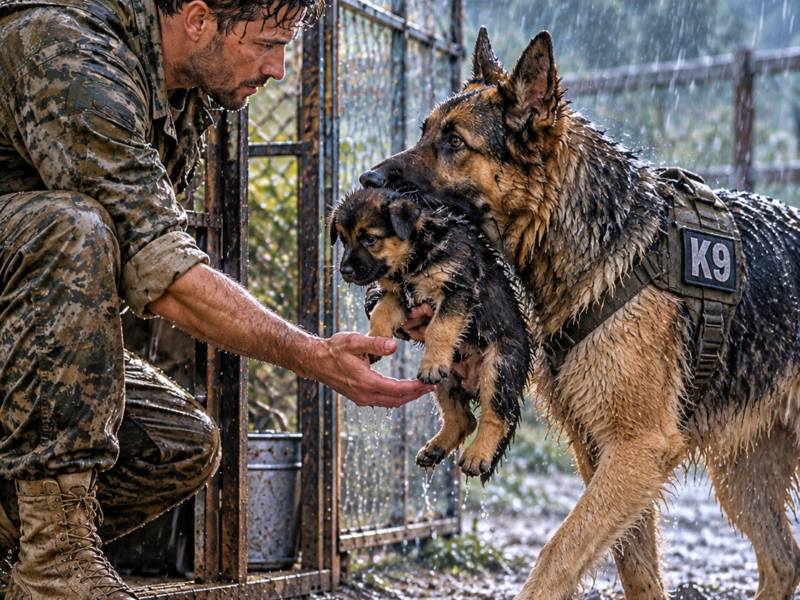
“The first time an old German Shepherd appeared on my porch, I thought she was lost and came to ask for help—but when I opened the door
The headlights disappeared.
For three seconds, the only sound inside my house was the puppy’s tiny breathing and the soft ticking of the kitchen clock.
Lucy stood between me and the front door, her body rigid, her ears pointed toward the darkness.
She wasn’t barking.
That frightened me more than barking would have.
I’d spent twenty years learning the difference between an animal that was afraid and one that was preparing to protect someone.
Lucy was protecting us.
I slipped Michael’s letter into my jacket and closed my hand around the brass key.
“Stay here,” I whispered.
Lucy glanced back at me.
Her cloudy brown eyes held mine, and for a moment I had the strange feeling she understood every word.
Then something scraped against the porch.
The puppy whimpered.
I moved toward the window and lifted the curtain just enough to look outside.
A dark SUV sat at the end of my driveway.
Its engine was running.
I couldn’t see the driver, but I could see the faint glow of a phone screen behind the windshield.
I reached for the old flashlight beside the door.
Before I could switch it on, my phone vibrated.
Unknown number.
I answered without speaking.
A man’s voice came through, calm and almost friendly.
“Daniel Brooks?”
“Who’s asking?”
“We need the dog.”
I looked at Lucy.
She had moved closer to the puppy, pressing her body against the little animal as if she could make herself into a wall.
“She’s not for sale.”
“This isn’t about money.”
“Then what is it about?”
The man paused.
“Your brother.”
My fingers tightened around the phone.
“What do you know about Michael?”
“Enough to know that he made a mistake.”
The call ended.
I stood in the dark, listening to the silence that followed.
For eleven years, I had believed Michael’s death was a terrible accident during his final deployment.
I had attended the funeral.
I had watched the flag folded into a triangle and placed in my hands.
I had listened while men in uniform told me my brother had died doing something brave.
And I had spent eleven years wondering why the last conversation we’d had ended with an argument.
Now an unknown man was sitting outside my house, asking for the dog Michael had somehow sent to me.
I looked down at the brass key.
“Okay, Mike,” I whispered. “I hear you.”
I didn’t sleep that night.
I moved the furniture in front of the back door, checked the windows twice, and kept the porch light off.
Lucy stayed beside the puppy.
Every so often, she lifted her head and watched me.
Near dawn, the SUV finally left.
I waited another hour before carrying the puppy to the kitchen.
It was a little female, perhaps eight weeks old, with oversized paws and a cream-colored patch across her chest.
She drank warm milk from a shallow dish and then fell asleep against Lucy’s front legs.
I had no idea what to call her.
Lucy seemed to have already decided she belonged.
I called the veterinarian in town and explained that I’d found an older German Shepherd and a puppy.
I didn’t mention the SUV.
I didn’t mention Michael’s letter.
And I certainly didn’t mention the man who had called me in the night.
The vet, Dr. Elaine Foster, agreed to see them that morning.
When I arrived, she examined Lucy carefully.
“She has some arthritis,” Elaine said, running her hands along the dog’s back. “And she’s lost weight. But she’s in better shape than I’d expect for a dog her age.”
“What about the puppy?”
“Healthy, as far as I can tell.”
Elaine checked Lucy’s microchip.
Her expression changed.
“That’s odd.”
“What?”
“This chip was registered to someone named Michael Brooks.”
I felt the room tilt.
“That’s my brother.”
Elaine looked up.
“Was he the dog’s owner?”
“I thought he was dead.”
She stopped writing.
“I see.”
I told her the short version.
Not everything.
Just enough to explain why the dog had appeared at my house with a puppy and why someone might be looking for her.
Elaine listened without interrupting.
When I finished, she closed the medical file.
“Daniel, I think you should know something.”
“What?”
“Lucy was brought here six months ago.”
“By whom?”
“A woman. She said she was helping an old friend. Lucy was frightened, but she wouldn’t let the woman leave without her.”
“Did she give you a name?”
Elaine shook her head.
“She paid in cash. But she left something behind.”
She walked to a cabinet and returned with a small envelope.
Inside was a photograph.
It showed Michael standing beside Lucy, his arm resting on her shoulders.
He looked younger than I remembered.
His hair was longer, and he wore the same crooked smile he had in the photograph on my kitchen shelf.
On the back, someone had written:
If Daniel comes looking, tell him the cabin is not empty.
I stared at the words.
“Who wrote this?”
“I don’t know.”
“Did the woman say anything else?”
Elaine hesitated.
“She said Lucy had been waiting a long time.”
I put the photograph in my pocket.
Then I looked at Lucy.
She was watching me from the examination table, her tail resting quietly against the metal.
“Looks like we’re going to the cabin,” I said.
The drive toward Black Mountain took less than an hour.
The road became narrower as we left town, winding through trees and climbing into the foothills.
The cabin had been in our family for three generations.
Michael and I had spent summers there as children.
We had built a crooked treehouse, caught frogs in the creek, and made promises about the men we would become.
After our parents died, Michael had wanted to keep it.
I had wanted to sell.
At the time, I thought I was being practical.
Michael called me a coward.
I called him selfish.
It was the last real conversation we ever had.
I hadn’t returned since the funeral.
When the cabin came into view, I pulled over.
The place looked smaller than it had in my memories.
The porch sagged.
The windows were dusty.
Weeds had grown around the stone path.
But something was different.
A fresh tire track cut through the mud near the shed.
Someone had been there recently.
Lucy lifted her head from the passenger seat.
Her ears stood straight.
The puppy was curled in a blanket beside her.
I stepped out and examined the track.
It was too wide for a motorcycle and too deep for an ordinary car.
The same kind of vehicle that had waited outside my house.
I took the brass key from my pocket.
The front door was locked.
The key turned easily.
Inside, the air smelled of dust, pine, and old wood.
The furniture was covered with sheets.
A cold fireplace stood against the far wall.
Everything looked exactly as I remembered.
Except for the kitchen table.
Someone had placed a fresh jar of dog food on it.
Beside the jar was a folded note.
I opened it.
Daniel, if you’re reading this, Lucy brought you here. That means she trusts you. Please don’t make the mistake I made. Trust the evidence, not the uniform.
There was no signature.
But I knew the handwriting.
Michael.
I looked around the room.
“Where are you, brother?”
Lucy walked past me.
She moved straight to the hallway and stopped in front of a narrow door beneath the stairs.
I’d forgotten that door existed.
It had always been locked when we were children.
I tried the brass key.
It didn’t fit.
Lucy sniffed the bottom of the door and scratched twice.
I crouched down.
There was a small metal plate near the floor.
I pressed it.
A click sounded from inside the wall.
The door opened.
Behind it was a narrow staircase leading to a basement.
I switched on my flashlight and descended slowly.
At the bottom, I found a small room with a desk, two filing cabinets, and a steel storage box.
The room was clean.
Not abandoned.
Someone had been maintaining it.
On the desk sat a photograph of Michael and a woman I didn’t recognize.
She had dark hair, tired eyes, and a small scar across her chin.
Michael was smiling at her.
Behind them stood Lucy, much younger, with a red ball in her mouth.
I picked up the photograph.
On the back was a name.
Sarah Miller.
Underneath it, Michael had written:
The only person who knows what happened.
I searched the desk.
There were old maps, printed emails, and several folders marked with dates.
One folder contained photographs from Michael’s final deployment.
A convoy.
A damaged truck.
A village street.
And a group of civilians standing beside a building with its windows blown out.
I recognized the location from the official report.
The report had said Michael’s unit was attacked during a routine patrol.
But the photographs told a different story.
In one image, Michael stood beside a military vehicle.
He was pointing toward a building.
In another, a man in uniform was handing a folder to someone in civilian clothes.
The man’s face was clear.
I knew him.
Colonel Richard Vance.
He had attended Michael’s funeral.
He had stood beside me at the graveside and told me my brother had been a good soldier.
I sat down.
My hands were shaking.
The steel box was locked.
I tried the brass key.
It opened.
Inside was a flash drive, a small notebook, and a sealed envelope with my name on it.
I opened the envelope first.
Dan,
If you’ve found this, I couldn’t bring the truth home myself. I’m sorry.
The mission that killed me was never supposed to happen. We were ordered to move through a village after intelligence warned us that civilians were still inside. I questioned the order. Vance told me the building was clear. It wasn’t.
When the operation began, I saw families running from the area. I tried to stop the advance, but the order came again.
I disobeyed. I got some of them out.
Afterward, the report was changed. The civilians were listed as enemy combatants. The photographs were removed. The people who questioned the report were threatened.
I copied what I could before they took my access. I gave the evidence to Sarah Miller. She was an interpreter who had helped us during the deployment. She knew the families. She knew the names of the people who were missing.
I was told to stop asking questions. Then I was told to stop talking.
I don’t know who will find this room. I don’t know if I’ll be able to come back.
But if I don’t, Lucy knows the way here. She knows the people who helped me.
The puppy is important, too. Her mother was one of the dogs that helped us find survivors after the operation. I promised I’d protect her line.
I know that sounds strange, but sometimes the only things we can save are the ones that trust us enough to follow.
Don’t let them turn this into another story about a soldier who died for nothing.
I love you, little brother.
Michael
I read the letter twice.
Then a third time.
My brother hadn’t died because he had made a mistake.
He had died because he had refused to accept one.
And for eleven years, I had carried the belief that our final argument was the last thing he remembered about me.
I pressed the letter against my chest.
“I should have listened,” I whispered.
Lucy approached and rested her head against my knee.
I placed my hand on her gray muzzle.
“I should have listened to you both.”
A floorboard creaked upstairs.
I went still.
Another creak.
Then the sound of a door opening.
Someone had entered the cabin.
I switched off the flashlight.
Lucy stood beside me.
The puppy remained in her blanket, sleeping.
Footsteps crossed the living room.
A man’s voice called out.
“Daniel?”
I recognized it immediately.
Colonel Richard Vance.
He had aged.
His voice was rougher, but it carried the same calm authority I remembered from the funeral.
“I know you’re down there.”
I reached for the flash drive and notebook.
Vance continued.
“You don’t understand what you’re holding. Your brother was confused. He was under enormous pressure. He made decisions that put people in danger.”
I stepped toward the stairs.
“You mean he refused to follow an order that would have killed civilians?”
Silence.
Then Vance sighed.
“That’s not how it happened.”
“I have his photographs.”
“Photographs can be misleading.”
“I have his letter.”
“Letters are emotional.”
“I have the names.”
That made him stop.
When he spoke again, the warmth was gone.
“Give me the drive, Daniel.”
I moved to the top of the stairs.
Vance stood in the hallway.
He was wearing a dark coat and leather gloves.
Behind him stood another man.
Younger.
Broad-shouldered.
His right hand rested near his jacket.
Vance looked past me and noticed Lucy.
“So that’s where she went.”
Lucy growled.
“She’s old,” Vance said. “She doesn’t need to be dragged into this.”
“She came here on her own.”
“She was trained to follow commands.”
“Not yours.”
His eyes hardened.
“You were never part of this, Daniel. Your brother made a choice. You don’t have to inherit it.”
“I inherited his silence for eleven years.”
“Then don’t make it worse.”
I held up the flash drive.
“What’s on here?”
Vance took a step forward.
“Evidence that could destroy reputations. Careers. Families. You think you want that?”
“I think the families in those photographs deserve to know what happened.”
“You have no idea what you’re talking about.”
“Then explain it.”
He looked at the younger man.
The man shifted his weight.
I knew that movement.
I had seen it in training rooms and on deployment.
A person preparing to act.
I moved one step to the side, putting the desk between us.
“Don’t,” I said.
Vance’s face changed.
For the first time, he seemed to understand that I wasn’t the grieving brother who had stood silently beside a coffin.
I was still a soldier.
Just not his.
Lucy barked.
The puppy woke and began to whimper.
Vance glanced toward the sound.
That moment was enough.
A voice came from the cabin entrance.
“Richard, step away from him.”
We all turned.
The woman from Michael’s photograph stood in the doorway.
Sarah Miller.
She was older now.
Her dark hair had silver strands, and the scar across her chin was more visible.
But her eyes were unmistakable.
Vance looked stunned.
“You should have stayed gone.”
“I tried,” Sarah said. “For eleven years.”
She held up a phone.
“The entire conversation has been recorded.”
The younger man stepped back.
Vance’s expression tightened.
“You have no idea what you’ve just done.”
“I know exactly what I’ve done.”
Sarah walked into the room.
She looked at me, then at Lucy.
For a second, her face crumpled.
“Michael was right,” she whispered. “She found you.”
I stared at her.
“Why didn’t you contact me?”
“Because I was afraid.”
“Of him?”
“Of everyone.”
Sarah explained that after Michael died, she had tried to send the evidence through official channels.
The first investigator had disappeared from the case.
The second had warned her to stop.
Her apartment had been searched.
Her phone had been monitored.
She had spent years moving from one place to another, keeping the original records hidden.
Lucy had stayed with her for a time.
But when Sarah learned that someone had discovered the cabin, she knew she couldn’t keep the dog safe.
She brought Lucy to the veterinarian, left the photograph, and arranged for her to follow the route Michael had taught her.
“She knew your scent,” Sarah said. “Michael kept an old jacket of yours in the cabin. Lucy remembered it.”
I looked down at the dog.
All those years.
All that distance.
She had crossed it carrying the last thing my brother had trusted her with.
“What about the puppy?”
Sarah smiled faintly.
“Her name is Hope.”
I looked at the little dog.
“Hope?”
“Michael chose it before he died. He said the world needed more of it.”
I swallowed.
Vance tried to move toward the stairs.
Sarah lifted her phone.
“Don’t.”
“You think a recording will be enough?”
“No,” she said. “But it will be a start.”
She pressed a button.
Outside, a siren sounded in the distance.
Vance’s expression shifted.
Sarah had contacted federal investigators before coming to the cabin.
She had also sent copies of Michael’s files to a journalist and to a military oversight office.
The younger man raised both hands.
Vance remained still.
For a long moment, he looked at me.
“You’re making a mistake.”
I thought about the funeral.
About the folded flag.
About the eleven years I had spent believing my brother had died with a secret he was too ashamed to share.
“No,” I said. “I’m finally correcting one.”
The investigators arrived minutes later.
They separated us and collected the documents.
Vance was taken away for questioning.
The younger man cooperated after learning that his own name appeared in one of the communications.
Sarah sat on the porch while an investigator photographed the cabin.
I joined her.
Lucy lay at my feet.
Hope slept against her side.
“Did Michael know you would bring Lucy here?” I asked.
Sarah nodded.
“He told me that if anything happened, she would find the one person who still had a reason to listen.”
I looked toward the trees.
“He knew I was angry with him.”
“He knew you loved him.”
“I didn’t say goodbye.”
Sarah turned toward me.
“Neither did I.”
We sat quietly.
The investigation took months.
There were interviews, hearings, and long conversations with people who had spent years trying to get their stories heard.
Michael’s records were authenticated.
The photographs were matched to archived mission files.
The altered reports were uncovered.
Several officers were placed under investigation.
Colonel Vance was eventually charged with obstruction and falsifying official records.
The case also reopened questions about the operation itself.
Some of the families were finally identified.
Some had already moved away.
Some had waited years for answers that should never have been withheld.
I couldn’t undo what had happened.
Neither could Sarah.
But we could make sure the truth didn’t disappear again.
One afternoon, I received a package from the military review office.
Inside was a copy of the corrected report.
Michael’s actions were described accurately.
He had disobeyed an unlawful order.
He had helped evacuate civilians.
He had preserved evidence when others tried to destroy it.
And his death was no longer described as the result of a routine mission gone wrong.
I read the final page at the kitchen table.
Then I carried it outside.
Lucy was lying in the sun.
Hope was trying to climb over her front legs.
The puppy had grown quickly.
Her paws were still too big, and she had developed a habit of stealing my socks.
I sat beside them and placed the report on the porch.
“Michael was a good man,” I said.
Lucy lifted her head.
“I should have known.”
She rested her chin on my knee.
I cried then.
Not quietly.
Not the way I had learned to cry in the dark, where no one could see.
I cried for my brother.
For the years we had lost.
For the families who had waited.
And for the man I had been before a dog walked up my porch steps carrying a piece of my past.
Sarah visited often after that.
At first, she came to help with the investigation.
Then she came to check on Lucy.
Eventually, she came because she enjoyed sitting on the porch with a cup of coffee and listening to Hope chase leaves.
She told me stories about Michael that I had never heard.
How he used to sing badly in the truck.
How he gave away his lunch to children in the village.
How he talked about coming home and opening a small animal rescue.
“He said he wanted a place where old dogs could spend their last years without being afraid,” Sarah told me one evening.
I looked at Lucy.
She was asleep beside the porch steps.
“Sounds like him.”
“He said you would help him build it.”
I laughed softly.
“He never asked me.”
“He thought you would say yes.”
For the first time in years, I could imagine my brother making plans for a future instead of disappearing into a memory.
The cabin became the beginning of something new.
I repaired the roof.
Replaced the broken windows.
Cleared the weeds from the path.
I turned the basement room into an office for the rescue organization we eventually started.
Sarah helped with paperwork.
Dr. Elaine Foster volunteered to handle the animals’ medical care.
A few neighbors offered food, blankets, and old kennels.
We called it Michael’s Haven.
Not because Michael had been perfect.
But because he had believed every living thing deserved a safe place.
Lucy became the heart of it.
She was never asked to work.
She had already done more than enough.
Her job was to rest in the sun, keep Hope company, and remind every frightened dog that a home could be gentle.
Hope grew into a strong young German Shepherd.
She followed me everywhere.
When I worked in the yard, she carried sticks.
When I sat at the desk, she rested her head on my boot.
And whenever Lucy entered a room, Hope moved aside to let her pass.
It was as if she understood that the old dog had brought her into the world and brought her into mine.
One cold morning, nearly a year after Lucy first appeared on my porch, I found Sarah standing beside the cabin’s old oak tree.
She was holding a small wooden box.
“What’s that?” I asked.
“Something Michael asked me to keep.”
She opened it.
Inside was a folded photograph of the two of us as boys.
I was maybe ten.
Michael was twelve.
We were standing in front of the cabin, covered in mud, with two dogs between us.
On the back, he had written:
Brothers don’t always know how to say they’re sorry. Sometimes they just have to find their way home.
I stared at the words.
Sarah handed me the box.
“He wanted you to have it.”
I ran my thumb across the handwriting.
For years, I had believed that the last thing between Michael and me was anger.
But that wasn’t the whole story.
There had been love before the argument.
There had been laughter before the silence.
And somewhere beneath all of it, there had always been a way back.
That afternoon, I took the photograph to the porch.
Lucy was resting on her blanket.
Her muzzle had grown whiter.
She struggled a little when she stood, but her eyes were still bright.
I sat beside her.
“Your boy was stubborn,” I told her.
Her tail moved once.
“So was I.”
Hope came running from the yard and dropped a stick at my feet.
I threw it.
She raced after it, ears bouncing.
Lucy watched her go.
Then she looked back at me.
I understood something I hadn’t understood when she first appeared.
She hadn’t brought me a puppy because she needed someone to raise it.
She had brought me a reason to open the door.
A reason to leave the house.
A reason to remember that love didn’t end just because someone was gone.
Sometimes it waited.
Sometimes it traveled a long way.
And sometimes it arrived on four tired legs, with a little puppy beside it and a secret tied to its collar.
I still live alone in the small wooden house outside Asheville.
But it no longer feels empty.
There are muddy paw prints on the kitchen floor.
There are dog beds in rooms I once kept locked.
There is coffee on the porch every morning, and Sarah usually arrives before the second cup gets cold.
On the wall above my desk hangs Michael’s corrected report.
Beside it is the photograph of two boys standing in front of a cabin, believing they had all the time in the world.
And beneath the photograph, in a simple wooden frame, are the words from his letter:
Don’t send her away.
I never did.
Lucy stayed with me until the following spring.
On her last morning, she lay beneath the oak tree at the cabin while the sunlight moved slowly across her fur.
Hope rested beside her.
I sat on the ground and held Lucy’s paw.
There was no fear in her eyes.
Only the quiet certainty of a dog who had finished the journey she was meant to make.
“Thank you,” I whispered.
She breathed out softly.
Then she rested her head against my leg.
I stayed there long after she was gone.
When we buried her beneath the oak tree, I placed Michael’s old brass tag beside her.
Hope watched from the grass.
Sarah stood beside me, her hand resting on my shoulder.
Neither of us tried to find the right words.
We didn’t need to.
A few weeks later, Hope began sleeping beside the porch door.
Every evening, she watched the driveway.
Sometimes I wondered whether she was waiting for Lucy.
Sometimes I wondered whether she was waiting for Michael.
Then one afternoon, a battered pickup stopped outside the cabin.
A young woman stepped out.
She carried a cardboard box.
Inside were three abandoned puppies.
She looked nervous as she approached.
“I heard you might be able to help,” she said.
I opened the gate.
“Come on in.”
Hope trotted over and sniffed the box.
The puppies began to squirm.
The young woman looked at the cabin, then at the dogs, and finally at me.
“Do you really take in every animal?”
I glanced toward the oak tree.
At the place where Lucy rested.
At the photograph of my brother hanging inside the window.
Then I looked back at her.
“We try,” I said. “Nobody should have to find their way home alone.”
I carried the box inside.
Hope followed.
And for the first time in eleven years, I understood that coming home wasn’t always about returning to the place where your story began.
Sometimes it was about opening the door for someone else’s story to begin.
Michael had known that.
Lucy had known it, too.
And now, finally, so did I.
The end.









