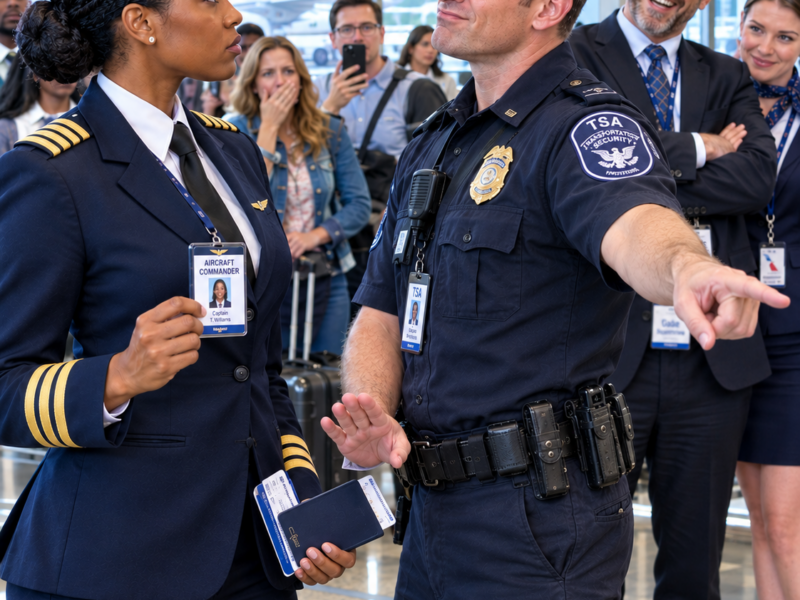
The airline staff blocked a Black woman from entering the cockpit, mocked her uniform, and told her to wait until a “real pilot” arrived
Captain Danielle Brooks settled into the left seat of Flight 718’s cockpit, fastened her shoulder harness, and looked over the instruments as if nothing unusual had happened that morning. Outside, ground crews moved beneath the wings while passengers filed into the aircraft, unaware that the woman responsible for flying them across the Atlantic had just been treated like an intruder at her own workplace. She checked the flight management system, reviewed the weather along the planned route, and listened as First Officer Michael Turner completed the preliminary checklist. Everything in the cockpit was familiar, precise, and reassuring. The only unfamiliar thing was the weight of knowing that, somewhere behind the cockpit door, people who had questioned her right to be there were now facing the consequences of their own assumptions.
“Before we continue,” Michael said quietly, “I want you to know that I’m sorry you had to deal with that.”
Danielle glanced at him. “You weren’t the one who did it.”
“I still saw how they treated you. I should have said something sooner.”
“You weren’t there at the beginning.”
“I heard enough when you came through the terminal.”
Danielle considered his words for a moment. She had spent years learning that not every apology required an immediate response, and not every uncomfortable conversation needed to become a confrontation. “Thank you,” she said. “Now let’s make sure we do our jobs properly. There are 246 people trusting us to get them to London.”
Michael nodded, and they returned to their checks.
Danielle had learned long ago that professionalism did not mean pretending injustice had never happened. It meant refusing to let someone else’s behavior dictate the quality of her own work. She would not allow the humiliation at the crew entrance to distract her from the responsibility in front of her. The passengers had paid for a safe journey, and every decision in the cockpit had to serve that purpose.
Yet when the aircraft was ready for departure, a message appeared on her company tablet. It came from David Bennett, the vice president of flight operations.
Captain Brooks, the executive review is underway. We have secured the initial access records and crew assignment documentation. You are not required to participate until after the flight. Please continue with your scheduled duties. We will contact you upon arrival.
Danielle read the message twice, then locked the screen.
“Everything all right?” Michael asked.
“Yes. Operations is handling the situation.”
“Good.”
She placed the tablet beside her checklist. “Let’s fly.”
The aircraft pushed back from the gate, taxied toward the runway, and rose into the morning sky. As New York grew smaller beneath the clouds, Danielle focused on the climb, the instruments, and the steady rhythm of a routine transatlantic departure. Her voice remained calm over the radio. Her hands moved with practiced confidence. To the passengers, she was simply the captain doing her job.
But back at the terminal, the morning was becoming anything but routine.
David Bennett stood inside a small conference room near the operations center. Around the table sat the regional operations director, a human resources representative, the airport station manager, and two members of the airline’s compliance team. A large monitor displayed the crew manifest for Flight 718, the electronic access records, and a timeline assembled from the initial reports.
Robert Collins sat at the opposite end of the table, his face pale and his arms folded tightly across his chest. Melissa Grant sat beside him, repeatedly smoothing the front of her uniform. Neither had been formally dismissed at that point, but both had been instructed to remain available while the company reviewed the incident.
David placed a printed copy of the flight assignment on the table.
“Captain Danielle Brooks was assigned as pilot in command of Flight 718,” he said. “Her credentials were valid. Her identity matched the company record. Her crew assignment was confirmed in the system. There was no operational reason for her to be stopped.”
Robert cleared his throat. “I understand that now.”
“That is not what I asked you,” David replied. “I asked whether there was a legitimate operational reason to stop her at the time.”
Robert looked toward the human resources representative. “We had a question about her authorization.”
“What question?”
“We needed to verify that she was supposed to be there.”
“Did you check the manifest?”
Robert hesitated. “Not immediately.”
“Did you contact operations?”
“No.”
“Did you ask a supervisor to verify her assignment through the established process?”
Robert’s jaw tightened. “No.”
David turned to Melissa. “What did you do?”
Melissa spoke quickly. “I saw someone approaching the crew entrance, and I asked to see identification. When she showed me her credentials, I wasn’t certain they were current.”
“Did you scan them?”
“No.”
“Did you call the crew desk?”
“No.”
“Did you check the manifest?”
“No.”
“Then what information did you use to decide she was not authorized to enter?”
Melissa’s eyes moved toward Robert. “I thought something seemed wrong.”
“What seemed wrong?”
She swallowed. “I can’t explain it exactly.”
David leaned back in his chair. “Captain Brooks was wearing her airline uniform. She presented company identification. Her name appeared on the flight assignment. Her credentials were valid. You had several straightforward ways to verify her status, and you used none of them. Instead, you escalated the situation.”
Robert shifted in his seat. “We were trying to protect security.”
“Security procedures are important,” David said. “That is precisely why they must be followed correctly. Security is not a personal feeling. It is a process based on evidence, verification, and consistent standards.”
The compliance officer opened a second document.
“We also have preliminary witness statements,” she said. “Several employees heard comments made during the interaction. We are reviewing the exact language and the circumstances in which those comments were made.”
Melissa’s face changed. “What comments?”
“The statements include remarks about Captain Brooks not looking like a pilot, references to waiting for the actual flight crew, and language suggesting that people like her were always trying to create complaints.”
“That isn’t how I meant it,” Melissa said immediately.
“Then you will have an opportunity to explain what you meant,” the compliance officer replied. “But we cannot evaluate intent without examining conduct and impact.”
Robert leaned forward. “This is getting out of hand. Nobody intended to stop a flight. Nobody was trying to hurt her.”
David’s expression hardened. “A person does not have to intend every consequence of an action for that action to cause harm. Captain Brooks was challenged in front of colleagues and passengers. She was treated as though her professional identity was inherently suspicious. Then security was brought into a situation that could have been resolved with a simple verification call.”
“We didn’t know who she was,” Robert insisted.
“You were given the opportunity to find out.”
The room fell silent.
David looked at the documents again. The initial timeline showed that Danielle had been stopped, questioned, and prevented from proceeding while employees discussed whether she could possibly be the captain assigned to the aircraft. Only after she contacted operations had anyone taken the time to verify what the system had already established.
That detail troubled him more than anything else. The company had spent years emphasizing security, professionalism, and respect for its employees. Yet two people had substituted their assumptions for the very procedures they were supposed to enforce.
“Until this review is complete,” David said, “both of you are removed from passenger-facing and crew-access responsibilities. This is an administrative measure, not a final determination. You are not to contact Captain Brooks or any witness about the incident. You are not to delete messages, alter records, or discuss your statements with other employees. Do you understand?”
Robert nodded reluctantly.
Melissa whispered, “Yes.”
“Good. We will continue the investigation.”
When they left the room, David remained at the table. He knew that a difficult decision lay ahead. He also knew that the company could not afford to treat the matter as a public relations inconvenience and move on. If the investigation found that the employees had violated established standards, the consequences would have to be real. If the evidence revealed a deeper organizational problem, discipline alone would not be enough.
He turned to the regional operations director. “I want the entire crew-access process reviewed. Not just this station. Every major airport where our employees work.”
“That could take weeks,” the director said.
“Then we start today.”
The flight continued across the Atlantic while the investigation widened. Danielle remained unaware of most of the details unfolding on the ground. She conducted the scheduled checks, monitored the aircraft’s performance, and coordinated with air traffic control. When a band of turbulence appeared along the route, she and Michael adjusted the flight plan in accordance with the latest reports. The cabin crew secured the service carts, and the passengers experienced only a brief interruption to their breakfast.
Several hours later, while the aircraft cruised above a vast field of clouds, Michael glanced at Danielle.
“Can I ask you something?”
“Go ahead.”
“Has anything like that happened to you before?”
Danielle kept her eyes on the instruments for a moment. “Not exactly like that. But enough times to recognize the pattern.”
“What pattern?”
“Someone looks at me and decides what I can’t possibly be. Then I have to prove I am what I already know I am.”
Michael was quiet.
“Sometimes it’s a passenger who assumes I’m a flight attendant,” she continued. “Sometimes it’s someone who asks whether the captain is available, even while I’m standing in uniform. Sometimes it’s a colleague who wants to double-check something they would never question if another person said it. Most of the time, I correct the misunderstanding and move on.”
“And today?”
“Today they brought security into it. Today they refused to use the systems that would have answered their questions. Today it became more than a misunderstanding.”
Michael nodded slowly. “I don’t know how you keep your composure.”
“Practice,” Danielle said. “And responsibility. When I’m in this seat, my feelings cannot become more important than the people on this aircraft. That doesn’t mean I don’t have feelings. It means I know when and how to deal with them.”
He looked at her with new respect. “You shouldn’t have to be that strong just to do your job.”
“No,” she agreed. “I shouldn’t.”
For a while, neither spoke. The cockpit was filled with the soft sounds of ventilation, electronic alerts, and the occasional radio transmission. Danielle watched the flight progress across the navigation display. She had worked too hard to reach this position to let a single morning define her, but she was no longer willing to accept the idea that endurance alone could solve a problem that required accountability.
She did not want revenge. She wanted the truth recorded accurately, the standards enforced consistently, and the next pilot spared the same humiliation.
When Flight 718 began its descent toward London, the sky beyond the windshield had softened into pale gold. Danielle reviewed the arrival information, briefed Michael, and coordinated with air traffic control. The approach was stable. The aircraft touched down smoothly and rolled toward the assigned gate.
As the engines wound down, the cabin filled with the familiar sounds of seat belts clicking open and passengers reaching for their bags. Danielle completed the required shutdown procedures before releasing the aircraft to the ground crew.
Michael turned toward her. “Good flight, Captain.”
“Good work, First Officer.”
He paused before leaving the cockpit. “I hope they do the right thing back there.”
“So do I.”
Danielle remained in her seat for another moment, checking the final entries and confirming that the aircraft had been secured. She knew the investigation would be waiting when she returned to the terminal. She also knew that no decision made in a conference room could undo what had happened at the crew entrance. The question was whether the company would acknowledge the harm and act to prevent it from happening again.
After she completed the handover, she collected her flight bag and walked into the terminal. Her uniform was slightly creased from the long journey, and fatigue had begun to settle behind her eyes. She had been awake for hours, managing a demanding flight while carrying the memory of a confrontation she should never have faced.
A company representative met her near the crew corridor.
“Captain Brooks, Mr. Bennett would like to speak with you when you are ready. We can arrange a private room, or you can rest first.”
“I would like to hear what you have learned,” Danielle said. “But I want to be clear that I expect this to be handled through the proper process. I don’t want anyone punished because I’m upset. I want the facts examined.”
“That is exactly what we intend to do.”
They walked to a quiet meeting room. David Bennett joined them a few minutes later, carrying a folder. He stood when Danielle entered.
“Captain Brooks, thank you for meeting with us after such a long flight.”
“I understand the matter is serious.”
“It is. First, I want to apologize on behalf of the company. You were properly assigned to Flight 718, your credentials were valid, and our employees failed to follow the required verification procedures. You should never have been placed in that position.”
Danielle sat down but did not reach for the folder.
“I appreciate the apology,” she said. “What happens next?”
“We have interviewed the employees involved and reviewed the available records. We are still gathering statements from witnesses and checking whether any relevant communications were omitted from the initial timeline. We have also placed both employees on administrative leave from their normal duties while the review continues.”
“Have you established whether they knew I was the captain before they called security?”
“We are still examining the precise sequence. What we can confirm is that they had access to a system that could verify your assignment, and they did not use it before escalating the situation.”
“That matters.”
“Yes,” David said. “It does.”
Danielle folded her hands on the table. “I want the investigation to consider the language used during the incident, not only the access procedure. If this were just a mistake about a credential, the process would be straightforward. But there were comments about what a pilot should look like. There was an assumption that I could not be the person assigned to command that aircraft. That is not the same as a routine security check.”
David nodded. “We have received witness accounts describing those comments. They are part of the investigation.”
“And I want the review to look at whether similar complaints have been made before.”
“We are doing that.”
“Not just at this airport?”
“Not just here.”
Danielle studied him. “Good. Because I don’t want this reduced to two people making a mistake if the company has a larger problem. But I also don’t want the company to make an example of them just to satisfy the public. Find out what happened. Apply the rules fairly. Then fix whatever allowed it to happen.”
David opened the folder and slid a document across the table. “That is the approach we intend to take. We are also reviewing our crew-identification and access protocols. One proposal is to require employees to document the verification step whenever a crew member’s authorization is questioned. That would create a record of what was checked and which system was used.”
“That would help,” Danielle said. “But paperwork alone will not solve a problem if people believe their assumptions are more reliable than the evidence.”
“We agree. Training will be part of the review.”
“Training is useful when people take it seriously. I want to know how you will measure whether it works.”
David paused, considering the question. “We can conduct recurring audits, review access incidents, track complaints, and require managers to demonstrate that staff are following the procedure. We can also create a confidential reporting channel for employees who witness discriminatory treatment.”
“Then put those measures in writing.”
“We will.”
Danielle finally opened the folder. The first pages contained the preliminary timeline. She read them carefully, marking two places where the language seemed too vague.
“This says I was ‘asked to verify my role,’” she said. “That does not describe what happened.”
David leaned closer. “What wording would you suggest?”
“I was stopped from entering the crew area after presenting my company identification. My credentials were not checked through the established system. The supervisor declined to verify my assignment, and security was called. There were comments questioning whether I could be a pilot because of my appearance. If the report softens those details, it will not be accurate.”
David took the document back and made a note. “We will revise it to reflect the witness statements and your account. We will not minimize the incident.”
“Thank you.”
They spent another half hour reviewing the sequence of events. Danielle answered questions about where she had been standing, what she had presented, and when she had contacted operations. She did not embellish her account or speculate about motives she could not prove. When she remembered a phrase precisely, she repeated it. When she was uncertain, she said so.
The distinction mattered to her. She wanted the record to be strong because it was accurate, not because it was dramatic.
At the end of the meeting, David closed the folder.
“You should know that the review may take several more days. We want to reach a decision based on the full evidence.”
“I understand.”
“Would you be willing to participate in a broader discussion about improving our procedures once the investigation is complete?”
“Yes,” Danielle said. “If the discussion leads to actual changes. I’m not interested in being invited into a room so the company can say it listened. I want the next person who walks through that door to be treated according to their credentials and the rules, not somebody’s expectations.”
“That is fair.”
Danielle stood. “Then I think we understand each other.”
When she left the meeting room, the airport was moving through its afternoon rush. Departing passengers hurried toward security, arrivals gathered around the baggage carousels, and crews moved between gates carrying flight bags and rolling suitcases. The ordinary life of the terminal continued, even though the morning had changed the course of several careers.
Danielle went to her hotel and slept. For the first time since the incident, she allowed herself to stop being the captain, the witness, and the person expected to remain composed. She sat on the edge of the bed, removed her uniform jacket, and stared at the floor for several minutes.
She thought about the passengers who had watched the confrontation. She thought about the younger pilots who might have been standing behind her, seeing how quickly a professional could be made to defend her own existence. She thought about how easily the entire matter could have disappeared if she had simply walked away, accepted the delay, and filed a quiet complaint that no one ever read.
Then she thought about the flight. The aircraft had reached London safely. The passengers had disembarked. Her responsibilities had been fulfilled.
That was not nothing.
But it was not enough.
The next morning, Danielle received a call from David Bennett. The company had completed additional interviews and obtained the relevant access logs. They wanted to schedule a final meeting once the remaining review steps were finished.
“Have you found anything else?” she asked.
“Yes,” David said. “The evidence confirms that your assignment was available for verification at the time of the incident. It also confirms that the required verification process was not completed before security was contacted. We have statements from multiple witnesses concerning the comments made to you. The investigation is now examining the conduct against our employment standards and disciplinary policy.”
“Does that include previous complaints?”
“Yes. We are reviewing the records we have, though we are being careful to distinguish substantiated complaints from unverified reports.”
“Good. That distinction matters.”
“We will contact you as soon as the findings are finalized.”
After the call, Danielle prepared for her next scheduled duty. She did not know whether the company would issue a warning, suspend the employees, or terminate them. She had deliberately avoided demanding a specific outcome. The facts should determine the decision.
Still, she understood that fairness did not mean avoiding consequences. It meant applying them based on conduct and evidence, rather than favoritism, fear, or pressure.
At the airline’s headquarters, the final review lasted most of the afternoon. Human resources presented the employment standards that applied to both employees. Compliance described the failures in the access process. The regional director explained the operational risks of refusing to verify an authorized crew member and unnecessarily involving security. Witness statements supported the account of the incident, while the system records established that the assignment had been available to check.
Robert and Melissa were given opportunities to respond.
Robert maintained that he had been protecting the airline. He said he had been under pressure to prevent unauthorized access and believed he was exercising sound judgment. He acknowledged that he had not checked the crew manifest before escalating the matter, but argued that the situation had become confusing.
The review panel asked him why he had not used the available verification process.
“I thought something was wrong,” he replied.
“What objective information supported that conclusion?”
Robert did not offer a clear answer.
He was then asked about his remarks during the confrontation. He said that some of the words attributed to him had been taken out of context and that he had not intended to offend Captain Brooks.
The panel asked whether he accepted that his conduct had been unprofessional even if he had not intended to cause offense.
Robert looked down at his hands. “I could have handled it differently.”
“Can you identify the specific steps you should have taken?”
“I should have checked her credentials and called operations before contacting security.”
“Why did you not do that?”
“I don’t know.”
The answer did little to resolve the panel’s concerns. A supervisor responsible for crew access was expected to understand and follow the process, particularly when a situation required verification.
Melissa’s account was more emotional. She admitted that she had made assumptions about Danielle’s role based on her appearance, though she insisted that she had not intended to discriminate against her.
“I thought the captain would be someone else,” Melissa said. “I realize that sounds terrible now.”
The human resources representative asked, “Why did you believe the captain would be someone else?”
Melissa struggled to answer.
“I suppose I had an idea in my head of what the captain usually looks like.”
“And when the evidence in front of you did not match that idea, what did you do?”
“I questioned her.”
“Did you verify her credentials?”
“No.”
“Did you ask operations to confirm her assignment?”
“No.”
“Did you reconsider your assumption when she presented company identification?”
Melissa’s eyes filled with tears. “I should have.”
The panel did not treat her tears as proof of guilt, nor did it treat them as proof of innocence. Emotion could be genuine without resolving the question of professional responsibility. The review focused on what she had done, what she had failed to do, and how her conduct had affected an authorized colleague.
By the time the meeting concluded, the panel had reached its decision. The findings were based on the documented sequence of events, the witness statements, the access records, and the employees’ own admissions. Both employees had failed to follow required procedures. Both had escalated a situation without completing basic verification. The evidence also supported the conclusion that assumptions about Danielle’s appearance had influenced how she was treated.
The panel determined that their conduct violated company standards governing professionalism, respectful treatment, and the appropriate use of security procedures. Given their responsibilities, the seriousness of the incident, and the established findings, the company concluded that continued employment was no longer appropriate.
Robert Collins and Melissa Grant would be terminated.
The decision was not announced as a victory, and Danielle was not invited to celebrate it. The company’s responsibility was to explain the findings, carry out the decision according to policy, and address the weaknesses that had allowed the incident to occur.
David Bennett called Danielle that evening.
“The investigation is complete,” he said. “The panel found that the employees involved failed to follow the required verification procedures. It also found that assumptions about your appearance played a role in the way you were treated. Based on the findings and the company’s employment standards, both employees have been terminated.”
Danielle closed her eyes briefly. She had expected the decision might go that way, but hearing it confirmed still brought a complicated mixture of relief and sadness.
“Was the decision made under the normal disciplinary process?” she asked.
“Yes. The panel reviewed the evidence and applied the relevant standards. Your complaint was considered, but the decision was not based solely on your request or your personal reaction. It was based on the documented conduct.”
“Were they given the opportunity to respond?”
“Yes.”
“Then I accept that the process has reached its conclusion.”
David paused. “I also want to tell you that the company is implementing the procedural changes we discussed. We will require documented verification when a crew member’s authorization is questioned. Staff will receive additional training on appropriate escalation, professional conduct, and bias in workplace decisions. We are establishing an audit process and a confidential reporting channel.”
“When do those changes begin?”
“The revised procedure will be issued this week. Training will be scheduled over the coming weeks, and the first compliance review will take place next month.”
“Please send me the written plan when it is finalized.”
“I will.”
Danielle thanked him and ended the call. She did not feel triumphant. She felt that one part of the matter had been resolved, while another had only just begun.
The following week, the airline circulated an internal notice to employees. It did not identify Danielle by name or turn her experience into a publicity campaign. Instead, it described the importance of following crew-access procedures, verifying authorization through established systems, and treating every employee with professional respect. It emphasized that no one should be denied access based on assumptions about their appearance, background, or perceived role.
The notice also explained that failure to follow required procedures could result in disciplinary action. Employees were reminded that security was a responsibility shared by the organization and that personal suspicion was not a substitute for verification.
Some employees welcomed the announcement. Others complained privately that the company was overreacting to a single incident. A few said the rules would make their jobs more complicated. But the revised procedure was clear, and managers were instructed to enforce it consistently.
At the airport where the confrontation had taken place, the station manager organized a briefing for employees working near crew access points. A trainer walked them through the updated process. Staff were shown how to confirm an assignment, how to contact operations, when security involvement was appropriate, and how to document a decision.
The trainer did not ask employees to abandon caution. The airline still had to protect restricted areas. Instead, the lesson was that caution had to be disciplined by evidence.
“If someone presents valid identification and says they are assigned to a flight,” the trainer explained, “you do not decide whether they look like the person you expected. You verify their authorization. If the records confirm their access, you follow the procedure. If the records raise a genuine concern, you escalate through the proper channel and document what you found. Your job is not to guess who belongs. Your job is to verify.”
Several employees nodded. One asked whether the changes applied to everyone, including senior pilots and managers.
“Yes,” the trainer said. “The procedure applies to everyone. No position makes someone exempt from verification, and no appearance makes someone less deserving of it.”
The words were simple, but their meaning lingered in the room.
Danielle returned to work as scheduled. She continued flying, completing training, mentoring younger colleagues, and managing the hundreds of small decisions that kept a complex operation safe. She did not become known only as the woman who had been blocked from the cockpit. She remained what she had always been: a pilot who had earned her position through training, judgment, and years of experience.
Yet the incident changed the way some colleagues approached her. A few apologized for not speaking up sooner. Others asked how they could support the new procedures. Some were embarrassed that they had witnessed the confrontation and failed to intervene.
Danielle accepted sincere apologies without pretending that every apology erased the experience. She encouraged people to speak up when they saw unfair treatment, but she did not make herself responsible for comforting everyone who felt guilty about what had happened.
One afternoon, a young first officer named Aisha Reynolds asked to speak with her after a training session. Aisha had recently completed her initial line training and was preparing for her first long-haul assignment. She stood outside the briefing room, holding a notebook against her chest.
“Captain Brooks, do you have a minute?”
“Of course. What’s on your mind?”
Aisha hesitated. “I read the internal notice about what happened at the airport. People have been talking about it.”
Danielle gestured toward a pair of chairs. “Sit down.”
“I wanted to tell you something,” Aisha said. “When I started training, I sometimes wondered whether I belonged here. I knew I had passed the exams and met the requirements, but I kept thinking that I would have to be twice as good to be taken seriously.”
Danielle listened without interrupting.
“When I heard about your experience, I was angry,” Aisha continued. “But I was also worried. I thought, if it can happen to a captain with your experience, what chance do I have?”
Danielle considered her carefully before answering.
“You have the chance your training, preparation, and judgment give you. You will encounter people who make assumptions. You may encounter people who question you for reasons that have nothing to do with your performance. When that happens, document what occurred, use the proper reporting channels, and ask for support when you need it. But do not let someone else’s assumption become your own.”
Aisha looked down at her notebook. “Sometimes I worry that speaking up will make people think I’m difficult.”
“Some people may think that,” Danielle said honestly. “You cannot control every opinion someone forms about you. You can control whether you act professionally, whether you tell the truth, and whether you stand by what you know to be right. Speaking up about a genuine problem is not the same as creating one.”
“What if nothing changes?”
“Then you keep the record accurate, keep asking for accountability, and find allies who are willing to help. Change can be slow. That does not mean it is impossible. But you should not have to carry the entire burden alone. The organization has responsibilities too.”
Aisha nodded, and some of the tension left her shoulders.
“Can I ask one more question?”
“Go ahead.”
“Did you ever think about walking away that morning?”
Danielle was silent for a moment.
“Yes,” she said. “Not because I thought they were right, but because I knew how much energy it would take to challenge them. I had a flight to operate. I had passengers waiting. I knew that if I insisted on being heard, I might be accused of making the situation more difficult.”
“What made you continue?”
“I reminded myself that I was entitled to the same professional respect as anyone else. I had followed the rules. I had the credentials. I had the assignment. I did not need to invent a reason to belong.”
Aisha took a slow breath. “Thank you. I needed to hear that.”
Danielle smiled. “You earned your place here. Remember that when someone forgets it.”
After Aisha left, Danielle remained in the briefing room for a few minutes. She thought about the younger woman’s question and recognized a familiar uncertainty in it. She could not guarantee that Aisha would never be treated unfairly. No policy could eliminate every prejudice, and no training session could instantly change every assumption. But a system could make it harder for those assumptions to control decisions. It could create records, provide avenues for reporting, and make consequences more consistent.
That was the work still ahead.
Over the following months, the airline began its first compliance audits. Reviewers examined access records, interviewed staff, and checked whether employees were following the updated verification process. Several stations required additional training after auditors found incomplete documentation. Managers were instructed to correct the problems promptly and report repeated failures.
The confidential reporting channel also received submissions from employees who described incidents they had previously considered too minor to report. Some involved misunderstandings that were resolved after review. Others revealed patterns that required further investigation. The company did not assume every allegation was proven, but it no longer dismissed a complaint simply because it was uncomfortable or inconvenient.
At a quarterly meeting, David Bennett presented the initial results to senior leadership. He described the changes that had been implemented, the gaps identified during the audits, and the steps taken to correct them. He also explained that the airline would continue monitoring the process rather than declaring success after a single training cycle.
“We cannot measure success by whether we have issued a statement,” he told the executives. “We have to measure it by whether employees can do their jobs without being subjected to arbitrary treatment, whether access decisions are based on evidence, and whether managers respond appropriately when something goes wrong.”
One executive asked whether the company was spending too much time and money on the issue.
David answered without hesitation. “The cost of doing this properly is part of operating a safe and professional airline. The cost of ignoring it is greater. We risk losing good employees, undermining trust, and creating an environment where people are afraid to report problems. That is not an acceptable outcome.”
The discussion continued, and the new measures remained in place.
Danielle was invited to join a working group reviewing the long-term policy. She agreed, provided that her participation would not be treated as a substitute for the company’s own responsibility. She contributed practical suggestions based on her experience as a pilot: make the verification process simple enough to use under pressure, ensure that staff know whom to contact, require records when access is denied, and create a clear path for employees to challenge a decision without facing retaliation.
She also insisted that the policy distinguish between legitimate security concerns and subjective judgments. A genuine discrepancy in identification had to be investigated. A mismatch between a person’s appearance and someone else’s expectation was not a discrepancy.
That distinction became part of the revised guidance.
Months later, Danielle passed through the same airport on another assignment. The terminal looked much as it had on the morning of Flight 718. Passengers queued at the gates, announcements echoed from the ceiling, and ground crews moved briskly between aircraft. The crew entrance had been repainted, though the electronic reader and access desk were still in the same places.
As Danielle approached, an employee looked up from the desk.
“Good morning, Captain. May I scan your identification, please?”
“Good morning,” Danielle replied, presenting her credentials.
The employee scanned the card, checked the assignment displayed on the screen, and stepped aside.
“Thank you, Captain Brooks. You’re cleared for access. Have a safe flight.”
There was nothing dramatic about the exchange. No one applauded. No executive appeared. No one delivered a speech about how far the airline had come. It was an ordinary interaction carried out according to the rules.
That was precisely why Danielle appreciated it.
She walked through the access point and continued toward the crew area. For a moment, she remembered standing in the same place months earlier, listening to someone question whether she could possibly be a pilot. The memory still stung, but it no longer held the same power over her. The incident had become part of the record, part of the training, and part of a broader effort to change how decisions were made.
As she entered the corridor, she noticed a young woman in a pilot’s uniform checking her flight documents. The woman looked up, recognized Danielle, and smiled with a mixture of surprise and nervousness.
“Captain Brooks?”
“Yes?”
“I’m Priya Shah. I’m flying as a first officer on the afternoon departure. I just wanted to say that I heard about the changes you helped bring in. My training group discussed them last week.”
Danielle returned the smile. “I hope the discussion was useful.”
“It was. The instructor said the point wasn’t that we should ignore security concerns. It was that we should never replace verification with assumptions.”
“That’s right.”
Priya hesitated, then added, “I think that distinction will stay with me.”
“Good. It should.”
They exchanged a few more words before going their separate ways. Danielle continued toward the briefing room, carrying the quiet satisfaction of seeing a practical lesson take root in someone who might one day be responsible for an aircraft of her own.
The airline’s response did not erase what had happened. Robert and Melissa had lost their jobs, and both had to confront the professional consequences of decisions they had made. Their departures did not mean that every employee had suddenly become free of prejudice, or that every future complaint would be handled perfectly. Danielle knew better than to believe that one investigation could resolve a problem that had existed for years.
But the company had documented the incident, applied its standards, changed its procedures, and begun checking whether those changes were being followed. It had moved beyond an apology and accepted that accountability required work after the headlines faded and the conference room emptied.
That mattered.
On the day of her next long-haul flight, Danielle arrived early enough to review the weather and meet with her first officer. She walked into the cockpit, checked the aircraft documents, and began the familiar routine of preparation. The aircraft was ready. The crew was in position. The passengers would soon board, carrying their own plans, worries, hopes, and expectations.
Danielle placed her flight bag beside the seat and looked out through the cockpit windows. The morning light rested on the terminal, and beyond it, the runway stretched toward the horizon.
She thought briefly of the question that had followed her through the incident: what did a captain look like?
The answer had never been complicated. A captain was a qualified professional who accepted responsibility for the aircraft, the crew, and the passengers. A captain studied the weather, evaluated risks, made decisions under pressure, listened to colleagues, and understood that confidence without discipline could be dangerous. A captain earned trust through competence and judgment, not through fitting someone else’s picture of authority.
Danielle had been all those things before the morning she was stopped at the crew entrance. She had remained all those things while being questioned. And she was still all those things now.
The difference was that more people inside the airline had been forced to examine the assumptions they once treated as harmless.
Michael entered the cockpit carrying two cups of coffee.
“Ready for another one?” he asked.
Danielle accepted a cup. “Always ready to prepare for one.”
He laughed. “Fair answer.”
They reviewed the route, discussed the weather, and completed the briefing. Their conversation turned to the ordinary details that mattered in aviation: fuel calculations, alternate airports, expected turbulence, and the procedures they would follow if the plan changed.
There was comfort in that routine. Every person had a role. Every role carried responsibility. Every decision could be checked against evidence, training, and established standards.
When the cabin crew reported ready, Danielle contacted ground control. The aircraft was cleared to push back, and the engines came alive with a steady roar. She taxied toward the runway, completed the final checks, and waited for clearance.
“Flight 718, cleared for takeoff.”
Danielle advanced the thrust levers. The aircraft accelerated, the runway markings rushed beneath the windshield, and the nose lifted into the air.
As the city fell away beneath the wings, she felt the familiar transition from the weight of the ground to the freedom of flight. She was not thinking about Robert Collins or Melissa Grant. She was not thinking about the investigation, the meetings, or the policy revisions. She was thinking about the aircraft, the weather, and the people trusting her to take them safely to their destination.
But she carried one lesson with her, as surely as she carried her training and experience: professionalism was not simply a matter of how an individual behaved. It was also a matter of whether an organization was willing to uphold its own standards when doing so became uncomfortable.
That morning, someone had looked at her and decided she could not be the captain. The company had initially failed to protect her from that judgment, but the investigation had forced it to confront the consequences. Her response had not been to demand special treatment. She had demanded the treatment the rules already promised her.
She had asked for the evidence to be examined, for the decision to be fair, and for the system to improve.
By the time the aircraft reached cruising altitude, the incident was no longer only a story about two employees who had lost their jobs. It was a reminder that assumptions could become actions, actions could cause real harm, and organizations had a responsibility to intervene when their own standards were violated.
Danielle looked across at Michael, who was checking the flight progress.
“Everything looks good,” he said.
“Agreed,” Danielle replied.
She settled into the rhythm of the flight, alert and composed, with the horizon stretching ahead of her.
She had not needed to prove that she deserved to be a captain. Her qualifications had already established that. What she had done was insist that the people responsible for enforcing the rules respect the evidence in front of them.
And in the end, that was the change she cared about most: not that two people had been fired, not that executives had apologized, and not that the airline had issued a new policy, but that the next qualified pilot approaching that entrance would be judged by the standards that mattered.
Credentials. Competence. Responsibility.
Not assumptions.
Not appearances.
Not prejudice.
Just the truth, verified and respected.
Danielle guided the aircraft onward, carrying 246 passengers toward their destination and leaving the old confrontation behind her—not because it had been forgotten, but because she had refused to let it be ignored.
THE END.









