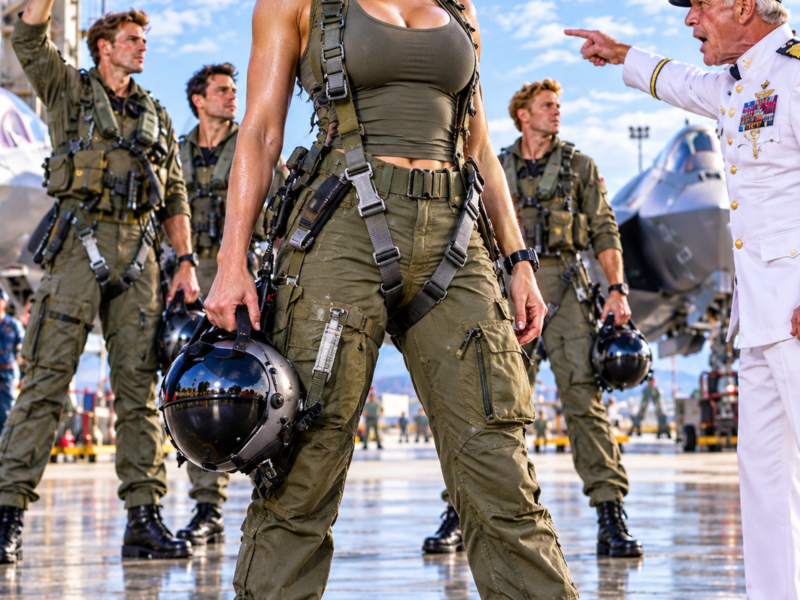
“The admiral slammed his fist onto the flight operations table and ordered security to remove my wings in front of thirty fighter pilots
I looked at the signature again.
Captain Michael Harlan.
The carrier’s maintenance operations officer.
He was standing less than twenty feet away, holding a tablet against his chest.
For a moment, he didn’t move.
Then he looked at Admiral Caldwell.
“Sir, I can explain that photograph.”
Caldwell extended his hand toward me.
“Give me the envelope, Commander.”
I didn’t.
“With respect, sir, I’d like to know why Captain Harlan’s signature is on a shipment authorization for a component that was never supposed to be installed on Daniel’s aircraft.”
Harlan stepped forward.
“That’s a routine authorization. It doesn’t prove anything.”
“Then why did the original inspection certificate disappear?”
His jaw tightened.
“Maintenance records get misplaced.”
I held up the photograph.
“Three aircraft received components from the same shipment. All three experienced engine warnings. One nearly crashed.”
Admiral Caldwell looked toward the pilots.
“Everyone needs to stand down. This matter will be handled through the proper channels.”
James Walker didn’t pick up his helmet.
“That’s what Commander Hayes asked for three weeks ago, sir. The report was never investigated.”
Caldwell turned toward him.
“Lieutenant Commander Walker, you are dangerously close to disobeying a direct order.”
Walker nodded.
“Then I suggest you give us an order that doesn’t put our lives at risk.”
Nobody spoke.
I could hear the ventilation system humming above us.
Captain Harlan finally broke the silence.
“Commander Hayes has been accessing records outside her assigned authority. She’s been encouraging pilots to question maintenance decisions. This is a personnel issue, not an engineering investigation.”
I looked at him.
“Then why are you trying so hard to keep the maintenance records out of the discussion?”
His face hardened.
“Watch your tone.”
Before I could answer, the door opened.
A woman in a Navy uniform entered carrying a thick document folder.
She was Commander Laura Bennett, the carrier’s legal officer.
Behind her stood two federal investigators.
One carried a sealed evidence case.
“Admiral Caldwell,” Bennett said, “we need to preserve the maintenance records associated with shipment 47-B.”
Caldwell’s expression changed.
“Commander, this is an internal disciplinary matter.”
“It was,” she replied. “It isn’t anymore.”
She handed him a document.
“An independent safety review has been authorized. All related records, communications, and physical components are now subject to evidence preservation.”
Harlan took a step backward.
One of the investigators noticed.
“Captain Harlan, please remain where you are.”
The admiral scanned the document.
“Who authorized this?”
“Naval Aviation Systems Command, in coordination with the Inspector General’s office.”
Caldwell looked toward me.
For the first time that morning, I saw something other than anger in his eyes.
He looked worried.
Not for me.
For himself.
I turned the photograph over again.
The signature was still there.
Captain Michael Harlan.
But I noticed something I had missed before.
A second set of initials appeared beneath his signature.
R.C.
I looked at the admiral.
His full name was Richard Caldwell.
“Sir,” I said slowly, “what do these initials mean?”
He stared at the photograph.
Then he closed the folder in his hands.
“Nothing that concerns you.”
Commander Bennett stepped closer.
“Actually, Admiral, it concerns everyone aboard this vessel.”
She took the photograph from me and examined it.
“These initials appear on the original shipment approval. We need to establish who added them and when.”
Caldwell looked at Harlan.
Harlan looked at the floor.
The investigators separated the two men.
The pilots remained standing.
I still had no idea where Daniel was.
And until I knew, I wasn’t ready to celebrate anything.
“Commander Bennett,” I said, “I need to know where Lieutenant Brooks is.”
She glanced at the investigators.
“He’s safe.”
“Where?”
“He’s been transferred to a medical facility for evaluation.”
“Why?”
“Because he reported receiving a threat.”
My stomach tightened.
“What kind of threat?”
Bennett lowered her voice.
“Someone told him that if he continued discussing the shipment, his medical records would become public and his flight career would be over.”
I looked toward the empty chair where his helmet had been placed.
“Did he leave the envelope?”
“He arranged for it to be delivered to you.”
I stared at her.
“How did he know I would be in this room?”
A faint smile crossed her face.
“He didn’t. He asked Commander Walker to deliver it as soon as he could.”
I looked at Walker.
He gave me another small nod.
Daniel had known what was happening.
He had prepared for the possibility that he might not get another chance to speak.
The investigators began collecting documents.
The security officers stepped away from me.
No one had removed my wings.
But I knew that wasn’t the end of it.
The most important question remained unanswered.
Why had someone approved an unauthorized component for a fighter aircraft?
And why had the admiral been so determined to silence the person who discovered it?
The investigation lasted longer than any of us expected.
During the first forty-eight hours, the carrier’s maintenance records were sealed.
Aircraft connected to shipment 47-B were grounded.
Every component from the same batch was removed and inspected.
The Navy sent additional technical specialists aboard.
Pilots who had been scheduled for missions were reassigned to training and readiness duties.
For the first time since I had joined the squadron, nobody complained about a delay in flight operations.
They understood why we were waiting.
I spent most of those days in a small conference room with Commander Bennett and the investigators.
They asked me to walk through every step of my original report.
I showed them the missing inspection certificate.
I explained how I had traced the component number across three aircraft.
I described my conversation with Daniel.
Then they asked about Captain Harlan.
I told them exactly what I knew.
Nothing more.
Nothing less.
I had learned long ago that guessing could damage an investigation as badly as lying.
On the third day, Commander Bennett brought me a preliminary technical report.
She placed it on the table.
“You’re going to want to read this.”
I opened it.
The component installed in Daniel’s aircraft had been manufactured for a different engine configuration.
It could physically fit with certain modifications, but it wasn’t approved for the aircraft in question.
The problem wasn’t simply that the component was defective.
It had been installed outside the authorized specifications.
The incorrect configuration could produce unstable readings under certain operating conditions.
That explained the warnings Daniel had experienced.
It also explained why the problem hadn’t appeared during every flight.
I looked up.
“Who ordered it?”
Bennett turned a page.
“The shipment was originally intended for a civilian maintenance contractor. It was diverted through a military procurement account before arriving aboard the carrier.”
“Who authorized the diversion?”
“That’s what we’re investigating.”
I studied the paperwork.
The first approval belonged to Captain Harlan.
The second initials were R.C.
But there was something else.
A handwritten notation appeared near the bottom of the page.
“Emergency replacement allocation.”
I recognized the phrase.
It was the same wording used in the report that had initially cleared Daniel’s aircraft.
“Someone created an emergency to justify using the wrong component,” I said.
Bennett nodded.
“That’s one possibility.”
“Or someone wanted the shipment to look legitimate.”
She closed the folder.
“We’re considering both.”
I thought about the admiral’s reaction.
He hadn’t simply been angry that I questioned his authority.
He had been desperate to stop the investigation before anyone looked closely at the shipment.
But I still wasn’t sure whether his initials meant he was involved in the procurement fraud or whether he had approved something without knowing the full circumstances.
I wanted the truth.
Even if it turned out to be worse than I expected.
That afternoon, I was finally allowed to visit Daniel.
The medical facility was on another part of the installation.
He was sitting on the edge of a bed, wearing a plain gray sweatshirt.
His left arm was in a sling.
A bruise extended from his shoulder toward his collarbone.
He looked tired, but when he saw me, he smiled.
“Hey, Raven.”
I stopped in the doorway.
“You look terrible.”
He laughed.
“Good to see you too.”
I walked over and pulled a chair beside him.
For a few seconds, neither of us spoke.
Then I pointed at his arm.
“What happened?”
“Nothing dramatic. I slipped while getting out of the transport vehicle.”
“Daniel.”
He looked away.
“Someone followed me after I left the maintenance office. They didn’t attack me. They just made sure I knew they were there.”
“Why didn’t you report it?”
“I did.”
“To whom?”
“Commander Walker.”
I leaned back.
“You could have told me.”
“I was trying to keep you from getting dragged into something before I had enough evidence.”
I stared at him.
“That didn’t work.”
“No.”
He smiled faintly.
“Apparently, you’re very difficult to keep out of things.”
I wanted to laugh.
Instead, I reached for his uninjured hand.
“Don’t do that again.”
“I won’t.”
We sat quietly for a while.
Then I asked the question that had been bothering me since the briefing.
“Why did you put your helmet in the center of the table?”
Daniel looked down.
“Because I wanted them to remember that this wasn’t about your career.”
He took a breath.
“When my aircraft started losing engine response, I thought I was going to die. I wasn’t thinking about regulations or promotion boards. I was thinking about getting home.”
He looked at me.
“And when I found out the component had been installed without approval, I realized someone had treated our lives like a line item in a budget.”
His voice became quieter.
“I couldn’t let that happen to anyone else.”
I squeezed his hand.
“Then we’ll make sure it doesn’t.”
The next morning, investigators discovered the first major financial connection.
A procurement officer had approved payments to a shell company registered in Virginia.
The company had no manufacturing facility, no technical staff, and no record of producing aviation components.
It existed only on paper.
The contractor receiving the payments had been created six months before shipment 47-B was delivered.
Its listed director was the brother-in-law of Captain Harlan.
The investigators found bank transfers connecting the contractor to a private account controlled by Harlan.
That was enough to establish a serious conflict of interest.
But it still didn’t explain the admiral’s initials.
The financial records showed something more disturbing.
A portion of the money had been transferred to a consulting firm associated with a retired naval officer who had previously worked under Caldwell.
The payments were labeled as advisory services.
There was no evidence of actual work.
Commander Bennett brought the report to me.
“Do you recognize this name?”
She pointed to the firm’s director.
I shook my head.
“No.”
“His company received three payments shortly after the maintenance shipment was approved.”
I read the name again.
Retired Rear Admiral Thomas Mercer.
I knew him.
He had served as Caldwell’s deputy during an earlier deployment.
He had also been the officer who recommended Harlan for the maintenance position.
“Could Caldwell have known about the payments?”
Bennett closed the folder.
“We don’t know yet.”
I looked at the initials.
R.C.
They were written in a different pen from Harlan’s signature.
The handwriting was similar to the admiral’s.
But similarity wasn’t proof.
That evening, the admiral requested a private meeting with me.
Commander Bennett advised me not to go alone.
I agreed.
We met in a secure conference room with two investigators present.
Caldwell entered without his usual entourage.
He looked older.
His uniform was perfectly pressed, but his face was tired.
He sat across from me.
“Commander Hayes.”
“Admiral.”
He looked at the photograph on the table.
“Do you know what it means to command an aircraft carrier?”
I didn’t answer.
“It means thousands of people depend on decisions made in seconds. It means every delay has consequences. It means the mission must continue even when circumstances are difficult.”
He paused.
“I have spent thirty years carrying that responsibility.”
I looked at him.
“Then you understand why a pilot needs to know whether the equipment in her aircraft is approved.”
His jaw tightened.
“I did not order anyone to install an unauthorized component.”
“Your initials are on the authorization.”
“I signed a procurement summary. I was told the component was approved for emergency use.”
“Did you verify that?”
He looked down.
For several seconds, he said nothing.
Finally, he answered.
“No.”
The admission surprised me.
He continued.
“I was told the shipment had been reviewed by technical personnel. I trusted the recommendation.”
“Who made it?”
“Captain Harlan and Admiral Mercer.”
“Then why did you order me to withdraw my report?”
His expression hardened.
“Because I had already approved the shipment, and I believed your report would create a crisis before we understood what had happened.”
“That’s not a reason to silence a safety officer.”
“I know that now.”
I watched him carefully.
“Did you receive money?”
His eyes lifted sharply.
“No.”
“Did you know Admiral Mercer was receiving payments?”
“I didn’t know until the investigators showed me the records.”
“Then why did you protect Harlan?”
He leaned back.
For the first time, his voice sounded less like a command and more like a confession.
“Because I had built my command around the belief that my people were competent. If I admitted that a senior officer had compromised the maintenance system, I would also have to admit that I had failed to supervise him.”
I held his gaze.
“So you made my report the problem.”
He didn’t deny it.
“I was wrong.”
The words were quiet.
They didn’t erase what he had done.
But they were the first honest words I had heard from him.
Commander Bennett asked whether he would provide a full statement.
Caldwell agreed.
He also surrendered his access credentials pending the investigation.
When he stood to leave, he paused beside me.
“Commander, I owe you an apology.”
I didn’t stand.
“An apology won’t make the aircraft safe, sir.”
“No. It won’t.”
“Then help the investigators find out how many more aircraft were affected.”
He nodded.
“I will.”
The investigation eventually confirmed that Captain Harlan had knowingly accepted unauthorized components through the shell company.
He had arranged for the parts to be entered into the maintenance system under false classifications.
In exchange, he received payments from the contractor.
Rear Admiral Mercer had helped arrange the procurement diversion and had used his former relationships to influence the approvals.
Admiral Caldwell had signed the summary without proper verification.
He had then attempted to stop my safety report from becoming an independent investigation.
The evidence did not establish that Caldwell had personally received money.
It did establish that he had abused his authority by trying to suppress a legitimate safety concern.
He was relieved of command pending administrative proceedings.
Captain Harlan was arrested and charged under applicable federal military statutes.
Mercer was also placed under investigation.
The Navy began reviewing every aircraft that had received components through the same procurement channel.
The final technical review identified seven aircraft with improperly documented parts.
Four had been grounded before any further incident occurred.
Three had already been repaired during routine maintenance without anyone recognizing the procurement fraud.
The most unsettling discovery came from the records of another squadron.
One pilot had reported repeated engine warnings months earlier.
His complaint had been dismissed as a sensor issue.
The aircraft had continued flying.
When investigators inspected it, they found another unauthorized component.
That pilot had survived because the problem had not progressed far enough to cause a serious failure.
I read the report twice.
Then I closed it.
Seven aircraft.
Thirty pilots in our briefing room.
And countless people who had trusted us to bring them home.
The following week, the Navy held a formal safety review.
I was asked to testify.
The room was smaller than the flight operations briefing room, but the stakes felt greater.
Senior officers sat along one side.
Technical specialists sat opposite them.
Several pilots from our squadron attended.
I explained the original discrepancies and the steps I had taken to verify them.
I described the pressure to withdraw the report.
Then the panel chairman asked me a question.
“Commander Hayes, why did you continue pursuing this matter after your flight schedule was suspended?”
I looked at the people in front of me.
“Because I knew what had happened to Lieutenant Brooks. I also knew the same component was installed in other aircraft.”
“Did you believe your career was at risk?”
“Yes, sir.”
“Why continue?”
I thought about the first time I had flown from a carrier deck.
I remembered the roar of the engines, the sudden acceleration, and the ocean disappearing beneath me.
I remembered the trust between a pilot and the people who maintained her aircraft.
“Because the people who work on our aircraft deserve to know that their warnings matter. And the people who fly them deserve to know that the equipment has been checked honestly.”
The chairman nodded.
“Thank you, Commander.”
I returned to my seat.
James Walker leaned toward me.
“That was good.”
I gave him a tired smile.
“I hope they heard it.”
He glanced toward the panel.
“They heard you.”
A month later, the Navy announced new safeguards for emergency aviation procurement.
No single officer could approve an unverified component for operational use.
Maintenance records would be cross-checked against original manufacturer documentation.
Independent inspections would be required for certain critical engine components.
And pilots would have a protected channel to report safety concerns without fear of immediate retaliation.
Our squadron was also scheduled to return to flight operations after every affected aircraft had passed inspection.
The day before the first scheduled flight, I received an official notice.
My suspension was lifted.
My flight qualifications were restored.
My position as flight safety officer was reinstated.
I read the document twice.
Then I placed it inside my desk drawer.
It wasn’t the piece of paper I had been waiting for.
What mattered was that the aircraft were safe.
Still, I won’t pretend it didn’t feel good to know that nobody had taken my wings.
On the morning of our return to flight operations, I arrived on the hangar deck before sunrise.
The air smelled of jet fuel and saltwater.
Maintenance crews were already working.
A row of F/A-18s stood beneath the overhead lights.
I walked toward my aircraft.
My name was still painted beneath the cockpit.
HAYES.
A familiar voice came from behind me.
“Didn’t think you’d be here this early.”
I turned.
Daniel stood near the maintenance platform.
His arm was out of the sling.
He still moved carefully, but his face looked healthier.
“You’re supposed to be resting,” I said.
“I’m supposed to be attending a flight readiness review.”
“That’s a very creative way of avoiding physical therapy.”
He laughed.
Then his expression became serious.
“Are you nervous?”
I looked at the aircraft.
“A little.”
“About flying?”
“About trusting everyone again.”
He nodded.
“I understand.”
For a moment, we watched the maintenance crew inspect the landing gear.
Then Daniel spoke.
“Do you remember what I said before the investigation?”
“Which part?”
“That we needed to talk somewhere private.”
I smiled.
“I remember.”
“I never got to finish.”
I turned toward him.
“What were you going to say?”
He looked at the aircraft.
“I was going to tell you that I had been offered a transfer to a training squadron. I was thinking about taking it.”
I hadn’t expected that.
“Why?”
“Because I was tired of pretending everything was fine. I wanted to teach younger pilots before another bad decision put someone in the ocean.”
I considered it.
“That sounds like you.”
He smiled.
“I think I might accept.”
“Then do it.”
He looked at me.
“Just like that?”
“You’ve spent enough time proving you can fly through anything. Maybe it’s time to teach people how to avoid the storm.”
He laughed softly.
“That’s a very Raven thing to say.”
We stood together until the flight crew called us to the briefing room.
The squadron was assembled.
Thirty pilots.
Thirty helmets.
The same people who had stood up when the admiral ordered my wings removed.
James Walker was at the front.
He looked around the room.
“All right. Before we begin, I want to say something.”
He waited until everyone settled.
“Last month, we refused to fly because we believed something was wrong. We didn’t do it to protect one officer’s career. We did it because every person in this room deserves to know the aircraft they’re flying has been maintained properly.”
He glanced at me.
“Today, we fly because the inspections are complete, the aircraft are cleared, and the people responsible for fixing this have done their jobs.”
He picked up his helmet.
One by one, the other pilots followed.
I looked down at the gold wings on my uniform.
For a brief moment, I remembered the admiral’s hand slamming against the table.
Take her wings.
I had spent years thinking those wings represented something I had to defend.
Now I understood they represented something much simpler.
Responsibility.
The briefing ended.
I walked toward the flight deck.
The ocean stretched beyond the carrier, dark blue beneath the morning sky.
My aircraft was ready.
The crew chief gave me a thumbs-up.
I climbed the ladder and settled into the cockpit.
The familiar smell of the aircraft surrounded me.
I checked the instruments.
Every reading was normal.
The maintenance records had been verified.
The component numbers matched the approved configuration.
I heard the crew chief’s voice through the radio.
“Raven, you’re good to go.”
I looked toward the flight deck.
James Walker was waiting in the next aircraft.
He raised his hand.
I returned the signal.
The launch officer moved into position.
The catapult engaged.
For a moment, the entire world seemed to narrow to the instruments in front of me.
Then the aircraft surged forward.
The carrier disappeared beneath my wings.
I climbed into the morning sky.
For the first time in months, I wasn’t thinking about the admiral, the investigation, or the photograph.
I was thinking about the people who had worked through the night to make sure the aircraft was safe.
I was thinking about Daniel.
And I was thinking about the thirty pilots who had placed their helmets on a table because they believed a fellow aviator deserved to be heard.
When I returned to the carrier that afternoon, the landing was smooth.
The deck crew guided me into position.
As I climbed out, James was waiting beside his aircraft.
He removed his helmet.
“How did it feel?”
I looked back at my jet.
“Like coming home.”
He smiled.
Then he pointed toward my uniform.
“By the way, Raven.”
“Yes?”
“You’ve got something on your wings.”
I glanced down.
A small streak of hydraulic fluid had marked the gold insignia.
I rubbed it with my thumb.
It didn’t come off.
James laughed.
“Looks like you’ll need a new uniform.”
I shook my head.
“No. I think I’ll keep this one.”
That evening, I walked alone along the edge of the hangar deck.
The carrier was alive with the ordinary sounds of work.
Tools clattered.
Engines cooled.
Sailors moved equipment across the floor.
Nothing about the scene looked historic.
There were no cameras.
No speeches.
No ceremony.
But I knew what had happened.
An officer had tried to make obedience more important than safety.
A group of pilots had refused to accept that choice.
And a maintenance investigation had uncovered a deception that could have cost lives.
I didn’t know what would happen to Admiral Caldwell’s career.
That was for the Navy to decide.
I only knew that his authority had never given him the right to silence a legitimate warning.
A few days later, I received a handwritten letter from him.
It was short.
He acknowledged that he had failed to verify the procurement approval and had mishandled my report.
He wrote that he had mistaken disagreement for insubordination.
I read it once.
Then I placed it in the same drawer as my reinstatement notice.
I wasn’t ready to forgive him.
Maybe I never would be.
But I didn’t need to carry his opinion of me into every flight.
Months later, Daniel accepted his transfer to the training squadron.
Before he left, he stopped by the hangar to say goodbye.
He was wearing a new set of flight instructor wings.
“How do they look?” he asked.
“Like you’ve finally learned something.”
He laughed.
“Careful. I might start teaching people to question everything.”
“Teach them to question the right things.”
He nodded.
Then he held out his hand.
I shook it.
“Take care of yourself, Brooks.”
“You too, Raven.”
He walked toward the corridor, carrying his helmet beneath one arm.
I watched until he disappeared.
Then I turned back toward the aircraft.
The gold wings on my uniform caught the overhead light.
They were still there.
Not because an admiral had approved of me.
Not because thirty pilots had made a scene.
And certainly not because I had won an argument.
They were there because I had earned them, and because I had refused to pretend that a dangerous lie was acceptable just because it came from someone with a higher rank.
The next morning, a young ensign approached me after the safety briefing.
She was new to the squadron and looked nervous.
“Commander Hayes?”
“Yes?”
“I heard about what happened with the maintenance report.”
I waited.
She glanced toward the aircraft.
“If I find something that doesn’t look right, should I report it even if a senior officer tells me not to?”
I looked at her uniform.
Her wings were new.
The gold still looked untouched.
I remembered how I had felt when I first earned mine.
“Especially then,” I said.
She nodded.
I handed her a maintenance checklist.
“Start by checking the details. Verify what you can. Write down what you find. And never confuse respect for rank with permission to ignore a safety problem.”
She held the checklist carefully.
“Yes, ma’am.”
As she walked away, I looked toward the flight deck.
A fighter jet was being prepared for another mission.
Its crew chief checked the same component number twice.
Then he signed the inspection record.
It was an ordinary moment.
Nobody applauded.
Nobody stood up.
But somewhere between that checklist and the aircraft waiting on the catapult, I realized that was the real victory.
The best pilots weren’t the ones who never questioned an order.
They were the ones who understood that every order, every inspection, and every signature ultimately carried the weight of someone’s life.
And as long as I wore those wings, I would never forget whose lives they were meant to protect.
The end.









