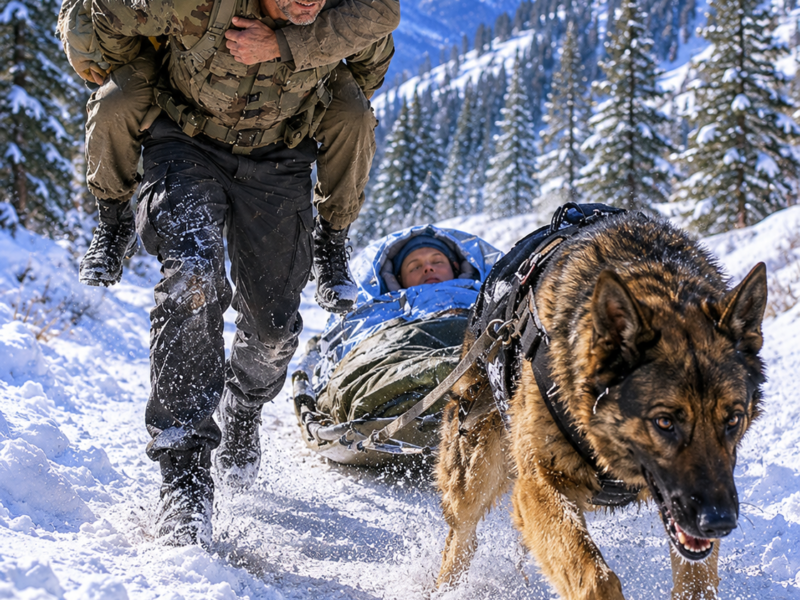
““Please, don’t leave us out here,” the old woman begged, clutching her husband’s frozen hand as the blizzard swallowed the roadside
The man behind my truck stepped into the headlights.
He wore a dark winter coat and held a phone against his ear.
He didn’t look like someone who had just stumbled upon two stranded elderly people.
He looked like someone who had been following them.
“Jack,” Robert whispered, “please. Drive.”
I looked at the black device in my hand.
Then at the old man beside me.
“Who is that?”
Robert swallowed.
“His name is Victor Shaw. He works for the company that handled our unit’s equipment after we returned from Afghanistan.”
“Why is he following you?”
“Because I have something that belongs to him.”
His wife, Margaret, leaned forward from the passenger seat.
“Robert, tell him everything.”
Robert closed his eyes.
“I will. But not here.”
Bear stood between Robert and the rear door, his body rigid.
His ears were pointed toward the stranger.
I had seen that posture before.
It meant Bear sensed danger.
I started the engine.
The man behind us raised his free hand.
“Mr. Miller! We need to talk!”
I didn’t answer.
I shifted into gear and pulled away.
The man stepped back just before my truck passed him.
In the mirror, I saw him raise his phone again.
“He’s calling someone,” Margaret said.
“Let him.”
I drove toward the nearest hospital.
Robert grabbed my sleeve.
“No hospital.”
I looked at him.
“You’re suffering from hypothermia. You don’t get to negotiate about medical care.”
“Jack, listen. If they identify us, they’ll know where the device is.”
“Then tell me what it is.”
He stared at the small black object in my palm.
“An encrypted storage unit. It contains copies of records from an operation six years ago.”
“The operation where Daniel died?”
Robert nodded.
My grip tightened.
“Tell me what happened to my brother.”
He looked down.
“I owe you that.”
I kept driving.
But I didn’t take the road toward the hospital.
I turned toward a small emergency clinic outside the town.
It was staffed overnight, and I knew the physician on duty.
Dr. Helen Morris had treated veterans for years.
She knew how to keep a patient safe without asking unnecessary questions.
I called her through the truck’s hands-free system.
“Helen, I need you to prepare for two elderly patients with severe cold exposure.”
“How severe?”
“One may have hypothermia. The other is conscious but exhausted.”
“Bring them in immediately.”
I hesitated.
“And Helen?”
“Yes?”
“Don’t discuss their arrival with anyone until I’ve spoken to you.”
There was a pause.
“Understood.”
When we arrived, two nurses were waiting.
They brought a wheelchair and a stretcher.
Robert tried to stand.
His legs gave way.
Bear moved closer, whining softly.
“Easy, boy,” I said.
Robert looked at him.
“That’s not Scout.”
“No. His name is Bear.”
Robert slowly touched his head.
“He’s got the same eyes.”
I felt something tighten in my chest.
“How did you know my brother’s dog?”
Robert looked at me.
“Because I was there when Scout disappeared.”
The nurses took him inside.
Margaret caught my hand before they wheeled her away.
“Please don’t let him leave without telling you.”
“I won’t.”
She looked toward Bear.
“Your brother would have liked him.”
Then she disappeared behind the clinic doors.
I remained in the waiting room.
Bear lay beside my boots, but his ears never relaxed.
I examined the device Robert had given me.
It was a small black storage unit with a scratched metal casing.
There was a tiny strip of tape on the back.
Four characters had been written on it.
D-17.
I knew the designation.
Daniel had used it in letters home.
He’d once joked that D-17 was the only place in the world where he could get a decent cup of coffee.
I’d assumed it was a nickname for a tent or a supply station.
Now I wondered whether it meant something else.
An hour later, Dr. Morris came out.
“Robert is stable, but his body temperature was dangerously low. We’re warming him gradually and monitoring his heart.”
“And his wife?”
“Exhausted and dehydrated. She’ll be all right.”
“Can I see them?”
“One at a time. And don’t keep them awake.”
I entered Robert’s room.
He looked smaller beneath the hospital blankets.
Without his coat and beard, I could see the man I’d known from photographs.
Sergeant First Class Robert Hayes.
Daniel’s commanding officer.
The man who had written the report stating that my brother had died during an enemy attack.
The same report that said Scout had been lost in the explosion.
I stood beside the bed.
“You have ten minutes.”
Robert nodded.
“Fair enough.”
“Start talking.”
He took a slow breath.
“Six years ago, our unit was assigned to secure a supply route near a small village. We were told the shipment contained medical equipment and emergency supplies.”
“That was the official mission.”
“Yes.”
“What was really happening?”
Robert stared at the ceiling.
“Some of those crates contained weapons. They were being moved under false inventory records.”
I felt my jaw tighten.
“Who ordered it?”
“At the time, I didn’t know. I only knew the shipment was wrong.”
“Daniel found out?”
“He noticed the serial numbers didn’t match. He was responsible for checking the equipment before it entered our convoy.”
I remembered my brother.
Daniel had always been meticulous.
He checked everything twice.
Even when everyone else was exhausted, he would insist on reading every label.
Robert continued.
“He photographed the crates and copied the records. He told me he intended to report it.”
“Did you stop him?”
“No.”
“Did you help him?”
Robert looked away.
“I should have.”
The answer made me angrier than an excuse would have.
“What happened during the operation?”
“Our convoy was attacked before we reached the extraction point. The first explosion hit the lead vehicle. Daniel was thrown into the ditch.”
“Was he alive?”
“Yes.”
My throat tightened.
“How long?”
“Long enough to talk to me.”
I closed my eyes.
Robert’s voice cracked.
“He told me to get the evidence out. He said the people behind the shipments knew we had found something.”
“Then what?”
“I moved him behind a concrete barrier. Scout stayed with him.”
I stared at the old soldier.
“Why did the report say Daniel died in the explosion?”
“Because I was ordered to write it that way.”
“By whom?”
“Victor Shaw’s employer.”
I took a step closer.
“Who is that?”
“Northstar Defense Logistics. They had a contract to manage the supply shipments.”
“You’re telling me a private contractor controlled the official report of a military operation?”
“No. I’m telling you someone inside the command structure helped them.”
I thought about the man behind my truck.
“And Victor?”
“Victor was their security liaison. He handled the investigation after the attack.”
“Why would he want the device?”
“Because the records show where the weapons went, who approved the shipments, and who received the payments.”
I looked at the device again.
“Then why didn’t you give it to investigators six years ago?”
Robert’s eyes filled.
“Because I was afraid.”
The honesty silenced me.
He looked toward the window.
“After Daniel was wounded, I was ordered to leave the area with the surviving team members. Scout wouldn’t leave him. I tried to pull him away, but he fought me.”
“What happened to Daniel?”
Robert swallowed.
“He was evacuated by another unit. I was told he died during transport.”
I shook my head.
“That’s not what the official record says.”
“I know.”
“Then why didn’t you correct it?”
“Because the next day, I was shown photographs of my wife and daughter leaving our house. They told me if I spoke, my family would pay.”
My anger didn’t disappear.
But it changed.
“Did you believe them?”
“I had no choice.”
“You always have a choice.”
Robert nodded slowly.
“You’re right.”
He looked at me.
“I’ve told myself that for six years.”
I wanted to believe him.
I also wanted to believe he had done more for my brother.
“Where did you get this device?”
“Daniel gave it to me before the evacuation. He said Scout would know what to do with it.”
I stared at him.
“Scout was listed as killed.”
Robert shook his head.
“Scout survived.”
I felt my breath catch.
“What?”
“After Daniel was evacuated, Scout disappeared. We searched for him, but the area was under attack. Later, I learned a local medical team had taken him.”
“Then why was he never returned?”
“Because someone made sure there was no official record of his recovery.”
I looked down at Bear.
For a moment, I imagined Scout standing beside Daniel again.
A dog who had waited for a man who never came back.
“How did you find out?”
“Years later, I received a photograph from someone who had worked at the field clinic. It showed Scout with a different handler. I recognized the scar on his shoulder.”
“Where is he now?”
Robert looked toward the door.
“I don’t know.”
I stared at him.
“Then why did you call Bear by that name?”
Robert hesitated.
“Because when I saw him tonight, I thought…”
He stopped.
“What?”
“His collar.”
I looked down at Bear’s collar.
It was an old military-style collar I’d bought when I adopted him.
There was nothing unusual about it.
Robert shook his head.
“Never mind. I was confused.”
I didn’t like that answer.
“Tell me what you know.”
He slowly raised one hand.
“Daniel gave Scout something before the evacuation. A small metal tag. He said it would help identify the original shipment records.”
“Where is it?”
“That’s what I never found out.”
I stared at him.
“Why didn’t you tell me this before?”
“Because I didn’t know whether the dog you brought was connected to the one I remembered.”
I looked at Bear again.
He was resting his head on his paws.
His eyes were open.
And for the first time, I noticed a small faded mark beneath his collar.
A narrow line of scar tissue.
I gently lifted the collar.
The scar curved behind his right ear.
My stomach tightened.
I had seen that mark before.
In the old photographs of Scout.
I turned back to Robert.
“Are you saying Bear might actually be Scout?”
Robert nodded.
“I don’t know. But I think you should have him examined by someone who can compare his military identification records.”
I didn’t answer.
Bear had been with me for four years.
I’d adopted him through a veterans’ service organization after he was retired from a working-dog program.
His paperwork listed him as a German Shepherd named Bear.
No previous military deployment was mentioned.
I’d never questioned it.
Now I had to.
I left Robert’s room and called the organization that had arranged his adoption.
A woman named Denise answered.
She remembered Bear.
When I explained the photograph and the scar, she asked me to hold.
A few minutes later, she returned.
“Jack, I reviewed his intake records. There’s something unusual.”
“What?”
“His original transfer file was incomplete. The dog arrived with a replacement identification number, and the previous handler field was blank.”
“Why?”
“We were told the records had been damaged during a transfer.”
“Can you send me a copy?”
“Yes. But there may be a delay.”
“Please do it tonight.”
I ended the call.
Then I looked at the device.
I had a feeling the two mysteries were connected.
By midnight, the clinic had become unusually quiet.
Margaret was resting in a separate room.
Robert was stable.
I sat beside Bear in the waiting area, trying to make sense of everything.
A nurse brought me coffee.
I barely touched it.
Then my phone vibrated.
An unknown number.
I answered.
“Mr. Miller?”
A man’s voice.
“Who is this?”
“You need to return what Robert Hayes gave you.”
I stood.
“Who are you?”
“Someone trying to prevent you from making a mistake.”
“Then explain the mistake.”
“You don’t understand what you’re holding.”
“Then explain it.”
The man sighed.
“Your brother was involved in something much larger than a shipment diversion. The files could damage people who have nothing to do with his death.”
“That’s convenient.”
“Listen carefully. Bring the device to the old rail depot tomorrow morning. Come alone.”
I looked at Bear.
“Why should I?”
“Because if you don’t, the old man and his wife won’t be the only people in danger.”
The call ended.
I stared at the phone.
Then I called Marcus, a former military investigator I trusted.
He had left the service two years earlier and now worked in a civilian oversight office.
I explained the situation.
He listened without interrupting.
When I finished, he said, “Don’t go anywhere alone.”
“I wasn’t planning to.”
“Good. And don’t connect that device to a regular computer.”
“I haven’t.”
“Keep it secure. I’ll come to you.”
Before hanging up, he asked one question.
“Did the caller identify himself?”
“No.”
“Then assume he was recording you.”
I looked toward Robert’s room.
“Marcus, I think Daniel may have been alive after the attack.”
There was a long silence.
“That’s a serious possibility.”
“I need to know.”
“Then we start with the original medical evacuation records.”
At 7:15 the next morning, Marcus arrived with a small evidence case and a second investigator.
He examined the device without opening it.
Then he studied the adoption paperwork Denise had sent.
His expression changed.
“Jack, look at this.”
He pointed to the original transfer number.
A series of letters and digits.
The final four characters were D-17.
I felt my heart pound.
“That’s the code on the device.”
Marcus nodded.
“This dog may have been transferred through the same program that handled the original mission records.”
He looked at Bear.
“Where did you adopt him?”
I told him.
Marcus made a call.
Twenty minutes later, he had confirmation.
Bear’s original military identification number had been changed after he was recovered from the field clinic.
His former name was Scout.
His last assigned handler was Sergeant Daniel Miller.
My brother.
I sat down.
For four years, I’d been calling him Bear.
And for four years, the dog who had once stood beside my brother had been sleeping at my feet.
Marcus placed a hand on my shoulder.
“I’m sorry.”
I looked at the dog.
He lifted his head when I said his old name.
“Scout.”
His ears rose.
Then he came over and pressed his muzzle against my chest.
I couldn’t hold back the tears.
I buried my face in his fur.
“You came home,” I whispered.
Scout licked my hand.
And suddenly I understood why Robert had reacted the way he had.
He hadn’t just recognized a familiar dog.
He’d recognized the last living connection to Daniel.
But the revelation raised another question.
If Scout had survived, why had he been sent to me under a different name?
Marcus found the answer in a transfer note.
The dog had been relocated after the clinic reported that he repeatedly refused to leave the recovery ward where Daniel had been treated.
When Daniel was moved to another facility, Scout had become distressed.
The staff believed he was suffering from prolonged separation.
A transfer officer recommended retirement and placement with a veteran family.
The paperwork had been deliberately altered to conceal his connection to the original operation.
Someone had wanted Scout out of the official records.
Someone had also wanted the device.
I looked at Marcus.
“We need to find out what happened to Daniel.”
He nodded.
“I’ve already requested the archived medical records.”
“How long?”
“Could take days.”
“We don’t have days.”
He looked toward the waiting room.
“Then we ask Robert.”
I returned to his room.
He was awake.
Margaret sat beside him, holding his hand.
I placed the adoption file on the table.
Robert read the first page.
His face crumpled.
“That’s Scout.”
“Yes.”
He looked toward the doorway.
The dog was standing beside me.
Robert began to cry.
“Daniel would have been glad.”
I let him reach out.
Scout approached slowly.
He sniffed Robert’s hand, then rested his head against it.
Robert closed his eyes.
“I’m sorry, old friend.”
I stood beside the bed.
“Now tell me where Daniel was taken.”
Robert opened his eyes.
“The first evacuation point was a field hospital outside the valley. But he was transferred later.”
“Where?”
“To a medical facility operated under a separate contractor.”
“Which one?”
“Northstar.”
I felt anger rise again.
“They controlled the medical records too?”
“They controlled the transport contract.”
Marcus stepped closer.
“Do you remember the facility’s location?”
Robert nodded.
“Near Kandahar. A private medical compound. It was listed as a temporary rehabilitation center.”
“Was Daniel treated there?”
“I saw a transport manifest. His name was on it.”
“Then what happened?”
Robert looked down.
“Two weeks later, his name disappeared.”
Margaret squeezed his hand.
“That’s when we started asking questions.”
“And that’s when they threatened you?”
“Yes.”
I looked at Marcus.
“We need those records.”
He nodded.
“I’ll contact the federal prosecutor.”
Before he could make the call, Robert spoke again.
“There’s something else.”
He looked at me.
“Daniel left a message. Not the recording on the device. A message for you.”
My throat tightened.
“What did he say?”
Robert reached beneath his pillow and pulled out a small envelope.
The paper was old and worn.
My name was written across the front.
I recognized Daniel’s handwriting immediately.
I opened it carefully.
Jack,
If this reaches you, I need you to know I didn’t abandon the mission.
I found proof that the shipments were being used to finance a private network operating outside official oversight.
I tried to report it.
When the attack happened, I knew they would make sure the records disappeared.
I gave Scout the identification tag because he was the only one I trusted to stay with the truth.
If Robert gets this to you, believe him.
He made a mistake, but he didn’t betray us.
I need you to take care of him and Margaret if I can’t come home.
And don’t spend your life thinking you should have been there.
You were where you were supposed to be.
I read the last line again.
Then again.
My vision blurred.
For six years, I’d blamed myself for not being beside my brother.
I’d imagined a thousand ways I could have saved him.
But Daniel had known what I would do to myself.
He had tried to stop me from carrying that guilt.
I folded the letter carefully.
“Where did you keep this?”
Robert looked at me.
“Inside my coat. I carried it for six years.”
“Why didn’t you send it?”
“Because I was afraid they’d intercept it. And because I couldn’t face you.”
I nodded slowly.
“I don’t forgive you yet.”
Robert lowered his eyes.
“I understand.”
“But I believe Daniel.”
He looked up.
That was enough for now.
Marcus called the prosecutor.
Within hours, an emergency investigation was underway.
The device was transferred under documented chain of custody.
The original shipment records were authenticated.
A team of investigators began tracing the medical transport contracts.
And the rail depot meeting was never allowed to happen.
Instead, federal agents arranged a controlled operation at the depot.
Victor Shaw arrived with two associates, expecting to receive the device.
He was met by investigators carrying a warrant.
He tried to leave.
He didn’t get far.
The records recovered from his office showed that he’d coordinated the false shipment reports and arranged the intimidation of Robert and Margaret.
His messages also revealed that he had known Scout survived.
He had been the one who approved the dog’s transfer under a false identity.
The reason was chillingly simple.
Scout’s identification tag contained a reference to the original shipment ledger.
Victor believed the dog had been carrying it.
He’d spent years trying to find the missing record.
But the tag was not the only evidence.
The device contained a copy of the original ledger, along with photographs and communications linking Northstar executives to the diverted shipments.
More importantly, it contained a recording made after Daniel was injured.
His voice was weak.
But he was unmistakably alive.
“I need this recorded,” he said. “My name is Sergeant Daniel Miller. I was wounded during the operation on the eastern supply route. The shipment records were altered before the attack. I have identified the individuals responsible.”
There was a pause.
Then another voice.
A medical officer.
“Sergeant, you need to rest.”
Daniel answered.
“I’ll rest when this is safe.”
The recording ended.
The investigation established that Daniel had been transferred to the contractor-operated facility after his initial evacuation.
He had received treatment there.
But his records were later manipulated.
He was moved again under an administrative identity.
The contractor’s records had falsely listed him as deceased.
That was why no official record of his recovery had reached our family.
For six years, we had believed he died during the attack.
The truth was more complicated.
Daniel had survived for several weeks.
He had been held at the facility while the people behind the shipment scheme tried to locate the missing evidence.
He had refused to cooperate.
He had refused to identify the source who had helped him.
And he had died from complications of his injuries before the investigation could reach him.
There was no secret escape.
No hidden rescue.
No miraculous second chance.
Just a wounded soldier who had fought to keep the truth alive until his body could no longer carry him.
When the prosecutor told me, I sat in silence.
I had wanted a different answer.
I had wanted to hear that Daniel had been waiting somewhere.
That I could still walk into a room and find him.
But the truth was the truth.
He had suffered.
He had been failed.
And he had still found a way to send something home.
The people responsible were eventually charged.
Northstar’s senior executives faced federal prosecution.
Several former officials were indicted for falsifying records and obstructing the investigation.
Robert agreed to testify.
He told the truth about the threats, the altered reports, and his own failure to speak sooner.
He never tried to make himself a hero.
At the hearing, he admitted that fear had kept him silent.
He also explained how Daniel had entrusted him with the evidence.
When the prosecutor asked why he had finally come forward, Robert looked toward the back of the courtroom.
I was sitting there with Margaret.
Scout lay quietly at my feet.
Robert said, “Because a promise shouldn’t expire just because the person who made it is gone.”
I lowered my head.
For the first time, I understood that Robert had not come through the blizzard only to ask for help.
He had come to finish something he had carried for six years.
And he had nearly died trying.
After the hearing, he approached me.
He looked older than he had in the hospital.
But his eyes were clearer.
“I don’t expect you to forgive me,” he said.
“I know.”
“I should have found you sooner.”
“Yes.”
He nodded.
“I’ll live with that.”
I looked at Margaret.
She was holding his arm.
Then I looked at Scout.
The dog sat between us.
I took a breath.
“Daniel trusted you with his last message.”
Robert’s eyes filled.
“He did.”
“I’m not going to pretend you made the right choices every time.”
“I know.”
“But you came back and told the truth.”
Robert nodded.
I held out my hand.
He stared at it for a moment before taking it.
It wasn’t a complete forgiveness.
It wasn’t a return to the past.
But it was a beginning.
Winter slowly gave way to spring.
Robert and Margaret recovered in a small veterans’ residence outside Colorado Springs.
They had lost their home during the years they spent moving from place to place.
Their savings had been drained by medical bills and legal expenses.
A local veterans’ organization helped them find a modest apartment.
I visited every weekend.
Scout always came with me.
At first, Robert couldn’t stop looking at him.
Sometimes he’d sit in the garden and talk to the dog about Daniel.
He told him stories I had never heard.
How Daniel used to share his rations with stray animals.
How he could never remember where he put his gloves.
How he once spent an entire night repairing a broken radio because he refused to let his team go without communication.
I learned things about my brother that no official report could have told me.
Margaret became close to Scout too.
She brought him small treats and knitted a blanket for his bed.
One afternoon, she handed me a photograph.
It showed Daniel kneeling beside Scout in Afghanistan.
His arm rested across the dog’s back.
Both were looking toward the camera.
Daniel was smiling.
Not the polite smile he used for family photographs.
A real one.
On the back, he’d written:
Two stubborn souls. Neither knows when to quit.
I laughed through the tears.
I framed the photograph and placed it beside the letter.
Months later, the military held a memorial ceremony recognizing Daniel’s service and the evidence he had preserved.
Robert attended in his old uniform.
Margaret wore a blue dress.
I stood beside them with Scout at my left.
The ceremony was simple.
There were no dramatic speeches.
No attempt to turn tragedy into something neat.
An officer read Daniel’s commendation.
Then he acknowledged Scout’s role in preserving the evidence that helped reopen the investigation.
A small medal was presented in his name.
I knelt and fastened it to Scout’s collar.
The old dog stood still.
His muzzle had turned almost completely gray.
His movements were slower.
But when I said Daniel’s name, his ears lifted.
I leaned close.
“You did good, partner.”
Scout rested his head against my shoulder.
After the ceremony, a young soldier approached me.
He had been assigned to a military working-dog unit.
He looked at Scout with admiration.
“Sir, is he really the dog from the operation?”
“Yes.”
“How did he know where to find the evidence?”
I looked at the old photograph in my hand.
Then at Scout.
“I don’t think he knew where the evidence was.”
The soldier frowned.
“Then what did he know?”
I smiled.
“He knew who needed help.”
That evening, Robert and Margaret came to my house for dinner.
For the first time, nobody looked over their shoulder.
Nobody checked the road before opening the door.
Nobody worried about a strange vehicle parked across the street.
We sat at the table and talked about ordinary things.
The weather.
The garden.
The neighbors.
Margaret laughed when Robert complained about the television remote.
Scout slept beside my chair.
At one point, Robert raised his glass.
“To Daniel.”
I raised mine.
“To Daniel.”
Margaret added softly, “And to the ones who kept his promise.”
We drank.
Later, after they left, I took Scout outside.
The night was clear.
The air was cold, but not cruel.
He walked slowly across the yard and settled beside the porch steps.
I sat next to him.
For a long time, we watched the stars.
I thought about the blizzard.
About two people freezing beside an empty gas station.
About the small black device pressed into my hand.
About the photograph that had brought six years of silence crashing into one night.
I had stopped because Bear had barked.
I had thought I was rescuing two strangers.
Instead, I had found my brother’s final message.
And I had brought home a part of him I never knew I’d lost.
Scout rested his head on my knee.
I scratched behind his ears.
“You can rest now, old friend.”
His eyes closed.
For the first time in years, I didn’t feel like I was waiting for something terrible to happen.
I felt at peace.
Daniel had not come home.
But his truth had.
And the dog who had carried it through the darkness was finally home, too.
The end.









