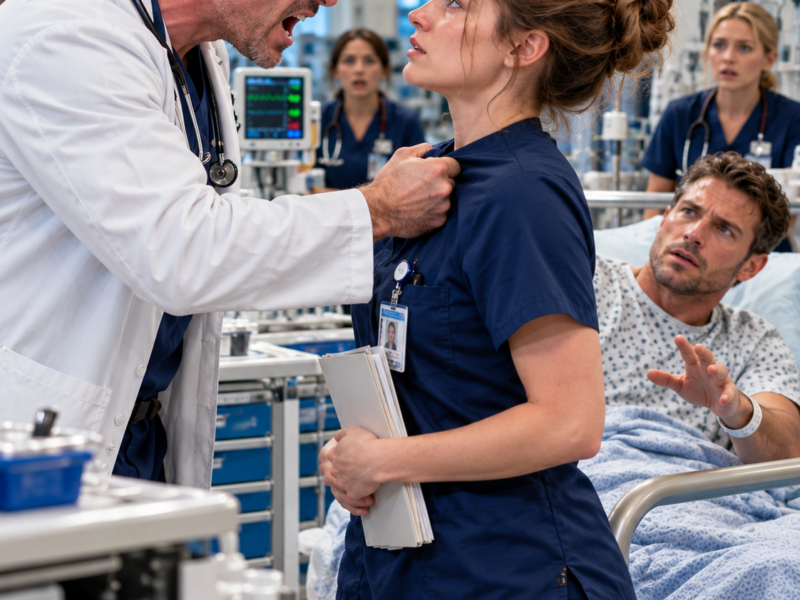
“Move, b*tch!” Dr. Richard Hayes shouted, shoving the quiet nurse away from the trauma bed
The man outside the trauma bay reached inside his jacket.
I recognized the movement before I recognized the danger.
Six years ago, I had watched men reach for weapons in the same way—slowly enough to look harmless, deliberately enough to make sure everyone noticed.
“Security!” I shouted.
The nearest guard turned toward the glass doors.
The stranger pulled out a phone instead of a gun, raised it toward the room, and took a photograph.
Then he smiled at me.
I knew that smile.
Not because I had met him before, but because it belonged to someone who believed the world had already been arranged in his favor.
Mason Cole caught my wrist.
“Don’t let them take the case.”
“What case?”
“The one you kept.”
My heart seemed to stop.
I hadn’t spoken about that case in six years.
I hadn’t even admitted to myself that I still had it.
Behind us, Dr. Richard Hayes was ordering the staff to clear the room. He looked furious that the patient had recovered without his permission and even more furious that everyone had witnessed it.
“Carter,” he snapped, “step away from the bed. Hospital security will handle the men outside.”
“No,” Mason whispered.
Hayes turned sharply.
“You’re a patient. You don’t give orders here.”
Mason forced himself to sit a little higher, grimacing as pain crossed his face.
“Then let me give you a warning.”
He looked straight at Hayes.
“If those men get into this room, you’re going to wish you had listened to her.”
The doctor gave a dismissive laugh.
“I’m done with this nonsense.”
He strode toward the door.
I moved to block him.
“Don’t open it.”
His face reddened.
“You’ve embarrassed me in front of my own staff, endangered my patient by acting outside your authority, and now you’re trying to tell me how to run my department?”
“I’m telling you that two unidentified men are watching this room, one of them has been photographing a patient, and neither has identified himself.”
“That’s what security is for.”
“Then let security verify them before anyone opens the door.”
For once, the room didn’t fall silent because Hayes had shouted.
It fell silent because the people around us were beginning to understand that I wasn’t afraid of him.
I was afraid of something else.
Something that had followed me from a place I had spent six years trying to forget.
The security supervisor arrived with two officers and ordered the men to step away from the glass.
One complied.
The other turned and walked toward the elevators.
“Stop!” the supervisor called.
The man broke into a run.
One officer pursued him while the other detained his companion near the nurses’ station.
The detained man didn’t resist. He simply smiled and asked for a lawyer.
When security searched him, they found no weapon.
They did find a visitor badge bearing a false name, three disposable phones, and a folded piece of paper with my full name written on it.
Underneath it were five words.
SHE STILL HAS THE ORIGINAL.
My hands went cold.
Mason saw my expression.
“You know what they’re looking for,” he said.
I swallowed.
“Yes.”
“Then it’s time you tell me the truth.”
I glanced at the staff gathered around us. The resident was pretending to check the medication cart, but he was listening. The nurses were exchanging worried looks. Hayes stood near the foot of the bed, his anger gradually giving way to suspicion.
“Not here,” I whispered.
Mason nodded.
“Then find us somewhere safe.”
I asked the charge nurse to arrange a monitored room and requested that hospital security document every person who had entered the trauma area. Mason’s condition was stable enough for a careful transfer, but he needed close observation and further imaging.
Hayes objected when I insisted on waiting for security clearance.
“This is a hospital, not a military compound.”
“Then you shouldn’t have unidentified people trying to access a trauma patient.”
“I’m the attending physician.”
“And I’m the nurse who recognized that he was dying while you were too busy shouting to listen.”
The words landed harder than I intended.
His face tightened.
For a moment, I thought he would have me removed anyway.
Then the resident stepped forward.
“She was right about the pneumothorax, Doctor. The ultrasound confirmed it. If we’d waited for your preferred procedure, he might not have survived.”
Hayes looked at him with cold disbelief.
“You’re making a serious professional accusation.”
“No,” the resident said, his voice shaking. “I’m describing what happened.”
That was the first time anyone in the room had openly challenged Hayes.
It would not be the last.
Mason was transferred under observation to a secured room on the surgical floor. His injuries were serious, but his breathing had improved, and the trauma team believed he had a reasonable chance of recovery.
I stayed beside him until the new nurse completed the handoff.
Then I closed the door.
Mason looked at me.
“Now tell me.”
I pulled a chair beside his bed.
“My name is Emily Carter. I served as a Navy SEAL combat medic. Six years ago, I was attached to a small team operating overseas. We lost three people during an extraction that should never have failed.”
“I know.”
“No. You know part of it.”
I stared at my hands.
“Our team leader was Lieutenant Daniel Mercer. Our communications specialist was Petty Officer Nathan Brooks. Our intelligence liaison was Chief Aaron Bell. They were good men. They trusted the people who sent us into the field.”
“And you?”
“I trusted them too.”
I could still hear the radio crackling in my headset.
The shouting.
The static.
The sudden silence after the last transmission.
We had been sent to recover a source who claimed to possess evidence of an illegal weapons pipeline. Our orders were simple: reach the source, secure the intelligence, and extract before the opposing force could close in.
But the route changed after we were already moving.
The revised coordinates directed us through a narrow valley where our vehicle column was exposed from both sides.
We came under fire before we reached the second checkpoint.
Daniel Mercer was hit while helping Nathan drag a wounded operator behind cover. Aaron Bell tried to call in an emergency extraction, but the radio kept receiving new instructions from command.
The instructions contradicted one another.
I treated the wounded while Daniel demanded clarification.
Then the voice on the radio issued a final order.
ABANDON THE SECONDARY POSITION. PROCEED TO THE PRIMARY LANDING ZONE.
Three of our people were still alive at the secondary position.
We followed the order.
The extraction aircraft lifted off with the survivors we could reach.
We left the others behind.
The official report said enemy surveillance had compromised the route. It described the failed extraction as an unavoidable consequence of rapidly changing battlefield conditions.
I signed the statement confirming the sequence of events.
I had not signed because I believed it.
I had signed because an investigator told me the raw communications were being preserved, and that speaking publicly before the review concluded could compromise an operation still underway.
By the time I realized the original transmissions were missing, the investigation had been closed.
I resigned from active service the following year.
I told everyone I wanted a quieter life.
The truth was that I couldn’t stand the sound of a radio anymore.
Mason listened without interrupting.
When I finished, he asked, “What was the original?”
I looked toward the locked cabinet beside the bed.
“An encrypted field recorder. It captured the original transmission and the routing data before the extraction order changed.”
“You kept it?”
“I recovered it from our equipment after the operation. It was damaged, but I managed to preserve the storage unit. I was told to surrender everything. I handed over the standard equipment and reported the recorder as destroyed.”
“Why?”
“Because the report had already been altered. I didn’t know who was involved, and I didn’t trust the people asking for it.”
I had hidden the recorder inside a small metal case and taken it home. Over the years, I had moved it twice. I never connected it to a computer, never tried to decode it, and never showed it to anyone.
I told myself it was insurance.
I also told myself I would never need it.
Mason shut his eyes.
“You shouldn’t have carried that alone.”
“I didn’t have a choice.”
“You always had a choice. You just didn’t know who you could trust.”
The words stung because they were true.
I stood and walked to the window.
“Why are you here, Mason? And don’t tell me it’s just because of the crash.”
He was silent for a long moment.
Then he said, “I found something in the mission archive.”
I turned.
“What?”
“An old communications audit. I was reviewing it for a separate security inquiry when I noticed the same routing identifier appearing in two different operations. One of those operations was ours.”
My pulse quickened.
“What was the identifier?”
“RAVEN-12.”
I felt the name like a blow.
RAVEN-12 had been the internal tag on the revised extraction order. I remembered it because Daniel had repeated it twice over the radio, asking why the instruction had appeared without a corresponding command confirmation.
The official report had omitted the tag entirely.
“Where did you find the audit?”
“In a restricted archive. The file had been accessed three weeks ago by an account belonging to a civilian contractor named Victor Sloane.”
“Who is he?”
“Former communications systems engineer. He worked for a defense contractor that maintained the routing platform used by our command center.”
I sat down again.
“Does he know you found it?”
“I don’t know. But a week later, someone followed me home. Then my vehicle’s brake warning system began acting strangely. I took it to a mechanic. He found a damaged sensor but couldn’t determine whether it was deliberate.”
“And you still drove here alone?”
“I wasn’t coming here alone. I was trying to reach you before the people behind the audit realized I knew your name.”
I stared at him.
“You could have called.”
“I did.”
My mouth went dry.
“When?”
“Three times. The first call went to a hospital switchboard. The second reached your old service number, which had been disconnected. The third went to a voicemail box that played your name and then cut off.”
I had never received any of those calls.
“Someone redirected them,” I whispered.
“That’s what I thought.”
The hospital phone rang.
We both turned toward it.
The nurse at the station answered, listened, then knocked on the door.
“Emily? There’s a call for you from someone claiming to be a federal investigator. He says it’s urgent.”
“What’s his name?”
“Victor Sloane.”
Mason and I looked at each other.
I signaled for the nurse not to transfer the call yet.
“Ask him for his agency and badge number,” I said. “Then verify them through the official directory. Don’t use any number he provides.”
The nurse nodded and stepped away.
Mason looked troubled.
“Why would Sloane call you directly?”
“Maybe he wants the recorder.”
“Or maybe he wants to know whether you still have it.”
We waited.
Two minutes later, the nurse returned.
“The badge number belongs to someone else. The agency says no one by that name has been assigned to this hospital.”
I felt the old instinct return—the cold clarity that came when every exit became a potential threat.
“Thank you,” I said. “Please tell security. No more calls get transferred to this room without verification.”
After she left, Mason lowered his voice.
“The recorder is the only thing they don’t control.”
“Maybe. But even if it contains the original transmission, we need a way to authenticate it.”
“The audit might help.”
“Then we need both.”
He reached for the water cup, but his hand shook. I steadied it for him.
For a moment, neither of us spoke.
Then Mason asked, “Why did you leave the service without telling anyone what happened?”
I could have given him the safe answer.
Instead, I told him the truth.
“Because every time I tried to explain what happened, I heard the radio again. I heard Daniel asking for permission to return for the others. I heard the order telling us to leave. And I heard myself saying that I understood.”
My voice broke on the last word.
“I could treat the wounded. I could keep people alive. But I couldn’t make myself believe that I had done the right thing.”
Mason watched me with quiet understanding.
“You didn’t make that order.”
“I obeyed it.”
“You were a medic in the field. You were receiving instructions from a command channel you had every reason to believe was legitimate. The people who changed the route knew exactly how to exploit that trust.”
“Knowing that doesn’t bring them back.”
“No,” he said. “But telling the truth might stop someone else from ending up where they did.”
For the first time in six years, I allowed myself to consider that possibility without immediately pushing it away.
Then the lights flickered.
Once.
Twice.
The room went dark.
The emergency lights came on a second later, bathing the walls in dim red.
An alarm sounded somewhere down the corridor.
Mason tried to sit up.
“Stay down,” I said.
“Emily, look at the monitor.”
His heart rate was climbing.
I checked his oxygen supply and the bedside equipment. Everything appeared connected, but the monitor’s display had frozen.
A second later, the door handle moved.
Someone tried it from the outside.
I stepped between the door and the bed.
“Who is it?”
No answer.
The handle moved again.
Then came three soft knocks.
“Hospital security,” a man’s voice called. “We need to transfer the patient.”
“Identify yourself.”
“Emergency protocol. Open the door.”
“Give me your name and badge number.”
Silence.
Mason’s eyes met mine.
I moved toward the bedside phone, but it was dead.
The handle jerked violently.
A heavy impact struck the door.
Mason reached beneath his blanket and pulled out a small black device.
“What is that?” I whispered.
“Personal emergency beacon. It has its own transmitter.”
He pressed the button.
A tiny light began to flash.
The person outside struck the door again.
I moved the crash cart into position, wedging it against the handle. Then I called out loudly enough for the corridor cameras to capture my voice.
“This room is occupied by a critical patient. Security has been notified. Step away from the door.”
The impact stopped.
Footsteps moved away.
For several seconds, I didn’t move.
Then the power returned, and the monitor rebooted.
Mason’s heart rate slowly came down.
I checked his breathing, his pulse, and the equipment. The interruption had lasted less than a minute, but it had been long enough to make one thing clear.
Someone had access to the hospital’s systems.
Someone knew exactly where we were.
And someone wanted the recorder badly enough to risk an assault inside a crowded medical center.
When security finally arrived, they found the corridor empty. The camera feed from the relevant hallway had been interrupted for forty-seven seconds. The electronic access logs showed a staff badge had opened the door to the floor, but the badge belonged to a nurse who had been working in another wing.
She swore she had never left her station.
Security escorted her to the supervisor’s office, not as a suspect but as a potential victim of stolen credentials. The hospital initiated a formal incident response and contacted local law enforcement.
I knew better than to assume the threat had ended.
The next morning, Mason’s condition improved enough for a short, supervised conversation with an investigator.
The investigator arrived with a hospital security officer and presented credentials that were verified independently. Her name was Special Agent Rebecca Sloan.
I recognized her immediately.
Six years earlier, she had been the junior investigator assigned to the review of our failed extraction. She had asked questions the senior investigators didn’t want to answer. Then, without explanation, she had disappeared from the case.
She looked older now, with gray beginning to show at her temples, but her gaze was just as direct.
“Emily Carter,” she said. “It’s been a long time.”
“You were removed from the investigation.”
“I was told to stop asking questions.”
“Did you?”
“No.”
She placed a folder on the table.
“Three weeks ago, I learned that the original routing server had been accessed. The access trail led to Victor Sloane, a contractor who worked on the system. When I attempted to interview him, he vanished.”
Mason shifted in bed.
“He called the hospital last night.”
Sloan’s expression sharpened.
“What did he say?”
“He claimed to be a federal investigator. His credentials didn’t match.”
“Then he’s getting desperate.”
I folded my arms.
“Why should we trust you?”
“You shouldn’t trust me because of my title,” she said. “You should trust the evidence I can show you, and you should verify every step we take.”
She opened the folder and slid a printed record toward us.
It showed an access log from the routing system, dated the night our team was lost.
The route change had been entered under a command authorization code. But the audit trail showed the request originated from a civilian terminal assigned to Sloane’s former contractor, not from the military command center.
A second record showed the authorization had been approved using a credential linked to a senior official named Malcolm Shaw.
I knew that name.
Shaw had chaired the review that closed our investigation.
“Who is Victor Sloane working for now?” I asked.
“We don’t know yet. His former employer says his contract ended four years ago. But financial records show payments to a company registered under a different name. That company has received money from a network of shell entities.”
“Can you connect those payments to Shaw?”
“Not conclusively. Not yet.”
Mason stared at the log.
“The route was changed before we reached the valley.”
“Yes,” Sloan said. “The timing suggests someone knew where your team would be and when you would arrive.”
I felt the old guilt rise again, but this time it had something solid beneath it.
Evidence.
“There’s an encrypted recorder,” I said. “I kept it after the operation. It may contain the original transmission.”
Sloan didn’t reach for the folder. She didn’t ask where I had hidden it.
Instead, she leaned back.
“Is it still in your possession?”
“Yes.”
“Then don’t bring it here. Don’t connect it to a networked computer, and don’t hand it to anyone without a documented chain of custody. We’ll arrange an independent digital forensics team and a secure transfer.”
Mason looked at me.
“She’s right.”
I nodded.
For years, I had treated the recorder as a burden. Now it was the one piece of evidence that might connect the altered route to the people who had ordered it.
But I wasn’t going to make the same mistake twice.
Before we moved anything, we would verify the people handling it.
Sloan arranged for two independent forensic specialists to meet us at a secure government facility. Their credentials were confirmed through official channels, and a written evidence protocol was prepared in advance.
I retrieved the recorder from my apartment with a police escort.
The metal case was still where I had left it, hidden behind a false panel in a storage cabinet. Dust covered the lid. The seal I had placed around the inner compartment six years earlier remained unbroken.
For a long time, I stood there holding it.
I could almost hear Daniel’s voice over the radio.
Come back for the others.
I had never been able to return to that valley.
But I could bring the truth home.
At the facility, the forensic team photographed the case, documented its condition, and created a verified image of the storage unit without modifying the original data. The device was old, damaged, and partially corrupted, but several files remained intact.
The first recordings contained routine mission traffic.
The second held the disputed extraction order.
The final file was badly damaged.
The team worked through the afternoon to reconstruct what they could.
At 4:38 p.m., one of the specialists called us into the analysis room.
“We recovered a section of audio that wasn’t included in the official archive,” she said.
The recording played through a set of speakers.
Static.
A burst of gunfire.
Daniel’s voice, strained and breathless.
“Command, this is Mercer. The secondary position is still occupied. We have three personnel alive. Request authorization to return.”
Then a different voice answered.
“Negative. Proceed to the primary extraction point.”
Daniel tried again.
“Command, we have wounded personnel. We can reach them in under four minutes.”
The reply came without hesitation.
“Your extraction window is closed. Leave the area.”
The audio crackled.
Then a third voice cut through the static.
It was quieter, but clear enough to understand.
“Confirm the team has abandoned the secondary position.”
A pause followed.
Then the same voice said, “Good. Ensure the original routing data is overwritten before the review begins.”
The recording ended.
Nobody spoke.
I had spent six years wondering whether the order had been a mistake, a misunderstanding, or a decision made in the chaos of battle.
Now the recording suggested that someone had known exactly what they were doing.
Sloan asked the forensic specialist to isolate the final voice and compare it with verified samples from the archived communications system. She cautioned that voice identification alone would not prove identity, but the combination of the audio, the authentication log, and the routing record could form a strong evidentiary chain.
Mason looked at me.
“That was the order.”
I nodded.
“It was.”
“Now you know.”
I looked at the frozen waveform on the screen.
“I knew something was wrong that night. I just didn’t know how far it went.”
Sloan closed the folder.
“This is enough to reopen the investigation formally. It isn’t enough to convict anyone by itself, but it gives us a clear path.”
Before we left, she asked me to make a full statement about the original mission, the report I had signed, and the instructions I had received afterward.
I agreed.
This time, I didn’t sign anything until I had read every line.
The investigation unfolded over the following weeks.
The forensic team matched the disputed authorization to a credential assigned to Malcolm Shaw’s office. Financial investigators traced payments from a contractor network to accounts associated with companies controlled by Victor Sloane. Security footage placed Sloane near the hospital on the night of the attempted transfer.
The evidence did not prove every detail immediately. Some records were incomplete. Some communications remained encrypted. But the pieces began to reinforce one another.
Then Sloane disappeared.
His apartment had been cleared. His car was found in a long-term parking lot. His passport had been flagged, but investigators couldn’t determine whether he had already left the country.
For two days, the case seemed to stall.
Then Mason remembered something.
“RAVEN-12,” he said during a follow-up interview. “It wasn’t just a routing identifier. It was the name of the backup communications relay.”
Sloan leaned forward.
“Where was it located?”
“An old contractor facility near the coast. It was decommissioned after the operation, but the site was never fully dismantled.”
“Could the original logs still be there?”
“Possibly. If the system had a local cache, it might contain records that never reached the main server.”
Sloan contacted the relevant authorities and obtained the necessary warrants. A technical team searched the facility and found a sealed server cabinet in a room that had been omitted from the original decommissioning inventory.
The local cache contained the missing authentication data.
It also contained a message exchange between Sloane and Shaw, sent hours after our extraction failed.
One message read:
THE TEAM FOLLOWED THE REVISED ROUTE. THREE REMAINED BEHIND.
The reply came minutes later.
THE REVIEW WILL ATTRIBUTE THE LOSS TO ENEMY SURVEILLANCE. REMOVE ALL REFERENCES TO THE SECONDARY POSITION.
Another message, sent the next day, contained a final instruction.
IF CARTER OR COLE RETAIN ANY RECORDING, RECOVER IT BEFORE THE AUDIT IS REOPENED.
The names were unmistakable.
They had known I kept the recorder.
They had known Mason was searching.
And they had been watching us for years.
Sloan authorized coordinated arrests after the evidence was independently reviewed. Victor Sloane was located at a private airfield outside the country and detained before he could board a charter flight. Malcolm Shaw was taken into custody at his office.
Both denied wrongdoing.
Both claimed the communications had been misinterpreted.
But the recovered records, the authenticated audio, and the financial trail told a different story.
The charges included conspiracy, evidence tampering, obstruction, and offenses related to the deliberate misuse of military communications systems. Additional charges were pursued as investigators uncovered the broader procurement network.
The case took months to move through the legal system.
I testified before a formal review panel and later gave evidence in proceedings connected to the criminal investigation. I described the mission as accurately as I could, including the parts I wished I could change.
I admitted that I had signed the original report.
I explained why.
I described the pressure placed on me to accept the official findings, and I acknowledged that I should have continued questioning the missing records sooner.
I did not pretend I had been fearless.
I had been frightened, exhausted, and convinced that speaking out would endanger the surviving members of the team.
That was the truth.
It was also the truth that my silence had helped the false report survive.
When I finished testifying, I expected to feel lighter.
Instead, I felt empty.
Mason found me outside the building.
He was still recovering, his movements slower than before, but he had insisted on attending the proceedings.
“You told them everything,” he said.
“Everything I could remember.”
“That’s what matters.”
I looked at him.
“Do you ever think about the three men we left behind?”
“Every day.”
“Does it get easier?”
He took a long breath.
“No. But I think it gets possible to live with.”
For the first time, I believed him.
The official review eventually corrected the record. It confirmed that the extraction route had been deliberately altered, that the command channel had been misused, and that the initial investigation had been compromised by people who had a financial interest in concealing the operation’s true purpose.
The families of Daniel Mercer, Nathan Brooks, and Aaron Bell received formal notifications.
I wrote to each family separately.
I didn’t ask them to forgive me.
I didn’t tell them that exposing the truth made everything right.
I told them what I remembered about the men they had lost. I told them how Daniel had kept his team focused when the radios failed, how Nathan had continued trying to restore communications under fire, and how Aaron had used his last strength to help another wounded operator.
I told them that their loved ones had not been abandoned because they were forgotten.
They had been abandoned because someone had decided their lives were expendable.
And I told them that the people responsible were finally being held accountable.
One family invited me to visit.
I almost declined.
I was afraid they would look at me and see the person who had come home when their son hadn’t.
But I went.
Daniel’s mother met me at the door. She was a small woman with silver hair and tired eyes. She listened as I spoke, then asked me to tell her what his last hours had been like.
I told her what I could.
I didn’t soften the truth.
When I finished, she held my hands.
“I spent six years wondering whether he had been alone,” she said.
“He wasn’t,” I answered. “He had his team.”
She closed her eyes.
Then she pulled me into a hug.
It wasn’t forgiveness for everything.
It wasn’t a declaration that the past had been repaired.
It was a moment of shared grief between two people who had spent too long trying to understand the same loss.
And it was enough.
Months later, Mason returned to the hospital for a follow-up appointment. His injuries had healed well enough for him to begin rehabilitation, though he still had pain in his shoulder and a long recovery ahead.
I was working in the emergency department when he appeared at the nurses’ station.
Dr. Hayes happened to be there, reviewing charts.
He looked up, saw Mason, and immediately straightened.
“Mr. Cole. How are you feeling?”
“Better.”
“Good. I’m glad we were able to stabilize you.”
Mason studied him for a moment.
“Emily stabilized me.”
Hayes’s face tightened.
“I was the attending physician.”
“And she was the one who recognized what was killing me while you were busy telling her to move.”
Several nurses looked up.
Hayes opened his mouth, then closed it.
For once, he didn’t have an immediate answer.
Mason turned to me.
“I came to thank you.”
“You already did.”
“Not properly.”
He handed me a small envelope.
Inside was a photograph of our old team. Daniel stood at the center, Nathan beside him, and Aaron was laughing at something outside the frame. I was in the back, holding a medical kit, looking tired and younger than I remembered.
On the back, Mason had written:
YOU DIDN’T FAIL THEM BY SURVIVING. YOU HONORED THEM BY TELLING THE TRUTH.
I read the sentence twice.
When I looked up, Mason was watching me.
“I spent years thinking you had disappeared because you couldn’t face what happened,” he said. “Now I understand that you were trying to survive it.”
“So were you.”
He nodded.
“Maybe we both needed someone to remind us that surviving wasn’t the same as betraying them.”
I tucked the photograph into my pocket.
Across the department, Hayes approached me after Mason had left.
For a moment, I expected another lecture or a warning about professional boundaries.
Instead, he stopped several feet away.
“I reviewed the incident report,” he said.
I waited.
“You were correct about the patient’s condition.”
“Yes.”
“I should have listened.”
It was not a full apology.
It was not enough to erase what he had said or done.
But it was the first time he had acknowledged his mistake without trying to blame someone else.
“I hope you listen next time,” I said.
He nodded once and walked away.
I returned to my work.
The emergency department was still loud, chaotic, and full of people who needed help. There would always be doctors who confused authority with infallibility, patients who arrived frightened and angry, and emergencies that demanded a decision before anyone could be certain.
I could not change all of that.
But I could keep showing up.
I could speak when silence would put someone at risk.
I could trust my training without pretending I was never wrong.
And I could stop measuring my worth by the people I had been unable to save.
I had once believed that leaving the military meant leaving the battlefield behind.
Instead, I had carried it into every quiet room, every difficult shift, and every moment when I wondered whether speaking up was worth the consequences.
That night in the trauma bay, when Dr. Hayes shouted at me to move, Mason had recognized the person I had tried to hide.
Not a perfect medic.
Not a fearless soldier.
Just someone who had made a promise, lost people she loved, and spent years trying to understand how to keep living afterward.
The truth did not bring Daniel, Nathan, or Aaron back.
It did something else.
It returned their names to the story.
And when I walked into work the next morning, I no longer felt that I had to disappear to honor them.
I was Emily Carter.
I was a nurse.
I had been a combat medic.
I had made mistakes, survived the consequences, and finally spoken the truth.
That was enough to begin again.
THE end.









