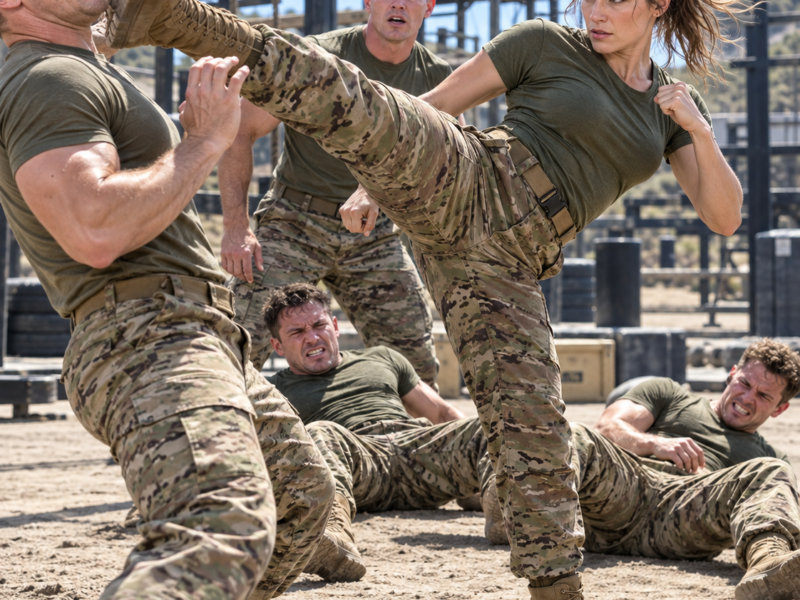
“I watched three senior instructors beat me to the ground during a so-called training drill at a Navy facility in Virginia
“The person who submitted that request also signed the report claiming you were physically unfit for this assignment.”
Commander Hayes’s words stayed with me as the corpsman helped me onto a stretcher.
I kept looking at the tablet in his hand, trying to make the dates fit together.
Three weeks before my fitness assessment, someone had already decided I wasn’t fit to serve.
Three weeks before I arrived at Little Creek, someone had tried to make sure I never got the chance.
And now, the men who had beaten me during a training exercise seemed more frightened of that report than they were of the consequences of what they’d done to me.
“Commander,” I said, gripping the edge of the stretcher, “who signed it?”
Hayes glanced toward the security personnel escorting Chief Ryan Cole out of the room.
“I’m going to find out.”
“That isn’t an answer.”
“No,” he admitted. “It isn’t.”
For some reason, his honesty frightened me more than a reassuring lie would have.
The corpsman wheeled me toward the medical clinic while the sounds of raised voices followed us down the corridor. I heard Cole insist that the entire incident had been misrepresented. One of the other instructors asked whether his command had been notified.
Then a door closed, cutting off their voices.
At the clinic, the corpsman examined my ribs, photographed the bruising, and documented the cut inside my mouth. An X-ray revealed two fractured ribs, but thankfully no internal injury requiring surgery.
The corpsman, a young petty officer named Lucas Bennett, looked uncomfortable as he entered the findings into the computer.
“I’m sorry,” he said quietly.
I stared at him.
“For what?”
He hesitated.
“For what happened in there.”
“You didn’t do it.”
“I was on duty when they brought you in last week for that shoulder injury.”
My fingers tightened around the blanket.
“What shoulder injury?”
Bennett looked at the screen, then back at me.
“The one from the equipment inspection. Chief Cole said you’d strained it during a conditioning exercise.”
I had never reported a shoulder injury.
I had never been examined for one.
“Can you check the date?”
He turned the monitor slightly toward himself and typed.
A moment later, the color drained from his face.
“That’s strange.”
“What?”
“The entry was created eleven days ago, but the examination field is blank. There isn’t a treatment note, either.”
“Who entered it?”
He clicked into another screen, then stopped.
“I’m not sure I’m allowed to show you this.”
“I’m the person the record is about.”
He studied me for a moment before turning the monitor around.
The record showed a preliminary entry created under an administrative account assigned to the training department.
The account holder was Lieutenant Commander Paul Whitmore.
My division officer.
The man who had personally approved my assignment to the program.
I read the name twice.
Whitmore had recommended me for the joint training attachment after I spent four months helping his team reconstruct a communications failure during a fleet exercise. When another department blamed a junior sailor for the incident, I found the missing transmission logs that proved the sailor had followed the correct procedure.
Whitmore had thanked me in front of the entire team.
He’d told me that my attention to detail was exactly what the Navy needed.
I had trusted him.
“Could this be an administrative mistake?” Bennett asked.
I wanted to say yes.
It would have been easier if the problem were a misplaced file or a careless clerk who had clicked the wrong name.
But I remembered the first week at Little Creek, when Whitmore called to ask how I was adjusting.
I’d told him that Cole was difficult but manageable.
Whitmore had gone quiet.
Then he’d said, “Don’t turn a personality conflict into a formal complaint, Emily. You worked hard to get this assignment. Don’t jeopardize it over bruised feelings.”
At the time, I’d assumed he was warning me about office politics.
Now I wondered what he’d known.
“Don’t change anything in that record,” I told Bennett. “And please don’t delete or correct it.”
“I wouldn’t.”
“Can you preserve the audit history?”
He nodded.
“I’ll flag it for the authorized records custodian.”
I thanked him, then lay back as the pain medication began to dull the sharpest edges of the room.
My phone sat in a clear property bag beside the bed.
There were four missed calls from my mother, two messages from a friend, and one notification from an unfamiliar number.
The message contained six words.
**You need to stop asking about Whitmore.**
I read it again.
Then I took a screenshot and called Commander Hayes.
He answered on the second ring.
“Mercer.”
“Someone just sent me a message about Whitmore.”
There was a pause.
“Read it to me.”
I did.
“Don’t respond,” he said. “Save the original message and make sure your phone stays with you. I’ll have the appropriate investigators handle it.”
“Did you find out who signed the report?”
“I’m still verifying the records.”
“Commander, Whitmore is my division officer. He approved my assignment.”
“I understand.”
“Then you understand why I need to know whether he was involved.”
“I do. But I won’t accuse someone before the evidence supports it, and neither should you.”
His answer irritated me because it was reasonable.
I wanted someone to tell me the whole thing was a misunderstanding. I also wanted someone to promise that the person responsible would never get near me again.
Hayes offered neither.
Instead, he told me that the incident had been referred for a formal investigation and that the training facility’s access logs and available video recordings were being secured.
Before he hung up, I asked him one more question.
“Why did you look so surprised when you saw the report?”
His voice softened.
“Because I saw something in the authorization history that didn’t make sense. I’m not ready to explain it until I’ve confirmed what it means.”
The call ended.
I stared at the ceiling, listening to the distant squeak of a cart moving through the hallway.
For the first time since arriving at Little Creek, I understood that doing everything right might not protect me.
It might only make someone more determined to get rid of me.
***
By late afternoon, the bruising along my ribs had darkened, and every breath reminded me of the concrete floor.
I was discharged with medical restrictions and instructions to return if my breathing worsened. A security escort accompanied me to the administrative building, where an investigator from the Navy’s appropriate investigative command took my initial statement.
Her name was Special Agent Laura Bennett, no relation to the corpsman.
She was in her forties, with short brown hair and a habit of letting silence sit between questions.
She asked me to describe the exercise from the moment I entered the room.
I told her about the missing safety briefing, the removal of protective equipment, and the first strike that came before I was ready.
She didn’t interrupt.
When I finished, she placed her pen on the table.
“Did you have a personal disagreement with Chief Cole before today?”
“He disliked me from the beginning.”
“That’s not quite what I asked.”
I considered the question.
“Three days ago, I challenged a discrepancy in a training report.”
“What kind of discrepancy?”
“The report said a trainee had failed a communications check because he hadn’t acknowledged an instruction. The recording showed that the instruction never reached his headset.”
“Who was responsible for the report?”
“Chief Cole’s team.”
“And what did you do?”
“I documented the discrepancy and sent it through the required reporting channel.”
“Did anyone ask you to change your findings?”
I thought about a phone call I had received the following morning.
A man from the training department had told me that the recording was incomplete and that I should consider withdrawing my objection until the exercise could be reviewed.
He had never explicitly threatened me.
He hadn’t needed to.
“No one ordered me to change it,” I said. “But I was encouraged to withdraw the finding.”
“By whom?”
“I don’t know his full name. He said he was calling on behalf of Lieutenant Commander Whitmore’s office.”
Agent Bennett wrote something down.
“Did you keep the call record?”
“Yes.”
“Good. Don’t delete anything, and don’t contact anyone you believe may be involved. If someone reaches out to you, preserve the communication and notify us.”
I nodded.
Then she asked about the request to remove me from the program.
I told her what Commander Hayes had said.
She closed her notebook.
“We’re aware of an administrative request, but its origin and purpose are still being examined. I can’t tell you more right now.”
“Was it submitted by Whitmore?”
“I can’t confirm that.”
“Was it submitted by someone above him?”
She held my gaze.
“I can’t confirm that, either.”
I pressed my palms against my knees.
“So everyone knows something except me.”
“No,” she said. “Right now, we have pieces of information. Our job is to establish which pieces belong together and which don’t.”
It was the first answer that made me feel as though someone was treating me like a person instead of a problem to be managed.
After the interview, I was escorted to temporary quarters while the investigation continued.
I barely slept that night.
Every time I closed my eyes, I heard Cole’s voice telling me to get up. I could feel the concrete beneath my cheek and the moment I realized the other sailors were waiting for someone else to intervene.
At 2:17 a.m., I got out of bed and opened the notebook where I kept my assignment records.
I wrote down dates, names, conversations, and the precise wording of every instruction I could remember.
Not because I thought I could solve the case myself.
Because I knew what happened when memories were left to compete with official reports.
By sunrise, I had filled nine pages.
At the bottom of the last page, I wrote one name in capital letters.
PAUL WHITMORE.
Then I drew a line beneath it.
I couldn’t yet decide whether that line was a warning or a boundary.
***
Commander Hayes summoned me to a secure conference room the following morning.
I arrived with my notebook tucked beneath my arm and my ribs tightly wrapped under my uniform.
Hayes was already there, along with Agent Bennett and a civilian records specialist.
A folder sat in the middle of the table.
No one invited me to sit until Hayes had checked that the door was closed.
“How are you feeling?” he asked.
“Like I lost a fight with a truck.”
One corner of his mouth moved, almost a smile.
“That’s an improvement over your medical assessment?”
“Not according to the corpsman.”
He gestured toward a chair.
The records specialist introduced herself as Karen Mills and explained that she had reviewed the available training documents, administrative entries, and authorization history.
She opened the folder.
“The exercise you participated in yesterday was not listed in the approved training schedule,” she said. “The roster was modified shortly before the session began.”
“By Cole?”
“We’re still establishing who made each change.”
She turned to another page.
“Your protective equipment was checked out that morning. The checkout record indicates that it was returned before your session.”
“But I was wearing it when I arrived.”
“That’s consistent with your statement. The return entry appears to have been recorded before the exercise began.”
I looked at Hayes.
“So someone made the paperwork say the equipment was back before I even used it.”
“That’s one possible interpretation,” he said. “We’re not treating it as a conclusion yet.”
Mills placed a second document on the table.
It was the request for my removal.
My name appeared near the top, followed by a summary of alleged performance concerns.
The language was formal, carefully worded, and almost entirely false.
It claimed that I had repeatedly failed to follow instructions, displayed poor stress tolerance, and demonstrated an inability to function effectively in a team environment.
I recognized several phrases from the evaluation Cole had given me the previous week.
I also recognized a sentence that had appeared in an email from Whitmore.
*The member’s continued participation may compromise the integrity of the training environment.*
I read it twice.
“That isn’t my performance record,” I said.
“No,” Mills replied. “It’s a summary based on selected entries.”
“Who selected them?”
“That’s what we’re tracing.”
Hayes leaned forward.
“Mercer, I want you to understand something. Your assignment isn’t being judged in this room. The question is whether someone manipulated the process that was supposed to evaluate you.”
I looked down at the document.
“Then why does it have my commanding officer’s endorsement?”
No one answered immediately.
Mills turned the page.
There were two endorsements, not one.
The first was Whitmore’s.
The second belonged to Captain Robert Ellison, the officer responsible for overseeing the broader training program.
I knew Ellison by reputation. He had served for more than twenty years, had an impressive operational record, and rarely appeared at routine training sessions.
His signature sat at the bottom of the page.
Beneath it was a date from two weeks before I had even arrived.
I felt the room tilt, though I knew it was only pain and exhaustion.
“Captain Ellison approved this before I started the assignment?”
“The document indicates that he approved the request for an administrative review,” Mills said carefully. “It doesn’t establish that he approved every allegation in the summary.”
“Did he know the report was based on incidents that hadn’t happened yet?”
“We don’t know.”
I looked at Hayes.
“Is he under investigation?”
“Everyone whose actions may be relevant is being interviewed or reviewed according to the applicable process,” he said. “That includes officers and enlisted personnel. No one is being presumed guilty.”
I appreciated the distinction.
I also hated it.
Because the men who had stood around me while I was on the floor had been free to assume I was weak, unfit, and deserving of what happened.
Now that I had evidence, everyone needed time.
Hayes seemed to read the thought on my face.
“I know this feels slow,” he said. “But if we move on assumptions, we risk giving the responsible people a way to escape accountability.”
I opened my notebook.
“There is one thing you should know.”
I told them about the communications report, the missing acknowledgment, and the call asking me to withdraw my objection.
Agent Bennett requested the details.
When I finished, Mills returned to the folder and removed a printout of the communications report.
The disputed exercise number appeared in the upper-right corner.
She placed it beside the removal request.
“The same exercise number appears in the supporting documentation for this review,” she said.
I leaned closer.
The number was identical.
“Why would a communications discrepancy be used to justify removing me from a training program?”
“That,” Hayes said, “is the question we’re trying to answer.”
For the first time, I saw him look genuinely angry.
Not at me.
At the documents.
He stood and walked to the window, where the morning light reflected off the parking lot.
“I’ve spent most of my career watching good people make mistakes under pressure,” he said. “Mistakes happen. Bad decisions happen. What concerns me is when a process appears to be designed to produce a predetermined result.”
He turned back toward us.
“And what happened to you yesterday will be investigated on its own merits, regardless of what we discover about the paperwork.”
I closed my notebook.
“Thank you, sir.”
He nodded once.
Then Mills said something that brought every other thought in the room to a halt.
“There is one more item in the authorization history. A restricted file was attached to the original removal request, then detached before the request was circulated.”
“What was in it?” I asked.
“We don’t have the contents yet. The file was moved to a separate records system.”
“Can you recover it?”
“We’ve submitted the request.”
“How long will that take?”
“I can’t promise a timeline.”
Hayes checked his watch.
“Until the record is recovered, nobody should speculate about its contents.”
He looked at me.
“If you remember anything else, report it. Don’t attempt to access restricted records yourself, and don’t confront the people involved.”
I understood the instruction.
I also understood that someone had gone to considerable trouble to keep one document separate from the rest.
And I had a feeling that whatever it contained would explain why a routine training assignment had turned into a campaign to discredit me.
***
That afternoon, the first formal consequences arrived.
Chief Cole and the two instructors who had participated in the drill were removed from training duties pending the investigation. Their access to the facility was restricted, and they were ordered to preserve relevant records and communications.
The decision wasn’t announced as a declaration of guilt.
It was a precaution.
But when I passed the administrative building with my escort, I saw Cole standing beside a staff vehicle, speaking to an officer I didn’t recognize.
He noticed me.
For several seconds, neither of us moved.
Then he walked toward me.
My escort stepped between us.
“Chief, you’re not authorized to approach the witness.”
Cole stopped, his jaw tightening.
“I just want to talk.”
“You’ve been instructed not to contact her,” the escort replied.
Cole looked over the escort’s shoulder at me.
“You think Hayes is going to protect you forever?”
I didn’t answer.
“You have no idea what you’ve stepped into, Mercer.”
The escort directed him back toward the vehicle.
I kept walking, but the words followed me all the way to the parking lot.
For the first time, I wondered whether Cole had been the person driving the effort against me or simply the person willing to carry it out.
That evening, Agent Bennett called to ask whether I had received any further messages.
I told her I hadn’t.
She asked me to continue preserving everything and said the investigation team had recovered additional access records.
She didn’t discuss the details.
Before ending the call, she added, “You did the right thing by documenting the exercise and the earlier discrepancies. Keep doing that.”
Afterward, I sat on the edge of my bed and opened my notebook again.
Nine pages had become twelve.
I had written down the first time Whitmore questioned my fitness scores, the day Cole reassigned me without explanation, and the exact wording of the message that had arrived after the incident.
I also wrote down something I hadn’t told anyone.
Two weeks before the drill, I had found an unexplained alteration in the communications exercise database.
A successful acknowledgment had been changed to a failure.
I had flagged it as a routine records discrepancy.
The correction request had disappeared from the queue the following morning.
At the time, I assumed someone had resolved the issue.
Now I wasn’t so sure.
I searched my personal email for the original notification.
It was still there, buried beneath routine administrative messages.
The notification contained the exercise number and the date of the alteration.
I printed it and added it to the folder of material I had already preserved.
Then I called Agent Bennett and reported the discovery.
She thanked me and told me not to investigate further on my own.
I promised I wouldn’t.
I meant it.
But as I placed the printed notification beside the report bearing Whitmore’s endorsement, one detail stood out.
The alteration had occurred before my assignment was approved.
Whatever had happened at Little Creek, the effort to discredit me had begun before I had ever set foot in the facility.
***
Two days later, I was called back to the conference room.
This time, Captain Ellison was there.
He sat at the far end of the table in a crisp uniform, his expression composed and his hands folded in front of him.
I had expected anger, perhaps even an accusation.
Instead, he stood when I entered.
“Petty Officer Mercer,” he said. “I’m sorry you were injured.”
“Thank you, sir.”
He indicated the chair opposite him.
“I’ve reviewed the preliminary findings concerning the training incident. The conduct described in the reports is unacceptable.”
I waited.
“I also understand that certain administrative documents may have given you reason to question the integrity of the process.”
“May have, sir?”
His eyes narrowed slightly.
“I understand that you’re upset.”
“I’m injured, sir. And a report says I failed exercises that I hadn’t even completed yet.”
The room became quiet.
Ellison sat back.
“The request I approved was for a review of your suitability for the attachment. It was not an order to falsify records or mistreat you.”
“Did you read the supporting documentation before approving it?”
“Yes.”
“Did you verify the dates?”
He paused.
“I relied on the information provided by the responsible staff.”
I nodded slowly.
“So you didn’t verify them.”
His jaw tightened.
“Petty Officer, administrative decisions are often made using information prepared by subordinate personnel. That doesn’t automatically make the approving officer responsible for every error.”
“No, sir. But once the errors are brought to your attention, what happens next matters.”
For a moment, I thought he might order me to leave.
Instead, he looked toward Agent Bennett.
“Is this questioning part of the formal interview?”
“No, Captain,” she replied. “This meeting was arranged to clarify the authorization process. Any additional statements will be documented through the appropriate channels.”
Ellison returned his attention to me.
“I will cooperate with the investigation.”
“Then I hope you’ll help them find out who changed the records.”
He said nothing.
The meeting ended without an apology beyond the one he had offered when I entered.
Outside the room, Hayes was waiting in the corridor.
“You held your ground,” he said.
“I wasn’t trying to challenge him.”
“I know.”
I glanced back at the closed door.
“Do you think he knew?”
Hayes took a moment before answering.
“I think the evidence will tell us more than either of our suspicions can.”
I almost smiled.
“You really don’t like giving direct answers.”
“I give direct answers when I have them.”
He started walking, and I followed.
At the end of the corridor, he stopped beside a window overlooking the training grounds.
“I want you to know that you’re not being asked to prove you deserved to be treated properly,” he said. “You didn’t need a perfect record to be entitled to a safe training environment. You didn’t need to win an argument with Cole. And you didn’t need to endure what happened to you to demonstrate your worth.”
I looked down at my hands.
For days, I had been replaying the drill, searching for the moment when I should have done something differently.
I had wondered whether I should have fought harder, shouted louder, or refused to participate.
His words didn’t erase those questions.
But they loosened their grip on me.
“Thank you,” I said.
He nodded.
Then he returned to the matter at hand.
“The records team has recovered the detached file.”
My breath caught.
“What does it say?”
“We’re reviewing it with the investigators. I don’t want to give you an incomplete interpretation.”
“Does it involve Whitmore?”
“Yes.”
The answer came without hesitation.
I gripped the notebook under my arm.
“Is he the person who requested my removal?”
“His office submitted the request. The audit trail shows that he personally approved the final version. We’re still determining what he knew about the underlying records and whether anyone directed him to act.”
It was the first confirmation I had received that Whitmore’s involvement was real.
But it still didn’t tell me why.
“Can I see the file?”
“Not yet. Some of the material is restricted, and investigators need to preserve the chain of custody.”
I swallowed.
“Then tell me one thing. Was I targeted because I found the altered communications report?”
Hayes studied me.
“That is now one of the central questions in the investigation.”
He walked away before I could ask anything else.
I stood by the window, watching sailors move across the training grounds in pairs.
For the first time, the events of the previous week seemed to form a pattern.
The altered report.
The missing safety documentation.
The attempt to remove me.
The message warning me to stop asking about Whitmore.
And somewhere inside a restricted file was the connection no one had yet explained.
***
The answer began to emerge the following morning.
Agent Bennett asked me to return to the conference room, where she and Mills had arranged several documents in chronological order.
The first was the original communications exercise report.
The second was my discrepancy notice.
The third was the request to remove me from the training program.
The final document was a memorandum attached to the recovered file.
Its heading identified a review of training-readiness data submitted for a forthcoming joint exercise.
Mills explained that the review had been initiated after inconsistencies appeared in several performance records.
Some trainees had been recorded as failing checks they had passed. Other entries showed equipment inspections that did not match the facility logs.
My discovery wasn’t the only discrepancy.
It was simply one of the few that had been formally documented before the records were changed.
“Why would anyone falsify training results?” I asked.
“We’re investigating several possible explanations,” Agent Bennett said. “The records alone don’t establish motive.”
She slid the memorandum closer.
It referenced an upcoming evaluation that would determine whether the training program could accept an expanded mission-support role.
The evaluation would influence staffing, resources, and future assignments.
If the program performed well, it would receive additional support.
If it failed, leadership would have to reconsider how the program was managed.
I read the paragraph twice.
“Someone wanted the program to look better than it was.”
“That’s one hypothesis,” Bennett said. “But we haven’t established who changed the data or why.”
Another page contained a list of personnel associated with the records.
Cole’s name appeared beside several disputed entries.
Whitmore’s office appeared beside the administrative review.
Ellison’s name appeared in the approval chain.
The three names sat close together on paper, but the evidence didn’t yet establish that they had acted together.
I thought about the men in the training room.
Cole had been cruel in a way that required no elaborate explanation. He had wanted to humiliate me, and he’d enjoyed having the power to do it.
But the paperwork suggested a second possibility.
My objections had threatened more than his authority over a training session.
They had threatened a system that needed certain failures to disappear.
“Did they remove the successful acknowledgment because it would have contradicted the evaluation?” I asked.
“We believe that may be connected,” Bennett replied. “But we need the underlying system logs and the statements of the people involved before reaching that conclusion.”
She turned another page.
The detached memorandum included a note about an analyst assigned to validate the disputed records.
The analyst’s initials were E.M.
Mine.
I felt the room grow smaller.
“They were already tracking my review?”
“The file indicates that your findings had been flagged for administrative attention before the removal request was submitted,” Mills said.
“Why?”
“That is still being examined.”
I looked at the initials.
For weeks, I had thought my assignment was simply a difficult opportunity in an environment where some people didn’t want me there.
Now I understood that someone had noticed my work before I arrived.
My attention to detail, the quality that had earned me the assignment, had made me inconvenient.
I looked at Agent Bennett.
“Did Whitmore know what I found?”
“We have evidence that he received a summary of your discrepancy notice.”
“And then he signed the request to remove me.”
“Yes.”
The word landed heavily.
“Did he know the report contained false dates?”
“We haven’t established that yet.”
I leaned back, careful not to aggravate my ribs.
It would have been easier if the answer were simple. If Whitmore had ordered the whole thing, I could have placed him neatly on the other side of a line and stopped wondering how someone I respected had become part of it.
But there were too many possibilities.
Perhaps he’d believed the summary.
Perhaps he’d ignored warning signs because the program’s success mattered more to him than one sailor’s career.
Perhaps he’d knowingly approved a false report.
Only evidence could distinguish among them.
“What happens now?” I asked.
“The investigators will interview the relevant personnel, review the original records, and determine whether the conduct warrants further administrative or disciplinary action,” Bennett said. “The training incident and the record manipulation will both be addressed.”
I nodded.
I had wanted the truth.
Now that it was beginning to surface, I understood that truth wasn’t a single door opening.
It was a corridor full of doors, each one leading to another question.
***
The most difficult conversation came three days later.
Whitmore requested an opportunity to provide a statement, and the investigators arranged a formal interview. I was not present for the entire session, but afterward Agent Bennett asked whether I would agree to a separate meeting in which he could address questions related to my assignment.
I agreed.
Whitmore entered the room without his usual confident smile.
He looked tired.
For a moment, I remembered the officer who had praised my work, who had told me I belonged in the room when others had doubted me.
Then I remembered the report.
He sat opposite me.
“Emily, I owe you an explanation.”
I kept my hands folded on the table.
“I’m listening.”
He glanced toward Agent Bennett, who sat to one side with her notebook open.
“I received a request to review your suitability for the program after concerns were raised about your performance and the way you handled the communications discrepancy.”
“Concerns raised by whom?”
“Personnel within the training department.”
“Cole?”
“His department submitted the initial comments.”
“And you approved the removal request.”
“Yes.”
“Before verifying the dates.”
He lowered his eyes.
“I should have checked them more carefully.”
“That isn’t the same as telling me why you didn’t.”
He took a breath.
“When the discrepancies first came to my attention, I believed they were administrative errors. The training program was preparing for a major evaluation, and there was pressure to resolve outstanding issues quickly.”
“So you signed a report saying I was unfit because the program was under pressure?”
“No.” He looked up. “I signed a request for a review. I did not intend for anyone to falsify your record.”
“But you included allegations that hadn’t been verified.”
“Yes.”
“And when I told you Cole was making the assignment difficult, you told me not to jeopardize my career over bruised feelings.”
His face tightened.
“I thought you were describing a personality conflict.”
“I was trying to tell you something was wrong.”
“I understand that now.”
I waited.
He rubbed his forehead.
“When the initial request came through, I believed that removing you from the attachment temporarily would allow the review to proceed without disrupting the evaluation. I thought it was an administrative measure.”
“Did you know about the three-on-one drill?”
“No.”
“Did you authorize Cole to use physical force against me?”
“Absolutely not.”
His answer came quickly, and for the first time I believed he was telling the truth.
But it didn’t absolve him.
“You didn’t order them to hurt me,” I said. “You just made it easier for them to portray me as someone who couldn’t do the job.”
He stared at the table.
“I can see how my decision contributed to that.”
“Can you?”
He nodded slowly.
“I should have questioned the report. I should have asked for independent verification. And when you raised concerns, I should have listened instead of warning you to stay quiet.”
The admission was painful because it was so ordinary.
No dramatic confession.
No hidden mastermind revealing a grand plan.
Just an officer who had chosen convenience over scrutiny, then discovered that his decision had helped protect people who were willing to go much further.
“Why didn’t you call me when you received the request?” I asked.
“I believed the review would be handled through the normal process.”
“You knew I was the person being reviewed.”
“Yes.”
“And you never asked me for my side.”
“No.”
He looked at me, his eyes red around the edges.
“I was wrong.”
I wanted those words to satisfy me.
They didn’t.
An apology could acknowledge harm, but it couldn’t undo the moment when I lay on the floor and realized that no one in the room had decided I was worth protecting.
“I’m not asking you to forgive me,” he said. “I’m asking you to understand that I didn’t set out to hurt you.”
“I understand the difference between intending to hurt someone and choosing not to protect them.”
He flinched.
Agent Bennett wrote something in her notebook.
Whitmore sat in silence for several seconds.
“I’ll cooperate fully with the investigation,” he said.
“I hope you do.”
When the meeting ended, he stood, hesitated as though he wanted to say something else, and then left without offering another apology.
I watched the door close.
I didn’t feel triumphant.
I felt tired.
Because the person I had trusted had not been the monster I feared.
He had been something more familiar and, in some ways, harder to forgive: a person who had known better and had failed to act when it mattered.
***
The investigation took several weeks.
During that time, I was reassigned to temporary administrative duties while my injuries healed. I was instructed not to contact the personnel involved, and I followed that instruction.
The investigators recovered additional electronic records, interviewed the instructors and staff, and compared the training logs against the original system data.
The findings were serious.
The three instructors had conducted an unauthorized exercise, failed to follow required safety procedures, and continued after I had attempted to stop the drill.
The records also showed that Chief Cole had submitted misleading comments about my performance before the exercise took place.
The disputed communications entry had been altered after the original result was recorded.
Messages recovered from the training department showed that Cole had been concerned that the discrepancy would undermine the upcoming evaluation.
He had pushed for my removal after I refused to withdraw my findings.
The evidence established his involvement in the effort to discredit me.
It did not establish that every officer who approved the administrative paperwork knew the records were false.
That distinction mattered.
The final report found that Whitmore had approved a removal request without adequate verification, failed to respond appropriately to my earlier concerns, and relied on inaccurate information that should have been independently checked.
He was relieved of his supervisory responsibilities pending the completion of separate administrative proceedings.
Captain Ellison’s approval was also reviewed. Investigators found that he had authorized an administrative review based on the information presented to him, but the available evidence did not establish that he knowingly directed anyone to falsify records or conduct the unauthorized drill.
He was formally counseled on oversight deficiencies and required to cooperate with corrective measures.
The instructors faced separate disciplinary proceedings. Cole was removed from his training position, and his case was referred for further action under applicable military procedures. The other instructors were also removed from their duties, with consequences determined according to their individual conduct and the evidence against them.
No one announced that their careers had ended in a single cinematic moment.
Real accountability was slower.
It required records, statements, reviews, and decisions that could withstand scrutiny.
But when Commander Hayes met with me after the findings were issued, he made one thing clear.
“The fact that the process took time doesn’t mean what happened to you was acceptable,” he said. “And the fact that we couldn’t prove every suspicion doesn’t diminish what we did establish.”
I nodded.
For the first time in weeks, I felt I could breathe without waiting for someone to tell me I was overreacting.
Hayes placed a document on the table.
It was the final review of my assignment.
The report concluded that the allegations of poor performance were unsupported by the verified evidence and that the altered records had compromised the original assessment.
My assignment was restored.
I read the conclusion carefully.
Then I read it again.
I had imagined that moment would feel like victory.
Instead, I thought about the sailor whose failed communications check had never actually failed, the trainees whose records might have been altered without their knowledge, and the people who had stood in that room and watched me get hurt.
“Will the other discrepancies be reviewed?” I asked.
“Yes,” Hayes said. “The program’s records are being audited, and the affected personnel will be notified through the appropriate channels.”
“Good.”
He studied me.
“You could have requested a transfer after what happened.”
“I considered it.”
“Why didn’t you?”
I looked at the restored assignment document.
“Because leaving would have been the easiest way to make the problem disappear from my life. But it wouldn’t have fixed the records.”
He nodded.
“You’re entitled to decide what’s best for you. You don’t owe this program your health or your career.”
“I know.”
And for the first time, I did.
I wasn’t staying to prove I could endure abuse.
I was staying because I wanted my work to mean something, and because the evidence had shown me how easily a false record could become someone’s official truth.
***
My first day back at Little Creek was quiet.
The training room had been closed temporarily while the safety procedures were reviewed. New instructors had been assigned, and the roster was being checked against the original authorization records.
A young sailor stood near the entrance holding a clipboard.
He looked up when I approached, then glanced toward the room behind me.
“Petty Officer Mercer?”
“Yes.”
He swallowed.
“I was there that morning.”
I recognized him as one of the trainees who had stood in the circle during the drill.
He had kept his eyes on the floor while I was on the concrete.
“I gave a statement,” he said. “I told them what happened.”
I waited.
“I should have said something sooner.”
He looked ashamed, but I couldn’t tell whether he wanted forgiveness or simply needed someone to acknowledge what he’d said.
“Why didn’t you?” I asked.
He stared at the clipboard.
“Chief Cole controlled our evaluations. I thought if I spoke up, I’d lose my place. And when everyone else stayed quiet, I convinced myself I hadn’t seen enough to be sure.”
I remembered the circle of sailors, the boots, the silence.
“You saw enough to know I was hurt.”
“Yes.”
“Then that’s what you should tell them. Exactly what you saw. No more, no less.”
He nodded.
“I will.”
I started toward the administrative office, but he called after me.
“Petty Officer Mercer?”
I turned.
“I’m sorry.”
I studied his face.
Part of me wanted to tell him that his silence had hurt almost as much as Cole’s actions. Another part understood that fear could make decent people do things they would later struggle to explain.
“Next time,” I said, “don’t wait until the paperwork gives you permission to tell the truth.”
He lowered his head.
“I won’t.”
I didn’t know whether he would keep that promise.
I knew only that it was his to keep, not mine to guarantee.
Inside the office, a new training schedule waited on my desk. My name appeared beside an assignment I had worked hard to earn.
For the first time since arriving at Little Creek, no one had added a warning beside it.
I sat down, opened my notebook, and turned to the first page.
The nine pages of dates and names were still there, followed by the printouts and the record of the message warning me to stop asking questions.
I didn’t throw them away.
I filed them with the case documentation and closed the folder.
Then I opened the training materials for the next exercise.
My ribs still hurt when I leaned forward, and I knew there would be days when the memory of that morning returned without warning.
The investigation hadn’t made me fearless.
It had made me more careful about the difference between authority and integrity.
Commander Hayes had stepped into that room and stopped what was happening. But he hadn’t been able to do it from a distance, and he hadn’t done it by demanding that everyone simply trust his judgment.
He had asked questions.
He had preserved evidence.
He had refused to let rank substitute for proof.
That was what I remembered when I returned to work.
Not Cole’s threats.
Not Whitmore’s apology.
Not even the moment my assignment was restored.
I remembered the silence in the training room, and how many people had waited for someone else to decide whether what they were seeing was wrong.
I couldn’t change what they had done.
I could decide what I would do the next time a report contradicted the evidence in front of me.
So I opened the first file, checked the dates, and began again.
THe ENd.









