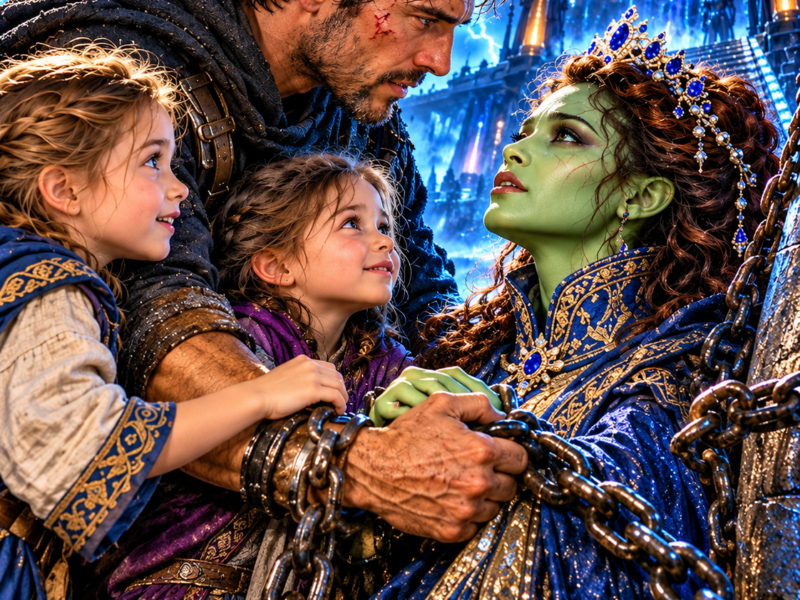
“I watched my five-year-old daughter walk past six cages filled with alien prisoners, point at the only woman nobody wanted, and tell the yardmaster, ‘We pick her’
The rain had stopped by the time we reached the highway, but Dasrath still sat quietly in the back seat, holding Mina’s hand as though she was afraid someone might take it away.
Juno had already offered her three cheese crackers, a plastic dinosaur, and half a packet of fruit snacks.
Dasrath accepted all three with the seriousness of someone receiving royal treasures.
I watched her in the rearview mirror.
She was trying to understand the world outside the prison yard.
Every time we passed another vehicle, her golden eyes followed it. When a truck sounded its horn, her tail tightened around her ankle.
“You’re safe,” I told her.
She looked at me.
“I do not know what that means anymore.”
I gripped the steering wheel a little harder.
“Well, we’re going to work on that.”
When we reached my property outside Adel, Georgia, the sun was beginning to break through the clouds.
My business sat on a gravel lot with two additional trucks, a small office trailer, and an old white farmhouse behind a field.
The sign above the gate read LOW FREIGHT.
The W had fallen off years earlier, and I had never gotten around to replacing it.
Dasrath studied it through the window.
“This is your house of work?”
“That’s one way to describe it.”
“And the white structure?”
“That’s home.”
She looked at the farmhouse for a long moment.
“Do you have a place for me?”
“I’ve got a spare bedroom. It used to be my wife’s sewing room. There’s a bed, a dresser, and a bathroom.”
I hesitated.
“But I need you to understand something. You’re not a servant. You’re not something I bought. You’re welcome to stay, but you don’t owe us anything.”
Dasrath turned toward me.
“I would rather work.”
“Work?”
“I saw your trucks. Your boxes. Your machines. I can lift heavy things. I learn quickly.”
She straightened her shoulders.
“I do not wish to be given a place. I wish to earn one.”
I looked at her for several seconds.
Then I smiled.
“My aunt Odessa has been telling me for six months that we need another person in the yard.”
Mina leaned forward.
“Does that mean Dasrath gets a job?”
“Looks that way.”
Juno clapped.
“She can work with us forever!”
I laughed.
“Let’s get through Monday first.”
Dasrath extended her hand.
I shook it.
“Welcome to Lowe Freight.”
I didn’t know it then, but that handshake would eventually become the most important business decision of my life.
Monday morning, my aunt Odessa returned from her church revival.
She was 68 years old, barely five feet tall, and capable of making a grown man feel guilty simply by looking over her reading glasses.
She had managed my business books for twelve years and had helped raise my daughters after Darlene died.
She also had absolutely no patience for nonsense.
At seven o’clock, she walked into the office trailer carrying a coconut cake.
Then she saw Dasrath sweeping the floor.
Odessa stopped.
She looked up.
And up.
And a little farther up.
Finally, she said, “Well, you missed a spot.”
Dasrath looked down.
There was a small patch of dust beneath the filing cabinet.
She swept it.
Odessa nodded.
“Better.”
Then she turned toward me.
“Curtis Abernathy Lowe, get in here.”
I knew I was in trouble.
I explained everything.
The prison yard, the cages, the restraints, the strange document, and the way my daughters had chosen the woman everyone else rejected.
Odessa listened without interrupting.
When I finished, she placed her purse on the desk.
Then she looked at Dasrath.
“Have you eaten?”
“Yes, ma’am.”
“Properly?”
Dasrath hesitated.
Odessa sighed.
“That’s what I thought.”
She cut the coconut cake and placed a generous slice on a plate.
Then she pointed toward a chair.
“Sit down, honey.”
Dasrath obeyed.
Odessa watched her take the first bite.
Something softened in her expression.
“You’re getting shoes today,” she announced. “Nobody works in my yard barefoot.”
“My feet are strong.”
“I’m sure they are. You’re still getting shoes.”
By lunchtime, Odessa had found a pair of size fifteen work boots at a Tractor Supply in Tifton.
She had also put Dasrath on the payroll at twelve dollars an hour.
When Dasrath corrected the spelling of her name on the time sheet, Odessa carefully wrote it again.
“Dasrath,” she repeated. “That’s a beautiful name.”
For the first time since I had met her, Dasrath smiled.
It was small, but it was real.
The next person to meet her was Lonzo Pickens, our mechanic.
Lonzo was 24, skinny, loud, and convinced he was the best diesel mechanic in South Georgia.
He had named all three of our trucks after country singers.
The red truck was Charlie.
The white one was Waylon.
My old blue Peterbilt was Merle.
Lonzo took one look at Dasrath and rubbed his chin.
“Ma’am, I have about four hundred questions.”
Dasrath tilted her head.
“You may ask one.”
Lonzo thought for a moment.
“Can you hold a wrench with your tail while holding a flashlight with your hands?”
Dasrath considered the question.
“Yes.”
Lonzo handed her a flashlight and a socket wrench.
She demonstrated.
He stared at her for several seconds.
Then he turned toward me.
“Curtis, I think we just hired the future of American transportation.”
Within a week, Dasrath had become the most valuable employee I had ever hired.
She learned to operate the forklift in a single morning.
She memorized every route in South Georgia after looking at the county map once.
One afternoon, Odessa was helping a driver who had gotten lost outside Fitzgerald.
Before she could finish explaining the directions, Dasrath spoke from the other side of the room.
“Tell him to return to the broken windmill. Take the left road after the white church. The feed store is behind it.”
Odessa repeated the instructions.
A moment later, the driver called back.
“Well, I’ll be. She’s right.”
Odessa slowly lowered the phone.
“You memorized the entire map?”
Dasrath nodded.
“Yes.”
Lonzo shook his head.
“I’m telling everybody we hired a GPS with a tail.”
But the greatest changes happened after work.
Mina and Juno had decided Dasrath was part of the family.
They showed her the creek behind our house, taught her to catch lightning bugs, and introduced her to the mysterious American tradition of eating peanut butter straight from the jar.
Dasrath, in return, told them stories about her home planet, Hethmor.
She described enormous spiral cities carved into cliffs, three small moons that rose together, and forests where the trees glowed at night.
She also taught them a special kind of Varen singing.
Her people could produce two notes simultaneously, one high and one low.
The first time she sang on our porch, I stopped washing dishes and stood at the kitchen window until she finished.
It was the most beautiful sound I had ever heard.
One evening, Mina asked her why she had cried when I first asked her name.
Dasrath sat between the girls’ beds with her tail curled around her knees.
“Among my people, asking someone’s name means you recognize them as a person. It means you want to know who they are.”
Mina thought about that.
“Nobody asked you?”
“No.”
“Not even the people who worked there?”
“Not once.”
Mina looked down at her blanket.
“I’m sorry.”
Dasrath gently touched her cheek.
“You chose me when nobody else would. That was also a kind of asking.”
Mina smiled.
Then she asked Dasrath to say her name in the Varen language.
Dasrath leaned forward and spoke the formal greeting of her people.
“Child of this house, what is your name?”
“Mina Darling Lowe,” Mina answered proudly.
Dasrath repeated it carefully.
“I will keep it.”
I was standing in the hallway.
I had thought grief would eventually become smaller.
Instead, it had simply become something I carried quietly.
But hearing my daughter’s name spoken with such tenderness reminded me that our house could still hold new memories without losing the old ones.
For the first time in three years, I went to bed that night without feeling quite so alone.
Then the phone calls began.
I contacted the State Department, the federal Office of Off-World Affairs, and anyone who might understand the laws governing the trading yard.
Most people transferred me to someone else.
Nobody wanted responsibility.
Finally, a deputy named Raylene Combs came to visit.
She had gone to high school with Darlene and had attended her funeral.
After listening to my story, she looked toward Dasrath, who was stacking boxes in the yard.
“Outside that fence, Curtis, nobody can own a person. I don’t care what some alien marketplace says.”
I felt relieved.
Then she continued.
“But there’s a problem. She has no identification, no immigration papers, and no official registration.”
“Can we fix that?”
“Probably. But I’d find someone who can translate that bond document you signed.”
That night, I found Dasrath sitting on the porch swing.
She was watching the stars.
I sat on the steps a few feet away.
“Raylene says you’re free.”
Dasrath nodded.
“I have always known I was free. It is other people who forgot.”
I studied her face.
“Can I ask how you ended up in that cage?”
She remained quiet for a long time.
Then she began telling me the truth.
“My mother is Queen Ouzen of Hethmor. I am her only child and heir to the throne.”
I stared at her.
“You’re a princess?”
“Yes.”
I leaned back.
“Well, that explains the manners.”
She almost smiled.
Then her expression changed.
“My cousin Ishvan wanted the throne. He arranged a journey for me to a trade summit. The crew he selected betrayed me. They sold my ship and delivered me to the traders.”
“Why didn’t your mother come looking for you?”
Dasrath looked toward the stars.
“Because Ishvan used our oldest law.”
She explained the chamber of bells, where every member of the royal family had a crystal bell that responded when their true name was spoken freely.
If an heir remained silent for a year and a day, the royal law considered that heir lost.
Her cousin had planned to keep her imprisoned until the deadline passed.
“How much time was left?” I asked.
“Twenty-two days.”
I looked at her.
“Then I asked your name.”
She nodded.
“My bell rang. My mother knows I am alive.”
I felt a small wave of relief.
“Then she’ll come get you.”
Dasrath looked at me.
“Yes. But Ishvan heard the bell, too.”
The next morning, Odessa answered the office phone.
It was Ostif Vagram, the yardmaster.
His voice sounded nothing like the cheerful man who had offered my daughters a gift.
“Curtis Lowe, you must return the Varen female immediately.”
“No.”
“You don’t understand. A royal visitor has arrived. He demands her return.”
“She’s not yours.”
There was a long silence.
Then Vagram whispered something that made the hair on my arms rise.
“Her cousin is already looking for her.”
Two days later, a long black car pulled into our gravel lot.
Two Corbanthi guards stepped out.
A human lawyer followed.
Then a tall bronze-skinned Varen man emerged from the back seat.
He was taller than Dasrath, dressed in an elegant wine-colored coat, with long braided hair threaded with silver.
His tail was decorated with silver rings.
He looked at our little office trailer and smiled.
“Princess,” he said warmly. “Look what they’ve done to you.”
Dasrath stepped out of the workshop.
Her tail went rigid.
“Cousin Ishvan.”
He smiled wider.
Then he turned toward me.
“You must be Curtis Lowe. The human who signed the household lease.”
“I signed a paper to get her out of a cage.”
“An unfortunate misunderstanding.”
His lawyer stepped forward with an envelope.
“Two million dollars,” he said. “A generous payment for your cooperation.”
I looked at the envelope.
Then I looked at Dasrath.
“No.”
Ishvan’s smile disappeared for half a second.
Before he could respond, Juno came running across the yard in her pink boots.
She stopped beside Dasrath and looked up at the stranger.
“Are you her family?”
Ishvan glanced down.
“I am.”
“What’s your name?”
He ignored her question.
Instead, he looked at me.
“You have nineteen days before the lease expires. Consider my offer carefully.”
Then he returned to his car.
Juno watched it disappear down the road.
“He didn’t tell me his name,” she said.
Dasrath knelt beside her.
“That is a serious insult among my people.”
Juno frowned.
“Why?”
“Because when someone asks your name and you refuse to answer, you are saying they do not deserve to know you.”
Juno considered that for a moment.
Then she said, “That’s not very nice.”
Dasrath hugged her.
“No, little one. It is not.”
The following week, we learned what the bond document really said.
A retired professor from Valdosta translated the Corbanthi writing.
The English portion described Dasrath as a gift.
The actual contract described her as a thirty-day leased household servant.
At the end of the lease, she was supposed to be returned.
There was even a clause allowing the yard to seize my trucks if I refused.
Someone had planned this carefully.
Ishvan hadn’t simply lost control of his prisoner.
He had built a legal trap around the person who rescued her.
The professor looked at me over his glasses.
“Mr. Lowe, this could become a federal treaty dispute.”
I rubbed my forehead.
“How bad?”
“Bad enough that I’d avoid signing anything else.”
Unfortunately, avoiding trouble was no longer an option.
Ishvan returned several days later with his lawyer.
He offered me the two million dollars again.
I refused again.
This time, he didn’t smile.
“Your business is small,” he said. “Your trucks are old. Your daughters are young. You have responsibilities, Mr. Lowe.”
I stepped closer.
“Don’t talk about my daughters.”
“I am simply reminding you of what you stand to lose.”
Dasrath stood beside me.
For a moment, neither of us spoke.
Then Ishvan looked at her.
“Come home, cousin. Your mother is confused. I can arrange everything.”
“My mother knows I am alive.”
His expression changed.
Only slightly.
But I saw it.
“You have been away too long,” he said.
Then he left.
That night, Dasrath asked me to teach her to drive.
I thought she was joking.
She wasn’t.
“If he comes again, I do not want to be helpless.”
I understood.
So I began teaching her in Merle, my old Peterbilt.
Her first attempt at shifting gears sounded like somebody dropping a toolbox down a staircase.
Lonzo heard it from the sleeper cab and shouted, “Oh, Merle! You didn’t deserve that!”
Dasrath looked at me.
“Is the machine damaged?”
“No. Your pride might be.”
She frowned.
Then she laughed.
Over the next two weeks, she learned to drive surprisingly well.
She studied the manual, memorized the controls, and practiced every night on empty roads.
By the end of the second week, she could handle Merle better than Lonzo.
He insisted the transmission was simply being cooperative.
Then came the night everything fell apart.
We were making a delivery outside Jacksonville and stopped at a truck stop in Lake City, Florida.
It was just after eleven.
I went inside to pay for fuel.
Dasrath remained in the cab with the doors locked.
She saw three Korbanthi approaching through the side mirror.
They wore dark jackets.
One carried a glowing blue wand.
She recognized it immediately.
It was the same kind of device the keepers had used to remove her restraints.
Only this time, she knew what it could do.
The men approached the cab.
One reached for the door lock.
Dasrath’s body remembered the cage before her mind could stop it.
For a moment, she couldn’t move.
Then she remembered Mina.
She remembered Juno.
She remembered the porch swing and the stories and the taste of dill pickles.
She leaned forward and pressed the air horn.
The sound shook the entire truck stop.
I dropped my coffee inside the store.
Through the window, I saw three figures surrounding Merle.
I grabbed a fire extinguisher and ran.
The first Korbanthi turned toward me.
I pulled the pin.
A cloud of white powder exploded across his face.
The second raised the glowing wand.
Before he could use it, the cab door opened.
Dasrath’s tail shot out, wrapped around his wrist, and ripped the device from his hand.
She stepped down onto the running board.
Seven feet tall.
Bronze skin.
Work boots.
Grease-stained Lowe Freight shirt.
She snapped the wand across her knee.
The third man ran.
The second followed.
The first stumbled after them, coughing and burping.
A crowd gathered.
A trucker in a camouflage cap stared at Dasrath.
“Lady, remind me never to make you mad.”
Dasrath looked at the broken wand in her hand.
Then she started laughing.
Not a quiet laugh.
A full, two-note Varen laugh that made people turn around.
“I have wanted to break one of those for eleven months,” she said.
I sat beside her on the truck step.
“Well, you did a pretty good job.”
We laughed until the crowd dispersed.
But the trouble was only beginning.
We returned to Georgia just before dawn.
Every truck in my yard had an orange sticker on its windshield.
There was one on the forklift.
One on the office trailer.
Even the front gate had been chained shut.
The notice stated that Lowe Freight was under federal investigation for trafficking a charter-bonded individual.
Our vehicles and operating authority had been suspended.
I read the notice twice.
Then I looked at Dasrath.
She stood behind me, perfectly still.
By lunchtime, Odessa had called the federal office four times.
By the afternoon, an agent arrived to explain that the complaint carried a royal seal.
He admitted that the case could take months.
We had payroll due Friday.
I didn’t have months.
That evening, Ishvan’s lawyer called.
He offered to withdraw the complaint if Dasrath returned to his custody.
The trucks would be released immediately.
The two million dollars remained available.
I hung up.
Later, Dasrath found me sitting at the kitchen table with a calculator and a stack of bills.
The mortgage.
The truck loans.
Employee wages.
The college savings jar on the counter, labeled in Darlene’s handwriting.
She sat opposite me.
“How long can you continue?”
“Couple of weeks. Maybe three.”
“If I return, he will release your trucks.”
I looked up.
“No.”
“Your daughters need their home.”
“They need to know that people aren’t something you trade when things get difficult.”
She lowered her eyes.
“Curtis, I cannot let your family lose everything because of me.”
“You’re not the reason this is happening. He is.”
She looked at me for a long time.
Then she said something I didn’t understand.
“That is why I must do something.”
The next morning, she was gone.
I found her note beneath the pickle jar on the kitchen table.
It was written in careful pencil letters.
“Curtis Lowe,
I give my notice. It is in writing as Odessa says. It is not two weeks. I am sorry.
You asked my name when nobody else would. You gave me work, a bed, and two daughters who wanted to hear my stories.
Among my people, when someone gives you that much, you must give something back.
Your trucks will be returned today.
Do not come after me.
Tell the girls I keep their names.
Your worker,
Dasrath.”
I read it three times.
Then I sat down on the kitchen floor.
For the first time since Darlene died, I had allowed myself to believe that someone might stay.
And now she was gone because she thought her life was worth less than my business.
I called Odessa.
She came over within fifteen minutes.
When she read the note, she pressed it against her chest.
“That stubborn girl.”
Mina appeared in the doorway.
“Where’s Dasrath?”
I couldn’t answer.
Juno came behind her, still wearing her plastic tiara.
She looked at the empty chair.
“Did she go home?”
I knelt in front of them.
“She’s trying to protect us.”
Mina’s eyes filled.
“But we didn’t ask her to leave.”
“I know, sweetheart.”
Juno began crying.
“She promised to tell me another story.”
I held both girls against me.
And I made a decision.
I wasn’t going to let a woman who had already lost eleven months of her life lose another day because of a lie.
I called Raylene.
Then I called the professor.
Then I called every number I could find for the federal Office of Off-World Affairs.
By noon, Odessa had taken charge of the office.
Lonzo had gathered every document related to the seizure.
Raylene was working with a federal investigator who had finally agreed to examine the complaint.
And I was driving toward the nearest off-world diplomatic communications center.
I didn’t know exactly how we were going to win.
But I knew we had to try.
Meanwhile, Dasrath was sitting in the back of Ishvan’s black car.
He had collected her before sunrise.
He looked pleased with himself.
“You see, cousin? It is much easier when you cooperate.”
Dasrath looked out the window.
“Where are you taking me?”
“Somewhere safe.”
“Safe from whom?”
He smiled.
“From people who don’t understand our customs.”
She turned toward him.
“You mean people who ask my name?”
His smile disappeared.
He leaned forward.
“You have become very attached to these humans.”
“They are my family.”
“Your family is on Hethmor.”
“My mother is my family. Curtis and his daughters are also my family.”
Ishvan laughed.
“You cannot possibly believe that a truck driver and two children are your equals.”
Dasrath looked at him.
“That is exactly what I believe.”
For the first time, Ishvan’s expression hardened.
He had expected gratitude.
He had expected fear.
He had not expected a princess who no longer wanted his approval.
But he had made another mistake.
He had underestimated the woman he had kept silent for eleven months.
That evening, the federal investigation produced something unexpected.
The professor had examined the bond document more closely.
He discovered a second seal hidden beneath the Corbanthi writing.
It was a royal authorization mark.
And it had been forged.
The signature belonged to Queen Ouzen.
Except the queen had never signed it.
The professor explained that the mark could only have been produced using a royal crystal held inside the palace.
That meant whoever had created the document had access to the royal treasury.
Ishvan had not simply arranged Dasrath’s disappearance.
He had used the authority of the crown to make the trafficking appear legal.
The evidence was enough to bring federal officials into the case.
But we still needed Dasrath.
And she needed a way to get word to her mother.
That was when Raylene found an old diplomatic communications terminal at the Valdosta exchange office.
It could send a message directly to Hethmor.
The federal investigator agreed to transmit our evidence.
I wrote a short statement.
I explained who I was, where Dasrath had been held, and what Ishvan had done.
Then I added one sentence.
“Your daughter is safe with people who know her name.”
I didn’t know whether she would ever read it.
But I sent it.
Two days later, something happened that nobody at the exchange office expected.
The terminal began ringing.
Not an ordinary telephone ring.
A deep, clear tone that seemed to vibrate through the walls.
The professor went pale.
“That’s the royal chamber signal.”
A message appeared on the screen.
It was written in the old Varen script.
The professor translated it slowly.
“Queen Ouzen requests immediate confirmation of her daughter’s location.”
The room went silent.
Then a second message arrived.
“Her Majesty is coming.”
I felt my knees weaken.
For the first time, I believed we might actually get Dasrath home.
But there was still the matter of getting her away from Ishvan.
The federal investigator obtained an emergency order preventing her transfer outside the exchange jurisdiction.
Raylene arranged for officers to accompany us.
We drove to the diplomatic holding facility where Ishvan had taken her.
It was a large building outside the old prison yard.
There were armed guards at the entrance.
The moment I stepped inside, I saw Dasrath standing near a glass partition.
She wore a dark robe.
Her hair was still short.
Her hands were folded in front of her.
When she saw me, she took one step forward.
“Curtis.”
I had never been so relieved to hear someone say my name.
“I’m sorry it took me so long.”
She shook her head.
“You came.”
I looked at the guards.
“You’re coming home.”
Ishvan appeared from a side corridor.
His silver rings clicked as he walked.
“This is a family matter.”
The federal investigator stepped forward.
“Not anymore.”
He showed Ishvan the emergency order.
The Varen prince read it.
Then he laughed.
“You think human paperwork can interfere with royal law?”
The investigator didn’t blink.
“We think forged royal authorization can interfere with federal law.”
Ishvan’s expression changed.
The investigator handed him a second document.
It contained the translated bond contract, the forged seal, and the statements from the traders who had handled Dasrath.
Ishvan looked toward his lawyer.
The lawyer lowered his eyes.
That was the first time I saw the prince look uncertain.
Then Dasrath spoke.
“I will not return with you.”
He turned toward her.
“You are making a terrible mistake.”
“No. I made a mistake when I believed you were family.”
The words were quiet.
But they landed harder than a shout.
Ishvan looked at me.
“This human has corrupted you.”
Dasrath stepped forward.
“No, cousin. He reminded me who I was.”
The guards moved between them.
Ishvan was escorted away for questioning.
His lawyer followed.
For a moment, nobody spoke.
Then Dasrath looked at me.
“Can we go home?”
I nodded.
“Yes.”
We returned to Adel that evening.
The orange stickers had been removed from the trucks.
The gate was open.
Odessa stood in the doorway holding a fresh coconut cake.
Lonzo was beside her with a wrench tucked into his belt.
Mina and Juno ran across the yard.
Juno reached Dasrath first.
“You came back!”
Dasrath knelt and opened her arms.
“I promised I would tell you another story.”
Juno hugged her neck.
“You can’t leave without saying goodbye again.”
Dasrath closed her eyes.
“I will try very hard not to.”
Mina stood beside them, wiping her face.
Then she took Dasrath’s hand.
“Did you keep my name?”
Dasrath smiled.
“Every part of it.”
For several weeks, life slowly returned to normal.
The federal investigation continued.
Ishvan was eventually charged with conspiracy, fraud, and trafficking under the exchange treaty.
The Varen government sent a delegation to Earth.
Among them was Queen Ouzen.
She arrived on a diplomatic ship that landed at the exchange facility outside Valdosta.
I expected someone imposing.
Someone surrounded by guards and ceremony.
Instead, when the queen stepped off the ship, I saw a woman who looked tired.
She was tall and bronze-skinned, with long silver-black hair and eyes almost identical to her daughter’s.
The moment she saw Dasrath, she stopped.
For eleven months, she had believed her daughter was gone.
Now they stood a few feet apart.
Neither moved.
Then the queen whispered something in the old language.
Dasrath answered.
The queen crossed the distance between them and wrapped her arms around her daughter.
They held each other for a long time.
I looked away.
Some reunions deserve privacy.
When they finally separated, Queen Ouzen approached me.
I removed my cap.
“Your Majesty.”
She looked at me carefully.
“You are Curtis Lowe?”
“Yes, ma’am.”
“My daughter tells me you asked her name.”
I nodded.
“I did.”
“Why?”
I thought about the question.
Then I looked toward Dasrath, who was standing beside Mina and Juno.
“Because she was a person standing in front of me.”
The queen lowered her head.
“On my world, that is the beginning of respect.”
She took my hands.
“Then you have given my daughter something I cannot repay.”
I shook my head.
“She gave us plenty, too.”
The queen smiled.
She offered Dasrath a place beside her on the royal ship.
Dasrath listened carefully.
Then she looked at my daughters.
At Odessa.
At Lonzo.
Finally, she looked at me.
“I want to return to Hethmor,” she said. “My people need to see that I am alive. I must help my mother restore what Ishvan damaged.”
I nodded.
“Of course.”
She continued.
“But I do not wish to disappear from this family.”
The queen looked surprised.
Dasrath held out her hand.
“I would like to serve as a representative between our worlds. I want the Varen people to understand that Earth is not simply a place to trade goods. It is a place where people live, love, and choose one another.”
The queen considered this.
Then she smiled.
“Your father would have been proud.”
Dasrath’s eyes filled.
She had not mentioned her father before.
The queen placed a hand on her shoulder.
“Your place is beside me, daughter. Not behind me.”
That was when Dasrath began to cry.
A month later, she returned to Hethmor.
The departure was difficult.
Juno cried so hard she soaked the front of Dasrath’s robe.
Mina tried to be brave but couldn’t stop wiping her eyes.
Odessa gave Dasrath a small notebook containing every recipe she had learned in our kitchen.
Lonzo gave her a miniature wrench.
“For emergencies,” he said.
Dasrath laughed.
“And what emergency requires this?”
“Any emergency involving a machine.”
She tucked it carefully into her bag.
Then she turned to me.
“I do not know how to thank you.”
I shook my head.
“You don’t have to.”
She reached out and touched her tail gently to my wrist.
The same greeting she had given Odessa on her first morning.
“Among my people, this means I recognize you as family.”
I felt my throat tighten.
“Then you’re stuck with us.”
She smiled.
“That is what I was hoping.”
Her ship rose above the trees.
The girls waved until it disappeared.
And for a few days, the house felt too quiet.
But Dasrath kept her promise.
She returned three months later as the official Varen ambassador to Earth.
The first thing she did was walk into the kitchen, open the refrigerator, and take out a jar of dill pickles.
Odessa stared at her.
“You traveled across the galaxy for pickles?”
Dasrath took a bite.
“No. But they are an excellent reason to return.”
Everybody laughed.
The years that followed changed our little corner of Georgia.
The old prison trading yard was eventually shut down and replaced by a regulated diplomatic exchange center.
The cages were dismantled.
The bonded prisoners were released.
Some returned home.
Others chose to remain on Earth.
Dasrath helped establish a program that gave off-world refugees legal status, employment, and the right to choose where they lived.
She also became one of the strongest voices against the practice of bonded servitude.
Ishvan lost his claim to the throne.
His crimes were proven, and the Varen council removed him from royal succession.
Queen Ouzen remained on the throne for many more years.
Dasrath eventually became queen herself.
But she never forgot the little freight company outside Adel.
She visited whenever diplomatic duties allowed.
She sat on our porch swing, ate pickles with Juno, helped Mina with her science homework, and sang the old two-note songs whenever someone in the house needed comfort.
Mina grew up to study international law.
She said she wanted to make sure nobody could ever use a piece of paper to turn a person into property again.
Juno became a teacher.
She kept the plastic tiara from that Saturday in a wooden box on her desk.
And I kept Darlene’s coffee mug beside the kitchen sink.
Life didn’t become perfect.
I still had truck repairs, late deliveries, bills, and mornings when my knees hurt before I got out of bed.
But our home became a place where people from different worlds could sit at the same table and feel welcome.
Years later, when Dasrath was crowned queen, she invited us to Hethmor.
The palace was built into a mountain, its enormous spiral halls glowing beneath three moons.
Thousands of Varen gathered in the great courtyard.
At the center stood the chamber of bells.
Dasrath led me inside.
There were hundreds of crystal bells hanging from silver arches.
One of them began to ring as she approached.
Its sound was clear and beautiful.
She turned toward me.
“That is mine.”
I looked at the bell.
“How long has it been there?”
“Since the day I was born.”
She reached out and touched its surface.
“For eleven months, everyone believed I was lost. But my bell was waiting.”
I thought about the prison yard.
The dark cage.
The woman who had stopped speaking because nobody had bothered to ask her name.
Then I looked at the queen standing beside me.
She smiled.
“You asked me a question that day, Curtis Lowe. Do you remember?”
I nodded.
“What’s your name?”
She laughed softly.
“Yes. And I have spent the rest of my life answering it.”
I looked through the palace doors toward the courtyard.
Mina and Juno were laughing with the young Varen children.
Odessa was arguing with a palace cook about the proper way to make coconut cake.
Lonzo was explaining the advantages of American diesel engines to a group of royal mechanics.
For a moment, I could almost see our old gravel lot in Adel.
The faded sign.
The three trucks.
The little office trailer.
The rainy Saturday that started everything.
I had gone to the prison yard that morning to deliver peaches, boiled peanuts, and pickles.
I had returned with someone who changed our lives.
And the greatest gift she ever gave me wasn’t a royal title, a palace invitation, or a friendship that crossed galaxies.
It was the reminder that sometimes the most important thing you can give another human being is the simple recognition that they are there, that they matter, and that they deserve to be known.
I had asked a woman in a cage for her name.
She had answered.
And somehow, that answer had become a family.
The End.









