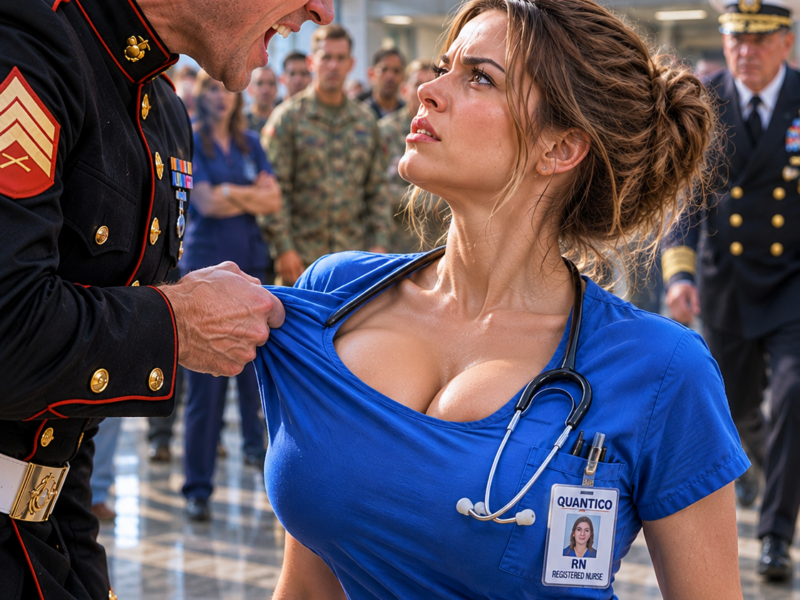
“I was standing in the middle of the Quantico medical center when a Marine colonel shoved my nursing credentials back across the counter and said
“I was standing in the middle of the Quantico medical center when a Marine colonel shoved my nursing credentials back across the counter and said, loud enough for everyone to hear, ‘People like you don’t belong anywhere near my command,’ but the moment the Commandant walked through those doors, he looked straight at me, went completely still, and raised his hand in a salute that made the entire room fall silent.”
My name is Claire Bennett, and until that morning, I had believed that being a nurse at Marine Corps Base Quantico meant earning respect through the work I did, not through the uniform I wore or the rank printed on someone else’s collar.
I’d been working at the medical center for nearly three months.
Most of the Marines who came through were respectful, even when they were injured, exhausted, or frustrated. Some called me ma’am. Others simply called me Claire after I’d introduced myself.
I never expected special treatment.
I just expected to be allowed to do my job.
That changed when Colonel Richard Hayes walked into the treatment area with two officers behind him.
He was in his late forties, tall, broad-shouldered, and carried himself like every room he entered already belonged to him.
A young corporal followed, holding his left arm against his chest.
“Get him a room,” Hayes ordered.
I stepped toward the corporal and noticed the blood soaking through the sleeve of his uniform.
“Sir, I need to assess that injury first.”
Hayes barely glanced at me.
“I gave you an instruction.”
“And I’m following medical protocol, Colonel. He may have a deeper injury than it appears.”
One of the officers shifted uncomfortably.
The corporal looked between us, clearly wishing he could disappear.
Hayes turned toward me.
“What’s your name?”
“Claire Bennett, sir.”
“Rank?”
“I’m a registered nurse assigned to this facility.”
His expression tightened.
“That wasn’t what I asked.”
I held his gaze.
“I don’t hold a military rank, sir.”
He gave a short, humorless laugh.
“Then perhaps you should remember your place.”
The treatment room became quiet.
I felt several people watching, but I kept my attention on the corporal.
His fingers were trembling.
“Can I at least see your arm?” I asked him gently.
He nodded.
Hayes stepped between us.
“Nobody touches him until I authorize it.”
I couldn’t believe what I was hearing.
“Colonel, he’s bleeding.”
“And you’re apparently having trouble understanding a direct order.”
He turned toward the reception desk, where my personnel file was sitting beside the computer.
“Who approved this nurse for assignment here?”
I didn’t answer immediately.
Not because I was afraid of him, but because something about the question bothered me.
He wasn’t asking about my qualifications.
He was questioning why I was there at all.
The clinic supervisor, Dr. Melissa Grant, came out of her office.
“Colonel Hayes, Claire is fully credentialed. She’s one of our most experienced trauma nurses.”
Hayes looked at her.
“I wasn’t asking for your opinion.”
Dr. Grant’s jaw tightened, but she said nothing.
I returned my attention to the corporal.
“What’s your pain level?”
“About a seven,” he whispered.
“Does it hurt when you move your fingers?”
“A little.”
I reached for a pair of gloves.
Hayes slapped my hand away from the examination tray.
The sound echoed through the room.
“Did I tell you to proceed?”
My hand stung.
For a moment, I simply stared at him.
Then I looked at the corporal, who had gone pale.
“Dr. Grant,” I said quietly, “I recommend immediate assessment. His circulation may be compromised.”
She stepped forward.
“I’ll take over.”
Hayes pointed toward the hallway.
“And you, Bennett, can explain to administration why you thought you could disregard my authority.”
I removed my gloves.
“Yes, sir.”
I didn’t argue.
I didn’t cry.
But as I walked toward the nurses’ station, I noticed the corporal watching me with an expression I couldn’t quite understand.
It wasn’t pity.
It was recognition.
He opened his mouth as if he wanted to say something, then looked at Hayes and closed it again.
That bothered me more than the colonel’s insult.
An hour later, I was called into the supervisor’s office.
Dr. Grant closed the door behind me.
“Claire, I need to ask you something.”
“Go ahead.”
“Have you ever met Colonel Hayes before?”
I shook my head.
“Not that I remember.”
She studied my face.
“Are you certain?”
“Why?”
She hesitated.
“Because when he saw your credentials, he looked like he’d recognized something.”
I sat down slowly.
“What do you mean?”
She opened a folder and turned it toward me.
It contained a copy of my assignment authorization.
At the bottom was a reference number I had never paid much attention to.
Beside it was a handwritten note.
Dr. Grant tapped the paper.
“This assignment came with instructions from an office above our normal administrative chain. I was told not to discuss the details unless someone with the appropriate clearance requested them.”
I looked at her.
“Why wasn’t I told?”
“That was part of the instruction.”
Before I could ask another question, someone knocked.
A young administrative officer opened the door.
“Ma’am, the Commandant has arrived. He’s conducting an unscheduled inspection.”
Dr. Grant stood immediately.
I followed her into the corridor.
The medical center suddenly filled with movement. Officers straightened their uniforms, staff stepped aside, and conversations faded as the Commandant entered with his security detail.
He was older than Colonel Hayes, with silver hair and a calm expression that made people instinctively pay attention.
Colonel Hayes hurried toward him.
“Sir, welcome to Quantico. I wasn’t expecting your visit.”
The Commandant nodded politely.
Then his eyes moved past Hayes.
They landed on me.
For several seconds, he didn’t move.
His expression changed so subtly that I might have missed it if I hadn’t been watching.
He stepped away from his security detail.
Then, in front of the officers, the nurses, and the same colonel who had humiliated me that morning, he brought his right hand sharply to his brow.
He saluted me.
Nobody spoke.
I instinctively looked behind me, certain he must be addressing someone else.
But there was nobody there.
The Commandant lowered his hand only after holding the salute for several seconds.
“Sergeant Bennett,” he said quietly.
My stomach tightened.
I hadn’t been called that name in years.
Colonel Hayes looked from him to me.
“Sir, she’s a civilian nurse.”
The Commandant didn’t turn around.
“I know exactly who she is, Colonel.”
Then he looked directly into my eyes.
“I was beginning to wonder whether you’d ever come back.”
I couldn’t find my voice.
He glanced toward the administrative folder still in Dr. Grant’s hands.
“Has she been shown the original authorization?”
“No, sir,” Dr. Grant replied.
The Commandant’s expression hardened.
“Then I believe it’s time.”
Colonel Hayes took one step forward.
“Sir, perhaps we should discuss this privately.”
The Commandant finally turned toward him.
“That’s an interesting suggestion, Colonel. Especially considering what you did to her this morning.”
Hayes went pale.
The Commandant reached for the folder.
He opened it, removed a sealed document, and placed it in my hands.
My fingers stopped moving when I saw the signature at the bottom.
It belonged to a man whose name I had spent five years trying not to remember.
And beneath it were six words that explained why Colonel Hayes had looked so frightened when he first saw me.
I stared at the document, unable to decide whether opening it would finally give me the answers I needed or bring back the one part of my past I’d never managed to bury.
Would you have opened that envelope immediately, or would you have demanded to know why Colonel Hayes seemed so terrified of what was inside?
The name on that signature was about to change everything I thought I knew about my return to Quantico. 👇
viết task 2
I stared at the signature for several seconds before I trusted myself to read the words beneath it.
The name was General Thomas Whitaker.
My former commanding officer.
The man who had been standing beside me the night my military career ended.
And beneath his signature, written in black ink, were six words:
“Her service was never officially concluded.”
I read them again.
Then a third time.
My mouth went dry.
“That’s impossible,” I whispered.
The Commandant stood quietly in front of me.
Colonel Hayes, however, looked as though someone had pulled the floor out from beneath him.
“Sir,” Hayes said, forcing a smile, “I don’t believe this is an appropriate place for that discussion.”
The Commandant closed the folder.
“Colonel, you’ve already made it appropriate.”
He turned toward Dr. Grant.
“Please clear the examination area. I need a private room.”
Within minutes, we were inside the supervisor’s conference room.
The Commandant entered first.
I followed, still holding the document.
Colonel Hayes came last, accompanied by the two officers who had been with him that morning.
The Commandant pointed toward a chair.
“Sit down, Colonel.”
Hayes obeyed.
I remained standing.
“Sir, I need an explanation.”
The Commandant looked at me.
“You deserve one.”
He placed another document on the table.
It was an old military photograph.
A group of Marines stood outside a field hospital in Afghanistan. Several were covered in dust, their uniforms stained from a long night.
I recognized the building immediately.
I recognized the mountains behind it.
And I recognized the woman standing in the center.
Me.
I looked younger, thinner, and considerably more exhausted.
My uniform was torn at the shoulder.
There was dried blood along my cheek.
But it was the man beside me who made my hands tremble.
Captain Daniel Brooks.
My closest friend.
The Marine who had died five years earlier.
I touched the photograph.
“Where did you get this?”
“From your original service file,” the Commandant replied.
I looked up.
“That file was supposed to be closed.”
“It was never properly closed.”
Colonel Hayes shifted in his chair.
“Sir, with respect, the circumstances surrounding that deployment were reviewed years ago.”
The Commandant didn’t look at him.
“Then perhaps you can explain why the final medical report was altered.”
Hayes stopped moving.
I turned toward him.
“What report?”
The Commandant opened the folder again.
“Five years ago, you were assigned to a medical evacuation team operating near a Marine forward position. Your unit was sent to assist after an attack left several Marines injured.”
I nodded slowly.
I remembered every second.
The explosion.
The smoke.
The screaming.
The radio that wouldn’t stop crackling.
Daniel dragging a wounded corporal behind a concrete barrier.
And the decision I had made when the evacuation helicopter arrived.
“I know what happened,” I said.
The Commandant shook his head.
“No, Claire. You know what you were told happened.”
Nobody spoke.
He continued.
“According to the official report, your team failed to follow evacuation protocol. Captain Brooks was listed as having died before medical assistance could reach him. You were accused of abandoning your assigned position and disobeying a direct operational order.”
My fingers tightened around the photograph.
“I didn’t abandon anyone.”
“I know.”
Those two words nearly broke me.
For five years, I had waited to hear them from someone who had the authority to say them.
But I needed more than reassurance.
I needed the truth.
“What happened to Daniel?”
The Commandant looked at General Whitaker’s signature.
“Before he died, Captain Brooks submitted a recorded statement. It was sealed because it contained information involving a classified operational decision.”
I swallowed.
“What decision?”
The Commandant glanced at Hayes.
“One that Colonel Hayes was involved in.”
Hayes immediately stood.
“This is becoming a personal accusation.”
“Sit down,” the Commandant said.
It wasn’t loud.
It didn’t need to be.
Hayes slowly returned to his chair.
The Commandant turned back to me.
“Five years ago, a convoy was ordered to move through a route that had been identified as unsafe. The warning reached headquarters, but the order was not changed.”
I felt my stomach tighten.
I remembered that warning.
I remembered Daniel arguing with someone over the radio.
I remembered him shouting that the route was compromised.
And I remembered the reply.
“Continue the mission.”
I had never known who gave that order.
The Commandant placed another sheet of paper on the table.
“That communication was signed by then-Major Richard Hayes.”
I stared at the document.
The man who had humiliated me that morning had been part of the same chain of command that sent my team into danger.
Hayes leaned forward.
“The intelligence available to us at the time was incomplete.”
“That doesn’t explain the medical report,” I replied.
He looked at me.
“You weren’t present for every decision.”
“No. I was present when Daniel died.”
My voice cracked on his name.
For a moment, the room seemed smaller.
I remembered the heat against my face and the weight of Daniel’s hand in mine.
I remembered promising him that I would get the others out.
And I remembered the last thing he said.
“Don’t let them make this your fault.”
I had spent five years believing that I had failed him.
The Commandant opened a small secure case.
Inside was a digital recording device.
“Captain Brooks left this statement shortly before his death. It was recovered during a subsequent review, but the original investigation never included it.”
He pressed a button.
A faint burst of static filled the room.
Then I heard a voice I hadn’t heard in five years.
“Claire, if you’re listening to this, I need you to understand something.”
My knees weakened.
It was Daniel.
His voice sounded tired, but unmistakably familiar.
“You’re going to hear that you abandoned us. They’re going to tell you that you made the wrong call. Don’t believe them.”
I covered my mouth.
The recording continued.
“You got the wounded out. You stayed when you could have left. You did everything we asked you to do.”
There was a pause.
Then he said something that made the Commandant look directly at Colonel Hayes.
“The order came from headquarters. We warned them about the route. They knew.”
The recording crackled.
“And if anything happens to me, don’t let them bury the report.”
A second voice could be heard faintly in the background.
Someone was asking Daniel to conserve his strength.
Then the recording ended.
I lowered my hand.
For five years, I had remembered Daniel’s death as the moment I lost my career.
I hadn’t realized that someone had also taken his final words away from me.
“Why wasn’t this released?” I asked.
The Commandant took a breath.
“Because the investigation was compromised. The people responsible for reviewing the evidence had accepted the original operational report as accurate. When discrepancies appeared, the review was quietly suspended.”
I turned toward Hayes.
“Did you know about this recording?”
He didn’t answer.
“Colonel?”
His eyes moved toward the window.
“I was informed that the recording was unreliable.”
“By whom?”
He rubbed his forehead.
“At the time, I believed the original report was sufficient.”
The Commandant leaned forward.
“That’s not what I asked.”
Hayes looked down.
“I received a copy of the recording six months after the incident.”
The silence that followed was heavier than anything that had happened in the treatment room.
I felt something cold settle in my chest.
“You had it for five years?”
Hayes nodded once.
“And you let me believe I had abandoned Daniel?”
He didn’t respond.
I stepped toward the table.
“Do you know what that did to me?”
“Claire, I understand—”
“No, you don’t.”
My voice was quieter now.
That made it harder to hide the hurt.
“You don’t understand what it’s like to wake up every morning remembering a decision you made in a room full of dying people. You don’t understand what it’s like to replay the last conversation you had with someone you loved and wonder whether one different choice could have kept him alive.”
Hayes looked at me.
“I made decisions under pressure.”
“So did I.”
He lowered his eyes.
The Commandant closed the recording case.
“Colonel Hayes, you are relieved of your duties pending a formal investigation. You will surrender your command credentials and remain available to investigators.”
Hayes stared at him.
“Sir, I’ve served this institution for twenty-six years.”
“And that service does not place you above accountability.”
Two military police officers entered.
Hayes stood slowly.
As he passed me, he stopped.
“Claire.”
I didn’t look at him.
“I never intended for you to suffer like this.”
I finally turned.
“That may be the only part of this story I believe.”
He left without another word.
For several minutes, I remained in the conference room with the Commandant.
The recording device sat on the table between us.
I couldn’t stop looking at it.
“Why did you call me Sergeant Bennett?” I finally asked.
The Commandant folded his hands.
“Because your military record was never legally terminated. After the incident, you were placed on administrative suspension while the investigation continued. Your civilian nursing assignment was arranged through a special medical service program.”
I frowned.
“But I was told I had been discharged.”
“Your separation paperwork was never completed.”
I shook my head.
“Then why did nobody tell me?”
“General Whitaker ordered that the matter remain restricted until the evidence could be independently reviewed. Unfortunately, the review took much longer than anyone anticipated.”
I looked down at the photograph.
“Does that mean I’m still a Marine?”
The Commandant didn’t answer immediately.
“It means your service record must be corrected. Whether you choose to return to active duty is entirely your decision.”
I looked at him.
“Why did you salute me?”
He gave a small, almost sad smile.
“Because five years ago, I read the report that described you as a failure. Then I read the testimony from the men you brought home.”
He paused.
“Thirty-one Marines survived that evacuation, Claire. Every one of them remembered the nurse who refused to leave.”
I couldn’t speak.
“Some of them wrote letters on your behalf. Those letters were placed in your file. I read every one.”
He slid a thick envelope across the table.
Inside were handwritten letters.
Some were from Marines I remembered.
Others were from men whose faces I couldn’t immediately place.
One letter began:
“To the woman who carried me out when I couldn’t walk…”
Another said:
“I don’t know whether she remembers me, but I remember her voice telling me to keep breathing.”
I sat down.
The first tear landed on the page before I could wipe it away.
“Why now?” I whispered.
“Because the evidence is finally being reopened, and because you deserve to hear the truth from the people who witnessed it.”
He stood.
“There is one more person who wants to see you.”
I looked up.
“Who?”
He didn’t answer.
Instead, he opened the conference room door.
A man in civilian clothes stood in the hallway.
He was tall, with a slight limp and a scar running along his jaw.
For a moment, I didn’t recognize him.
Then he smiled.
“Hey, Claire.”
My breath caught.
It was Corporal Michael Reeves.
The young Marine from that morning.
The one whose injured arm Colonel Hayes had refused to let me examine.
I stood so quickly that my chair scraped against the floor.
“Michael?”
He nodded.
“Good to see you again.”
I walked toward him.
“But you were…”
“At the evacuation site,” he finished.
I stared at his arm.
The sleeve was rolled up, revealing an old surgical scar.
He looked down at it.
“Got a piece of shrapnel lodged near the shoulder. They fixed it eventually.”
I remembered him.
I remembered carrying his weight while Daniel helped another Marine toward the helicopter.
I remembered telling him not to close his eyes.
“Why didn’t you say anything this morning?” I asked.
His smile faded.
“I tried.”
He glanced toward the corridor where Hayes had disappeared.
“Colonel Hayes recognized me before I even reached the treatment room. He knew I’d been one of the men who gave a statement about that night.”
I stared at him.
“So he brought you here knowing I’d be on duty?”
Michael nodded.
“I think he wanted to see whether you still had the original assignment credentials.”
“Why?”
“Because the investigation was about to become public within the command.”
He hesitated.
“Your name was on the list of witnesses.”
I looked toward the Commandant.
He nodded.
“Michael requested treatment here because he wanted to speak with you personally. We didn’t know Hayes would be present when he arrived.”
Michael stepped closer.
“I should have told you years ago that I remembered everything.”
I shook my head.
“You were injured. You had enough to deal with.”
“I was twenty-two, Claire. I was scared. When they asked me to sign a statement, I thought the officers knew what they were doing.”
He looked down.
“I signed a version that said the evacuation team had lost control of the situation. I never said you abandoned us, but I didn’t correct the people who claimed you had.”
I felt the old wound open again.
“Why didn’t you come forward?”
“Because I was afraid my statement would hurt my career. Then I got married, had a daughter, started working construction. Every year, I told myself I’d fix it next year.”
He looked at me.
“I’m sorry.”
I studied his face.
He wasn’t asking me to make him feel better.
He looked like a man who had carried his own shame for too long.
“I can’t tell you it doesn’t matter,” I said.
“I know.”
“But I’m glad you finally came.”
He nodded, and for the first time that morning, I saw him breathe normally.
The Commandant left us alone.
Michael and I walked outside to a small courtyard behind the medical center.
The November air was cool.
A few Marines crossed the pavement carrying coffee cups, talking about weekend plans.
It was an ordinary morning again.
That almost made everything harder.
“Do you still have the photograph?” Michael asked.
I nodded.
“Why?”
“Because there’s something in it you might have missed.”
He reached into his jacket and pulled out a folded printout.
It was a copy of the same photograph from the service file.
He pointed to the far right side.
Behind the medical tent, partially hidden by a military vehicle, stood a man holding a radio.
I leaned closer.
The image was grainy, but I could make out his face.
Major Richard Hayes.
He wasn’t simply an officer whose signature appeared on a document.
He had been there.
He had been at the forward position the night Daniel died.
Michael spoke softly.
“He told the investigators he was back at headquarters when the evacuation started.”
I looked at the photograph again.
The timestamp was visible in the lower corner.
It was taken twenty minutes after the first emergency call.
Hayes had been at the site.
He had heard the warnings himself.
And he had known exactly how dangerous that route was.
I handed the photograph back.
“Does the investigation have this?”
Michael nodded.
“General Whitaker received a copy last week.”
I closed my eyes.
The morning’s humiliation suddenly seemed very small compared with what I was beginning to understand.
Hayes hadn’t just questioned my place at Quantico.
He had spent years trying to keep the past from catching up with him.
And I had walked straight into the place where he thought he was safest.
Over the following weeks, the investigation expanded.
I was interviewed twice.
Michael gave a formal statement.
Several former members of the evacuation team were contacted.
The original radio logs were recovered from an archived military communications system.
One of the recordings contained a transmission that had been missing from the official report.
It was Daniel’s voice.
He was requesting permission to change the evacuation route.
A second voice denied the request.
The voice belonged to Hayes.
The investigators also found that the final medical report had been altered after Daniel’s death.
A sentence stating that the evacuation team had received conflicting orders had been removed.
Another sentence, suggesting that I had abandoned my assigned post, had been added.
The person who authorized the revision was not an anonymous clerk.
It was Colonel Hayes.
The investigation did not prove that Hayes had intended for anyone to die.
But it established that he had knowingly concealed evidence, misrepresented his location, and allowed a false account of the evacuation to damage my reputation.
There were consequences.
He was formally charged under military regulations and removed from command.
His career ended before the disciplinary process was complete.
General Whitaker testified about the sealed evidence and the years it had taken to reopen the case.
And my record was finally corrected.
I received a formal letter confirming that the accusations against me had been withdrawn.
It also acknowledged my actions during the evacuation.
I read it in my apartment on a rainy Thursday evening.
Then I placed it beside the photograph of Daniel.
For the first time in five years, I didn’t feel the need to apologize to him.
But the letter didn’t erase everything.
There were still nights when I woke up hearing the radio.
There were still moments when I smelled smoke and remembered the field hospital.
And there were still questions nobody could answer.
Why had Daniel’s last days been spent protecting me from a truth that should never have been hidden?
Why had I believed that surviving meant I had somehow failed him?
The answers didn’t arrive all at once.
They came through conversations.
Through old photographs.
Through letters from men who had carried their own memories of that night.
Three months after the investigation began, the Commandant invited me to a small ceremony at Quantico.
I almost declined.
I wasn’t sure I wanted to stand in front of a room full of Marines and revisit something I had spent years trying to leave behind.
But Michael called me the night before.
“There’s one reason you should come,” he said.
“What’s that?”
“Some of the men you carried out will be there.”
That settled it.
The ceremony was held in a modest hall.
No television cameras.
No press conference.
Just a few officers, several Marines, and the people who had worked to correct the record.
I wore my civilian nursing uniform.
I didn’t want to pretend that the years between my service and that morning hadn’t happened.
The Commandant stood at the front.
He spoke briefly about accountability, duty, and the importance of preserving the truth even when the truth was uncomfortable.
Then he called my name.
“Sergeant Claire Bennett.”
I walked forward.
For a moment, I was back in the medical center.
I could see Colonel Hayes standing beside the reception desk, pushing my credentials away.
But this time, nobody was laughing.
The Commandant handed me a framed citation.
It recognized my actions during the evacuation and acknowledged the medical care I had provided to wounded Marines.
I accepted it with both hands.
Then something happened that I hadn’t expected.
Michael stepped forward.
He was wearing a clean dress uniform.
His daughter stood beside him, holding his hand.
He turned toward me.
“Sergeant Bennett, on behalf of the men who made it home, thank you.”
He raised his hand in a salute.
One by one, the other Marines followed.
I stood there looking at them.
Men with scars.
Men with gray hair.
Men who had built families and careers after a night they probably wished they could forget.
I returned the salute.
And then I cried.
Not because the ceremony had made me important.
Not because the Commandant had recognized me.
I cried because Daniel’s name had finally been spoken without anyone attaching blame to it.
Afterward, Michael introduced me to his daughter.
“This is the nurse I told you about,” he said.
The little girl looked up at me.
“You’re the one who helped my dad?”
I smiled.
“I was lucky enough to be there.”
Michael shook his head.
“No, Claire. We were lucky you were there.”
I didn’t know what to say.
So I simply hugged him.
A few days later, I visited the cemetery where Daniel was buried.
I brought the corrected service record and the photograph from Afghanistan.
The grass was damp from the morning rain.
I knelt beside his headstone and placed the photograph against the base.
“Hey, Daniel,” I whispered.
“I finally heard your recording.”
The wind moved through the trees.
“I wish I’d known you weren’t blaming me.”
I brushed a small leaf away from his name.
“I spent five years thinking I had failed you.”
My voice shook.
“But I didn’t leave you. I carried the others because you asked me to.”
I stayed there for a long time.
Before I left, I placed a folded copy of the Commandant’s letter beneath the photograph.
It wasn’t a replacement for the truth.
It was simply proof that the truth had finally made it home.
I returned to work at Quantico the following Monday.
Dr. Grant was waiting near the nurses’ station.
She looked at my corrected credentials and smiled.
“Everything official now?”
I nodded.
“Everything official.”
She handed me a chart.
“Good. Room three needs you.”
I laughed softly.
Some things, thankfully, hadn’t changed.
A young Marine was sitting on the examination table, holding a bandaged hand.
He looked nervous.
“Am I in trouble?”
I pulled on a pair of gloves.
“Not with me. Let’s see what happened.”
He relaxed a little.
As I examined his hand, I noticed a photograph tucked into the clear cover of his wallet.
It showed him standing with two friends outside a training building.
He couldn’t have been more than nineteen.
“First deployment?” I asked.
He nodded.
“Yes, ma’am.”
I smiled.
“Then remember something. You don’t have to prove you’re tough in here. You just have to tell me where it hurts.”
He looked relieved.
And as I worked, I understood something I hadn’t been able to understand five years earlier.
My place had never depended on a colonel’s approval.
It had never depended on a document, a title, or a salute.
Those things could be taken away, misplaced, or corrected years too late.
What mattered was what I had done when someone needed help and I had the chance to give it.
That afternoon, I passed the hallway where the Commandant had first seen me.
The reception desk had been moved.
The old chair where Colonel Hayes had stood was gone.
For a second, I remembered the sound of my credentials sliding across the counter.
Then I kept walking.
I still carried Daniel’s photograph in my locker.
Not as a reminder of the night I lost him.
But as a reminder of the promise I had kept.
I had brought his people home.
And after five long years, I had finally allowed myself to come home, too.
THE end.









