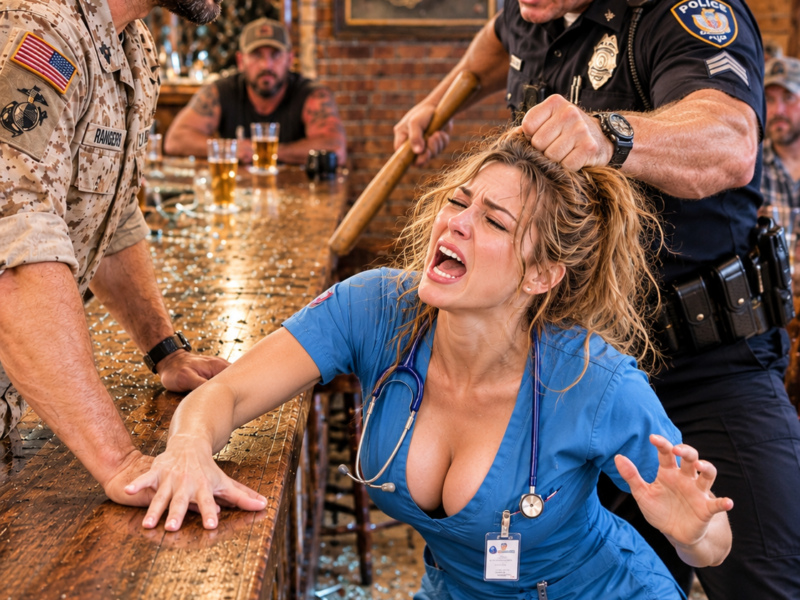
“I was standing beside the memorial wall at a small veterans’ bar in Virginia Beach when a deputy sheriff grabbed my wrist
The commander folded the photograph carefully and looked toward the deputy.
“Before we discuss anything else, I want you to step away from this young woman.”
Deputy Travis Cole hesitated.
For the first time since he’d grabbed my wrist, he seemed unsure of himself.
“I didn’t do anything illegal,” he muttered.
Mike, the bartender, stepped forward.
“Travis, there are cameras in here. You grabbed her, threatened her, and refused to let her leave.”
Cole looked toward the ceiling.
A small security camera was mounted above the memorial wall.
The commander nodded toward the entrance.
“Leave your contact information with the manager. We’ll deal with the rest through the proper channels.”
Cole straightened his uniform.
“You military guys think you can walk into any place and run things.”
The man with the scar shook his head.
“No. We just know when someone needs help.”
Cole glanced at the fifty men surrounding him.
Then he turned and walked toward the door.
Before leaving, he looked back at me.
“This isn’t over.”
I wanted to say something.
Anything.
But the commander stepped between us.
“Actually, Deputy, it is. And if you contact her again, she’ll have witnesses and video evidence.”
The door closed behind him.
Only then did I notice how badly my hands were shaking.
The commander pulled out a chair.
“Emily, would you sit down?”
I looked at the photograph.
“I think I need an explanation first.”
He nodded.
“That’s fair.”
He introduced himself as Commander Robert Hayes, a retired Navy SEAL who had served alongside my father.
The man with the scar was Marcus Reed, a former senior chief who had known my father for almost twenty years.
The other men weren’t all active-duty SEALs, as I’d initially assumed.
Some were retired operators, corpsmen, support personnel, and veterans who had served with my father.
But all of them had gathered at The Harbor Line for the same reason.
They were remembering a man who had saved their lives.
And they had been waiting for me.
I sat down.
“Why?”
Hayes placed the photograph on the table.
“Because your father made us promise something.”
“What promise?”
“That if you ever came here wearing that anchor, we’d tell you the truth.”
I touched the pendant.
It was small, silver, and slightly worn around the edges.
My father had given it to me when I graduated from nursing school.
He had fastened the chain around my neck himself.
“Why didn’t he tell me?”
Hayes looked down.
“Because he didn’t want you to carry the weight of what happened.”
I frowned.
“What happened?”
He glanced toward Marcus.
Marcus pulled out the chair opposite me.
“Your father saved my life during an operation off the coast of Somalia.”
I looked at him.
“My father was a Navy corpsman. He worked in medical support.”
Marcus nodded.
“That’s what the official paperwork said.”
“What does that mean?”
Hayes answered.
“Your father was a Navy medical specialist assigned to support a special operations team. He wasn’t a SEAL, but he worked with us closely enough that we considered him one of our own.”
I looked at the fifty men.
They were listening without interrupting.
One of them, an older man with a white beard, held a glass between both hands.
Another had placed a photograph of my father on the table.
I recognized the smile immediately.
He was wearing a baseball cap backward, laughing at something outside the frame.
I hadn’t seen that expression in years.
“Tell me what happened,” I said.
Hayes took a breath.
“Fifteen years ago, our team was sent to assist in the evacuation of a group of civilians from a coastal area where armed militants had taken control.”
He explained that the mission had been expected to last several hours.
It became a disaster after their transport vehicle was struck during an extraction.
Several men were injured.
Communication was lost.
And the team was trapped in an exposed area with limited medical supplies.
“My father was there?”
“He was already treating two wounded men when the second attack happened.”
Marcus leaned forward.
“One of the men had a serious abdominal injury. Another had lost a lot of blood. Your father was trying to keep both alive while the rest of us secured the perimeter.”
I swallowed.
“What did he do?”
“He refused to leave them.”
Marcus looked down at his hands.
“We received an order to withdraw. The situation was deteriorating, and command believed another rescue attempt would put more lives at risk.”
“But my father stayed?”
“He stayed because one of our men couldn’t be moved.”
Hayes paused.
“That man was me.”
I stared at him.
He continued.
“I had been wounded in the leg and was losing blood. Your father could have left me with the others and followed the evacuation plan. Instead, he organized a makeshift treatment station behind a damaged concrete structure.”
Marcus nodded.
“He used his own body to shield Hayes when another round came through.”
My throat tightened.
“Was he injured?”
Marcus looked at me.
“Yes.”
I felt my fingers close around the pendant.
“How badly?”
“Badly enough that he should have been evacuated immediately.”
Hayes placed both hands on the table.
“But he refused.”
I looked around the room.
“Why?”
Marcus answered quietly.
“Because he knew we weren’t all out.”
For a moment, nobody spoke.
Then the older man with the white beard pushed a photograph toward me.
It showed my father kneeling beside a young sailor, wrapping a bandage around his shoulder.
On the back was a date and a short message.
Mike says we’re going home.
I smiled despite myself.
My father had always been like that.
When I was little, I once fell off my bicycle and scraped my knee.
He had carried me into the house, cleaned the wound, and told me that the important thing wasn’t how far I fell.
It was knowing someone would help me stand again.
I had forgotten that story.
Or perhaps I had simply stopped allowing myself to remember the ordinary things.
“Did he save everyone?” I asked.
Hayes nodded.
“Every man who made it to the extraction point that day survived.”
“Then why did he never tell us?”
“Because the mission was classified, and because your father didn’t think what he did was extraordinary.”
Marcus gave a small, sad smile.
“He used to tell us that he was just doing his job.”
I looked at the folded photograph.
“But what happened three days after his funeral?”
Hayes went quiet.
The room seemed to become smaller.
“That’s the part your father asked us to keep from you until you were ready.”
I looked directly at him.
“I’m ready now.”
He didn’t answer immediately.
Instead, he reached into his jacket and removed a second envelope.
It was old, yellowed around the edges, and sealed with clear tape.
My name was written across the front.
The handwriting was my father’s.
I recognized the way he crossed the letter T.
Hayes slid it toward me.
“He left this with Marcus shortly before he died.”
My mouth went dry.
“Before he died?”
“Yes.”
“Then why didn’t anyone give it to me at the funeral?”
Marcus looked genuinely uncomfortable.
“Because we didn’t know whether you wanted anything to do with his military life. Your father made us promise not to contact you unless you came here yourself.”
I looked at him.
“That’s not an answer.”
“No,” he admitted. “It isn’t.”
He explained that my father had asked them to wait until I was old enough to understand that his work had involved people who would never appear in photographs or family stories.
He hadn’t wanted me to think of him only as a uniform.
He wanted me to remember the man who made pancakes on Sunday mornings, sang badly in the car, and never missed one of my school performances.
I stared at the envelope.
Then I opened it.
Inside was a letter and a small photograph.
The photograph showed my father with Hayes, Marcus, and three other men.
They were standing outside a medical tent.
My father had one arm around a young sailor.
Everyone was smiling.
I unfolded the letter.
My sweet Emily,
If you’re reading this, then you found your way to The Harbor Line.
I hope they treated you well. Those men can be stubborn, especially Marcus.
I laughed softly.
Marcus looked down, smiling.
I continued.
There are things I never told you because I wanted you to have a life that wasn’t shaped by the worst moments of mine.
I know you sometimes wondered why I came home quiet. Why I woke up at night. Why I spent so much time sitting in the garage after everyone else had gone to bed.
It wasn’t because I didn’t want to talk to you.
It was because I didn’t always know how to explain what I’d seen.
My eyes began to sting.
You once asked me why I chose medicine instead of something easier.
I told you I liked helping people.
That was true, but it wasn’t the whole truth.
I had watched good men die because nobody could reach them in time. I had watched people survive injuries they should never have survived. I learned that sometimes the smallest act of kindness can be the difference between someone giving up and trying one more time.
I stopped reading.
I could hear the soft clinking of glasses behind me.
No one interrupted.
I continued.
I am proud of you for becoming a nurse.
Not because you followed my footsteps, but because you chose a profession where you will meet people on the worst days of their lives and still find a way to treat them like human beings.
A tear fell onto the page.
There is one thing I need you to understand.
Those men will tell you I saved their lives. Maybe I did. But they saved mine, too.
When I came home after that mission, I struggled more than I ever admitted. I was angry, exhausted, and ashamed of how frightened I had become.
They called. They visited. They sat with me when I couldn’t sleep. They reminded me that I was still the same man.
I never wanted you to think courage meant never being afraid.
It means allowing people to stand beside you when you are.
The last paragraph was shorter.
If you ever need a family outside the one you were born into, look around that room. You won’t have to ask twice.
Love always,
Dad.
I lowered the letter.
For a few seconds, I couldn’t speak.
Then I looked at Hayes.
“Why did you say I was wearing the anchor?”
He pointed toward my pendant.
“Your father wore the same symbol on a small chain beneath his uniform. He gave you the matching one before his final deployment.”
I nodded.
I remembered.
He had placed it in my palm at the kitchen table.
“Keep it close,” he’d said.
I’d thought it was just a father’s gift.
Now I understood that it had meant something to him beyond its shape.
Marcus leaned forward.
“Emily, there’s another reason we wanted you here tonight.”
I wiped my cheeks.
“What?”
He looked toward the memorial wall.
“Your father helped establish this place.”
I followed his gaze.
The Harbor Line wasn’t just a bar.
It was a place where veterans could come without needing to explain why they couldn’t sleep, why they missed someone, or why a certain date made them quiet.
My father and several of the men had helped the original owner create the memorial wall.
They had wanted a place where nobody would be treated like a problem simply because they were having a hard day.
“Your father used to say that a man shouldn’t have to earn the right to sit somewhere in peace,” Marcus explained.
I glanced toward the entrance where Deputy Cole had disappeared.
Something inside me tightened.
“Then why was that deputy allowed to behave like that?”
Hayes’ expression hardened slightly.
“That’s a fair question.”
Mike approached with a glass of water.
“Travis has caused trouble here before.”
I looked at him.
“Before?”
Mike nodded.
“He used to come in after his shifts. Sometimes he was fine. Sometimes he tried to intimidate people, especially younger veterans who didn’t know how to challenge him.”
“Why didn’t you report him?”
“I did. More than once.”
He lowered his voice.
“Nothing changed.”
Marcus looked toward the door.
“Then tonight he made the mistake of choosing someone who wasn’t alone.”
I glanced down at my wrist.
There was a red mark where Cole had grabbed me.
“Does he know any of you?”
Hayes nodded.
“He’s been involved in several calls involving veterans.”
“Is that why he was angry when he saw my badge?”
Mike answered.
“Partly. He has a habit of treating people in uniforms like they owe him an explanation.”
I thought about the way Cole had looked at my hospital badge.
The way he’d mocked me for being a nurse.
The way he’d acted as if I had no right to stand near the memorial wall.
I had spent the entire evening thinking I was the problem.
But I wasn’t.
And neither were the veterans he’d apparently treated the same way.
“Are you going to do something about him?” I asked.
Hayes nodded.
“Mike has agreed to preserve the security footage. We’ll provide statements. You’ll be able to file your own complaint, and we’ll support the process.”
I looked at Marcus.
“I don’t want anyone getting special treatment because they know fifty military men.”
He smiled faintly.
“Neither do we.”
That surprised me.
He continued.
“If you want this handled properly, we make sure the evidence is preserved and let the authorities do their jobs. Nobody touches him. Nobody threatens him. That’s what your father would have expected.”
I nodded.
For the first time that night, I felt the ground beneath me again.
The following Monday, I filed a formal complaint.
Mike provided the video footage.
Three patrons gave written statements.
I also submitted photographs of the bruising on my wrist.
The department opened an internal review.
Deputy Cole was placed on administrative leave while the incident was investigated.
I didn’t celebrate.
I knew how difficult it was to challenge someone with authority.
And I knew an investigation could be uncomfortable, slow, and frustrating.
But I had learned something that night.
Silence often protects the person who already has power.
I wasn’t willing to contribute to that silence.
Two weeks later, I returned to The Harbor Line.
The memorial wall had been cleaned.
Someone had added a small brass plaque beneath my father’s photograph.
It read:
Michael Carter
Navy Corpsman
A man who never left someone behind.
I stood in front of it for a long time.
Marcus approached carrying two cups of coffee.
“Your father hated coffee,” he said.
I laughed.
“He drank it every morning.”
“That’s because he thought it made him look tough.”
I smiled.
For the first time since his death, I heard someone tell a story about my father that I hadn’t already heard from my mother.
Marcus told me about the time Dad had tried to repair a broken radio with a spoon.
About the night he had fallen asleep during a briefing and woken up insisting he had been listening the entire time.
About how he had once given away his own jacket to a sailor who was shivering in the rain.
Small things.
Ordinary things.
The things that made him more than the uniform in the photograph.
I asked Marcus why the men had all stood up when the deputy grabbed me.
He considered the question.
“Because we recognized the pendant.”
“Just because of that?”
“No.”
He looked at the memorial wall.
“We stood because your father taught us that when someone is being mistreated, you don’t sit there pretending you didn’t see it.”
I swallowed.
“And the commander?”
Marcus smiled.
“He stood because he knew your father would have done the same.”
I looked around the room.
There were only twelve men there that evening.
The other forty or so had gone home.
But their photographs and memories remained.
I realized that the fifty men hadn’t surrounded Deputy Cole because they wanted to intimidate him.
They had stood together because none of them wanted a young nurse to feel alone in a place her father had helped build.
A week later, I received a letter from Commander Hayes.
It wasn’t long.
He wrote that the department’s review was continuing and that several previous complaints were being examined.
He also included a photograph.
It showed my father standing in front of The Harbor Line years earlier.
He was younger, wearing a Navy jacket and holding a toolbox.
Behind him, a few men were installing the original memorial wall.
On the back, my father had written:
Someday, Emily will understand why this place matters.
I placed the photograph in a frame beside my father’s old Navy picture.
Then I returned to work.
The hospital was still the hospital.
There were still long shifts, difficult patients, and days when I questioned whether I was good enough to do the job.
But something had changed.
I no longer thought of my father’s pendant as simply a piece of jewelry.
It reminded me that kindness wasn’t weakness.
And standing up for someone didn’t always require shouting or fighting.
Sometimes it meant refusing to look away.
Several months after the incident, the department announced that Deputy Cole had been disciplined following the investigation.
The findings included the conduct at The Harbor Line and earlier substantiated complaints.
I was informed that I could pursue further legal action if I wished.
I decided to let the process continue without making my life revolve around him.
He had already taken enough of my peace.
One Friday evening, I returned to the bar after work.
Mike had saved me a seat near the memorial wall.
I ordered ginger ale.
Marcus was there with Hayes and several others.
They waved me over.
I sat beside them.
For the next hour, we talked about ordinary things.
A football game.
The hospital.
A broken coffee machine.
Someone’s granddaughter getting accepted into college.
At one point, an elderly veteran entered alone.
He stood near the doorway, looking at the photographs.
Nobody rushed him.
Nobody demanded to know why he was there.
Marcus simply stood, walked over, and offered him a chair.
“There’s room here,” he said.
The man hesitated.
Then he sat down.
I watched him accept a glass of water from Mike.
His shoulders gradually relaxed.
And I understood something about the memorial wall that I hadn’t understood when I first walked into the bar.
It wasn’t only there to remember the people who had died.
It was there to remind the living that they still belonged somewhere.
Before leaving, I stopped in front of my father’s photograph.
I touched the silver anchor at my neck.
“Thanks, Dad,” I whispered.
Then I looked at the plaque beneath his picture.
A man who never left someone behind.
For years, I had believed my father left me only memories.
That night, I finally understood he had also left me people who remembered him, a place where I would always have a seat, and a lesson I hoped I would never forget.
I had walked into The Harbor Line thinking I was alone.
I walked out knowing that sometimes family isn’t just the people who share your name.
Sometimes it’s the people who stand up when someone tries to make you feel small.
The end.









