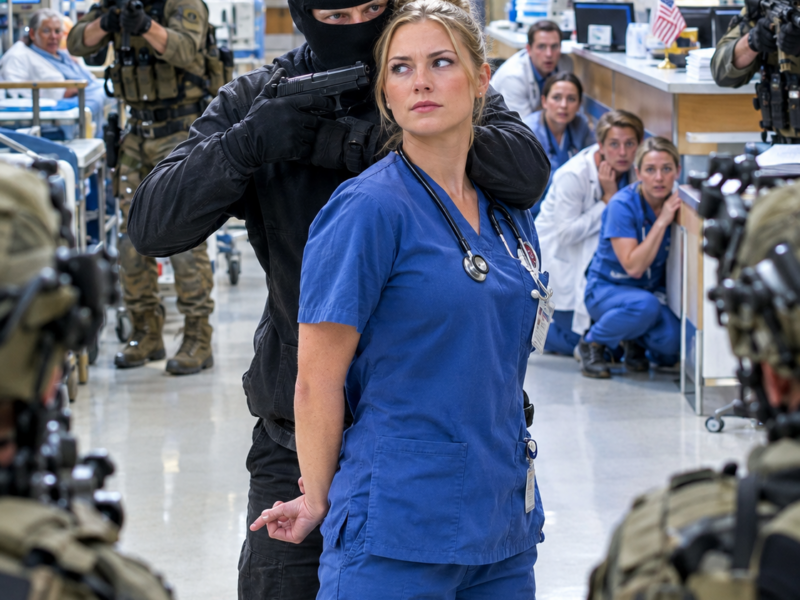
“I was kneeling beside a wounded hostage in the emergency room at Baltimore Memorial when a gunman grabbed me by the hair
Marcus’s fingers tightened around my hair as the door handle turned.
“Don’t move,” he whispered.
I kept my eyes on the reflection in the dark window of the supply cabinet. Marcus stood behind me, his injured side pressed against the edge of a counter, his pistol trembling just enough to tell me he was losing blood.
The door opened two inches.
“Rachel?” Detective Harris called. “Step away from him. We have the room covered.”
Marcus gave a humorless laugh.
“Covered by who, Detective? The same men who put a bullet in my back?”
“Put the gun down, Marcus.”
“You first.”
I watched Harris’s hand appear through the gap. His fingers were spread, palm visible, the familiar posture of someone trying to appear calm.
But his other hand remained hidden.
I had seen that mistake before. Men who wanted to look harmless often forgot that the rest of their bodies told a different story.
“Detective,” I said carefully, “you told me he killed an officer.”
“He did.”
Marcus’s grip tightened.
“Ask him which officer.”
Harris’s jaw shifted.
“Rachel, he’s manipulating you. He’s dangerous, and he’s already hurt someone today.”
“Then answer the question,” I said.
For one brief moment, Harris looked directly at me.
Not at the gun. Not at Marcus.
At me.
His expression changed, and I knew he had realized something.
I wasn’t panicking.
I was watching him.
“Officer Daniel Price,” Harris said. “Marcus shot him during an arrest attempt.”
Marcus shook his head.
“Price was alive when Harris left him.”
The room seemed to grow smaller.
Outside, I heard a radio crackle. Someone ordered the hallway cleared. The wheels of a medical cart squealed against the floor, then stopped.
I had a patient on the other side of the room who needed help. A security guard lay somewhere in the emergency department with a gunshot wound. Hundreds of people were trapped between a man with a pistol and a police detective who seemed far too interested in controlling the story.
I couldn’t afford to decide who was telling the truth based on who sounded more convincing.
I needed evidence.
“Marcus,” I said, “if you want me to believe you, tell me why you came here.”
He looked at Harris.
“Because the only copy of the file is in this hospital.”
Harris pushed the door wider.
“Enough.”
Marcus lifted the gun, and the detective immediately stepped back.
That was when I saw the object in Harris’s hidden hand.
A small black radio.
His thumb rested on a button.
Not the emergency channel.
A separate frequency, the kind used by specialized teams when they wanted to communicate without the main dispatch recording everything.
My stomach tightened.
I had used radios like that overseas.
I also knew the procedure Harris had just tried to use.
The phrase he’d given his team wasn’t standard police terminology. It was a variation of a military command designed to trigger a coordinated entry before a hostage could be moved.
Someone had taught him.
Someone who knew exactly what would happen when that command was spoken.
“Detective,” I said, keeping my voice level, “who taught you that entry protocol?”
His eyes narrowed.
“What?”
“The command you gave your team. Who taught you?”
Marcus stared at me.
For the first time since he had grabbed me, his expression held something other than desperation.
Recognition.
“You know it,” he murmured.
I ignored him.
Harris slipped the radio into his pocket.
“Rachel, I’m trying to get you out alive.”
“Then stop giving commands that make everyone outside move at once.”
A heavy thud struck the door.
Marcus flinched.
Harris’s face hardened.
“Last chance,” he said. “Put the weapon down, Marcus.”
“You’re not taking me anywhere,” Marcus replied. “Not until she sees it.”
He reached into the inner pocket of his jacket with his free hand.
“Don’t,” I warned.
He froze.
“Slowly,” I said. “Show me what you’re reaching for before you move.”
Marcus swallowed, then withdrew two fingers from the pocket. Between them was a small silver memory drive, stained dark red at one corner.
“This is what they killed Daniel for,” he said.
My heart gave one hard, painful beat.
Daniel.
Not my brother Daniel, I told myself. Not every man named Daniel was the one I had buried. But the name still reached straight through the years and found the scar I had spent so long pretending wasn’t there.
Harris saw my reaction.
“Don’t listen to him,” he said.
Marcus looked at me.
“Your brother served with a unit overseas, didn’t he?”
The pistol in his hand wavered.
I felt cold all over.
“How do you know about my brother?”
“Because he found the same thing I did.”
The room went silent except for the faint hiss of oxygen flowing from the wall.
My brother, Daniel Morgan, had died during a deployment three years earlier. The official report described an equipment failure during a routine transfer. I had been told there was no hostile involvement, no suspicious activity, no reason to question the findings.
I had believed it because believing anything else meant reopening a door I had barely managed to close.
Marcus watched my face.
“He sent a message before he died,” he said. “I was supposed to deliver it to someone he trusted.”
“Who?”
“You.”
Harris moved.
It was only a small shift, one foot sliding forward, but Marcus saw it and swung the pistol toward the door.
“Don’t take another step!”
The detective stopped.
I didn’t look at him. I couldn’t afford to.
“Why didn’t you contact me before today?” I asked Marcus.
“Because I didn’t know if you were alive.”
“I’m standing right here.”
“I know that now.”
He swallowed, and a thin line of sweat slid down his temple.
“Daniel gave me your name and the hospital. He said if anything happened to him, I should find you only when I had proof.”
“Proof of what?”
“That his death wasn’t an accident.”
I heard a radio crackle outside.
Then Harris spoke into the room, his voice low and sharp.
“Rachel, whatever he told you, he is a fugitive who shot an officer. You need to understand that he has every reason to invent a story.”
“Then why are you afraid of a memory drive?”
“I’m not.”
His answer came too quickly.
Marcus gave a short, exhausted smile.
“He always did talk too much when he was scared.”
The door shuddered again.
“Detective Harris,” a voice called from the hall. “We need a decision.”
Harris didn’t answer.
I could feel Marcus’s pulse racing where his arm pressed against my shoulder. He was losing strength. If he collapsed while still holding that gun, the weapon could discharge. If I tried to wrestle it away, he might fire on instinct.
And if Harris was part of whatever had happened to my brother, the hallway wasn’t necessarily safer than the room.
I needed to slow everything down.
“Marcus,” I said, “you need medical treatment. Right now.”
“I need you to look at the file.”
“I can do both, but not if you keep a gun pointed at people.”
He glanced at the weapon as if he had forgotten it was in his hand.
For a second, the man behind the gun looked less like a hardened criminal than someone who had spent too many hours being hunted.
“I can’t go with them,” he whispered.
“Then tell me why.”
His eyes flicked to Harris.
“Because they won’t let me reach a courtroom.”
The detective’s face turned stony.
“That is enough.”
“No,” I said.
The word came out louder than I intended.
Both men looked at me.
I took a slow breath.
“You want me to help you, Marcus? Put the gun on the floor. Push it away. Then let me stop the bleeding. If you’re telling the truth, you’ll need to be alive to prove it.”
He stared at me for a long moment.
Then he lowered the pistol.
“Don’t come closer,” Harris warned from the doorway.
Marcus crouched awkwardly, grimacing as pain tore across his face. He placed the gun on the tile and nudged it away with his shoe.
It skidded beneath the far counter.
I stepped sideways, putting space between myself and the weapon, then moved toward the trauma cart.
“Hands where I can see them,” I told Marcus.
He raised both hands.
“Good. Sit down.”
He sank onto the edge of the bed.
The moment I turned toward the supplies, Harris tried to enter.
Marcus jerked upright.
“Stay back!”
Harris stopped again.
I looked at him over my shoulder.
“If you want him alive, let me treat him.”
“I want him in custody.”
“Then let me keep him conscious enough to get there.”
For a few seconds, nobody moved.
Finally, Harris stepped back into the hall.
“Fine. Treat him.”
He spoke into his radio.
“Hold position. No entry until I give the word.”
There it was again.
The same cadence. The same carefully clipped phrasing.
The same unnatural pause before the last three words.
I had heard it once before, years ago, in a briefing room thousands of miles away.
My hands stopped over the dressing tray.
A voice from the past came back to me with startling clarity.
If the lead officer gives the final command before visual confirmation, the team does not enter. That phrase is the abort trigger.
It had been part of a classified hostage-response exercise conducted by a joint special operations group. The wording wasn’t supposed to appear in any civilian training manual.
Harris hadn’t simply learned military terminology.
He had learned a procedure designed to prevent a team from rushing into a hostage situation.
And he was using it to control everyone outside the room.
I pressed gauze against Marcus’s wound.
He hissed through his teeth.
“Sorry,” I said. “Keep breathing.”
“Are you going to help me?”
“I’m going to help you survive. The rest depends on the truth.”
I examined the wound without removing the embedded fragment of torn fabric. The bleeding was significant, but Marcus was still alert. I needed a proper team, not a solo rescue attempt. The emergency department had been designed for crises, and I wasn’t going to let my past turn me into someone who ignored the people best equipped to help.
I glanced at the call button near the bed.
Harris noticed.
“Don’t call anyone else,” he said.
I looked straight at him.
“You don’t get to decide that.”
His hand disappeared into his jacket again.
Marcus stiffened.
I raised my voice.
“Detective, take your hand out of your pocket. Slowly.”
The hallway fell quiet.
Harris stared at me as if he couldn’t decide whether to laugh or threaten me.
“You’re a nurse, Rachel.”
“Yes,” I replied. “And I am asking you to keep your hands visible in a hospital room with a wounded patient and an armed response team outside.”
For the first time, I saw uncertainty in his eyes.
He withdrew his hand.
It was empty.
“Now,” I said, “I need the trauma team. If you want this handled without more injuries, let them work.”
Harris looked toward the hall.
Then he nodded once.
I pressed the call button.
Within seconds, the hospital’s emergency physician, Dr. Patel, arrived with two nurses and a trauma technician. The armed officers stayed outside while Harris spoke to them through the gap in the door.
I gave Dr. Patel a concise report.
“Adult male, penetrating wound to the right flank, significant blood loss, conscious and responsive. Weapon is out of immediate reach beneath the counter. We need to maintain distance and keep his hands visible.”
Dr. Patel didn’t ask why I sounded so calm.
He simply began issuing medical orders.
As the team worked, I stepped aside and kept Marcus talking.
“Tell me about Daniel.”
His eyes followed me.
“He was investigating missing equipment shipments,” Marcus said. “Not weapons shipments at first. Medical supplies, communications equipment, things that were supposed to reach a forward operating base.”
“What did he find?”
“Some shipments were being redirected. The paperwork said they arrived. The people who needed them never received them.”
“Who was responsible?”
“I don’t know the whole chain. But there was a contractor involved. A company called Northstar Strategic Logistics.”
The name meant nothing to me.
“Daniel found duplicate manifests,” Marcus continued. “One version showed the supplies delivered. Another showed they had been sold to a private buyer. He copied the records and sent them to an investigator.”
“Who?”
“An internal oversight officer. Someone who was supposed to protect whistleblowers.”
“And instead?”
“Daniel died. The investigator disappeared. The case was closed.”
My throat tightened.
“Why didn’t the official report mention any of this?”
“Because the records were changed. The messages were deleted. And someone claimed Daniel had violated protocol.”
I could barely hear him over the monitor.
“Who made that claim?”
Marcus looked at the door.
“Harris.”
Dr. Patel glanced at me, then returned to the patient.
I forced myself to breathe.
“My brother died three years ago,” I said. “You expect me to believe a detective in Baltimore had something to do with a deployment overseas?”
“I expect you to look at the drive.”
“Why did you shoot the security guard?”
Marcus closed his eyes.
When he opened them again, they were wet.
“He tried to stop me from reaching the hospital entrance. I panicked. I didn’t mean to hit him.”
“That doesn’t undo what happened.”
“I know.”
For the first time, he sounded ashamed rather than defensive.
“I made a choice. Now a man may die because of it.”
His gaze dropped to the floor.
“I can’t change that. But I can tell the truth about Daniel.”
I wanted to hate him for bringing my brother into this room, for dragging my past into a life I had built so carefully. But the shame in his voice sounded real, and the wound beneath his hand was not a story he could talk his way out of.
I could believe that he had done terrible things and still be willing to hear what he knew.
Those truths weren’t mutually exclusive.
When the trauma team had stabilized him enough for transport, Dr. Patel asked for a secure route to the operating area.
Harris immediately objected.
“He stays here until we complete the interview.”
“He needs surgery,” Dr. Patel replied.
“He’s a suspect.”
“He’s also a patient with internal bleeding. You can arrange custody without interfering with medical treatment.”
Harris stepped into the room.
“This is a police matter.”
“And this is a hospital,” Dr. Patel said. “You don’t get to overrule a medical emergency.”
For one glorious second, Harris had no answer.
Then the radio at his shoulder crackled.
A different voice came through.
“Unit Three, confirm the status of the package.”
Harris went completely still.
Not the patient.
Not the suspect.
The package.
He reached for the radio, but I was already looking at the small camera mounted above the door.
Its red indicator light was on.
Every word had been recorded.
Harris noticed me watching it.
His face changed.
“Turn that camera off,” he ordered.
Dr. Patel looked up.
“Why?”
“Patient privacy.”
“The camera records the hallway and the entrance during security incidents. It doesn’t record the examination area.”
Harris’s eyes moved to the lens again.
He knew that.
Which meant he hadn’t been worried about patient privacy.
He’d been worried about the recording.
“Detective,” I said quietly, “what exactly is the package?”
He didn’t answer.
Two officers appeared behind him. One was young, tense, and clearly unsure why the detective had called for a special team to stand outside a hospital room.
The other was a woman with short dark hair and a gold badge clipped to her belt.
She looked at Harris, then at me.
“I’m Lieutenant Naomi Brooks,” she said. “Internal Affairs. Detective Harris, step away from the patient.”
Harris stared at her.
“Who called you?”
“Someone in dispatch flagged your radio traffic.”
“I was managing an armed hostage situation.”
“Then you won’t mind explaining why you used a restricted response code and referred to a wounded suspect as a package.”
The color drained from his face.
Marcus let out a weak breath.
“Told you,” he murmured.
Lieutenant Brooks didn’t look at him.
She kept her eyes on Harris.
“Hands where I can see them.”
For a moment, I thought he might run.
Instead, Harris raised his hands with a slow, theatrical calm.
“This is a setup. The suspect has manipulated the scene, and the nurse is involved.”
“I’m involved in treating a patient,” I said. “That’s all.”
Brooks turned to me.
“Are you willing to make a statement?”
“Yes.”
“Good. Don’t discuss the incident with anyone until we can take your account.”
She looked toward the trauma team.
“Get him to surgery. My people will secure the route.”
Harris’s jaw tightened.
“You have no idea what you’re interfering with.”
“Then explain it,” Brooks said.
He said nothing.
As Marcus was wheeled toward the operating area, his hand reached weakly toward mine.
“The drive,” he whispered.
I looked toward the counter.
The small silver device was still there, lying beside a bloodied piece of gauze.
I picked it up with a gloved hand and placed it in a clear evidence bag, then handed it to Lieutenant Brooks.
“I haven’t opened it,” I said. “He says it contains records connected to my brother’s death.”
Brooks studied the label on the bag.
“Your brother’s name?”
“Daniel Morgan.”
Her expression shifted, just slightly.
“You should come with me after your statement.”
“Why?”
“Because this may be bigger than a local police investigation.”
She turned to one of her officers.
“Secure the evidence. Log every transfer. Nobody accesses that device without a documented chain of custody.”
Harris gave a sharp laugh.
“You think a memory stick is going to bring down anyone?”
Brooks looked at him.
“No. But your reaction to it might.”
The operating doors closed behind Marcus.
For the first time in nearly an hour, I could hear the ordinary sounds of the hospital again: phones ringing, nurses calling out medication doses, a child crying somewhere down the corridor.
The emergency department had not become safe.
But it had become a place where people could begin asking the right questions.
And that was a start.
The next several hours blurred into statements, forms, and the difficult work of returning a hospital to normal after a violent incident.
The security guard, whose name was Luis Ortega, survived surgery. The bullet had passed through his upper arm without damaging a major artery. When I heard the news, I sat down in an empty consultation room and let myself cry for the first time that afternoon.
I cried for Luis.
I cried for the patients who had watched a gunman take control of their emergency department.
And I cried for my brother, whose name had suddenly become part of a case that someone had tried very hard to bury.
Lieutenant Brooks waited until I was ready before joining me.
She carried two paper cups of coffee and set one on the table.
“Marcus Reed is out of surgery,” she said. “He’s stable. He’ll be under guard while he recovers.”
“Will he be charged?”
“Yes. The shooting, the hostage situation, the assault. Those charges aren’t going away because he brought us evidence.”
I nodded.
“And the evidence?”
“It’s been transferred to a digital forensics team. They’ve made a verified copy and are examining the contents.”
“Have you found anything?”
Brooks hesitated.
“We found an encrypted folder. The metadata indicates it was created three years ago, shortly before your brother’s death.”
I stared at the coffee.
“Can you open it?”
“Not yet. But the drive also contains several unencrypted files. One is a scanned shipment manifest with your brother’s signature.”
My hands began to shake.
“His signature?”
“Yes. The document appears to have been altered after he signed it. We won’t know more until the forensic team completes its analysis.”
I looked up.
“Did Harris know my brother?”
Brooks took a breath.
“Detective Harris worked with a federal task force that investigated contractor fraud. Three years ago, he was temporarily assigned to a joint inquiry involving overseas logistics. The inquiry was closed without charges.”
“Why?”
“According to the official record, there wasn’t enough evidence.”
“And now?”
“Now we have reason to reopen it.”
She leaned forward.
“Rachel, I need to ask you something. When Harris entered the room, did he say anything about the evidence before you mentioned it?”
“No. He told me Marcus was a murderer. Then he tried to control the room.”
“Did he try to take the drive?”
“He didn’t know I had it until Marcus showed it to me.”
Brooks wrote something down.
“And the radio command?”
I told her exactly what I had heard and why it had caught my attention. I explained that I’d received specialized training years earlier, but I made clear I was not an active-duty operator and had not been involved in any military mission since leaving service.
Brooks listened without interrupting.
When I finished, she folded her notebook shut.
“That may explain why he wanted you in that room,” she said.
“Why would he want me?”
“Because he may have recognized your name. Or because someone told him you were the intended recipient of the evidence.”
I thought of Daniel’s final letters, the ones I had kept in a shoebox at the back of my closet. The last one had arrived weeks before his death. He had written about the weather, a terrible cup of coffee, and how he hoped I’d finally taken a vacation.
Nothing about missing supplies.
Nothing about an investigator.
Nothing about danger.
“He never told me he was investigating anything,” I said.
“Maybe he was protecting you.”
I shook my head.
“That’s what people say when they don’t know what else to say.”
Brooks accepted the rebuke without flinching.
“You’re right. We don’t know yet.”
That honesty earned more of my trust than any promise could have.
She stood.
“Go home when you’re finished here. We’ll contact you as soon as we have something concrete. And Rachel?”
I looked at her.
“Don’t assume everyone involved in this investigation is compromised. But don’t assume a badge makes someone trustworthy, either.”
After she left, I sat alone for a while.
I had spent three years trying to make peace with a death I believed I understood. Now I had a memory drive, a detective under investigation, and a brother whose final months might have been nothing like I had imagined.
The truth was coming.
I wasn’t sure I was ready for it.
Two days later, Lieutenant Brooks called me at home.
The forensic team had recovered the files.
I returned to the station that afternoon, carrying Daniel’s last letter in my bag. I didn’t know why I’d brought it. Maybe I wanted something of his with me that wasn’t evidence.
Brooks led me into a small interview room where a computer displayed a scanned document.
At the top was the logo of Northstar Strategic Logistics.
Below it was a shipment number, a delivery date, and a list of medical supplies marked as received at a forward operating base.
Near the bottom was Daniel’s signature.
I recognized it immediately.
He had a habit of making the final stroke of the letter M extend too far beneath his name. When I was a child, he’d signed my birthday cards that way, and I used to tell him his handwriting looked like a mountain range.
The signature on the document looked right.
But the date was wrong.
Daniel had been on leave when the manifest claimed he had authorized the delivery.
“Someone copied his signature onto a false record,” I said.
“That’s our preliminary assessment,” Brooks replied. “The original file was modified after the shipment date. We also found a series of emails between a contractor representative and an investigator assigned to the task force.”
“Who was the investigator?”
Brooks brought up another document.
The name was Paul Harris.
I closed my eyes.
The detective’s face returned to me: the way he had watched my reaction, the way he had reached for his radio when Marcus mentioned the drive.
“What did the emails say?”
“They suggest Harris knew the manifests were altered. They also show that he asked for your brother’s report to be classified as an administrative failure rather than a criminal inquiry.”
“Why?”
“We don’t know whether he was protecting the contractor, protecting himself, or following instructions from someone higher up.”
“Did he order Daniel’s death?”
Brooks didn’t answer immediately.
“We have no evidence proving that. We have evidence that he helped suppress the investigation afterward. Those are serious allegations, but we have to be precise.”
I appreciated the distinction, even though it hurt.
I wanted someone to tell me exactly what had happened to Daniel. I wanted a name, a confession, and a reason that would make three years of grief suddenly make sense.
Instead, I had a trail of documents and a system that would require time to untangle them.
“What about Marcus?” I asked.
“He says he was a logistics contractor working at the same base. He copied the records after Daniel asked him to preserve them. After Daniel died, Marcus tried to contact the oversight investigator, but that person disappeared. He kept the drive and went into hiding.”
“And the officer he supposedly killed?”
“Officer Price survived. He was injured during the arrest attempt, but he is alive. Marcus believed he had been sent to silence him. We haven’t confirmed that belief.”
“So Marcus was wrong about the officer?”
“He was wrong to shoot him, whatever he believed. But there are indications that someone used the arrest operation to get hold of the drive.”
I stared at the screen.
“Why bring it here? Why put a gun to my head?”
“Marcus says he didn’t know whether you were still at the hospital. He believed he was being followed and thought he had only minutes to get the evidence to you.”
“He could have called the police.”
“He didn’t trust the police.”
I almost laughed.
That was the cruelest part. His distrust had not come from nowhere. But his fear had turned him into the very danger he claimed to be running from.
“Did he know I had served?”
Brooks shook her head.
“He says Daniel told him you were medically trained and could recognize his records. He didn’t know about your special operations background.”
I sat back.
For years, I’d tried to separate the nurse I was from the person I had been before. I’d convinced myself that leaving the service meant leaving that life behind.
But the skills I’d carried into civilian medicine had helped me recognize Harris’s command, keep Marcus talking, and buy time for the truth to surface.
I had not become someone else.
I’d simply learned how to live with both parts of myself.
“What’s next?” I asked.
“Federal investigators are taking over the contractor case. Harris has been suspended pending a full investigation. We expect more interviews and possibly more charges once the evidence is verified.”
“And Daniel?”
Brooks turned the computer toward me.
“There is one more file.”
The screen showed an audio recording dated two days before Daniel’s death.
My mouth went dry.
“Have you listened to it?”
“Yes,” she said. “But I want you to know that it may be difficult to hear.”
I nodded.
She pressed play.
Static filled the room. Then came a voice I knew as well as my own.
“Rachel, if you ever hear this, I’m sorry.”
I covered my mouth.
Daniel sounded tired, but calm. Behind him, I could hear a fan or an engine humming.
“I should have told you what I was working on. I thought keeping you out of it would keep you safe. Maybe I was wrong.”
There was a pause.
“The records are real. Someone is selling supplies that were meant for our people, then making the paperwork say everything arrived. When I questioned it, they told me to sign off and forget it. I wouldn’t.”
Another pause. A faint click.
“If something happens to me, don’t let anyone turn this into a story about me making a mistake. I didn’t make one. I found something they didn’t want found.”
His voice softened.
“I love you, little sister. Whatever happens, don’t spend your life waiting for the world to become fair before you let yourself be happy.”
The recording ended.
For a long time, I couldn’t move.
I’d spent three years remembering the last conversation we’d had. Daniel had called while I was finishing a shift, and I’d told him I was too tired to talk for long. He’d teased me about working too much. I’d promised to call him the next day.
I never got the chance.
I had replayed that conversation so often that it had become a punishment.
Now, hearing his voice again, I realized how unfairly I had treated myself. I hadn’t known. He hadn’t wanted me to know. And the love between us had never depended on one final phone call.
I wiped my face.
“Can I have a copy?”
“Once the evidence team authorizes a personal copy, yes,” Brooks said. “We’ll make sure you receive one.”
I nodded.
“What happens to Marcus?”
“He’ll face the charges. His cooperation may be considered, but he won’t be exempt from responsibility.”
“Good.”
Brooks studied me.
“You don’t sound angry.”
“I am angry.”
“At him?”
“At everyone who made this possible. At Harris. At the people who altered those records. At Marcus for putting a gun to my head. At myself for believing a report just because it had official letterhead.”
I took a breath.
“But anger doesn’t get to decide what happens next.”
The investigation lasted months.
Harris was eventually charged with obstruction of justice, evidence tampering, and conspiracy connected to the falsified logistics records. Investigators found financial links between him and a senior contractor executive. They did not establish that Harris had ordered Daniel’s death, and no one was able to prove who had planned the fatal operation.
That part of the truth remained unfinished.
But the official finding about Daniel’s death was reopened, and the record that had described his work as an administrative failure was corrected. His actions were formally recognized as an attempt to report criminal misconduct.
Northstar Strategic Logistics lost its government contracts. Several executives were indicted, and a wider review uncovered other missing shipments and falsified reports.
Marcus pleaded guilty to the assault and hostage-related charges. He also testified about the evidence he had preserved. He apologized to Luis Ortega in a letter that Luis chose to read but not answer.
I visited Luis once after he returned to work.
He was still angry, and he had every right to be. His arm was healing, but he told me he sometimes woke at night remembering the sound of the gunshot.
I listened.
I didn’t tell him Marcus had been desperate, or that the case had exposed corruption. None of that changed what Luis had endured.
Before I left, he thanked me for staying calm that day.
“I wasn’t calm,” I told him. “I was choosing what to do with the fear.”
He considered that.
“Maybe that’s what courage is.”
I carried his words with me.
Six months after the hostage incident, I returned to the hospital for a regular shift. The trauma bay was loud, crowded, and familiar. A child had fallen from a bicycle. An elderly man was struggling to breathe. Someone in the waiting room was arguing about insurance.
Life had resumed its ordinary chaos.
I washed my hands and stepped into the first treatment room.
For a moment, I thought of the gun against my forehead, Harris’s hidden radio, and the memory drive lying in a pool of blood on the counter.
Then I looked at the patient in front of me.
He needed a nurse.
Not a soldier. Not a witness. Not a sister trying to solve her brother’s death.
A nurse.
So I got to work.
I still carried Daniel’s last letter in my bag. The audio recording was saved on my phone, and sometimes I listened to it on the drive home. I no longer used it to punish myself for the call I’d missed. I listened because I wanted to remember his voice as it really was: warm, teasing, and full of a future he had believed I deserved.
I never learned every detail of what happened overseas. Some witnesses were gone. Some records had been destroyed. Some people who knew the truth were never charged.
But the lie about my brother no longer stood unchallenged.
And the next time someone looked at my hospital badge and assumed it told them everything about me, I let them.
I didn’t need the world to know what I had been trained to do.
I only needed to know what I would do when it mattered.
On the day Marcus chose the wrong nurse, he thought he had found someone he could use to escape.
He found someone who would keep him alive long enough to face what he’d done.
And in the end, the truth did not come from a gun, a threat, or a perfect tactical plan.
It came from a nurse who refused to look away.
THE END.









