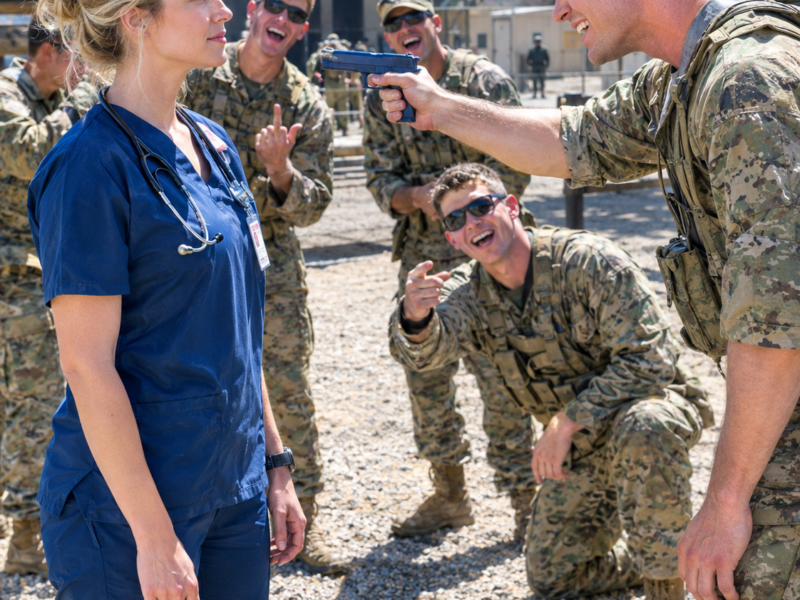
“I was halfway through treating a bleeding cadet in the naval academy infirmary when his commanding officer shoved a pistol against my temple
For several seconds, I couldn’t hear anything except the fluorescent lights humming above me.
Admiral Whitaker stood beside the treatment-room door, waiting.
Commander Hayes had stopped trying to explain himself. His eyes kept moving between the admiral and me, as though he were searching for a way to turn what he’d witnessed into something that could still be controlled.
I looked at Whitaker.
“Who told you about that report, sir?”
His expression tightened.
“That isn’t an answer.”
“It’s the only question I’m willing to answer until I know why you’re asking.”
The master chief beside him shifted his weight. He was an older man with silver hair, a weathered face, and the kind of stillness I remembered from men who had spent their careers around people capable of making terrible decisions.
Whitaker studied me for another moment.
Then he nodded toward the security officers.
“Take Commander Hayes and Cadet Grant to separate rooms. Secure the weapon, preserve the medical records, and make sure neither man contacts anyone involved in this incident.”
Hayes stiffened.
“Admiral, with respect, this is a disciplinary misunderstanding.”
Whitaker turned toward him.
“A cadet pointed a loaded firearm at a medical professional while you stood by and encouraged him. If you believe that qualifies as a misunderstanding, Commander, I strongly suggest you stop talking until someone with investigative authority arrives.”
The security officers escorted Hayes out.
Grant followed, his face pale and his hands trembling.
At the doorway, he looked back at me.
For the first time since he’d entered my treatment room, he looked like a frightened young man rather than an untouchable cadet.
I almost felt sorry for him.
Almost.
When the door closed, Whitaker pulled a chair away from the wall but didn’t sit.
“Six years ago, a Navy SEAL team disappeared during an operation in the eastern Mediterranean,” he said. “Three men died. Two came home with serious injuries. One of those survivors was a Navy corpsman named Claire Bennett.”
“I know what happened to me, Admiral.”
“Do you know what happened to the report?”
My throat tightened.
“No.”
Whitaker finally sat down.
“The official investigation concluded that your team entered the target area using intelligence you knew was unreliable. It stated that you acknowledged receiving a warning about an ambush and chose not to pass it to the team leader.”
I stared at him.
“That’s a lie.”
“I know.”
The words came so quietly that I almost missed them.
I gripped the counter.
“Then why did nobody correct it?”
Whitaker looked toward the closed door.
“Because the people who could have corrected it were either dead, reassigned, or afraid of what the correction would expose.”
I felt the old pressure building behind my ribs, the same sensation I’d spent six years learning to breathe through.
Three names came back to me before I could stop them.
Petty Officer Daniel Ruiz.
Chief Petty Officer Marcus Cole.
Senior Chief Ethan Brooks.
I could still remember the sound of Ruiz laughing over a terrible cup of coffee the night before the mission. I remembered Cole checking the buckles on every man’s gear twice, even though he’d inspected them himself. I remembered Brooks telling me that if I ever got tired of the Navy, I should open a little clinic somewhere near the ocean.
They had all believed they were coming home.
I had been the one who came back carrying their blood on my uniform.
“I gave my statement,” I said. “I told the investigators exactly what happened.”
Whitaker nodded.
“Your signed statement was replaced.”
The room seemed to tilt.
“Replaced with what?”
“A document claiming you had received a warning that the operation’s intelligence was compromised and had deliberately withheld it.”
I shook my head.
“That warning came after we were already moving.”
“According to the recovered communications, yes.”
“Then you have the transmission logs.”
“We do.”
“Radio traffic?”
“Some of it.”
“Mission timestamps?”
“Several independent sources.”
I laughed once, without humor.
“Then this should have taken a week to clear up.”
“It should have.”
He looked down at his hands.
“But the investigation was closed in nine days.”
Nine days.
Three men dead, two men wounded, and a woman blamed for a decision she hadn’t made.
Nine days was all it had taken to turn my name into something I couldn’t bear to hear spoken aloud.
I stepped away from the counter and sat on the edge of the examination table.
“Why are you telling me this now?”
Whitaker reached inside his uniform jacket and removed a thin folder.
“Because yesterday morning, an anonymous source sent a copy of the original communications archive to the inspector general. The archive contains a transmission that was never included in the official investigation.”
I stared at the folder.
“What transmission?”
“The one in which the team leader requests permission to abort the mission after discovering the intelligence discrepancy.”
My hands went cold.
Marcus Cole had made that request.
I remembered standing beside him in the cramped operations room, watching the signal break apart through static.
He’d asked for confirmation.
The answer had come back telling us to proceed.
“Who authorized us to continue?” I asked.
Whitaker didn’t answer immediately.
He opened the folder and turned a page toward me.
At the bottom of a printed transcript was a call sign I hadn’t seen in six years.
Then, beneath it, a signature.
Commander Richard Hayes.
I looked up so quickly that the folder slipped from his hand.
“Hayes wasn’t on that mission.”
“No,” Whitaker said. “He was working in intelligence operations at the time. His name appears in the communications chain as the officer who relayed the final authorization.”
I stared at the page.
“Why was he in my treatment room today?”
“That’s what I’m trying to establish.”
I thought of the way Hayes had entered the room, the way he’d demanded that I falsify Grant’s report, the way he had watched a cadet put a pistol against my head without the slightest hesitation.
Then I remembered something else.
When Hayes had first looked at me, there had been a moment of recognition in his eyes.
Not the kind that came from meeting a nurse.
The kind that came from seeing someone you had hoped never to encounter again.
“He knew who I was,” I whispered.
Whitaker nodded.
“We believe he recognized your name when you were assigned to the academy. We don’t yet know whether he knew your full service history had been restored to the personnel archive.”
“My service history was never supposed to be restored.”
“Someone requested it three weeks ago.”
I looked at him.
“Who?”
“The request came through an administrative office. It carried the credentials of a retired intelligence officer who died two years ago.”
For a moment, neither of us spoke.
Outside, I heard footsteps pass the treatment-room door.
The academy was continuing with its ordinary afternoon, students crossing courtyards, instructors moving between buildings, bells marking the hour.
Inside, the past I had buried was beginning to come apart.
“Admiral,” I said, “I need to see the original transmission.”
Whitaker closed the folder.
“You will. But first, I need you to understand something. If the archive is authentic, this isn’t just about clearing your name. Someone may have altered an official investigation, concealed evidence, and knowingly sent a team into danger.”
“Three men died.”
“I know.”
“No, sir.” My voice cracked despite my effort to control it. “You know their names. I knew what their children called them.”
Whitaker lowered his eyes.
That was the first moment I saw something beyond authority in his face.
Regret.
“I’m sorry, Claire.”
I looked away.
An apology couldn’t give Ruiz back to his daughter. It couldn’t put Cole back at his wife’s kitchen table or let Brooks finish the clinic he’d talked about building.
But it was the first honest thing anyone in authority had said to me about those deaths in six years.
And I didn’t know what to do with it.
The investigation began before sunset.
A special team from the Navy’s inspector general arrived at the academy, followed by two investigators from the Naval Criminal Investigative Service.
They interviewed me in a small conference room overlooking the Severn River.
I told them about the cadet, the weapon, and Hayes’s demand that I falsify the medical report. Then I answered their questions about my service history.
One investigator, a woman named Special Agent Laura Mitchell, listened without interrupting.
When I finished, she placed her pen on the table.
“Ms. Bennett, I need to ask you something that may seem unrelated.”
“Go ahead.”
“Have you received any unusual phone calls, messages, or visitors in the past month?”
I thought about it.
“No.”
“Has anyone asked you about your former unit?”
“No.”
She opened a second folder.
“Have you ever heard the name Daniel Mercer?”
The room went quiet around me.
I knew that name.
Daniel Mercer had been a communications specialist attached to our operation. He wasn’t one of the men who had died, and he hadn’t been among the survivors who returned with me.
He’d been questioned during the investigation, then transferred to a different command.
I’d never heard from him again.
“Why are you asking about Mercer?”
“His name appears in the newly recovered archive. He was responsible for logging the incoming intelligence messages on the night of your mission.”
I leaned forward.
“Then he can confirm when the warning came through.”
“Possibly. We haven’t located him yet.”
“How long have you been looking?”
“Since this morning.”
I studied her face.
“You think he’s involved.”
“I think someone made a deliberate effort to remove his name from the final report.”
She slid a photograph across the table.
It showed a man in his late forties leaving a building with a briefcase. His hair had gone gray at the temples, and his face was partially turned away from the camera.
“Is that Daniel Mercer?” I asked.
“Yes. The image was taken four days ago in Norfolk, Virginia.”
I examined it more closely.
“Then he isn’t missing.”
“Not necessarily. We haven’t confirmed that he still lives at the address we have on file.”
I looked up.
“What happens if you find him?”
“We ask him what he knows.”
“And if he refuses to talk?”
Mitchell closed the folder.
“Then we find out why.”
When the interview ended, she gave me her office number and told me not to contact anyone connected to the old operation.
I agreed.
I meant it, too.
But as I drove home that evening, I kept seeing the photograph of Mercer.
Four days ago.
Someone had known where he was.
Someone had known where I worked.
And someone had been willing to use the academy’s own hierarchy to put pressure on me.
The question was whether Hayes had acted alone.
I lived in a modest apartment above a bakery on the quieter side of Annapolis.
The smell of fresh bread usually reached the stairwell before I unlocked my door. That night, I barely noticed it.
I set my keys on the kitchen counter and stood in the dark, looking at the small framed photograph beside the refrigerator.
It had been taken during my last week with the team.
Ruiz was grinning at the camera, one arm around Cole’s shoulders. Brooks stood behind them with a coffee cup in his hand, pretending he didn’t want to be photographed.
I was on the far right, younger by six years, my hair tucked beneath a cap.
I had kept the photograph because throwing it away had felt like abandoning them a second time.
My phone rang.
An unknown number.
I almost let it go to voicemail.
Then I answered.
“Hello?”
A man’s voice came through, rough and quiet.
“Claire Bennett?”
“Who’s calling?”
“My name is Daniel Mercer.”
I gripped the phone.
“Where are you?”
“Somewhere I can talk for about five minutes before I have to disappear again.”
“Agent Mitchell is looking for you.”
“I know.”
“Then you should call her.”
“I will. But not before I tell you what happened to your report.”
I glanced at the photograph.
“How did you get this number?”
A pause.
“I’ve had it for six years.”
The answer unsettled me more than it should have.
“Why didn’t you contact me?”
“Because I was told that if I did, the people who buried your statement would make sure the whole team was remembered as incompetent, reckless, and responsible for their own deaths.”
My mouth went dry.
“Who told you that?”
“Richard Hayes.”
I sat down slowly.
Mercer’s voice softened.
“Claire, I need you to listen carefully. The transmission you heard that night wasn’t the only one. There was another message, sent before your team left the staging area.”
“What did it say?”
“It warned that the target location had changed and that the original intelligence was no longer reliable.”
I closed my eyes.
That was the warning the official report had claimed I’d received and ignored.
But I’d been treating a wounded sailor when the message first came in. I hadn’t seen it until Cole called me over.
By then, the team was already preparing to move.
“We reported the discrepancy,” I said. “Cole requested an abort.”
“I know.”
“And command ordered us forward.”
“Yes.”
I stood and began pacing.
“Then why did the investigation say I knew about the warning beforehand?”
“Because someone altered the timestamps.”
The words landed with the weight of a physical blow.
Mercer continued.
“They changed the time the warning was logged, then removed the transmission in which Cole asked for permission to abort. The replacement statement made it look as though you had received the warning, understood the danger, and deliberately withheld it from the team.”
I pressed my free hand against the counter.
“Why would anyone do that?”
“Because the operation wasn’t supposed to happen the way it did.”
I waited.
Mercer drew a shaky breath.
“The target location had been changed because a source inside the organization we were tracking had warned that our original approach was compromised. That source wasn’t supposed to be anywhere near the final objective.”
“Who was the source?”
“I never learned his name. But I saw the authorization file. Someone wanted the operation completed before the intelligence could be independently verified.”
“Who?”
“I think Hayes knows. I also think he was following instructions from someone above him.”
“Who?”
“I don’t have enough proof to say.”
My anger rose so quickly I had to put the phone down for a second.
“Three men died, Daniel. You can’t call me after six years and tell me you think someone gave a bad order.”
“I’m not calling to tell you that.”
His voice cracked.
“I’m calling because I signed the original transmission log. I watched them replace it. I was a coward, Claire. I told myself I was protecting my family. I told myself that if I stayed quiet, the truth would eventually come out on its own.”
I closed my eyes.
“Why now?”
“Because someone tried to break into my house last week. They didn’t take money or electronics. They took the backup drive I kept hidden in a fireproof box.”
I stared at the dark window.
“Did you keep a copy?”
“Yes.”
A long silence followed.
“Where is it?”
“I’ll tell you when we meet.”
“Daniel, you need to meet the investigators.”
“I will. But I need to know you understand something first.”
“What?”
“The person who ordered that operation wasn’t trying to get your team killed.”
For a moment, I couldn’t speak.
Mercer continued.
“They were trying to reach someone before he disappeared. Your team was supposed to secure him and bring him out. The operation was rushed because someone believed he was about to expose a much larger intelligence breach.”
“Then why send us in without verified intelligence?”
“Because someone had already decided the risk was acceptable.”
I gripped the edge of the counter until my fingers hurt.
“Who was the target?”
Mercer hesitated.
“I don’t know his real identity. But I know what happened after the mission failed.”
“What?”
“The man you were sent to retrieve was never listed among the casualties. He disappeared from every record I could find.”
I thought of the empty spaces in the official report, the unexplained gaps in the communications archive, the way the investigation had closed before anyone could question the timeline.
“Daniel, where can I meet you?”
“Tomorrow morning. Seven o’clock. There’s a diner near the old waterfront in Norfolk called Harbor Light. I’ll be in the back booth.”
“You should tell Mitchell.”
“I will. But I need you to bring one thing.”
“What?”
“Your original field notebook.”
I stopped pacing.
My notebook was locked in a small metal box beneath my bed.
It contained the notes I’d made during the operation, including the times I had treated the wounded and the messages I’d heard over the radio.
I’d given the investigators a copy six years ago.
The original had never left my possession.
“How do you know I still have it?”
“Because I saw you put it away the morning after we returned.”
My stomach tightened.
“Who else knows about it?”
“I don’t know.”
The call ended.
I remained standing in the kitchen long after the screen went dark.
Then I went to the bedroom, pulled the metal box from beneath the bed, and unlocked it.
The notebook lay exactly where I’d left it, its edges softened by time.
I opened to the page marked with the date of the mission.
My own handwriting stared back at me.
02:14 — Cole requests abort. Intelligence discrepancy confirmed.
02:19 — Command orders team to proceed.
02:27 — First contact.
I ran my finger over the second entry.
I remembered writing it in the back of the transport vehicle, my hands shaking from adrenaline while I tried to make sure I wouldn’t forget the sequence of events.
The official report had claimed that I received the warning at 01:52.
My notebook showed that I didn’t learn about it until after 02:00.
I turned the page.
At the bottom, beneath a note about Ruiz’s injuries, was a sentence I’d written so quickly that the letters slanted into one another.
Ask Cole why command already knew our target had moved.
I stared at it.
I had forgotten writing those words.
Or perhaps I had spent six years trying not to remember them.
Because even on the night of the mission, something had told me that the intelligence failure wasn’t an accident.
And I had never asked Cole what he knew.
At seven the next morning, I arrived at Harbor Light.
The diner sat between a marine supply store and a boarded-up office building, its windows fogged from the heat inside.
A waitress poured coffee into thick white mugs while a radio played softly behind the counter.
I spotted Mercer in the back booth.
He looked older than he had in the photograph. His shoulders were hunched, and he kept glancing at the entrance.
I slid into the seat opposite him.
“You look terrible,” I said.
He gave a faint, tired smile.
“So do you.”
For a moment, neither of us knew what to say.
Then I placed the notebook on the table.
Mercer didn’t touch it.
“Did you bring it?”
“Yes.”
“Good.”
He reached into his coat and removed a small flash drive.
“This contains the original transmission log, the altered version, and the audit trail showing which credentials were used to change the timestamps.”
I looked at the drive.
“Why didn’t you give this to the investigators yesterday?”
“Because the audit trail points to a classified access system. I wanted to know whether the people looking into this case had the authority to protect the evidence.”
I studied him.
“You’re still afraid.”
“Every day.”
He looked down at his hands.
“I have a daughter, Claire. She’s twenty-two. She thinks I spent my career doing routine communications work. I didn’t want her to grow up knowing her father helped bury the truth about three dead sailors.”
I softened despite myself.
“Then help us bring it out.”
He nodded.
Before he could hand me the drive, the bell above the diner’s entrance rang.
Mercer’s face changed.
I turned.
A man in a navy-blue jacket walked inside, scanned the room, and headed straight toward our booth.
He was tall, clean-shaven, and perhaps in his early fifties. His expression was calm in a way that made me more nervous than open hostility would have.
“Mr. Mercer,” he said. “You’ve been difficult to reach.”
Mercer slid the drive beneath his hand.
“Who are you?”
The man produced a leather credential wallet.
“Special investigator assigned to the intelligence review.”
I glanced at the badge.
Something about it felt wrong.
Not obviously fake. The seal looked right, and the identification had the polished appearance of an official document.
But the man hadn’t shown it to the waitress, and he hadn’t identified himself to anyone else in the diner.
He had come directly to our table.
“May I see your authorization?” I asked.
His eyes moved toward me.
“Ms. Bennett. I’m familiar with your case.”
“Then you know NCIS is conducting the investigation.”
“I do. I’m here to coordinate the classified portion.”
“With which agent?”
His expression barely shifted.
“That information is restricted.”
I leaned back.
“Then you won’t mind waiting while I call Special Agent Mitchell.”
For the first time, the man looked annoyed.
“You’re making this unnecessarily difficult.”
Mercer began to rise.
The man placed a hand on his shoulder.
“Sit down.”
I saw Mercer flinch.
That was enough.
I stood and stepped out of the booth.
“Take your hand off him.”
The man’s gaze hardened.
“Ms. Bennett, I suggest you remember your position.”
I’d heard that sentence before.
In a medical room.
From a man who believed that rank gave him the right to intimidate anyone beneath him.
I took out my phone.
“Agent Mitchell,” I said when she answered, “I’m at Harbor Light in Norfolk. Someone claiming to be part of the classified review just approached Daniel Mercer. I need you to verify his credentials.”
The man reached toward my phone.
I moved it out of his reach.
“Don’t.”
For one second, he looked as though he might grab it anyway.
Then he stepped back.
“You have no idea what you’re interfering with.”
“That’s what I’m trying to find out.”
He turned and walked out.
Through the window, I watched him get into a dark sedan and drive away.
Mitchell stayed on the line.
“Claire, don’t leave the diner. We’re sending agents now.”
I looked at Mercer.
He had gone pale.
“That wasn’t an investigator,” he whispered.
“How do you know?”
“Because I know who he works for.”
He took the flash drive from beneath his hand and placed it in front of me.
“That’s the man who came to my house last week.”
Within twenty minutes, two NCIS agents arrived and secured the diner.
Mercer gave them a statement. I handed over my notebook and the flash drive, and Agent Mitchell arranged for both of us to be taken to a secure facility for further interviews.
The drive contained more than Mercer had described.
There were original radio logs, altered copies of the investigation documents, and a chain of electronic approvals connecting the mission’s final authorization to an intelligence office far above Hayes’s position.
One name appeared repeatedly in the access records.
Vice Admiral Robert Vance.
He had been a rear admiral at the time of our mission, serving as a senior official overseeing intelligence coordination.
Now he was one of the most influential officers in the Navy.
When Mitchell showed me his photograph, I recognized him immediately.
I’d seen him once during a briefing before the operation.
He had stood at the front of the room, speaking about urgency and national security. He’d never met my eyes.
I remembered thinking he seemed more concerned with the briefing schedule than the men who would be entering the target area.
“Does this prove he ordered the mission to proceed?” I asked.
“Not by itself,” Mitchell said. “The authorization records show his office approved the operation. They don’t yet establish what he knew about the compromised intelligence.”
“What about the altered report?”
“The access logs show that someone used credentials linked to his office to open the investigation files after the operation.”
“Can you prove he made the changes?”
“Not yet.”
I leaned forward.
“Then what do you need?”
“A witness who can explain why the changes were made, and evidence that connects the alterations to a specific decision.”
Mercer, seated across the room, lifted his head.
“I can explain part of it.”
Mitchell turned toward him.
Mercer swallowed.
“After the operation, I was called into a secure office. Commander Hayes was there, along with a civilian intelligence adviser. They showed me the original logs and told me the investigation was going to be handled at a higher level.”
“Did you see Admiral Vance?”
“No. But the civilian adviser said the admiral’s office wanted a clean report before the next congressional briefing.”
Mitchell’s expression sharpened.
“Did he use those words?”
“Yes.”
“Can you identify the adviser?”
Mercer nodded.
“I saw him at the diner this morning.”
The room went silent.
Mitchell looked at me, then back at Mercer.
“You’re certain?”
“I’ve spent six years trying to forget his face. I’m certain.”
The next few hours unfolded in a blur of interviews, document reviews, and calls between investigators.
By early afternoon, NCIS had identified the man from the diner as a former intelligence contractor who had worked under Vance’s office. His credentials had been revoked years earlier, but someone had recently accessed a restricted personnel system to create a temporary authorization under a similar name.
The deception was deliberate.
The man had been sent to recover the drive before the investigators could examine it.
That alone didn’t establish who had ordered him to act.
But it told us someone knew the evidence existed.
At four o’clock, Admiral Whitaker arrived.
He entered the conference room without his usual entourage and sat beside Mitchell.
“I’ve spoken with the inspector general,” he said. “The investigation will be expanded to include the original operation, the altered report, and the unauthorized contact with Mr. Mercer.”
He turned toward me.
“Your name will be formally cleared once the evidence has been reviewed and the findings are approved.”
I looked at him.
“I don’t need a ceremony, Admiral. I need the truth about the men who died.”
He nodded.
“Then that’s what we’ll pursue.”
I wanted to believe him.
But I had learned that the distance between an honest promise and a completed investigation could be measured in years.
And I wasn’t willing to spend another six waiting for someone else to decide my life was worth correcting.
Three days later, I was called to a secure conference room at the Navy Yard in Washington, D.C.
Vice Admiral Robert Vance sat at the far end of a polished table.
He was older than I remembered, with white hair and a face that had become practiced at appearing calm under pressure.
Commander Hayes sat to his right, accompanied by legal counsel.
Neither man looked pleased to see me.
Admiral Whitaker stood near the wall, while Special Agent Mitchell arranged the recovered documents in front of me.
Vance folded his hands.
“Ms. Bennett, I understand you’ve been through a difficult experience at the academy.”
I looked at him.
“Is that what you’re calling six years of being blamed for three deaths?”
His jaw tightened.
“The circumstances of that operation were classified. The investigation was conducted under extraordinary pressure.”
“Then explain why my statement was replaced.”
Vance glanced at Mitchell.
“The documents are still being authenticated.”
“The timestamps match my notebook. The original transmission logs match the radio traffic. Mr. Mercer has testified that he witnessed the alterations.”
“Mr. Mercer is a compromised witness who failed to report alleged misconduct for six years.”
I turned toward him.
“You’re right about one thing. He should have spoken sooner.”
Mercer had given his statement under protection that morning. I had spoken with him briefly afterward, and he had made no attempt to excuse his silence.
“But his delay doesn’t change what the records show,” I continued. “You had the authority to stop that mission. Someone in your office approved it after the intelligence was compromised. Then someone changed the report to make it look like I was responsible.”
Vance’s expression hardened.
“You weren’t in a position to understand the strategic considerations.”
“I was in a position to treat the men who paid for them.”
The room went still.
Hayes shifted in his chair.
Vance turned toward him.
“Commander, did you alter the investigation records?”
Hayes looked at his attorney.
“I acted on instructions from the intelligence office. I believed the changes were necessary to protect a classified source.”
“Did you alter Ms. Bennett’s statement?”
Hayes swallowed.
“I didn’t personally edit the final document.”
“That wasn’t the question.”
His face reddened.
“I provided the replacement language.”
I felt a cold calm settle over me.
There it was.
Not an excuse, not an accusation, not a carefully worded denial.
An admission.
Mitchell wrote something down.
Whitaker remained motionless.
Vance leaned forward.
“The commander was operating under extraordinary circumstances. The operation involved a sensitive source whose exposure could have endangered lives across multiple theaters.”
“Then why wasn’t the source protected without blaming me?” I asked.
He didn’t answer.
“Why were the timestamps changed?”
No answer.
“Why did the investigation close in nine days?”
Vance’s mouth tightened.
“Because the Navy needed to preserve operational stability.”
I stared at him.
“Three families were told that a corpsman had failed their sons. You preserved stability by giving them someone to blame.”
For the first time, the admiral’s composure faltered.
“The decision was made to prevent a larger intelligence failure from becoming public before the source could be secured.”
“And was the source secured?”
Vance looked down at the documents.
Mitchell spoke before he could answer.
“The individual identified in the recovered records was never secured by the team. He disappeared after the operation. His whereabouts remain unknown.”
I watched Vance.
“Did you know that when you approved the report?”
He said nothing.
The silence told me more than any denial could have.
Whitaker finally stepped forward.
“Admiral Vance, this meeting is being recorded. You are required to preserve all records related to the operation and to cooperate with the inspector general’s investigation.”
Vance’s face became rigid.
“You don’t have the authority to threaten me.”
“I’m not threatening you,” Whitaker said. “I’m telling you that the evidence will be examined by people who are not under your command.”
For several seconds, the two admirals looked at each other.
Then Vance gathered his papers.
“I have nothing further to add.”
He stood and left with his attorney.
Hayes remained seated.
As the door closed, he turned toward me.
“I didn’t know they’d put a gun to your head.”
I looked at him.
“You stood there while it happened.”
“I was trying to control the situation.”
“No. You were trying to control me.”
He lowered his eyes.
For a moment, I thought he might apologize.
Instead, he said, “You have no idea what pressure I was under.”
I rose from my chair.
“You’re right. I don’t know what pressure you were under six years ago. But I know what you chose to do when you had the power to tell the truth.”
I walked out before he could answer.
The investigation took four months.
There were no dramatic press conferences and no sudden parade of officers confessing everything they had done.
There were interviews, subpoenas, document reviews, and long stretches when nobody would tell me whether the case was moving forward.
Some days, I felt as though I were back in the months after the mission, waiting for someone to decide what my memories were worth.
But this time, I wasn’t alone.
Mercer testified before the inspector general and provided the original communications archive. His evidence, combined with my notebook and the recovered system logs, established that the official timeline had been deliberately altered.
Hayes was removed from his command responsibilities while the investigation continued. He eventually admitted to supplying the false language used in my replacement statement and to helping conceal the missing transmission.
He claimed he had believed he was protecting a sensitive intelligence source.
The investigators found that his actions had protected the people responsible for the operation’s failures instead.
Vance was relieved of his duties pending further proceedings. The review concluded that his office had authorized the operation to continue despite unresolved intelligence concerns, then participated in the effort to limit the damage by shifting responsibility onto me.
The report did not answer every question about the missing source.
Some records had been destroyed before the investigation began, and the individual we had been sent to retrieve remained unaccounted for.
But the central truth was no longer in dispute.
I had not withheld the warning.
I had not caused the deaths of my teammates.
And the statement used to condemn me had never been mine.
The Navy issued a formal correction to my service record and sent written notifications to the families of Ruiz, Cole, and Brooks.
I received my own copy in a plain envelope.
There was no medal ceremony, no applause, no speech about courage.
Just several pages of official language acknowledging what should have been acknowledged six years earlier.
I read the correction once.
Then I read it again.
When I reached the sentence stating that the findings against me were unsupported by the evidence, my hands began to shake.
I sat at my kitchen table until the light outside faded.
For six years, I had imagined that clearing my name would feel like taking off a heavy pack after a long march.
Instead, it felt like discovering that I had been carrying something so long that my body had forgotten how to stand without it.
The report could restore my record.
It couldn’t restore the years I had spent avoiding old friends because I didn’t know how to explain what the Navy had said about me.
It couldn’t return the sleep I’d lost or the conversations I’d never had with the families of the men who died.
I had spent so long believing that I needed to prove I wasn’t responsible that I hadn’t considered what I would do once the proof finally existed.
For the first time in years, I had no mission to complete.
Two weeks after the correction was issued, I drove to Virginia to visit Daniel Ruiz’s family.
His daughter, Sofia, had been eight when he died.
I remembered her as a little girl with two missing front teeth, clutching a stuffed dolphin while her father crouched beside her at a family event.
Now she was fourteen.
She opened the front door wearing a sweatshirt several sizes too large and looked at me with her father’s dark eyes.
“You’re Claire,” she said.
I nodded.
“Yes.”
“My mom said you might come.”
She stepped aside.
The house smelled of cinnamon and laundry detergent. A framed photograph of Ruiz stood on a shelf near the living room, his uniform crisp, his smile wide enough to show the small gap between his front teeth.
His wife, Elena, came in from the kitchen and wiped her hands on a dish towel.
For a moment, we simply looked at each other.
Then she walked over and hugged me.
I hadn’t prepared for that.
My arms stayed at my sides for one awkward second before I hugged her back.
“I’m sorry,” I whispered.
She pulled away and looked at me.
“For what?”
“For not coming sooner. For not being able to tell you everything. For letting you believe—”
“Claire.”
Her voice was gentle but firm.
“We read the corrected report.”
I swallowed.
“I know it doesn’t bring Daniel back.”
“No. It doesn’t.”
She glanced toward the photograph.
“But for six years, I wondered whether he had died because someone on his team had failed him. I wondered whether there was something I should have seen, something I should have asked, something I should have known.”
Her eyes filled.
“I don’t have to wonder that anymore.”
Sofia stood near the stairs, listening.
She looked at me for a long moment.
“Did my dad know he wasn’t coming home?”
The question was so direct that I couldn’t hide behind official language.
“No,” I said. “He believed we would all make it back.”
“Was he scared?”
I thought of Ruiz checking his equipment, making jokes about the terrible coffee, and asking whether I thought his daughter would still be interested in marine biology when she got older.
“Yes,” I said. “Sometimes. But he was also funny, stubborn, and the kind of person who noticed when somebody else was afraid.”
Sofia looked down at her hands.
“Mom says he would have liked that I want to study the ocean.”
“He would have been insufferable about it.”
A small smile appeared on her face.
“He would have told everyone?”
“Everyone. Including people who didn’t ask.”
Sofia laughed, and for one brief moment, I could almost hear her father laughing with her.
Before I left, Elena handed me a small envelope.
Inside was a photograph of Ruiz and me standing beside a transport vehicle, both of us exhausted and grinning at something outside the frame.
On the back, in his handwriting, were four words.
Make it home, Bennett.
I held the photograph carefully.
“I don’t know how to thank you,” I said.
Elena shook her head.
“You don’t have to thank us for believing the truth.”
I carried the photograph to my car and sat behind the wheel for a long time before starting the engine.
For the first time since the mission, remembering Ruiz didn’t immediately feel like reopening a wound.
It felt like remembering a man I had loved as a teammate.
There was a difference, and I was beginning to understand it.
A month later, I returned to the academy medical wing.
I had considered leaving after the investigation, but the thought of giving Hayes the satisfaction of driving me away made me reconsider.
More importantly, the young men who came through those doors still needed medical care, whether they understood the value of it or not.
The room had been repainted. A new tray sat on the counter, and the damaged cabinet had been repaired.
The academy had also changed its procedures for reporting misconduct and handling weapons in medical facilities.
I didn’t know whether those changes would last.
I only knew that they existed because someone had finally been forced to look at what happened when authority went unchallenged.
On my first morning back, a young cadet appeared at the door with a split eyebrow.
He hovered near the entrance.
“Are you Nurse Bennett?”
“I am.”
He glanced at the treatment table.
“I got hit during training. I think I need stitches.”
“Then come sit down.”
He hesitated.
“I heard about what happened.”
I pulled on my gloves.
“Most people have.”
“People are saying you’re some kind of special operator.”
I looked at him.
“I’m a nurse.”
“But you used to be—”
“I’m still a nurse,” I said. “And right now, you’re bleeding on my floor.”
He sat down immediately.
I cleaned the wound, examined his eye, and explained how many stitches he would need.
He was nervous, but he followed instructions.
When I finished, he looked at the small bandage in the mirror.
“Thank you, ma’am.”
“Keep it clean. Come back if you develop a fever, worsening pain, or changes in your vision.”
He nodded and left.
I watched him disappear down the corridor.
The truth about my past had become public enough that strangers had begun treating me differently. Some looked at me with admiration. Others seemed disappointed that I didn’t match the stories they had heard.
I couldn’t control what they imagined.
I could control how I treated the person sitting in front of me.
That was enough.
Later that afternoon, Admiral Whitaker stopped by.
He stood near the doorway, his hands clasped behind his back.
“I heard you’re staying.”
“I am.”
“Good.”
He glanced toward the new tray.
“I also wanted to tell you that the academy has approved a review of how junior personnel can report misconduct without fear of retaliation.”
“That’s a start.”
He smiled faintly.
“You haven’t made it easy for anyone to offer you praise.”
“I’m not looking for praise.”
“I know.”
He stepped farther into the room.
“Claire, there’s something else. The Navy would like to offer you a position helping train medical personnel assigned to special operations units. Your field experience could save lives.”
I considered the offer.
Part of me wanted to return to the world I had left, to show that the worst thing that had happened to me wasn’t the only thing I was capable of doing.
Another part remembered the quiet mornings, the ordinary patients, and the simple comfort of being able to help someone without a classified file determining what my work meant.
“Thank you,” I said. “But I’m not ready to go back to that life.”
Whitaker nodded without arguing.
“Then stay here as long as you want.”
He paused at the door.
“And Claire?”
“Yes, sir?”
“I’m sorry it took six years for someone to listen.”
I looked down at the medical tray.
“So am I.”
After he left, I stood alone for a moment.
Then I straightened the instruments and returned to work.
On a cool Saturday morning in early spring, I drove to the Chesapeake Bay.
I brought the photograph Ruiz’s wife had given me, the corrected service record, and a small thermos of coffee.
The sky was pale gray, and the wind carried the smell of saltwater across the shoreline.
I sat on a wooden bench and watched the waves break against the rocks.
For years, I had believed that surviving meant carrying every memory exactly as it had happened, preserving every detail so that the men who died would never be forgotten.
But memory wasn’t a report.
It wasn’t a list of timestamps or a statement that someone could alter.
It was Ruiz making terrible jokes when the team was exhausted. It was Cole checking everyone’s equipment twice. It was Brooks talking about the clinic he wanted to build near the ocean.
They had been more than the way they died.
And I was more than the accusation that had followed me home.
I took the photograph from my coat pocket.
The four words on the back had begun to soften at the folds.
Make it home, Bennett.
I had spent six years believing that coming home meant leaving the mission behind.
Now I understood that home was something I had to build from whatever remained.
I couldn’t bring my teammates back.
I couldn’t recover every lost record or force every person who had failed us to feel the weight of what they’d done.
But I could tell the truth.
I could keep their names alive without allowing the lie to define them.
And I could stop punishing myself for surviving.
I placed the photograph beside me on the bench and let the wind move across my face.
For the first time in six years, the silence didn’t feel like something I had to endure.
It felt like room to breathe.
I picked up the photograph, tucked it safely into my coat, and walked back toward the parking lot.
The tide kept coming in behind me, covering the footprints I left on the sand, but not the path that had brought me there.
THE END.









