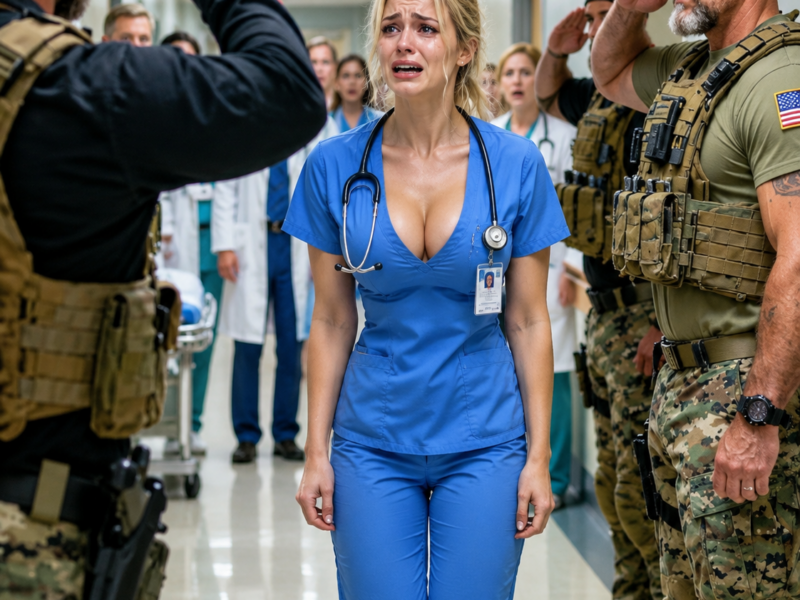
“I was changing a dying man’s IV in the emergency room when six Navy SEALs suddenly walked through the doors
“Ma’am, I think it’s time you heard what we’ve been trying to tell you.”
The alarm continued screaming from trauma bay one.
I didn’t have time to ask Marcus what he meant.
“Sarah, bring the crash cart. Get the blood bank on the phone. I need two units of O-negative blood ready.”
Sarah immediately moved.
Dr. Reynolds was already performing chest compressions while another nurse prepared the defibrillator.
I stepped beside the patient and looked at the monitor.
His blood pressure was collapsing.
“What’s his latest hemoglobin?” I asked.
“Still waiting on the lab,” Sarah answered.
“Don’t wait. Activate the massive transfusion protocol.”
Dr. Reynolds glanced at me.
“Emily, I’ve got this.”
“I know, Michael. But look at his abdomen.”
The patient’s stomach was visibly distended. His skin had turned pale, and the pulse in his neck was barely detectable.
I looked at the surgical resident.
“Possible internal hemorrhage. He needs an operating room now.”
“We’re waiting for the surgeon.”
“Then get him on the phone.”
Marcus stood near the entrance, watching everything.
I turned toward him.
“Your team needs to clear this hallway. We’re taking him to surgery.”
“Understood, Ma’am.”
He immediately directed the other operators away from the treatment area.
For the next eleven minutes, the emergency room became a blur of movement.
Blood products arrived.
The surgical team prepared the operating room.
Dr. Reynolds and I worked together to stabilize the patient long enough to move him.
As the stretcher rolled toward the elevators, the patient’s right hand suddenly caught my wrist.
His eyes opened slightly.
“Lieutenant…”
I leaned closer.
“You’re safe. Save your strength.”
His lips moved.
“Daniel…”
I stopped.
“What about Daniel?”
His fingers tightened weakly.
“He didn’t…”
The monitor began beeping faster.
“Chief Walsh, don’t try to talk.”
He looked directly at me.
“Not… his fault.”
Then his eyes closed.
The operating room doors swallowed him before I could ask another question.
I stood in the hallway, staring at the closed doors.
Marcus approached quietly.
“He knows.”
“Knows what?”
“About his brother.”
I turned toward him.
“Start talking.”
Marcus glanced at the other operators.
“Not here.”
I looked at the clock.
“Then you can wait. I’m not leaving this hospital until I know he’s stable.”
Marcus nodded.
“That’s exactly what I expected you to say.”
For the next two hours, I returned to my patients.
I checked Mr. Harris, whose blood pressure had finally improved.
I helped Sarah prepare a discharge packet.
I answered a call from radiology.
I did everything I normally did.
But every time the operating room doors opened, I looked up.
At 2:43 a.m., Dr. Reynolds finally came out.
He removed his surgical cap and rubbed his forehead.
“He’s alive.”
I released a breath I hadn’t realized I’d been holding.
“How bad?”
“Internal bleeding. A damaged spleen and significant blood loss. We managed to control it.”
“Neurologically?”
“Too early to tell. He’s going to intensive care.”
I nodded.
“Thank you.”
Dr. Reynolds studied me.
“Emily, can we talk?”
We walked into the small physicians’ lounge.
He closed the door.
“I’ve worked with you for six years.”
“I know.”
“I’ve seen you handle difficult cases. I’ve watched you stay after shifts to help families. But I’ve never seen six military operators salute a nurse.”
I looked at the floor.
“There’s a lot you don’t know.”
“Clearly.”
He pulled out a chair.
“Are you in some kind of trouble?”
“No.”
“Is the patient connected to something dangerous?”
I hesitated.
“I don’t think so.”
He looked at me carefully.
“Emily, I don’t need your entire military history. But if something from your past could affect the safety of this hospital or our patients, I need to know.”
I appreciated that he hadn’t demanded an explanation.
“I’ll tell you what I can when I understand it myself.”
He nodded.
“Fair enough.”
When I returned to the ICU waiting area, Marcus was sitting alone.
The other five SEALs had gone to retrieve their equipment and complete the required incident paperwork.
He stood as soon as he saw me.
“He’s stable?”
“For now.”
Marcus rubbed his hands together.
“Thank you.”
I sat across from him.
“Now tell me about Daniel.”
He took a breath.
“My older brother was Lieutenant Daniel Walsh. He served with your medical support unit in Afghanistan.”
I stared at him.
“Daniel Walsh?”
“Yes.”
I remembered him immediately.
Daniel had been thirty-four when I met him.
He had a habit of tapping his fingers against his rifle whenever he was thinking.
He was the kind of officer who remembered the birthdays of his junior men and always made sure the newest operator had enough food.
He had also been the man who went back into a burning compound to retrieve two wounded soldiers.
I had treated him twice during that deployment.
The second time, he had nearly died.
“What happened to him?” I asked.
Marcus looked down.
“That’s what I’ve spent twelve years trying to understand.”
He pulled a folded piece of paper from his uniform pocket.
It was a photograph.
The same photograph I had seen earlier.
My younger self stood beside seven operators.
Daniel was standing on my left.
Marcus pointed to him.
“That’s my brother.”
I nodded slowly.
“I remember.”
“He told our family you were the best medical officer he’d ever worked with.”
A faint smile touched my face.
“He used to complain that I made him drink too much water.”
Marcus smiled briefly.
“He complained about everything.”
Then his expression changed.
“Ma’am, the official report says my brother died during a hostile engagement after refusing an evacuation order.”
I said nothing.
“But another report says he was already dead before the helicopter arrived.”
My hands went still.
“Who gave your family that information?”
“A military liaison officer. He told my parents there had been no possibility of recovery.”
“And?”
Marcus reached into another pocket.
He removed a small envelope.
“My mother received this three months ago.”
The envelope was worn and had been opened carefully.
Inside was a photocopy of a handwritten note.
I recognized the handwriting before I finished reading the first line.
It was Daniel’s.
Emily,
If the operation goes wrong, remember what I told you about the northern ridge.
The coordinates in the briefing aren’t right.
Someone changed them.
Don’t let them make you believe we didn’t know.
Daniel.
I read it again.
Then a third time.
“Where did this come from?”
“My brother’s personal effects were returned to our family after the operation. This note wasn’t among them.”
I looked up.
“Who sent it?”
“No name. Just a return address in Virginia.”
“Why didn’t you contact me sooner?”
“We tried.”
Marcus pulled out his phone and showed me an old email.
It had been sent eleven months earlier.
The subject line read: Lieutenant Emily Carter.
I recognized the hospital address, but the message had been sent to an account I had stopped using years ago.
Marcus continued.
“We also contacted the Navy personnel office. They told us you had left active service and that your records were restricted.”
I stared at the note.
“What exactly do you think happened?”
Marcus hesitated.
“I think my brother discovered something before the mission. Something he wanted you to know.”
I looked toward the ICU doors.
“And Chief Walsh?”
“He was on the same mission. He survived, but he never spoke about what happened. Not to our parents. Not to me.”
“Why?”
“Because he believed he had failed Daniel.”
I slowly folded the note.
“Then we need to hear his version.”
Marcus nodded.
“That’s why he insisted on coming here.”
The next morning, I arrived at the ICU just after seven.
Chief Daniel Walsh was awake.
He looked considerably older than the man in the photograph, and the surgical dressings made him appear smaller.
But his eyes were the same.
He recognized me immediately.
“Lieutenant Carter.”
I stepped closer.
“Chief Walsh.”
He tried to sit up.
“Don’t,” I said. “You’ve had enough surgery for one night.”
He gave a weak smile.
“Still giving orders, I see.”
“Somebody has to.”
His smile faded.
“Did Marcus tell you?”
“He told me about the note.”
Daniel closed his eyes.
“I wondered when that would reach you.”
I pulled a chair beside his bed.
“Tell me what happened.”
He looked toward the door to make sure we were alone.
Then he began.
Twelve years earlier, our unit had been assigned to support an evacuation operation near a remote mountain settlement.
The mission briefing described a safe northern route.
Daniel had questioned the intelligence.
The coordinates were inconsistent with the satellite photographs.
He believed someone had deliberately directed our team toward an exposed valley.
I remembered that briefing.
I remembered arguing with him over the map.
He had been right.
But the revised coordinates had come through an authorized command channel.
We had followed them.
The first explosion destroyed our lead vehicle.
The second separated the team.
Daniel had been injured while helping two wounded operators reach cover.
I had treated him in the back of a damaged vehicle.
He was losing blood, but he was conscious.
“Emily,” he had said, “if we get out of this, I need you to remember something.”
“Save your breath.”
“No. Listen.”
I had pressed gauze against his side.
“Someone knew our original route.”
I looked at him.
“What?”
“The coordinates were changed before the briefing reached us.”
He tried to say more, but another explosion shook the vehicle.
I had been thrown against the side panel.
When I regained consciousness, Daniel was gone.
The helicopter arrived later.
I was told he had been killed while trying to reach the extraction point.
Now, twelve years later, the same man was sitting in front of me.
I gripped the edge of the chair.
“Daniel, I saw the report. I thought you were dead.”
“I know.”
“Your family was told you died.”
He looked down.
“They were told what someone wanted them to believe.”
I waited.
He took a careful breath.
“After the second explosion, I was pulled from the wreckage by a recovery team. I was badly injured. I remember waking up in a military medical facility several days later.”
“Why didn’t you contact us?”
“I tried.”
His voice cracked slightly.
“When I was finally conscious enough to ask about my team, I was told everyone had been recovered and that the operation had been classified.”
“But you were alive.”
“Yes.”
“Your family thought you were dead.”
He nodded.
“They told me my identification had been recovered from the wreckage. They said the original report had been finalized and that contacting my family could compromise an ongoing investigation.”
I stared at him.
“Who told you that?”
“Colonel Robert Vance.”
The name brought back an unpleasant memory.
Vance had been the senior operations officer overseeing the mission.
He was also the person who had approved the coordinates.
“What happened after that?”
Daniel looked at the ceiling.
“I was transferred to another facility. I had a head injury, multiple fractures, and a spinal injury. By the time I could walk again, the investigation was over.”
“Did you try to challenge it?”
“Of course.”
He swallowed.
“But the records said I had been killed. There was no official explanation for why a dead man was asking to correct a classified report.”
I couldn’t believe what I was hearing.
“How did you end up leaving the military?”
“I didn’t leave by choice. My injuries ended my operational career. They eventually gave me a medical retirement.”
“Why didn’t you tell your family?”
“I was told the notification process had been handled. I was ashamed, Emily.”
He looked at me.
“I had survived while men under my command hadn’t. I couldn’t bear to explain that I had been alive for months while my mother mourned me.”
I felt something tighten in my throat.
“Marcus deserves the truth.”
“I know.”
“Your mother deserves it too.”
His eyes filled.
“I know that now.”
I leaned forward.
“Why did you come looking for me?”
He turned his head toward me.
“Because you’re the only person I remember who questioned the coordinates before we moved.”
I sat back.
“I was told the route had been verified.”
“That’s what they told all of us.”
He paused.
“But I remember you finding something on the map.”
I searched my memory.
There had been a marked ridge, a narrow access road, and a small communications station.
I had noticed that the station’s location appeared differently on two versions of the briefing.
I had asked the intelligence officer about it.
He had dismissed the discrepancy.
“Daniel, I reported that difference.”
He nodded.
“I know.”
“How?”
“Because I found a copy of your report.”
I stared at him.
“Where?”
“In my personal effects. Someone had hidden it inside the cover of my field notebook.”
My breath caught.
He continued.
“I believe Vance wanted to know whether you still had a copy.”
A chill moved through me.
I remembered the unfamiliar calls.
The sudden appearance of the SEALs.
The photograph.
The note.
This was no longer just an old military misunderstanding.
Someone had spent twelve years making sure the truth remained buried.
“Do you still have the notebook?” I asked.
Daniel shook his head.
“It disappeared during my transfer.”
“Then we need to find it.”
He looked at me.
“Emily, there’s something else.”
I waited.
“Vance wasn’t the only person involved.”
Before I could ask another question, the ICU door opened.
Marcus entered carrying a paper bag.
“How’s my brother?”
“Annoyed that everyone keeps telling him to rest,” I answered.
Daniel smiled.
“Some things never change.”
Marcus placed the bag on the table.
Then he noticed our expressions.
“What happened?”
Daniel looked at me.
I nodded.
“Tell him.”
Daniel took his younger brother’s hand.
For several seconds, he couldn’t speak.
Then he said, “Marcus, I’m sorry.”
Marcus stared at him.
“For what?”
“For letting you believe I was dead.”
The bag slipped slightly from Marcus’s hand.
He looked at his brother as if he were seeing him for the first time.
“Mom…”
Daniel’s eyes filled.
“I know.”
“She put your picture on the mantel every Christmas.”
Daniel covered his face.
Marcus pulled a chair closer.
“She still talks about you.”
Daniel began to cry.
And for the first time since I had known him, the man who had once led an entire team through enemy territory looked completely helpless.
I stepped outside and gave the brothers some privacy.
Sarah was waiting near the nurses’ station.
She handed me a cup of coffee.
“You’re going to tell me eventually, right?”
I looked at her.
“Eventually.”
She studied my face.
“Whatever happened, you don’t have to carry it alone.”
I smiled.
“Thank you.”
But I wasn’t finished.
That afternoon, I contacted an attorney who specialized in military records and veterans’ cases.
I also reached out to a former intelligence analyst from our unit, Captain James Porter.
He had retired several years earlier and now worked in Virginia.
He answered on the third ring.
“Emily Carter?”
“Hello, James.”
There was a long silence.
“I haven’t heard your voice in years.”
“I need your help.”
“Is this about the northern ridge?”
I closed my eyes.
“Yes.”
He exhaled slowly.
“I was hoping that day would never come.”
“James, did you know the coordinates had been changed?”
Another silence.
Then he answered.
“I found out after the operation.”
“Who changed them?”
“I don’t have proof. But I saw the original transmission.”
“Was it Vance?”
“I believe so.”
“Why didn’t you report it?”
“Because I was ordered not to.”
“By whom?”
He lowered his voice.
“Admiral Thomas Whitaker.”
I felt my stomach tighten.
Whitaker had been a senior officer in the operational chain of command.
He had retired years ago.
“Why would an admiral interfere with a mission report?”
James took a breath.
“The original route passed near a communications site that wasn’t supposed to be on the briefing map.”
“What communications site?”
“A private intelligence relay station. It was being used for an operation that hadn’t received the proper authorization.”
I sat down.
“You’re saying our team was sent into danger to protect an unauthorized operation?”
“I’m saying the route was changed to keep your team away from the actual objective. When the mission went wrong, the people responsible wanted the whole thing buried.”
I closed my eyes.
“Can you prove it?”
“I kept copies of the original transmission logs.”
“Where?”
“In a secure archive. I never destroyed them.”
“James, I need those records.”
“I’ll bring them to you.”
He paused.
“But Emily, if you reopen this, people who spent twelve years believing they were safe will start making calls.”
I looked through the ICU window.
Daniel was asleep.
Marcus sat beside him, holding his hand.
“Let them call,” I said.
Two days later, James arrived at the hospital.
He carried a small document case and looked as tired as I felt.
We met in a private conference room with Daniel, Marcus, and a Navy legal representative.
James placed three folders on the table.
“The first contains the original coordinates.”
The second contained the radio transmissions.
The third contained a series of internal emails.
I began reading.
One email, dated four days before the operation, referred to a route adjustment.
The sender was an officer in Vance’s command.
The recipient was Whitaker.
The message contained a single sentence:
“Team Carter will remain outside the primary objective area. No additional disclosure required.”
I read it twice.
“Team Carter.”
James nodded.
“They knew exactly who was being sent.”
Daniel leaned forward.
“Why?”
James opened the final folder.
“Because the communications station was monitoring transmissions from a source that senior command wanted kept secret.”
He pointed to a second email.
After the operation, the station had been shut down.
Its records had been transferred to a private contractor.
The same contractor had later been investigated for unauthorized intelligence collection.
The mission had not been an ordinary extraction operation.
Our team had been used to keep another operation hidden.
When the route changed and the ambush occurred, the people responsible had chosen to protect themselves rather than admit what had happened.
Daniel stared at the documents.
“So they made me the dead man who abandoned the team.”
James nodded.
“And they made sure nobody asked why the coordinates changed.”
I looked at the legal representative.
“Can these records be authenticated?”
“Yes. We’ll need an independent review, but they provide substantial grounds for reopening the investigation.”
Daniel shook his head.
“After twelve years?”
The attorney looked at him.
“Justice doesn’t become unnecessary because someone waited too long to tell the truth.”
For the next several weeks, the investigation expanded.
The Navy secured the original transmission records.
The contractor’s archived files were subpoenaed through the appropriate legal process.
Former personnel were interviewed.
And the official report was suspended pending review.
Whitaker was contacted.
Vance was questioned.
Both denied knowingly directing the team into danger.
But their explanations contradicted the documented communications.
Then came the discovery that changed everything.
A former communications technician contacted James.
He had kept a backup copy of a recording from the night of the operation.
It contained a conversation between Vance and Whitaker.
The recording was short.
But one sentence was clear.
“Do not recover the secondary team until the primary site is secure.”
The room fell silent.
Daniel closed his eyes.
I felt sick.
We had been waiting for help while someone made a decision about which objective mattered more.
The recording didn’t prove that every loss had been intentional.
But it proved that our safety had not been the priority.
And that was enough to destroy the story we had been told for twelve years.
The independent investigation eventually confirmed that mission coordinates had been altered without proper authorization, material communications had been withheld, and the original casualty report contained significant false statements.
The Navy corrected Daniel’s service record.
His status was formally restored.
The allegations that he had abandoned his team were withdrawn.
Whitaker and Vance faced separate proceedings over their roles in the unauthorized operation and the concealment of evidence.
Neither man escaped scrutiny simply because he had once worn a higher rank.
But the most important moment happened on a quiet Sunday afternoon.
Daniel was finally strong enough to leave the hospital.
Marcus drove him home.
I followed in my old Honda.
We traveled to Ohio the following weekend.
Daniel’s mother, Margaret, lived in a small white house surrounded by maple trees.
She was seventy-six years old.
When Daniel stepped onto the porch, she opened the door.
For a moment, she simply stared.
Then she whispered his name.
“Daniel?”
He nodded.
“Hi, Mom.”
She reached out and touched his face.
Then she began crying.
Daniel wrapped his arms around her.
“I’m sorry.”
She shook her head.
“Don’t you dare apologize for coming home.”
Marcus stood behind them, wiping his eyes.
I turned away, pretending to look at the garden.
But Margaret noticed.
She reached for my hand.
“You’re Emily, aren’t you?”
“Yes, ma’am.”
She held both my hands.
“My son has told me about you.”
I tried to smile.
“He was a good officer.”
She shook her head.
“He said you saved his life.”
I looked toward Daniel.
“I only did my job.”
Margaret squeezed my fingers.
“Sometimes that’s what saves a life.”
We spent the afternoon looking through old photographs.
Daniel told his mother about the men from the unit.
Marcus filled in stories he had heard growing up.
And I finally told Margaret what had happened on the night of the operation.
I didn’t leave out the difficult parts.
I told her about the explosions.
The delayed extraction.
The orders.
The uncertainty.
And the years when we believed Daniel was gone.
She listened quietly.
When I finished, she looked at her son.
“I knew you hadn’t abandoned those men.”
Daniel lowered his head.
“I should have come home sooner.”
Margaret touched his cheek.
“You came home when you could.”
Then she turned to me.
“And you, sweetheart, have carried this long enough.”
I didn’t know how to answer.
For twelve years, I had believed my silence was protecting everyone.
Now I understood that it had also kept people from grieving properly, from asking questions, and from knowing the truth.
A month later, the SEAL team returned to St. Mary’s.
Not because of another emergency.
They came because Daniel had insisted on seeing the people who had saved his life.
Dr. Reynolds met them in the lobby.
He shook Daniel’s hand.
“Chief, you’re looking much better.”
“Thanks to your team, Doctor.”
Marcus approached me.
“Ma’am.”
I smiled.
“Marcus.”
He held out a small wooden box.
“From the guys.”
Inside was a silver unit insignia and a folded card.
I opened it.
There were seven signatures.
Marcus’s.
Daniel’s.
And the names of the men who had survived that deployment.
The message was simple.
“To Lieutenant Emily Carter.
You never stopped being one of us.
Thank you for bringing us home.”
I looked at the signatures for a long time.
Dr. Reynolds stood beside me.
“Now I understand.”
I glanced at him.
“Understand what?”
“Why they called you Ma’am.”
I smiled faintly.
“I was just doing my job.”
He shook his head.
“No. You were doing something most people wouldn’t have had the courage to do.”
I looked down at the insignia.
For years, I had believed leaving the military meant leaving that part of myself behind.
But I had never really stopped being the person who ran toward an injured stranger, who stayed beside a frightened patient, or who refused to give up when the odds looked impossible.
I had simply found a different place to do it.
That evening, after the SEALs left, I returned to the emergency department.
A young nurse was struggling with a frightened patient whose father had just been brought in after a serious accident.
I stepped beside her.
“What’s happening?”
“He’s asking whether his dad is going to die.”
I looked at the young man.
His hands were shaking.
I pulled a chair beside him.
“I can’t promise you what will happen,” I said gently. “But I can promise you that we’re doing everything we can.”
He nodded, fighting tears.
I stayed with him until the surgeon came out.
When I finally returned to the nurses’ station, I noticed the wooden box Marcus had left beside my bag.
I opened it once more.
The silver insignia caught the fluorescent light.
I placed it beside my old watch.
Two reminders of two different lives.
One had taught me how to save people under fire.
The other had taught me that courage doesn’t disappear when the uniform comes off.
The next morning, I put on my blue scrubs, tied my hair back, and walked into the emergency department.
Nobody stood at attention.
Nobody saluted.
A patient needed help, a monitor was beeping, and Sarah was calling my name.
I smiled and went to work.
I had once believed that being remembered meant someone had to recognize my rank.
Now I knew better.
The greatest honor wasn’t hearing six SEALs call me Ma’am.
It was knowing that after twelve years of silence, a brother had found his way home, a mother could finally hold her son again, and the truth no longer needed to hide behind a uniform.
The END.









