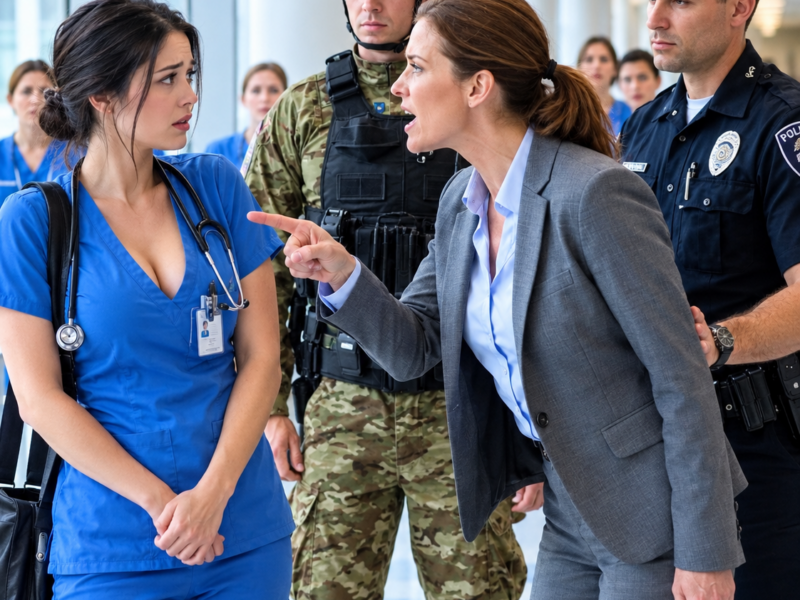
“I was being escorted out of Mercy General’s emergency room with my badge in my hand when the hospital director told the security guards not to let me back inside
I stared at the photograph on Commander Hayes’s phone, trying to make the face match the person I knew.
The hospital ID clipped to the coat belonged to Dr. Michael Bennett, Mercy General’s chief of emergency medicine.
He had hired me twelve years earlier.
He had stood beside me when my father died in the same hospital, quietly placing a hand on my shoulder after the other nurses had gone home.
And he had been the one person who defended my decisions when Richard Harlan became hospital director.
“That’s Dr. Bennett,” I whispered.
Hayes watched me carefully. “You’re certain?”
“Of course I’m certain. He’s the chief of emergency medicine.”
“Then I need you to tell me why he would enter Sergeant Brooks’s room at 3:17 in the morning, administer a drug that nearly killed him, and leave without documenting the visit.”
I looked up sharply.
“You said someone was trying to make it look like I gave him the medication.”
“That’s what the evidence suggests.”
“Then why are you questioning me?”
“Because your name is on the medical record, and you’re the only person who refused to sign it.”
His answer was blunt, but it didn’t sound like an accusation.
It sounded like a man who had learned the hard way that trusting the wrong person could cost someone their life.
I glanced toward the hospital entrance.
Through the glass, Harlan was speaking rapidly into his phone. When he noticed me watching, he turned his back.
“Commander, if Dr. Bennett did this, there has to be a reason,” I said. “He’s treated thousands of patients. He doesn’t just walk into a room and inject someone with something dangerous.”
Hayes slipped the phone into his jacket.
“That’s what I need to find out.”
He looked at the security guards beside me.
“She’s coming with us.”
Harlan pushed through the doors before either guard could answer.
“Absolutely not.”
Hayes didn’t raise his voice.
“Mr. Harlan, you’re interfering with an active federal investigation.”
“This is a private hospital. You don’t get to remove my employees because you show up in tactical gear and make demands.”
“She’s not your employee anymore, remember?”
For the first time that morning, Harlan had no immediate reply.
Hayes turned back to me.
“I can’t force you to help us, Ms. Carter. But if someone falsified a medical record using your credentials, you deserve to know why.”
I thought of my mother’s surgery bill.
My sister’s unanswered messages.
The badge in my hand, which had represented twelve years of work until twenty minutes ago.
Then I thought of Daniel Brooks, barely conscious, gripping my wrist.
Don’t let them move me.
“I’ll help,” I said. “But I’m not going to lie for you, and I’m not going to accuse Dr. Bennett without proof.”
Hayes nodded once.
“That’s exactly what I want.”
He opened the passenger door of the SUV.
Before I climbed in, I turned toward Harlan.
He was watching me with an expression I couldn’t quite read.
Not anger.
Not disappointment.
Fear.
And for the first time, I wondered whether my firing had been intended to punish me—or to get me out of the hospital before I discovered something.
The SUV took us to a federal office building about fifteen minutes from Mercy General.
Hayes introduced himself as Nathan Hayes, commander of a joint task force investigating a series of attacks against military personnel and their families.
Sergeant Daniel Brooks had been working undercover on the investigation.
Three nights earlier, he had disappeared while transporting evidence connected to a private medical contractor.
He was found injured near an interstate outside Columbus and brought to Mercy General under a restricted admission.
“Why Mercy General?” I asked.
“Because Daniel specifically requested it.”
“Did he know someone here?”
Hayes looked through the windshield.
“He grew up in Columbus. His mother was treated at this hospital for years.”
Something about that answer bothered me.
“Then why didn’t he come in under his own name?”
“Because the people who attacked him had access to information they shouldn’t have had.”
I sat back.
The hospital was supposed to be a place where you could tell someone the truth about your body without worrying that the information would be used against you.
If Daniel had been afraid of someone inside the system, I could understand why he wanted to remain anonymous.
But that didn’t explain Dr. Bennett.
“What’s the medication?” I asked.
“Midazolam.”
I frowned.
“That’s a sedative. It’s used every day in hospitals.”
“Correct. It can also be dangerous in the wrong circumstances, especially when combined with other medications.”
“What was Daniel receiving?”
“That hasn’t been established yet.”
“Then you don’t know the medication almost killed him.”
“We know his breathing deteriorated sharply after the documented administration. We also know the medication record was altered.”
I turned toward him.
“Those are two different things.”
A faint, tired smile crossed his face.
“You’re right.”
I hadn’t expected him to concede the point.
It made me trust him a little more, though not enough to forget that he was still withholding information.
“Who else has seen the footage?” I asked.
“Two investigators and our digital forensics team.”
“Does Dr. Bennett know?”
“We haven’t confronted him.”
“Then you should.”
“Not until we understand what happened.”
I shook my head.
“That’s how hospitals work, too. Everyone wants to wait until they have enough information to protect themselves. Meanwhile, a patient is lying in a bed, and the clock keeps moving.”
Hayes studied me.
“You think we’re wasting time.”
“I think Daniel could have died while everyone argued over who was allowed to ask questions.”
For a moment, neither of us spoke.
Then Hayes said, “That’s why I asked for you.”
I looked at him.
“What do you mean?”
“Daniel remembered the nurse who treated him. He told us she was the only person in the room who listened when he said something was wrong.”
My throat tightened unexpectedly.
I’d spent twelve years learning to keep moving after difficult shifts. You learned to put the patient in the bed ahead of you before the one you couldn’t save yesterday.
But hearing that Daniel had remembered me made it harder to dismiss the whole thing as a bureaucratic nightmare.
“Can I see him?”
Hayes’s expression changed.
“He’s awake, but there are complications.”
“What kind?”
“His condition is stable. His memory isn’t.”
I leaned forward.
“Then we need to speak to him before someone else gets to him.”
Hayes didn’t answer immediately.
Finally, he reached for his phone.
“I was hoping you’d say that.”
Daniel Brooks was being treated at a secure military medical facility outside the city.
When I entered his room, he was sitting upright with a blanket over his legs, an IV line taped to his forearm, and a bruised yellow shadow spreading beneath his left eye.
He looked smaller than I remembered.
Not physically, exactly. More like the man who had terrified me with his desperate grip in the ER had been reduced to someone trying to put his life back together one piece at a time.
He watched me approach.
“You’re the nurse.”
“Emily Carter.”
“I remember your voice.”
I pulled a chair beside the bed.
“How are you feeling?”
“Like I got hit by a truck and then argued with the truck about it.”
I laughed before I could stop myself.
It was the first time I’d laughed since Harlan dismissed me.
Daniel smiled faintly.
“Good. I was worried they might have fired you for having a sense of humor.”
My smile faded.
“They did fire me.”
His face changed.
“What?”
“They said I violated protocol. Then Commander Hayes showed me a medical record with my name on a medication I never administered.”
Daniel stared at his hands.
“That’s what they wanted.”
“Who?”
He rubbed his thumb over the edge of the blanket.
“I don’t know. Not all of them.”
I waited.
“Daniel, I can’t help you if you won’t tell me what happened.”
He glanced at Hayes, who had remained near the doorway.
“Is she cleared?”
Hayes answered, “She’s not under investigation by us. She’s also not obligated to say anything.”
Daniel considered that.
Then he looked back at me.
“I was transporting a drive containing patient records.”
“Medical records?”
“Thousands of them. Military personnel, veterans, government employees. People who’d been treated through a private contractor called Meridian Clinical Systems.”
The name meant nothing to me.
Daniel continued.
“Meridian had contracts with military hospitals and civilian providers. They were supposed to coordinate specialty care and medication management. Instead, someone was changing records, moving prescriptions, and making it look as if patients had received treatments they never got.”
My stomach tightened.
“Why?”
“At first, we thought it was fraud. Billing for procedures that never happened. Then we found cases where medication histories had been changed before patients were transferred between facilities.”
I thought about the altered timestamp at Mercy General.
“What happens when a medication history is wrong?”
“Doctors make decisions based on it. Pharmacists trust it. Insurance companies use it. If someone changes the wrong information, a patient can get a drug they shouldn’t receive.”
The room felt colder.
“How many people were hurt?”
Daniel looked away.
“We’re still counting.”
Hayes stepped forward.
“Daniel, tell her about the night you were attacked.”
The sergeant’s jaw tightened.
“I was supposed to meet my contact and hand over the drive. Someone knew where I’d be. They hit me before I reached the meeting point.”
“Did you see them?”
“One.”
“Who?”
Daniel closed his eyes.
“I saw a face. I just can’t hold on to it.”
I noticed his right hand trembling slightly against the blanket.
“Take your time,” I said.
He breathed in slowly.
“I remember the car. Dark blue sedan. No front plate. I remember someone saying they had the drive. Then I remember being in the ambulance.”
“And Mercy General?” I asked.
His eyes opened.
“That part I remember.”
He reached for a cup of water, but his fingers shook hard enough that the cup rattled against the bedside table.
I steadied it for him.
“Thank you,” he murmured.
Then he looked directly at me.
“Someone came into my room that night and told me I needed to stop asking questions.”
I kept my voice calm.
“Was it Dr. Bennett?”
Daniel frowned.
“Who?”
I showed him the photograph on Hayes’s phone.
He studied it for several seconds.
Then he shook his head.
“I don’t know that man.”
I glanced at Hayes.
“You’re certain?” Hayes asked.
Daniel looked offended.
“I’ve never seen him before in my life.”
The room went quiet.
If Daniel had never met Dr. Bennett, why had the chief of emergency medicine entered his room at 3:17 a.m.?
And why had someone placed my name on the record?
Daniel leaned toward me.
“There’s something else.”
“What is it?”
“When I woke up in the ER, I heard someone outside the curtain say, ‘The nurse hasn’t signed it yet.'”
My fingers curled around the edge of the chair.
“Did you hear who said it?”
“No. But I heard the answer.”
He swallowed.
“They said, ‘Then make sure she doesn’t get the chance.'”
I barely slept that night.
I stayed in a small guest room at the federal facility while investigators examined the footage and reviewed the hospital’s electronic records.
At 6:12 the next morning, Hayes knocked on the door.
He held two cups of coffee.
“Black, right?”
I stared at him.
“How do you know that?”
“You drank it black in the ambulance bay. I noticed because the paramedic offered you sugar three times.”
I took the cup.
“That sounds like an alarming amount of attention to pay to someone’s coffee.”
“I’ve been told I notice things.”
He looked as tired as I felt.
“What did you find?”
He placed a folder on the small table.
“Your credentials were used to access Daniel’s medication record at 3:14 a.m. The sedative was entered at 3:17. The record was then edited at 3:21.”
“By whom?”
“An administrative account.”
“Whose?”
“That’s the problem. The account belongs to the hospital’s clinical compliance office.”
I opened the folder.
The first page showed a timeline. The second listed access attempts from several hospital terminals.
My name appeared four times.
“I was in the supply room at 3:14,” I said. “I was looking for a portable suction unit.”
“Can anyone confirm that?”
“Possibly. The respiratory therapist was in the corridor. And I called the charge nurse because we were running low on oxygen tubing.”
Hayes made a note.
“We’ll verify it.”
I turned the page.
A medication administration entry had been marked as completed, then changed. The original record was hidden beneath a correction history that required special access to view.
“This is deliberate,” I said.
“It appears to be.”
I stared at the screen printout.
“Whoever did this knew the system. They knew which account to use and how to hide the change.”
Hayes nodded.
“And they knew you’d refuse to sign a report you believed was false.”
I looked up.
“How could they know that?”
“Your supervisor’s notes. Three previous incident reports show you challenged discrepancies in patient charts.”
I remembered two of them.
One involved an elderly man whose allergy information had been copied incorrectly from another patient. The other concerned a woman discharged with the wrong medication list.
Both times, I had insisted that the errors be corrected.
Both times, someone had told me I was making too much trouble.
“I didn’t think anyone was keeping track.”
“Someone was.”
He closed the folder.
“We’re going back to Mercy General.”
I stood.
“To confront Harlan?”
“To get the original audit logs before they’re altered or deleted.”
I grabbed my coat.
“And Dr. Bennett?”
“We need to find him first.”
Dr. Bennett lived in a quiet neighborhood on the north side of Columbus.
When we arrived, his car was parked in the driveway, but no one answered the door.
A neighbor told us she’d seen him leave before sunrise carrying a small duffel bag.
Hayes called his office.
No answer.
Then he called Harlan.
The director picked up immediately.
“Commander, I’ve already explained that Dr. Bennett’s schedule is confidential.”
“Where is he?”
“I don’t know.”
“His car is in his driveway, and a neighbor saw him leave with a bag.”
“I can’t account for his private movements.”
Hayes’s voice hardened.
“Then account for the hospital records.”
Silence.
“We’ll be there shortly,” Hayes said, and ended the call.
As we drove toward Mercy General, my phone rang.
The number was unfamiliar.
I almost ignored it.
Then I answered.
“Emily Carter?”
A woman’s voice.
“Yes.”
“My name is Laura Mitchell. I’m a pharmacist at Mercy General.”
I sat up.
“What’s going on?”
“I need you to listen carefully. I shouldn’t be calling you, but I found something in the medication logs.”
“What did you find?”
“There’s a second version of Daniel Brooks’s chart. It was created before he arrived at the hospital.”
My mouth went dry.
“That isn’t possible.”
“I know. The system shows the file was uploaded two days earlier.”
“Who uploaded it?”
“I can’t tell from the copy I found. But it contains a medication history that doesn’t match anything in his official records.”
Hayes held out his hand for the phone.
“Laura, this is Commander Hayes. Can you preserve that file?”
“I already made a copy.”
“Don’t send it through the hospital network. We’ll arrange a secure transfer.”
She hesitated.
“There’s something else.”
“What?” I asked.
“The file contains a note that says, ‘If Carter is assigned, proceed with contingency.'”
For a moment, I couldn’t hear anything except the road beneath the tires.
My name.
Two days before Daniel arrived.
Before I had ever met him.
Hayes looked at me.
“Ask her who wrote it.”
I repeated the question.
Laura’s breathing grew shallow.
“The note is signed with initials.”
“Whose initials?”
She whispered them.
“R.H.”
Richard Harlan.
The call disconnected.
I stared at my phone.
Hayes didn’t speak for several seconds.
Then he signaled the driver to take the next exit.
“We’re not going to the hospital yet,” he said.
“Why?”
“Because if Harlan planned this before Daniel arrived, we need to know what he expected you to do.”
I looked at the folder in my lap.
A file created two days early.
My name listed before I’d even been assigned to the patient.
A medication record designed to make it appear that I’d administered a dangerous drug.
And a director who had fired me the moment I refused to sign.
I had spent twelve years believing that doing the right thing would eventually be enough.
Now I understood how dangerous that belief could become when the people in charge decided the truth was inconvenient.
We met Laura in a small federal conference room.
She was in her early forties, with dark circles beneath her eyes and a wedding ring she kept turning around her finger.
She placed a flash drive on the table.
“I’ve worked at Mercy General for seventeen years,” she said. “I’ve never seen anything like this.”
Hayes didn’t touch the drive.
“Tell us how you found it.”
“An automated alert flagged a discrepancy between Daniel’s medication list and the list attached to his admission. I thought it was a routine data-matching error, so I checked the history.”
She looked at me.
“The second file was buried in a folder normally used for imported records. It had your name on it, but the timestamp showed it was created two days before the admission.”
“Could someone have entered the wrong name?”
“That’s what I thought. Then I saw the contingency note.”
She opened a laptop and showed us a scanned document.
The wording was brief and clinical.
If Carter is assigned, proceed with contingency. Ensure final administration record is completed before morning review.
My skin prickled.
“Who is Carter?” I asked.
Laura shook her head.
“I don’t know. The note doesn’t include a first name.”
“But it was attached to my credentials,” I said.
“Yes.”
Hayes leaned forward.
“Did you tell anyone at the hospital?”
“My supervisor. She said to leave it alone and referred the issue to compliance.”
“Who in compliance?”
Laura’s eyes dropped to the table.
“Richard Harlan.”
The silence that followed felt heavier than any accusation.
Hayes finally picked up the flash drive.
“We’ll have the files authenticated.”
Laura rubbed her forehead.
“There’s something I haven’t told you.”
I waited.
“After I found the second chart, I went back to check the medication inventory. The vial number entered on Daniel’s record was assigned to a shipment that never arrived.”
“Never arrived?” I repeated.
“The hospital’s system showed the shipment was received, but the delivery signature didn’t match anyone in pharmacy. The entire shipment was marked as reconciled the following morning.”
“What medication was in it?”
“Several medications, including sedatives. I can’t say which vial was intended for Daniel without the original shipping documents.”
Hayes exchanged a glance with his investigator.
“Can you get those documents?”
“I can try. But if Harlan finds out I’ve spoken to you, I’ll lose my job.”
I thought of my badge sitting on some administrator’s desk.
“You might lose it anyway,” I said quietly. “The difference is that you’ll know you didn’t help them hide what happened.”
Laura looked at me for a long moment.
Then she nodded.
“I’ll get the shipping records.”
We returned to Mercy General that afternoon with a formal request for the original audit logs.
Harlan met us in a glass-walled conference room overlooking the parking garage.
He looked composed again, but his right hand kept moving toward the knot of his tie.
“Commander, I understand your concerns,” he said. “But these records contain protected patient information. We have procedures for releasing them.”
Hayes placed a document on the table.
“This authorizes preservation and collection of records relevant to a federal investigation.”
Harlan barely glanced at it.
“I’ll refer it to legal counsel.”
“Your legal counsel can review it while we secure the data.”
“You can’t simply seize hospital systems.”
“We aren’t seizing your hospital. We’re preserving evidence.”
Harlan looked at me.
“I hope you understand that your personal involvement may complicate matters, Ms. Carter.”
I met his gaze.
“My involvement began when I treated a patient who couldn’t breathe.”
“And it ended when you violated a direct instruction.”
“No,” I said. “It ended when you tried to make me sign a record that wasn’t true.”
His expression hardened.
“You have no idea what you’re talking about.”
“Then show me the original record.”
He said nothing.
Hayes watched him for a moment, then stood.
“We’ll return with the technical team.”
As we reached the door, Harlan spoke again.
“Emily.”
I turned.
For the first time, he looked less like a hospital director than a man who hadn’t slept.
“You should think carefully about the people you’re trusting.”
I held his gaze.
“I have been.”
Outside, Hayes waited until the doors closed behind us.
“He’s scared,” I said.
“Yes.”
“Of you?”
“Maybe.”
I looked back at the building.
“Or of what we’ll find.”
Hayes didn’t answer.
His phone rang.
He listened for several seconds, then looked at me.
“We found Dr. Bennett.”
“Where?”
“At a hotel near the airport. He’s agreed to speak with us.”
Dr. Bennett sat in a plain interview room with his hands folded on the table.
He looked exhausted.
When he saw me, he lowered his eyes.
“Emily.”
I had imagined this moment several times during the drive.
In every version, I demanded an explanation immediately.
But when I stood in front of the man who had once taught me how to recognize a failing patient from the way their shoulders moved, the words came out smaller than I’d expected.
“Why was your badge in Daniel’s room?”
Bennett closed his eyes.
“Because I went in there.”
“Did you administer the medication?”
“No.”
The answer came quickly.
Hayes pulled out the security photograph.
“Then explain this.”
Bennett looked at the image.
“I went in at 3:17, but I didn’t touch Daniel’s IV. I checked his monitor and tried to wake him.”
“Why didn’t you document the visit?”
“Because I was told not to.”
“By whom?”
Bennett stared at the table.
“Richard Harlan.”
I felt a sharp sting of anger.
“You let me believe you were involved in trying to hurt him.”
“I know.”
“You let me get fired.”
“I know.”
“Then tell me why.”
Bennett pressed his fingertips together.
“Two weeks ago, I discovered discrepancies in several medication records. At first, I thought they were errors caused by the new electronic charting system. Then I found a pattern.”
“What pattern?”
“Patients connected to Meridian Clinical Systems had medication histories changed shortly before emergency admissions. In some cases, the changes made them appear to have been prescribed drugs they had never taken. In others, medications they depended on disappeared from their records.”
He looked up.
“Some patients had suffered serious complications. One died.”
The room seemed to shrink around us.
“Did you report it?”
“I went to Harlan.”
I shook my head.
“Why would you do that if you suspected someone inside the hospital?”
“Because he was the director. I thought he had to know.”
“And he told you to keep quiet.”
Bennett nodded.
“He said the hospital was under pressure from a federal contract review. He said premature accusations could cost hundreds of people their jobs.”
“Did you believe him?”
“I wanted to.”
He rubbed his eyes.
“Then he showed me a file containing information about my daughter.”
I felt my anger falter.
“What information?”
“She was treated for a chronic condition when she was a teenager. Her records were part of a Meridian transfer. Someone had copied details from her medical history into an unrelated file.”
He swallowed.
“They knew where she worked. They knew where she lived. They didn’t threaten her directly. They didn’t have to.”
For the first time, I understood why he might have been frightened enough to make a terrible decision.
It didn’t excuse what he had done.
But it made him human.
“What happened the night Daniel arrived?” Hayes asked.
Bennett drew a breath.
“Harlan told me Daniel was carrying stolen patient information. He said the task force needed time to contain a data breach and that I had to keep the admission quiet.”
“Did you believe that?”
“At first.”
“And later?”
Bennett looked at me.
“At 3:17, I received a message telling me Daniel’s condition was deteriorating and that I needed to confirm his identity before he was transferred.”
“From Harlan?”
“Yes.”
“So you entered the room.”
“I checked his pulse and the monitor. He was unconscious, but his breathing was already poor. I realized someone had given him something he shouldn’t have received.”
“Why didn’t you call for help?”
“I should have.”
His voice cracked.
“But I saw the medication entry on the screen. Your name was already there. I knew you hadn’t given it, because I had spoken to you earlier that night.”
I remembered passing him outside the trauma bay.
He had asked whether the patient was stable, and I’d told him we were doing everything we could.
“You knew I was being framed,” I said.
“I suspected it.”
“And you said nothing.”
He bowed his head.
“I was afraid.”
I stood so abruptly that the chair scraped across the floor.
“So was I. I was afraid I’d lose my job. I was afraid I couldn’t pay for my mother’s surgery. I was afraid that if I challenged Harlan again, no hospital in the city would hire me.”
Bennett didn’t look up.
“But I didn’t let that fear turn into a lie.”
“No,” he said softly. “You didn’t.”
For a moment, I wanted to tell him that everything he had taught me meant nothing now.
Instead, I asked the question that mattered.
“Did you see who administered the drug?”
Bennett hesitated.
“I saw someone leaving through the medication preparation area. I only caught a glimpse. A white coat, dark hair, and a badge turned backward.”
“Was it Harlan?”
“I couldn’t tell.”
Hayes leaned forward.
“Why didn’t you tell us this earlier?”
“Because I thought the hospital was monitoring my calls. And because I didn’t know whom to trust.”
He reached into his pocket and placed a folded piece of paper on the table.
“I wrote down what I remembered before I left the hospital.”
Hayes opened it.
A time.
A room number.
And a short line beneath them.
Loading dock camera, east entrance, 3:12 a.m.
I stared at the note.
The person who had administered the drug might have entered through the loading dock, avoiding the main security checkpoint.
And if that camera had captured the person’s face, we might finally know who had been inside Daniel’s room.
The loading dock footage was grainy, but the time stamp was clear.
At 3:12 a.m., a dark blue sedan pulled beside the service entrance.
A person stepped out carrying a small insulated case.
The driver never left the vehicle.
The person entered through the service door using an access card.
Five minutes later, the same figure left without the case.
Hayes paused the footage.
“Can you identify the car?”
One of the investigators zoomed in on the rear window.
A small dealership decal was visible.
They traced the vehicle to a leasing company that maintained cars for several medical contractors.
The sedan had been assigned to Meridian Clinical Systems.
The person entering the building wore a white coat.
The face was obscured by the camera angle, but the access card was visible for less than a second.
The number belonged to the hospital’s compliance office.
Harlan’s department.
I watched the clip again.
“Can we see the corridor camera?”
The investigator switched files.
The corridor outside Daniel’s room was empty until 3:16 a.m., when a figure entered the frame.
The person wore a white coat and carried nothing.
At 3:17, Dr. Bennett appeared.
He entered Daniel’s room and stayed for less than a minute.
At 3:19, he left.
At 3:21, the figure in the white coat returned to the corridor.
This time, the person’s hands were empty.
The figure stopped beside the medication cabinet, looked toward the camera, and walked away.
“Who had access to that cabinet?” I asked.
“Authorized clinical staff and compliance personnel with emergency override privileges,” the investigator replied.
“That includes Harlan?”
“Yes.”
Hayes leaned back.
“We have enough to establish that someone used the compliance account and a Meridian vehicle to enter the building. We still need to establish who administered the medication.”
I stared at the screen.
Something about the sequence bothered me.
“Go back to 3:17.”
The investigator rewound the footage.
Dr. Bennett entered the room.
Then, for a fraction of a second, the figure in the white coat appeared at the far end of the corridor.
I pointed.
“Stop.”
The investigator froze the image.
The person had a distinctive way of walking, with the left shoulder held slightly higher than the right.
I had seen that movement hundreds of times.
Not in Harlan.
Not in Dr. Bennett.
In someone else.
“That’s Laura,” I whispered.
Hayes turned toward me.
“You’re sure?”
“No. But I think it is.”
Laura Mitchell, the pharmacist who had called me, had a shoulder injury from a car accident years earlier. She always carried her bag on her right side because lifting her left arm too high caused pain.
The figure on the screen held the left shoulder stiffly.
But Laura had helped us.
She had given us the flash drive.
She had risked her job.
Why would she be involved?
Unless she’d given us only part of the truth.
Hayes immediately called her.
No answer.
He called again.
Still nothing.
Then an investigator entered the room holding a new printout.
“We found the shipping records.”
The medication shipment had been marked as received by Laura Mitchell.
Her electronic signature appeared beneath the inventory reconciliation.
I felt a knot tighten in my stomach.
“She told us the delivery signature didn’t match anyone in pharmacy.”
“It doesn’t,” the investigator said. “But her credentials were used to approve it.”
Hayes stood.
“Find her.”
Laura was at the hospital when we arrived.
She stood alone in the pharmacy corridor, staring at a computer screen.
When she saw us, she didn’t run.
She simply closed her eyes.
“I was hoping you’d figure it out before Harlan did,” she said.
Hayes stepped forward.
“Laura Mitchell, I need you to come with us.”
She looked at me.
“I didn’t give Daniel the drug.”
I believed that she was frightened.
I didn’t yet know whether I believed anything else.
“Then tell us what happened,” I said.
She glanced down the corridor.
“Not here.”
Hayes motioned to an investigator, who secured the area before we moved to a private consultation room.
Laura sat with both hands wrapped around a paper cup.
“My husband worked for Meridian,” she began. “He was an account manager. He handled contracts and records transfers between medical providers.”
“What happened to him?” I asked.
“He found billing irregularities. Then he found patient records being altered after they were transferred. He reported it internally.”
She stared into her cup.
“Two months later, he was fired. A week after that, someone broke into our house and took his laptop. The police said it looked like a burglary, but nothing else was missing.”
“Did he go to the authorities?”
“Eventually. But the evidence was gone, and he couldn’t prove what he’d seen.”
Hayes asked, “How does that connect to Daniel Brooks?”
“Daniel contacted him. He said he had proof that Meridian was doing more than falsifying billing records. He believed someone was deliberately altering medication histories to make patients appear unstable, noncompliant, or responsible for complications they hadn’t caused.”
“And the night Daniel was admitted?” I asked.
Laura’s eyes filled with tears.
“Harlan contacted me before the shipment arrived. He told me the hospital was facing a major compliance crisis and that if I didn’t cooperate, my husband could be implicated in the investigation.”
“Cooperate how?”
“Approve a shipment that hadn’t arrived. Make the inventory match the electronic record. He said it was temporary, that no patient would receive anything from it.”
I felt sick.
“But someone did receive it.”
She nodded.
“I didn’t know about Daniel until the next morning. When I found his chart, I realized what had happened.”
“Why didn’t you go straight to the police?” Hayes asked.
“Because the person who’d altered the medication records had access to everything. I thought if I went through the hospital’s reporting system, the information would reach Harlan before anyone else.”
“So you called me.”
“Yes.”
“Why didn’t you tell us about the shipment?”
“I was afraid you’d think I was involved.”
I looked at her.
“You were involved. You approved a shipment that never arrived.”
She flinched as if I’d struck her.
“I know.”
Her voice was barely audible.
“I kept telling myself it was paperwork. That I was protecting my husband from people who could destroy his life. I didn’t think about the patients whose records were being changed.”
She finally looked up.
“Then I saw your name on Daniel’s chart. I knew what they’d done to you, and I couldn’t keep quiet anymore.”
Hayes placed the inventory record on the table.
“Who administered the medication?”
Laura closed her eyes.
“Richard Harlan.”
The name settled into the room.
She explained that Harlan had obtained emergency access privileges after claiming the hospital was dealing with a security incident. He had used the compliance account to alter the chart, then entered Daniel’s room with the medication from the unrecorded shipment.
Laura had seen him return to the pharmacy area carrying the empty case.
She hadn’t witnessed the administration itself, but she had recognized the vial number and understood what the falsified record was designed to accomplish.
“Why did the security footage look like you?” I asked.
Laura stared at me.
“What?”
“The figure in the white coat. The way the person held their shoulder.”
She looked down at her left arm.
Then she shook her head.
“That wasn’t me.”
Hayes turned toward the investigator.
“Can we enhance the footage?”
“We’re already working on it.”
Laura leaned forward.
“There’s one more thing. Harlan told me Daniel’s records weren’t the only ones being changed. He said the problem had been going on for months, and that if anyone investigated, they’d find evidence pointing to Dr. Bennett and Emily.”
I sat very still.
“Why me?”
“Because you kept flagging discrepancies. You were becoming a problem.”
I thought of the two incident reports I’d filed months earlier.
The incorrect allergy.
The wrong medication list.
I’d thought I was fixing ordinary mistakes.
Instead, I had been leaving a trail of evidence.
Harlan hadn’t chosen me by accident.
He had chosen me because he knew I would refuse to sign a false record, and because that refusal could be used to make me look guilty.
Hayes stood.
“Laura, you’ll need to provide a formal statement.”
“I will.”
“And your husband?”
“He’s at home. He has copies of some of the original Meridian documents.”
Hayes exchanged a look with his investigator.
“Get a team to his address.”
Laura reached across the table and caught my hand.
“I’m sorry,” she said. “I should have spoken up sooner.”
I looked at her trembling fingers.
“So should a lot of people.”
I wasn’t ready to forgive her.
But I understood the fear that had kept her silent, and I knew what it felt like to discover that your silence had helped someone else get hurt.
The next morning, we returned to Mercy General with a federal team and the original audit logs.
Harlan was waiting in his office.
He stood behind his desk as Hayes entered.
“I assume you’ve come to make a scene.”
“No,” Hayes replied. “We’ve come to arrest you.”
For the first time since I’d met him, Harlan looked genuinely confused.
“On what grounds?”
“Evidence tampering, falsification of medical records, conspiracy, and attempted obstruction of a federal investigation. Additional charges may follow as the evidence is reviewed.”
Harlan looked at me.
“Emily, you need to understand something. This hospital employs thousands of people. If you let this investigation proceed without considering the consequences, you could destroy the livelihoods of people who had nothing to do with any of this.”
I remembered the security guards escorting me out.
My badge in my hand.
My mother’s surgery bill sitting unpaid on the kitchen counter.
“You used those people as a reason to keep everyone quiet,” I said. “You used their jobs as a shield.”
“You don’t know what I was trying to prevent.”
“Then explain it.”
For a moment, I thought he might.
His eyes moved toward the window.
Then his expression hardened.
“I won’t discuss this without counsel.”
Hayes nodded to the agents.
As they approached, Harlan turned back to me.
“You think you’re helping people. But you have no idea what this will cost.”
I looked at the hospital ID clipped to his coat.
“I already know what it cost me.”
The agents placed him in handcuffs.
He didn’t struggle.
He didn’t shout.
He simply watched me as they led him out, as if he still believed I would eventually regret refusing to cooperate.
I stood in the office long after the door closed.
For twelve years, I’d believed that hospitals were held together by people who showed up, did their jobs, and tried to leave the world a little less broken than they found it.
I still believed that.
But now I understood that institutions could also be held hostage by people who knew how much everyone else had to lose.
The investigation lasted months.
Meridian’s offices were searched, its contracts suspended, and its executives questioned about the altered medical records.
Daniel’s drive contained thousands of entries, including records that linked the falsified medication histories to suspicious billing activity and a series of unexplained patient complications.
Investigators eventually established that Harlan had used his authority to conceal the scheme and shift blame toward employees who had challenged the records.
He had not acted alone.
Several Meridian employees had helped create false files, while others had looked away when discrepancies appeared.
The investigation also revealed that the drug administered to Daniel had been obtained through the unrecorded shipment. It had been given in a dose that caused severe respiratory depression, and the altered chart was designed to make the administration appear to be my work.
Daniel survived because I recognized the signs of deterioration and treated him before his breathing failed completely.
The medical team could not determine whether Harlan had intended to kill him or merely silence him long enough to recover the drive.
That question remained part of the criminal investigation.
Dr. Bennett cooperated with the authorities. He admitted that fear had kept him from reporting what he knew, and he accepted the professional consequences of his silence.
He resigned from his position before the hospital’s board could decide whether to remove him.
Laura gave a full statement and turned over the documents her husband had preserved. She also accepted responsibility for approving the false shipment record.
She lost her job.
Her husband became a key witness in the case.
None of those consequences disappeared simply because the truth finally came out.
Neither did the patients whose records had been altered.
For some families, the investigation brought answers. For others, it revealed years of medical decisions based on information they had never known was wrong.
The hospital established a review program for affected patients and brought in an independent team to audit its medication records.
It was a start, not a repair.
I understood that difference better than most people.
Three months after my firing, I received a letter from Mercy General’s board of trustees.
They had reviewed the investigation and formally cleared me of wrongdoing.
They also offered to reinstate me with back pay and an apology.
I read the letter twice at my kitchen table.
My mother sat across from me, slowly turning a mug between her hands.
“Are you going back?” she asked.
I looked toward the window.
Outside, a neighbor was helping his son ride a bicycle along the sidewalk. Every few seconds, the boy wobbled, and his father caught the seat before he could fall.
“I don’t know.”
My mother waited.
She had never been the kind of woman who filled silence just because it made other people uncomfortable.
“They offered me my old job,” I said. “But I don’t know if I can walk through those doors and pretend the place hasn’t changed.”
“Maybe it has changed.”
“Maybe.”
She reached across the table.
“Then don’t decide based on what they offered you. Decide based on what you want to do there.”
I thought about the patients still arriving through the ambulance entrance.
The nurses covering extra shifts.
The doctors trying to do good work in a system that sometimes made good work harder than it needed to be.
I thought about Daniel’s hand around my wrist.
Don’t let them move me.
And I thought about the version of myself who had walked out of the hospital holding a badge, certain that twelve years of service had been reduced to one signature she refused to give.
“I want to take care of patients,” I said. “I just don’t want to spend the next twelve years wondering whether the person above me is asking me to do the right thing or the convenient thing.”
My mother nodded.
“Then ask for the things you need before you go back.”
I called the board the following morning.
I told them I would consider returning only if the hospital established an independent reporting process for medication discrepancies, protected staff who raised concerns, and allowed nurses to challenge questionable orders without being threatened with dismissal.
I also asked for a permanent patient-safety committee with frontline nurses represented on it.
The board accepted.
Not because they had suddenly become brave, I suspected, but because the investigation had made it impossible to ignore how much their old system had failed.
I returned to Mercy General six weeks later.
The first day, I stood outside the employee entrance for nearly a minute before swiping my new badge.
The doors opened with the same soft click.
The smell of disinfectant was unchanged.
So was the hurried rhythm of footsteps in the corridor.
A young nurse named Olivia met me at the station.
“I’ve heard about you,” she said.
I raised an eyebrow.
“That sounds dangerous.”
She laughed nervously.
“I mean, the story about the medication record. My preceptor said you refused to sign something you knew was wrong.”
I placed my bag in the locker.
“I did.”
“What if the person giving the order is the chief of medicine?”
I thought about Dr. Bennett, Harlan, Laura, and the years of fear that had allowed the scheme to continue.
“Then you ask questions,” I said. “You document what you see. And if you still believe something is wrong, you find someone outside that chain of command who can help you.”
Olivia nodded slowly.
“What if they fire you?”
I looked at my badge.
For a moment, I remembered the cold morning air and the security guards standing beside me.
“Then they fire you,” I said. “But you don’t make a patient’s chart say something that never happened just to keep your job.”
Her expression changed.
Not into fear.
Into understanding.
Before I could say anything else, an ambulance rolled into the bay.
The radio crackled.
A paramedic called out a patient’s age, blood pressure, and symptoms.
Olivia turned toward the treatment area.
I followed her.
The work was waiting, just as it always had.
Daniel came to visit two weeks later.
He was walking without assistance, though he still moved carefully when he sat down.
He carried a small paper bag from a bakery near the hospital.
“I wasn’t sure what nurses eat when they’re not running on coffee and adrenaline,” he said, setting it on the counter. “So I brought muffins.”
I laughed.
“You brought food to an emergency department?”
“I was told it was a dangerous move.”
“It is. Half the staff will know about these in thirty seconds.”
He looked toward the nurses’ station.
“Then I’d better make friends quickly.”
We sat in the small staff lounge during my break.
For a while, we talked about ordinary things. His recovery. My mother’s surgery, which had finally gone ahead after we arranged a payment plan. The weather, which had turned cold again.
Eventually, Daniel grew quiet.
“I wanted to thank you,” he said.
“You already did.”
“Not properly.”
He rested his hands on the table.
“When I woke up that night, I knew someone was trying to keep me from talking. I didn’t know who I could trust. You didn’t know me, and you had no reason to believe anything I said.”
“I had a patient who needed help.”
“That’s the part I keep thinking about.”
He looked down at the paper cup between his hands.
“People like to say courage means not being afraid. I was afraid. So was Laura. So was Bennett. I think Harlan was afraid, too.”
“Fear explains a lot,” I said. “It doesn’t excuse everything.”
“I know.”
He nodded.
“I’ve been thinking about that since the investigation. About the people who stayed quiet because they thought the damage would be worse if they spoke.”
I watched him carefully.
“What’s changed?”
“I’m trying to pay attention to the moments when staying quiet feels easier than telling the truth.”
He glanced at me.
“I don’t know if I’ll always get it right.”
“Neither do I.”
For the first time, the words didn’t feel like an admission of weakness.
They felt like the only honest answer.
When Daniel stood to leave, he paused beside the door.
“Commander Hayes says they’re building a better process for handling evidence from medical investigations. He wants nurses involved in the training.”
“That sounds like him.”
“He also says you scared the life out of him when you challenged his assumptions.”
I smiled.
“Good.”
Daniel laughed.
Then he held out his hand.
I shook it, and he gave mine a firm, grateful squeeze.
“Take care of yourself, Nurse Carter.”
“You too, Sergeant.”
He left through the same doors I’d once been escorted out of.
This time, I watched him walk into the daylight without wondering whether someone would try to stop him.
The following spring, I stood in front of a small group of nurses during a patient-safety training session.
There were no cameras.
No reporters.
No hospital executives sitting in the back of the room waiting for someone to say something useful for a press release.
Just nurses, a pharmacist, two physicians, and a stack of anonymized case studies.
I told them about the altered medication record, the false timestamp, and the moment I realized someone had tried to turn my refusal into evidence against me.
I didn’t tell them they should never be afraid.
That would have been dishonest.
I told them to write down what they saw, preserve what they could, and seek help when the ordinary reporting channels failed.
I told them that protecting a patient’s safety sometimes meant challenging a person whose title made everyone else fall silent.
Afterward, Olivia approached me.
“I used to think being a good nurse meant never making trouble.”
I gathered my notes.
“Being a good nurse means knowing when trouble is already in the room.”
She smiled, then returned to her shift.
I stayed behind for a moment, looking at the empty chairs.
For months, I had replayed the morning Harlan fired me, searching for the moment when I might have prevented everything.
Maybe I should have questioned the restricted admission earlier.
Maybe I should have pushed harder when the security camera appeared.
Maybe I should have recognized that the people who told me not to ask questions were the very people who needed me to stop asking.
But I couldn’t change those moments.
What I could change was what happened the next time a nurse noticed a discrepancy and wondered whether speaking up would cost her everything.
That afternoon, I returned to the emergency department.
A new patient was waiting for a medication reconciliation, and the chart contained a discrepancy between the pharmacy list and the transfer paperwork.
The young nurse assigned to the case had already flagged it.
She looked at me across the desk.
“Can you help me sort this out?”
I pulled up a chair.
“Of course.”
We checked the original prescription, called the outside pharmacy, and corrected the record before the patient received anything.
It took twenty minutes.
No one threatened to fire us.
No commander arrived at the ambulance entrance.
No dramatic announcement followed.
Just a patient who received the right care because someone had been willing to stop and ask a question.
I clipped my badge to my coat and headed back toward the trauma bays.
The doors opened, and the familiar rush of voices and footsteps rose around me.
For twelve years, I had thought my badge meant I belonged to the hospital.
Now I understood that it meant something simpler, and far more important.
It meant I had been trusted with someone’s life.
And no title, no contract, and no fear of losing my job would ever make a false record worth more than that.
The end.









