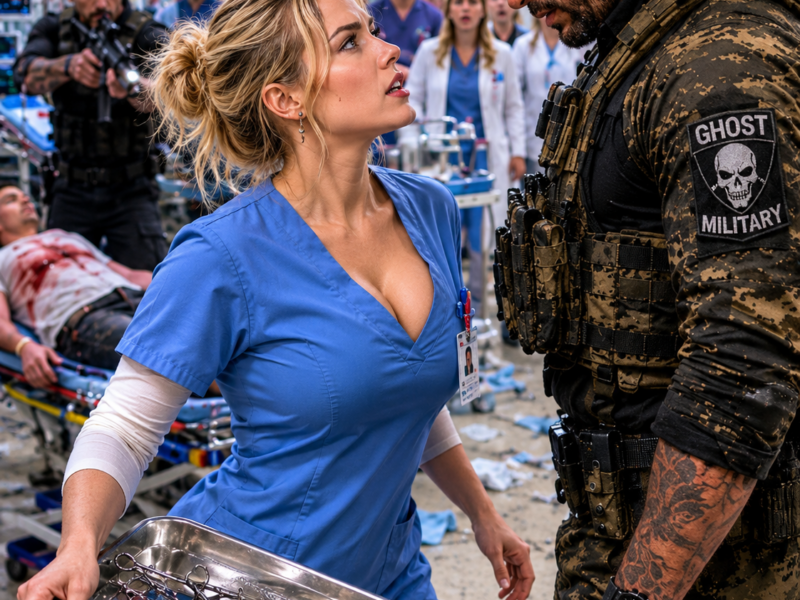
“I spilled an entire tray of coffee across the Navy SEAL commander’s uniform in the middle of the hospital hallway, and when he looked down at me
I stared at Jack Sullivan, waiting for him to take back what he’d just said.
But he didn’t.
The hallway seemed unusually bright. Somewhere behind me, a monitor beeped, and a nurse called for someone to check room 214.
Ordinary hospital sounds continued around us while my entire childhood seemed to collapse into one impossible sentence.
“What did you just say?”
Jack slipped his phone into his pocket.
“I said the woman buried under your mother’s name may not have been your mother.”
“That’s not an answer.”
“I know.”
“Then give me one.”
He looked at the two sailors standing behind him.
“Petty Officer Miller, take the team downstairs. I’ll meet you there.”
Neither man moved immediately.
“Commander, are you sure?”
“Yes.”
They exchanged a glance before walking toward the elevators.
Jack waited until they were gone.
Then he pointed toward an empty consultation room.
“Can we talk somewhere private?”
I wanted to refuse.
I wanted to call hospital security and tell them a stranger was making disturbing claims about my family.
But my father’s handwriting was still visible on the envelope.
And I had spent fifteen years wondering why my mother had died so suddenly, why my father had become a different person afterward, and why every adult in my life seemed to know something I wasn’t allowed to ask.
I followed him into the room.
Jack closed the door but didn’t sit down.
Neither did I.
“Start with the photograph,” I said.
He placed it on the table.
“My sister, Sarah, was your mother.”
I stared at him.
“No. My mother’s name was Elizabeth.”
“Sarah Elizabeth Sullivan. Everyone called her Liz.”
I shook my head.
“My birth certificate says Elizabeth Carter.”
“Your father registered you under his surname after you were born. Sarah and Daniel weren’t married at the time.”
The information came too quickly.
I reached for the back of a chair.
“You’re saying my mother was your sister?”
“Yes.”
“And you knew my father?”
“I was there when you were born.”
I looked at him.
For a moment, he seemed younger than the man in the uniform.
“Why didn’t you come looking for me?”
“I did.”
His answer was quiet.
“I went to your father’s house after Sarah disappeared. The house was empty. His phone was disconnected. When I contacted the police, I was told Daniel had left the state with you.”
“Then why didn’t you keep searching?”
“I did. But your father used a different address, and eventually I was deployed overseas. By the time I returned, the records I had were outdated.”
He paused.
“Then I received a letter.”
“From my father?”
Jack nodded.
“Three weeks before he died.”
I stared at the envelope.
“Why didn’t you send it to me?”
“Because the letter didn’t contain an address. It said he would contact me when he knew it was safe.”
“Safe from whom?”
Jack rubbed his forehead.
“That’s what I was trying to find out.”
I pulled out the chair and sat down.
“Open it.”
Jack didn’t move.
“Emily, I think you should read it yourself.”
He placed the envelope in front of me.
My fingers struggled with the old adhesive.
Inside was a single sheet of paper, folded into thirds.
The handwriting was unmistakable.
My little Megan,
If Jack has found you, then I have failed to keep the promise I made to your mother.
There are things I should have told you when you were younger. I thought I was protecting you, but perhaps I was only protecting myself from having to explain what happened.
Your mother did not abandon you.
I stopped reading.
The words blurred.
For years, I’d believed my mother had died when I was four.
My father had told me she became sick, went into the hospital, and never came home.
I remembered the smell of her perfume.
I remembered her singing while she brushed my hair.
I remembered a red scarf she wore in winter.
But I also remembered the funeral.
Or what I thought was the funeral.
I swallowed and continued.
The accident was real. The fire was real. But the person we were told had died that night was never positively identified.
I was afraid of what would happen if I challenged the people who made that decision.
I kept you away because I believed someone was watching us.
Jack knows part of the story. He doesn’t know everything.
There is one person who does.
The letter ended with a name.
Margaret Hayes.
I read it twice.
“Who is Margaret Hayes?”
Jack pulled out a chair.
“Your mother’s closest friend.”
“Where is she?”
“I don’t know.”
I looked at him sharply.
“You’ve had this letter for seventeen years and you don’t know?”
“I found her once. She refused to speak to me.”
“Why?”
“She told me if I wanted you to stay alive, I should stop looking.”
I stood so quickly the chair scraped against the floor.
“Alive? What kind of story is this?”
Jack raised both hands.
“I know how it sounds.”
“No, you don’t. You don’t get to walk into my workplace, call me by a name I haven’t heard in years, and tell me my mother might be alive.”
His expression tightened.
“You’re right.”
He stood.
“I should have started with the truth I could prove.”
He reached into his jacket and removed another photograph.
This one showed a woman standing outside a small house.
She had shoulder-length brown hair, a red scarf, and one hand resting against the wooden porch railing.
I recognized the scarf before I recognized her face.
My throat tightened.
It was the same red scarf from my childhood memories.
“Where was this taken?”
“About six months ago.”
“Who took it?”
“A private investigator I hired.”
I looked at the date written on the back.
October.
Six months ago, I had been working double shifts and worrying about my rent.
Somewhere in the country, someone who looked like my mother had been standing outside a house.
I turned the photograph over again.
There was an address.
“Take me there.”
Jack hesitated.
“Emily—”
“Don’t.”
I pointed at the picture.
“You’ve had seventeen years to decide what I can handle. I’m done letting other people make that decision.”
He studied me.
Then he nodded.
“All right.”
We left the consultation room together.
Rachel caught me near the nurses’ station.
She looked from Jack to the photograph in my hand.
“Grace, what’s going on?”
I tried to smile.
It came out badly.
“I need to leave.”
“You’re on shift.”
“I know.”
She looked at my face and immediately stopped arguing.
“Are you okay?”
“No.”
She touched my arm.
“Then go. I’ll explain to the charge nurse.”
I hugged her before I could change my mind.
Outside, the November air smelled like rain.
Jack’s black SUV was parked near the emergency entrance.
As he opened the passenger door, I noticed a small silver compass hanging from his rearview mirror.
It was identical to mine.
I looked at it.
Jack noticed.
“Your mother gave it to me.”
I touched the pendant at my throat.
“Why did she give me one?”
“She bought two. She said you should always have a way home.”
I turned away before he could see my face.
The drive took nearly two hours.
We passed through small Virginia towns, gas stations, and stretches of highway where the trees had already lost most of their leaves.
Jack didn’t ask me to talk.
I appreciated that.
At one point, I noticed him glancing at me.
“What?”
“Nothing.”
“You’re doing that thing where people say nothing because they want to say something.”
He almost smiled.
“Your mother used to say that.”
I looked out the window.
“Tell me about her.”
He considered the question.
“She was stubborn. She hated being told what to do. She once drove four hours because she heard a neighbor’s kid was sick and didn’t have anyone to take him to the hospital.”
“That sounds familiar.”
“She also burned every pancake she ever made.”
I laughed unexpectedly.
The sound surprised both of us.
For a few seconds, the woman in the red scarf felt less like a ghost and more like someone who might have existed in an ordinary kitchen.
Then Jack spoke again.
“She loved you more than anything.”
I didn’t answer.
Because if that was true, I needed to understand why I’d spent my childhood believing she was gone.
The address led us to a modest house on a quiet street in a town called Ashland.
White siding.
Blue shutters.
A small porch with two wooden chairs.
There were flowerpots beside the steps, even though the season was nearly over.
Jack parked across the street.
“That’s the house.”
I stared through the windshield.
A woman was standing near the front window.
Her hair was shorter than in the photograph.
She wore a gray sweater.
Then she turned slightly.
And I saw her face.
I couldn’t breathe properly.
There are moments when memory doesn’t arrive as a picture.
It arrives as a smell, a sound, a feeling in your hands.
I remembered warm fingers fastening my coat.
A voice whispering that monsters couldn’t get through locked doors.
A kiss on my forehead before bedtime.
I opened the car door.
Jack reached toward me.
“Wait.”
I looked at him.
“What?”
“Let me go first.”
“Why?”
“Because we don’t know how she’ll react.”
I pulled away.
“I’ve waited long enough.”
I crossed the street.
My shoes sounded too loud against the pavement.
I climbed the porch steps and knocked.
Once.
Twice.
The woman appeared in the doorway.
She looked at me for several seconds.
Then her eyes dropped to the necklace around my neck.
Her hand went to her mouth.
“Megan?”
The name came out as a breath.
I gripped the railing.
“Are you Sarah?”
She began crying.
Not dramatically.
She simply covered her mouth and bent her head as though her body had finally given in to something she’d been holding for years.
I wanted to run into her arms.
I also wanted to ask why she had let me grow up without her.
Both feelings arrived together.
“Is it really you?” I whispered.
She nodded.
“My baby.”
I stepped backward.
“Don’t call me that.”
Her face crumpled.
“I’m sorry.”
I looked past her into the house.
There was a framed photograph on a side table.
A little girl with uneven pigtails.
Me.
“Why?”
It was the only word I could manage.
Sarah opened the door wider.
“Please come inside.”
I didn’t move.
Jack had reached the bottom of the steps.
He stayed there, giving us room.
Sarah wiped her cheeks.
“I know you have questions.”
“I have fifteen years of them.”
“I know.”
“Then answer one.”
She nodded.
“Did you know I thought you were dead?”
Her eyes filled again.
“Yes.”
The answer hurt more than I expected.
I gripped the railing.
“How could you let me believe that?”
She looked down.
“Because I was told that if I contacted you, the people who were trying to find me would come for you too.”
“Who?”
She glanced at Jack.
He stepped onto the porch.
“Sarah, it’s time.”
She shook her head.
“Not yet.”
I turned toward him.
“What is going on?”
Sarah took a slow breath.
“Daniel didn’t disappear because he wanted to keep you away from me.”
She looked directly into my eyes.
“He disappeared because he was trying to keep you safe from your grandfather.”
I frowned.
“My grandfather?”
“Your mother’s father,” Jack said.
I stared at him.
“I never knew him.”
“His name was Robert Sullivan. He was a wealthy defense contractor. He had connections in Washington, and he was used to getting what he wanted.”
Sarah’s voice trembled.
“He never accepted Daniel. He thought your father was beneath our family. When I became pregnant, he tried to convince me to give you up.”
I felt cold.
“Why?”
“Because Daniel worked for a company that had contracts with my father’s business. He discovered financial records that suggested money was being moved through shell companies. He believed some of those payments were connected to classified military procurement.”
Jack nodded.
“I was in the Navy then. Daniel asked me to help him get copies of the documents to an investigator.”
“Did you?”
“Yes.”
Sarah looked toward the street.
“My father found out.”
She explained that a fire had broken out at a remote property where she had been staying.
She escaped, but the person who died in the fire was never properly identified.
Her father used his influence to make sure the death was recorded as hers.
“Why didn’t you go to the police?”
“I tried. The first investigator I spoke to disappeared from the case. Another told me there was nothing to investigate. My father had friends in places I didn’t understand.”
“And my father?”
“Daniel took you and left. He thought separating us would make you harder to find.”
I remembered my father working late.
The way he checked the locks before bed.
The way he changed our phone number every few months.
The boxes that were never unpacked completely.
I had thought those were signs of a difficult man.
Now they looked like pieces of a decision I had never understood.
“Why didn’t he tell me?”
Sarah’s eyes lowered.
“He wanted to. But he was afraid.”
“Afraid of what?”
“That you’d try to find me.”
I stared at her.
“Maybe I should have.”
She nodded.
“Maybe.”
There was no excuse in her voice.
No attempt to make herself innocent.
That somehow made the anger harder to hold.
I looked at Jack.
“Why did you keep searching after my father died?”
“Because I promised him.”
“Did you know where she was?”
“Not until recently.”
Sarah shook her head.
“Jack didn’t know the whole story either.”
I turned toward her.
“What story?”
She hesitated.
Then she walked to a cabinet and removed a small metal box.
It was old and scratched, with a tiny brass lock.
She placed it on the table.
“Your father left this with me before he disappeared.”
I looked at the box.
“What’s inside?”
“Copies of the original financial records. And something else.”
She unlocked it.
Inside were several documents, a flash drive, and a photograph of three people standing outside a building.
My father.
Sarah.
And a younger Jack.
On the back, someone had written:
The truth belongs to the people who were hurt by it.
Sarah lifted the flash drive.
“Your father made a copy of everything.”
Jack examined the documents.
His expression changed as he read the first page.
“Where did you get this?”
“Daniel gave it to me before he left.”
Jack looked at her.
“You told me you didn’t have anything.”
“I was protecting Megan.”
I looked at the papers.
The company name appeared repeatedly.
Sullivan Defense Systems.
My grandfather’s company.
I had heard the name before.
Years earlier, I’d seen it on a plaque in an old newspaper clipping about a defense contract.
I had never connected it to my family.
“Is this why you stayed hidden?”
Sarah nodded.
“After your grandfather died, I thought it would finally be safe. But some of the people involved were still alive. I didn’t know who I could trust.”
“Then why stay here?”
“Because I was tired.”
Her voice cracked.
“I had spent so many years looking over my shoulder that I didn’t know how to be a mother anymore. I told myself that if I stayed away until I was certain, I’d eventually find the courage to come back.”
She looked at me.
“Then your father died, and I learned about it too late.”
I turned toward the window.
A car passed slowly along the street.
I couldn’t stop watching it until it disappeared.
“Did you ever try to contact me?”
Sarah nodded.
“Once.”
“When?”
“About eight years ago. I sent a letter to the foster care agency where I believed you were staying.”
“Did it reach me?”
“No.”
“How do you know?”
“Because it came back.”
She went to another drawer and removed a folded envelope.
My name was written on it.
Not Emily.
Megan.
The return address was a post office box.
The postmark was dated eight years earlier.
I took it with both hands.
The envelope had never been opened.
“Why didn’t you try again?”
“I should have.”
She didn’t offer another excuse.
“I was afraid you’d hate me.”
I stared at the letter.
“I don’t know what I feel.”
“That’s fair.”
For a long time, none of us spoke.
Then Jack placed the financial documents back into the box.
“There’s something we need to do with these.”
Sarah looked worried.
“What?”
“Take them to the federal investigator who handled the original case. He’s still working in Norfolk.”
“Can we trust him?”
“I’ve already spoken with him. He knows Daniel’s name.”
I looked between them.
“Are you saying this is over?”
Jack shook his head.
“No. I’m saying we finally have evidence that can be examined properly.”
I looked at the documents again.
For years, I had imagined that discovering the truth about my family would feel like finding a missing piece of myself.
Instead, it felt like opening a door into a room filled with things I wasn’t ready to touch.
But I knew one thing.
I wasn’t going to let anyone decide what I could know anymore.
“Then let’s take it to him.”
Sarah looked at me carefully.
“Are you sure?”
I nodded.
“Yes.”
She reached for my hand.
I let her take it, though I didn’t squeeze back.
Not yet.
The following morning, we met with a federal investigator named Thomas Reed in a small office in Norfolk.
He examined the documents, checked the dates, and asked Jack several questions about the original investigation.
He didn’t promise anything.
He didn’t act impressed by the family name.
He simply listened.
When he finished, he looked at me.
“Your father preserved records that may be important. We need to authenticate them before drawing conclusions.”
“What happens now?”
“We reopen the inquiry.”
The next several weeks were difficult.
I returned to work.
I answered questions from Rachel, who listened to the entire story over two cups of coffee and one very long evening.
She didn’t laugh when I told her about the coffee incident.
Instead, she asked whether I’d eaten.
That was Rachel.
The investigation moved slowly.
Some of the records were genuine.
Others required additional verification.
Two former employees agreed to speak with investigators.
A retired accountant confirmed that payments had been routed through several companies that had no clear business purpose.
The case eventually became part of a larger inquiry into financial misconduct involving the old defense contractor.
But the most important discovery wasn’t in the documents.
It was in a box of photographs Sarah brought to my apartment.
One evening, she arrived carrying a cardboard container.
“I thought you might want these.”
I opened it on the kitchen table.
There were dozens of photographs.
My first birthday.
A summer picnic.
My mother holding me in a hospital room.
My father standing beside a tiny pink cake, looking terrified of the frosting.
I laughed when I saw that one.
Sarah smiled.
“He was always better at changing diapers than decorating cakes.”
I touched the photograph.
“I don’t remember this.”
“You were very little.”
She sat across from me.
“I used to think that if I could just show you enough photographs, you’d remember me.”
I looked at her.
“That’s not how memory works.”
“I know.”
Her eyes moved to the table.
“I suppose I wanted proof that I hadn’t imagined those years.”
I understood that more than I wanted to admit.
For the first few months, I called her Sarah.
Sometimes I called her Mom.
Neither felt completely natural.
There were days when I wanted to see her.
There were other days when I couldn’t bear to hear her voice.
She never demanded more than I could give.
One Sunday, she invited me to her house for dinner.
She made pancakes.
They were burned.
I stared at the plate.
Then I laughed.
She looked confused.
“What’s funny?”
“Jack said you burned every pancake you ever made.”
Sarah covered her face.
“He told you that?”
“Yes.”
“That man has never forgiven me for setting off the smoke alarm.”
We laughed together.
It wasn’t the kind of laughter that erased fifteen years.
It didn’t make everything right.
But it was something we hadn’t been able to share before.
A few months later, the investigation reached a turning point.
A former company executive agreed to cooperate and confirmed that my grandfather had ordered the destruction of certain financial records.
He also provided evidence that someone had deliberately falsified the death report after the fire.
The government eventually brought charges against two former executives for fraud and obstruction related to the financial scheme.
My grandfather had died years earlier.
No court could hold him accountable.
But the people who had helped cover up the wrongdoing could no longer hide behind his name.
The investigator also confirmed something important about the fire.
Sarah had escaped before the building collapsed.
The body recovered afterward belonged to an unidentified employee who had been working at the property.
For years, the official record had said my mother was dead.
Now it was corrected.
The first time I saw the amended record, I sat in my car outside the federal building and cried.
Not because it brought back my childhood.
Because it finally stopped telling a lie about it.
Jack called me that evening.
“How are you holding up?”
I looked at the document on the passenger seat.
“I don’t know.”
“That’s an honest answer.”
“Do you ever get used to finding out that the people you trusted kept things from you?”
He was quiet for a moment.
“No. But you can learn to decide what happens after you know.”
I thought about that for a while.
“Thank you for finding me.”
He exhaled.
“I should have found you sooner.”
“You kept looking.”
“I made a promise to your father.”
I smiled faintly.
“I think he knew you’d keep it.”
We met for dinner a few days later.
Jack brought the old photograph from the pier.
I brought my compass necklace.
We placed them side by side on the table.
“Do you remember that day?” he asked.
I studied the little girl on his shoulders.
“Not really.”
“Your mother made us stay until sunset because she wanted one perfect photograph.”
“Did she get it?”
He smiled.
“She got about twenty terrible ones and this one.”
I laughed.
Then I looked at him.
“Why did you call me Megan that day?”
He leaned back.
“Because that’s the name I knew. The last time I saw you, you were a little girl who refused to answer to anything else.”
I touched the pendant.
“Emily is the person I became.”
“And Megan is the little girl you were.”
I nodded.
“I don’t want to lose either of them.”
“You don’t have to.”
For a long moment, I looked at the photograph.
Then I slipped it into my bag.
I wasn’t ready to become the little girl in the picture again.
But I no longer needed to pretend she had never existed.
A year after the day I spilled coffee on Jack’s uniform, Sarah came to the hospital.
She had a small paper bag in her hand.
I was working at the nurses’ station when she approached.
Rachel spotted her first.
“Your mother is here.”
I looked up.
Sarah stood near the entrance, wearing a blue coat and holding the bag like she was afraid it might disappear.
I walked toward her.
“What’s that?”
She handed it to me.
“Something I thought you might like.”
Inside was a small wooden frame.
It held the photograph from the pier.
The little girl on Jack’s shoulders.
My mother smiling behind the camera.
My uncle looking much younger than I remembered.
And me, wearing the silver compass.
I ran my thumb over the edge of the frame.
“Where did you get this?”
“Jack had another copy.”
I looked at her.
“Thank you.”
She smiled.
Then she glanced toward the coffee machine.
“Are you still spilling drinks on people?”
I laughed.
“Only occasionally.”
“Good. I wouldn’t want you to lose your reputation.”
We stood there for a moment, neither of us knowing exactly what to say.
Then she reached out.
I stepped forward and hugged her.
It wasn’t a perfect reunion.
It didn’t erase the years we’d lost or the choices we’d made.
But this time, when she held me, I didn’t feel like I was borrowing someone else’s childhood.
I felt like I was beginning a new part of my own.
Before she left, Sarah touched the compass pendant at my neck.
“Your father chose well,” she whispered.
I looked down at it.
For years, I’d thought the compass was simply a gift from a man who wanted me to remember him.
Now I understood something else.
It had been given to me by two people who had loved me, even when fear and distance made that love difficult to recognize.
I still had questions.
I still had days when anger arrived without warning.
And there were things my mother and I might never fully repair.
But I had stopped confusing the absence of an explanation with the absence of love.
That evening, after my shift, I stood outside the hospital beneath the fading Virginia sky.
The compass rested against my chest.
For the first time in fifteen years, I knew where my mother was.
And for the first time in my life, I understood that finding your way home doesn’t always mean returning to the place you came from.
Sometimes it means finally having the freedom to decide where you belong.
The end.









