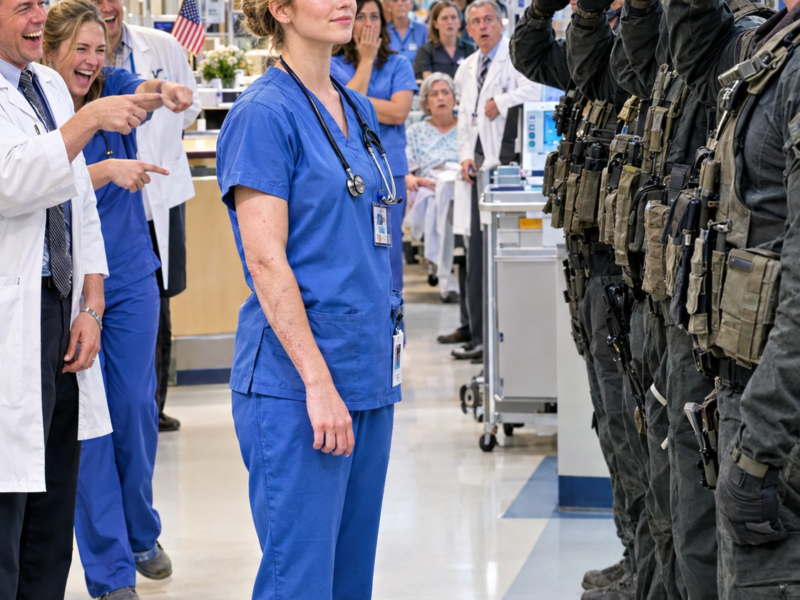
“I heard the nurses laughing about the scars on my arms before I even reached the supply room
The security alarm kept ringing.
Nobody moved for the first two seconds.
Then Patricia Wells snapped out of her shock and ordered the waiting-room doors secured. A security guard hurried toward the reception desk while the attending surgeon disappeared through the operating-room doors with Ghost.
Daniel Mercer lowered his salute.
“Captain, we need to move you somewhere secure.”
I looked at the six men standing in front of me.
Three years ago, I had watched a helicopter lift off without me. I had listened to gunfire fade into the distance and accepted that the men aboard might never know what had happened to me.
Now Daniel Mercer stood in my emergency department, calling me Captain as if no time had passed at all.
“I’m not going anywhere until you tell me why you believe the man who signed my death report sent you here.”
Daniel glanced toward the ceiling camera.
“Not here.”
“Then choose your words carefully. This is my workplace, and there are patients who need me.”
“Captain, with respect, this hospital may be the least secure place you could be right now.”
“That’s interesting,” I said. “Because you brought your wounded teammate here.”
His jaw tightened.
“We didn’t have a choice.”
“Neither do I. I’m responsible for the people in this department.”
For a moment, I saw the young sergeant I remembered beneath the hardened operator. Daniel had once been the man who stayed awake all night beside a teammate with a fever, telling terrible jokes until the pain medication took effect.
He had also been the man who followed orders without asking questions.
That was why I needed to know what had changed.
“Start talking,” I said.
Before he could answer, Brooke stepped closer.
“Excuse me, but can someone explain what’s happening? Emily is a nurse. She’s not a captain.”
Daniel turned toward her.
“Ma’am, I suggest you step away from this conversation.”
Brooke’s face reddened.
“I am the senior nurse assigned to this shift.”
“And I am asking you to give us space.”
She looked at me, apparently expecting me to intervene on her behalf.
I didn’t.
“Brooke, check with Patricia about the security alarm,” I said. “We still have patients in the waiting room.”
Her mouth opened, then closed.
She walked away without another word.
I turned back to Daniel.
“You have sixty seconds.”
He took a breath.
“Three years ago, after Operation Lantern, the command believed you were killed during the extraction. Your personnel record was sealed. We were told your remains couldn’t be recovered.”
I felt something twist inside my chest.
“Operation Lantern was not an extraction failure.”
“No, ma’am.”
“It was a compromised mission.”
His expression confirmed that he knew what I meant.
Three years earlier, I had been assigned as the senior combat medic supporting a small special operations element conducting a hostage recovery. Our target was a former intelligence contractor who had disappeared with information that several powerful people wanted buried.
The mission was supposed to be simple.
It never was.
Our team entered a compound before dawn. We located the hostages, secured the target, and began moving toward the extraction point.
Then someone who should never have known our location opened fire.
The first blast hit the building behind us.
The second destroyed our planned route.
I remembered smoke, dust, the sharp taste of blood, and the weight of a wounded operator whose body had gone limp in my arms.
I remembered getting two men behind cover.
I remembered telling the team leader that our route was compromised.
And I remembered the final order that came through the radio.
Leave the site. No recovery.
I had refused.
A wounded teammate was still breathing beneath the collapsed section of a wall. I went back for him.
The next explosion threw me into a drainage trench and buried part of the passage behind me.
When I woke, the radio was dead.
I spent two days moving through rough terrain with a broken rib, a damaged shoulder, and a wound across my forearms from the metal that had torn through my uniform.
A local family hid me until I could travel.
By the time I reached a friendly checkpoint, the operation had been officially closed.
The report said I had died during the initial blast.
The team had been ordered to mourn me.
I had been ordered to remain silent while an inquiry was conducted.
I complied because I was told it was necessary to protect the surviving operators and prevent the enemy from learning who had escaped.
Then the inquiry vanished.
The military hospital discharged me after months of treatment. My identity was restricted while investigators reviewed the operation. Eventually, I was offered a quiet separation and told I could begin again as a civilian.
I accepted.
I never received an explanation.
Now Daniel Mercer was telling me the man who had signed my death report had sent his team to my hospital.
“Who signed it?” I asked.
Daniel hesitated.
“Colonel Adrian Vale.”
The name landed like a stone.
Vale had been the senior operations officer overseeing the mission.
He had approved the route.
He had authorized the extraction.
And when the radio call came ordering us to leave, his voice had been the one delivering it.
“Why would Vale send you here?”
“Because Ghost recovered something from the operation.”
“Recovered what?”
Daniel looked toward the operating-room doors.
“A copy of the original mission log.”
My heart began to pound.
“Original?”
“The transmissions were altered after the mission. Ghost found a backup copy in a secure archive. It shows the extraction order came from a channel that wasn’t supposed to be active.”
“Whose channel?”
“We don’t know yet.”
I stared at him.
“You expect me to believe you brought a wounded operator into a civilian hospital because you found an old radio log?”
“No, ma’am. We brought him here because our safe medical facility was compromised.”
That was the first answer that frightened me more than the alarm.
“How?”
“Someone entered the facility before we arrived. They knew our route and the time we were coming. We lost our communications, and Ghost was hit while we were leaving.”
“Who fired?”
“We never got a clear visual.”
“And you came here because?”
“Because Ghost insisted we find you.”
I looked at the operating-room doors again.
The patient on that table was no longer just a wounded stranger. He was a man who knew something about the worst night of my life.
But I wouldn’t let that knowledge interfere with my work.
“Then you can wait until he’s stable,” I said. “No one is going to question him while he’s under anesthesia.”
Daniel nodded.
“Understood.”
A crash sounded near the emergency entrance.
One of the security guards shouted.
Daniel turned instantly, and the five operators moved with him. Their calm vanished into focused readiness.
I stepped toward the corridor.
“Emily, stay back,” Daniel ordered.
I stopped.
Not because he had given me a command, but because I could see the fear behind his eyes.
He wasn’t afraid for himself.
He was afraid the same thing that had happened three years earlier was about to happen again.
“Tell me what you’re seeing,” I said.
“Possible forced entry at the ambulance bay.”
“That entrance leads to the trauma corridor.”
“I know.”
“Then stop standing here and help secure the patients.”
He looked at me for a fraction of a second.
Then he nodded to his team.
Two operators moved toward the ambulance entrance with hospital security, while the others stayed near the nurses’ station.
I turned toward Patricia.
“Lock down the public entrances. Keep the patients away from the windows, and don’t move anyone into a corridor until security confirms it’s clear.”
She didn’t question me.
Neither did the charge nurse beside her.
For the first time that night, the people around me weren’t looking at my scars.
They were listening to my instructions.
A security guard hurried back from the entrance.
“Someone tried to force the ambulance doors,” he said. “They’re gone.”
“Did you see who?”
He shook his head.
“Just a dark vehicle pulling away.”
Daniel’s expression hardened.
“They’re testing the perimeter.”
“Or they’re trying to scare us,” I said.
“Same result.”
“Not if we refuse to panic.”
He looked at me.
For a moment, neither of us spoke.
Then he said quietly, “You haven’t changed.”
I almost smiled.
“You have.”
His eyes dropped.
“That’s what happens when you spend three years believing someone you respected abandoned you.”
I felt the words like a hand closing around my throat.
“Daniel, I didn’t abandon anyone.”
“I know that now.”
The security alarm finally stopped.
The silence afterward seemed louder than the noise.
I looked at the six operators, at their weapons secured according to hospital policy, at their exhausted faces and the fresh dirt still caught in the seams of their uniforms.
“Tell me everything,” I said. “From the beginning.”
Daniel pulled a folded document from an inside pocket.
It was a photocopy of a mission summary, creased and worn.
He handed it to me.
My name appeared halfway down the page.
CAPTAIN EMILY CARTER — PRESUMED KILLED IN ACTION.
Beneath it was a list of recovered personnel.
Three names had been marked as surviving.
Two were listed as injured.
One name had been blacked out.
I stared at the final entry.
“Who is this?”
“That’s what we’re trying to find out.”
“You have the original log but not the name?”
“The copy was damaged. The final page was missing.”
I looked up.
“And you think Ghost knows?”
“He was part of the archive recovery. He said the missing name was the key to proving what happened during Operation Lantern.”
“Why didn’t he tell you?”
“He said he would only discuss it with you.”
I let out a slow breath.
That sounded like Ghost.
Some operators trusted no one outside their own unit. Others trusted only the people who had once risked their lives beside them.
I hadn’t met Ghost before that night, but he knew enough about me to demand my presence.
That was unsettling.
“What’s his real name?” I asked.
Daniel hesitated.
“Ethan Cole.”
I froze.
The hallway seemed to tilt.
“Ethan Cole?”
“Yes, ma’am.”
“No.”
I shook my head.
“That isn’t possible.”
Daniel said nothing.
Ethan Cole had been my teammate during Operation Lantern. He was the wounded man beneath the collapsed wall, the one I had gone back for when the extraction order came through.
I had held pressure against his chest until my hands went numb.
I had felt his pulse fade beneath my fingers.
I had listened to the medic on the radio tell me there was nothing more I could do.
I had left him only because I believed he was already dead.
For three years, I had carried the memory of his last breath.
Now Daniel was telling me Ethan was alive.
I gripped the counter to steady myself.
“Why didn’t he contact me?”
“He said he couldn’t. Not until he had proof.”
“Proof of what?”
“That the mission was deliberately compromised.”
I closed my eyes.
Three years of grief, guilt, and unanswered questions pressed against me at once.
Then I opened them.
“Is he stable?”
“The surgeon hasn’t given us an update.”
“Then that’s where we go.”
Daniel nodded.
We walked toward the surgical waiting area, where the other operators had gathered. The hospital staff watched us pass, whispering among themselves.
I could hear Brooke behind us.
“I don’t understand,” she said to another nurse. “Why are they treating her like some kind of hero?”
I stopped.
Daniel stopped with me.
I turned around.
Brooke stood beside the medication station, her arms crossed.
For weeks, she’d made my scars a joke. She’d treated my quietness as weakness and my privacy as proof that I had something shameful to hide.
I could have told her everything.
I could have described the mission, the explosion, the men I had treated under fire, and the long months it took to learn how to sleep without waking at every sound.
But she didn’t need my history.
She needed to understand that she had no right to turn another person’s pain into entertainment.
“They aren’t treating me like a hero,” I said. “They’re recognizing someone they thought they had lost.”
Brooke glanced at Daniel.
“I didn’t know.”
“No,” I replied. “You didn’t.”
“I was just joking about the scars.”
“They’re part of my body, Brooke. You don’t have to understand them, but you don’t get to make them a joke.”
Her face flushed.
“I didn’t mean to hurt you.”
“You never asked whether you had.”
She looked down.
For the first time since I’d known her, she had nothing to say.
I turned away.
I wasn’t interested in humiliating her. I had spent too much time learning that pain did not become smaller simply because someone else was made to feel it.
At the surgical waiting area, Patricia joined us.
“Emily,” she said softly, “I’ve arranged for another nurse to cover your patients. You can stay here until we know what’s happening.”
“Thank you.”
She looked at Daniel and the operators.
“Whatever is going on, I want this hospital kept out of it as much as possible.”
Daniel nodded.
“So do we.”
We waited nearly two hours.
During that time, I learned that Ghost had been transported with significant internal bleeding and that the surgeons were working to repair the damage. I learned that the hospital’s security team had reviewed the ambulance entrance footage and found a vehicle with no visible plates. I learned that Daniel’s team had lost their secure communications for eleven minutes before reaching the hospital.
Eleven minutes.
In my line of work, eleven minutes could mean the difference between a patient living and dying.
It could also mean someone had known exactly when to strike.
At 2:16 a.m., the surgeon finally came out.
“His condition is serious, but he’s stable,” she said. “We’ll be monitoring him closely.”
I let out a breath I hadn’t realized I’d been holding.
“Can I see him?”
“Briefly, once he is moved to recovery.”
Daniel placed a hand on my shoulder.
“Thank you, ma’am.”
I looked at him.
“Don’t thank me yet.”
An hour later, I entered the recovery room.
Ethan lay beneath a thin blanket, his face pale, an oxygen line resting beneath his nose. The years had changed him. There were new lines around his eyes and a scar along his jaw that hadn’t been there before.
But it was him.
I stood beside the bed, unable to speak.
His eyes opened.
For a moment, he looked confused.
Then he saw me.
“Emily?”
My throat tightened.
“You’re supposed to be dead.”
He gave the smallest, most exhausted smile.
“So are you.”
I laughed once, though it came out broken.
Then I took his hand.
“I thought you died under that wall.”
“I know.”
“I heard your pulse stop.”
“I know.”
“I left you there.”
His fingers tightened around mine.
“No,” he whispered. “You saved my life.”
I shook my head.
“I couldn’t get you out.”
“You got me breathing long enough for someone else to find me.”
I stared at him.
“What?”
He swallowed, grimacing with pain.
“After the blast, a local recovery team found me. I was unconscious. They moved me to a medical facility outside the operation area. By the time I could speak, the official report said I was dead.”
“Why didn’t you contact us?”
“Because I wasn’t supposed to be alive.”
His eyes shifted toward the door.
“Someone had altered the mission record. Anyone who asked questions was being watched. I couldn’t risk exposing the people who helped me survive.”
“Who altered the record?”
“Colonel Vale.”
The name again.
Ethan’s breathing grew shallow, and I motioned for him to rest.
“No more questions for now,” I said. “You need to recover.”
He shook his head.
“One more.”
“Ethan—”
“The missing name.”
He looked directly at me.
“It wasn’t an operator.”
I waited.
“It was the person who gave Vale the extraction route.”
A chill moved through me.
“Who?”
“Someone inside our command structure.”
“Do you know the name?”
He closed his eyes for a second.
“Yes.”
I leaned closer.
“Tell me.”
Before he could answer, the monitor beside his bed began to alarm.
His heart rate surged.
A nurse hurried in, followed by a physician. I stepped away as they checked his vitals and adjusted his medication.
When they finally stabilized him, he was too exhausted to speak.
Daniel met me outside the room.
“What happened?”
“He was about to tell me who compromised the mission.”
Daniel’s expression hardened.
“Then we need to get him somewhere secure.”
“He is somewhere secure. He’s in a hospital.”
“Emily, the people who did this have already tried to reach us twice.”
“And moving him before his surgeon clears him could kill him.”
Daniel looked away.
I knew that expression. It was the same one he had worn during training whenever he was forced to choose between following the plan and protecting a teammate.
“Listen to me,” I said. “We don’t solve this by becoming reckless. We protect Ethan, preserve the evidence, and let the proper investigators do their jobs.”
“And if the investigators are compromised?”
“Then we find the ones who aren’t.”
He studied me for a long moment.
Then he nodded.
“Understood, Captain.”
For the first time that night, the title didn’t feel like a ghost from another life.
It felt like a responsibility I had never entirely put down.
By morning, the hospital had returned to something resembling normal.
The waiting room was open. The security alarm had been reset. Patricia had arranged additional security without turning the emergency department into a military checkpoint.
But the pressure had not disappeared.
Two federal investigators arrived just after eight. They introduced themselves as Special Agent Laura Bennett and Special Agent Marcus Hill, both assigned to investigate irregularities connected to Operation Lantern.
They brought authorization to collect the mission documents and interview Ethan once his doctors approved.
Daniel gave them the recovered copy of the mission log.
I watched as Agent Bennett examined the damaged pages.
“This is significant,” she said. “But we need corroboration before we can draw conclusions.”
“What about Colonel Vale?” I asked.
“He’s under preliminary review. We have no authority to detain him based solely on this copy.”
“Then what do you need?”
“Original communications, corroborating testimony, and a reliable chain of custody for the records.”
I looked at Daniel.
“We can provide the chain of custody for what we recovered,” he said. “But the original communications are in a secure archive.”
“Where?”
He hesitated.
“On a military installation.”
Agent Hill made a note.
“Then we’ll coordinate with the appropriate command authority.”
I didn’t like the delay. But I knew the danger of letting anger set the pace of an investigation.
We had spent three years chasing fragments of a truth. We weren’t going to destroy the case by rushing the next step.
That afternoon, Ethan was awake long enough to give a preliminary statement. He confirmed that Colonel Vale had changed the extraction plan without informing the field team. He also confirmed that the original mission log had been altered after the operation.
But when the investigators asked him to name the person who had provided Vale with our route, he refused.
“Not until I know the evidence is protected,” he said.
Agent Bennett didn’t argue.
“We can arrange independent custody and documented access.”
Ethan looked at me.
I nodded.
“You don’t have to trust everyone. But you have to give the truth a chance to stand on its own.”
He stared at the ceiling.
Then he agreed to cooperate.
The following week, the investigation moved to a federal facility. I wasn’t allowed to attend every interview, but Agent Bennett kept me informed about the parts of the case that directly concerned me.
The original communications archive had been recovered.
The audio confirmed that the extraction order came from a channel not authorized for operational command. The log also showed that the route had been transmitted to an external number minutes before the ambush.
The number belonged to a private security contractor that had been working with a company linked to the original hostage target.
It was a trail, not a verdict.
But it was the first trail that didn’t disappear when someone pulled on it.
Then Ethan finally gave the missing name.
Major Stephen Rourke.
He had been the liaison officer responsible for distributing mission updates between command and the field team.
Rourke had been the one person with access to our route, our timing, and the contingency plan.
He had also been the officer who signed the initial report stating I had died in the blast.
When investigators questioned him, he denied everything.
Then they showed him the original communications.
He requested a lawyer.
Two days later, he agreed to cooperate.
Rourke admitted that he had forwarded the route to a private contractor in exchange for money. He claimed he had believed the information would be used only to negotiate with the hostage target, not to expose the team to an attack.
He had been wrong.
The contractor had passed the information to an armed group that wanted the target silenced.
The ambush had not been intended to kill every member of our team. It had been designed to create confusion, recover the target’s files, and make the surviving operators look responsible for the failure.
Colonel Vale had helped conceal the breach to protect the operation’s reputation and prevent the scandal from reaching senior command.
He had signed my death report because a dead officer could not contradict the official version.
But Ethan had survived.
And I had survived.
The report had never been the truth. It had been the story someone needed everyone else to believe.
When Agent Bennett told me the findings, I sat very still.
I had imagined the explanation countless times. Some nights, I had blamed myself for disobeying the extraction order. Other nights, I had blamed Vale for leaving us behind.
The truth was worse in some ways, because it meant the danger had come from inside the system I had trusted.
But it was also a relief.
I hadn’t imagined the inconsistencies.
I hadn’t failed Ethan.
And I hadn’t abandoned my team.
The investigation continued for months. Rourke pleaded guilty to conspiracy and unlawful disclosure of classified operational information. Vale was charged with obstruction and falsification of official records after investigators established that he had knowingly concealed evidence of the breach.
The contractor faced separate federal charges.
Not every question was answered, and not everyone responsible faced the same consequences. But the official record of Operation Lantern was corrected, and the names of the surviving team members were restored.
My death report was withdrawn.
My service record was amended.
And the scars on my arms finally had an explanation that didn’t belong to anyone else’s imagination.
Ethan remained in the hospital for nearly three weeks before he was transferred to a rehabilitation facility. I visited when my shifts allowed, usually bringing coffee he complained was too weak and magazines he pretended not to read.
One afternoon, he watched me adjust the blanket over his legs.
“Do you ever regret coming back for me?” he asked.
I stopped.
“No.”
“Even after everything?”
I looked at the scars on my forearms.
“I regret that we were put in that position. I regret that we lost people. I regret that we trusted the wrong people.”
I met his eyes.
“But I don’t regret trying to save you.”
He nodded slowly.
“I needed to hear that.”
“You needed to hear it three years ago.”
“Three years ago, I wasn’t in a condition to listen.”
That made me laugh.
It was the first time I had laughed without feeling guilty since the mission.
When I returned to St. Vincent’s, the hospital felt different.
The patients still arrived in pain. The monitors still beeped. The fluorescent lights still made everyone look tired by three in the morning.
But people treated me differently.
Some were respectful. Some were curious. A few suddenly acted as though they had always known I was exceptional.
I didn’t need any of it.
Patricia called me into her office one afternoon and apologized for not addressing Brooke’s behavior sooner.
“I should have stopped the comments when I first heard them,” she said. “You shouldn’t have had to deal with that.”
“Thank you.”
She hesitated.
“Would you consider helping us improve our emergency response training? Your experience could be valuable.”
I thought about it.
“I’d be happy to help with medical readiness and trauma coordination. But I don’t want my military background to become a spectacle.”
“It won’t,” she promised.
And she kept that promise.
Brooke approached me several days later. She looked less polished than usual, as though she had spent a long time rehearsing what she wanted to say.
“Emily, can I talk to you?”
I put down my chart.
“Sure.”
She took a breath.
“I owe you an apology. The things I said about your scars were cruel. I told myself I was joking, but I knew you didn’t like it, and I kept going.”
I waited.
“I saw those men salute you, and I realized I had been making assumptions about someone whose life I knew nothing about.”
I looked at her carefully.
“That’s a good thing to realize. But you shouldn’t need to see a team of operators stand at attention before you treat a coworker with respect.”
Her eyes dropped.
“You’re right.”
“I don’t need you to admire me, Brooke. I need you to treat people decently, especially when you don’t understand what they’re carrying.”
She nodded.
“I will.”
I didn’t offer instant forgiveness or pretend that the comments hadn’t hurt. I simply accepted the apology and returned to work.
That was enough for that day.
Several weeks later, Daniel visited the hospital without his tactical gear. He wore jeans, a plain jacket, and the same crooked smile I remembered from years earlier.
He found me restocking supplies in Trauma Two.
“Captain Carter,” he said.
I glanced at him.
“Sergeant Mercer.”
He smiled.
“I’m not a sergeant anymore.”
“Then you should introduce yourself properly.”
He stood a little straighter.
“Daniel Mercer. Retired from the unit, currently figuring out what normal people do on weekends.”
“Have you tried sleeping?”
“I heard that’s popular.”
We laughed.
Then his expression softened.
“I wanted to thank you.”
“For what?”
“For making us slow down. For refusing to let this become another mission where we followed the loudest voice instead of asking the right questions.”
I leaned against the counter.
“You did the hard part. You brought the evidence.”
“We brought a lot of assumptions, too.”
“So did I.”
He looked at my arms.
“Do the scars still hurt?”
“Sometimes.”
“Physically?”
I considered the question.
“Not always.”
He understood without asking me to explain.
Before he left, he handed me a small envelope.
Inside was a photograph from our old unit. The team stood together in front of a transport aircraft, dusty and exhausted, their expressions caught between relief and the need to move on to the next task.
I was in the middle, younger, with my sleeves rolled up and a grin I barely recognized.
On the back, someone had written: Nobody gets left behind.
I traced the words with my thumb.
For years, I had believed I had failed that promise.
Now I understood that the promise had never meant every person would come home untouched. It meant we would keep trying to bring one another back, even when the outcome was uncertain.
Sometimes that effort saved a life.
Sometimes it left scars.
And sometimes, years later, it gave the truth a chance to breathe.
I returned the photograph to its envelope and placed it in my locker beside Daniel’s last letter.
Then I pulled my sleeves down, washed my hands, and stepped back into the emergency department.
A new patient had arrived.
Someone was calling for help.
I moved toward the bed.
I was no longer trying to erase the woman I had been before I became a nurse. I no longer felt obligated to explain my scars to people who treated them as an invitation to judge me.
I had learned that quiet didn’t mean weak, that kindness didn’t mean helpless, and that a person’s worth had nothing to do with whether strangers understood their history.
The six operators had stood at attention because they remembered the woman who had refused to abandon them.
But the greatest proof of who I was had never been the salute.
It was the fact that, after everything, I still chose to walk toward the people who needed help.
THE END.









