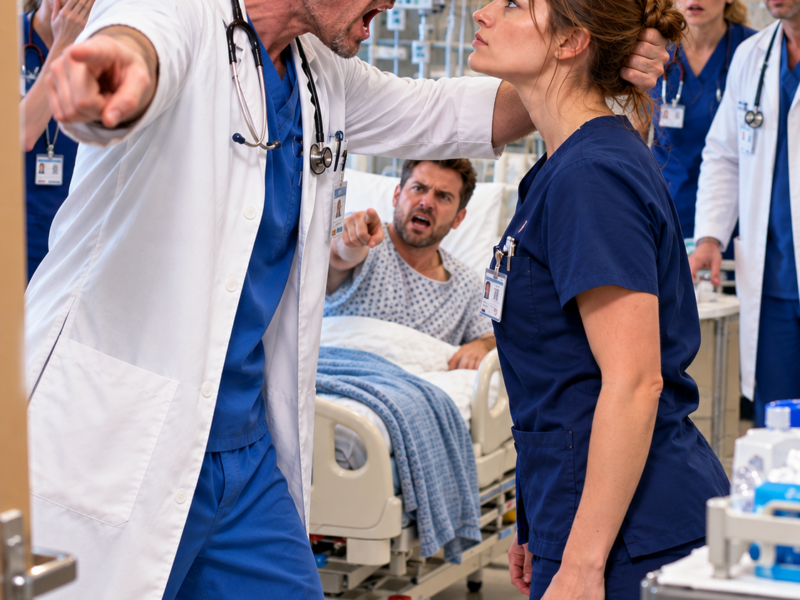
“Get the F*ck Out, Nurse!” the chief surgeon shouted across the trauma bay at Walter Reed, ripping the medical chart from my hands in front of a room full of doctors
I read the message again, standing beneath the fluorescent lights of the parking garage with the photograph trembling between my fingers.
MERCER KNOWS WHO REALLY GAVE THE ORDER.
Seven years ago, that sentence would have meant nothing to me. Now it felt like a door opening onto a room I had spent years trying not to remember.
I slid the photograph into my jacket and drove home without turning on the radio.
My apartment was twelve miles from Walter Reed, in a quiet neighborhood where nobody asked questions about the faint scar beneath my collarbone or why I woke up at three in the morning more often than I slept through the night.
I had chosen it because it was ordinary.
A small kitchen. A secondhand couch. A balcony overlooking a parking lot. No military photographs, no medals, no reminders of the woman I had been before everything fell apart.
I locked the deadbolt, checked it twice, and laid the photograph on my kitchen table.
The three men stared back at me.
I remembered the desert heat shimmering above the helicopter blades. I remembered the smell of hydraulic fluid and dust. I remembered the sound of a radio cutting in and out while our team waited for authorization to move.
And I remembered the voice that had given us the order.
Captain Michael Reeves.
He had been our commanding officer, the man whose instructions we followed because hesitation could cost lives. He had also been the last person to speak to us before our mission went wrong.
Officially, Reeves had died during the operation.
His remains had never been recovered, but the military had declared him killed in action after the investigation concluded that the helicopter had been destroyed during an enemy ambush.
The photograph in my hand had been taken three days before that mission.
The man standing on the right was Daniel Mercer.
The man on the left was Staff Sergeant Lucas Bennett, my closest friend on the team.
Lucas had died that night.
I closed my eyes.
For seven years, I had carried the memory of his final radio transmission, the broken words swallowed by static as I tried to reach him through the smoke.
I had been the communications specialist assigned to coordinate our extraction. When the operation collapsed, the report said I had relayed the wrong coordinates, sending our support aircraft into hostile territory.
Three men had died.
One had never been found.
And I had been blamed for the decisions that led to all of it.
I was removed from active duty, investigated, and quietly separated from service. The formal findings never accused me of deliberate misconduct, but the damage was already done.
My career was over.
My reputation was in pieces.
The people who had once trusted me stopped returning my calls.
I had told myself that if I stayed quiet, if I accepted the official conclusion and built a life somewhere else, I could eventually stop hearing Lucas’s voice in my dreams.
Now Daniel Mercer had looked me in the eyes and called me Ghost Six.
I picked up my phone and dialed a number I hadn’t used in six years.
It rang four times.
Then a familiar voice answered.
“Who is this?”
“It’s me, Nora.”
Silence.
“Nora?”
“Hi, Sam.”
Samuel Carter had served as our team’s intelligence liaison. He had been the person who compiled the evidence for the investigation, and he had testified that my transmission matched the coordinates provided by command.
I had not spoken to him since the hearing.
“What happened?” he asked.
“I need you to tell me something about the operation in Kandahar.”
His breathing changed.
“That was seven years ago.”
“I know exactly how long it’s been.”
“Then you know there’s nothing useful left to discuss.”
“Daniel Mercer is alive.”
The silence on the other end became so complete that I checked whether the call had disconnected.
Finally, Sam said, “Where did you hear that name?”
“He was brought into Walter Reed tonight. He recognized my call sign.”
“That isn’t possible.”
“Apparently, it is.”
“Listen to me carefully, Nora. Stay away from him.”
I gripped the edge of the kitchen counter.
“Why?”
“Because whatever he told you, you don’t understand what you’re stepping into.”
“Then explain it.”
“I can’t.”
“Or you won’t?”
He exhaled sharply.
“Do you remember what happened to Lucas?”
The question landed like a slap.
“Every day.”
“Then don’t make the same mistake twice.”
He hung up.
I stared at the phone.
Sam had always been careful with words, but that wasn’t what frightened me. It was the way he had asked whether I remembered Lucas, as though my friend’s death were a warning rather than a tragedy.
I looked at the photograph again.
Someone had placed it beneath my windshield wiper. Someone knew where I lived, knew my old call sign, and knew Daniel Mercer was alive before the hospital had even finished treating him.
I needed answers.
And I knew exactly where to begin.
At 6:40 the next morning, I returned to Walter Reed.
I had slept less than an hour. My eyes burned, and my coffee had gone cold before I reached the hospital entrance.
Emily met me near the nurses’ station.
“You look terrible,” she said.
“Good morning to you, too.”
She gave me a tired smile, then glanced over her shoulder.
“Dr. Hayes asked about you.”
“What did he want?”
“He wanted to know whether you had said anything unusual after the patient was admitted.”
My stomach tightened.
“What did you tell him?”
“That you did your job.”
I studied her face.
“Thank you.”
“Don’t thank me yet.” She lowered her voice. “He’s been in the ICU twice this morning. Both times, he asked the staff whether Mercer had regained consciousness.”
“That’s normal.”
“Maybe. But he also ordered a security officer to stand outside the room.”
I looked toward the elevators.
“Has anyone from the military been back?”
“One man. Same civilian clothes as last night. He spoke to Hayes, then went inside Mercer’s room.”
“How long ago?”
“Twenty minutes.”
I thanked her and headed for the ICU.
A security guard stood beside the door to Daniel’s room. He was broad-shouldered, perhaps in his forties, with a clipped haircut and a face that suggested he had spent years learning not to show what he was thinking.
“I’m here to check on Mr. Mercer,” I said.
“Are you assigned to his care?”
“I was part of the trauma team that brought him in.”
“Then you can speak with the attending physician.”
Before I could answer, a nurse emerged from the room carrying an empty tray.
She glanced at me, then at the guard.
“Dr. Hayes needs you in the surgical office,” she told him. “Something about the visitor log.”
The guard frowned.
“Right now?”
“That’s what he said.”
He hesitated, then walked away.
The nurse continued down the hallway without looking back.
I waited until she turned the corner, then slipped into Daniel’s room.
The curtains were half open. Morning light fell across the bed, revealing a pale face, dark hair, and bruising that spread from his temple to his jaw.
Machines surrounded him, their steady rhythms the only sounds in the room.
I moved closer.
“Daniel?”
His eyelids fluttered.
“Can you hear me?”
He turned his head a fraction.
When his eyes opened, recognition came slowly, followed by a flicker of fear.
“Ghost Six,” he whispered.
“My name is Nora Bennett now.”
He stared at me.
“Bennett?”
“Lucas was my brother.”
The words escaped before I could reconsider them.
For seven years, I had avoided saying that sentence to strangers. In the military, Lucas had been my teammate. In every other part of my life, he had been my little brother, the boy who stole my baseball cap and the young man who called me every Sunday, no matter where we were stationed.
Daniel’s eyes filled with tears.
“I didn’t know,” he rasped.
“Nobody did. We kept our family connection out of our operational records.”
He closed his eyes briefly.
“I’m sorry.”
I swallowed the ache rising in my throat.
“Why did you call me Ghost Six?”
His fingers moved against the blanket.
“Because you were the only one who heard the original transmission.”
“What transmission?”
“The order that sent us into the valley.”
I leaned closer.
“Daniel, I heard the order from Captain Reeves. I relayed the coordinates I was given. That’s what the investigation established.”
“That’s what they wanted you to believe.”
He tried to lift his head, grimaced, and sank back against the pillow.
I reached for the water cup, but he shook his head.
“Where’s the envelope?” he whispered.
“What envelope?”
“The one Reeves gave me before we went out.”
My pulse quickened.
“You said there was an envelope?”
He looked toward the door.
“Not here.”
“Daniel, you have to tell me what happened.”
“Not until I know who’s listening.”
I glanced at the monitor, then at the doorway.
“You’re in a secure hospital room.”
His expression changed, and I realized how little that assurance meant to him.
“Hayes,” he whispered. “Don’t trust him.”
“Why?”
“Because he was there.”
“At the operation?”
He nodded, then winced.
Before I could ask another question, footsteps approached the room.
Daniel’s hand shot out and caught mine.
“There’s a second report,” he whispered. “The original one. It shows who changed the coordinates.”
The door opened.
Dr. Hayes stepped inside, followed by the same civilian I had seen the night before.
Hayes’s eyes went straight to our joined hands.
“Ms. Bennett,” he said coldly. “I believe I made myself clear about your involvement with this patient.”
I stood up.
“I was checking on his recovery.”
“You’re not assigned to his care.”
“Then why does he keep asking for me?”
Hayes’s jaw tightened.
The civilian stepped between us.
“Ma’am, I need you to leave the room.”
Daniel tried to speak, but the effort triggered a coughing fit. His oxygen saturation began to fall.
I moved toward the bed instinctively.
Hayes raised his voice. “Don’t touch him!”
I stopped with my hands suspended in the air.
For a few seconds, all I could do was watch the numbers on the monitor drop.
Then Daniel forced out a single word.
“Reeves.”
The civilian went rigid.
It was the smallest reaction imaginable, but I saw it.
Hayes saw it, too.
Their eyes met.
And in that brief exchange, I understood that Daniel hadn’t merely mentioned a dead officer.
He had named someone these men were afraid to discuss.
The security guard returned with another hospital employee, and I was escorted out.
I didn’t fight them.
I had learned a long time ago that the fastest way to lose access to the truth was to let anger make your decisions.
But as the ICU doors closed behind me, I heard Hayes say something that made my skin prickle.
“Find out what he told her.”
I kept walking.
I didn’t stop until I reached the stairwell.
My hands were shaking, so I pressed them against the cold metal railing and forced myself to breathe.
Daniel had said there was a second report.
If it existed, it could prove the coordinates had been changed after I received the original order.
That would mean the investigation had been built around incomplete evidence.
It would mean someone had allowed Lucas to die and then let me carry the blame.
I pulled out my phone and searched through my contacts for the one person who might know where the original operational files had gone.
Major Evelyn Shaw had been our intelligence officer. She had challenged the findings during the investigation, arguing that the radio logs were incomplete.
Her objections had been dismissed.
Three months later, she resigned from active duty.
I had heard she was working as a defense contractor in Virginia, but I had no idea whether she would speak to me.
I sent a message.
*It’s Nora Bennett. I need to talk about the Kandahar operation. Daniel Mercer is alive.*
Her reply came less than a minute later.
*Do not call me. Meet me at the old diner on Route 1 at 11:30. Come alone.*
I stared at the screen.
Then another message appeared.
*And Nora? Bring nothing connected to the hospital.*
At 11:25, I parked outside a faded roadside diner with a cracked sign and a row of pickup trucks along the curb.
Evelyn was seated in the back booth, wearing a gray sweater and a baseball cap. Time had put lines around her eyes, but she still watched the entrance the way she used to watch a command post.
She didn’t stand when I approached.
“You shouldn’t have contacted me,” she said.
“That’s what everyone keeps telling me.”
“Maybe you should listen.”
I slid into the booth across from her.
“Daniel says there’s an original report.”
Her expression barely moved, but her hand tightened around her coffee cup.
“Where did he get that idea?”
“He said Captain Reeves gave him an envelope before the mission.”
Evelyn looked toward the window.
“Did he tell you what was in it?”
“No.”
“Then he’s still protecting someone.”
“Who?”
She stared at me for a long moment.
“That’s what I spent seven years trying to find out.”
A waitress approached. Evelyn ordered another coffee for herself and a glass of water for me. She waited until the woman had walked away before speaking again.
“The operation was compromised before your team ever left the staging area. We suspected an intelligence leak, but every channel we investigated came back clean.”
“Except the coordinates.”
“Yes. The coordinates.”
She reached into her bag and removed a small notebook.
“I kept copies of the discrepancies I found in the mission logs. The official report said you transmitted the wrong extraction location at 0214 hours.”
“I transmitted what I was given at 0209.”
“Exactly.”
She opened the notebook.
“Five minutes later, a command authorization was entered into the system. It changed the extraction grid. The problem is that the authorization was recorded under Reeves’s credentials.”
“Then he changed it.”
“Maybe. But the system logs showed his credentials being used from a terminal he wasn’t near.”
I stared at her.
“Could someone have accessed his account?”
“Someone did. We just couldn’t prove who.”
The waitress returned with our drinks. Evelyn waited until she had left again.
“There was another anomaly,” she continued. “A secondary transmission was received at 0212. It was never included in the investigation file.”
“What did it say?”
“I don’t know. The audio was classified and removed before I could obtain a copy.”
I felt a cold pressure settle behind my ribs.
“Why didn’t you tell me this during the hearing?”
“I tried. The panel said the transmission wasn’t relevant because it hadn’t been authenticated.”
“You could have told me afterward.”
“I was ordered not to discuss classified evidence. I thought the truth would eventually surface.”
“And when it didn’t?”
Her eyes dropped to the notebook.
“I got tired of watching good people lose everything while the people responsible kept their careers.”
I wanted to be angry with her. Part of me was.
But I could see the years in her face, the same exhaustion I carried myself.
“Why meet me now?”
“Because Daniel Mercer wasn’t supposed to survive.”
The words hung between us.
Evelyn closed the notebook.
“His transport was delayed twice before he reached Walter Reed. The explanation was a routing error, but the timing doesn’t make sense. Someone wanted to know whether he was conscious before he was brought into the hospital.”
“How do you know that?”
“I still have friends who work in military logistics.”
I leaned forward.
“Can you get the original report?”
“Not directly. But there may be a copy in the archive from the original investigation. If the files weren’t destroyed, they’ll be stored under the operation’s incident number.”
She wrote a series of digits on a napkin and slid it across the table.
“That’s the archive reference. The report won’t be accessible through the public system. You’ll need someone with authorization.”
“Do you know anyone?”
Evelyn looked at me.
“I know someone who might help. But before you contact him, I need you to understand something.”
“What?”
“If the coordinates were deliberately changed, the person responsible wasn’t just trying to sabotage a mission. They were trying to make sure nobody came back with evidence.”
I looked down at the napkin.
“Then why leave Daniel alive?”
“Maybe they thought he was dead. Maybe they thought he wouldn’t remember. Or maybe someone has been protecting him all these years.”
She stood and placed several bills beneath her coffee cup.
“Don’t go back to the hospital alone. And don’t assume the people wearing uniforms are on your side.”
“Evelyn, wait. Who is the person I need to contact?”
She hesitated.
“Sam Carter.”
My stomach tightened.
“I spoke to him last night.”
“Then he knows you’re looking.”
“He told me to stay away from Daniel.”
“That sounds like Sam.”
“Do you trust him?”
Evelyn put on her cap.
“I trust the man I served with. I don’t know what the man who testified against you has become.”
She walked out before I could ask anything else.
I sat in the booth for another ten minutes, staring at the archive reference until the ink began to blur.
Then I called Sam again.
He answered immediately.
“You met with Evelyn.”
It wasn’t a question.
“How did you know?”
“Because she called me five minutes ago.”
“What did you do, Sam?”
“I tried to keep you alive.”
“By letting me take the blame for Lucas’s death?”
His silence was answer enough.
I gripped the phone.
“Tell me where the original report is.”
“I can’t give you that over the phone.”
“Then meet me.”
“No.”
“Daniel is alive. He remembers the transmission. He says Reeves gave him an envelope.”
Sam exhaled sharply.
“Listen to me. That envelope was never supposed to leave the operation.”
“What’s in it?”
“I don’t know.”
“You’re lying.”
“Maybe. But I’m not lying about the danger you’re in.”
I closed my eyes.
“Then tell me one thing. Did you know the coordinates had been changed before the mission?”
The line went silent.
When Sam finally spoke, his voice was barely audible.
“Yes.”
I felt the words before I understood them.
“You knew?”
“I discovered the discrepancy after the team was already in the field. I reported it to command.”
“And they told you to do nothing?”
“They told me the change had been authorized. I was ordered to stand down.”
“So you let us go in.”
“I didn’t have operational authority, Nora. I couldn’t pull your team out.”
“You could have warned us.”
“I tried to reach Reeves.”
“Did you?”
“I sent a message through the command channel. I never received confirmation.”
I wanted to believe him. I also remembered his testimony, the way he had looked at the panel and said my transmission was the only verified coordinate record.
“You said the logs were complete.”
“I was told they were.”
“And you never questioned it?”
“I did. By then, the investigation had already been closed.”
The anger inside me was too old and too deep to disappear because he sounded sorry.
“Where is the original report?”
“There’s a backup in a restricted archive at Fort Meade. The access code is tied to the incident number Evelyn gave you.”
“Can you get it?”
“I can request access.”
“Will you?”
Another silence.
“Yes,” he said. “But not through official channels.”
I ended the call.
For the first time since Daniel had spoken my call sign, I had something more than suspicion.
I had a witness who admitted he knew the coordinates had changed.
I had an intelligence officer who had documented discrepancies.
And I had a report that someone had gone to considerable trouble to bury.
At 4:30 that afternoon, Emily called me from the hospital.
Her voice was strained.
“Nora, you need to come here.”
“What happened?”
“Daniel’s awake. He’s asking for you.”
“Did Hayes let him speak to anyone?”
“No. That’s the problem.”
I stood up from my kitchen table.
“What do you mean?”
“Someone tried to move him to another facility. They said it was a military transfer, but the paperwork doesn’t have the usual authorization.”
“Who signed it?”
“Dr. Hayes.”
I grabbed my keys.
“Don’t let them move him.”
“I can’t stop a military transfer.”
“Then get the attending physician. Get hospital administration. Do whatever you have to do.”
“Nora, there’s something else.”
I waited.
“Daniel told me to give you a message if you called.”
“What message?”
Emily swallowed.
“He said, ‘Tell Ghost Six the envelope isn’t the evidence. It’s the reason they killed Reeves.'”
I stopped moving.
“What?”
“That’s exactly what he said.”
The photograph lay on my kitchen table, the dead captain standing between two men whose lives had been torn apart by the same operation.
If Daniel was telling the truth, Reeves might not have died in the ambush at all.
And the envelope might contain something far more dangerous than a record of changed coordinates.
I drove to Walter Reed with my phone on speaker, listening as Emily described the transfer order.
By the time I reached the hospital, the paperwork had vanished from the unit’s desk.
Hayes was nowhere to be found.
The civilian security officer stood outside Daniel’s room, speaking quietly into his phone.
I walked straight toward him.
“I need to see the patient.”
“You’re not authorized.”
“Then call whoever authorized his transfer.”
He stepped in front of the door.
“Ma’am, I suggest you leave.”
Before I could answer, the door opened behind him.
Daniel lay propped against his pillows, his face gray with exhaustion. His eyes found mine.
“Nora,” he whispered.
The guard turned.
“Sir, you need to rest.”
Daniel ignored him.
“Tell her.”
The guard reached for the door.
I moved quickly, catching it before he could close it.
“Tell me what?”
Daniel looked directly at me.
“Reeves wasn’t killed in the ambush.”
The guard seized my arm.
I pulled free.
Daniel’s voice rose, raw with effort.
“He was alive when they took him.”
The hallway seemed to fall silent.
“Who took him?” I asked.
Daniel’s eyes shifted toward the guard.
Then back to me.
“The men who changed your coordinates.”
The guard shoved the door shut between us.
I stood in the hallway, hearing Daniel’s last words repeat in my head.
Captain Michael Reeves had been declared dead seven years ago.
But if Daniel had seen him alive after the mission collapsed, then the official report wasn’t merely wrong.
Someone had built an entire investigation around a death that might never have happened.
My phone vibrated.
A message from Sam.
*I found the archive record. The original transmission is still there. But there’s a second file attached to it, one that was never included in your investigation.*
A second message followed.
*The file is marked with Reeves’s authorization code.*
Then a third.
*The access log shows it was opened yesterday.*
I stared at the screen.
Yesterday.
Before Daniel arrived at Walter Reed.
Before he spoke my call sign.
Before I knew the past was coming back for me.
Someone had accessed the file and knew exactly what it contained.
I called Sam.
He answered on the first ring.
“Tell me you didn’t open it.”
“I didn’t. The system flagged the access, but the user credentials were masked.”
“Can you trace them?”
“Not without going through the security office.”
“Then don’t. We need a copy before someone deletes it.”
“I already made a request for a preservation hold.”
“Will that work?”
“It should.”
“Should isn’t enough.”
“I know.”
I heard a keyboard in the background.
“There’s one more thing, Nora.”
“What?”
“The second file wasn’t just opened yesterday. It was modified.”
My fingers tightened around the phone.
“Modified how?”
“The metadata shows a new authorization entry. Someone added a name to the record.”
“Whose name?”
Sam hesitated.
Then he said it.
“Yours.”
For a moment, I couldn’t hear anything except the blood rushing in my ears.
“That’s impossible.”
“I know.”
“I haven’t accessed that system in seven years.”
“That’s why I’m calling you.”
“Who entered it?”
“I don’t know yet. But the authorization is tied to a credential that should have been deactivated when you left the service.”
I looked through the ICU window.
Daniel was watching the door, his face drawn and exhausted, while the security officer stood beside his bed.
Someone had used my identity to access a file connected to the operation that destroyed my career.
Someone had arranged for a wounded SEAL to arrive at the hospital where I worked.
And someone had tried to move him before he could tell me what he remembered.
“Sam,” I said, “we need to see that file.”
“I agree.”
“Tonight.”
He paused.
“There’s something else in the metadata. A location tag.”
“Where?”
“An old military relay station outside Annapolis. It was decommissioned years ago.”
I looked at the photograph tucked inside my jacket.
Three men in the desert.
One declared dead.
One standing in a hospital bed, fighting to tell the truth.
And one, my brother, who would never get the chance to explain what he had heard that night.
“Send me the coordinates,” I said.
“Nora, if this is what I think it is, going there could put you in the same position you were in seven years ago.”
I watched the security officer turn away from Daniel’s bed to answer his phone.
“Sam, seven years ago, I followed an order because I trusted the people giving it.”
I ended the call.
“This time, I’m going to find out who gave it.”
When I reached my car, a final message arrived from an unknown number.
There was no greeting, no explanation, only a photograph of a building with a rusted antenna and a line of text beneath it.
*Come alone if you want to know what happened to Captain Reeves.*
I stared at the image.
In the corner of the photograph, barely visible through the shadows, stood a man wearing a dark jacket.
He was facing the camera.
His face was older, thinner, and marked by a scar along the jaw.
But I knew him.
I had watched the military bury his name seven years ago.
I had mourned him with my brother.
And I had spent years believing he was dead.
Captain Michael Reeves was alive.
The End.









