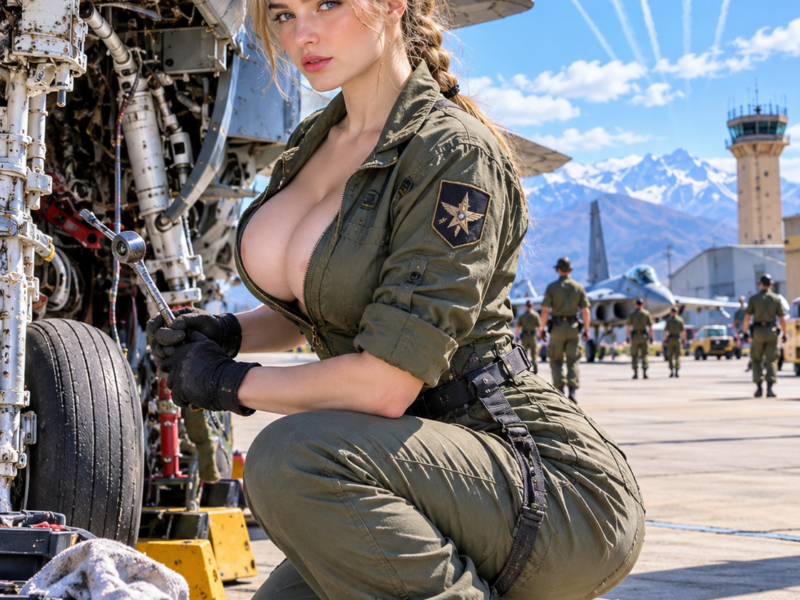
“Four enemy jets locked onto our airbase just as the commanding officer ordered everyone to take cover, and while trained pilots scrambled toward their aircraft
My fingers closed around the emergency radio.
Colonel Hayes grabbed my shoulder.
“Put that down, Carter.”
I looked through the hangar doors.
The fourth enemy fighter was still approaching, its silhouette growing larger against the pale Nevada sky.
“Sir, get everyone away from the northern side of this building.”
Hayes didn’t move.
“You have five seconds to explain why a civilian mechanic is being called by a military callsign.”
I turned toward him.
“Because four years ago, I was the pilot who taught those men how to fly that formation.”
The colonel’s expression changed.
It wasn’t disbelief anymore.
It was recognition.
“Viper Six?”
I nodded.
Tyler Reed stood behind him, holding his helmet against his chest.
“Wait. You’re Daniel Carter? The Viper Six?”
I didn’t have time to answer.
The emergency radio crackled again.
“Viper Six, this is Viper One. If you can hear me, acknowledge.”
I pressed the transmit button.
“Viper One, this is Carter. Identify yourself.”
There was a pause.
Then a familiar voice answered.
“Daniel? My God. We thought you were gone.”
I closed my eyes briefly.
“Who’s speaking?”
“Marcus.”
For a second, I forgot about the four incoming fighters.
Marcus Cole.
My former wingman.
The man I’d spent hundreds of hours flying beside.
The man whose aircraft had disappeared from radar on the night our squadron was destroyed.
“Marcus, where are you?”
“That’s not important right now. Listen carefully. They’re not trying to destroy the base.”
I glanced at the radar.
“Then what are they doing?”
“They’re looking for something.”
“Something on the base?”
“Something that was brought here three days ago.”
The radio went silent.
Colonel Hayes stepped closer.
“Ask him what.”
I pressed the button again.
“Marcus, what exactly are they looking for?”
His answer came quietly.
“The flight recorder from your last mission.”
I stared at the radio.
Four years.
Four years of nightmares, unanswered questions, and a silence I had carefully built around myself.
And now the very thing I’d spent those years trying to forget had followed me to Nevada.
I looked at Hayes.
“What was brought here three days ago?”
He didn’t answer immediately.
That was enough.
“Colonel?”
He glanced toward the communications officer.
“Get everyone out of this hangar.”
“Sir,” Tyler said, “what about the aircraft?”
“Leave them.”
The colonel finally looked at me.
“Come with me. Now.”
I didn’t move.
“Why is my flight recorder here?”
Hayes lowered his voice.
“Because someone in Washington requested that it be transferred to this facility.”
“Who?”
“I don’t know.”
“You signed the transfer order.”
His jaw tightened.
“Yes.”
“And you didn’t think to tell the man who flew the aircraft?”
“I was instructed not to discuss it.”
I laughed once, without humor.
“Of course you were.”
A deep rumble rolled across the airfield.
The approaching fighters were close enough that the windows trembled.
The tower radio erupted.
“All personnel, incoming aircraft have crossed the final warning line. Interceptors are unable to establish a firing solution.”
Hayes grabbed the radio.
“Why can’t they engage?”
The controller responded.
“They’re flying inside a restricted electronic corridor. Our targeting systems keep losing lock.”
I looked at the radar again.
The formation was familiar, but something was different.
The aircraft weren’t simply avoiding our defenses.
They were forcing our pilots into predictable positions.
I knew the next move.
“Tell the interceptors to break left and descend below the cloud line.”
Hayes stared at me.
“Why?”
“Because the lead fighter is baiting them into a vertical turn. If they follow, the two aircraft on the sides will trap them.”
“How do you know?”
“Because I helped develop that tactic.”
The colonel grabbed the radio.
“Tower, hold the interceptors’ current heading. Do not make any changes until I verify this.”
I looked at him.
“Colonel, verification is going to cost you time.”
He hesitated.
Then he handed me the radio.
“One instruction. If you’re wrong, I’ll have you removed from this base.”
I took it.
“Understood.”
I transmitted the warning.
The response came almost immediately.
“Command, we have visual confirmation. Lead contact has begun the vertical turn.”
I watched the screen.
The two side contacts moved outward.
Then, just as I had predicted, the lead aircraft climbed sharply.
The interceptors broke formation and descended.
A few seconds later, the two enemy fighters crossed the space where our pilots would have been.
Tyler let out a breath.
“That would’ve been bad.”
“Yes,” I said.
The fourth fighter was still moving toward Hangar Three.
It hadn’t changed course.
I looked at the radio.
“Marcus, what is the fourth aircraft doing?”
“He’s waiting for the recorder.”
“How would he know where it is?”
Another pause.
Then Marcus said something that made my hands tighten around the microphone.
“Because someone gave them the storage location.”
I turned toward Hayes.
The colonel was already looking at me.
Neither of us spoke.
A person inside the base had told the enemy exactly where to find the evidence.
And whoever it was had known about the transfer before most of the command staff.
“Lock down the records building,” I said.
Hayes nodded to an officer.
“Do it.”
“And check everyone who had access to the transfer authorization.”
The colonel looked uncomfortable.
“You’re making serious accusations.”
“I’m making sure we don’t lose the only evidence that can explain what happened to my squadron.”
The radio crackled.
Marcus spoke again.
“Daniel, there’s something else.”
I lowered my voice.
“What?”
“The recorder isn’t the only thing they want.”
I looked at the radar.
“What else?”
“They want the original mission file. The one that never made it into the official report.”
I felt the old memories pressing against the back of my mind.
That mission had been classified.
We had been sent to escort an aircraft carrying sensitive surveillance equipment through a disputed air corridor.
The briefing had described it as routine.
It wasn’t.
Halfway through the flight, our navigation systems began receiving conflicting signals.
Then the enemy fighters appeared.
I remembered calling for clearance to disengage.
I remembered command ordering us to hold position.
And I remembered the final transmission from my squadron leader.
“Viper Six, break off. That’s an order.”
I had refused.
Not because I was brave.
Because I believed I could bring everyone home.
Three aircraft never returned.
My own jet barely made it to an emergency landing.
The official report blamed poor judgment and a navigation failure.
I had never believed it.
But I had also never had enough evidence to prove otherwise.
“Where’s the original file?” I asked Marcus.
“Somewhere inside the base.”
“Do you know where?”
“Not yet.”
“How are you seeing this?”
Marcus hesitated.
“Because I’m not one of the four aircraft.”
I stared at the radio.
“What?”
“I’m flying with the recovery team. We’re outside the engagement zone.”
Before I could respond, the radio changed frequencies.
A different voice came through.
“Colonel Hayes, this is Security Operations. We have an unauthorized access attempt at the records building.”
Hayes snatched the microphone.
“Identify the personnel involved.”
“Lieutenant Colonel James Mercer, sir.”
Hayes went completely still.
Mercer was his deputy.
I’d seen him almost every morning for two years.
He was polite, soft-spoken, and the kind of officer who remembered the names of maintenance workers.
He had brought coffee to the hangar during overnight repairs.
Once, he’d stayed late to help Tyler find a missing tool.
I couldn’t imagine him betraying the base.
“Where is he now?” Hayes demanded.
“Inside the building, sir. He claims he has authorization.”
Hayes turned toward the communications officer.
“Have security detain him.”
The reply came after several seconds.
“Sir, we can’t.”
“Why not?”
“Because he has a weapon, and he has taken the records supervisor into custody.”
The colonel swore under his breath.
I looked at the radar.
The fourth aircraft was still approaching.
Then I looked at the clock.
We had minutes, perhaps less.
“He’s trying to buy time,” I said.
Hayes nodded.
“Security team, move in carefully. No one fires unless absolutely necessary.”
I grabbed my toolbox.
Hayes stared at me.
“Where are you going?”
“To the records building.”
“Absolutely not.”
“Your deputy has the only evidence that can tell us why those aircraft are here. And if he destroys it, we may never know who sent them.”
“You’re not trained for this.”
I looked at him.
“Sir, I’ve been trained for more than you know.”
For the first time since I’d met him, Hayes didn’t have an answer.
He called two security officers over and ordered them to escort me.
We ran across the service road.
The air smelled of jet fuel and hot dust.
Above us, the fighters were still circling.
Every few seconds, the warning siren rose above the engines.
When we reached the records building, the main entrance was locked.
Two security officers stood behind a concrete barrier.
One of them recognized Hayes.
“Sir, Mercer is inside with the supervisor. He told us he’ll release her when the aircraft leave.”
“Did he say why?”
“He said the base has no idea what it’s protecting.”
Hayes looked at me.
I stepped toward the glass doors.
“Mercer!”
There was no answer.
I tried again.
“James, it’s Daniel Carter.”
A few seconds later, a face appeared behind the glass.
Mercer looked exhausted.
His uniform collar was open, and there was a dark mark near his right cheek.
When he recognized me, his expression shifted.
“Daniel. You shouldn’t be here.”
“Neither should you.”
He glanced toward Hayes.
“Colonel, you need to leave.”
“Put down the weapon, Mercer.”
Mercer shook his head.
“You don’t understand what that recorder contains.”
“Then explain it.”
He looked directly at me.
“It contains the truth about your squadron.”
I stepped closer.
“Then let us see it.”
His eyes filled with something I couldn’t immediately identify.
Regret, perhaps.
Or fear.
“You think I wanted this?” he asked.
I didn’t answer.
He continued.
“Four years ago, your squadron was sent into that corridor because someone wanted to test a new electronic warfare system. The enemy fighters weren’t supposed to engage you. They were supposed to force you into a controlled retreat.”
I felt my mouth go dry.
“Who authorized it?”
Mercer looked down.
“Someone who knew the system would fail.”
“And command knew?”
“Some people did.”
The colonel stepped forward.
“Names, Mercer. I need names.”
Mercer shook his head.
“You’re too late.”
A loud impact sounded from inside the building.
The security officers raised their weapons.
Mercer disappeared from the glass.
Then the lights inside went out.
“Move!” Hayes shouted.
The officers forced the entrance open.
I followed them through the dark corridor.
A fire alarm began ringing.
Smoke was already drifting from the records room.
The records supervisor was crouched beside a filing cabinet, coughing.
One security officer pulled her toward the exit.
The other ran toward Mercer.
I saw him near a metal storage case.
He was holding a small black device.
“Don’t touch it!” I shouted.
Mercer turned.
For a brief moment, our eyes met.
Then he dropped the device.
A sharp electronic chirp came from somewhere inside the case.
I recognized the sound.
It was a data destruction timer.
“Get away from the case!”
Everyone moved.
A few seconds later, the device went silent.
The case remained intact.
But when I opened it, the drive compartment was empty.
The flight recorder was gone.
Mercer sat against the wall, breathing heavily.
Hayes approached him.
“Where is it?”
Mercer didn’t answer.
I crouched in front of him.
“James, listen to me. I don’t care what you were told. Three men died because of that mission. I spent four years wondering whether I made the wrong decision. If you know what happened, tell me.”
Mercer looked at me.
Then he said something I hadn’t expected.
“Your wingman is alive.”
I stopped breathing for a moment.
“Which wingman?”
“Marcus Cole.”
I grabbed his sleeve.
“Where is he?”
Mercer swallowed.
“He’s the one who brought the recorder here.”
I stared at him.
“That doesn’t make sense. I just spoke to him.”
“Then you need to ask him why he disappeared for four years.”
Before I could respond, the building shook.
A massive explosion sounded from the northern side of the base.
The fourth enemy aircraft had struck the perimeter.
The emergency lights flickered.
Hayes turned toward the corridor.
“Everyone out. Now!”
We helped the supervisor outside.
Mercer was taken into custody.
As soon as we reached the service road, I grabbed the radio.
“Marcus, answer me.”
Static.
“Marcus, this is Daniel. I need you to answer.”
Nothing.
Then a voice came through.
It wasn’t Marcus.
It was the tower controller.
“Command, we have lost contact with the recovery aircraft.”
I looked toward the sky.
One of our interceptors was circling low over the airfield.
The four enemy fighters had separated again.
But now one of them was heading toward the southern runway.
I reached for the radio.
“Tower, this is Carter. What’s the status of the recovery aircraft?”
“Unknown. Last position was twelve miles northwest.”
“Any emergency beacon?”
“Negative.”
I looked at Hayes.
“Where’s the nearest available aircraft?”
He hesitated.
“All combat aircraft are either airborne or under maintenance restrictions.”
I looked toward Hangar Three.
My F-16 was still there.
The aircraft I’d been repairing before the first alarm.
Its maintenance panel was open.
The hydraulic system had been serviced.
The engine had passed its inspection.
But the aircraft was not cleared for flight.
Hayes followed my gaze.
“No.”
I didn’t answer.
“Daniel, absolutely not.”
“Sir, Marcus is out there.”
“You don’t even know if he’s alive.”
“That’s why I need to find him.”
Hayes stepped in front of me.
“You’ve been out of the cockpit for four years. You can’t just climb into a fighter and pretend nothing happened.”
I looked at him.
“I don’t intend to pretend.”
For a moment, the colonel seemed to struggle with something.
Then he lowered his voice.
“If I authorize this, there’s no guarantee you’ll come back.”
I thought about the three men whose voices I still heard in my sleep.
I thought about Marcus.
And I thought about the last time I’d walked away from an aircraft.
“I know.”
Hayes turned toward the tower.
“Prepare Hangar Three. Get the flight surgeon and the chief engineer here. We need a full inspection.”
I looked at him.
“Thank you, sir.”
“Don’t thank me. If that aircraft isn’t safe, you’re not going anywhere.”
For the next twenty minutes, the hangar became a blur of movement.
The maintenance crew checked every system.
Tyler worked beside me, passing tools without being asked.
He knew something was different.
When the chief engineer finally gave the aircraft a limited clearance, Tyler looked at me.
“You’re really doing this?”
I nodded.
He swallowed.
“Can I ask you something?”
“Sure.”
“Why did you stop flying?”
I looked at the aircraft’s open cockpit.
“Because I came home when three other men didn’t.”
Tyler didn’t say anything.
He simply handed me my helmet.
I climbed the ladder.
The familiar smell of the cockpit hit me.
Old leather.
Warm electronics.
Hydraulic fluid.
My hands rested on the controls.
For a few seconds, I couldn’t move.
Then I heard a voice over the radio.
“Viper Six, this is Viper One. If you’re there, don’t come looking for me.”
Marcus.
I leaned forward.
“That’s not your decision.”
His reply was weak.
“Daniel, listen to me. I have the original mission file. I know who gave the enemy our coordinates.”
“Where are you?”
“Old test range. Twelve miles northwest.”
“Can you land?”
A pause.
“My aircraft is damaged.”
“Can you eject?”
“Negative.”
I tightened my grip.
“Then hold on.”
He laughed softly.
“Still giving orders, Carter?”
“Somebody has to.”
For the first time in four years, I smiled.
The tower cleared the runway.
The engine came alive beneath me.
The ground crew moved away.
And then, slowly, I began to taxi.
I had forgotten how much power an aircraft could carry.
The runway lights stretched ahead.
My breathing became steady.
The moment the wheels left the ground, the old world came rushing back.
I wasn’t a mechanic anymore.
I was Viper Six.
But I wasn’t the same man who had left the cockpit four years earlier.
I climbed toward the northwest.
The radar picked up three enemy fighters moving away from the base.
The fourth was still circling near the test range.
I contacted the tower.
“Redstone, this is Viper Six. Requesting location of recovery aircraft.”
“Viper Six, be advised, unknown aircraft are still active in the area.”
“Understood.”
I didn’t need a warning.
I needed a position.
The controller gave me the coordinates.
I adjusted my heading.
Then I saw something on the horizon.
A dark shape moving unevenly above the desert.
Marcus.
His aircraft was trailing smoke.
I reached him within minutes.
“Marcus, I have you in sight.”
His voice came through.
“About time.”
I could see the damage along the wing.
The aircraft was struggling to maintain altitude.
“Can you hold your position?”
“Trying.”
I kept my distance and assessed the situation.
Then the fourth enemy fighter appeared on my radar.
It was approaching from behind.
“Daniel, you’ve got company,” Marcus warned.
“I see him.”
The enemy aircraft moved into a position behind me.
My warning system began sounding.
I felt the old instinct return, but this time I didn’t let it take over.
I remembered the pattern from the first formation.
The enemy pilot wanted me to climb.
I stayed low and changed direction.
The warning tone continued.
“Daniel, break away!” Marcus shouted.
“Not yet.”
I watched the radar.
The enemy fighter adjusted.
It was trying to force me toward the open desert, away from Marcus.
I understood.
They weren’t trying to shoot me down immediately.
They wanted to separate us.
I transmitted to the tower.
“Redstone, I need the electronic interference pattern recorded from the last fifteen minutes.”
“Stand by.”
Seconds passed.
Then the controller replied.
“We have it.”
“Send the frequency data to my display.”
“Copy.”
The information appeared.
I compared it with the old mission pattern I remembered.
The same interference signature.
The same sequence.
The same mistake.
I finally understood what had happened four years ago.
The enemy hadn’t defeated our squadron through superior flying.
Someone had given them access to our navigation frequencies.
They had known exactly where we’d be.
And someone on our side had known the system was compromised.
The warning tone changed.
The enemy aircraft had moved closer.
I made a sharp turn, then leveled out.
The fighter overshot my position.
For a moment, I had a clear view of its markings.
There was no official insignia.
But there was a small white symbol near the tail.
A black circle crossed by two diagonal lines.
I recognized it.
It was the same symbol I’d seen on the classified test documents before my final mission.
The aircraft weren’t simply attacking the base.
They were connected to the program that had destroyed my squadron.
“Marcus, do you see that symbol?”
“Yes.”
“Did you know?”
“I found out two years ago.”
My hands tightened.
“Two years?”
“I was alive, Daniel.”
“I know that now.”
“I couldn’t contact you.”
“Why?”
“Because I was trying to find proof.”
The enemy fighter turned away.
I kept my position between it and Marcus.
“Tell me everything.”
Marcus took a breath.
“After your emergency landing, I was picked up by a recovery team. My aircraft had been forced down in the desert. I survived, but I was badly injured.”
I listened.
“The official report said you were the only survivor. That was convenient. They classified the entire operation and moved me into a restricted medical facility.”
“Who ordered it?”
“General William Prescott.”
The name meant something.
Prescott had been a senior operations officer at the time.
He had approved our mission.
“Why would he do that?”
“Because the test wasn’t authorized. The system was being developed for a private defense contractor, and they wanted combat data without going through the proper channels.”
I looked toward the distant mountains.
“And the enemy fighters?”
“One of the contractor’s foreign partners supplied them with the flight information. The plan was to create a controlled engagement, collect the data, and make the whole thing look like a routine training failure.”
“Three pilots died.”
“I know.”
“Did they know?”
Marcus went silent.
Then he said, “They knew the risks. They just didn’t think the system would fail.”
I felt something heavy settle in my chest.
For four years, I had blamed myself.
I had replayed every turn, every radio call, every decision.
I had believed that if I’d been faster, smarter, or less stubborn, I might have brought my squadron home.
But the truth was that someone had put us in danger before we ever took off.
“Why didn’t you come to me?”
“Because I didn’t have proof.”
“You had two years.”
“I had a hospital bed, a restricted file, and people watching every move I made.”
I didn’t respond.
Then Marcus said something else.
“The recorder contains the original transmission from Prescott. He ordered the system activated even after we reported interference.”
I looked at the sky.
“Where is the recorder now?”
“With me.”
I glanced toward his aircraft.
A small emergency storage compartment was visible behind the cockpit.
“You brought it with you?”
“Yes.”
“Why?”
“Because I knew they’d come for it.”
The enemy fighter had disappeared from my radar.
For the first time in several minutes, the warning tone stopped.
I looked toward the base.
“Marcus, we’re going home.”
He laughed weakly.
“That’s what I’ve been trying to do for four years.”
The recovery aircraft was escorted back toward Redstone.
By the time we reached the runway, the other enemy fighters had withdrawn.
The base was damaged.
One hangar had lost part of its roof, and the northern perimeter was covered in smoke.
But the personnel had survived.
The fourth aircraft had struck an empty service structure after losing its approach.
The base medical team was waiting near the runway.
I landed first.
Marcus followed, barely keeping his aircraft under control.
As soon as his wheels touched the concrete, emergency vehicles rushed toward him.
I climbed out and removed my helmet.
For several seconds, I just stood there.
Then I saw Marcus being helped down from his cockpit.
He was thinner than I remembered.
His hair had turned gray at the temples.
A long scar ran from his jaw toward his neck.
But he was alive.
I walked toward him.
He looked at me and tried to smile.
“Still wearing that same miserable expression?”
I laughed.
Then I hugged him.
Neither of us said anything for a long time.
Colonel Hayes approached us.
“Captain Carter.”
I turned.
He was holding a folder.
“I owe you an apology.”
I looked at him.
“For what?”
“For treating you like you were just a mechanic.”
I glanced back at Hangar Three.
“I am a mechanic.”
Hayes nodded.
“I know. That’s what makes this more complicated.”
He handed me the folder.
Inside were copies of the original mission orders, the transfer authorization, and a preliminary security report.
There was one signature I recognized immediately.
General Prescott.
But beneath it was another.
Lieutenant Colonel James Mercer.
I looked up.
“Mercer helped move the recorder?”
Hayes nodded.
“He claims he was ordered to transfer it and keep it hidden.”
“Did he know the enemy would attack?”
“We don’t know yet.”
I thought about the frightened expression on Mercer’s face.
I remembered how he’d looked at me when he said the recorder contained the truth.
“Don’t decide he’s guilty before he has a chance to explain.”
Hayes studied me.
“After what happened today, you’re still defending him?”
“I’m not defending him. I’m asking you to investigate properly.”
The colonel nodded slowly.
“Fair enough.”
The next few days were difficult.
Federal investigators arrived.
The flight recorder was secured.
Marcus gave his statement.
I gave mine.
The evidence showed that General Prescott had authorized an unauthorized electronic warfare test during our final mission.
The contractor had supplied the equipment and shared sensitive flight information with a foreign partner.
When the system malfunctioned, Prescott ordered our squadron to maintain formation rather than disengage.
The resulting interference caused three aircraft to lose navigation and communication.
The report that blamed our squadron had been deliberately altered.
Mercer admitted that he had helped conceal the original transfer records.
He claimed he had done so after being threatened with charges for violating classification rules.
He also admitted that he had been the one who contacted the foreign partner about the recorder’s location.
He said he believed they would retrieve it quietly.
He hadn’t expected an attack on the base.
I didn’t know whether I believed every word.
But I knew he would have to answer for what he had done.
General Prescott was suspended within a week.
The defense contractor’s offices were searched.
The investigation continued for months.
And for the first time since the mission, the official report acknowledged that the three missing pilots had not been responsible for their deaths.
It wasn’t enough.
Nothing could bring them back.
But their families finally received the truth.
I attended the memorial service at Redstone.
The three names were engraved on a dark granite wall.
Captain Eric Lawson.
Lieutenant James Porter.
Major Samuel Brooks.
I placed three small flight patches beneath their names.
Marcus stood beside me.
Neither of us spoke for several minutes.
Then he said, “You know, I thought about leaving aviation forever.”
I looked at him.
“What changed your mind?”
He shrugged.
“I got tired of letting the people who caused it decide what I was allowed to remember.”
I looked at the names again.
“I understand.”
He turned toward me.
“Are you going back?”
I watched the maintenance crews moving across the airfield.
For four years, I’d believed that flying again meant betraying the men I’d lost.
Now I understood that staying away hadn’t protected their memory.
It had only allowed someone else to define it.
“I don’t know,” I said honestly.
Marcus nodded.
“You don’t have to decide today.”
A week later, I returned to Hangar Three.
My toolbox was still where I’d left it.
Tyler was working beneath an F-16, trying to fit a replacement panel.
When he saw me, he stood up.
“Captain Carter.”
I raised an eyebrow.
“Daniel is fine.”
He smiled.
“Everyone’s talking about you.”
“That sounds unfortunate.”
He laughed.
Then he looked at the aircraft.
“Are you leaving maintenance?”
I considered the question.
The cockpit was no longer something I feared.
But the workshop had become something I valued.
I had learned that flying wasn’t the only way to serve the people who depended on you.
“I think I’ll stay for now.”
Tyler nodded.
“Good. I still have a lot to learn.”
I picked up my wrench.
“Then stop overtightening those bolts.”
He looked embarrassed.
“How did you know?”
“Because I’ve been watching you do it for ten minutes.”
We both laughed.
A few months later, the base held a small ceremony recognizing the maintenance crews who had kept the aircraft operational during the attack.
Colonel Hayes presented the awards.
When he reached me, he paused.
“Captain Daniel Carter. Former Viper Six. Current senior aircraft maintenance specialist.”
A few people laughed.
I shook his hand.
He leaned closer and said quietly, “You know, you could have asked for your old position back.”
I looked across the hangar.
Tyler was showing a younger mechanic how to inspect a hydraulic line.
Marcus was standing near the door, wearing a clean uniform for the first time in years.
I smiled.
“I already have a position.”
Hayes nodded.
“I thought you might say that.”
After the ceremony, I walked outside.
The Nevada sun was beginning to set, turning the runway gold.
An F-16 passed overhead.
Its engine roared across the desert.
I watched until it disappeared beyond the mountains.
For years, that sound had reminded me of everything I’d lost.
Now it reminded me that the men I’d lost had finally been given their names back.
I still flew occasionally, but I no longer felt the need to prove that I could.
Some mornings, I arrived before sunrise, opened my toolbox, and listened to the familiar sounds of the hangar waking up.
Tyler eventually earned his certification.
Marcus returned to flight operations after months of rehabilitation.
And I kept my place beneath the aircraft, where a loose panel or a stubborn engine could still demand all my attention.
One afternoon, Tyler asked me why I never displayed my old combat medals.
I looked at the small wooden box in my locker.
Inside were four photographs, three folded letters, and a worn squadron patch.
I handed him the patch.
“Because medals tell people what you did,” I said. “They don’t tell them who you did it for.”
He studied the stitching.
Then he carefully handed it back.
I placed it beside the three photographs of my friends.
For the first time in four years, I left the locker open.
And when the evening shift ended, I walked out of Hangar Three without feeling like I was leaving anyone behind.
The end.









