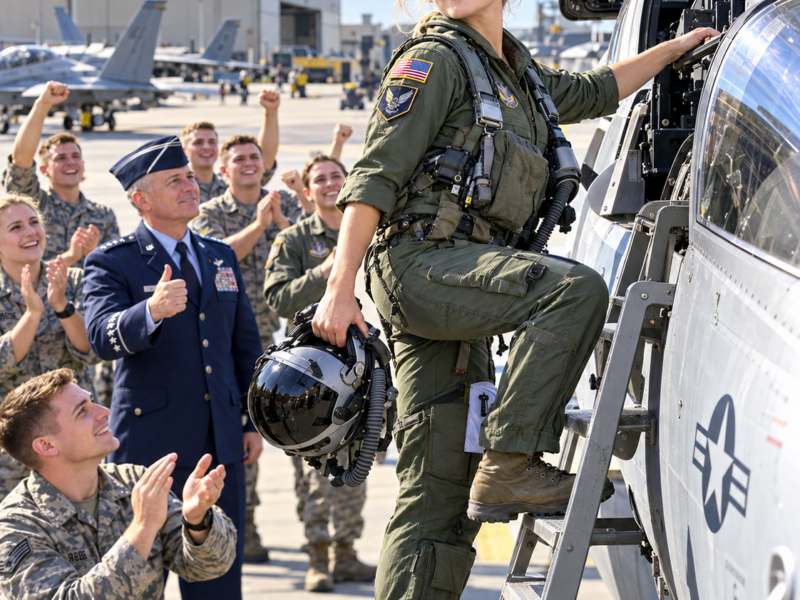
For eight years, I hid the fact that I was a fighter pilot. I wore a different uniform, worked behind closed doors, and let people believe
For eight years, I had watched other pilots climb into fighter jets while I remained behind a glass wall, studying the sky through radar displays and mission reports. I had told myself that the cockpit was part of my past. I had accepted that the decision made about my career was final.
But at 0413 that morning, three allied aircraft were missing, unidentified fighters were approaching their last known position, and the personnel record that had kept me grounded for eight years was suddenly under investigation.
And for the first time in nearly a decade, I had a chance to find out whether the truth could finally set me free.
“Commander Hale,” I said, looking at the name displayed on the personnel officer’s screen, “I need to know whether you ever reviewed my suspension.”
Hale looked as though I had struck him.
“No,” he answered. “I never signed that withdrawal. I wasn’t even assigned to the review board when your qualification was suspended.”
The personnel officer, Lieutenant Sarah Kim, checked the record again. “The electronic signature is linked to your command credentials, sir. But the authorization timestamp doesn’t match your duty log. You were deployed overseas on that date.”
Hale pulled a chair toward the terminal.
“Preserve the record. Copy the audit trail. Nobody edits anything until legal reviews it.”
Captain Marcus Reed glanced at the tracking screen. “With respect, we don’t have time to solve an eight-year-old personnel dispute. We have three pilots out there.”
“He’s right,” I said.
Reed turned toward me, apparently surprised that I agreed.
“My qualification record needs to be investigated,” I continued. “But the missing aircraft are the immediate priority. I can help identify their possible routes and interpret the weather changes. If there’s an authorized way for me to contribute beyond the operations room, we need to establish that now.”
Hale studied me carefully.
“Your old flight qualification is not enough to put you into a combat aircraft. We need to verify your current medical status, training currency, and authorization.”
“I understand, sir.”
“Then start with what you can do from here.”
I returned to the main display and pulled up the last known positions of the three missing aircraft. Their call signs were Falcon One, Falcon Two, and Falcon Three. They had been operating together near the edge of a restricted corridor when their communications failed.
The official report showed their last positions as a tight formation moving west.
That bothered me.
“Lieutenant Kim, can you pull the raw tracking data instead of the summarized display?”
“Already working on it.”
She brought up a second window. The raw data showed brief position updates before the signals disappeared. The three aircraft had not remained in formation. Falcon Two had drifted north, while Falcon Three had turned sharply south.
“Those aren’t random deviations,” I said.
Reed leaned over the display. “Could be instrument problems.”
“Possibly. But all three aircraft lost communication within the same narrow window. If the weather alone caused the deviation, I’d expect a different pattern.”
“What are you suggesting?”
“I don’t know yet. We need to compare their last recorded positions with the actual wind conditions and the terrain between them and the recovery corridor.”
I overlaid the latest weather data. A fast-moving pressure system had pushed the cloud boundary farther east than predicted. The safest return corridor had narrowed, leaving a gap between two areas of heavy turbulence.
I traced the gap with my finger.
“If they’re still airborne, this is the corridor I’d want them to use. But their instruments may be giving them inconsistent information, and they may not know which part of the weather system has moved.”
Hale looked at the display. “Can we transmit the updated weather assessment?”
“We can send it through the verified command channel. But we shouldn’t assume the aircraft can receive it until we confirm the communications problem.”
As if in response, a signal appeared.
Falcon Two.
The signal lasted less than a second before disappearing.
Kim leaned toward her console. “We have a partial transmission. No voice, just a brief data burst.”
“Save it,” I said. “Compare the timestamp with the interference pattern from the repeater station.”
She worked quickly. The two records aligned within seconds.
My stomach tightened.
“The interference may not have been limited to our ground radio,” I said. “If the aircraft were passing through the same network coverage, it could have affected their ability to communicate with us.”
Reed looked at me. “Could it have forced them off course?”
“Not directly, at least not from what we know. But if they lost reliable updates and were already dealing with rapidly changing weather, the combination could have made their recovery much more difficult.”
Hale turned to the operations team.
“Transmit the updated weather assessment through the verified channel. Request confirmation from every available regional relay.”
Orders moved across the room. For the next several minutes, I watched the displays and waited.
Then Falcon Two’s signal returned.
This time, a weak voice came through.
“—con fuel low—unable to confirm position—”
The transmission broke apart.
The operator tried to respond, but there was no answer.
“Falcon Two is still airborne,” Kim said.
“And may be separated from the others,” I replied. “We need to establish whether the other aircraft are still transmitting on a different frequency.”
Reed looked at Hale. “If we can get a recovery aircraft airborne, we may be able to locate them.”
“We’re checking every available option,” Hale said.
A flight surgeon entered the operations center carrying a tablet. He had been reviewing my archived medical record and current readiness information.
“Lieutenant Ward,” he said, “I need to ask you several questions about your current physical condition and recent training.”
I answered honestly. I had remained physically active and continued to study flight procedures, but I had not flown a fighter aircraft in eight years. I had not completed the current flight qualification requirements, and I would not claim otherwise.
The surgeon nodded.
“Your archived records show no permanent medical disqualification. However, the suspension and the time away from flying mean we cannot simply treat your old qualification as current.”
“I understand.”
He glanced at Hale. “She may be eligible for an expedited evaluation, depending on the aircraft and the specific duties being considered. But she cannot be cleared for a combat sortie solely because of this emergency.”
Reed exhaled sharply. “So that’s it. We have a pilot who might be able to help, but we can’t put her in the air.”
“I didn’t say that,” the surgeon replied. “I said we have to establish what she can legally and safely do.”
I looked toward the display.
“Then let me complete the evaluation.”
Everyone turned toward me.
I continued before anyone could object. “I’m not asking you to ignore the requirements. I’m asking you to verify them as quickly as possible. If I can’t be cleared, I’ll continue supporting the mission from here. But if there is a lawful way for me to fly a recovery or support role, I want that option assessed.”
Hale nodded once.
“Doctor, begin the evaluation. Lieutenant Kim, contact the flight-readiness office and request the complete qualification history. Captain Reed, identify every available aircraft and crew, including reserve personnel. We will not make a decision until we know what options are actually available.”
The room erupted into activity again.
I followed the surgeon to the medical assessment room, where he checked my vital signs, reviewed my current medications, and asked detailed questions about sleep, stress, and physical readiness. I completed the assessments he required and waited while he reviewed the results.
He did not promise me anything.
At 0526, he returned with a preliminary determination.
“There is no immediate medical finding that would automatically disqualify you from further assessment,” he said. “But that is not a flight clearance. The aviation authority still needs to review your training status and determine what, if any, duties are appropriate.”
“Thank you, Doctor.”
I returned to the operations center.
Falcon Two had transmitted another short burst. This time, the signal included a partial coordinate sequence. Kim plotted it against the weather display.
The location was well north of the planned corridor.
“That’s not where they were supposed to be,” Reed said.
“No,” I replied. “But it fits the possibility that they turned away from the developing storm.”
Hale looked at me. “Can we reach them from the northern relay?”
“Possibly. The signal is weak, but if we use the correct relay and avoid the compromised routing system, we may be able to establish contact.”
The communications team switched to a separate, verified channel. They transmitted a brief message containing the updated weather assessment and a request for the aircraft to acknowledge.
For several seconds, there was only static.
Then a voice broke through.
“Falcon Two, receiving partial. Falcon One is not responding. Falcon Three last seen turning south. Instruments unreliable. Request assistance.”
The room became completely still.
Hale leaned toward the radio. “Falcon Two, this is regional operations. We read you. Confirm your aircraft status.”
The pilot reported that his aircraft remained controllable, but he could not establish a reliable position for the other two aircraft. His fuel state was deteriorating, and the weather ahead was closing the safest return route.
Reed looked at the display. “We need an aircraft in the air to help guide him back.”
“Agreed,” Hale said. “What’s our earliest available launch?”
The flight-readiness officer answered from the doorway. “We have one support aircraft that can be prepared shortly, but the available crew is not qualified for the full recovery profile in this weather. The reserve pilot is still en route.”
The situation was tightening.
I studied the data again. The northern corridor was narrow, but it remained usable for the moment. If Falcon Two continued on its current course, he might reach clearer air. If he turned too sharply, he risked entering the most unstable section of the storm.
“Tell him not to make any abrupt route changes based solely on the old weather briefing,” I said. “Give him the updated corridor and ask him to confirm his instruments against the independent navigation data available to him.”
Hale relayed the recommendation.
Falcon Two acknowledged.
Then the transmission cut out again.
At 0540, a new report arrived from regional command. Falcon One had been detected briefly on a secondary sensor, farther east than expected. The signal was too weak to establish a reliable track, but it proved that at least one of the missing aircraft might still be in the air.
The third aircraft remained unlocated.
Reed paced behind the operations table.
“Every minute we spend here makes this worse.”
“Every unverified decision could make it worse faster,” I replied.
He stopped.
For a moment, I thought he would snap back at me. Instead, he looked toward the display and nodded.
“Then tell us what you need.”
It was the first time since I had met him that he had asked me that question without sarcasm.
“I need the raw tracking feed, the verified weather data, and the original flight plan. I also need to know which recovery aircraft are actually available, not which ones might become available.”
He gave the orders.
I worked through the information, building a clearer picture of where the missing aircraft might be and what routes remained possible. It was not a perfect solution. The data was incomplete, the weather was changing, and we could not know exactly what the pilots were experiencing inside their cockpits.
But uncertainty did not mean we had to guess blindly.
At 0610, the aviation authority completed its initial review of my records.
The result was not what I had expected.
My original qualification had been valid before the suspension. The medical records did not show a permanent disqualification. But the archived training review contained conflicting entries, and the current system could not confirm that I had completed the required recent evaluations.
The authority authorized an expedited assessment for a limited support role, subject to the final flight-readiness checks and the specific aircraft assignment. It did not reinstate my full combat qualification.
I read the message twice.
It wasn’t the clearance I had once dreamed of receiving.
It was a narrow opening, with conditions attached and no guarantee that I would be the person chosen.
Hale came to stand beside me.
“This is an opportunity to be assessed,” he said. “Not an order to fly.”
“I understand.”
“If the flight-readiness officer says you cannot safely perform the assignment, you stay on the ground.”
“Yes, sir.”
He held my gaze.
“And if you are cleared, you follow the mission plan and the flight lead. You do not try to make up for eight lost years in one sortie.”
I almost smiled. “That wasn’t my plan, sir.”
“Good. Because I won’t authorize it.”
The assessment began immediately.
I reviewed the aircraft systems and current operating procedures with an instructor pilot, answered technical questions, and completed the required simulator checks. The instructor challenged me on emergency scenarios, weather interpretation, and the limitations of my old training. I made mistakes. I corrected them. When I did not know an answer, I said so instead of pretending.
Afterward, he closed the assessment file.
“Your underlying knowledge is strong,” he said. “But the time away from the cockpit matters. I can recommend you for a limited, supervised support assignment if the aviation authority approves the specific mission. I cannot certify you as fully current for unrestricted combat operations.”
“I understand.”
He studied me for another moment.
“Why didn’t you return to flying when your original review ended?”
The question caught me off guard.
“Because I was told the decision was final. And because every time I tried to reopen it, I was warned that I would make things worse.”
“Did anyone tell you the review was complete?”
“Yes.”
“Did anyone give you a written explanation of the missing reinstatement recommendation?”
“No.”
He wrote something in the margin of the report.
“Then the record needs to be examined beyond the technical question of flight currency.”
When I returned to the operations center, the missing aircraft situation had deteriorated again.
Falcon Two had established intermittent contact, but Falcon One was still unresponsive. A brief sensor return suggested that Falcon Three had moved toward the southern edge of the storm system.
The reserve pilot had arrived, but his aircraft required a maintenance inspection that would delay launch. The support aircraft remained available, and the instructor pilot had completed his assessment of me.
Hale called a short command meeting.
“We have a possible limited support option,” he said. “Lieutenant Ward has completed an expedited assessment. The recommendation is conditional, and the aviation authority has not restored her full combat qualification. If we use her, it will be within the specific limits authorized for this recovery task.”
Reed folded his arms.
“Is she ready?”
The instructor pilot answered before I could.
“She has demonstrated strong systems knowledge and sound judgment in the assessment. Her time away from flying remains a significant limitation. I have recommended a restricted assignment with appropriate supervision, not unrestricted combat duty.”
Hale nodded. “That is the standard we will follow.”
He turned toward me.
“Lieutenant, do you accept a limited support role if the final authorization comes through?”
I looked at the three aircraft symbols on the display.
“Yes, sir. Within the approved limits.”
The final authorization arrived minutes later. It assigned me to a supervised support flight, with an experienced instructor pilot as the aircraft commander. My task would be to assist with navigation, weather assessment, and recovery coordination—not to conduct an independent combat engagement.
I signed the acknowledgment.
As I prepared to leave the operations center, Reed caught up with me.
“Ward.”
I turned.
“I owe you an apology.”
I waited.
“I spent months assuming that because you weren’t flying, you didn’t understand what the pilots needed. I dismissed your assessments without giving them the attention they deserved.”
“You weren’t the only person who made that mistake.”
“Maybe. But I was the one who said it out loud.”
He glanced toward the hangar.
“I don’t know what happened eight years ago. But if someone altered your record, that needs to be investigated properly. Whatever happens with your qualification, you shouldn’t have had to spend years wondering whether you were being punished for something you didn’t do.”
For the first time, I believed he meant it.
“Thank you, Captain.”
He nodded and stepped aside.
I walked toward the flight line with the instructor pilot, Lieutenant Commander James Ellis. He briefed me on the aircraft, the mission limits, and the communication procedures. He did not treat me as a legend returning to save the day. He treated me as a pilot with strong foundational knowledge, significant experience away from the cockpit, and a responsibility to respect every limit of the authorization.
That was exactly what I needed.
The aircraft was already being prepared. The morning sky looked deceptively calm near the base, but the weather display showed the storm still moving across the region.
Before boarding, I paused beside the ladder.
Eight years earlier, I had climbed out of a cockpit believing I would never return. I had carried the shame of an incomplete investigation and the fear that speaking up would cost me the little career I had left.
Now I was standing beside an aircraft again, not because the past had magically disappeared, but because the evidence had finally given the authorities a reason to reassess what they had been told.
Ellis glanced at me.
“You ready?”
I looked at the sky.
“Ready to follow the plan, sir.”
He smiled slightly. “That’s the right answer.”
We completed the final checks and received clearance to launch.
As the aircraft lifted into the morning light, I felt the familiar pressure of acceleration and the deep concentration that came with working through a complex environment. I did not pretend that eight years away had vanished. I relied on Ellis, followed the approved procedures, and focused on the task in front of us.
The first objective was to establish a reliable communications link with Falcon Two.
We reached the authorized support area and attempted contact through the verified relay. The response came in broken fragments, but it was enough to confirm that Falcon Two was still airborne and moving toward the updated corridor.
Ellis coordinated with regional operations while I compared the aircraft’s reported position with the weather data.
“His route is drifting north,” I said. “The western boundary is closing faster than expected. If he stays on the current line, he may reach the clear corridor, but his margin is shrinking.”
Ellis relayed the assessment and requested confirmation from Falcon Two.
The pilot responded with a short acknowledgment.
Then we received a new sensor return for Falcon One.
It was farther east than the last estimate, moving slowly toward the edge of the storm. There was still no reliable voice contact.
“Could be a damaged communications system,” Ellis said.
“Or an antenna problem caused by the aircraft’s current attitude,” I replied. “We can’t assume he’s receiving our messages.”
We transmitted a brief, standardized instruction through the authorized channel, asking Falcon One to acknowledge if able. There was no immediate response.
Minutes passed.
Then a weak signal appeared.
Falcon One’s pilot confirmed that his aircraft was controllable but that he was dealing with unreliable navigation information. He had been trying to return toward the original corridor, which was now obscured by the storm.
I studied the updated weather display.
“Tell him the original corridor is no longer the safest option,” I said. “Give him the verified northern route and request confirmation of his remaining fuel before he commits to the turn.”
Ellis passed the message.
The pilot acknowledged, then reported a fuel state that left little room for delay.
We had to be precise.
I cross-checked the latest wind data, the pilot’s reported position, and the updated recovery route. The numbers did not offer a perfect answer, but they supported a path toward more stable air if the pilot could follow the instructions without interruption.
I read the assessment to Ellis. He checked it independently and approved the transmission.
Falcon One began moving toward the northern corridor.
For the next twenty minutes, our aircraft served as a communications and navigation support platform. We did not engage the unidentified aircraft, and we did not attempt any maneuver outside our authorization. Our job was to help the missing crews regain contact and reach a safer recovery path.
At 0728, Falcon Two reported that he had reached clearer air and was proceeding toward the designated recovery point.
One aircraft accounted for.
At 0741, Falcon One transmitted a clear acknowledgment. His pilot confirmed that he had regained more reliable navigation information and was following the updated route.
Two aircraft accounted for.
Falcon Three remained missing.
The last known sensor return placed it near the southern boundary of the storm, where the cloud cover and terrain made tracking difficult. Regional operations was coordinating additional surveillance support, but there was no confirmed position.
Ellis checked our remaining fuel and mission time.
“We have to return within our limits,” he said. “Another aircraft will take over the search.”
I looked at the display. Part of me wanted to stay, to keep looking until all three symbols were accounted for. But the instructor’s words from the assessment returned to me: the time away mattered, and judgment included knowing when the limits of an assignment had been reached.
“Understood,” I said.
We transmitted the last verified information about Falcon Three and handed the search coordination back to regional operations. Then we turned toward base.
I had not rescued the entire patrol. I had not flown an unrestricted combat mission, and I had not proved that I could simply step back into the cockpit as if the last eight years had never happened.
But two pilots had regained a safer route because we had listened to the evidence and used the support role within its limits.
That mattered.
We landed safely at 0816.
As I climbed out, Hale was waiting near the hangar entrance. He looked exhausted.
“Falcon Two and Falcon One have both returned,” he said. “Falcon Three’s location is still unconfirmed, but the search team has a better lead.”
I nodded, struggling to find words.
“You did exactly what you were authorized to do,” he continued. “And you did it well.”
I looked back at the aircraft.
“Thank you, sir.”
He hesitated.
“There’s something else. The records review has found another discrepancy. The recommendation to reinstate your qualification was drafted by the original review officer, but it was removed from the approval queue using a credential that did not belong to that officer. The audit trail points to a command-level account that had access to the personnel system.”
“Do they know who used it?”
“Not yet. The account was shared by several administrators at the time, which was itself a violation of policy. Investigators are examining the archived logs and the original review documents.”
I felt the old anger rise, but this time it did not swallow everything else.
“Then they’ll need to establish who was responsible.”
“Yes,” Hale said. “And they will. We can’t promise what the findings will be, but the record is being reopened under independent review.”
I looked toward the operations building.
For eight years, I had imagined that one day I would prove everyone wrong. I thought that if I ever returned to the cockpit, the act itself would settle the question of whether I belonged there.
But the truth was more complicated.
Flying again had not erased the lost years. It had not automatically restored my qualification. It had not answered every question about the people who had altered my record. What it had done was show that my knowledge and judgment were still valuable—and that the decisions made about my career deserved to be examined honestly.
The search for Falcon Three continued throughout the morning. Later that day, the search team established contact with the aircraft’s pilot, who had diverted away from the storm and landed at an alternate airfield under an approved emergency plan. He was safe, though exhausted, and the aircraft required inspection before it could return to service.
All three pilots survived.
The review into my personnel record took several more weeks. Investigators confirmed that the withdrawal of the reinstatement recommendation had been processed improperly. They could not establish from the surviving records exactly who had initiated the action, but they found enough evidence to invalidate the administrative basis for keeping the recommendation hidden. The suspension was formally reviewed, and my file was corrected to reflect the unresolved procedural failures.
My qualification was not restored overnight. I had to complete current training, medical certification, and the required flight evaluations. Some of the old restrictions remained in place until I met the updated standards. This time, however, I had a transparent process, written criteria, and the right to appeal decisions supported by incomplete or inaccurate records.
I returned to the cockpit through the proper channels, one evaluation at a time.
Months later, after completing the required refresher training and passing the necessary assessments, I received authorization to resume flying within the duties and limitations specified by the aviation authority. It was not a ceremonial moment. No one gathered the entire base to applaud. An officer reviewed the final documents, checked the signatures, and handed me the updated qualification record.
I read it carefully before signing.
For years, I had believed that my story would only feel complete if the people who had wronged me admitted what they had done. I still wanted accountability. I still wanted answers about the record that had kept me grounded. But I no longer needed someone else’s confession to recognize what I had earned.
On the day I returned to the flight line, Commander Hale met me outside the hangar.
“Ready, Lieutenant?”
I looked at the aircraft waiting beneath the morning sun.
“Ready to do the work, sir.”
He nodded.
“Then do it by the book.”
I smiled. “Always.”
As I climbed toward the cockpit, I remembered the woman I had been eight years earlier: a young pilot standing in a corridor with her wings in a box, trying to convince herself that silence was the same thing as strength.
She had been wrong about that.
Silence had kept me safe for a while, but it had also allowed other people to define my future without answering for their decisions. What changed everything was not a dramatic flight or a perfect act of courage. It was the moment I chose to speak clearly, present the evidence, and let the truth be tested—even when I could not control what it would reveal.
That morning, I had been the last available hope for three missing pilots, but I was never their only hope. The team worked together, the medical and aviation authorities did their jobs, and experienced people made sure that an emergency did not become an excuse to ignore safety.
That was what real leadership looked like.
And when I finally settled into the cockpit again, I did not feel like a legend returning from exile.
I felt like a pilot who had been given the chance to earn her place honestly, with her eyes open and her responsibilities clear.
Eight years ago, someone had tried to make my past the final word on my future.
This time, I was the one who would decide what came next.
THE END.









