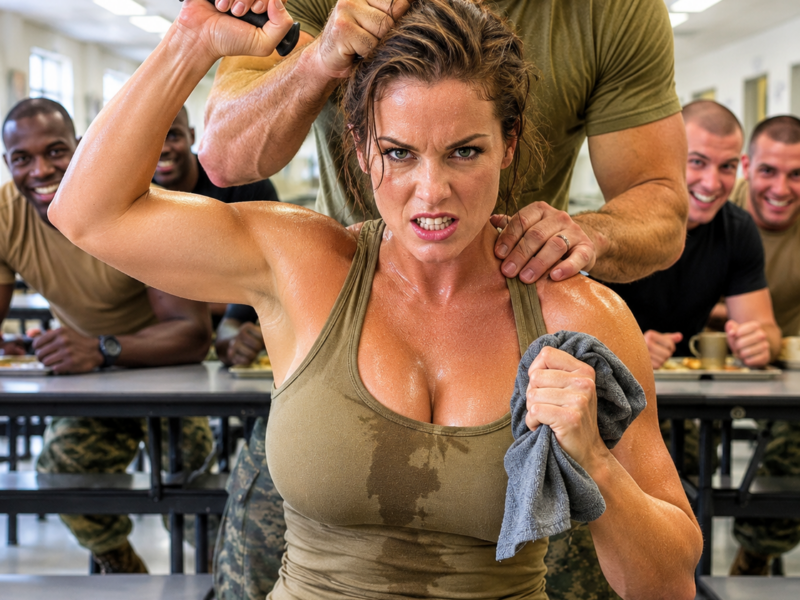
“Five young recruits surrounded me in the Navy training compound, laughing at my faded veteran jacket and demanding to know whether I was lost
“Before you open it, you need to know that one of those five recruits has a connection to the man who wrote it.”
Commander Hayes’s words stayed between us.
I looked down at the envelope again.
The handwriting was unmistakable.
Daniel Mercer.
For seventeen years, I’d carried the memory of that name like a stone in my chest.
Daniel had been my commanding officer, my mentor, and the closest thing I’d ever had to a brother in the Navy.
He was also the man whose death had ended my career as an active-duty SEAL.
I turned the envelope over.
There was no return address, no official stamp, and no indication of where it had been stored.
“Michael, tell me exactly how you got this.”
Hayes glanced toward the administrative building.
“It arrived in a secure package three days ago. No sender information. No tracking record. Just this envelope and a note addressed to me.”
“What did the note say?”
He hesitated.
“That you would know what to do with it.”
I looked at him.
“And you waited three days to call me?”
“I needed to establish whether it was authentic.”
“Is it?”
He nodded slowly.
“The paper, the handwriting, even the old unit reference. Everything checks out.”
I ran my thumb across Daniel’s name.
“Then why are you worried?”
Hayes lowered his voice.
“Because the package included a second document. A personnel file belonging to one of our recruits.”
I looked toward the briefing room.
“Which one?”
“Recruit Carter.”
I remembered the tall young man who had blocked my path.
“What connection does he have to Daniel?”
“His grandfather.”
Hayes paused.
“Retired Master Chief Thomas Carter.”
I closed my eyes briefly.
Thomas.
Of course.
I hadn’t heard that name in years.
“Does the boy know?”
“Not according to his records.”
I looked at the envelope.
“Then let’s find out what his grandfather left behind.”
***
We entered the briefing room together.
The five recruits stood beside their chairs.
Carter was at the front, his arms folded across his chest.
The shorter recruit, whose name tape read BENNETT, looked particularly uncomfortable.
The other three were named Harris, Cole, and Ramirez.
Their instructor, Senior Chief Wallace, stood near the whiteboard.
“At ease,” Hayes ordered.
The room settled.
“Recruit Carter, step forward.”
Carter obeyed.
“Sir.”
“What’s your grandfather’s full name?”
“Thomas Edward Carter, sir.”
Hayes looked at me.
I took one step forward.
“Did he ever tell you about a Navy SEAL named Daniel Mercer?”
Carter’s expression changed.
Not dramatically.
Just a slight tightening around his eyes.
“Yes, ma’am.”
“Tell me what he said.”
Carter looked at Hayes before answering.
“He said Commander Mercer was one of the finest men he’d ever served with.”
“Where did they serve?”
“Overseas. I don’t know the exact location.”
“Did your grandfather ever mention a woman named Evelyn Brooks?”
Carter hesitated.
Then he looked directly at me.
“He said you saved his life.”
For a moment, the room seemed to disappear.
I hadn’t expected that answer.
“Did he tell you how?”
“No, ma’am. He never explained much. He just said there was a woman who walked into a place where nobody expected her to come out.”
I felt my fingers tighten around the envelope.
“Did he ever tell you what happened to Daniel Mercer?”
Carter shook his head.
“He said Commander Mercer died protecting his team.”
I looked at Hayes.
That was not the story in the official records.
Not even close.
“Recruit Carter,” I said, “your grandfather may have known more about my last deployment than anyone still alive.”
Carter swallowed.
“Ma’am, he passed away four years ago.”
“I’m sorry.”
“He left me a box of military things. My parents told me not to go through it until I was older.”
“Do you still have it?”
“Yes, ma’am.”
“Have you opened it?”
“No.”
I studied his face.
“Why not?”
He looked down.
“Because my grandfather told me there were things in there that could hurt people who didn’t deserve it.”
Nobody spoke.
Then Carter added something that made me look at him again.
“He also said that if a woman named Evelyn Brooks ever came looking for it, I should give it to her without asking questions.”
I slowly lowered the envelope.
“Did he say anything else?”
Carter nodded.
“He said I might not like what I found.”
***
I asked Hayes to dismiss the other recruits.
He agreed, but before they left, I noticed Bennett standing near the door.
He seemed reluctant to go.
“Something you want to say?” I asked.
He shifted his weight.
“Ma’am, I recognized your name.”
“I know.”
“My grandfather used to talk about you.”
I turned.
“Who was he?”
“Master Chief William Bennett. He served in a support unit attached to yours.”
That name brought back another memory.
William Bennett had been a quiet, dependable man.
He had once spent an entire night repairing a communications system because he knew my team would need it before sunrise.
“How is he?”
Bennett looked down.
“He died last year.”
“I’m sorry.”
He nodded.
“Before he passed, he gave me something.”
“What?”
“A photograph.”
He reached into his pocket and pulled out a small, folded picture.
It showed six people standing outside a military building.
I recognized every face.
Daniel was standing beside me.
Thomas Carter was behind us.
William Bennett stood at the far right.
And at the center was a man whose face I hadn’t seen in seventeen years.
Admiral Richard Vaughn.
I stared at the photograph.
On the back, in faded ink, were five words.
*The sixth man knew everything.*
I looked at Bennett.
“Did your grandfather explain that?”
“No, ma’am. He only said I should show it to you if I ever got the chance.”
I turned the photograph over again.
There were six people in the picture.
But only five names were written beneath it.
Mine.
Daniel’s.
Thomas’s.
William’s.
And Vaughn’s.
The sixth name had been scratched out.
I looked at Hayes.
“Michael, I think we need to reopen the old investigation.”
He nodded.
“Already requested.”
“Who authorized it?”
His expression became serious.
“Admiral Vaughn.”
I looked at the photograph.
The man whose name was missing had been deliberately removed.
And the man who had authorized the investigation was standing in the same picture.
***
That evening, I drove to the small house Thomas Carter had left to his family.
Carter had called his parents and explained why I was coming.
His mother met me at the front door.
“Mrs. Brooks?”
“Yes.”
She looked at me for a moment.
Then she stepped aside.
“My father-in-law talked about you more than he admitted.”
The house smelled of old books and furniture polish.
A framed photograph of Thomas in his dress uniform hung above the fireplace.
He had been a serious man, but his eyes always softened when he spoke about his family.
Carter waited near the dining table.
“I brought the box.”
It was an old wooden case with brass hinges.
The edges were worn, and a small metal plate on the front carried Thomas’s initials.
I sat down.
“Did your grandfather ever tell you why he kept it locked?”
Carter shook his head.
“He said it wasn’t mine until I understood what it meant.”
I opened the lid.
Inside were service medals, old photographs, folded letters, and a leather notebook.
Beneath them lay a sealed plastic envelope.
My name was written on it.
I stared at the handwriting.
Thomas had written it.
I opened the envelope carefully.
The letter inside was dated six months before his death.
*Evelyn,*
*If this reaches you, then the people who kept the truth buried have finally started moving again.*
*I should have told you everything years ago.*
*Daniel did not die during that operation.*
I stopped reading.
Carter looked at me.
“Ma’am?”
I couldn’t speak.
I continued.
*He survived. I saw him after the extraction.*
*The official report was changed before it reached the investigation team.*
*I was ordered to sign a statement confirming that Daniel had been killed during the operation.*
*I refused.*
*They threatened my family. I signed anyway.*
My eyes moved across the page.
*I have regretted it every day since.*
The final paragraph was underlined.
*The man who gave that order was not Admiral Vaughn. It was someone inside our own team. Someone who knew every route, every password, and every contingency.*
I read the sentence twice.
Then I turned the page.
There was a name.
**COMMANDER MICHAEL HAYES.**
I stopped breathing for a moment.
Michael.
The same man who had called me back to Coronado.
The same man who had handed me Daniel’s letter.
The same man who had apologized for the recruits’ behavior that morning.
Carter looked at the page.
“Is that our commander?”
I closed the notebook.
“I don’t know yet.”
But I did know one thing.
If Thomas was telling the truth, someone had spent seventeen years making sure Daniel’s disappearance remained a closed case.
And now that someone knew I was looking.
***
I returned to Coronado before midnight.
Hayes was in his office.
He looked up when I entered.
“Claire? Is everything all right?”
I placed Thomas’s letter on his desk.
He read the first paragraph.
Then his eyes reached the name.
For several seconds, he didn’t move.
Finally, he leaned back.
“Where did you get this?”
“Thomas Carter’s personal effects.”
Hayes looked at the letter again.
“He’s been dead four years.”
“Yes.”
“Then he can’t explain what he meant.”
“Perhaps you can.”
Hayes stood.
“Evelyn, you need to understand that I was a junior officer during that deployment.”
“You were the communications liaison.”
“Exactly. I wasn’t involved in operational decisions.”
“Then why did Thomas write your name?”
He rubbed his forehead.
“I don’t know.”
I watched him carefully.
There was no obvious sign of panic.
But he had stopped calling me Claire.
I remembered something Daniel had once said about Hayes.
“He always knows which channel to use,” Daniel had told me.
At the time, I’d thought it was a compliment.
Now it sounded different.
I picked up the photograph Bennett had shown me.
“Do you recognize the sixth man?”
Hayes glanced at it.
“Not clearly.”
“Look again.”
He studied the picture.
Then he pointed to the figure at the far edge.
“That might be Lieutenant Paul Mercer.”
“Daniel’s brother?”
Hayes nodded.
“Yes. He worked in intelligence.”
I looked at him.
“Daniel told me he was an only child.”
Hayes’s face changed.
Only slightly.
But enough.
“Maybe he didn’t want people knowing.”
“Why?”
Hayes walked to the window.
“Paul was killed before the deployment.”
“Where?”
“An accident during training.”
I studied the photograph.
The sixth man had been standing beside Daniel.
And the name beneath him had been scratched out.
I turned the photograph toward the light.
There was a faint impression beneath the ink.
I could just make out the letters.
P. MERCER.
“Michael,” I said quietly, “why is Daniel’s brother in a photograph taken after he supposedly died?”
Hayes didn’t answer.
Then his phone rang.
He looked at the screen.
For the first time that evening, his composure broke.
He declined the call.
A second later, a message appeared.
I caught only a few words before he turned the phone over.
*She’s found the Carter letter. Do not let her reach the archive.*
I stared at him.
“Who sent that?”
He closed his eyes.
And when he opened them again, the expression on his face was no longer one of confusion.
It was exhaustion.
“I was hoping you’d never find that letter.”
***
I stepped away from the desk.
“Tell me the truth.”
Hayes sat down.
“Seventeen years ago, our unit was assigned to protect an intelligence transfer. The official briefing described it as a routine recovery operation.”
“And the real mission?”
“Someone had discovered that classified surveillance records were being sold to private contractors. Daniel was investigating it.”
I remembered the altered coordinates.
The sudden change in our orders.
The radio silence.
“Who was selling the information?”
“An intelligence officer named Paul Mercer.”
I looked at the photograph again.
“Daniel’s brother?”
Hayes nodded.
“Paul had been using his position to divert sensitive information. Daniel discovered it and reported him.”
“Why would Thomas say Daniel survived?”
“Because he did.”
My hands went cold.
Hayes continued.
“During the extraction, Daniel’s aircraft was forced down. Thomas found him alive. But before he could get him to safety, another team arrived.”
“Whose team?”
“Men working for Paul.”
I felt my jaw tighten.
“Why didn’t you tell the investigation?”
Hayes stared at the floor.
“Because I was ordered to keep the communications records sealed.”
“By whom?”
“Admiral Vaughn.”
I shook my head.
“Thomas said you gave the order.”
“I transmitted it. I didn’t create it.”
“That distinction didn’t save Daniel.”
Hayes looked up.
“No. It didn’t.”
For a moment, the office was silent.
Then he opened a drawer and took out a small key.
“There’s an archive beneath the old training administration building. The original mission records are still there.”
“Why?”
“Because Daniel arranged for a copy to be stored before the operation. He knew someone might try to erase the evidence.”
I stared at him.
“Why didn’t you tell me earlier?”
Hayes’s eyes filled.
“Because I was afraid.”
It was the first honest thing he’d said all evening.
“I had a wife and a young daughter. They knew where my family lived. I told myself I was protecting them.”
“And Thomas?”
“He signed the false report. I helped bury the truth. We both made choices we had to live with.”
I took the key.
“Then let’s stop making them.”
***
The archive was located beneath an old building that had been scheduled for renovation.
Hayes and I entered with two security officers.
The room was narrow, lined with metal cabinets.
He walked to the far wall and unlocked a small storage compartment.
Inside was a black document case.
I recognized the label.
OPERATION NIGHT HARBOR.
My final deployment.
I opened it.
There were mission reports, communications transcripts, and a digital storage device.
At the bottom lay a handwritten note.
Daniel’s handwriting.
*If Evelyn is reading this, tell her I tried to come home.*
I sat down.
For seventeen years, I had imagined a thousand versions of Daniel’s final moments.
In some, he was angry with me.
In others, he blamed me.
I had never considered that he might have been waiting for me to find him.
Hayes stood nearby.
“I should have brought this forward years ago.”
I looked up.
“Yes.”
“I know you may never forgive me.”
“Forgiveness isn’t the first thing we need tonight.”
I inserted the storage device into the secure terminal.
A video appeared.
Daniel sat in front of a plain wall.
He looked younger, tired, but unmistakably alive.
“Evelyn,” he began, “if you’re seeing this, I hope Thomas found a way to get the evidence to you.”
I covered my mouth.
“I don’t know how long they’ll keep me here. Paul thinks I’ve destroyed the records, but I made a copy.”
He leaned closer to the camera.
“The operation was never supposed to be a rescue mission. We were sent to recover the surveillance files before they could reach investigators. When I refused, Paul arranged for our aircraft to be diverted.”
He paused.
“Vaughn knew what was happening. He approved the cover-up. But the person who made the final transmission was someone closer to us.”
Daniel looked directly into the camera.
“Michael Hayes.”
I turned toward the commander.
He didn’t move.
Daniel continued.
“Michael knew the route, the communications codes, and the extraction schedule. He was the one who gave Paul our position.”
The video ended.
For several seconds, I could hear only the hum of the computer.
I looked at Hayes.
“You told me you were afraid.”
He lowered his head.
“I was.”
“You told me you only transmitted the order.”
“I did.”
“Daniel says you gave Paul our position.”
Hayes swallowed.
“I gave him the original route. I thought he was going to intercept Daniel and recover the files. I didn’t know they’d shoot him down.”
“You didn’t know?”
“No.”
“Did you know Daniel was alive afterward?”
His eyes filled.
“Yes.”
The answer was barely audible.
I took a step back.
“Then you let us bury him.”
Hayes looked at me.
“I was told he would be released if the evidence disappeared.”
“And you believed them?”
“I wanted to.”
I stared at the man who had welcomed me back to Coronado.
The man who had handed me the envelope.
The man who had watched five recruits surround me while pretending everything was normal.
“Where is Daniel now?”
Hayes shook his head.
“I don’t know.”
“Who does?”
He looked toward the door.
“Paul.”
***
A security alarm suddenly sounded.
One of the officers moved toward the terminal.
“Ma’am, we’re detecting an unauthorized connection.”
The screen flickered.
A new message appeared.
*STOP SEARCHING. THE NEXT PERSON WHO GETS HURT WILL BE YOUR RESPONSIBILITY.*
Hayes stepped toward the computer.
“That’s Paul.”
I turned to the officer.
“Can you trace it?”
“Not yet.”
Then another message appeared.
This one contained a photograph.
A man sitting in a room with a concrete wall.
His hair was gray.
His face was thinner than I remembered.
But I knew him.
Daniel.
Under the photograph were six words.
*HE IS ALIVE. COME ALONE.*
I stared at the screen.
Hayes moved toward me.
“Evelyn, don’t.”
I turned.
“You’ve had seventeen years to tell me where he was.”
“I don’t know where the photograph was taken.”
“Then help me find out.”
The security officer began examining the image metadata.
“Ma’am, there’s a location marker embedded in the file.”
“Where?”
He read the coordinates.
An abandoned coastal communications station outside San Diego.
Hayes looked at me.
“That’s where the original surveillance equipment was stored.”
I picked up my bag.
The officer stepped in front of me.
“Ma’am, you can’t go there alone.”
“I’m not planning to.”
***
We assembled a security team and contacted federal investigators.
The operation was authorized before dawn.
Hayes was placed under supervision and agreed to cooperate.
I insisted on joining the team, not as an operator, but as someone who could identify Daniel and understand the old communications system.
Nobody argued for long.
We reached the coastal station just after sunrise.
The building stood near the water, its windows boarded up and its exterior walls marked by years of salt and wind.
The team secured the perimeter.
I entered with two officers.
Inside, the air smelled of rust and damp concrete.
A corridor led toward a lower-level room.
I noticed an old military identification plate beside the door.
NIGHT HARBOR — COMMUNICATIONS.
My stomach tightened.
The room was empty.
A chair sat near the wall.
There was a glass of water on a table.
And beside it lay a photograph of Daniel and me, taken during our first deployment.
On the back was a handwritten message.
*You always said I’d never learn to be patient.*
I recognized the handwriting.
“Daniel?”
A faint sound came from behind the metal door at the far end of the room.
I turned toward the officers.
They moved forward.
The door was locked.
A security specialist worked on it for several seconds.
Then it opened.
A man sat on a narrow bed.
His hands were trembling.
He looked up.
And for the second time in seventeen years, I saw Daniel Mercer alive.
He stared at me as if he wasn’t sure I was real.
Then he whispered,
“Evelyn?”
I stepped forward.
“It’s me.”
He tried to stand.
His knees gave way.
I reached him just as he began to fall.
For a moment, neither of us spoke.
Then he pressed his forehead against my shoulder.
“I thought they’d never let you find me.”
I held him carefully.
“I should have found you sooner.”
He shook his head.
“You came.”
That was enough.
***
The rescue team took Daniel to the hospital.
Doctors discovered that he had been moved between several locations over the years and had received inconsistent medical treatment.
He was weak, but his condition was stable.
Federal investigators secured the station and recovered additional records linking Paul Mercer to the surveillance operation.
Paul was arrested two days later at a private airfield while attempting to leave the country.
The investigation also uncovered the role played by Admiral Vaughn and several contractors.
Hayes gave a full statement.
He admitted providing the route information that exposed Daniel’s team, concealing evidence afterward, and remaining silent about Daniel’s survival.
His cooperation helped investigators establish the entire chain of events.
But cooperation did not erase responsibility.
He was removed from command and faced a formal investigation.
Thomas Carter’s signed statement was entered into the record.
William Bennett’s photograph helped establish who had been present during the original operation.
The old case was finally reopened.
And this time, the evidence wasn’t going to disappear.
***
Three months later, I visited Daniel at the rehabilitation center.
He was sitting outside beneath a tree, wearing a gray sweatshirt and holding a cup of coffee.
“You know,” he said when I approached, “I used to think I’d never get tired of hospital coffee.”
I laughed.
“How’s that working out?”
“Terrible.”
I sat beside him.
For a while, we watched people crossing the courtyard.
Then Daniel asked, “Did you ever find out why those recruits were giving you such a hard time?”
I smiled.
“Five young men who thought a faded jacket meant I didn’t belong.”
He shook his head.
“That sounds familiar.”
“You should have seen Carter’s face when he realized who I was.”
“Did you tell him?”
“Eventually.”
Daniel took a sip of coffee.
“And?”
“He apologized.”
“Good.”
I looked at him.
“Actually, he asked me to speak to his class.”
Daniel raised an eyebrow.
“About what?”
“Leadership. Respect. Knowing when to listen.”
“Sounds like they could use it.”
“They could.”
I paused.
“There’s something else.”
“What?”
“I’ve been thinking about Thomas Carter.”
Daniel nodded.
“He was a good man.”
“He carried that letter for years. He knew the truth, but he was afraid of what would happen to his family.”
Daniel looked down.
“He should have spoken sooner.”
“Yes.”
“But I understand why he didn’t.”
I turned toward him.
“Do you forgive him?”
Daniel considered the question.
“I forgive the man who spent the last years of his life trying to make it right. I don’t have to pretend his silence didn’t hurt people.”
I nodded.
That was probably the most honest answer I’d heard in years.
***
The following week, I returned to Coronado.
The five recruits were waiting in the briefing room.
Carter stood at the front.
Bennett was beside him.
Harris, Cole, and Ramirez had taken seats near the back.
Commander Hayes was no longer in charge of the training center.
A new senior officer had taken his place.
I stood before the class wearing my old navy jacket.
No medals.
No ceremony.
Just the same faded clothes I’d worn the day they stopped me at the gate.
“Before we begin,” I said, “I want to talk about something that happened outside this building.”
The recruits looked at one another.
Carter stepped forward.
“Ma’am, I want to apologize again for how we treated you.”
I nodded.
“I accept your apology.”
He looked relieved.
“But I want you to understand something.”
The room became quiet.
“When you saw me that morning, you saw an older woman carrying a bag. You decided she didn’t belong here because she didn’t look like the people you expected to find.”
Nobody moved.
“Your mistake wasn’t that you failed to recognize a famous SEAL. Your mistake was believing someone had to prove their worth before you treated them with basic respect.”
Carter lowered his eyes.
I continued.
“Rank doesn’t make a person decent. Strength doesn’t make a person wise. And a uniform doesn’t automatically make someone honorable.”
I looked at all five recruits.
“One day, you may stand beside someone who has been through more than you can imagine. You might never know what they sacrificed. You might never hear their story.”
I paused.
“Treat them with respect anyway.”
Bennett raised his hand.
“Ma’am, can I ask something?”
“Go ahead.”
“Why did you leave the SEAL teams?”
I looked toward the window.
For a moment, I saw the old training grounds.
I remembered Daniel.
Thomas.
William.
And all the people whose names had been reduced to lines in official reports.
“Because I lost someone I believed I could bring home.”
The room was silent.
“And for a long time, I thought leaving meant I had failed.”
I looked at the young men.
“Now I understand that sometimes the hardest part of service is finding the strength to keep living after the mission is over.”
Nobody laughed.
Nobody interrupted.
Carter stood a little straighter.
“Thank you, ma’am.”
I nodded.
“You’re welcome.”
***
Before I left, Carter approached me outside the building.
“My grandfather kept a picture of you in his desk,” he said.
I smiled.
“I remember Thomas.”
“He wrote something on the back.”
Carter handed me a small photograph.
It showed Thomas standing beside me during a training exercise.
On the back were the words:
*She never asked anyone to respect her. She simply gave them a reason to respect themselves.*
I read it twice.
Then I looked at Carter.
“Your grandfather was a better judge of character than most.”
He smiled.
“I think he would have liked you coming back.”
I slipped the photograph into my jacket.
“I think I would have liked that too.”
***
That afternoon, I visited Daniel one last time before driving home.
He was waiting outside the rehabilitation center.
The sun was beginning to set, and the sky above the Pacific had turned a soft shade of gold.
“How did it go?” he asked.
“Five recruits learned a lesson.”
“Only five?”
I laughed.
“Don’t get greedy.”
He held out a small object.
It was an old silver trident.
The edges were worn, but the insignia was still recognizable.
“I found this in the belongings they returned to me,” he said.
I took it carefully.
“Where did you get it?”
“You gave it to me after our first deployment. Remember?”
I turned it over.
On the back, someone had engraved two words.
EAGLE STRONG.
I smiled.
“I thought you’d lost it.”
“I thought you had.”
We stood together, watching the sun disappear beyond the water.
For seventeen years, I had believed my last mission ended with an empty chair, a folded flag, and a name carved into a memorial.
I had been wrong.
Some missions take longer than anyone expects.
Some truths survive because ordinary people refuse to let them disappear.
And sometimes, the people who look least like heroes are the ones who have carried the heaviest burdens.
I slipped the silver trident into my pocket.
Then Daniel and I walked toward the parking lot, no longer carrying the weight of a secret that had never belonged to us in the first place.
The end.









