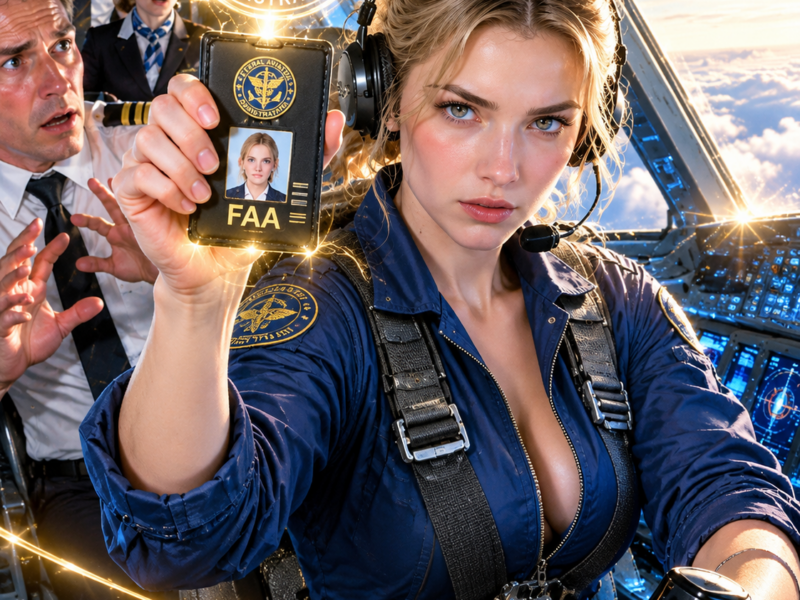
“Everyone on that aircraft thought I was just another nervous passenger—until the cockpit went silent, the captain stopped responding
The first thing I saw through the narrow opening was blood.
It ran from the captain’s forehead down the side of his face, disappearing beneath his white shirt collar. He was gripping the edge of the center console with one hand, while the other rested awkwardly against his chest.
Beside him, the first officer was struggling to keep his head upright.
The cockpit smelled of hot electronics and something sharp, almost metallic.
“Get in here,” the captain gasped.
I pushed the door open.
“What’s your name?” I asked the first officer.
“Daniel. Daniel Foster.”
“Daniel, look at me. Are you injured?”
“My shoulder. I can still fly.”
His hands were trembling on the controls.
The captain tried to speak.
“Engine failure. Then the flight controls started fighting us. Autopilot disconnected. The aircraft keeps trimming itself nose-down.”
I looked at the instrument panel.
A warning light was flashing.
The autopilot was off, but the aircraft was still struggling against the pilots’ inputs. The control column moved slightly, then returned as if an invisible hand were pulling it.
“Did you get a runaway stabilizer warning?”
The captain nodded.
“Couldn’t stop it.”
I glanced at the center console.
“Did you use the stabilizer trim cutout switches?”
Daniel looked at me.
“We tried. The left switch didn’t respond.”
“Then stop fighting the trim electrically. We need to isolate it.”
I knew this aircraft wasn’t one of the military jets I’d flown. Its cockpit layout was different, its systems had different logic, and I wasn’t going to pretend otherwise.
But the basic principles hadn’t changed.
Fly the aircraft.
Understand what it was doing.
Don’t let panic make decisions.
“Daniel, keep your hands on the controls. Don’t chase every movement. I need you to tell me exactly what the aircraft is doing.”
He swallowed.
“It’s pitching down. I pull back, and it fights me. Then the nose comes up suddenly.”
“Good. Keep the wings level. Small corrections.”
The captain leaned toward us.
“Who are you?”
“Rachel Morgan.”
He stared at me.
Then his eyes moved to the identification card still clipped to my jacket.
“Colonel Morgan?”
“Formerly.”
His expression changed.
“Eagle?”
I didn’t answer.
There wasn’t time.
The aircraft dropped again.
Daniel grunted as the control column pushed against his hands.
“It’s getting worse!”
I leaned forward and examined the trim indicators.
The stabilizer was moving in the wrong direction.
“Daniel, listen to me. You’re not going to win a wrestling match with the aircraft. Hold the attitude. I’ll isolate the electric trim.”
I reached toward the cutout switches.
The captain caught my wrist.
“Wait. The left side failed when we tried it.”
“Then we use the remaining system carefully.”
I moved the switches.
A warning tone sounded.
The trim indicator stopped moving.
For one terrifying second, nothing happened.
Then the aircraft settled.
Daniel exhaled so sharply that it sounded like a sob.
“It’s stopped.”
“Not fixed,” I said. “Just stopped.”
I looked at him.
“Can you hold the aircraft?”
“Yes.”
“Then keep doing exactly that.”
The captain reached for the radio.
“Mayday, mayday, mayday. Flight 284 declaring an emergency. Engine failure and flight-control malfunction. We have three crew members in the cockpit, one pilot injured, and a passenger assisting with aircraft control.”
I almost corrected him.
Passenger.
That was what I was on the manifest.
But the tower didn’t care what my boarding pass said.
“Flight 284, say your intentions,” came the response.
The captain gave our altitude, heading, and condition.
Then Daniel looked at me.
“Can you take the controls?”
I studied the instruments.
I could help him. I could monitor the aircraft, manage the emergency, and make decisions under pressure.
But I wasn’t certified on this exact model.
And I wasn’t going to risk nearly two hundred lives by confusing confidence with competence.
“I’m going to assist you,” I said. “You’re still the flying pilot. I need you to do exactly what I tell you, and if something doesn’t make sense, say so.”
He nodded.
“Understood.”
The captain tried to sit upright.
“I’m going to coordinate with the cabin crew.”
“You’re going to stay conscious,” I replied. “That’s your job right now.”
He gave a weak, humorless smile.
“Still giving orders, Colonel?”
“Only when people need them.”
I pressed the interphone.
“This is Rachel Morgan in the cockpit. I need the senior flight attendant.”
A woman’s voice answered almost immediately.
“This is Melissa.”
“Melissa, I need you to secure the cabin. Make sure everyone is seated with seat belts fastened. Check for injuries. Keep the aisles clear. We may be making an emergency landing.”
There was a pause.
“Are you a member of the flight crew?”
“No. I’m assisting the pilots.”
Another pause.
Then she said, “Understood.”
I could hear the fear in her voice, but there was something else now.
Trust.
I didn’t take that lightly.
“Melissa, one more thing. Don’t tell passengers we’re going to crash. Tell them we’re diverting because of a technical emergency. Keep your voice calm. They will follow your example.”
“Copy that.”
I returned to the instruments.
The right engine had been shut down, but the damage was more serious than a simple engine failure. The aircraft had suffered a cascade of problems, and the flight-control warnings suggested that the crew had been dealing with more than one failure at once.
Daniel was doing everything he could.
His shoulder was injured, his face was pale, and sweat had gathered along his hairline.
“Where can we land?” he asked.
I looked at the navigation display.
We were west of the central United States, with several airports within reach. The captain was speaking to air traffic control, requesting the nearest suitable runway.
“Let’s hear what they recommend.”
The radio crackled.
“Flight 284, we have you showing an emergency. Pittsburgh is being prepared for your arrival. Emergency services are standing by. Can you maintain your current altitude?”
The captain looked at me.
I checked the instruments.
“Tell them we can maintain altitude for now, but we need priority handling and no unnecessary maneuvering.”
He relayed the message.
Then the controller said something that made my stomach tighten.
“Flight 284, we are receiving reports of smoke from the right engine. Do you have any indication of fire?”
Daniel glanced at the engine instruments.
“No fire warning,” he said.
I checked the panel.
“Tell them no fire indication in the cockpit. Ask them to keep the fire crews ready.”
The captain repeated it.
I looked at the right-side engine display again.
The temperature readings were falling, but not as quickly as I wanted.
“Daniel, how does the aircraft feel?”
“Still heavy. It wants to pitch down, but I can hold it.”
“Good. Don’t change anything unless I tell you.”
He looked at me for a second.
“Can I ask you something?”
“Not while we’re busy.”
He almost smiled.
“Were you really a colonel?”
“Yes.”
“What did you fly?”
“Different things.”
“That’s not an answer.”
“It’s the only one you’re getting until we’re on the ground.”
He gave a short laugh.
It was the first normal sound I’d heard in the cockpit.
Then the aircraft shuddered again.
A new warning appeared.
Daniel’s smile vanished.
“What now?”
I leaned toward the panel.
The cabin pressure indication was changing.
“Captain, check the pressurization.”
The captain examined the display.
“We’re losing cabin pressure.”
“How fast?”
“Not catastrophic yet.”
“Then let’s get ahead of it.”
Daniel looked at me.
“Do we need to descend?”
“That’s for you and the captain to coordinate with the controller. But if the cabin pressure keeps dropping, we need a safe altitude quickly.”
The captain contacted air traffic control and requested an emergency descent.
The controller cleared us.
Daniel began the descent, keeping the aircraft as steady as he could.
I watched the altitude unwind.
Twenty-eight thousand.
Twenty-six.
Twenty-four.
The aircraft was holding, but the control column remained heavy.
Then the cabin warning sounded.
A thin, piercing tone filled the cockpit.
The captain looked at the oxygen system.
“Cabin altitude rising.”
“Tell the cabin crew to prepare for oxygen masks.”
I pressed the interphone.
“Melissa, put the cabin on oxygen if the masks deploy. Make sure your crew are seated and secured. Do not attempt to move around while we’re descending.”
“Understood.”
I heard her voice become louder as she spoke to the passengers.
“Ladies and gentlemen, please remain calm. We are making an emergency descent. Oxygen masks may deploy. If they do, place the mask over your nose and mouth and breathe normally. Follow the crew’s instructions.”
A moment later, the masks dropped.
The cockpit filled with the sound of compressed air and the muffled breathing of three people.
Daniel’s hands tightened around the controls.
“I’m losing the nose again.”
I checked the trim.
It hadn’t moved.
“It’s not the trim this time. Look at your attitude indicator. Small correction. Don’t overcontrol.”
He followed the instruction.
The aircraft responded.
“That’s it,” I said. “Hold it there.”
We descended through eighteen thousand feet.
Then fifteen.
Then twelve.
The cabin pressure stabilized.
The oxygen warning faded.
The worst of the descent was behind us.
But the landing was still ahead.
And we had one engine, a damaged flight-control system, a wounded captain, and a first officer whose shoulder was beginning to swell beneath his uniform.
I looked at Daniel.
“Can you land this aircraft?”
He stared at the runway display.
“I’ve landed worse.”
“Good. Then we’re going to give you the best chance possible.”
The captain turned toward me.
“Colonel, I need you to understand something.”
I waited.
“If Daniel loses control, I may not be able to take over.”
“I understand.”
“And if he can’t land, you might have to.”
I looked at the instruments.
Then at the young first officer.
“Let’s not get ahead of ourselves.”
The radio crackled again.
“Flight 284, Pittsburgh approach. Runway 28L is available. Wind is calm. Emergency vehicles are positioned. Confirm you can accept.”
Daniel glanced at me.
I nodded.
He replied.
“Flight 284 accepts runway 28L.”
The controller continued.
“Flight 284, be advised, we have reports of possible structural damage near your right wing. Emergency crews will inspect after landing.”
I looked out the window.
For the first time, I could see the damage.
A section of the right engine cowling appeared distorted. Something dark was trailing behind the wing.
I couldn’t tell how serious it was from that angle.
But it was enough.
“Daniel,” I said, “we’re going to keep the approach as stable as possible. No sudden changes. If the aircraft doesn’t respond, tell me immediately.”
He nodded.
The captain leaned back, breathing heavily.
“I’m going to make the landing callouts.”
I turned toward him.
“You’re injured.”
“I can still read instruments.”
“Then read them. Don’t try to take the controls.”
He nodded.
For the next several minutes, we did not speak unless necessary.
The aircraft descended toward Pittsburgh.
I monitored the speed, altitude, and trim.
Daniel kept the wings level.
The runway appeared ahead as a gray strip between green fields and low industrial buildings.
“Landing checklist,” the captain said.
Daniel began working through it.
The radio carried the controller’s voice.
“Flight 284, wind calm. Cleared to land runway 28L.”
Daniel acknowledged.
I watched the runway grow larger.
At two thousand feet, the aircraft gave another small shudder.
Daniel’s breathing changed.
“Rachel?”
“I’m here.”
“It’s pulling left.”
“Compensate gently. Don’t fight it.”
He adjusted.
The aircraft steadied.
At one thousand feet, the captain called out the altitude.
At five hundred, he did it again.
At two hundred, I could see the runway markings clearly.
The aircraft was drifting slightly.
“Correct right,” I said.
Daniel adjusted.
“Hold it.”
The runway rushed beneath us.
“Fifty.”
“Forty.”
“Thirty.”
The main wheels touched down hard.
The aircraft bounced once.
Daniel kept his hands steady.
Then the wheels hit again.
A violent vibration ran through the floor.
The nose came down.
I braced against the console.
The aircraft pulled left.
“Stay with it!” I shouted.
Daniel corrected.
The aircraft veered back toward the centerline.
The remaining engine roared as he used the thrust available to keep the aircraft stable.
Then the brakes engaged.
The plane slowed.
Faster.
Slower.
The runway markings passed beneath the nose.
And finally, the aircraft stopped.
For a moment, nobody moved.
Nobody spoke.
The only sound was the engine winding down and the soft hiss of the cockpit ventilation.
Daniel’s hands remained frozen on the controls.
The captain closed his eyes.
I looked through the windshield.
Red emergency vehicles were racing toward us.
Then I heard a sound from the cabin.
Applause.
It began with one person.
Then another.
Within seconds, nearly the entire aircraft was clapping.
I didn’t smile.
Not yet.
“Daniel,” I said quietly, “secure the aircraft.”
He blinked.
Then he nodded.
We completed the shutdown procedures as the emergency crews approached.
The captain finally looked at me.
“You just saved this flight.”
“No,” I said. “Daniel flew it.”
He shook his head.
“You kept us alive long enough for him to do it.”
I looked at the first officer.
His eyes were wet.
He tried to say something, but his voice broke.
I placed a hand on his uninjured shoulder.
“You did your job. That’s what matters.”
The cockpit door opened.
Melissa stood there, pale but composed.
“Everyone is accounted for,” she said. “A few minor injuries. No serious injuries reported.”
I exhaled.
That was the first moment I allowed myself to feel anything.
Nearly two hundred people had walked onto that aircraft expecting an ordinary flight.
And now they were alive.
The emergency crews escorted us off the plane.
The cold air hit my face as I stepped onto the tarmac.
A paramedic immediately approached the captain and Daniel.
Another asked me to sit down.
“I am fine.”
“Ma’am, you’ve just been through an emergency.”
“I said I’m fine.”
He looked at the identification card still clipped to my jacket.
“Colonel Morgan?”
I sighed.
“Apparently, that card has become a problem today.”
He smiled.
“Not a problem. A reason we’re all standing here.”
I didn’t know what to say.
Then I heard someone calling my name.
“Rachel!”
I turned.
A young woman was walking toward me, holding the hand of a little girl.
The child couldn’t have been more than seven.
Her eyes were red from crying.
The woman stopped a few feet away.
“I wanted to thank you,” she said.
I shook my head.
“You don’t have to.”
“My daughter was terrified. She kept asking if we were going to die.”
The little girl looked up at me.
“Were you the pilot?”
I crouched so we were at eye level.
“No, sweetheart. There were two pilots up there. They did the flying.”
“But you helped?”
I nodded.
She studied my face for a moment.
Then she reached into her small backpack and pulled out a folded piece of paper.
It was a drawing.
An airplane with two wings, a smiling sun, and a woman standing beside it.
Across the top, in uneven letters, she had written:
THANK YOU FOR BEING BRAVE.
I stared at it longer than I should have.
“What’s your name?” I asked.
“Emily.”
“That’s a beautiful picture, Emily.”
“Are you going to fly again?”
The question caught me off guard.
For six years, I had avoided aircraft.
I had told people it was retirement.
I had told myself I was done.
But the truth was more complicated.
The accident that ended my military career had taken the lives of three people under my command. I had survived, but survival had never felt like a victory.
I had spent years believing that stepping away from the cockpit was the only way to honor them.
Emily waited for my answer.
“I don’t know,” I said honestly.
She nodded, as if that was enough.
Then she gave me the drawing.
I folded it carefully and slipped it into my jacket.
By the time the airport medical team finished checking everyone, reporters had begun gathering near the perimeter.
Someone had already posted a video of the emergency landing online.
Another passenger had recorded me walking into the cockpit.
The clip was spreading.
A reporter approached with a microphone.
“Colonel Morgan, is it true that you took over Flight 284 after the pilots lost control?”
I looked at her.
“No.”
“But witnesses say you entered the cockpit and assumed command.”
“I assisted the crew. The first officer flew the aircraft.”
“Were you trained as a military pilot?”
“Yes.”
“Were you an instructor?”
“Yes.”
“Did you ever fly combat missions?”
I didn’t answer.
The reporter leaned closer.
“People are calling you a hero.”
I glanced back toward the aircraft.
Its right engine was badly damaged. Emergency crews were inspecting the wing, and the cabin was being evacuated.
“I don’t think the word helps anyone,” I said.
Then I walked away.
I wanted to go home.
I wanted a quiet room, a shower, and a few hours without hearing alarms.
But that wasn’t going to happen.
At the hospital, Daniel was treated for his shoulder injury. The captain needed stitches and observation, but both men were expected to recover.
I sat in a waiting room with a paper cup of coffee.
It was terrible coffee.
I drank it anyway.
An hour later, Daniel appeared in the doorway with his arm in a sling.
“Colonel Morgan?”
I stood.
“Daniel.”
He looked uncomfortable.
“I wanted to thank you.”
“You already did.”
“No. I mean it.”
He stepped closer.
“I thought I was going to lose the aircraft. I knew what the instruments were telling me, but every time I tried to correct it, something else happened. I started thinking about the passengers. About the people who’d never get to go home.”
I said nothing.
He continued.
“Then you walked into the cockpit and started asking questions. You didn’t panic. You didn’t pretend you knew everything. You just made things clearer.”
I looked at him.
“That’s what training is supposed to do.”
He nodded.
“Can I ask you something?”
“Go ahead.”
“Why did you stop flying?”
The question landed harder than I expected.
I looked down at the coffee cup.
“An accident.”
“Military?”
“Yes.”
“Were you injured?”
“Not physically.”
He understood enough not to ask further.
After a moment, he said, “I hope you know that today doesn’t erase what happened before.”
I looked up.
He held my gaze.
“But maybe it means you’re allowed to fly again.”
I didn’t answer.
He gave me a small smile and returned to the treatment room.
That night, I checked into a hotel near the airport.
I placed Emily’s drawing on the desk.
Then I sat by the window and watched aircraft lights moving across the dark sky.
For the first time in six years, I didn’t look away.
The next morning, my phone began ringing.
Former colleagues.
Old friends.
People I hadn’t spoken to in years.
Some had seen the video.
Others had heard the story through military channels.
One message came from a number I hadn’t saved.
It read:
I saw what happened. You still have the hands of a pilot.
I stared at the screen.
Then another message arrived.
This one had a name attached.
General Thomas Avery.
My former commanding officer.
I hadn’t spoken to him since the accident.
The message was short.
Rachel. We need to talk. There’s something about your last flight that you were never told.
I read it twice.
My hands went cold.
The last flight.
The one that had ended my career.
The one that had taken three lives.
For six years, I had believed the investigation was complete.
I had believed the aircraft had suffered an unavoidable mechanical failure.
I had believed I had made the wrong decision in the final minutes.
And now my former commander was telling me there was something I didn’t know.
I called him.
He answered on the first ring.
“Rachel.”
“General.”
There was a long silence.
“Are you alone?” he asked.
“Yes.”
“Good. Listen carefully. What happened on Flight 284 has brought something back to the surface. Someone recognized your name. Someone who was involved in the investigation six years ago.”
“Who?”
“I can’t tell you over the phone.”
“Then tell me where to meet you.”
“There’s a military airfield outside Washington. Come tomorrow morning.”
I gripped the phone.
“General, what are you talking about?”
His voice dropped.
“The accident that ended your career wasn’t caused by the mechanical failure you were told about.”
My chest tightened.
“Then what caused it?”
He hesitated.
And when he finally spoke, the words seemed to drain the air from the room.
“Someone changed your flight-control data before you took off.”
I stood perfectly still.
For six years, I had carried the belief that I had failed three people who trusted me.
Now I was being told that the failure might never have been mine.
I looked at Emily’s drawing on the desk.
The little airplane.
The smiling sun.
The words written in a child’s uneven handwriting.
THANK YOU FOR BEING BRAVE.
Then I looked back at the phone.
“Who did it?” I whispered.
General Avery took a breath.
“That’s what we’re going to find out. But Rachel, there’s one thing you need to understand.”
“What?”
“The person who altered your flight data is still serving.”
And before I could ask another question, he added:
“He knows you’re alive, and after what happened yesterday, he knows you’re flying again.”
The end.









