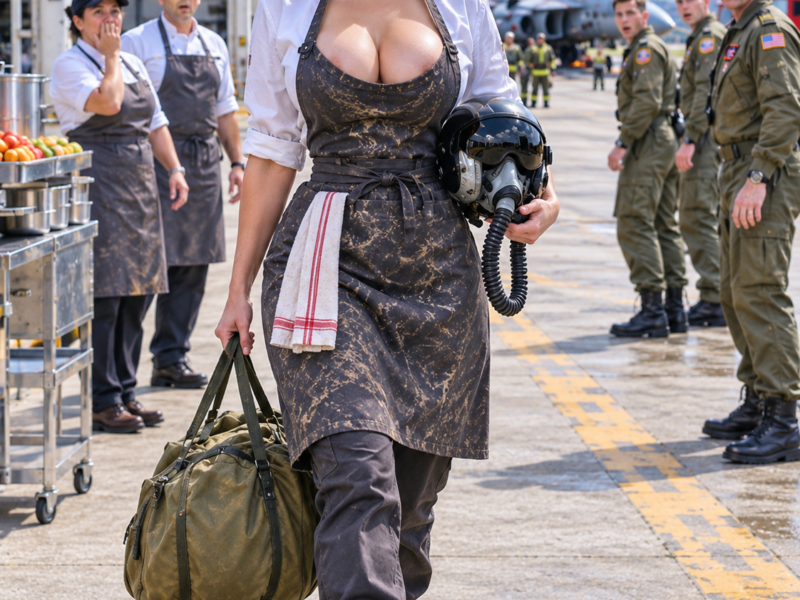
“Everyone at Falcon Ridge Air Base knew me as the quiet woman who served breakfast and cleaned the kitchen1
I looked at the communications officer.
“Who gave you this document?”
“Colonel Whitaker, ma’am. He wants you in the tower immediately.”
I folded the paper carefully.
“Is Lieutenant Brooks alive?”
The officer hesitated.
“They haven’t confirmed an ejection.”
That was all I needed to hear.
I took off my kitchen apron, hung it over the back of a chair, and followed him out.
Behind me, the dining hall remained silent.
Captain Mitchell was standing near the coffee station.
He looked at me differently now, but I didn’t have the energy to care.
As I crossed the parking area, I could hear helicopters approaching from the direction of the mountains.
A rescue team was already searching the crash site.
The control tower stood at the far end of the runway.
When I entered, several officers were gathered around a large display.
Colonel James Whitaker stood beside the main console.
He was in his late fifties, with a square jaw and the permanent expression of someone who had spent his career delivering bad news.
He turned as soon as he saw me.
“Rebecca. Close the door.”
I did.
A technician brought up the aircraft’s final telemetry.
The F-16 appeared on the screen as a series of colored lines and numbers.
“That’s Lieutenant Brooks’s flight data,” Whitaker said. “The aircraft experienced an unexpected flight control malfunction at 0718.”
I stepped closer.
“Show me the control channel history.”
The technician looked at the colonel.
Whitaker nodded.
The display changed.
I studied the information.
There it was.
The same pattern.
The same sequence of control interruptions.
The same strange signal appearing just before the aircraft began rolling.
I felt my throat tighten.
“Where did this signal originate?”
The technician answered.
“We’re still investigating.”
I pointed at the screen.
“That’s not a normal system failure. Someone or something is sending conflicting commands through the secondary flight control channel.”
Whitaker crossed his arms.
“Can that happen accidentally?”
“Not with this timing.”
He studied me.
“Explain.”
I took a breath.
“Six years ago, I experienced the same thing during a combat mission. My aircraft received control inputs that didn’t match anything I was doing. I lost control for eleven seconds.”
“Your official report says you suffered a computer malfunction.”
“That’s what they told me to write.”
The colonel looked toward the other officers.
“Everyone except Major Collins, stay outside.”
The room emptied.
When the door closed, Whitaker lowered his voice.
“Rebecca, I need you to tell me exactly what happened six years ago.”
I looked at the telemetry.
Then at him.
“First, I need to know why Lieutenant Brooks’s aircraft was flying with the same system.”
He didn’t answer.
That was when I realized he already knew.
I pulled a chair toward the console.
“Sir, how long has this base been testing the secondary control software?”
Whitaker rubbed his forehead.
“Three months.”
“Who approved it?”
“Defense Systems Integration.”
I stared at him.
“That’s a contractor, not a military authority.”
“They were operating under a development agreement.”
“With whose approval?”
He looked away.
“General Thomas Caldwell.”
The name hit me harder than I expected.
General Caldwell had been the commander of my squadron during my final deployment.
He had signed the report that ended my flying career.
And he had been the last person to speak to me before I ejected.
For six years, I’d believed that was the end of it.
Apparently, it had only been the beginning.
“Where is he now?” I asked.
“At the Pentagon.”
“Does he know about the crash?”
“He’s been informed.”
I leaned back.
“Then he’s probably already calling someone.”
Whitaker frowned.
“Why would you say that?”
I pointed to the screen.
“Because the software doesn’t just malfunction. It recognizes certain aircraft configurations and sends commands based on the flight profile.”
“You’re saying someone deliberately caused this?”
“I’m saying we need to stop every aircraft using that software until we know what’s happening.”
The colonel picked up his phone.
“Ground all affected aircraft. Immediately.”
A technician began making calls.
I watched the telemetry again.
Then I noticed something.
“Wait.”
Whitaker turned.
“What?”
“Bring up the emergency recording.”
The technician opened the audio file.
Static filled the room.
Then Ethan’s voice came through.
“Falcon Ridge, this is Brooks. Controls are responding incorrectly. I’m attempting manual recovery.”
A few seconds later, there was another sound.
A sharp electronic tone.
Then Ethan said something almost too quiet to hear.
“Why is it doing what I did six years ago?”
I moved closer to the speaker.
“Play that again.”
The technician repeated the recording.
This time, I heard the words clearly.
“Why is it doing what I did six years ago?”
I looked at Whitaker.
“Has anyone spoken to Ethan’s family?”
“His wife is waiting at the medical center.”
I closed my eyes.
Ethan had known something.
Maybe not everything, but enough to recognize the failure.
“Did he survive the ejection?”
The colonel didn’t answer.
Instead, the tower phone rang.
He picked it up.
“Whitaker.”
He listened.
His face changed.
“Understood. Send the coordinates.”
He hung up.
“They found the aircraft.”
I stood.
“Where’s Ethan?”
“His parachute was spotted about two miles from the crash site.”
“Is he alive?”
“The rescue team hasn’t reached him yet.”
I grabbed the back of the chair.
“Get me a vehicle.”
Whitaker shook his head.
“You can’t go out there.”
“Sir, I know the terrain. I know what he might be looking for if he managed to get away from the wreckage.”
“What makes you think he’s looking for anything?”
I looked at the recording screen.
“Because he recognized the failure.”
The colonel considered that for a moment.
Then he called the rescue coordinator.
“Add Rebecca Hayes to the recovery team. She has relevant flight experience.”
Twenty minutes later, I was in the passenger seat of a military rescue vehicle, heading toward the desert ridge.
The morning sun was already burning through the windshield.
Two medics sat behind me.
A security officer drove.
I kept looking at the telemetry report in my lap.
The control signal had appeared eleven seconds before the aircraft began rolling.
Exactly the same interval as my own emergency six years earlier.
I remembered the day clearly.
We had been flying over a restricted training corridor when my aircraft suddenly began responding to commands I hadn’t made.
My wingman, Captain David Miller, had called over the radio.
“Rebecca, your aircraft is moving strangely.”
I had tried to correct the roll.
Nothing happened.
Then the control system began pushing the aircraft into a steep descent.
I ejected at the last possible moment.
My aircraft crashed in the desert.
I survived with a broken shoulder and a damaged thumb.
The investigation lasted three weeks.
At the end, I was told that the aircraft had suffered a rare electronic malfunction.
I was offered a desk assignment.
I refused.
I couldn’t sit in an office while everyone pretended the incident was understood.
So I resigned.
A month later, I moved to Arizona.
I changed my routine.
I stopped watching military news.
And eventually, I found work in the kitchen at Falcon Ridge.
I thought the past had finally lost interest in me.
The vehicle slowed.
One of the medics pointed toward a small cluster of rocks.
“There!”
A yellow emergency parachute was caught in the brush.
The driver stopped.
We climbed out.
The desert was quiet except for the distant sound of helicopters.
A medic called Ethan’s name.
No answer.
Then I noticed footprints leading away from the parachute.
“He’s conscious,” I said.
The security officer looked down.
“How can you tell?”
“The prints are uneven, but they’re not dragging. He’s walking.”
We followed them toward a shallow ravine.
After several minutes, we found him sitting beneath a rock formation.
His flight suit was torn.
Blood ran from a cut above his eyebrow.
But he was awake.
“Ethan!”
He looked up.
“Rebecca?”
I crouched beside him.
“Don’t move too quickly.”
He tried to smile.
“I thought you were just the lady who made breakfast.”
I laughed despite myself.
“That’s what I wanted you to think.”
The medic began checking his injuries.
Ethan grabbed my wrist.
“Did you hear the recording?”
“Yes.”
He swallowed.
“I saw something before I ejected.”
“What?”
He looked toward the ridge.
“There was a second aircraft.”
I frowned.
“The four enemy fighters?”
“No. A small surveillance drone. It was flying near the training corridor before my controls failed.”
I looked at the medic.
“Did you report this?”
Ethan nodded.
“Before I lost control, I saw it on my display. Then my aircraft started receiving commands.”
“Did you recognize the signal?”
He shook his head.
“But I heard someone talking over the emergency channel.”
“Who?”
Ethan looked directly at me.
“General Caldwell.”
For a moment, I couldn’t hear anything except the wind.
“What did he say?”
Ethan swallowed painfully.
“He said, ‘Proceed with the test. The pilot will be recovered.'”
I stared at him.
“Are you certain?”
“I recorded it.”
He reached toward the pocket of his flight suit.
The fabric was torn, and his hands were shaking.
A small memory card was tucked inside.
I took it carefully.
“Where did you get this?”
“Emergency cockpit camera. It kept recording after the aircraft lost power.”
The medic looked up.
“Ma’am, we need to get him to the hospital.”
I nodded.
But before we moved, Ethan grabbed my sleeve again.
“Rebecca, there’s something else.”
“What?”
He looked frightened now.
“Before the controls failed, the system displayed your name.”
My mouth went dry.
“What do you mean?”
“Your old pilot identification. It appeared on the diagnostic screen.”
I looked at the memory card.
Then at the crashed aircraft visible beyond the ridge.
Someone had connected the new flight system to the records of my old mission.
And they had deliberately used the same control pattern.
This wasn’t simply a malfunction.
It was a message.
The rescue team transported Ethan to the base medical center.
His injuries were serious but not life-threatening.
His wife, Sarah, was waiting outside the treatment room.
She stood when she saw me.
“You’re Rebecca?”
I nodded.
She took both my hands.
“Thank you for finding him.”
I didn’t know what to say.
“He did most of the work himself.”
She shook her head.
“He told me you were the only person who understood what was happening.”
I looked through the glass at Ethan.
He was awake now, talking quietly with a doctor.
“He’s a good pilot,” I said.
Sarah smiled through tears.
“He talks about flying all the time. I keep telling him he needs a hobby that doesn’t involve falling out of the sky.”
For a moment, we both laughed.
Then she asked something I wasn’t prepared for.
“Are you going to fly again?”
I looked down at my hands.
“I don’t know.”
She nodded.
“I hope you do. Ethan said you sounded like you belonged up there.”
I didn’t answer.
Because belonging somewhere and being willing to return were two very different things.
That afternoon, Colonel Whitaker called an emergency briefing.
The memory card had been secured.
The recording showed General Caldwell speaking over a restricted test channel.
His voice was unmistakable.
He had authorized the electronic control test despite receiving a warning that the software was unstable.
But the recording revealed something else.
A second voice could be heard in the background.
Someone asking whether the test aircraft had been selected.
Caldwell answered, “Use the same profile as Hayes.”
My name.
Rebecca Hayes.
I stared at the screen.
“Why would they use my profile?”
The technician opened a second file.
It contained a list of test configurations.
My old aircraft identification was at the top.
Beneath it was a note:
PILOT RESPONSE BASELINE — HAYES INCIDENT.
I felt the room grow colder.
They had used my emergency flight as a template.
They hadn’t been studying the malfunction to prevent another accident.
They had been studying how to reproduce it.
Whitaker turned toward me.
“Rebecca, I need to ask you something.”
I looked up.
“Go ahead.”
“Did you ever authorize anyone to use your old flight data?”
“No.”
“Did you sign any documents related to the software after leaving the Air Force?”
“No.”
He exchanged a glance with Major Collins.
Then he showed me a document.
It was an authorization form dated five years earlier.
My name appeared at the bottom.
My signature was there.
But I had never signed it.
Someone had forged my approval.
I stared at the page.
“Who submitted this?”
Whitaker answered quietly.
“General Caldwell.”
I leaned back.
For six years, I had believed I left the Air Force because I couldn’t bear to fly again.
Now I wondered whether leaving had been exactly what someone wanted.
If I remained in the military, I might have asked more questions.
I might have challenged the report.
I might have noticed the system was being developed around the very failure that had forced me out.
The colonel placed the document on the table.
“There’s a chance Caldwell will deny everything.”
“Then give him the recording.”
“We intend to.”
I shook my head.
“Not yet.”
Whitaker frowned.
“Why?”
“Because the recording proves he authorized the test. It doesn’t prove who supplied the software or why my data was used.”
I pointed to the signature.
“We need the original authorization records.”
Major Collins spoke.
“Those records are held at the contractor’s research facility.”
“Where?”
“Phoenix.”
I looked at the colonel.
“Then that’s where we need to go.”
Whitaker shook his head.
“You’re a civilian employee. This investigation is now being handled by federal authorities.”
“I understand.”
“You can’t walk into a defense contractor’s facility and demand files.”
“I wasn’t planning to walk in.”
I paused.
“I know someone who used to work there.”
Whitaker waited.
“Who?”
“David Miller.”
The name brought back another memory.
David had been my wingman during the mission six years earlier.
He had been flying behind me when my aircraft lost control.
After the investigation, he’d been reassigned.
We had exchanged a few messages, then lost contact.
But he had mentioned working for a flight systems contractor in Phoenix.
I hadn’t thought about him in years.
I searched my phone.
His number was still there.
I called.
He answered on the fourth ring.
“Hello?”
“David, it’s Rebecca.”
Silence.
Then a quiet laugh.
“Well, I’ll be damned.”
I closed my eyes.
“How are you?”
“Still alive. Mostly retired from flying. What about you?”
“I’m working in a kitchen.”
He laughed.
“That sounds peaceful.”
“It was.”
I told him about Ethan.
About the failed flight control system.
About Caldwell.
And about the forged authorization.
David didn’t interrupt.
When I finished, he asked one question.
“Did you find the original test file?”
“Not yet.”
He exhaled.
“Then you need to be careful.”
“Why?”
“Because I saw that software before it was approved.”
My grip tightened around the phone.
“What did you see?”
“Your flight data.”
I stared at the wall.
“How?”
“It was in the original development package. They had the exact sequence from your emergency. Every control input. Every warning. Even the point where you ejected.”
“Who gave it to them?”
“I don’t know. But I remember one thing.”
“What?”
“The project manager was a retired Air Force officer. His name was Colonel Steven Ward.”
I wrote it down.
“Do you still have access to the facility?”
“No. But I kept copies of some old technical reports.”
“Can you send them?”
“I can.”
There was another pause.
Then he said something that made my stomach tighten.
“Rebecca, there’s something you should know about David Miller.”
I frowned.
“You’re David.”
He gave a short laugh.
“Sorry. I meant something about the old mission. I was there when the original software was tested.”
I went quiet.
“What?”
“I wasn’t your wingman that day by accident. I was assigned to observe the system’s performance.”
I stared at the phone.
“You’re saying you knew?”
“I knew they were testing a prototype. I didn’t know it could take control of your aircraft.”
“Why didn’t you tell me?”
“Because I was ordered not to. And because I believed the system was safe.”
His voice cracked slightly.
“I’ve regretted that for six years.”
I sat down.
“David, three people died.”
“I know.”
“You watched me eject.”
“I know.”
“And you let me believe it was my fault.”
He didn’t answer.
I closed my eyes.
“Send me the reports.”
“I will.”
The call ended.
For several minutes, I sat alone in the briefing room.
I wasn’t angry in the way I’d expected.
I was tired.
Tired of discovering that people I had trusted had made decisions about my life without ever telling me.
That evening, I went home for the first time in two days.
My apartment was quiet.
I made a cup of tea and sat at the kitchen table.
I opened the old wooden box where I kept my flight medals.
Underneath them was a photograph of my former squadron.
Five pilots standing beside their aircraft.
I was the only woman in the picture.
David stood on my left.
Three men who never came home stood behind me.
I ran my thumb over their faces.
For six years, I had avoided looking at that photograph.
Now I couldn’t stop.
The next morning, David sent the files.
There were twenty-seven pages of technical notes, internal emails, and test summaries.
I read them slowly.
The software had been developed to test a remote aircraft recovery system.
The idea was to allow ground operators to take control of a damaged fighter and guide it away from populated areas.
In theory, it could save lives.
But the system had a dangerous flaw.
Under certain conditions, it could interpret a pilot’s corrective movements as commands from the remote operator.
Instead of helping the pilot regain control, it could fight against them.
My emergency flight had exposed that flaw.
Instead of shutting the project down, the developers had used my flight data to improve the system.
And they had continued testing it on active aircraft.
There was one email dated three months before Ethan’s crash.
The subject line read:
HAYES PROFILE — LIVE VALIDATION.
The message was from Steven Ward to General Caldwell.
It said:
“Recommend using an active aircraft with a pilot unaware of the test parameters. This will provide realistic recovery data.”
I read the sentence twice.
Then I called Whitaker.
He answered immediately.
“Rebecca?”
“I found the email.”
“Send it to me.”
I did.
A minute later, he called back.
“You’re certain this is authentic?”
“David has the original files.”
“Then we have enough to escalate this.”
I looked at the screen.
“There’s something else.”
“What?”
“Someone knew Ethan was going to be flying that aircraft.”
The colonel went silent.
I continued.
“The software wasn’t supposed to be active during ordinary training. Someone deliberately enabled it for his flight.”
“Who had access?”
“That’s what we need to find out.”
Whitaker exhaled.
“Come to the base. We have a visitor.”
When I arrived, a black government vehicle was parked outside the command building.
Inside, a man in a dark suit was waiting.
He introduced himself as Special Agent Michael Turner.
He was with the Air Force Office of Special Investigations.
He had already reviewed the recording.
“Ms. Hayes,” he said, “we believe General Caldwell authorized the test, but we’re still trying to establish whether he acted alone.”
I sat down.
“Have you spoken to Steven Ward?”
“We attempted to contact him.”
“And?”
“He left his residence yesterday.”
I looked at Whitaker.
“He’s running.”
Agent Turner nodded.
“We have reason to believe he may be trying to destroy evidence.”
I leaned forward.
“Then you need to move quickly.”
“We are.”
He opened a folder.
“There’s another issue. Lieutenant Brooks’s aircraft wasn’t the only one connected to the test program.”
I stared at him.
“How many?”
“Seven.”
I looked toward the window.
Seven pilots.
Seven people who could be unknowingly flying aircraft with a system capable of taking control away from them.
“Ground every aircraft connected to the program.”
“That’s already underway.”
“Then don’t let anyone restart testing until the system is fully understood.”
Turner closed the folder.
“Ms. Hayes, would you be willing to provide a formal statement about your 2020 flight?”
I looked at the old photograph in my bag.
“Yes.”
“Are you prepared to testify if this becomes a criminal case?”
I hesitated.
Six years ago, I had walked away because I couldn’t bear to fight a system that seemed determined to silence me.
Now that system had nearly killed another young pilot.
I looked at Turner.
“Yes.”
The investigation moved quickly after that.
Steven Ward was located at a hotel outside Phoenix.
Investigators recovered two encrypted drives from his room.
One contained the original software development records.
The other contained communications between Ward and Caldwell.
The evidence showed that Caldwell had approved live testing without proper authorization.
Ward had knowingly concealed the software’s control instability.
And the contractor had used falsified pilot consent documents to justify the tests.
My forged signature was only one of several.
David agreed to provide a sworn statement.
He admitted that he had known about the prototype during my final mission and had failed to warn me.
It was a painful admission.
But it helped establish how the program had been hidden.
General Caldwell was relieved of command and later charged in connection with the unauthorized testing and falsification of records.
Steven Ward faced charges for destroying evidence and concealing safety violations.
The contractor lost its testing agreement.
The software was grounded pending a full independent review.
And every pilot involved in the program was contacted.
Ethan recovered slowly.
He had a fractured wrist, several broken ribs, and a concussion.
But he returned to the base before the end of the year.
The first time I saw him walking without assistance, he was carrying two cups of coffee.
He handed one to me.
“Breakfast delivery,” he said.
I smiled.
“You’re supposed to be resting.”
“I’ve been resting for weeks.”
We sat outside the dining hall.
He looked toward the runway.
“Do you miss it?”
I knew what he meant.
“Sometimes.”
“Why don’t you go back?”
I watched a maintenance crew preparing an aircraft.
“Because I spent six years thinking the cockpit was the place where I failed.”
Ethan shook his head.
“You didn’t fail. You survived.”
I looked at him.
He continued.
“And you saved me.”
I lowered my eyes to the coffee cup.
“I didn’t fly that day.”
“You knew what to tell the people who could.”
I didn’t have an answer.
A few weeks later, Colonel Whitaker called me into his office.
He had a folder on his desk.
“Your resignation from the Air Force was accepted six years ago,” he said.
“I remember.”
“Your record has now been formally reviewed. The original flight investigation has been corrected.”
I waited.
“Your flight data confirms that you experienced an unauthorized control input. There was no evidence of pilot error.”
I looked at the paper.
For six years, I had waited for someone to say those words.
But when they finally came, I didn’t feel the relief I’d imagined.
I felt grief.
For the woman who had walked out of the Air Force believing she wasn’t good enough.
For the years she had spent hiding from aircraft sounds.
For the people who had known the truth and let her carry the blame.
Whitaker slid another document across the desk.
“The Air Force would like to offer you a position as a flight safety instructor.”
I looked at him.
“Flying?”
“Not necessarily operational combat duty. You would help train pilots to recognize and respond to electronic control failures.”
I read the offer.
Then I set it down.
“I need some time.”
“Of course.”
I stood to leave.
“Colonel?”
“Yes?”
“Do you think the kitchen will still need me?”
He smiled.
“I suspect the pilots will be very disappointed if you stop making breakfast.”
I laughed.
For the next month, I kept my kitchen job.
I made eggs.
I poured coffee.
I listened to pilots talk about their training.
But something had changed.
I no longer lowered my eyes whenever an aircraft passed overhead.
One morning, Captain Mitchell came through the serving line.
He stopped in front of me.
“Morning, Captain Hayes.”
I raised an eyebrow.
“Morning.”
He looked uncomfortable.
“I owe you an apology.”
I waited.
“That morning, when I asked how hard it could be to cook eggs…”
I remembered.
He continued.
“I had no idea who you were.”
I gave him a small smile.
“You didn’t need to know who I was to treat me with respect.”
He nodded.
“You’re right.”
Then he picked up his breakfast and walked away.
I watched him go.
There was no satisfaction in humiliating him.
I had learned that respect meant more when it was given before someone knew your history.
That afternoon, I visited the runway.
Ethan was preparing for his first supervised return to flight.
His wife stood behind the safety line.
He saw me and raised his hand.
I waved back.
Then I looked toward the control tower.
For the first time in six years, I felt ready to climb the stairs.
I accepted the flight safety instructor position the following Monday.
I didn’t return to combat duty.
I didn’t need to.
My first assignment was to teach young pilots how to recognize unusual control inputs, how to trust their instincts, and how to respond when technology stopped behaving as expected.
On my first day, I walked into the classroom wearing my old flight suit.
The room became quiet.
One young pilot raised his hand.
“Ma’am, is it true you used to fly fighters?”
I looked at him.
“Yes.”
“Why did you stop?”
I thought about the answer.
Then I said, “Because I believed I had failed someone.”
The room stayed silent.
I looked at the faces in front of me.
“Turns out, I was wrong.”
After class, I returned to the kitchen.
My apron was still hanging behind the counter.
I folded it and placed it in a drawer.
I wasn’t ashamed of the years I’d spent cooking for the people who served at Falcon Ridge.
Those mornings had given me something the cockpit never could.
A quiet place to heal.
And when the next generation of pilots climbed into their aircraft, I wanted them to know that the person who taught them to survive didn’t always have to be the one flying beside them.
Sometimes, the person who understands the danger best is the one standing quietly on the ground, holding a cup of coffee and waiting for someone to come home.
The end.









