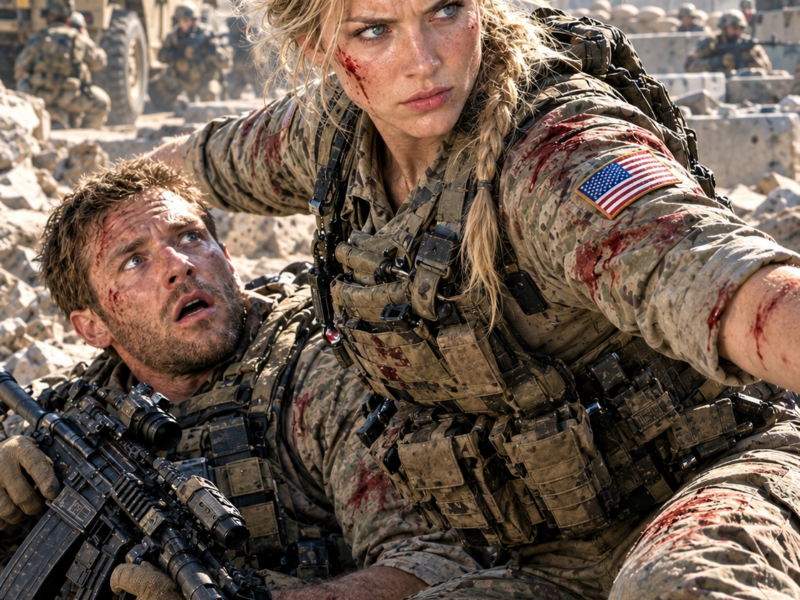
“At a rain-soaked marina in Virginia Beach, I stepped between a gunman and a wounded Navy SEAL just as the weapon fired
The answer began with a name I hadn’t spoken aloud in years.
Chief Brooks didn’t step inside until I invited him.
The other men remained outside, spread across the front yard and sidewalk, their attention moving between passing cars and the houses on either side of mine.
I led him into my living room.
He didn’t sit.
“Before we discuss your father, I need you to understand something,” he said. “We’re not here to arrest you, and we don’t believe you helped the shooter.”
“That’s reassuring, considering you brought an entire army to my front door.”
His mouth tightened, almost a smile.
“We’re a small team.”
“Twenty people?”
“Some of them are support personnel.”
I folded my arms.
“That makes me feel much better.”
He accepted the sarcasm without reacting.
“Logan asked us to protect you.”
“Why?”
“Because he believes someone may try to contact you.”
“Someone already did. He called me from the hospital and told me not to trust everyone wearing a badge.”
Chief Brooks’s expression changed.
“Those were his exact words?”
“Yes.”
He looked toward the window.
“Did he say which badge?”
“No. That’s why I’ve been awake all night wondering whether I’m in danger from the man who shot him or the people investigating the shooting.”
For the first time, he seemed to understand how ridiculous this must look from my side of the door.
“You have every right to be suspicious,” he said. “I’ll tell you what I can, but some details involve an active investigation.”
“Then start with my father.”
He placed the photograph on the coffee table.
“Six years ago, Michael Mitchell was listed as a civilian contractor attached to a military logistics operation overseas. He died in a vehicle accident during his return from a deployment.”
“I know. The military sent my mother a letter. There was a funeral.”
“Did you see his body?”
The question landed harder than it should have.
“No. The remains were badly damaged. My mother handled everything.”
“And did your father ever discuss his work with you?”
“Not much. He repaired communications equipment. At least, that’s what he told us.”
Chief Brooks nodded slowly.
“Logan Reed encountered your father’s name during an investigation that began eleven months ago.”
“What investigation?”
“A series of missing equipment shipments. On paper, the shipments were routine. In reality, records had been altered, and some of the equipment was never delivered to its assigned destination.”
“What does that have to do with my father?”
“We believe someone used his credentials after his death.”
I stared at him.
“That’s impossible.”
“Someone thought so too. Until we found a document bearing his signature, dated two years after he died.”
I sat down because my knees suddenly felt unreliable.
My father had been a careful man. He labeled every drawer in his workshop, saved receipts for decades, and once drove across town to correct a typo on a warranty form.
He wasn’t careless with his name.
But I also remembered the way my mother had shut down every conversation about his final months.
Whenever I asked whether he’d been afraid before his deployment, she’d tell me to remember him as he was.
Whenever I asked about the accident, she’d say there were things families didn’t need to know.
I had mistaken her silence for grief.
Now I wondered what else it might have been.
“Why would Logan investigate my father?”
“Because the altered records eventually pointed toward a storage facility in Norfolk. Inside, investigators found a damaged laptop, several encrypted files, and a photograph of a man whose face had been cut out.”
“Was it my father?”
“We don’t know. Logan believed it might be.”
I looked again at the photograph in the evidence bag.
The picture showed Logan at the marina, but the angle was strange. It had been taken from a distance, possibly from behind the window of a parked car.
Someone had known where he’d be.
Someone had also known I would be there.
“How did you get this?”
“It was delivered to our office shortly after midnight.”
“By whom?”
“An anonymous courier.”
“Then how do you know it’s connected to me?”
“Because the envelope contained your full name, your home address, and a copy of your father’s death certificate.”
The room seemed to tilt.
I gripped the edge of the sofa.
Chief Brooks moved toward me, then stopped when I raised my hand.
“I need a minute.”
He waited.
I stared at the ceiling, trying to force my thoughts into an order that made sense.
My father was dead.
A Navy SEAL had been shot.
Someone had photographed me at the marina.
And now twenty men stood outside my house because my name had somehow become part of an investigation I knew nothing about.
“Can I see Logan?” I asked.
“Not yet.”
“He’s the only person who might know why my father is connected to this.”
“He’s recovering from surgery.”
“Then let me speak to him on the phone.”
Chief Brooks hesitated.
That hesitation told me more than his explanations had.
“What aren’t you telling me?”
“Logan remembers the shooting,” he said. “He also remembers seeing someone near the marina before you arrived.”
“Who?”
“He hasn’t identified the person.”
“Does he think it was the shooter?”
“We don’t know.”
I stood.
“Then I’m going to the hospital.”
“Miss Mitchell—”
“I spent the night with a stranger’s blood on my hands, and now you’re telling me my dead father may have been involved in something dangerous. You don’t get to tell me to sit quietly in my apartment.”
He held my gaze for several seconds.
Finally, he nodded.
“I’ll arrange an escort.”
“I don’t need twenty men following me into the hospital.”
“You’ll have two.”
“One.”
“Two.”
“Fine.”
For the first time that morning, he almost smiled.
At the hospital, the two men stayed near the elevators while I walked to Logan’s room with Chief Brooks.
Logan looked pale beneath the fluorescent lights, with an IV running into his arm and a bandage wrapped around his torso.
He was awake, watching the doorway.
When he saw me, he tried to sit up.
“Don’t,” I said.
“You came.”
“You sound surprised.”
“I was hoping you would.”
His eyes moved toward Chief Brooks.
“Did you tell her?”
“Some of it.”
“Then you told her enough to frighten her.”
“She’s already frightened,” I said. “Now I’m angry, which is considerably worse for everyone.”
Logan gave a faint, pained laugh.
Chief Brooks pulled a chair beside the bed.
“Tell her what you told me.”
Logan looked at me.
“Your father wasn’t a soldier.”
“I know. He was a contractor.”
“No. I mean he wasn’t just a contractor. He was an investigator.”
I frowned.
“An investigator for whom?”
“For a federal oversight team examining defense logistics. He was looking into missing equipment and falsified delivery records.”
I shook my head.
“My father fixed radios.”
“He had a background in communications systems. That’s how he got access. He knew how the records worked, where the gaps appeared, and how someone could make a shipment disappear without making it look suspicious.”
“Why didn’t anyone tell my family?”
“Because the investigation was classified.”
“That doesn’t explain why my mother buried him without telling me what he did.”
Logan looked away.
I watched him closely.
“You know something about my mother.”
“I know her name appears in a document we found.”
“What document?”
“A list of people who received payments connected to the missing shipments.”
The words struck like a slap.
“No.”
“Hannah—”
“No. My mother worked at a public library. She spent forty years returning overdue books to people who didn’t deserve the courtesy. She didn’t steal military equipment.”
“I’m not saying she did.”
“But you just said her name was on a payment list.”
“Her name was there. We don’t know why.”
I stepped away from the bed.
My mother, Elaine Mitchell, lived in a small brick house in Chesapeake, about twenty minutes from my apartment.
She still planted tomatoes every spring, still called me on Sundays, still sent me home with leftovers whenever I visited.
She was the person who had held me through my father’s funeral.
If she knew anything about this, every memory I had of that day suddenly felt uncertain.
“Did my father know he was in danger?” I asked.
Logan was quiet.
“Yes.”
“How do you know?”
“Because the night before he died, he sent a message to someone on my team.”
“Your team?”
“I was assigned to a joint security operation overseas. We were protecting a logistics officer who had discovered irregularities in the same supply network. Your father’s message was forwarded to us after his death.”
“What did it say?”
Logan looked at Chief Brooks, who gave a small nod.
“It said, ‘If anything happens to me, find the woman who kept the original.'”
I felt a chill crawl across my arms.
“Which woman?”
“We don’t know.”
“Then how do you know it wasn’t my mother?”
“We don’t.”
I stared at him.
For the first time, I understood why he had begged me not to mention the photograph.
He wasn’t simply protecting a secret.
He was trying to find out who could be trusted with it.
“Why were you at the marina?” I asked.
“Someone contacted me two days ago. They claimed to have information about the missing shipments and offered to hand over an original record.”
“The photograph?”
“I was supposed to meet a source. I thought I’d identified him, but I was wrong.”
“Was the man who shot you the source?”
“I don’t know. He knew details that only someone inside the investigation should have known.”
Chief Brooks leaned forward.
“Logan, you need to tell her the rest.”
Logan’s jaw tightened.
“Not until we know the room is secure.”
Chief Brooks looked toward the door.
“Everyone in this wing has been vetted.”
“By whom?”
The question hung between them.
Then Logan looked at me.
“That’s the problem.”
A nurse entered to check his vitals, and the conversation stopped.
I stood beside the window, watching the parking garage across the street.
On the sixth floor, a man in a gray coat stood near the far stairwell, speaking on his phone.
He looked up.
For one second, our eyes met through the glass.
Then he turned and walked away.
I couldn’t explain why I remembered his face.
Perhaps it was the way he held his shoulders, or the small scar running from his left temple toward his ear.
Or perhaps I’d seen him before.
“Chief Brooks,” I said.
He followed my gaze.
“What’s wrong?”
“I think someone is watching this room.”
By the time two security personnel reached the stairwell, the man was gone.
They found a discarded coffee cup and a side exit propped open with a folded piece of cardboard.
Nothing else.
Chief Brooks ordered additional security.
Logan didn’t look surprised.
“That’s why I told you not to talk to anyone,” he said.
“You told me not to trust people wearing badges. That doesn’t exactly narrow things down.”
He looked genuinely ashamed.
“I know.”
For several seconds, neither of us spoke.
Then he said, “I’m sorry you got pulled into this.”
“I stepped in front of a gun because I thought someone was about to die. I didn’t know who you were, and I didn’t know anything about your investigation.”
“I know.”
“So don’t ask me to pretend this is nothing.”
“I’m not.”
His voice softened.
“I just don’t want you paying for a decision you made in a second.”
I looked at the bandage beneath his hospital gown.
“Neither do I.”
When I left the hospital, Chief Brooks had one of his men drive me to Chesapeake.
I told him I wanted to see my mother alone.
He didn’t like the idea, but he agreed to wait outside.
My mother’s car was in the driveway.
The curtains were open, and the kitchen light was on even though the sun had finally come out.
I found her standing at the counter, slicing apples into a bowl.
She looked up and smiled.
“You’re early. I was just about to call you.”
Then she saw my face.
The knife stopped moving.
“Hannah? What happened?”
I placed the photograph on the counter.
For a moment, she didn’t seem to recognize it.
Then the color drained from her face.
She put the knife down so carefully that the blade made no sound.
“Where did you get that?”
“Someone sent it to the people investigating Dad.”
She gripped the edge of the counter.
“What people?”
“The military. Federal investigators. I’m not sure who knows what anymore.”
She stared at the photograph.
“Is Logan alive?”
I went completely still.
I hadn’t told her his name.
“How do you know who Logan is?”
Her eyes filled with tears.
“Oh, sweetheart.”
“Don’t call me that. Not yet.”
She covered her mouth with one hand.
I had never spoken to her that way in my life, and the hurt on her face nearly made me take it back.
Nearly.
“Tell me what you know,” I said.
She pulled out a chair and sat down.
For a long time, she looked at the table instead of me.
Then she began to speak.
“Your father discovered that someone was changing the shipment records. At first, he thought it was ordinary fraud. Then he found evidence that equipment was being diverted through private companies and sold to people who should never have had access to it.”
“Who was doing it?”
“He didn’t know the whole operation. He only knew that the records were being altered and that someone inside the system was helping.”
“Why didn’t he go to the police?”
“He did. He reported what he found to his supervisor, who promised to investigate.”
She rubbed her thumb over a small scratch in the table.
“Three days later, a man came to our house. He told your father to stop asking questions.”
My mouth went dry.
“Who?”
“I never learned his name. He wore a gray coat. He had a scar near his left temple.”
I remembered the man at the hospital.
The scar.
The gray coat.
I gripped the back of the chair.
“Mom, I saw him today.”
She looked up sharply.
“Where?”
“Outside Logan’s hospital room.”
For a moment, the kitchen seemed to lose every sound.
Then my mother stood and went to the pantry.
She moved a stack of flour bags, reached behind a tin of coffee, and pulled out a small metal box.
I’d seen that box before when I was a child. My father kept old screws, batteries, and spare keys inside it.
After he died, it disappeared.
My mother set it on the table.
“I promised your father I’d keep this safe,” she whispered. “He told me never to open it unless someone came looking for the original.”
I stared at the box.
“What’s inside?”
“The reason your father died.”
She lifted the lid.
Inside lay a folded letter, a small brass key, and a photograph of my father standing beside two men in front of a warehouse.
One man was younger than I remembered Logan being in the photograph at the marina.
The other wore a gray coat.
Even in the old picture, the scar was visible.
On the back, my father had written a date and a single sentence.
If they say I died in an accident, find out who signed the report.
My mother pressed the letter into my hands.
“I should have told you years ago,” she said. “But I was afraid that if I told you the truth, someone would come for you too.”
I unfolded the paper.
The first few lines were in my father’s familiar handwriting, neat and precise.
He wrote that he had copied the original shipment records and hidden them somewhere no one would think to look.
He named a storage facility, an access code, and a man he believed was arranging the thefts.
Then I reached the final paragraph.
“If you’re reading this, I failed to get the evidence to the people who can use it. Do not trust the report that says I died on Route 17. The vehicle was found there, but I was already gone.”
I read the sentence twice.
My father might not have died in the accident at all.
I looked at my mother.
“Did you know?”
She shook her head, tears slipping down her cheeks.
“I knew the story didn’t make sense. I didn’t know what had happened to him.”
A knock sounded at the front door.
My mother flinched.
I folded the letter and slipped it into my pocket.
Chief Brooks had been waiting outside. I heard his voice through the door, asking whether everything was all right.
Then another voice answered him.
A man’s voice.
Calm, familiar, and close enough to hear clearly.
“Federal investigator. I need to speak with Hannah Mitchell.”
My mother went rigid.
Through the narrow window beside the door, I saw the gray coat.
The scar near the left temple.
He had found us again.
I reached for my phone and called Chief Brooks.
He answered immediately.
“What’s happening?”
“The man from the hospital is at my mother’s house.”
“Do not open the door.”
The man outside knocked again.
“Hannah,” he called, “I know your father left you something. Whatever your mother told you, you need to give it to me before people get hurt.”
I looked at the letter in my hand.
Then I looked at the small brass key.
And suddenly I understood why someone had written SHE KNOWS EVERYTHING on the photograph.
They didn’t know what I knew.
They were afraid of what I might discover.
I slipped the key into my pocket just as Chief Brooks’s men moved toward the front steps.
The man in the gray coat saw them coming.
His expression changed.
For the first time, he looked frightened.
Then he smiled at me through the glass and mouthed two words.
“Ask Logan.”
By the time Chief Brooks reached the door, the man had disappeared.
We searched the surrounding streets, checked the backyard, and questioned a neighbor who had seen a dark sedan parked near the house earlier that morning.
The car was gone.
So was the man.
Chief Brooks took the letter and photographed every page before returning it to me.
He did not ask to keep the key.
“Your father may have left evidence somewhere that could establish what happened to him,” he said. “But if the man at your door knows about it, we need to assume he will try again.”
“Then we go to the storage facility.”
“Not without a plan.”
“Chief, with respect, every hour we wait gives him another chance to destroy whatever is there.”
He studied me.
“You understand that if the evidence is real, this could involve people with significant authority?”
“I understand that my father may have been murdered, that someone tried to kill Logan, and that a man just threatened my mother in her own home.”
My voice shook, but I kept going.
“I’m done waiting for someone else to decide how much truth I’m allowed to know.”
Chief Brooks finally nodded.
“We leave in twenty minutes.”
The storage facility stood near the industrial edge of Norfolk, behind a row of auto shops and a fenced equipment yard.
It was the kind of place most people passed without noticing.
A narrow office stood at the entrance, and the manager looked deeply unhappy when Chief Brooks showed him the warrant.
The key fit a unit at the back.
Inside, we found a workbench, an old desktop computer, several boxes of cables, and a plastic storage bin sealed with yellow tape.
There was no dramatic pile of stolen equipment.
No secret room.
Just the dusty remnants of a life my father had kept separate from the family he loved.
I opened the plastic bin.
Inside were notebooks, printed shipping records, and a small black laptop wrapped in a towel.
The laptop had no power cable.
Chief Brooks called a technical specialist, who arrived with a portable battery and a forensic kit.
While he worked, I examined the notebooks.
My father’s handwriting filled page after page with dates, shipment numbers, and short notes about people he’d interviewed.
Several names appeared repeatedly.
One belonged to a logistics officer who had died overseas.
Another belonged to a private contractor whose company had dissolved shortly after my father’s death.
And a third belonged to a senior official in the very office responsible for reviewing the investigation.
I recognized the name.
The same official had signed the report confirming my father’s death.
Chief Brooks leaned over my shoulder.
“That’s the first thing we’ve found that connects the death report to the investigation.”
“Can you prove he falsified it?”
“Not yet.”
The technical specialist looked up from the laptop.
“I have something.”
The screen flickered, then displayed a list of encrypted files.
One had been modified three days after the date my father supposedly died.
Another contained a video file.
The specialist opened it.
My father’s face appeared on the screen.
He looked older than I remembered, exhausted, with dark circles beneath his eyes and a small cut on his forehead.
He was sitting in what looked like a parked vehicle.
“If you’re seeing this,” he said, “then I wasn’t able to bring the evidence forward myself.”
My hand flew to my mouth.
For six years, I’d carried my father’s death as a fact.
Now his voice filled the storage unit, familiar enough to make the back of my knees ache.
“I need you to understand something. The records prove the thefts, but they don’t prove who ordered them. I have copies of the original transactions and the names of the people who altered them.”
He glanced toward something outside the camera’s view.
“The man I trusted to deliver the evidence has betrayed me. I don’t know how far this goes, and I don’t know who else is involved.”
He paused, rubbing his eyes.
“If Elaine is watching this, I’m sorry. I wanted to keep you and Hannah out of it. I thought I could fix this before anyone knew.”
My mother began to cry quietly beside me.
My father looked directly into the camera.
“Hannah, if you’re seeing this when you’re old enough to understand, remember that I didn’t leave because I stopped loving you.”
The image trembled.
“I left because I believed the only way to keep you safe was to make them think I was dead.”
The room seemed to close around me.
My father had been alive after the accident report.
He had recorded this message after the date on the gravestone.
But the video did not tell us whether he’d survived beyond that moment.
He continued.
“I made one mistake. I kept trusting people because I couldn’t accept that someone I knew would do this. Don’t make that mistake for me.”
Then he named the person who had betrayed him.
It was the same senior official listed in the notebooks.
The man who had signed the death report.
The video ended with my father giving a location and a date.
The location was an abandoned coastal property outside the city.
The date was six years earlier, three days after the accident.
Chief Brooks immediately called his command.
The technical specialist continued examining the files while we waited for authorization to search the property.
Then his expression changed.
“There’s another recording.”
He opened a second video.
This one showed a man sitting in a plain room, his hands folded on a table.
It was the man in the gray coat.
He looked younger, but the scar was unmistakable.
“I was told the evidence had been destroyed,” he said to someone off camera. “Mitchell’s death was supposed to close the investigation. I signed the report because I was assured the body had been identified.”
He swallowed.
“Then the records resurfaced. Someone has been moving them between storage sites, and Reed is getting close.”
Chief Brooks leaned toward the screen.
“Keep playing it.”
The man looked directly into the camera.
“If this reaches the wrong people, they’ll bury everyone involved. I don’t care what happens to me, but the woman and her daughter were never supposed to be part of this.”
The recording cut off.
For several seconds, nobody spoke.
Then my phone buzzed.
A message from an unknown number.
Your father is alive. If you want to see him, come alone.
Beneath it was a photograph of a weathered house near the coast.
I recognized it from my father’s video.
Chief Brooks read the message over my shoulder.
“You’re not going anywhere alone.”
“I know.”
“That could be a trap.”
“I know that too.”
I looked at the photograph again.
For six years, I’d visited my father’s grave on his birthday.
I’d spoken to the stone when I couldn’t bring myself to say certain things to my mother.
I’d told him about my nursing degree, my first apartment, and the relationship that had ended when I realized I was trying to build a life around someone who never really listened.
I’d thought those conversations were a way of keeping him close.
Now I wondered whether I’d been saying goodbye to a man who was still somewhere in the world.
Chief Brooks arranged a controlled operation at the coastal property.
Logan, still recovering, insisted on joining us remotely from the hospital. He refused to leave his bed, but he stayed on the phone throughout the drive, helping identify the roads and access points from the details in my father’s recording.
The house stood behind a stand of wind-bent pines, its paint peeling and its windows dark.
A narrow path led to the front porch.
The door was unlocked.
Inside, we found a table, two chairs, and a portable radio.
On the table lay an envelope with my name on it.
I opened it with trembling fingers.
The note inside contained only one sentence.
If you came with the people who claim they can protect you, ask them why the death report was signed before the body was identified.
I turned toward Chief Brooks.
“Can that happen?”
“Not legally,” he said. “But the timing may have been altered, or the record may have been falsified.”
He took the note and photographed it.
A floorboard creaked in the hallway.
Every person in the room turned.
A door at the back opened slowly.
A man stepped into the light.
His hair was mostly gray, his face thinner than I remembered, and he leaned slightly to one side as if his right leg hurt.
But I knew the shape of his smile.
I knew the small scar above his eyebrow from the time he’d fallen off a ladder while fixing our porch light.
I knew the way he looked at me as if he were afraid that even breathing too hard might make me disappear.
“Hannah,” he whispered.
My father stood ten feet away.
For a moment, I couldn’t move.
Then I took one step toward him and stopped.
“You were dead.”
He closed his eyes.
“I know.”
“You let us bury you.”
His face crumpled.
“I thought it was the only way to keep you alive.”
“You let Mom mourn you for six years.”
“I know.”
“You let me visit your grave.”
He looked down.
“I know.”
The anger I’d carried into the house rose so quickly that I could barely speak.
“Then why should I care that you’re standing here now?”
He didn’t reach for me.
He didn’t ask me to forgive him.
He simply said, “You shouldn’t have to forgive me today.”
That answer hurt more than any excuse would have.
My father explained that the accident had been staged after he discovered that the official reviewing the missing shipments was coordinating the thefts.
The body recovered from the vehicle had been misidentified, and the records were manipulated to close the case.
My father had survived the attempt on his life but knew the people behind it could reach my mother and me.
He went into hiding with help from a source he believed he could trust.
That source eventually disappeared.
For years, he stayed away, gathering evidence and waiting for an opportunity to expose the operation without placing us in immediate danger.
Then Logan’s investigation brought the case close to breaking open.
My father had arranged for the original records to be delivered to Logan, but someone intercepted the message and discovered the marina meeting.
“Who sent the photograph to the team?” I asked.
“I did,” my father said. “I wanted them to find you before the people watching the investigation did.”
“By writing that I knew everything?”
“I didn’t write those words.”
He looked toward Chief Brooks.
“Someone else altered the photograph. I sent it to warn the team that you were in danger.”
Chief Brooks’s expression hardened.
“Then the person who changed it knew about your contact with us.”
My father nodded.
“That’s why we need to move quickly.”
A sound came from outside.
Tires on gravel.
Chief Brooks raised one hand, signaling everyone to stay back from the windows.
His radio crackled.
One of the men stationed near the driveway reported a vehicle approaching without authorization.
Then a voice came through the open doorway.
“Michael.”
The man in the gray coat stepped onto the porch.
He held a handgun low at his side.
“You should have stayed dead.”
My father moved in front of me.
Chief Brooks drew his weapon and ordered the man to put his gun down.
The man laughed.
“You still think this is about a few missing shipments?”
“No,” my father said. “It’s about the people who died because you sold equipment that was supposed to protect them.”
The man’s expression hardened.
“I signed a report. I didn’t pull the trigger.”
“You arranged the accident.”
“I arranged a warning. You were supposed to disappear, not leave evidence everywhere.”
The admission hung in the air.
Chief Brooks kept his weapon trained on him.
“Put the gun down.”
The man looked from Chief Brooks to me.
“Your father could have ended this years ago. He could have handed over the files and gone back to his family. Instead, he decided he was the only honest man in a dirty world.”
My father didn’t move.
“I made a mistake trusting you.”
“Yes,” the man said. “You did.”
He raised the gun.
Everything happened in a blur.
Chief Brooks shouted.
A shot cracked through the room, shattering a window.
My father stumbled, clutching his shoulder.
The men outside rushed the porch.
The gunman tried to turn toward the back door, but two officers tackled him before he reached it.
I dropped beside my father, pressing my hands against the wound.
For the second time in less than twenty-four hours, I found myself trying to keep a man alive while blood spread beneath my fingers.
“Stay with me,” I said.
He looked at me, his eyes full of pain and something that looked painfully like relief.
“I didn’t want you to see this.”
“You don’t get to decide what I can survive anymore.”
He gave a faint, broken laugh.
“No,” he whispered. “I suppose I don’t.”
The ambulance arrived within minutes.
My father survived the surgery.
The man in the gray coat was arrested, and the evidence recovered from the storage unit led investigators to a broader network of people involved in falsifying records, diverting equipment, and obstructing the original investigation.
The official who signed my father’s death report was removed from his position and later charged after financial records and recorded statements corroborated the case.
The investigation took months.
There were hearings, interviews, and days when my father could barely manage a conversation because the weight of what he’d done had finally caught up with him.
Logan recovered more slowly than he wanted.
When I visited him, he was walking short distances with the help of a physical therapist and complaining bitterly about hospital food.
“You know,” he said one afternoon, “most people who save my life don’t make me regret it this much.”
I raised an eyebrow.
“You’re welcome.”
He smiled.
Then his expression grew serious.
“I owe you an apology.”
“For what?”
“For asking you to keep quiet before I understood what that would mean for you.”
“You were scared.”
“That doesn’t make it right.”
I sat beside his bed.
For a while, we listened to the muted sounds of the hospital corridor.
Then I said, “I was scared too. I just didn’t have the luxury of pretending I wasn’t.”
He looked at me with a kind of respect that had nothing to do with the fact that I’d stepped in front of a gun.
“I think that’s what I admired about you from the beginning.”
I looked away before he could see how much those words meant to me.
My father came home to Chesapeake three months later.
He didn’t move back into the house immediately.
He stayed in a small apartment nearby while my mother decided what she could forgive and what she could not.
Some days, she visited him.
Other days, she told me she couldn’t bear to see him.
I stopped trying to persuade her either way.
For years, my mother had been asked to live with a story someone else had written for her.
She deserved the time to decide what came next.
My father and I began with coffee.
Then short walks.
Then conversations that lasted longer than either of us expected.
He told me about the years he had spent in hiding, the friends he’d lost, and the nights he had nearly called home.
I told him about nursing school, the apartment he’d never seen, and the small moments he’d missed that could never be returned.
We didn’t pretend those years could be repaired by a few honest conversations.
But we kept having them.
Logan was discharged a week after my father returned to Chesapeake.
Before he left the hospital, he came to my apartment with a paper bag containing two coffees and a box of doughnuts.
“You know,” he said, standing awkwardly in my doorway, “I was told there would be twenty people here the next time I visited.”
I laughed.
“They’re outside.”
He looked toward the street.
Sure enough, several of his teammates were gathered beside two parked cars, pretending not to watch us.
“Subtle,” I said.
“They’re terrible at subtle.”
He handed me a coffee.
Then he grew quiet.
“I don’t know what happens next,” he admitted. “I have a lot of recovering to do, and you have a lot to sort out with your family.”
“That’s true.”
“But I’d like to see you again when neither of us is bleeding, being followed, or uncovering a government investigation.”
I smiled.
“That sounds like a reasonable starting point.”
He held my gaze.
“Is that a yes?”
“It’s a coffee, Logan. Don’t make it complicated.”
He laughed, and for the first time since the marina, the sound carried no fear.
We went for a walk along the waterfront that afternoon.
The rain had passed, leaving the harbor bright beneath a pale blue sky.
Boats rocked gently against their moorings, and the air smelled of salt and fresh-cut grass.
I thought about the woman I’d been the night I stepped between Logan and the gunman.
I had believed bravery meant acting without fear.
Now I understood that sometimes it meant asking questions after the danger had passed, refusing to accept an easy explanation, and allowing people to face the consequences of their choices—even when you loved them.
My father had tried to protect me by taking away my right to know the truth.
Logan had tried to protect me by asking me to stay silent.
Neither man had been entirely wrong about the danger.
Neither had been entirely right about what I needed.
The truth had hurt us all, but it had also given us something we hadn’t had before: the chance to choose what came next.
A few weeks later, my mother invited my father to dinner.
She didn’t promise forgiveness.
He didn’t ask for it.
They sat across from each other at the kitchen table, speaking carefully at first, then more freely as the evening went on.
When I left, my father walked me to the porch.
“I can’t give you those six years back,” he said.
“No.”
“I wish I could.”
I looked at the man who had once taught me to ride a bicycle, who had helped me with algebra, who had disappeared from my life in the name of keeping me safe.
“I don’t need you to change what happened,” I said. “I need you to stop deciding what I can handle.”
He nodded, his eyes wet.
“I can do that.”
I hugged him before I went down the steps.
It wasn’t forgiveness for everything.
It was simply a beginning.
Months after the shooting, I returned to the marina alone.
The wooden walkways had been repaired, and the blue fishing crates were stacked neatly beside the docks.
I stood where Logan had fallen and listened to the water move beneath the boats.
I had come looking for an ending, but the place held no answers.
Only the memory of a choice made in a fraction of a second.
I had stepped between a stranger and a bullet because I couldn’t bear the thought of watching someone die when I might be able to help.
I hadn’t known he was a Navy SEAL.
I hadn’t known twenty men would stand outside my door the next morning.
And I certainly hadn’t known that saving his life would lead me back to the truth about my father.
When my phone buzzed, I smiled before I even looked at the screen.
It was a message from Logan.
Dinner Friday? No gunfire, no investigations, and absolutely no mysterious photographs.
I typed back, I’ll consider it if you promise not to get shot.
His reply came almost immediately.
I’ll do my best.
I slipped the phone into my pocket and watched the sunlight settle across the harbor.
For six years, I’d believed the hardest part of losing my father was learning to live without him.
I was wrong.
The hardest part was learning that love could survive the truth, but only if we stopped using it as an excuse to hide from one another.
And as I walked back toward the street, with the tide rising quietly behind me, I finally felt ready to begin again.
THE END.









