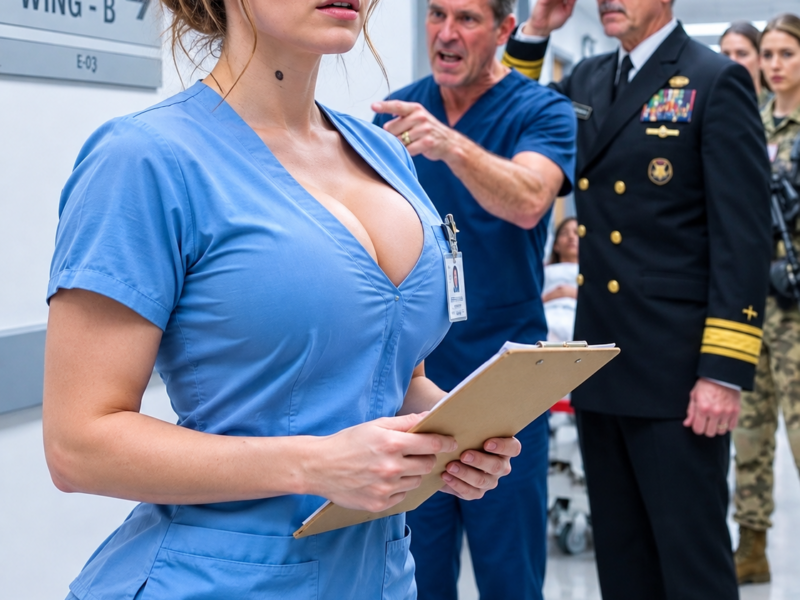
At 2:17 a.m., the emergency department at Harbor Point Medical Center was drowning.
The name on the sealed file was Captain Nathaniel Brooks.
For a moment, the emergency department disappeared.
The alarms.
The voices.
The fluorescent lights.
Everything faded until all I could see was that name.
I hadn’t spoken it in four years.
I hadn’t allowed myself to think about it for longer than a few seconds at a time.
And now it was sitting in front of me, printed in black letters on a military document.
“Where did you get that?” I whispered.
Admiral James Walker closed the file halfway.
“From the Naval Special Warfare command investigation office.”
I shook my head.
“No. That’s impossible.”
“Olivia, we need to talk.”
“I treated fifteen patients tonight. I’m exhausted. Whatever this is, it can wait.”
One of the SEALs stepped forward.
“Ma’am, please.”
I looked at him.
His face was older.
His hair was shorter.
There was a scar near his left eyebrow that hadn’t been there the last time I saw him.
But I knew those eyes.
“Ethan?”
His jaw tightened.
“It’s me.”
I felt my knees weaken.
Ethan Cole had been the youngest member of our medical support team four years earlier.
He had been twenty-four then.
He had been the one who carried Nathaniel out of the smoke.
And he had been the last person I expected to see standing in a hospital hallway.
“Your report said you were gone,” I whispered.
Ethan looked down.
“It was wrong.”
Admiral Walker gestured toward a quiet consultation room.
“Can we speak privately?”
I looked at Dr. Harris.
He was still staring at me as if the person he had supervised for eleven weeks had suddenly become a stranger.
“Doctor, I need to finish my patient handoffs first,” I said.
The admiral nodded.
“Of course.”
That answer surprised me.
He had arrived with a four-star rank and six elite operators.
But he didn’t order me to follow him.
He waited.
Because he understood something I had learned long ago.
A patient comes first.
Ten minutes later, all fifteen patients had been handed over to the appropriate teams.
I checked each transfer.
I confirmed the medication records.
I made sure the receiving nurses understood which patients needed close monitoring.
Only when the last handoff was complete did I remove my gloves.
Dr. Harris approached me.
“Olivia, what exactly is going on?”
I looked at him.
“I used to be a Navy combat medic.”
He blinked.
“You?”
“Yes.”
“You never mentioned it.”
“I wasn’t hiding it from the hospital. I just didn’t want it to be the first thing people knew about me.”
He glanced toward the consultation room.
“Why is an admiral looking for you?”
I swallowed.
“Because of something that happened four years ago.”
Dr. Harris studied my face.
Then he nodded.
“Go talk to him. I’ll make sure your patients are covered.”
“Thank you.”
He hesitated.
“And Olivia?”
“Yes?”
“Whatever happened before you came here, it doesn’t change what you did tonight.”
For the first time that night, I felt close to tears.
“Thank you, Doctor.”
I walked into the consultation room.
Admiral Walker sat at the table.
Ethan stood near the window.
Four other SEALs waited outside.
The admiral opened the file.
“Four years ago, you were assigned to a medical support detachment attached to a Naval Special Warfare training mission.”
“Yes, sir.”
“You were twenty-two.”
“Yes.”
“You received the Navy and Marine Corps Medal for actions during the operation.”
I stared at the file.
“I received a commendation.”
“You received the medal. The formal award was approved after you left service.”
I shook my head.
“That doesn’t matter.”
“It matters to the people who survived because of you.”
I looked at Ethan.
He hadn’t moved.
“Where is Nathaniel?” I asked.
The admiral lowered his eyes.
“That’s why we’re here.”
My throat tightened.
“Tell me.”
He turned the file toward me.
Inside was a photograph of Captain Nathaniel Brooks.
He was standing beside a helicopter, wearing a flight jacket, with a wide smile and one arm around Ethan’s shoulders.
I remembered that smile.
Nathaniel had been the kind of commander who remembered everyone’s birthday.
He had once stayed awake for thirty hours because one of our junior sailors was afraid to sleep after a difficult mission.
He had also been the man who ordered me to evacuate when the operation went wrong.
“Four years ago,” the admiral began, “your team was supporting a classified maritime rescue exercise. The mission was compromised when an equipment failure caused an explosion near the training site.”
I closed my eyes.
I remembered the blast.
The sudden darkness.
The radio cutting out.
The injured men.
And Nathaniel shouting for everyone to move.
“We lost communications,” the admiral continued. “Several personnel were injured. Captain Brooks was listed among the missing.”
“I saw him.”
Ethan finally spoke.
“You saw him after the explosion?”
I nodded.
“He was alive when I reached him.”
My voice shook.
“He had a serious injury. I tried to stabilize him, but the extraction point was collapsing. He told me to leave with the others.”
Ethan looked away.
“I carried him as far as the landing zone.”
“You told me he didn’t make it.”
“I believed he didn’t.”
I looked at the admiral.
“Then why is his name in that file?”
The admiral took a slow breath.
“Because Captain Brooks was found alive several hours after the official evacuation.”
I stared at him.
“What?”
“He was recovered by a second rescue element. He had been transferred to a secure medical facility under a protected identity because the operation had exposed a serious security breach.”
My hands went cold.
“Why didn’t anyone tell me?”
“His condition was critical. The investigation was ongoing. Certain details were restricted.”
“Four years?”
The admiral didn’t answer immediately.
“His recovery took a long time. He has been receiving treatment and rehabilitation. He is now able to speak with you.”
I pressed my palms against the table.
“Where is he?”
“Here.”
The door opened.
A man entered slowly, using a walking stick.
His hair was shorter than I remembered.
His face was thinner.
A long scar ran along his jaw.
But it was him.
Nathaniel Brooks.
For several seconds, neither of us spoke.
Then he smiled.
“Hello, Bennett.”
My eyes filled instantly.
“Captain?”
“I’m not your captain right now.”
He took another careful step.
“I’m just Nathan.”
I stood so quickly that my chair scraped backward.
I wanted to run to him.
I wanted to ask a hundred questions.
But all I could say was, “You’re alive.”
He nodded.
“I am.”
I covered my mouth.
Four years of grief rose up at once.
I had imagined his final moments a thousand times.
I had replayed every decision.
Every order.
Every second when I had chosen one injured sailor over another.
And now the man I believed I had failed to save was standing in front of me.
“I thought you died,” I whispered.
“I know.”
“I tried everything.”
“I know that too.”
“I should have stayed.”
Nathan’s expression changed.
“No.”
“I could have—”
“No, Olivia.”
His voice was firm, but gentle.
“You followed my order. You got the others out. You did exactly what I asked you to do.”
I shook my head.
“I left you there.”
“You saved the people who were still reachable. If you had stayed, we might have lost you too.”
I looked down.
“I couldn’t save everyone.”
Nathan stepped closer.
“You were never supposed to save everyone.”
The words broke something open inside me.
I began to cry.
Not quietly.
Not politely.
I cried the way I had wanted to cry for four years.
Nathan put one hand on my shoulder.
“I am sorry you had to carry that alone.”
When I finally sat down, Admiral Walker explained why they had come that night.
The fifteen sailors brought into Harbor Point Medical Center had been part of a Naval Special Warfare training detachment.
Their exercise had encountered a serious equipment failure.
The initial reports suggested an accident.
But the medical team had noticed something unusual.
Several patients had injuries that didn’t match the first account of what had happened.
One sailor had a fragment wound inconsistent with the equipment listed in the exercise report.
Another had signs of exposure to a chemical used in a restricted training system.
And a third had carried a damaged communications component that should never have been present at the training site.
The Navy needed to establish exactly what had happened.
But there was another reason the admiral had asked for me.
“Your actions tonight were extraordinary,” he said.
“I was doing my job.”
“You were doing more than that.”
He opened another document.
“During the first hour, you noticed that two patients had similar symptoms despite being involved in different parts of the exercise. You flagged the pattern to the attending physician.”
I remembered.
One sailor had been coughing and struggling to breathe.
Another had developed sudden dizziness and confusion.
I had thought the symptoms might be connected.
“I asked the doctor to consider a shared exposure,” I said.
“And that prompted the team to notify toxicology and preserve the patients’ clothing and equipment.”
I looked at him.
“Was there a chemical exposure?”
“We don’t know yet. Testing is underway.”
He turned another page.
“You also recognized that one patient’s identification tag did not match the paperwork accompanying him.”
“That was Ryan Cole.”
Ethan looked up.
“My brother.”
I turned toward him.
“Your brother?”
He nodded.
“Petty Officer Ryan Cole. He was one of the fifteen.”
I remembered the young sailor from bed fifteen.
His pale face.
His brief loss of consciousness.
The way his eyes had opened when I called his name.
“Is he okay?”
“He’s stable,” Ethan said. “He’s being evaluated upstairs.”
I released a breath I hadn’t realized I was holding.
“Thank God.”
Ethan looked at me.
“You recognized the mismatch before anyone else.”
“I didn’t know who he was.”
“You didn’t need to.”
The admiral closed the file.
“That’s what impressed this team. You didn’t know these men. You didn’t know their unit. You didn’t know what had happened. You simply treated every patient according to what they needed.”
I looked toward the door.
“That’s what a nurse is supposed to do.”
Nathan smiled faintly.
“That’s what a good medic does too.”
At 5:30 a.m., the hospital director arrived.
He had been called from home after learning that a four-star admiral and a SEAL team were in the emergency department.
He looked concerned.
“Admiral, is there a problem with our staff?”
“No,” Admiral Walker replied. “Quite the opposite.”
He explained that Olivia had played a critical role in the emergency response.
The director looked at me.
“Eleven weeks on the job?”
“Yes, sir.”
“And you handled fifteen incoming casualties?”
“With the team.”
Dr. Harris stepped forward.
“She was instrumental in the response. She identified changes in patient conditions, communicated effectively, and helped coordinate care across multiple bays.”
Rachel nodded.
“She never stopped moving.”
The director looked genuinely impressed.
But then his expression changed.
“Olivia, why didn’t you tell us about your military medical experience?”
I took a breath.
“Because I wanted to build a career here based on the work I do now. Not on what I did before.”
He considered that.
“That’s understandable.”
Then he looked at Admiral Walker.
“Does the Navy intend to take her back?”
The admiral shook his head.
“We didn’t come to recruit her.”
I glanced at him.
“Then why did you come?”
He placed a second envelope on the table.
“Because we wanted you to know the truth about Captain Brooks. And because we need your help understanding what happened during tonight’s exercise.”
I looked at the envelope.
“What kind of help?”
“Your clinical observations. Your notes. Anything you noticed that might help investigators reconstruct the sequence of events.”
I nodded.
“I’ll provide a statement through the proper channels.”
“Thank you.”
The admiral paused.
“And Olivia, there is one more thing.”
He opened the envelope.
Inside was a formal letter.
It confirmed that the Navy and Marine Corps Medal had been approved for my actions during the rescue four years earlier.
I stared at the document.
“I don’t want an award.”
“I know,” he said.
“I didn’t save everyone.”
“No one is asking you to claim that you did.”
He placed the letter in front of me.
“This recognizes what you did save.”
I couldn’t look at it for long.
Because the truth was, I had spent four years believing that the people who survived were not enough to make up for the people who didn’t.
I had confused grief with guilt.
And I had mistaken punishment for responsibility.
Nathan reached over and gently tapped the document.
“You should accept it.”
I looked at him.
“Why?”
“Because I remember what you did.”
His eyes were steady.
“I remember you staying with me until the last possible moment. I remember you refusing to give up on the others. And I remember telling you to leave because I knew you would keep trying even when there was nothing left you could safely do.”
He paused.
“You didn’t abandon us, Olivia. You followed the order that gave the rest of us a chance.”
I lowered my eyes.
Then, slowly, I picked up the letter.
The official investigation took several months.
The fifteen sailors recovered, although three required longer rehabilitation.
Ryan Cole was eventually discharged from intensive care and began physical therapy.
The equipment failure was traced to a maintenance error involving a component that had been improperly inspected.
Investigators also discovered that the original exercise report had omitted several important details.
There was no evidence that the failure had been deliberately caused.
The Navy revised its safety procedures and began a full review of the equipment inspection process.
I provided my statement and shared the notes I had made during the emergency.
I didn’t return to military service.
I stayed at Harbor Point Medical Center.
But something had changed.
I no longer felt the need to hide every part of my past.
I began helping train new emergency nurses in trauma assessment and communication during mass-casualty incidents.
I never called myself a hero.
I never told the trainees that they had to be fearless.
Instead, I taught them something much simpler.
When the department becomes chaotic, slow your thinking down.
Look at the patient.
Listen to the team.
Check the details.
And never let the noise around you make you forget the person in front of you.
Dr. Harris once asked me why I always repeated those instructions.
I told him, “Because when everything is falling apart, the smallest detail can save someone’s life.”
He nodded.
Then he added my name to the hospital’s emergency response training program.
Rachel became my closest friend at work.
She still teased me about being the quiet rookie.
“Eleven weeks,” she would say. “That’s how long it took you to make the entire Navy show up at our hospital.”
I would laugh.
“I didn’t invite them.”
“No, apparently they invited themselves.”
And every time I saw Ryan Cole during his follow-up appointments, he would give me a small salute.
I always told him to stop.
He never did.
Almost a year after that night, I received a message from Nathan.
It contained a photograph.
He was standing outside a rehabilitation center, holding a cup of coffee.
Ethan stood beside him.
Ryan was between them, smiling.
All three looked healthier than they had the night I met them in the emergency department.
Under the photograph, Nathan had written:
You once told me you couldn’t save everyone.
I want you to see the people who made it home.
I stared at the picture for a long time.
Then I printed it and placed it in my locker.
Beside it, I kept the small medal the Navy had sent.
Not because I wanted people to know what I had done.
But because I needed a reminder of what I had finally learned.
I had not failed simply because I couldn’t control every outcome.
I had not been weak because I had left the military.
And I had not become less valuable by choosing a quieter life.
I was still the same person who had walked into Harbor Point Medical Center eleven weeks earlier, unsure whether she belonged in the emergency department.
Only now I understood that courage didn’t always look like running toward an explosion.
Sometimes it looked like checking a patient’s breathing while alarms sounded around you.
Sometimes it meant asking one more question when a chart didn’t make sense.
And sometimes it meant allowing yourself to believe that you had done enough.
On the anniversary of the night the fifteen sailors arrived, I was working the evening shift.
A new nurse stood beside me, staring nervously at the crowded emergency department.
“Olivia,” she said, “what if I make a mistake?”
I looked at her.
“You will make mistakes. Everyone does.”
Her face fell.
I smiled gently.
“But you can learn to catch them. You can ask for help. You can slow down and look carefully. And you never have to face a difficult moment alone.”
She nodded.
Then the ambulance doors opened.
A new patient was coming in.
I pulled on my gloves and stepped forward.
The hospital was loud.
The monitors were beeping.
Someone was calling for a physician.
And somewhere down the hall, a patient needed help.
I didn’t think about admirals.
I didn’t think about medals.
I didn’t think about the past.
I looked at the person in front of me.
And I got to work.
Because I had finally understood that the greatest part of my story wasn’t that I had once been the Navy’s most decorated combat medic.
It was that, after everything I had lost, I had found my way back to the work I loved.
Olivia had saved fifteen patients in two hours, but the greatest battle was the one she had fought inside herself for four years.
The end.









