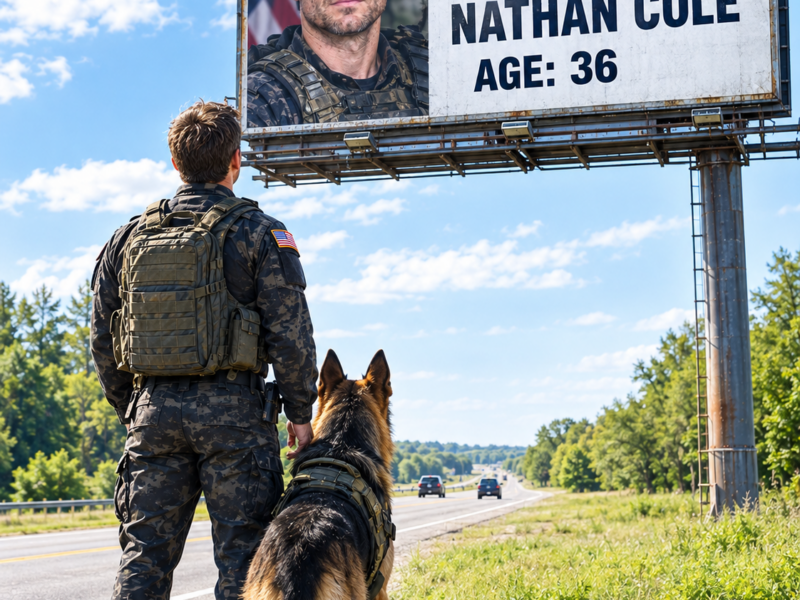
“After eleven months overseas, I returned home with my loyal K9 expecting nothing more than a quiet reunion with my family
For three seconds, I forgot how to breathe.
“Your death was supposed to be permanent.”
The stranger’s words hung in the cold air between us.
My mother clutched my arm so tightly that her fingers hurt. Atlas stood in front of us, teeth bared, his entire body trembling with the effort of holding his ground.
I had spent eleven months following orders, surviving hostile territory, and trusting the men beside me with my life.
Now I was home, and a stranger was telling me that someone had planned my death.
I looked at the document in his hand.
“Put it down. Step away from my house.”
He didn’t move.
“My name is Agent Robert Hayes. I’m here under federal authority. Chief Petty Officer Cole, you need to come with me immediately.”
“Then show me identification I can verify.”
He reached slowly into his coat and produced a badge. I examined it from several feet away but didn’t lower my guard.
“Why is my face on a missing-person billboard?”
“Because your status was changed in the official system.”
“Changed by whom?”
“That is precisely what we need to discuss.”
“Then start talking.”
Hayes glanced at my mother.
“Not here.”
I almost laughed.
“You’ve got a lot of nerve asking me to trust you when someone just told me my death was supposed to be permanent.”
A second vehicle turned onto the street.
The black pickup from the highway.
It rolled past the house, slowed, and stopped at the corner.
Hayes noticed it.
For the first time, his calm expression cracked.
“Get inside,” he ordered.
“Who are they?”
“Inside. Now!”
A sharp metallic click came from the pickup.
Atlas barked and lunged toward the curb.
I caught his harness before he could reach the street.
The pickup accelerated away.
Hayes drew his phone and spoke rapidly into it, giving the vehicle’s description and license plate. When he finished, he turned back to me.
“Your family is in danger.”
“My family has been in danger for weeks, apparently. You’re going to explain everything before I take another step.”
He studied me for a moment.
Then he nodded toward the front door.
“Five minutes. That’s all I can give you.”
I took my mother inside.
The house smelled like cinnamon and the lavender detergent she had used for as long as I could remember. My childhood photographs still lined the hallway. A pair of my father’s old boots sat beside the coat closet.
Everything looked normal.
But the living room table was covered with newspaper clippings, printed emails, and photographs of me.
My mother had been collecting evidence of my disappearance.
There were pictures of the billboard, letters from military officials, and a list of phone numbers with dates beside them.
At the center lay an envelope marked with my name.
I recognized my father’s handwriting.
My stomach tightened.
“Mom, where did you get this?”
She sank onto the sofa.
“It arrived three days after the military told us you were missing. There was no return address. I was afraid to open it.”
“Why?”
“Because the person who delivered it told me that if I wanted you to come home, I had to stop asking questions.”
I stared at her.
“Who delivered it?”
“A man wearing a military uniform. He said he worked with your unit.”
“Did you recognize him?”
She shook her head.
I opened the envelope.
Inside was a photograph of six military personnel standing beside a transport aircraft. I recognized myself, two members of my team, and our former operations officer, Commander Elias Ward.
The man standing at the far end had his face partially turned away.
On the back, my father had written a message.
*Nathan, if you are reading this, someone has used your identity. Find the original mission report. Do not trust the revised copy.*
I read it twice.
My father had been dead for five years.
How could he have known something like this would happen?
Then I noticed a date in the corner of the photograph.
It had been taken six months before he died.
“Mom,” I said quietly, “did Dad ever tell you he was investigating anything connected to my work?”
She looked down at her hands.
“He asked me once whether I would recognize a lie if it came from someone I trusted.”
“What did you say?”
“I told him I hoped I would.”
Her voice broke.
“He said that was what frightened him most.”
I sat beside her.
For years, I had believed my father had spent his retirement fixing old radios, tending his garden, and worrying about whether I was eating enough vegetables overseas.
Now I wondered how much of his life I had never understood.
A knock sounded at the door.
Hayes stood outside, checking his watch.
I slipped the photograph into my jacket.
“I’m coming,” I said.
My mother grabbed my hand.
“Please don’t leave me again.”
The words hurt more than any wound I had received overseas.
I knelt in front of her.
“I didn’t choose to disappear.”
“I know.”
“I’ll find out what happened.”
She searched my face.
“And you’ll come back?”
I squeezed her hand.
“I will do everything I can.”
It wasn’t a promise that nothing could happen to me.
It was the only honest promise I could make.
Atlas pressed his head against her knee before following me outside.
Hayes looked at the dog.
“Is he trained for protection?”
“He’s trained to recognize trouble.”
“Then keep him close.”
I opened the SUV door.
“Where are we going?”
“To a secure facility. There are people who need to hear your account.”
“Which people?”
“Investigators who have been trying to establish what happened to your team.”
“Then why didn’t they contact me overseas?”
Hayes met my eyes.
“Because according to the official records, you weren’t overseas.”
I stared at him.
“What?”
“Your identity was attached to a casualty report eleven months ago. The report states that you died during an operation in a foreign country. A body was recovered, identified through records associated with you, and transferred under restricted procedures.”
My mouth went dry.
“Who was the body?”
“We don’t know yet.”
I looked toward the house.
My mother was watching us through the window.
Someone had convinced her son was missing. Someone had created a report declaring him dead. Someone had used the system I had sworn to serve to erase the truth.
And now that I was home, they wanted me to disappear again.
“Take me to the original mission report,” I said.
Hayes opened the driver’s door.
“That may not be possible.”
“Why?”
“Because the officer who signed the revised report died two weeks ago.”
I turned sharply.
“Who?”
“Commander Elias Ward.”
The name landed like a blow.
Ward had been my commanding officer during my last deployment. He was the man who had approved our final mission briefing and personally sent us into the field.
I had trusted him.
I had followed his orders.
And now he was dead.
“Was it an accident?”
“That’s what the report says.”
I climbed into the vehicle.
“Then we’d better find out whether the report is lying, too.”
***
The secure facility was an unmarked federal building outside Colorado Springs. No sign identified it, and the windows were covered with reflective film.
Hayes led me into a conference room where two investigators waited.
One was a woman in her early forties with short dark hair and a folder thick enough to hold a dozen secrets. She introduced herself as Special Agent Laura Bennett.
The second man was older, with silver hair and a scar running beneath his jaw.
He did not introduce himself.
Instead, he looked at me and said, “You should have stayed overseas.”
I recognized his voice before I recognized his face.
Major General Richard Voss.
He had attended our predeployment briefing eleven months earlier. He was also the senior officer who had publicly praised our unit after the operation in which my identity had supposedly been lost.
I had watched that speech from a hospital bed overseas.
At the time, I had thought it was a tribute to the team.
Now I wondered if it had been a funeral for a man who was still alive.
“General,” I said.
He motioned toward a chair.
“Sit down, Cole.”
I remained standing.
“Why was I declared dead?”
Agent Bennett opened her folder.
“Your identity was used in a casualty report submitted after a classified operation. The report was approved through multiple channels. The body listed as yours was never independently identified by a family member.”
“Who was it?”
“We don’t know.”
“Then how did anyone approve the death?”
“That’s one of the questions we’re investigating.”
Voss folded his hands.
“Sometimes operational security requires decisions that seem unreasonable to people who don’t have the full picture.”
I looked at him.
“You’re telling me someone used my identity, told my family I was dead, and placed a missing-person billboard in my hometown for operational security?”
“No. I’m telling you that your situation is more complicated than you understand.”
“Then explain it.”
He leaned back.
“Your last mission involved intelligence that could not be allowed to fall into hostile hands. During the extraction, your team encountered unexpected resistance. Communications were compromised, and several personnel were lost.”
“I know what happened during the extraction. I was there.”
“Then you know why the report was classified.”
“I know what I saw. I also know the report says I died.”
For the first time, Voss’s expression hardened.
“Your continued presence creates a serious security problem.”
“I’m not the one who created it.”
Agent Bennett raised a hand.
“General, let him finish.”
I turned to her.
“I want the original mission report, the casualty records, and the name of the person who identified the body.”
“We’re working to obtain those records.”
“Then why am I here?”
“Because someone sent a message to our office two days ago claiming that Nathan Cole had returned to the United States. The message included your current location and a photograph of your vehicle.”
I thought of the black pickup.
“They were watching me.”
“Yes.”
“Who sent the message?”
“We don’t know.”
I looked at Voss.
“Do you?”
He said nothing.
That silence told me more than his answers had.
I turned back to Agent Bennett.
“I want to see the casualty report.”
She hesitated, then removed several pages from her folder.
The first page carried my name, rank, service number, and the date of the alleged death.
The second listed the location of the incident.
The third contained the names of the personnel assigned to the extraction team.
I read the list.
Then I stopped.
Petty Officer Daniel Mercer.
My closest friend on the team.
The man who had pulled me from a burning vehicle during an earlier deployment.
The man I had last seen running toward the extraction point while gunfire tore through the night.
According to the report, Daniel had died in the same incident.
I stared at his name.
“Did they recover his body?”
Agent Bennett’s expression changed.
“No.”
I looked up.
“Then why is he listed as dead?”
“The report states that recovery was impossible.”
“Did his family receive a notification?”
“Yes.”
I pushed the pages across the table.
“Then you have at least two men declared dead without bodies being independently identified.”
Voss stood.
“That’s enough.”
“No, General. It isn’t.”
I stepped closer to the table.
“Where is Daniel Mercer?”
Voss looked at me with an expression I had never seen during our briefings.
Not anger.
Not surprise.
Fear.
It lasted less than a second.
But I saw it.
Agent Bennett saw it too.
“General,” she said, “I think we need to discuss this in private.”
Voss gathered his papers.
“This meeting is over.”
He walked out.
The door shut behind him.
For several seconds, nobody spoke.
Then Agent Bennett leaned forward.
“Chief Cole, I need you to answer one question honestly.”
“Ask it.”
“Did you see Daniel Mercer die?”
I remembered the explosion, the smoke, and the radio screaming in my ear. I remembered Daniel’s voice telling us to keep moving. I remembered turning back and seeing him disappear behind a wall of dust and fire.
“No,” I said. “I saw the explosion. I never saw his body.”
Bennett closed the folder.
“Then I think we may have a much bigger investigation than anyone expected.”
***
That night, I was placed in a secure hotel under temporary protection.
I hated every minute of it.
Atlas hated it even more.
He paced the room, sniffed beneath the door, and refused to settle until I checked the windows twice.
I called my mother from a secure phone.
She answered immediately.
“Nathan?”
“I’m okay, Mom.”
“Where are you?”
“Somewhere safe.”
“That’s what everyone keeps telling me.”
I closed my eyes.
“I know.”
“Are you coming home?”
“Yes. But I need to find out who did this.”
She was quiet for a moment.
“Your father used to say that the truth always leaves something behind.”
I sat on the edge of the bed.
“What did he mean?”
“I don’t know. He never explained it.”
I glanced at the photograph I’d taken from the envelope.
The six men beside the transport aircraft.
The man at the end, his face turned away.
“Mom, do you still have Dad’s old radio equipment?”
“Some of it. Why?”
“Don’t throw anything away. And don’t let anyone into the house unless you know who they are.”
Her voice tightened.
“Nathan, what aren’t you telling me?”
“I’m trying to keep you safe.”
“Don’t do to me what everyone else has done.”
Her words stopped me cold.
She was right.
I had spent the last several hours demanding the truth from people who had hidden it from me, yet I was already withholding information from her.
“Someone may have used Dad’s research to uncover what happened during my mission,” I said. “I don’t know how much he knew, but I think his old records could matter.”
“Then come home and look for them.”
“I will.”
After we ended the call, I sat in silence while Atlas rested his head on my knee.
My father had spent years fixing radios. He could repair almost anything with a circuit board and a soldering iron. After his death, I had packed most of his equipment into boxes in the basement.
I had never thought much about it.
Now I wondered what else he had left behind.
My phone vibrated.
A message from an unknown number.
STOP ASKING ABOUT MERCER.
A second message appeared.
YOU HAVE ALREADY BEEN GIVEN ONE CHANCE TO STAY DEAD.
Then came a photograph.
Daniel Mercer stood beside a weathered wooden building, wearing civilian clothes. His beard was longer, and a scar crossed his cheek.
But it was unmistakably him.
He was alive.
The message beneath the photograph contained an address and a time.
MIDNIGHT. COME ALONE IF YOU WANT THE TRUTH.
I showed the message to Agent Bennett when she arrived ten minutes later.
She read it without speaking.
“We’ll need to verify the location.”
“You can do that. I’m going.”
“Absolutely not.”
“He’s my teammate.”
“And whoever sent this has already threatened you twice.”
“Then I’ll take precautions.”
Bennett studied me.
“You military types always think you can solve everything by walking into danger.”
“Not everything.”
“Just the things most likely to get you killed?”
I almost smiled.
“Something like that.”
She sighed.
“You will not go alone. My team will establish a perimeter. You will follow instructions, and if we see anything suspicious, we abort.”
“Agreed.”
She pointed at Atlas.
“And the dog stays with me.”
Atlas gave her a look of deep personal offense.
“He’s coming,” I said.
“Chief Cole—”
“He’s part of my team.”
Bennett rubbed her forehead.
“Fine. But if he bites anyone, I’m writing the report.”
***
The address led to an abandoned maintenance building near an old railway spur.
Snow drifted across the tracks. The building’s windows were dark, and a rusted sign hung above the entrance.
I stepped out of the vehicle with Atlas beside me.
The federal team had taken positions beyond the perimeter. Bennett’s voice came through the earpiece.
“Cole, proceed to the entrance. Do not enter until I confirm the area is clear.”
I waited.
A minute passed.
Then the earpiece crackled.
“Perimeter is clear. Move.”
The door stood slightly open.
I pushed it inward.
“Daniel?”
A shape moved in the darkness.
Then a voice answered.
“Still impatient, I see.”
Daniel Mercer stepped into the light.
For a moment, I couldn’t move.
He looked thinner than I remembered. His face carried the weariness of someone who had spent months sleeping with one eye open. But his eyes were the same.
“Daniel.”
He gave a short, humorless laugh.
“That’s what they called me last time I checked.”
I crossed the room and grabbed his shoulder.
“You’re supposed to be dead.”
“So are you.”
I pulled him into an embrace.
He held on for a moment, then stepped back.
“I’m sorry, Nathan.”
“For what?”
“For letting you believe I was gone.”
I wanted to be angry. I wanted to demand every detail of the months he had disappeared.
Instead, I looked at the scar on his face.
“What happened?”
“After the explosion, I was captured by the people who had compromised our mission. They wanted the location of a data package we were carrying. When I refused, they moved me between safe houses and tried to make me disappear.”
“Who were they?”
“Contractors working for someone inside our own chain of command.”
“Voss?”
Daniel glanced toward the door.
“I can’t prove that yet.”
“Then why did they declare us dead?”
“Because a dead soldier can’t contradict an official report.”
The simplicity of the answer made my stomach turn.
Daniel led me to a table covered with documents and photographs.
“They were moving intelligence through a private logistics network. Mission schedules, extraction routes, personnel records. They used legitimate shipments to hide the transfers.”
“And our mission?”
“We were sent to recover evidence. But the operation was compromised before we arrived. Someone changed our extraction coordinates and gave the enemy our route.”
I remembered the radio call that had sent us toward the wrong valley.
The explosion.
The smoke.
The moment I realized the route was wrong.
“Who changed the coordinates?”
“I’m still trying to find out.”
He slid a photograph across the table.
It showed Commander Elias Ward meeting with a civilian in a parking garage.
The civilian was the same man whose face had been turned away in my father’s photograph.
I leaned closer.
“Who is he?”
“His name is Peter Lang. He was a contractor who handled restricted shipments. He vanished after Ward died.”
“Why was he meeting with our commander?”
“That’s what I’ve been trying to prove.”
Daniel opened a folder.
Inside were printed emails, partial shipping records, and a handwritten list of dates.
One date had been circled.
October 14.
The same date listed beneath my photograph on the billboard.
“What happened on October 14?” I asked.
“Someone submitted the final change to your status.”
“But I was still overseas.”
“I know.”
“Who signed it?”
Daniel hesitated.
“Your identity was used to authorize the transfer. Someone made it appear that you had died, then used your credentials to close several records related to the operation.”
I stared at him.
“Someone had access to my identity.”
“More than that. They had access to information that should never have left our unit.”
A sudden sound echoed outside.
Three short knocks against the metal door.
Daniel went pale.
“That isn’t our signal.”
Atlas moved in front of me, growling.
I reached for Daniel’s arm.
“Did you tell anyone you were meeting me?”
“No.”
The door opened.
A man stepped into the building with his hands raised.
I recognized him immediately.
Peter Lang.
The contractor from the photographs.
He looked directly at me.
“Chief Cole,” he said. “If you want to know why your face is on that billboard, you need to stop looking at the people who signed the report.”
“Then who should I look at?”
He swallowed.
“The person who ordered it.”
A gunshot rang out from somewhere beyond the building.
Lang dropped to the floor.
Atlas barked furiously as Daniel pulled me behind the table.
Outside, someone shouted for the federal team to take cover.
Bennett’s voice exploded through my earpiece.
“Cole! Report!”
“Shots fired! We have a civilian down!”
Daniel crawled toward Lang while I checked the doorway.
Lang was still breathing, but blood spread across his shoulder.
“Stay with me,” Daniel said.
Lang grabbed his sleeve.
“The original file,” he gasped. “Your father kept it.”
“My father?”
Lang nodded weakly.
“Not in the basement. Inside the radio.”
Then his hand fell away.
Bennett and two agents rushed inside moments later. One secured the entrance while another began treating Lang’s wound.
The shooter had escaped into the snow.
As the team evacuated us, I kept hearing Lang’s final words.
Inside the radio.
My father had left something behind.
Something powerful enough that people had tried to erase me, my teammate, and the truth itself.
***
I returned to my childhood home before sunrise with Agent Bennett and two officers.
My mother opened the door before I could knock.
She took one look at my face and pulled me into her arms.
“You came back.”
“I told you I would.”
She held me for several seconds, then stepped aside to let the agents enter.
The basement smelled of dust and old wood. Boxes lined the walls, many labeled in my father’s careful handwriting.
I found the radio equipment on a workbench beneath a faded American flag.
There were three old receivers, a soldering station, and a wooden cabinet full of spare parts.
I picked up the largest radio.
Its metal casing was scratched, and a small label on the back read: PROPERTY OF THOMAS COLE.
My father’s name.
I turned it over and examined the seams.
At first, I found nothing.
Then Atlas nudged a box beneath the workbench.
Inside lay a small screwdriver and a folded note.
I recognized my father’s handwriting immediately.
*Nathan, if the day comes when someone tells you that the truth is too dangerous, look inside the one thing that always carried my voice.*
My throat tightened.
I removed the back panel of the radio.
Behind the circuit board, secured inside a narrow metal sleeve, was a small storage device.
Agent Bennett took photographs before the device was removed.
“Do you know what’s on it?” she asked.
“No.”
I looked at the radio.
“But my father wanted someone to find it.”
The device was transferred to a secure laboratory.
Hours later, Bennett called me into a conference room.
She looked exhausted.
“We recovered several files. Your father recorded conversations with Peter Lang and Commander Ward. He also kept copies of the original shipment logs.”
“Does it prove Voss was involved?”
“Not directly. But one recording identifies a senior official who ordered the records altered.”
She placed a transcript in front of me.
The voice was unmistakable.
General Richard Voss.
He was heard instructing Ward to classify the failed mission as unrecoverable and to close the investigation before the shipment records could be examined.
Another recording contained Ward’s response.
“What about Cole and Mercer?”
Voss answered without hesitation.
“They’re liabilities. If they survive, they become part of the problem.”
I read the transcript twice.
The room seemed to tilt.
“He ordered them to erase us.”
“He ordered the operation to be contained,” Bennett said. “Whether that constitutes a direct order to kill you will be determined by the investigation.”
I looked up.
“Are you going to arrest him?”
“An arrest warrant is being prepared. The recordings give us probable cause, and the other evidence supports the case.”
For the first time since I had seen the billboard, I felt that the truth might survive.
Then Bennett’s phone rang.
She listened, her expression changing.
“What do you mean he’s gone?”
She ended the call and looked at me.
“Voss has left his residence. His security detail says he’s heading toward a private airfield.”
I stood.
“Then he’s running.”
“Or trying to destroy evidence.”
“Either way, we can’t let him disappear.”
Bennett reached for her coat.
“We have units moving to the airfield. You are staying here.”
I wanted to argue.
But I looked at my mother, who stood at the top of the basement stairs, listening.
I had spent years believing that following orders was the same as doing the right thing.
Now I understood that sometimes the right thing was to make sure the truth reached people who could no longer be silenced.
“Fine,” I said. “I’ll stay.”
It was the hardest order I had followed all day.
***
General Voss was arrested at the airfield before his aircraft could leave.
Investigators recovered two phones, a laptop, and a set of documents that linked him to the private logistics network. Peter Lang survived surgery and agreed to cooperate.
The original mission report was restored.
Daniel and I were officially removed from the casualty list.
The military issued a correction, though no statement could undo what our families had endured. An independent investigation continued, and the people responsible for falsifying records and concealing the operation faced criminal charges.
But the most important moment came several weeks later.
I stood in my mother’s kitchen while she prepared the meal she had promised to make when I returned from deployment.
Roast chicken.
Mashed potatoes.
Too much gravy.
The kind of dinner that had always meant home.
Atlas slept beside the table, his head resting on his paws. Daniel sat across from me, looking more like himself with every passing day.
My mother placed a plate in front of him.
“You’re eating twice as much as Nathan,” she observed.
Daniel smiled.
“Someone has to make up for the months he spent surviving on military food.”
I laughed.
It felt strange at first, as though laughter belonged to another version of my life.
Then my mother reached across the table and touched my hand.
“I kept looking at that billboard,” she said softly. “Every time I drove past it, I thought I should take it down. But I was afraid that if I did, no one would keep looking for you.”
I squeezed her fingers.
“You shouldn’t have had to do that.”
“I know.”
She glanced toward the window.
“But I never stopped believing you were alive.”
I looked at her.
“Why?”
She smiled sadly.
“Because when you were a little boy, you once got lost in the woods behind our house. Your father and I searched until midnight. When we finally found you, you were sitting beside a stray dog, sharing your sandwich.”
I remembered the story.
My father had told it at every family gathering, usually with exaggerated details about how I had supposedly organized a rescue operation.
“Your father said you had the same expression then that you had when you came home,” she continued. “You looked frightened, but you were still trying to make sure the dog was safe.”
She reached down and scratched Atlas behind the ears.
“I knew you wouldn’t give up without a fight.”
I swallowed the lump in my throat.
For eleven months, I had believed my greatest responsibility was to survive the mission and return to the people I loved.
Now I understood that coming home was only the beginning.
There were records to correct, families to face, and wounds that wouldn’t disappear simply because the danger had passed.
Daniel and I spent the next several months helping investigators reconstruct what had happened during our final operation. We testified about the compromised extraction route, the altered orders, and the men whose deaths had been falsely recorded.
Some questions remained unanswered.
Not every person involved was identified, and not every secret was exposed.
But the central lie had been broken.
We were no longer missing.
We were no longer officially dead.
And no one could erase what we had witnessed.
On a clear morning in spring, I drove past the intersection where I had first seen the billboard.
The sign had been removed.
Only four small bolt holes remained in the metal frame.
I pulled onto the shoulder and stepped out with Atlas.
For a moment, I pictured my face staring down at the road, beneath the word MISSING.
I remembered the fear, the anger, and the terrible certainty that my life had been taken from me without my knowledge.
Then I looked toward the town.
My mother’s house stood beyond the trees.
A thin trail of smoke rose from the chimney.
Home.
Atlas pressed against my leg, and I rested my hand on his head.
“You know,” I murmured, “I thought the hardest part would be getting back.”
He looked up at me with calm, knowing eyes.
I smiled.
“Turns out it was learning to trust the world again.”
We returned to the SUV and drove toward the house.
My mother was waiting on the porch.
Daniel was beside her, holding two cups of coffee.
For the first time in a long time, I didn’t scan the road for a vehicle following us. I didn’t wonder who might be watching from the trees. I didn’t check my phone for another anonymous warning.
I simply stepped out of the car and walked toward the people who had never stopped waiting for me.
The billboard had told the world I was missing.
The official report had declared me dead.
But neither had been able to erase the truth.
I was Nathan Cole.
I was alive.
And after everything they had taken from us, I was finally home.
THE end.









