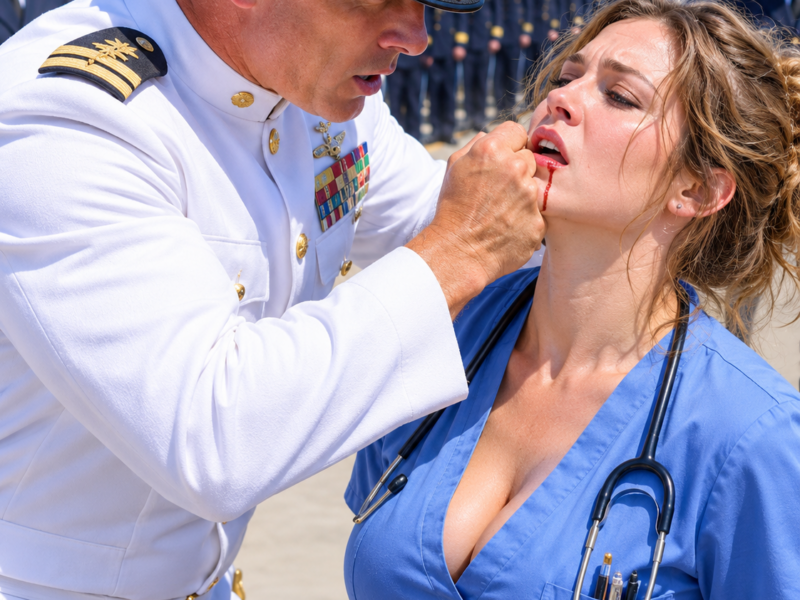
“Admiral Richard Cole stripped me of my nursing rank in front of an entire military hospital, then ordered security to escort me out
I looked at Commander Shaw and then at the message on my phone.
“Who is the next patient?”
She didn’t answer immediately.
Instead, she took the phone from my hand, read the message, and slipped it into an evidence sleeve from her folder.
“Someone who has been receiving the same medication for six weeks.”
“Who?”
“Chief Petty Officer Daniel Brooks. He’s scheduled for an evaluation tomorrow morning.”
I knew the name.
Daniel was a Navy SEAL who had been admitted twice in the previous month for unexplained episodes of dizziness, muscle weakness, and irregular heart rhythms.
His medical records described the incidents as stress-related.
I had questioned that diagnosis during my last rotation.
Now I understood why the file had bothered me.
“Where is he?”
“Currently at the naval training facility.”
“Then we need to get him here.”
Commander Shaw studied my face.
“You’ve just been demoted. Your access has been restricted. If I take you into this investigation, someone could accuse you of interfering with an official inquiry.”
I looked at her.
“Someone already accused me of that.”
For a moment, she said nothing.
Then she nodded.
“All right. But from this point forward, you don’t act alone.”
We went to her office, where two investigators were waiting.
One was a civilian forensic accountant named Peter Walsh.
The other was a Navy legal officer, Lieutenant Commander James Porter.
Shaw introduced me and placed the medication records on the table.
Peter examined the inventory codes.
“These aren’t standard pharmaceutical tracking numbers,” he said.
“What does that mean?” I asked.
“It means somebody created a parallel inventory system. The hospital’s official database shows one set of purchases, while these codes correspond to a different set of shipments.”
He turned his laptop toward me.
A series of transactions appeared on the screen.
Several military facilities had purchased the same product under different descriptions.
Nutritional supplements.
Recovery compounds.
Training support products.
But the supplier was always the same.
A company called Meridian Clinical Solutions.
“Who owns it?” I asked.
Peter clicked another document.
“The registered owner is a man named Victor Hale.”
Commander Shaw folded her arms.
“Former Navy procurement officer. Left the service seven years ago.”
I looked at the transaction history.
“Why would an ordinary supplier need so many different descriptions?”
Peter leaned back.
“Because the real product may not be what they’re reporting.”
He opened a laboratory report.
The medication contained an unapproved compound that could interfere with potassium regulation and cardiac function.
I thought about Tyler’s trembling hands.
“That’s why his bloodwork changed.”
“Possibly,” Peter replied. “But we need independent testing before we establish exactly what happened.”
Commander Shaw looked at me.
“Do you recognize any of the other patient names?”
I scanned the list.
Then I stopped.
One name belonged to a corpsman who had died during a training exercise four months earlier.
His death had been officially attributed to an undiagnosed cardiac condition.
I remembered reading the incident report.
He had been twenty-four.
“Did he receive this medication?”
Peter checked.
“According to the shipment records, yes.”
I felt sick.
“How many more?”
“We don’t know yet.”
Commander Shaw closed the laptop.
“That’s why we need to move carefully.”
I looked at her.
“Carefully doesn’t mean slowly, does it?”
“No,” she said. “It means we make sure nobody can bury this.”
The next morning, we arrived at the training facility with an emergency medical team and an official inspection order.
Daniel Brooks was waiting in the medical examination room.
He was broad-shouldered, in his late thirties, with tired eyes and a wedding ring that looked slightly too tight around his finger.
When he saw me, he frowned.
“Lieutenant Voss?”
“I was hoping you’d remember me.”
He gave a weak smile.
“Hard to forget the nurse who argued with three doctors about my bloodwork.”
I pulled up a chair.
“How have you been feeling?”
“Fine.”
I waited.
He sighed.
“All right. Not fine.”
He rubbed his left hand.
“Sometimes my fingers go numb. I get dizzy when I stand up. Last week, I nearly passed out during a routine workout.”
“Have you been taking the recovery supplements?”
His expression changed.
“Yes.”
“Did anyone explain what was in them?”
“They said it was part of the performance program.”
“Did you sign a consent form?”
He shook his head.
“No. We were told it was mandatory.”
Commander Shaw exchanged a look with the legal officer.
“Daniel, nobody can force you to take an unapproved medication without proper medical authorization,” she said.
He stared at her.
“Are you saying somebody has been experimenting on us?”
“We’re investigating that possibility.”
He leaned forward.
“Then tell me something. Why did my friend Kevin die?”
Nobody answered.
Daniel’s eyes moved between us.
“Kevin was healthy. He passed every examination. Then one morning, he collapsed during training.”
I looked at the medical report in my hand.
“Did Kevin receive the same supplement?”
Daniel nodded.
“He was one of the first.”
His voice cracked slightly.
“His wife still thinks he had a hidden heart condition.”
I lowered the report.
“We’re going to find out what happened.”
Daniel stared at me for a long moment.
“Is that a promise?”
I hesitated.
I had learned in nursing school never to promise something outside my control.
But I could promise him something else.
“I promise we won’t pretend nothing happened.”
He nodded.
That was enough.
An independent medical team collected samples and transferred Daniel to the hospital for observation.
By afternoon, the preliminary results confirmed that the substance in his system matched the compound found in Tyler Bennett’s records.
The investigation had become more than a procurement scandal.
People had been exposed to an unapproved substance without informed consent.
And some of them were still getting sick.
Then the first major complication arrived.
Admiral Cole requested an emergency meeting with Commander Shaw.
He wanted to know why an Inspector General team had entered a military training facility without notifying his office.
Shaw showed him the inspection authorization.
Cole barely glanced at it.
“You’re exceeding your authority.”
“We’re investigating potential medical misconduct and falsified procurement records.”
“Those are serious accusations.”
“Which is why we’re collecting evidence.”
Cole looked toward me.
“Why is Lieutenant Voss involved?”
I answered before Shaw could.
“Because I identified the first altered patient record.”
His eyes narrowed.
“You are not currently assigned to clinical duties.”
“No, sir.”
“Then I suggest you remember your position.”
Commander Shaw placed a document on the table.
“Admiral, your authorization appears on several purchase orders connected to Meridian Clinical Solutions.”
Cole didn’t touch the document.
“I approve hundreds of procurement requests. That doesn’t make me responsible for every supplier.”
“Do you recognize Victor Hale?”
For the first time, Cole’s expression shifted.
Only slightly.
But I saw it.
“Yes.”
“How?”
“He was a procurement officer under my command.”
“Did you know he owned Meridian Clinical Solutions?”
Cole looked at her.
“No.”
Peter Walsh opened his laptop.
“Then perhaps you can explain why the company received payments from an account associated with a military medical development fund.”
Cole stood.
“This meeting is over.”
Commander Shaw remained seated.
“Admiral, we have not finished.”
“You don’t give me orders, Commander.”
He walked toward the door.
Before leaving, he turned to me.
“Lieutenant Voss, I hope you understand the consequences of making accusations you cannot substantiate.”
I met his eyes.
“I hope you understand the consequences of ignoring patients who are getting sick.”
He left without another word.
That evening, I received a call from Linda.
My former supervisor.
I almost didn’t answer.
“Hello?”
“Mara, I need to talk to you.”
Her voice sounded strained.
“About what?”
“The medication records.”
I sat down.
“What about them?”
“I should have listened to you.”
I closed my eyes.
“Linda, what happened?”
She took a breath.
“Someone asked me to change Tyler’s chart before the review. They said it was a routine correction.”
“Who?”
“I don’t know. The request came through an administrative office.”
“Did you change it?”
“No.”
There was a long pause.
“But I didn’t report it either.”
I looked down at my hands.
“Why?”
“Because I was scared. I have a husband and two children. I thought if I stayed out of it, nobody would come after me.”
I didn’t know what to say.
Then she whispered, “Mara, I found something.”
“What?”
“A paper medication authorization. It was placed in Tyler’s file after you were removed from the unit.”
“Who signed it?”
Linda hesitated.
“Your name.”
I stood up.
“What?”
“It looks like your signature.”
“That’s impossible.”
“I know. I compared it with your original forms. Whoever did this copied your handwriting.”
I felt cold.
“They’re trying to make it look like I authorized the medication.”
“Yes.”
“Where is the document?”
“I made a scan. I’m sending it to Commander Shaw.”
“Don’t touch the original.”
“I won’t.”
Before we hung up, Linda said something else.
“Mara, I’m sorry I let them walk you out of that room.”
I looked toward the hospital window.
“So am I.”
The following day, investigators found the forged authorization in Tyler’s file.
It had been uploaded from an administrative terminal at 11:43 p.m., less than an hour after my demotion.
The account belonged to a department director named Alan Mercer.
He had worked directly under Admiral Cole for nearly a decade.
When investigators requested an interview, Mercer was already gone.
His office had been cleared.
His government-issued laptop was missing.
And his building access card had been used at 3:12 a.m. to enter the medical records archive.
Peter Walsh found another troubling detail.
Meridian Clinical Solutions had made payments to a consulting company owned by Mercer’s brother.
The payments were listed as operational advisory fees.
They totaled nearly two million dollars over three years.
“That’s our financial connection,” Peter said.
“Can we prove the money went to Mercer?”
“Not yet. The account records are incomplete.”
Commander Shaw studied the transactions.
“Keep following the money.”
Then her phone rang.
She listened for a few seconds before her expression changed.
“What do you mean he’s missing?”
She ended the call.
“Tyler Bennett has disappeared from the hospital.”
I stood immediately.
“He was in intensive care.”
“His room is empty. The overnight nurse says he was transferred after an order came through.”
“Who authorized it?”
“An electronic transfer request carrying the medical director’s approval.”
I stared at her.
“Was it real?”
“We’re checking.”
I grabbed my coat.
“Where would they take him?”
Commander Shaw looked at the screen.
“The order lists a private rehabilitation facility outside the base.”
“That’s not a suitable place for a patient who just had a cardiac event.”
“We’ll get an inspection team there.”
I shook my head.
“By the time we get there, he could be gone.”
Shaw picked up her phone.
“Then we’re going now.”
The facility was a low building behind a gated parking lot.
There were no visible signs identifying it as a medical center.
A receptionist tried to stop us at the entrance.
Commander Shaw presented the inspection order.
“We’re looking for Tyler Bennett.”
The receptionist looked at her computer.
“He was discharged.”
“When?”
“An hour ago.”
“Who signed the discharge?”
She hesitated.
“I don’t have that information.”
I moved toward the hallway.
A door stood slightly open at the end.
Inside, I saw a wheelchair.
A hospital blanket.
And an empty IV stand.
I heard a faint noise from the room beside it.
A cough.
I opened the door.
Tyler was lying on a narrow bed, pale and sweating.
His IV line had been removed.
He looked at me.
“Lieutenant?”
I rushed to his side.
“Tyler, what happened?”
“They said I was being transferred.”
“Who?”
He shook his head.
“Two men. They told me I had to sign something.”
“Did you?”
“No.”
He swallowed.
“They said if I didn’t, they’d report me for refusing medical treatment.”
I checked his pulse.
It was rapid.
“Commander Shaw!”
The medical team came running.
Tyler was transported back to the hospital under protective custody.
As we left the facility, one of the security cameras caught a man entering a vehicle parked behind the building.
I recognized him from the administrative conference room.
Alan Mercer.
He looked directly at me before closing the car door.
Then he smiled.
It wasn’t a friendly smile.
It was the expression of someone who believed he had already won.
That night, Commander Shaw called me into her office.
She had received an urgent update from the investigators.
Meridian’s warehouse was being searched.
Several boxes of unregistered medication had been recovered.
But the most important discovery was a collection of handwritten shipment instructions.
They connected Victor Hale, Alan Mercer, and several procurement officers.
Admiral Cole’s name appeared on the authorization chain.
However, there was still no proof that he had knowingly participated in the fraud.
I looked at the documents.
“Could he have approved the purchases without knowing what was inside?”
Peter nodded.
“That’s possible.”
“Then we need to establish who concealed the actual product.”
Shaw agreed.
“We have a warrant for Hale’s financial records. His interview is tomorrow.”
I looked at her.
“And Mercer?”
“He’s been located. He’s being questioned.”
“What about Cole?”
Shaw paused.
“He has requested legal representation.”
I leaned back.
For the first time since my demotion, I felt that the investigation might actually reach the people responsible.
But the next morning, everything changed again.
Victor Hale arrived for questioning with an attorney and a carefully prepared statement.
He claimed Meridian had only supplied legal nutritional products.
He blamed the medical facilities for administering them incorrectly.
Then he produced a document that nearly stopped the investigation.
It was a purchase authorization signed by Admiral Cole.
The document stated that the product was intended for an experimental military recovery program.
Hale’s attorney argued that the admiral had approved the program knowingly.
Cole’s office immediately denied the accusation.
The two men were now pointing at each other.
Commander Shaw placed the document in front of me.
“Something about this bothers me.”
I examined it.
The signature looked genuine.
The date was correct.
But the product description was vague.
I read it again.
“Where is the supporting medical protocol?”
“There isn’t one in the file.”
“Then how was this program approved?”
“That’s what we’re trying to establish.”
I looked at the bottom of the page.
There was a small reference number.
I recognized the format.
It was identical to the numbers used in Tyler’s altered bloodwork.
“Peter, can you trace this reference number?”
He typed it into the system.
A moment later, his expression changed.
“That’s not a purchase reference.”
“What is it?”
“It’s a clinical review identifier.”
Commander Shaw leaned closer.
“Meaning?”
Peter opened another document.
“Someone attached a legitimate clinical review number to an unrelated procurement request.”
I looked at the signature again.
“Then Cole may have approved the purchase believing it was part of an existing medical program.”
Shaw nodded slowly.
“That doesn’t excuse the failure to verify it.”
“No,” I said. “But it changes who may have been responsible for the deception.”
The next piece came from Linda.
She had found the original printed medication order in a locked filing cabinet.
Unlike the electronic copy, it contained a handwritten note from Alan Mercer.
The note read:
“Use existing review number. Do not create new authorization.”
Beneath it was a second instruction.
“All patient documentation to be consolidated before monthly inspection.”
Linda had photographed both pages and sent them to the investigators.
The handwriting matched the notes recovered from Mercer’s office.
Peter compared the dates.
The instruction had been written three days before the first shipment.
We finally had evidence that the procurement records had been deliberately manipulated.
But we still needed to know whether Cole had been involved or merely careless.
Commander Shaw arranged a formal interview with him.
I wasn’t required to attend.
But she asked me to sit in because I had discovered the original discrepancies.
Cole entered wearing his uniform.
He looked older than he had during my demotion.
He sat across from us and placed his hands on the table.
“I’ve been advised not to answer questions concerning an ongoing investigation.”
Shaw nodded.
“Then perhaps you’ll answer one question about your own decision.”
She placed Tyler’s medical record in front of him.
“Did you know this patient received an unapproved substance?”
“No.”
“Did you know his original bloodwork was altered?”
“No.”
“Did you know Lieutenant Voss’s signature was forged?”
Cole looked toward me.
“What?”
I slid the document across the table.
“This authorization was created after you demoted me.”
He studied the signature.
His jaw tightened.
“Who signed this?”
“Your office is connected to the terminal used to upload it.”
He looked at Shaw.
“Are you suggesting I ordered this?”
“I’m asking whether you knew about it.”
Cole stared at the paper for several seconds.
Then he shook his head.
“Alan Mercer handled the administrative side of the recovery program. He told me the medication was approved through the medical research office.”
“Did you verify that?”
“No.”
“Why not?”
Cole looked down.
“Because I trusted him.”
The room became quiet.
I remembered the way he had spoken to me.
The way he had dismissed my concerns without even examining the evidence.
“You demoted me for reporting something you hadn’t bothered to investigate,” I said.
He looked at me.
“I believed you had violated procedure.”
“I followed the medical reporting process.”
“I know that now.”
His voice was quieter.
“That doesn’t undo what I did.”
It was the first time he had acknowledged his mistake.
But it wasn’t enough.
Commander Shaw asked him to explain the purchase authorizations.
He described a recovery initiative presented by Mercer as a low-risk program intended to improve performance after demanding training cycles.
Cole had approved the funding because he believed it had received medical clearance.
He had never seen the actual formulation.
He had never met Victor Hale.
And he had never authorized anyone to falsify patient records.
The investigators later confirmed much of his account.
Cole had been negligent in his oversight.
But there was no evidence that he had knowingly joined the fraud.
Mercer, however, had done far more than falsify paperwork.
The financial records showed that he had helped create the false medical review references, arranged the shipments, and directed staff to conceal adverse reactions.
Victor Hale had supplied the substance while disguising its composition.
Both men had profited from the arrangement.
The final breakthrough came from a source nobody expected.
Daniel Brooks.
While recovering at the hospital, he remembered that Mercer had visited his training facility several times.
On one occasion, Mercer had asked him to sign a document confirming that the recovery supplement was voluntary.
Daniel refused.
He had asked for a copy.
Mercer told him the document was confidential.
But Daniel had taken a photograph of it before handing it back.
The photograph showed a statement claiming that every service member had received a full medical explanation and had voluntarily agreed to participate.
The date was important.
It was two weeks before the first shipment.
And the document already contained the names of service members who had not yet been informed about the program.
Daniel’s photograph proved that the consent records had been prepared in advance.
It was the evidence that connected the procurement fraud to the deliberate concealment of patient exposure.
When Commander Shaw told me, I sat quietly for several minutes.
“People signed forms they never saw,” I said.
“Yes.”
“And the patients were told they had no choice.”
“Yes.”
I looked through the window at the hospital courtyard.
“Then this was never really a recovery program.”
“No,” Shaw replied. “It was a business built around people who trusted their command.”
The investigation lasted another four months.
Victor Hale was charged with fraud involving military procurement and the distribution of an unapproved substance.
Alan Mercer faced charges related to falsified medical records, financial misconduct, and obstruction.
Several other officials were removed from their positions while their involvement was reviewed.
The Navy also ordered an independent medical evaluation for every service member who had received the product.
The results revealed that dozens had experienced symptoms consistent with exposure.
Some recovered quickly.
Others needed extended cardiac monitoring and treatment.
Tyler eventually returned home to his family.
Daniel Brooks required several months of rehabilitation, but his heart function improved.
Kevin’s death was formally reviewed.
His family received an official acknowledgment that the earlier investigation had failed to examine the possibility of medication-related harm.
It could never bring him back.
But at least his wife no longer had to wonder whether she had imagined the unanswered questions surrounding his death.
As for Admiral Cole, he was relieved of his command pending a separate review of his oversight failures.
He wasn’t charged with participating in the fraud.
However, his decision to dismiss my concerns and demote me without a proper investigation became part of the official findings.
One morning, I received a message from Commander Shaw.
The review board wants to meet with you. Your clinical assignment is being reconsidered.
I read it twice.
Then I looked at the empty space where my badge had once hung.
I wasn’t sure I wanted to return.
Not because I had stopped loving nursing.
But because I had seen how easily a patient’s suffering could disappear behind an official document.
Still, I knew where I belonged.
Two weeks later, I walked into the hospital administration building.
The review board consisted of five senior officers and two civilian medical specialists.
They asked about the original bloodwork.
The altered medication records.
The conversation with Tyler.
And the meeting where Admiral Cole had demoted me.
I answered every question.
When they asked whether I regretted reporting the discrepancies, I shook my head.
“No.”
“Even knowing the consequences?”
I looked directly at the board.
“Especially knowing them.”
One of the officers glanced at the findings.
“Your actions were consistent with your professional obligations. Your reassignment is being reversed, and your clinical credentials will be restored.”
I nodded.
“Thank you.”
The chairman paused.
“Lieutenant Voss, there’s one more matter.”
I waited.
“Admiral Cole has requested an opportunity to speak with you.”
I didn’t immediately agree.
But eventually, I said yes.
He was waiting in a small conference room.
Without the other officers around him, he looked less imposing.
He stood when I entered.
“Lieutenant.”
“Admiral.”
He gestured toward the chair.
I remained standing.
“I owe you an apology.”
I didn’t answer.
He continued.
“I made a decision based on rank and appearances rather than evidence. I assumed your position made your concerns less credible.”
“You didn’t just dismiss my concerns, sir. You made sure everyone else knew they should dismiss them too.”
He lowered his eyes.
“You’re right.”
For a moment, neither of us spoke.
Then he said, “I cannot undo the damage to your reputation.”
“No.”
“But I can make sure the official record reflects what happened.”
I looked at him.
“That’s a start.”
He nodded.
“I also want to thank you.”
I frowned.
“For what?”
“For continuing to protect the patients after I ordered you to stop.”
I thought about Tyler’s frightened expression.
Daniel’s trembling hands.
The photograph of Kevin’s consent form.
“I didn’t do it for you, Admiral.”
“I understand.”
I turned toward the door.
Before leaving, I stopped.
“Sir, there’s something I want you to remember.”
He looked up.
“A patient’s medical record isn’t an inconvenience. It’s their life. When someone tells you something is wrong, you don’t silence them because their rank is lower than yours.”
Cole stood quietly.
“I won’t forget that.”
I returned to the intensive care unit the following Monday.
Linda was waiting near the nurses’ station.
She had a new coffee mug in her hand and an expression that suggested she had been rehearsing what to say.
“Welcome back.”
I smiled.
“Good to be here.”
She handed me the mug.
It had three words printed across the front.
Ask One More Question.
I laughed.
“Subtle.”
“I thought about getting you a medal, but apparently those require paperwork.”
We both laughed.
Then she became serious.
“Mara, I’m sorry.”
I looked at her.
“You already apologized.”
“I know. But I want you to know I won’t make the same mistake again.”
I nodded.
“That’s all I can ask.”
Later that afternoon, Tyler visited the unit for a follow-up appointment.
He looked healthier.
His color had returned, and the trembling in his hands was gone.
When he saw me, he smiled.
“Lieutenant Voss.”
“How are you feeling?”
“Better. Much better.”
He held up a small paper bag.
“My wife insisted I bring you something.”
Inside was a framed photograph of Tyler with his family.
His little daughter was sitting on his shoulders, laughing.
On the back, his wife had written:
“Thank you for noticing what everyone else missed.”
I swallowed hard.
“Tell her she’s welcome.”
Tyler hesitated.
“There’s something else.”
“What?”
“I heard what happened to your assignment. I heard you got your position back.”
I smiled.
“I did.”
“Good. People like you should be taking care of patients.”
After he left, I placed the photograph on my desk.
For the first time in months, the unit felt like a hospital again instead of a battlefield.
A few days later, Commander Shaw stopped by.
She had finished the main investigation and was preparing to move to another case.
“I wanted to say goodbye,” she said.
“Are you leaving?”
“Tomorrow morning.”
I stood and shook her hand.
“Thank you for believing me.”
She smiled.
“I didn’t believe you because you were a nurse, Mara. I believed you because the evidence supported what you said.”
I nodded.
“That’s exactly how it should work.”
She looked at the framed photograph on my desk.
“Keep asking questions.”
“I intend to.”
After she left, I returned to my patients.
There was a young sailor waiting for a dressing change.
An elderly chief recovering from surgery.
And a mother who had been sitting beside her son’s bed for nearly six hours without eating.
I brought her a sandwich and a cup of water.
She looked up at me.
“Thank you. I didn’t know who to ask.”
I pulled a chair beside her.
“You’re allowed to ask for help.”
She smiled weakly.
I checked the patient’s chart, reviewed his medication list, and made sure every order matched what had actually been administered.
It was an ordinary nursing task.
But I took my time.
That evening, I pinned Tyler’s photograph beside my name badge.
The badge had been returned to me, and beneath my name was the title I had worked so hard to earn.
Lieutenant Mara Voss, Registered Nurse.
I ran my thumb across the letters.
The admiral had tried to make an example of me.
Instead, his decision had exposed how dangerous it could be when people in authority stopped listening.
I didn’t return to the hospital as a hero.
I returned as a nurse.
And the next time a patient told me something didn’t feel right, I knew exactly what I would do.
I would pull up the chart, check the numbers, look the patient in the eyes, and ask one more question.
The End.









