The ranch hands laughed as Matthew Holloway threw my ruined flour sack at my feet in front of thirty-six starving men, but none of them knew who had sabotaged his kitchen.
The first sentence of my mother’s letter was written in a hand I recognized immediately, though I had not seen it in ten years.
“Rachel, if this letter has reached you, then the past has finally caught up with the people I tried to protect.”
For a moment, the kitchen disappeared around me, and I was a little girl again, standing beside my mother’s bed while winter wind rattled the windows of our Pennsylvania home.
I remembered her thin fingers gripping mine, her face pale from sickness, and the strange urgency in her voice when she told me never to travel west if anyone bearing the Holloway name came looking for me.
Back then, I had thought the fever was making her frightened and confused.
Now, with Matthew standing across the kitchen table and the brass key hidden in my apron, I wondered whether my mother had spent her final days afraid of something far worse than death.
I unfolded the letter carefully, terrified that even the smallest tear might destroy the only explanation I had left.
“My dearest Rachel, there is a truth about your father that I should have told you long ago, but I feared the cost of telling it.”
I stopped reading.
My father had died when I was too young to remember his face, and my mother had always told me he was a traveling carpenter who had never returned from a job in the mountains.
I had spent years imagining him as a quiet, hardworking man who had simply been unlucky.
“What does it say?” Matthew asked, his voice barely audible.
I looked at him through eyes already burning with tears.
“It says my mother lied to me.”
He lowered his gaze, and the silence that followed told me he already knew more than he wanted to admit.
I forced myself to continue.
“Your father was not a carpenter, Rachel, and he did not abandon us; he was a partner in a ranching business with a man named Samuel Holloway.”
The name struck the room like a gunshot.
Matthew gripped the edge of the table, his knuckles turning white.
Samuel Holloway had been Matthew’s father, the man who built the ranch from a few cattle and a patch of stubborn Colorado land into one of the largest operations in the county.
I had heard the ranch hands speak of him with reverence, describing a man who could repair a broken fence in a blizzard and lend money to a neighbor without demanding repayment.
But my mother’s letter painted a different picture.
She wrote that my father, Daniel Foster, had discovered Samuel was secretly borrowing money against land that belonged to both families, then falsifying their accounts to conceal the debt.
Daniel intended to expose him before the bank foreclosed on their property, but before he could present the evidence, he disappeared during a winter journey through the mountains.
Samuel claimed that Daniel had stolen the partnership funds and fled east.
The accusation destroyed my father’s name, and the family that remained behind was left with nothing but shame.
My mother had sold her belongings to keep us fed, moved from town to town, and eventually changed our circumstances enough to make the past seem distant.
She never told me the truth because she feared Samuel would come after the evidence Daniel had hidden.
I lowered the letter, unable to breathe properly.
All my life, I had believed my father had chosen to leave me.
Now I was learning that someone might have stolen even the memory of him.
“Why didn’t you tell me?” I asked Matthew.
He did not answer immediately.
“My father told me Daniel Foster had betrayed him,” he finally said. “I grew up believing it.”
“Did you believe it when you hired me?”
His eyes lifted to mine.
“No.”
The answer came too quickly to be a lie, but it did not make the pain any easier.
Matthew admitted that he had recognized my surname the first day I arrived at the ranch.
He had found an old account book among his father’s belongings, and the name Daniel Foster appeared beside a partnership agreement that had vanished from the ranch records years earlier.
He had hired me because he wanted to understand why my mother had disappeared from the county and why her name had been written beside a debt his father never explained.
I stepped away from the table, feeling as though every kind thing Matthew had done might have concealed another motive.
“You let me believe you needed a cook,” I whispered.
“I did need a cook,” he replied. “But I also needed someone who might know the truth.”
“And you thought you could use me to find it?”
His expression crumpled.
“I thought I could find the truth before whoever ruined that flour destroyed everything else.”
I wanted to hate him, because anger was easier than admitting that I had begun to trust him.
Instead, I folded my mother’s letter and placed it in my pocket.
“From now on, you tell me everything,” I said. “No more deciding what I can bear.”
Matthew nodded, and for the first time since I had met him, he looked less like a ranch owner and more like a frightened son.
We spent the morning searching the office for the missing partnership agreement.
The ranch smelled of wet leather, cold ashes, and the coffee I had forgotten on the stove, while snow pressed against the windows and muffled the world outside.
Matthew opened drawers filled with receipts, cattle inventories, and letters tied with faded ribbon.
I examined the account book he had mentioned, noticing that several pages had been cut out with a sharp blade.
The missing pages were not torn accidentally; their edges were straight, deliberate, and old.
Near the back cover, I discovered a faint impression left by writing on a sheet that had once rested above it.
I rubbed a piece of charcoal over the paper, carefully revealing the pressure marks beneath the faded ink.
Three words emerged slowly.
“North cellar wall.”
Matthew stared at the page, then looked toward the old storage building behind the ranch house.
“My father used that cellar for his business records,” he said. “After he died, I sealed it because the foundation was beginning to collapse.”
We crossed the yard with a lantern and a shovel, our boots sinking into fresh snow.
The storage building stood apart from the main ranch, its weather-beaten boards creaking in the wind.
Inside, the air smelled of earth and decaying wood, and a narrow staircase descended into darkness.
Matthew went first, testing each step before allowing me to follow.
At the bottom, we found broken barrels, rusted tools, and shelves lined with empty bottles.
The north wall was covered in old timber, some boards newer than the others.
Matthew pried them loose with a crowbar while I held the lantern steady.
Behind the third board lay a small iron box wrapped in oilcloth.
My hands shook as I lifted it from its hiding place.
The brass key fitted the lock perfectly.
Inside were letters, bank receipts, a partnership agreement, and a leather-bound notebook bearing my father’s name.
For several seconds, neither of us spoke.
I touched the notebook as if I were touching the hand of a man I had never known.
The first pages contained ordinary ranch accounts, notes about cattle prices, and sketches of fences that needed repairing.
Then the writing changed.
My father’s final entries described unexplained withdrawals, forged signatures, and repeated arguments with Samuel Holloway.
The last entry was dated three days before my father disappeared.
“Samuel says he will make this right, but I no longer trust the man who has become my brother.”
I read the sentence twice, feeling grief rise inside me with a force that made my knees weak.
Matthew stood beside me, staring at the pages as though they had turned his entire childhood into a lie.
Near the bottom of the box, we found a folded statement signed by a bank clerk who had since died.
It confirmed that Samuel had borrowed against the partnership land without Daniel’s consent and had later used Daniel’s signature to cover the debt.
The evidence was devastating, but it did not explain what had happened to my father.
Then I found a letter addressed to my mother, never sent.
“Elizabeth, if I cannot return, Samuel knows where I am going, and I fear he has already arranged for me to be stopped.”
A chill crawled across my skin.
Matthew took the letter gently and read it again.
“My father might have caused his disappearance,” he said, his voice hollow.
I looked at the man standing beside me, a man who had inherited a ranch built partly on a lie.
“Then we find out what happened,” I said.
Before he could answer, the cellar door slammed overhead.
We both turned toward the staircase.
Footsteps crossed the floor above us, slow and deliberate, followed by the scrape of something heavy being dragged across the entrance.
Matthew rushed toward the stairs, but a cloud of dust fell from the ceiling as the building shuddered.
Someone had wedged the door shut.
Then came the unmistakable smell of smoke.
I looked up at Matthew, my heart pounding so violently that I could barely hear my own voice.
“We’re trapped.”
He grabbed a shovel and began striking the door from below, but the wood barely moved.
Smoke curled down the stairwell, turning the lantern light into a dirty orange haze.
I clutched the iron box against my chest, suddenly understanding that the person who had ruined the flour had not intended merely to frighten Matthew.
They wanted the evidence destroyed, and they were willing to bury us with it.
Matthew struck the door again, then stopped when a beam cracked overhead.
He turned toward the far wall, searching frantically for another way out.
“My father said the cellar connected to an old drainage tunnel,” he shouted. “It was sealed years ago, but there may still be an opening.”
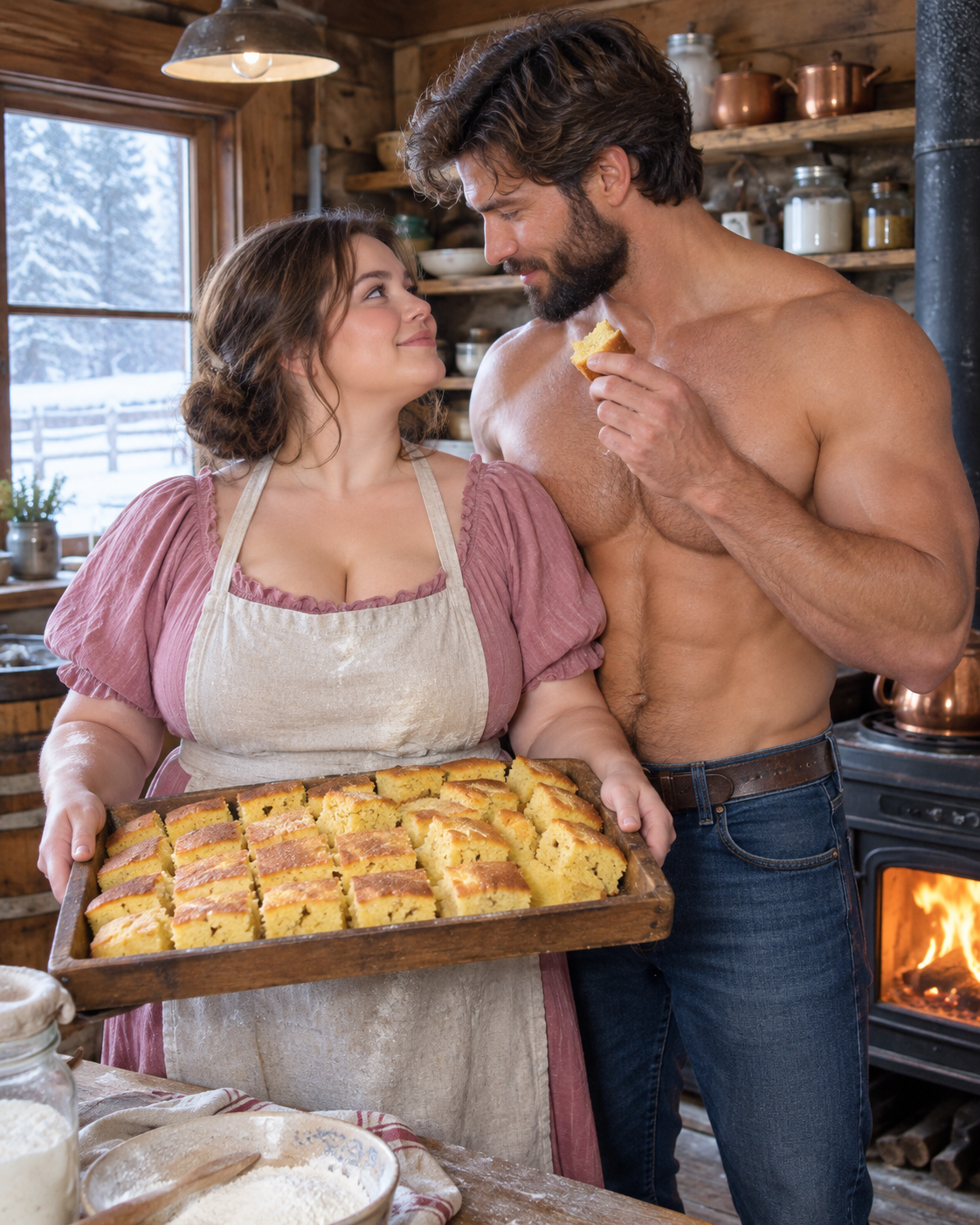
We crawled through the narrow space behind the shelves, coughing as smoke filled the cellar.
At the far end, Matthew found a low stone arch partly blocked by collapsed timber.
He wedged the shovel beneath the largest piece and pushed until the wood shifted.
I squeezed through first, scraping my shoulder against the stone while the iron box dragged painfully against my ribs.
Matthew followed just as the cellar ceiling groaned behind us.
We emerged into a shallow ditch beyond the storage building, where freezing air struck my lungs like a blade.
Behind us, flames climbed through the broken roof.
Matthew caught my arm before I could stumble into the snow.
Across the yard, a rider was mounting a dark horse.
Even through the smoke, I recognized the broad shoulders and distinctive gray hat of Mr. Harlan Pike, the ranch’s trusted supply manager.
He had brought the replacement flour, controlled the delivery records, and always seemed to know when Matthew was away from the kitchen.
Pike saw us and kicked his horse into a gallop.
Matthew reached for his rifle, but I caught his sleeve.
“If you shoot at him, he can claim you tried to kill him.”
He stared after the rider, rage and disbelief warring in his face.
Then he lowered the rifle.
“We have the evidence,” I said. “Now we need witnesses.”
By sunrise, the fire had burned itself down to a blackened skeleton of timber, but the iron box survived.
Matthew sent two ranch hands to fetch Sheriff Elias Turner while I returned to the kitchen and prepared coffee for the men who had spent the night fighting the flames.
My hands still trembled whenever I remembered the smoke, yet I refused to let fear decide what happened next.
The ranch hands gathered around the kitchen table, listening as Matthew explained the missing money, the ruined flour, and the documents recovered from the cellar.
Some looked angry, others confused, and a few struggled to accept that a man they had trusted might have betrayed them.
Old Ben Carter, the ranch’s oldest hand, finally spoke.
“I saw Pike near the flour wagon before dawn the day Rachel came to work,” he said. “He told me the shipment had been delayed, but the wagon was already inside the yard.”
His testimony changed everything.
A stable boy then admitted that Pike had paid him to move several sacks into the storage building, claiming they were damaged and needed to be thrown away.
The boy had kept the coins because he was saving to buy his younger sister a pair of winter boots.
He began to cry when he realized that the money he had accepted might have helped someone poison the ranch’s food supply.
Matthew knelt beside him instead of shouting.
“You were frightened, son,” he said. “Tell the sheriff the truth, and don’t hide anything else.”
When Sheriff Turner arrived, he examined the documents and listened to each witness separately.
He did not promise an immediate arrest, but his expression darkened when he found Pike’s signature on the flour delivery records.
By afternoon, a rider returned from town with news that Pike had tried to sell a horse and leave the county.
The sheriff organized a search party, and Matthew insisted on going with them.
I wanted to stop him, terrified that the man who had already tried to burn us alive might be waiting with a gun.
Instead, I pressed my father’s notebook into Matthew’s hands.
“Bring yourself back,” I told him. “The truth won’t mean much if we lose another person to it.”
He held my gaze for a long moment, then touched my hand before riding away.
The hours that followed stretched unbearably.
I cleaned the kitchen because it was the only thing I could control, kneading bread dough and scrubbing pots while every sound outside made me turn toward the door.
When the sun began to sink behind the mountains, hoofbeats finally thundered across the yard.
Matthew returned beside Sheriff Turner, with two deputies escorting Harlan Pike in handcuffs.
Pike’s hat was gone, his coat torn, and the smug confidence I had once seen in his eyes had been replaced by something colder.
He did not look at Matthew.
He looked directly at me.
“You should have stayed in that boardinghouse,” he said.
Sheriff Turner ordered him to be quiet, but Pike smiled as though he still possessed some secret advantage.
The evidence against him was substantial, yet the sheriff needed a confession to establish exactly how the flour had been tampered with and whether Pike had acted alone.
At the station, Pike denied everything until the sheriff placed the forged delivery records beside my father’s notebook.
His expression changed when Matthew produced the old partnership agreement.
Pike finally admitted that he had altered the flour records and mixed spoiled grain into the shipment to make the ranch appear careless and financially unstable.
He had been paid by a powerful cattle buyer who wanted Holloway’s land before the bank could extend Matthew’s loan.
The buyer had promised Pike a position managing the property once Matthew lost control.
But when the sheriff asked who had ordered the attempt to burn the cellar, Pike’s face hardened.
“I was told to recover the documents,” he said. “I wasn’t told anyone would be inside.”
His words brought no relief.
The man who had tried to destroy our lives was still willing to protect the person who had paid him.
Then Sheriff Turner laid one final paper on the table.
It was a bank transfer bearing the cattle buyer’s name.
The name belonged to Silas Reed, a wealthy rancher whose influence stretched across three counties and whose friendship with Samuel Holloway had lasted for decades.
Matthew stared at the paper in disbelief.
“Reed was my father’s closest friend.”
Pike leaned back in his chair, his smile returning.
“Your father owed him more than money.”
Before the sheriff could demand an explanation, Pike fell silent and refused to answer another question.
The investigation continued for weeks, and the ranch lived beneath a tension that made even ordinary conversations feel dangerous.
Matthew worked beside his men from dawn until dark, repairing fences, arranging new flour shipments, and negotiating with the bank to prevent foreclosure.
I kept the kitchen running, determined that no man would have to choose between an honest day’s work and an empty stomach.
The ranch hands began bringing me small gifts: a jar of honey, a knitted scarf, a tin of buttons for my mending basket.
They were humble things, but each one reminded me that a home was not built from money alone.
One evening, Matthew found me sitting beside the stove with my father’s notebook open across my knees.
“I keep wondering what he was like,” I confessed. “Whether he laughed loudly, whether he sang while he worked, whether he ever thought about me before he disappeared.”
Matthew sat opposite me, leaving enough space for me to breathe.
“I can’t give you the years you lost,” he said. “But I can promise you that no one will call him a thief while I still have a voice.”
For the first time since reading my mother’s letter, I allowed myself to cry without trying to hide it.
Matthew did not tell me to be strong or promise that everything would become easy.
He simply stayed until the tears passed.
That small kindness changed something between us, though neither of us dared to name it.
By early spring, Sheriff Turner had gathered enough evidence to bring charges against Pike, and the bank agreed to delay its claim against the ranch while the fraud investigation continued.
Silas Reed was questioned, but his lawyers denied any involvement, and the transfer could not yet prove that he had ordered the crimes.
The sheriff warned us that the case would take time, and that powerful men rarely surrendered quietly when their reputations and fortunes were threatened.
Matthew accepted the uncertainty with a steadiness I had not seen in him before.
He had once believed that protecting his father’s name meant defending every choice Samuel had made.
Now he understood that honoring a parent sometimes required admitting that the parent had been wrong.
One afternoon, as I reorganized the pantry, Matthew entered carrying a small wooden box.
Inside lay a silver pocket watch engraved with the initials D.F.
“I found it among the documents,” he said. “I believe it belonged to your father.”
I lifted the watch carefully, tears gathering before I could stop them.
It had stopped at ten minutes past four, its glass cracked and its chain dark with age.
For years, I had wanted something that proved my father had existed beyond a story told by a grieving woman.
Now I held something he had touched, something that had traveled through the years to find me.
On the inside of the cover, a few tiny words had been engraved.
“To Rachel, when she is old enough to know the truth.”
I pressed the watch against my chest, mourning the childhood I had lost and the father I had never been allowed to know.
Matthew stood quietly beside me until I reached for his hand.
Outside, the first wildflowers of spring pushed through the melting snow, and the ranch hands laughed as they repaired the last fence damaged by winter.
For the first time in months, the future seemed like something we might build rather than something we had to survive.
But the peace did not last.
A week later, Sheriff Turner arrived at the ranch with a telegram from the county seat.
Silas Reed had disappeared before the authorities could question him again, leaving behind an empty house, unpaid workers, and a safe that had been opened from the inside.
The sheriff handed Matthew a second envelope, explaining that it had been delivered to the courthouse that morning with no return address.
Matthew opened it slowly, and his face lost every trace of color.
Inside was a single sheet bearing a familiar signature.
Daniel Foster.
Beneath the signature was a sentence written in fresh ink.
“Samuel did not make me disappear, and the man who helped me escape is still alive.”
I stared at the words, unable to understand how my father’s signature could appear on a letter written decades after his disappearance.
Matthew turned the page over, revealing a final line that made the room seem suddenly colder.
“Rachel must come alone if she wants to learn where her father has been hiding.”
I looked toward the window, where the evening shadows stretched across the yard and the kitchen fire glowed behind me.
My father might still be alive, but the letter could also be another trap designed to finish what Pike had begun.
Matthew reached for my hand, his expression torn between hope and fear.
Whatever waited beyond the mountains, I knew I could no longer live with the unanswered questions that had followed me since childhood.
Yet as I folded the letter, I noticed a small mark beneath my father’s signature, a symbol drawn beside the date.
It was the same mark I had seen on the brass key hidden in my apron.
And suddenly I understood that the truth about my father was only the beginning of a much larger secret.
THE END.