Esther Palmer had just fed nearly 140 wedding guests when she discovered there wasn’t a single chair reserved for her. Then she overheard a woman explaining why.
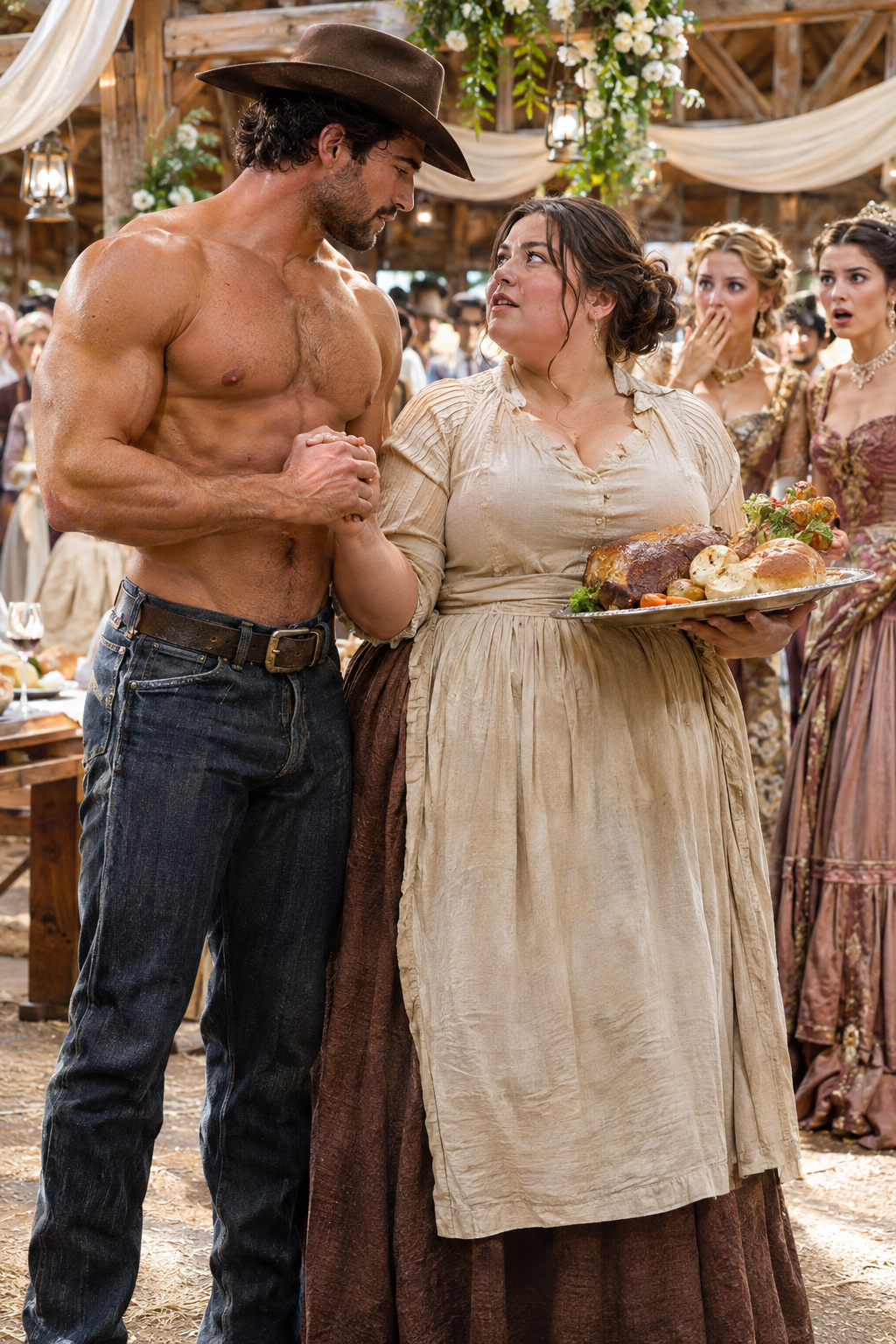
“Esther Palmer,” Benjamin said, holding out his hand, “would you do me the honor of sharing the first dance?”
Esther stared at his open palm. For a moment, she wondered whether she had misunderstood him. Behind Benjamin, Estelle Pierce stood perfectly still, her expression changing from surprise to disbelief.
“The first dance?” Esther repeated.
Benjamin smiled. “Unless you’ve already promised it to someone else.”
Estelle stepped forward before Esther could answer.
“Benjamin, surely you’re joking. Hazel has been waiting all evening.”
“Then I owe Hazel an apology for keeping her waiting,” he replied calmly. “But I haven’t promised her a dance.”
Esther looked down at her plain dress. There was flour on one sleeve, and her shoes were worn from months of standing beside hot ovens. She could still smell roasted meat and wood smoke in her hair.
“I don’t think I’m dressed for dancing,” she whispered.
Benjamin glanced at his own large boots.
“And I’ve been told I look like a barn door wearing a Sunday coat. I suppose we’ll manage.”
Despite herself, Esther laughed.
He kept his hand extended, giving her the freedom to decide. There was no impatience in his expression, no embarrassment, and certainly no sign that he was making fun of her.
Esther placed her apron on the wooden bench beside the door.
Then she took his hand.
Estelle hurried ahead of them, apparently hoping to reach Hazel before anyone noticed what was happening. But when Benjamin entered the room with Esther beside him, conversations began to fade.
The musicians lowered their instruments. Several guests turned in their chairs.
Hazel Pierce stood near the center of the room, wearing a pale blue dress that had been carefully chosen for the occasion. Her hopeful smile vanished when she saw whose hand Benjamin was holding.
Esther felt the familiar urge to disappear.
She had spent most of her life making herself useful enough that people might overlook the things they disliked about her. She cooked, cleaned, worked longer hours than anyone expected, and apologized whenever she occupied too much space.
Now there was nowhere to hide.
Benjamin leaned slightly toward her.
“Would you rather go back outside?”
Esther looked at the guests, then at the man beside her.
“No,” she answered quietly. “I think I’d like that dance.”
Benjamin nodded toward the musicians.
The fiddle began playing.
His hand settled gently against her back, and Esther placed hers on his shoulder. Their first few steps were awkward. Benjamin moved too quickly, and Esther nearly stepped on his boot.
“I’m afraid I’m not very good at this,” she admitted.
“Neither am I,” he said. “That’s why I needed someone patient.”
She laughed again, and something inside her began to loosen.
By the time they reached the center of the room, Esther had almost forgotten the people watching. Benjamin didn’t hold her at an uncomfortable distance. He didn’t seem worried about how they looked together.
He simply danced with her.
Near the wall, an elderly woman began clapping. Her husband joined her, followed by several ranch hands who had spent the afternoon carrying supplies into Esther’s kitchen.
Soon other couples stepped onto the floor.
Esther was smiling when the music ended.
Then Estelle Pierce ruined the moment.
“Well,” she announced loudly enough for the nearby guests to hear, “I suppose we should all admire Benjamin’s generosity. Not every man would sacrifice his first dance to make a lonely woman feel better.”
Esther’s smile disappeared.
Benjamin turned toward Estelle.
“Sacrifice?”
Estelle gave an uncomfortable laugh.
“Oh, you know what I mean. It was a charitable gesture.”
“No, Mrs. Pierce. It wasn’t.”
The guests closest to them fell silent.
Benjamin looked directly at her.
“I asked Esther to dance because I wanted to dance with Esther. I hope that’s clear enough.”
Estelle’s face reddened.
Hazel lowered her eyes, while Esther stood beside Benjamin, hardly able to believe what she had heard.
Nobody had ever defended her so openly.
Before Estelle could respond, Benjamin led Esther toward the supper tables.
“Now,” he said, “I believe someone here hasn’t had a proper meal.”
He pulled out a chair beside his own.
Esther hesitated.
“That seat was meant for someone else.”
“Tonight, it’s yours.”
One of the ranch hands brought her a plate. Another poured her a cup of coffee. The elderly woman who had started clapping introduced herself and asked how Esther had managed to make such wonderful biscuits.
For the first time that evening, Esther tasted the supper she had prepared.
But across the room, Estelle was watching.
And she wasn’t finished.
The following morning, Esther woke before sunrise, as she always did. The wedding guests were preparing to leave, although several had decided to remain another day because of the damaged mountain roads.
She entered the kitchen and found Benjamin sitting beside the stove with two cups of coffee.
“I thought you’d be sleeping,” she said.
“I could say the same about you.”
He pushed a cup toward her.
Esther sat down.
For a while, they talked about the wedding, the weather, and the supplies that would need replacing.
Then Benjamin reached into his coat and placed an envelope on the table.
“Your wages.”
Esther opened it and counted the money.
There were fifty dollars inside.
She immediately pushed fifteen dollars back toward him.
“We agreed on thirty-five.”
“We agreed on a wedding supper under ordinary circumstances. You fed nearly a hundred and forty people with half the supplies you were promised.”
“I still agreed to thirty-five.”
“And I’m paying you for the additional work.”
Esther studied his face, searching for any hint of pity.
There was none.
Slowly, she accepted the money.
“Thank you.”
Benjamin smiled.
“How much more do you need for that bakehouse?”
“Quite a bit. I’ve been saving for four years.”
She explained that she had found an empty building in town with a large brick oven. The owner was willing to rent it, but she needed enough money for the deposit, repairs, equipment, and ingredients.
Benjamin listened carefully.
“Would you consider staying here a little longer?” he asked. “The ranch could use a permanent cook.”
Esther looked toward the stove.
It was a tempting offer. The ranch was comfortable, the work was steady, and she enjoyed Benjamin’s company more than she wanted to admit.
But she had spent too many years putting her own dreams aside.
“I appreciate it,” she said. “But if I keep working in other people’s kitchens, I’ll never have one of my own.”
Benjamin nodded.
“Then I hope you get your bakehouse.”
His answer surprised her.
Most employers became offended when Esther spoke about leaving. They wanted her loyalty without considering what she wanted for herself.
Benjamin seemed genuinely pleased that she had a dream beyond his ranch.
Before she could tell him how much that meant, the kitchen door opened.
Estelle entered carrying a small leather purse.
“Benjamin, I need to speak with you privately.”
“Esther and I are having breakfast.”
“This concerns Esther.”
Something in her tone made Esther straighten.
Estelle placed the purse on the table.
“Hazel’s gold bracelet is missing.”
Benjamin frowned.
“Have you searched her room?”
“Of course. She removed it before supper yesterday. She remembers leaving it near the washbasin in the guest room.”
Esther felt a sudden chill.
Earlier that afternoon, she had entered Hazel’s room to deliver fresh towels at Estelle’s request.
Estelle turned toward her.
“You were in that room, weren’t you?”
“Yes. You asked me to bring towels.”
“And nobody else entered afterward.”
“You can’t possibly know that,” Benjamin said.
Estelle ignored him.
“I think we should examine Esther’s belongings before she leaves.”
Esther’s stomach tightened.
The humiliation of the previous evening had been painful, but this was different. A reputation for dishonesty could destroy everything she had worked toward.
Nobody would hire a cook accused of stealing.
Nobody would trust a woman with a business of her own.
“You may search my things,” Esther said, forcing herself to remain calm. “I have nothing to hide.”
Benjamin stood.
“No one is searching anything based on an accusation alone.”
“Are you suggesting my daughter is lying?”
“I’m suggesting a missing bracelet doesn’t make Esther a thief.”
Estelle folded her arms.
“Then perhaps you should ask why she was so eager to leave the celebration last night.”
Esther rose from her chair.
“I went outside because I overheard you laughing about my size and saying there was no place for me at the table.”
For once, Estelle had no immediate answer.
Benjamin looked at her with quiet anger.
“Is that true?”
“It was a private conversation.”
“That doesn’t make it any less cruel.”
Estelle grabbed her purse.
“I won’t be insulted in this kitchen.”
She stormed out.
Esther sat down again, her hands trembling.
Benjamin started to speak, but she interrupted him.
“I want that bracelet found.”
“Esther, I know you didn’t take it.”
“But everyone else might believe I did.”
She looked at the envelope containing her wages.
“I can’t afford to have people questioning my honesty.”
Benjamin understood.
He called his housekeeper, Mrs. Miller, and asked her to gather everyone who had entered the guest rooms the previous day.
The search began.
They checked drawers, bedding, laundry baskets, and the spaces beneath the furniture. Nothing appeared.
By midday, rumors had spread through the ranch.
Esther heard whispers whenever she passed the remaining guests. A woman who had praised her bread the previous evening suddenly refused to meet her eyes.
Then Hazel arrived in the kitchen.
Her face was pale.
“Miss Palmer, may I speak with you?”
Esther set aside the dough she was kneading.
“Of course.”
Hazel glanced toward the doorway.
“My mother told me you might have taken my bracelet.”
“I didn’t.”
“I know.”
Esther stopped moving.
Hazel reached into the pocket of her dress and pulled out a gold bracelet.
For several seconds, Esther could only stare at it.
“Where did you find that?”
Hazel’s eyes filled with tears.
“In my mother’s traveling case.”
The kitchen seemed suddenly very quiet.
Hazel explained that she had found it while helping her mother pack. When she asked how it had gotten there, Estelle told her to put it back and remain silent.
“She said Benjamin was making a terrible mistake,” Hazel whispered. “She thought if he stopped trusting you, he’d come to his senses.”
Esther gripped the edge of the table.
She had expected the bracelet to turn up somewhere innocent. She had never imagined that someone would deliberately threaten her livelihood because of a dance.
“Why are you telling me?”
Hazel wiped her cheeks.
“Because I let her say those things about you yesterday. I didn’t stop her. And this morning, I nearly let her do something worse.”
She placed the bracelet on the table.
“I’m sorry.”
Esther looked at the young woman for a long moment.
“Thank you for telling me the truth.”
Benjamin was summoned immediately.
When Hazel repeated her confession, his expression hardened.
He asked Mrs. Miller to bring Estelle into the dining room, where several remaining guests were gathered.
Estelle arrived looking irritated.
“What is it now?”
Benjamin placed the bracelet on the table.
“Hazel found this in your traveling case.”
Estelle froze.
Then she turned toward her daughter.
“You foolish girl.”
Hazel flinched.
Benjamin’s voice remained controlled.
“You accused an innocent woman of theft. You allowed people to question her character when you knew where the bracelet was.”
“I was trying to protect you!”
“From what?”
Estelle pointed toward Esther.
“From a woman who clearly wants more than her wages! Don’t you understand what people will say about you?”
Benjamin looked at Esther, then back at Estelle.
“I understand what they’ll say about you when they learn the truth.”
Estelle’s mouth opened, but no words came.
Benjamin continued.
“You owe Esther an apology. And everyone who heard your accusation deserves to know it was false.”
Estelle glanced around the room. The people who had once listened eagerly to her gossip now watched her with disappointment.
At last, she turned toward Esther.
“I apologize.”
Esther could hear the resentment in her voice.
She could have demanded a better apology. She could have reminded Estelle of every cruel remark and enjoyed watching her embarrassment.
Instead, she spoke quietly.
“I hope the next woman you dislike doesn’t have to prove her innocence just to earn your respect.”
Estelle looked away.
By the following morning, the Pierce family had left Broken Spur Ranch.
Hazel came to say goodbye before climbing into the carriage.
“I hope you open your bakehouse,” she told Esther.
“I intend to.”
Hazel smiled faintly.
“I think I’ll come buy something when you do.”
After the carriage disappeared down the mountain road, Benjamin found Esther standing near the fence.
“Are you all right?”
“I will be.”
She watched the distant mountains.
“Benjamin, I don’t want you fighting every battle for me.”
“I know.”
“I’ve spent my whole life being treated as though I should be grateful whenever someone is kind to me.”
He waited.
“I don’t want to feel that way with you.”
Benjamin rested his arms against the fence.
“Then don’t. I enjoy your company, Esther. I respect your work. And when someone treats you unfairly, I’ll speak up. I’d hope you’d do the same for me.”
Esther looked at him.
“I would.”
“Good. That sounds fair.”
Several weeks passed.
Esther returned to town with her savings and rented the little building she had been dreaming about. Unfortunately, the brick oven needed more repairs than she had expected, and part of the roof leaked whenever it rained.
She spent nearly everything she had making the building usable.
One afternoon, she sat alone among empty shelves, calculating how much flour she could afford.
The numbers didn’t work.
She had enough money to open, but barely enough to survive if customers were slow to arrive.
For the first time in years, Esther wondered whether her dream had been a mistake.
Then someone knocked.
Benjamin stood outside, holding a folded sheet of paper.
“I have a business proposal.”
Esther raised an eyebrow.
He handed her the paper.
It was an order for bread, biscuits, and pies to be delivered to Broken Spur Ranch every week.
“The men have been complaining about the bread since you left,” he explained. “I thought we might solve that problem.”
Esther examined the quantities and prices.
“You’re paying the same rates I charge everyone else.”
“Of course.”
“And you really need this much bread?”
“You haven’t seen twenty hungry ranch hands after moving cattle.”
She laughed.
The order wouldn’t make her wealthy, but it would provide enough steady income to purchase ingredients and keep the bakehouse running while she built her business.
Benjamin wasn’t offering charity.
He was offering her a customer.
Esther extended her hand.
“Mr. Archer, you have yourself a deal.”
He shook it solemnly.
“Miss Palmer, I look forward to doing business with you.”
On opening morning, Esther arrived before dawn and lit the oven. By seven, the smell of fresh cinnamon rolls drifted into the street.
Her first customer was Mrs. Miller.
The second was the elderly woman who had applauded during the wedding dance.
By noon, several former wedding guests had stopped by, and Esther had sold nearly everything.
Just before closing, Hazel Pierce entered.
She purchased two loaves of bread and a cherry pie.
“My mother won’t admit it,” Hazel said with a small smile, “but she hasn’t stopped talking about your biscuits.”
Esther laughed.
“Perhaps you should take her some.”
Hazel bought another dozen.
As the months passed, Palmer’s Bakehouse became one of the busiest little businesses in town. Esther hired a widow who needed work and later took on a young woman whose previous employer had dismissed her for being too slow.
Esther taught them patiently.
She remembered what it felt like to have someone notice only your shortcomings.
Benjamin visited whenever his ranch duties allowed. Sometimes he bought bread. Sometimes he helped carry heavy sacks of flour. Most evenings, when the shop was quiet, he sat across from Esther and shared whatever remained unsold.
Their conversations grew longer.
Their friendship became something neither could ignore.
One snowy evening, almost a year after the wedding, Benjamin arrived as Esther was locking the front door.
“Have you eaten?” he asked.
“Not yet.”
“Good. I brought supper.”
They sat beside the warm oven, sharing a meal from the basket he had carried into town.
Afterward, Benjamin reached into his coat.
Esther expected another order from the ranch.
Instead, he placed a small wooden box on the table.
Her heart began pounding.
“Esther, I know how much this place means to you. I would never ask you to give it up.”
He opened the box, revealing a simple gold ring.
“I don’t need someone to run my kitchen. I don’t need someone to make my life easier. What I want is someone to share my life with.”
His voice softened.
“And I’d very much like that someone to be you.”
Esther covered her mouth.
For years, she had imagined what it might feel like to be loved. Yet somewhere along the way, she had stopped believing it would happen.
She had built a life she was proud of without waiting for a man to rescue her.
Now one stood before her who wanted to walk beside her, not take that life away.
“Yes,” she whispered.
Benjamin smiled.
“Is that a yes to supper tomorrow, or a yes to marrying me?”
Esther laughed through her tears.
“Both, you ridiculous man.”
They married the following spring at Broken Spur Ranch.
Esther insisted on hiring someone else to prepare the wedding supper.
“For once,” she told Benjamin, “I’d like to attend a wedding without worrying about the biscuits.”
The celebration was smaller than the one that had brought them together, but every person there was welcome.
There were seats for the ranch hands, the musicians, the cooks, and the women who helped serve the meal.
Before the dancing began, Esther noticed a young kitchen worker standing alone near the doorway.
“Have you eaten?” Esther asked.
The girl shook her head.
“I was told to wait until everyone else finished.”
Esther took her hand and led her toward the supper table.
“There’s a place for you here.”
Later, when Benjamin approached his bride for their first dance, Esther accepted his hand without looking around to see who might be watching.
She was still the same woman who had stood outside folding her apron a year earlier. Her body hadn’t changed. She hadn’t become more deserving of kindness, respect, or love.
What had changed was her understanding of her own worth.
And as Benjamin held her close beneath the warm lantern light, Esther realized that the greatest gift he had given her wasn’t a wedding ring, a steady customer, or even that unforgettable first dance.
It was the freedom to be herself without feeling that she needed to apologize.
Years later, whenever someone asked Esther how her bakehouse had become so successful, she would tell them about hard work, patience, good ingredients, and the importance of keeping one’s promises.
But above the entrance to her shop hung a small wooden sign Benjamin had made for her.
It carried six simple words.
“There is a place for everyone.”
Esther made sure those words meant something.
Nobody who entered her bakehouse was mocked for their appearance, their clothing, their occupation, or the amount of money they carried. People were welcomed with the same warmth, whether they bought an entire basket of bread or could afford only a single roll.
She understood that dignity was not something people should have to earn by being beautiful, wealthy, useful, or admired.
It belonged to them simply because they were human.
Once, Esther Palmer had believed she needed to make herself smaller to deserve a place in the world.
Instead, she built a life big enough to make room for others.
And that became the most beautiful thing about her.
The years that followed were not always easy, but Esther and Benjamin learned that a good marriage was built in much the same way as a good loaf of bread. It required patience, care, and the willingness to begin again when something went wrong.
One winter, a terrible storm swept through the valley. Snow buried the roads, cattle disappeared beneath the drifts, and several families found themselves without enough food.
Esther emptied her shelves and instructed her employees to keep the ovens burning.
“Mrs. Archer, we won’t make any money doing this,” one of them warned.
“Then we won’t make any money today,” Esther replied. “People need to eat.”
Benjamin organized the ranch hands to deliver baskets of bread throughout the valley. For three days, they worked from sunrise until well after dark.
On the fourth morning, an unexpected visitor arrived at the bakehouse.
It was Estelle Pierce.
She looked older than Esther remembered. Her expensive coat was worn at the cuffs, and her hands trembled as she approached the counter.
“My husband’s business has failed,” she admitted. “Hazel has been helping me, but with the roads closed, she hasn’t been able to reach me.”
Esther immediately prepared a basket of bread, biscuits, and preserves.
Estelle stared at it.
“I can’t pay you.”
“I didn’t ask you to.”
The older woman’s eyes filled with tears.
“After everything I did to you, why would you help me?”
Esther rested her hands on the counter.
“Because I remember what it feels like to be standing outside when everyone else has a place at the table.”
Estelle lowered her head.
“I was a terrible woman to you. You had done nothing wrong, and I wanted to make you feel worthless.”
This time, there was no audience to impress and no reputation to protect.
“I am truly sorry, Esther.”
Esther accepted her apology.
She had never forgotten what Estelle had done, but she no longer carried the anger that once accompanied those memories.
Before Estelle left, Esther invited her to sit beside the stove and enjoy a cup of coffee.
The two women talked for nearly an hour.
When Benjamin arrived that afternoon and learned what had happened, he looked at his wife with admiration.
“You’re a remarkable woman.”
Esther smiled.
“I’m just a baker who made too much bread.”
Benjamin laughed and kissed her forehead.
Many years later, when Benjamin’s dark hair had turned silver and Esther’s hands had grown stiff from decades of kneading dough, they handed the daily operation of the bakehouse to two women Esther had trained herself.
The business continued to thrive, and its reputation spread far beyond the mountain valley.
On their thirtieth wedding anniversary, their friends organized a celebration at Broken Spur Ranch.
Esther wore a beautiful green dress. Benjamin wore a coat that still made his enormous shoulders look even broader.
After supper, the musicians began playing a familiar tune.
Benjamin approached his wife and extended his hand.
“Mrs. Archer, would you do me the honor of sharing the first dance?”
Esther smiled as memories of that cold evening returned to her.
“Unless you’ve already promised it to someone else,” she teased.
“Never.”
They stepped onto the dance floor.
Their movements were slower now. Benjamin’s knees troubled him, and Esther could no longer turn as easily as she once had. But neither cared.
Around them stood generations of people whose lives had been touched by their kindness.
Esther rested her head against Benjamin’s chest.
“Do you remember what you said to me that first night?”
“About looking like a barn door?”
She laughed.
“No. When you told everyone you danced with me because you wanted to.”
Benjamin held her a little closer.
“I meant every word.”
“And after thirty years?”
“Especially after thirty years.”
Esther closed her eyes and smiled.
She had once believed that happiness belonged to women who were prettier, thinner, wealthier, or more admired than she was.
Life had taught her something different.
The right people would never demand that she become someone else before welcoming her into their lives. And the wrong people’s opinions were never a reliable measure of her worth.
She had found love, built her dream, earned her independence, and helped countless others discover opportunities they might never have received.
Not because she had changed herself to satisfy the world, but because she had finally stopped allowing the world to decide who she was.
When the music ended, Benjamin kissed her hand, just as he had done so many years before.
Together, they returned to a table surrounded by people they loved.
And there, among the laughter, warm bread, and familiar faces, Esther knew she had everything she had ever truly wanted.
A life filled with purpose.
A love built on respect.
And a place where she belonged.
Never measure someone’s worth by their appearance, their occupation, or their social standing. The person you overlook today may possess a kindness, strength, and courage greater than anything money or beauty could ever buy.
True beauty is revealed through the way we treat others, especially those who have nothing to offer us in return.
Esther Palmer’s greatest achievement was not becoming the wife of a wealthy ranch owner.
It was becoming the woman she had always deserved the freedom to be.
Five years after their thirtieth wedding anniversary, Benjamin became seriously ill during the winter.
For the first time since Esther had known him, the enormous man who had always seemed strong enough to carry the troubles of an entire ranch needed help walking from his bed to the fireplace.
Esther stayed beside him, reading letters from old friends, bringing him warm meals, and telling him stories about the bakehouse.
One afternoon, Benjamin watched her place a bowl of soup beside his chair.
“You’ve spent your whole life taking care of people,” he said. “I wish you’d let someone take care of you for a change.”
Esther smiled and adjusted the blanket across his knees.
“You’ve been doing that for thirty-five years.”
Benjamin reached for her hand.
“Were you happy, Esther?”
The question caught her by surprise.
“Of course I was.”
“Even when things were difficult?”
“Especially knowing I didn’t have to face those difficult things alone.”
Benjamin smiled and closed his eyes.
That evening, as snow fell quietly across Broken Spur Ranch, he passed away peacefully with Esther holding his hand.
The funeral brought people from across the valley. Ranch hands, farmers, merchants, former employees, and families who remembered receiving bread during the terrible winter came to pay their respects.
Hazel Pierce, now a grandmother herself, stood beside Esther throughout the service.
Afterward, Esther returned to the ranch house and found an envelope tucked inside Benjamin’s desk.
Her name was written across the front.
Inside was a letter he had prepared months earlier.
“My dearest Esther,
If you’re reading this, I’ve gone ahead of you. I imagine you’re already worrying about whether everyone has eaten.
Please remember to take care of yourself, too.
Before you came to Broken Spur, I had a large house, plenty of land, and more money than I needed. But I never understood the difference between having a house and having a home until you walked into my kitchen.
You once told me that people always noticed your size before they noticed your heart.
What a terrible mistake they made.
Your heart was the finest thing about you.
If I could live my life again, I would still walk past every guest in that crowded room. I would still find you standing outside with your apron in your hands.
And I would still ask you to dance.
All my love,
Benjamin.”
Esther pressed the letter against her chest and cried.
For several weeks, the ranch house felt unbearably quiet. She missed Benjamin’s footsteps, his laughter, and the way he always managed to steal a piece of bread before supper.
But she remembered his wish for her to continue living.
When spring arrived, Esther made an important decision.
She arranged for a portion of the ranch’s income to support women who dreamed of starting businesses but lacked the money or opportunity to do so.
The program helped widows, struggling mothers, and young women who had been turned away by other employers.
Esther personally interviewed every applicant.
She never asked whether they were attractive, well connected, or from respectable families.
She asked what they dreamed of doing and whether they were willing to work toward it.
One young woman arrived wearing a patched dress and carrying a notebook filled with recipes.
“I want to open a bakery,” she confessed. “But everyone says nobody would buy anything from a woman like me.”
Esther recognized the uncertainty in her eyes.
“People once said similar things about me.”
The young woman looked surprised.
“What did you do?”
“I opened my bakehouse anyway.”
Esther helped her develop a business plan, find a suitable building, and purchase her first supplies.
Two years later, the young woman’s bakery was thriving.
She sent Esther a handwritten letter thanking her for believing in someone whom everyone else had dismissed.
Esther kept that letter beside Benjamin’s.
At the age of eighty-two, Esther visited Palmer’s Bakehouse for the last time.
The building had been expanded, the shelves were filled with fresh bread, and the original wooden sign still hung above the entrance.
“There is a place for everyone.”
A little girl approached Esther while she sat beside the window.
“Are you the lady who started this bakery?”
Esther nodded.
“Were you rich when you started?”
“Not at all.”
“Were you scared?”
“Very.”
The girl considered that answer.
“Then how did you do it?”
Esther smiled.
“I decided that being afraid wasn’t a good enough reason to give up on something I loved.”
The girl grinned and hurried back to her mother.
Esther looked around the bakehouse, listening to the conversations and watching customers share tables with strangers.
Everything she had once dreamed of had become something greater than she could have imagined.
That evening, she returned to Broken Spur Ranch, placed Benjamin’s letter beside her bed, and fell asleep peacefully.
She never woke the following morning.
Esther was buried beside Benjamin beneath a large tree overlooking the valley.
At her request, there were no expensive decorations or elaborate speeches. Instead, everyone who attended received a freshly baked roll from Palmer’s Bakehouse.
Hazel’s granddaughter read a short message Esther had written before her death.
“Do not remember me because of the man I married or the business I built. Remember me whenever you see someone standing alone. Make room for them. You may never know how much that simple kindness will mean.”
Decades passed, and Broken Spur Ranch changed with the times.
New buildings appeared in town. Roads improved. Families came and went.
But Palmer’s Bakehouse remained open.
Benjamin and Esther’s story became a treasured part of the valley’s history, passed down from parents to children.
It was the story of a cook who had been denied a chair at a wedding supper, a ranch owner who refused to judge her by her appearance, and a single dance that began a lifetime of love.
Yet their greatest legacy was not their romance.
It was the countless people who discovered their own worth because someone had finally given them a chance.
Esther had entered Broken Spur Ranch hoping to earn thirty-five dollars.
She left behind something no amount of money could purchase.
A community that understood the meaning of dignity, compassion, and belonging.
And above the bakehouse door, those six simple words continued to welcome every stranger who walked inside.
There is a place for everyone.
THE END.