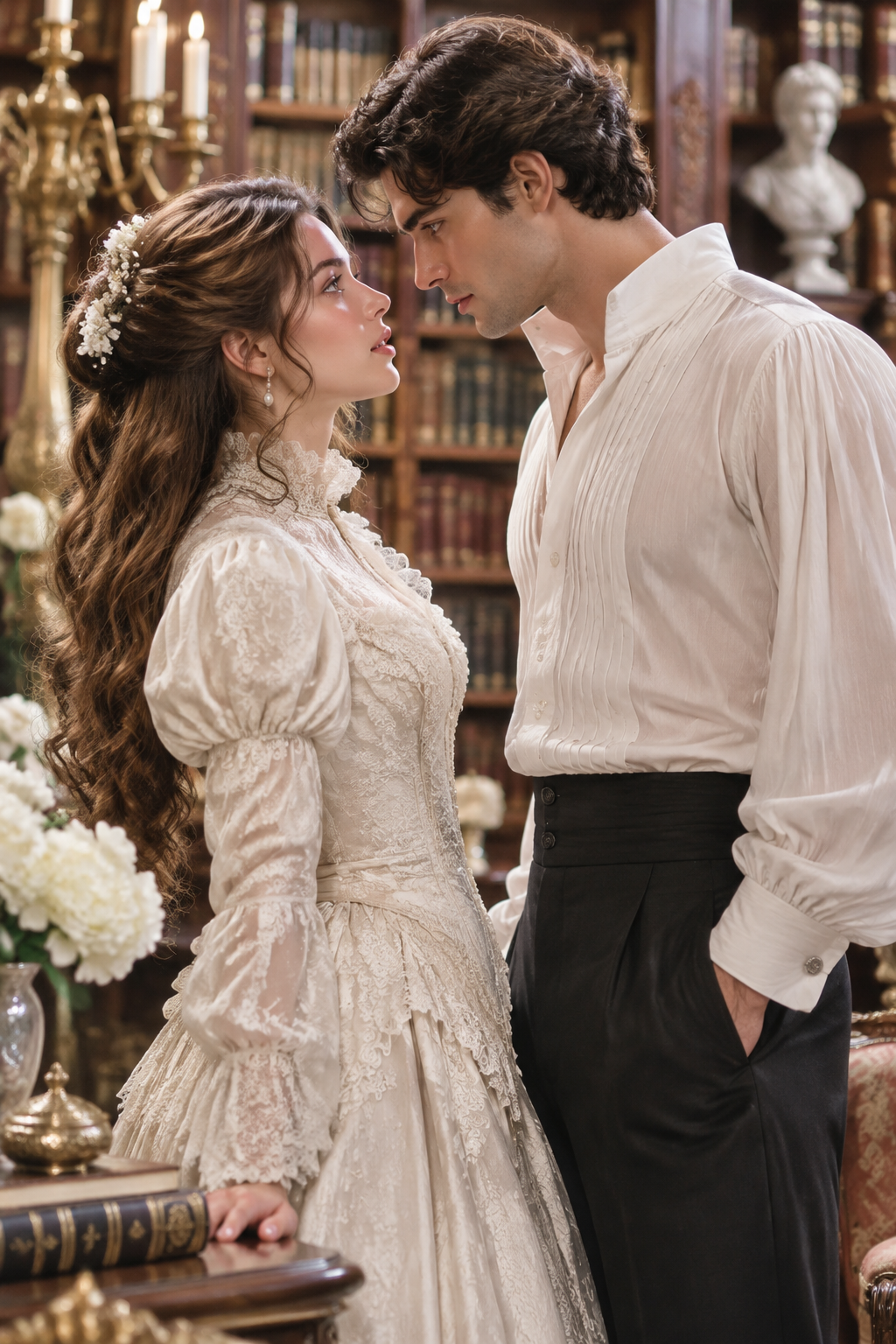
“Please don’t turn away from me,” Lachlan said softly. “Not for wanting what I want, and not for wanting it yourself.”
“Is this what you have been writing about me?”
Aunt Agatha’s voice cut through the quiet room.
Margaret stood beside her writing desk, her fingers resting on the edge of the notebook. For a moment, she was twelve years old again, standing before the same stern woman, waiting to be told what she had done wrong.
Lachlan was in the doorway. He had heard the question, but he did not interrupt.
Margaret looked at the notebook, then at her aunt.
“Yes,” she answered.
Agatha’s eyebrows rose. “You have been keeping a diary about your family?”
“I have been writing about myself.”
“Then why is my name in it?”
Margaret swallowed. Her heart was beating so hard that she could hear it.
“Because some of the things you taught me still frighten me. Even now.”
For the first time since her arrival, Agatha seemed unable to find an immediate reply.
She closed the notebook carefully and placed it on the desk.
“I suppose you have decided I was a terrible guardian.”
“That isn’t what I said.”
“But it is what you mean.”
Margaret looked toward Lachlan. He gave her a small, reassuring nod.
She turned back to her aunt.
“I know you wanted me to become a respectable woman. I know you believed you were preparing me for life. But you also taught me that wanting happiness was selfish. That enjoying my own body was shameful. That a woman should be grateful for whatever little comfort she was given.”
Agatha’s expression hardened.
“Those were the values by which I was raised. They kept women safe.”
“Did they make you happy?”
The question fell between them.
Agatha looked away.
Margaret had never asked her aunt such a thing. In all the years of her upbringing, she had asked permission, sought approval, and apologized. She had never questioned the woman who made the rules.
“Your husband has clearly put these ideas into your head,” Agatha said at last.
“No,” Margaret replied. “He has helped me understand that I am allowed to have ideas of my own.”
Lachlan remained silent.
Agatha glanced at him, perhaps expecting him to defend himself. Instead, he stepped closer to Margaret and gently rested a hand against her shoulder.
“You needn’t explain yourself to me, my dear,” he said. “But if you wish to speak, I am listening.”
Margaret felt something loosen inside her.
She was not alone anymore.
The rest of the morning passed in uncomfortable silence.
At luncheon, Agatha spoke about the weather, the household accounts, and the condition of the estate. Margaret answered politely, but the familiar fear no longer controlled every word.
After the meal, Agatha retired to her guest chamber.
Margaret remained at the table, staring at her untouched tea.
“I shouldn’t have spoken so sharply,” she murmured.
Lachlan pulled out the chair beside her.
“Were you unkind?”
“I questioned her.”
“Is that the same thing?”
Margaret considered the question.
“No.”
“Then perhaps you should stop apologizing for it.”
She smiled faintly, though her eyes remained troubled.
“I don’t know how to be around her without becoming that frightened girl again.”
“Then don’t demand that you become someone else overnight.”
He took her hand.
“You have spent years learning to fear her disappointment. It will take time to learn that you can survive it.”
Margaret leaned against him.
That evening, she returned to her notebook.
For the first time, she wrote an entry that was not about tea, sunlight, or a pleasant walk.
She wrote:
Today I told Aunt Agatha that her lessons hurt me. I was frightened, but I did not take my words back. I still love her. I am beginning to understand that loving someone does not mean agreeing with everything they have done.
She closed the notebook.
It was a small entry, but it felt like a beginning.
The second day of Agatha’s visit brought an unexpected change.
Margaret found her aunt in the library, sitting beside the window with a book open on her lap.
Agatha looked unusually tired.
“Your husband has made quite a comfortable home for you,” she remarked.
“He has.”
“And you seem pleased with your marriage.”
“I am.”
Agatha turned a page without reading it.
“You were always a sensitive child, Margaret. I worried that the world would take advantage of you.”
Margaret sat opposite her.
“I understand that you worried.”
“Your parents left you in my care. I had a responsibility.”
“You did.”
“I could not afford to raise you carelessly.”
Margaret studied her aunt’s face. There was something different in her voice. Beneath the familiar firmness, she heard a trace of defensiveness, perhaps even sadness.
“Did anyone ever teach you how to be happy, Aunt Agatha?”
Agatha looked up sharply.
“What sort of question is that?”
“An honest one.”
For several seconds, neither woman spoke.
Then Agatha shut her book.
“My mother taught me that a woman who expected too much from life would eventually be disappointed.”
“Did you believe her?”
“I had no reason not to.”
Margaret’s heart softened, but she did not rush to comfort her.
“Did you ever want something different?”
Agatha looked toward the garden.
“When I was young, I wanted to learn music. I wanted to travel. There was a piano in the house where I grew up, but I was told that lessons were an unnecessary expense.”
“What happened?”
“I learned to manage without them.”
Margaret waited.
Agatha’s mouth tightened.
“That was what women did.”
Margaret recognized the answer. She had heard it many times.
But for the first time, she began to see the person behind it.
Aunt Agatha had not simply inherited a set of rules. She had inherited disappointments and passed them down as instructions.
That did not make the hurt disappear.
But it helped Margaret understand where some of it had begun.
“I’m sorry you never had the chance to learn music,” she said.
Agatha looked almost offended by the sympathy.
“There is no point feeling sorry for things that cannot be changed.”
“Perhaps not. But we can still wish things had been different.”
Agatha said nothing.
That afternoon, Margaret took her notebook into the garden.
She found a quiet bench beneath an old tree and opened to a fresh page.
She wrote about the conversation with her aunt. Then she wrote about the difference between understanding someone and allowing them to control her.
She had once believed forgiveness meant pretending that nothing painful had happened.
Now she wondered whether forgiveness could mean something else.
Perhaps it meant letting go of the need to punish someone while still protecting herself.
She was still thinking when Agatha appeared along the garden path.
“May I sit?”
Margaret moved her notebook aside.
“Of course.”
Agatha settled onto the bench.
For a while, they watched the gardeners working near the rose bushes.
“Your mother liked flowers,” Agatha said suddenly.
Margaret looked at her.
“You rarely spoke about her.”
“There was little to say.”
“I would like to hear about her.”
Agatha’s expression shifted.
“She laughed often. More than was considered proper, according to your grandmother.”
Margaret smiled.
“I think I would have liked that.”
“She enjoyed music, too.”
“Did she play?”
“Quite beautifully.”
Agatha’s voice became quieter.
“She used to say that a house without music was only a place where people slept.”
Margaret looked down at her hands.
She had spent years believing her aunt’s rules were the only inheritance she had received from her family.
Now she was discovering that there had been other things before those rules.
Laughter.
Music.
A love of beauty.
Perhaps even a little courage.
“Why didn’t you tell me these things before?” Margaret asked.
Agatha stood.
“Because memories are not always useful.”
Then she walked back toward the house.
Margaret watched her go, wondering what else her aunt had buried beneath all those years of discipline.
On the final morning of the visit, Margaret woke early.
Lachlan was still asleep, so she dressed quietly and went downstairs.
She found Agatha in the drawing room, standing before the old pianoforte.
The instrument had belonged to Lachlan’s mother. Margaret had often admired it but had never learned to play.
Agatha rested her fingers on the closed lid.
“I used to think a woman who spent hours playing music was wasting her time,” she said without turning.
Margaret approached.
“And now?”
“Now I think I may have wasted mine.”
Margaret did not know what to say.
Agatha looked at the keys.
“Your mother used to play a particular melody. I remember only part of it.”
“Would you like to try?”
Agatha hesitated.
“I haven’t touched a piano in decades.”
“Then you needn’t be perfect.”
The older woman glanced at her.
Margaret smiled gently.
“It’s only music.”
Agatha sat down.
Her fingers hovered above the keys. She pressed one, then another. A few uncertain notes filled the room.
She stopped.
“I’ve forgotten.”
“Perhaps you only need to remember one note at a time.”
Agatha gave her a doubtful look, but tried again.
This time, she managed a short sequence.
It was imperfect. The rhythm faltered, and one note sounded painfully wrong.
Yet Margaret recognized the emotion in the melody.
For the first time in many years, she saw her aunt as a young woman who had once wanted something.
Not simply as the stern guardian who had raised her.
When Agatha finished, she quickly withdrew her hands.
“That was dreadful.”
“It was beautiful,” Margaret said.
“Don’t flatter me.”
“I am not.”
Agatha stood and straightened her sleeves.
“I must prepare for my departure.”
But as she left the room, Margaret noticed that her aunt’s eyes were wet.
Later that morning, the carriage was brought around.
Agatha stood in the entrance hall while a servant collected her belongings.
Margaret approached her.
“Thank you for visiting.”
Agatha nodded.
“You have become rather independent.”
“I am trying.”
“Your mother would have wanted you to be happy.”
Margaret felt her throat tighten.
“Do you think so?”
“I know so.”
For a moment, Agatha looked as though she might say something more. Instead, she reached into her handbag and removed a small folded piece of paper.
“This was hers.”
Margaret took it carefully.
“What is it?”
“A note she wrote to me shortly before she died. I thought you might like to keep it.”
Margaret unfolded the paper.
The handwriting was delicate and familiar, though she had never seen it before.
Agatha,
Promise me you will teach my daughter to be strong. But please, do not teach her that strength means never needing anything. I want her to know that a good life can hold duty and laughter, responsibility and pleasure. Let her have both.
Margaret read the words twice.
Then a third time.
Her eyes filled with tears.
She looked at her aunt.
“You knew?”
Agatha’s lips pressed together.
“I knew what your mother wanted. I thought the world was too harsh to allow it.”
“So you tried to protect me by teaching me to expect less?”
“I thought I was preparing you.”
Margaret folded the letter carefully.
“I believe you wanted to protect me. But I needed more than protection.”
Agatha lowered her eyes.
“I know.”
Those two words were almost too quiet to hear.
For years, Margaret had imagined a moment when her aunt would finally admit that she had been wrong. She had thought such an admission would bring immediate relief.
Instead, she felt a complicated mixture of grief, tenderness, and sadness for the childhood she could never reclaim.
She stepped forward and embraced her aunt.
Agatha remained stiff for a moment.
Then, slowly, her arms came around Margaret.
Neither woman spoke.
When they separated, Agatha adjusted her gloves.
“I suppose I shall have to write more often.”
“I would like that.”
“And perhaps you might send me a copy of that music your mother used to play.”
Margaret smiled.
“I would love to.”
Agatha climbed into the carriage.
As it pulled away, Margaret stood beside Lachlan and watched until it disappeared beyond the gates.
He slipped an arm around her waist.
“How do you feel?”
“Sad,” she answered.
He nodded.
“And?”
“Relieved. Hopeful. A little frightened.”
“That sounds like quite a collection.”
She laughed.
For once, she did not apologize for it.
The days after Agatha’s departure were quieter.
Margaret returned to her notebook, but the entries began to change.
She no longer recorded every small pleasure as though she needed to prove that she deserved it.
Instead, she began writing about the things she wanted to explore.
She wanted to learn music.
She wanted to visit the village school and help the girls whose families could not afford books.
She wanted to walk through the gardens without worrying about whether anyone thought she was wasting time.
And she wanted to become comfortable with affection, not because she owed it to her husband, but because she wanted to share it.
Lachlan encouraged her without turning her progress into another duty.
Some evenings, he played cards with her. Other evenings, they read beside the fire.
Sometimes they kissed, and sometimes they simply held hands.
There were still difficult moments.
One afternoon, Margaret accidentally broke a porcelain cup that had belonged to Lachlan’s mother.
The sound of it striking the floor sent a familiar wave of panic through her.
She immediately began apologizing.
“I’m so sorry. I should have been more careful. It was careless of me.”
Lachlan looked at the broken pieces.
“It’s a cup, Margaret.”
“It was valuable.”
“Yes. But you are more valuable.”
She stared at him.
“You aren’t angry?”
“I’m disappointed that we have one fewer cup.”
Despite herself, she laughed.
He helped her gather the pieces.
Later, she wrote about the incident in her notebook.
Not because breaking a cup was an important achievement, but because she had learned something.
A mistake did not make her a bad person.
An accident did not mean she deserved punishment.
And being loved did not require being perfect.
A week later, a letter arrived from Agatha.
Margaret recognized the handwriting immediately.
She opened it beside the window, with Lachlan reading quietly nearby.
My dear Margaret,
I have been thinking about our conversation. I cannot pretend that I understand all your choices, and I suspect I shall continue to disagree with some of them.
However, I have been thinking about your mother’s letter.
I kept it for many years. Perhaps I should have given it to you sooner.
I have also found an old music book. I believe it contains the melody I attempted at your house. I am sending it to you.
I hope you will learn it properly.
Your aunt,
Agatha.
Margaret smiled through her tears.
Lachlan looked up.
“Good news?”
“I think so.”
She handed him the letter.
He read it and returned it.
“Would you like to write back?”
“Yes.”
“What will you say?”
Margaret considered the question.
She could tell her aunt that everything was forgiven. She could promise to visit soon. She could pretend that their conversation had erased the years of shame.
But that would not be honest.
Instead, she sat at her writing desk and began:
Dear Aunt Agatha,
Thank you for sending the music book. I would like to learn the melody, and perhaps one day we can play it together.
I am glad we have begun speaking more honestly. I still have difficult memories, and I am still learning to understand them. I hope we can continue to build a relationship in which neither of us has to pretend.
I love you.
Margaret.
She read the letter once before sealing it.
This time, she did not write it to release anger.
She wrote it because she wanted a future that was different from the past.
Spring arrived gradually.
The gardens filled with flowers, and the days grew longer.
Margaret began taking music lessons from a local teacher. Her first attempts were clumsy, and she often lost the rhythm.
But she kept practicing.
Lachlan sometimes sat nearby with a book, pretending not to notice when she played the same passage incorrectly for the tenth time.
One afternoon, she finally managed the melody from her mother’s old music book.
The final note lingered in the room.
Margaret sat still, her hands resting on the keys.
Lachlan closed his book.
“Was that the melody?”
She nodded.
“Would you like to hear it again?”
“Very much.”
She played it once more.
This time, she did not stop when she made a mistake.
She simply continued until the music reached its end.
When she finished, Lachlan crossed the room and kissed her forehead.
“You did it.”
Margaret looked at the music book.
“I think my mother would have liked this.”
“I think she would have been proud.”
Margaret smiled.
Then she looked at the notebook on the table.
For months, it had been a place where she recorded small victories over fear.
Now it contained something more.
Plans.
Dreams.
Memories.
Letters she had not sent.
And proof that a person could change without becoming someone entirely different.
That summer, Agatha returned for another visit.
This time, she brought the old music book with several pages carefully marked.
Margaret greeted her at the entrance.
“I’m glad you’re here.”
Agatha looked around the house.
“I see you have kept the pianoforte in good order.”
“We have.”
“Then perhaps you will play for me.”
Margaret smiled.
“Only if you play with me afterward.”
Agatha looked horrified.
“I haven’t practiced enough.”
“Neither have I.”
For a moment, the older woman seemed ready to refuse.
Then she removed her gloves.
“Very well.”
They sat side by side at the pianoforte.
Margaret played the melody first. Agatha followed, hesitantly joining her on the second attempt.
Their playing was far from perfect.
At one point, they both pressed the wrong key and stopped.
Margaret burst into laughter.
Agatha stared at her.
Then something extraordinary happened.
Agatha laughed, too.
It was brief and unfamiliar, but it was real.
Margaret looked at her aunt.
For the first time, she wondered whether this was the woman her mother had known.
The woman who had loved music.
The woman who had once dreamed of more.
The woman who had spent so many years believing that happiness was something other people were allowed to have.
After they finished, Agatha touched the pages of the music book.
“Your mother used to say that music made a person feel less alone.”
Margaret nodded.
“I think she was right.”
Agatha looked at her.
“Perhaps I was wrong about more things than I care to admit.”
Margaret took her hand.
“You don’t have to change everything in one day.”
Agatha gave a small, thoughtful smile.
“Neither do you.”
They sat together in the quiet room, their hands resting near the old piano keys.
There were still memories that hurt.
There were still things they could not repair.
But there was also room for something new.
That evening, after Agatha had gone upstairs, Margaret and Lachlan walked through the garden.
The air was warm, and the last sunlight rested on the hedges.
“Do you remember the first night you told me you felt ashamed?” Lachlan asked.
Margaret nodded.
“I remember thinking you would eventually grow tired of me.”
“Why?”
“Because I was afraid of so many ordinary things. Because I could not always accept your affection. Because I seemed unable to enjoy even the simplest pleasures without feeling guilty.”
Lachlan stopped walking.
“Margaret, I did not marry you because I expected you to arrive without fears.”
She looked at him.
“I married you because I loved you.”
He brushed a loose strand of hair from her face.
“You are not a problem I need to solve. You are my wife. We are supposed to learn how to live together.”
Margaret felt tears gather in her eyes.
“I used to think love meant being good enough to deserve it.”
“And now?”
She thought for a moment.
“Now I think love should allow a person to become more fully themselves.”
Lachlan smiled.
“That sounds rather wise.”
“It took me a long time.”
“Some lessons do.”
He kissed her gently.
Margaret did not pull away.
She did not feel the need to explain herself afterward.
She simply rested her head against his chest and listened to the steady rhythm of his heartbeat.
For once, the moment was enough.
Before going to bed, Margaret opened her notebook.
She turned to the final blank page and began writing.
I once believed that being a good woman meant asking for very little.
I believed that duty required me to silence my wishes, that respectability meant hiding my feelings, and that happiness was something I should accept only when everyone else had been satisfied.
I was wrong.
I can be responsible and still enjoy my life. I can love my family without agreeing with every belief they hold. I can forgive someone without pretending they never hurt me.
I can be gentle without being silent.
I can be grateful without feeling guilty for wanting more.
She paused and looked toward the window.
The moonlight rested on the garden, and somewhere in the distance, an owl called from the trees.
Margaret thought about the frightened girl she had once been.
She wished she could reach back through the years and tell that child something important.
That she was not wicked for wanting affection.
That she was not selfish for wanting laughter.
That her body was not something to be ashamed of.
That she did not have to earn every moment of happiness through endless obedience.
Most of all, she wished she could tell her that the world was larger than the rules she had been taught.
She could not change her childhood.
She could not recover the years she had spent feeling guilty for being human.
But she could choose what happened next.
Margaret closed the notebook and placed it on her bedside table.
When she returned to bed, Lachlan opened his arms.
She settled beside him.
“Are you happy?” he asked.
She thought about it carefully.
“Yes,” she whispered. “And I think I’m finally allowing myself to know it.”
He kissed her forehead.
“Then that is enough for tonight.”
Margaret closed her eyes.
For years, she had believed that happiness was something fragile, something that could disappear if she enjoyed it too much.
Now she understood that happiness was not a reward for perfect behavior.
It was part of being alive.
And sometimes, the bravest thing a person could do was simply allow themselves to feel it.
The End