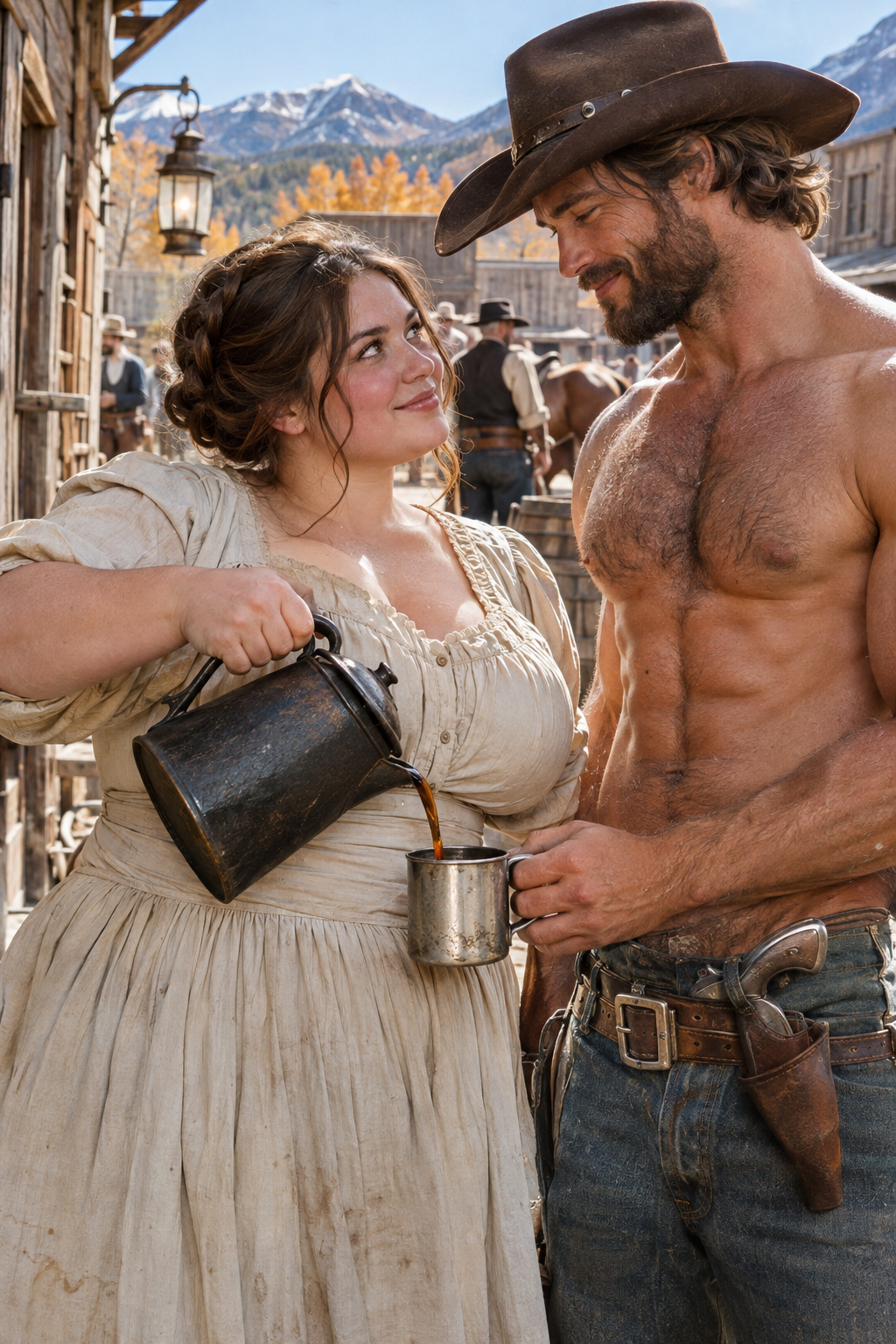
On her first morning at a Wyoming cattle ranch, Emily Foster took a plate of biscuits away from a cowboy twice her size. Twenty-one other men stopped eating, waiting to see what would happen.
“The ranch belongs to me, Emily.”
For a moment, Emily thought she had misunderstood him. She looked toward the dark barn, then back at Daniel, searching his face for some sign that he was joking. But his expression hadn’t changed.
“You own High Timber?”
Daniel nodded. “My full name is Daniel Hayes. My father bought this land when I was a boy. When he passed away, everything became mine.”
Emily suddenly remembered the way Walter spoke to him, how the men followed his orders without hesitation, and how nobody seemed willing to challenge him. All those little things that had puzzled her finally made sense.
“Why didn’t you tell me?”
“Because people behave differently when they know who signs their paychecks. I wanted you to feel comfortable here.”
Emily folded her arms. “You could have trusted me with the truth.”
“I know,” Daniel admitted. “And I’m sorry.”
He looked out across the muddy yard. Somewhere in the darkness, a horse moved restlessly inside the barn.
“But owning this place isn’t the hardest thing I’ve been keeping from you.”
Daniel reached into his shirt pocket and pulled out a small, worn photograph. He handed it to Emily. In the picture, a smiling woman stood beside him, holding the hand of a little girl with bright eyes and curly brown hair.
“My wife, Sarah. And our daughter, Lucy.”
Emily studied the photograph carefully. She could hardly recognize the happy young man standing beside them.
“What happened?”
“Five years ago, they were driving home from town when their car went off an icy road. Neither of them survived.”
Emily lowered the photograph. Suddenly, she understood why Daniel had looked so frightened when Eli went missing.
“After that, I stopped living in the main house,” he continued. “Too many memories. I moved into one of the cabins and started working alongside the men. Keeping busy was easier than going home to an empty room.”
Emily handed the photograph back with both hands.
“My husband died three years ago,” she said quietly. “His name was Michael. He got sick, and by the time the doctors figured out what was wrong, there wasn’t much they could do.”
Daniel turned toward her.
“We had plans,” she continued. “A little house, children, maybe a restaurant someday. After he died, everyone kept telling me I needed to move on. But nobody could explain how.”
Daniel understood that feeling better than most people ever could.
They remained on the porch until the clouds began breaking apart. Neither tried to offer comforting words that couldn’t possibly fix what had happened. For the first time in years, Daniel felt that someone understood his silence.
But the following morning, Emily discovered that Daniel’s ownership of High Timber was only the beginning of a much bigger problem.
A black truck pulled into the yard shortly after breakfast. A tall man in an expensive coat stepped out, carefully avoiding the mud. Walter met him near the barn, and their conversation quickly became heated.
Emily was carrying a basket of clean towels when the stranger entered her kitchen without knocking.
“You must be the new cook.”
“And you must be someone who forgot his manners,” Emily replied.
The man smiled without warmth.
“Richard Hayes. Daniel’s older brother.”
Emily set the basket down.
“Is Daniel expecting you?”
“He knows why I’m here.”
Before Emily could answer, Daniel appeared in the doorway. His entire expression changed when he saw Richard.
“Outside,” Daniel said.
Richard glanced around the kitchen.
“Still pretending you’re one of the hired hands? You always did enjoy making things difficult.”
“Not in here, Richard.”
The brothers walked outside, but their voices soon became loud enough for Emily to hear through the open window.
“You’ve got six weeks,” Richard said. “After that, the bank won’t care about your memories or those men you’ve been carrying.”
“I’m handling it.”
“You’ve been saying that for two years.”
Richard left shortly afterward. Daniel remained beside the fence, staring at the mountains.
When Emily approached him, he didn’t try to hide his frustration.
“High Timber is in trouble,” he finally admitted.
Two difficult winters, rising expenses, damaged equipment, and falling cattle prices had left the ranch buried in debt. Daniel had borrowed money to keep the operation running, refusing to dismiss workers whose families depended on their wages.
Richard wanted him to sell the property to a development company. The offer would clear the debts and leave Daniel financially comfortable, but the ranch would eventually disappear.
“What happens to the men?” Emily asked.
“They lose their jobs.”
“And Eli?”
Daniel shook his head. “He’s got nowhere else to go.”
That evening, Emily watched the cowboys eating supper. Frank was telling a ridiculous story about a stubborn horse. Walter was arguing over a card game, and Eli was laughing so hard he nearly dropped his fork.
None of them seemed to realize how close they were to losing everything.
The next morning, Emily asked Walter to show her the ranch’s kitchen accounts and supply records.
“What for?”
“Because something doesn’t make sense.”
She had noticed that the kitchen received far less flour, meat, and canned food than the invoices suggested. At first, she assumed it was poor recordkeeping. But after comparing several months of receipts, she discovered something disturbing.
High Timber had been paying for supplies that never arrived.
And it wasn’t just food.
Walter brought her records for livestock feed, fencing materials, and equipment repairs. Together, they found thousands of dollars in questionable charges.
“Who approves these payments?” Emily asked.
Walter pointed toward a signature at the bottom of several documents.
“Richard handles some of the ranch’s purchasing through his company. Daniel trusted him to take care of it.”
Emily felt a cold sensation in her stomach.
“Walter, we need to show Daniel.”
Daniel examined the documents that afternoon. At first, he defended his brother. Richard had helped manage the family business after their father’s death. There had been disagreements, but Daniel had never imagined he would deliberately hurt High Timber.
Then Emily placed two invoices side by side.
The ranch had paid for the same equipment repair twice, although Walter confirmed the equipment had never been repaired at all.
Daniel stared at the papers for a long time.
“Get me every record we have,” he told Walter.
Over the next several days, Daniel contacted an independent accountant. What began as a few suspicious invoices turned into evidence of years of inflated charges and payments to companies connected to Richard.
The findings explained a significant portion of the ranch’s financial problems.
Daniel called his brother and demanded that he return to High Timber.
Richard arrived the following afternoon. Daniel invited him into the ranch office, where Emily and Walter were waiting.
He placed the accountant’s preliminary report on the desk.
“Explain this.”
Richard barely looked at it.
“You don’t understand how business works.”
“Then explain it to me.”
“Administrative fees. Service charges. That’s normal.”
“Charging me for things I never received isn’t normal.”
Richard’s face tightened.
“You were barely functioning after Sarah died. Someone had to manage things.”
Daniel stood slowly.
“I trusted you.”
“And I kept this family from falling apart while you spent years feeling sorry for yourself!”
The room went silent.
Emily saw Daniel’s hands tighten, but he controlled himself.
Richard continued, his voice growing louder.
“Sell the ranch. Take the money. Stop ruining your life over a piece of land.”
Daniel looked directly at his brother.
“You’re no longer authorized to handle anything connected to High Timber. My attorney will contact you.”
Richard stared at him in disbelief.
“You’d turn against your own brother?”
“No,” Daniel answered. “I’m finally standing up to him.”
Richard stormed out, slamming the office door behind him.
Although uncovering the missing money gave Daniel grounds to pursue repayment, recovering it would take time. The bank’s deadline was still approaching, and High Timber needed an immediate solution.
That night, Daniel gathered the entire crew in the dining hall.
For the first time, he told them exactly how serious things had become.
“I’ve tried to protect you from this,” he said. “But you deserve to know the truth. If anyone wants to find another job, I won’t stand in your way.”
Nobody spoke.
Finally, Frank pushed his chair back.
“How long have I worked here, Daniel?”
“Seventeen years.”
“And when my wife needed surgery, who made sure I got paid while I stayed home with her?”
Daniel lowered his eyes.
Frank looked around the room.
“I’m not leaving.”
Walter stood beside him.
“Neither am I.”
One after another, the cowboys offered to stay and help. Some suggested repairing equipment themselves. Others knew neighboring ranchers who might need temporary services.
Then Emily stepped forward.
“We’ve been looking at everything this ranch owes,” she said. “Maybe it’s time we looked at everything this ranch has.”
She proposed opening High Timber to visitors during quieter periods. Families could experience ranch life, enjoy home-cooked meals, and learn about horses and cattle. Several unused buildings could eventually become guest cabins.
It wouldn’t solve every problem immediately, but it could create another source of income.
Frank grinned.
“You mean people would actually pay to do our chores?”
“Some people pay good money to escape their ordinary lives,” Emily replied. “We just have to give them something worth coming for.”
For the first time in weeks, Daniel smiled.
They began organizing a community supper and ranch open house. Emily contacted businesses in town, Walter arranged safe demonstrations, and the cowboys worked together to prepare the property.
News traveled quickly. Former employees, neighboring families, and people Daniel had helped over the years offered their support.
Then, three days before the event, disaster struck.
Emily woke shortly after midnight to the sound of frantic shouting.
“Fire! The hay barn’s on fire!”
She rushed outside. Orange flames were rising above the barn, and thick smoke filled the yard. Daniel was already calling emergency services while Walter directed everyone away from the burning structure.
The men hurried to move horses from a nearby stable before the flames could spread.
Emily counted the workers as they gathered in the open yard.
Then her heart dropped.
“Where’s Eli?”
Frank looked toward the stable.
“He was helping with the horses.”
Daniel immediately called the boy’s name.
A faint answer came from inside the smoke-filled stable. Eli had fallen while trying to move a frightened horse, and his leg was trapped beneath a damaged stall gate.
Daniel reached the stable entrance, but smoke forced him back. Walter grabbed his shoulder.
“You can’t see anything in there!”
Before Daniel could respond, a volunteer firefighter arrived with the first emergency crew. Daniel told him exactly where Eli was trapped. Two firefighters entered with protective equipment while the others worked to contain the spreading flames.
Emily stood beside Daniel, gripping his hand as they waited.
Minutes later, the firefighters emerged carrying Eli.
The boy was coughing, frightened, and unable to stand, but he was alive.
Daniel rushed beside him as the paramedics began treating him.
“I’m sorry,” Eli whispered. “I was trying to help.”
Daniel knelt beside the stretcher.
“Listen to me. There isn’t a horse, a building, or a single dollar on this ranch worth more than your life.”
Eli began crying.
Daniel stayed beside him until the ambulance departed.
By sunrise, the fire was under control. The hay barn was destroyed, and part of the stable had suffered serious damage. Investigators later traced the fire to faulty electrical wiring.
Daniel stood before the blackened remains, looking utterly defeated.
“We’re finished,” he whispered.
Emily took his hand.
“Eli is alive. Every man is accounted for. Whatever else we’ve lost, we can face it.”
Daniel shook his head.
“You don’t understand how much this will cost.”
“Maybe not. But I know what it costs to give up on living.”
He looked at her.
“Don’t make the mistake of believing that losing something means you’ve lost everything.”
The community event was nearly canceled. Instead, when people heard about the fire, something remarkable happened.
Neighbors arrived with trailers of hay. A local contractor offered help rebuilding the stable. Businesses donated food, equipment, and supplies.
On Saturday morning, trucks began filling the ranch driveway.
Emily had expected perhaps fifty visitors. By afternoon, several hundred people had come through the gates.
An elderly woman approached Daniel and reminded him of the winter he had delivered firewood to her home without asking for payment.
A mechanic offered discounted repairs because Daniel had once given his son a summer job.
A neighboring rancher shook Daniel’s hand.
“You helped me when my place flooded. Did you really think we’d forget?”
Daniel struggled to find the words to respond.
For years, he had believed he was carrying High Timber alone. Now he was discovering how many people had been quietly carrying him.
The event raised enough money to cover several urgent expenses. More importantly, it generated bookings for future ranch visits and attracted local business partners.
With the accountant’s findings, insurance assistance, a revised business plan, and new income commitments, Daniel approached the bank again.
After several tense meetings, the bank agreed to restructure the ranch’s debt.
High Timber would survive.
When Daniel returned from town with the signed agreement, Emily was kneading bread in the kitchen.
He placed the envelope on the counter.
“We’re keeping the ranch.”
Emily stared at him.
“Are you serious?”
Daniel nodded.
She threw her arms around him before either of them had time to think.
The kitchen erupted in cheers when Walter announced the news. Frank lifted his hat, Eli clapped from his chair, and someone began ringing the old dinner bell outside.
Daniel laughed harder than Emily had ever heard him laugh.
Months later, Richard reached a legal settlement requiring him to repay a substantial portion of the improperly collected money. Daniel chose to let his attorneys handle the matter rather than spend his remaining years consumed by anger.
Meanwhile, High Timber began changing.
The damaged buildings were repaired. The first guest cabins opened. Emily’s cooking became so popular that visitors started making reservations weeks in advance.
Eli recovered from his injuries and returned to work under Walter’s careful supervision. Daniel also arranged for him to continue his education, making sure the young man had opportunities beyond the ranch.
One evening, Daniel invited Emily to the main house.
She had never been inside.
Dust covered the furniture, and framed photographs lined the walls. A child’s drawing remained attached to the refrigerator. In the living room, a small wooden rocking horse stood beside the fireplace.
Daniel touched its handle.
“I couldn’t bring myself to move anything.”
Emily stood quietly beside him.
“You don’t have to.”
“I thought keeping everything exactly the same meant I was keeping them close.”
“Maybe you were,” she said. “But loving them doesn’t mean you have to stop loving everything else.”
Daniel looked at her with tears in his eyes.
Together, they opened the curtains and let the evening sunlight into the house.
Over the following weeks, Daniel began sorting through his family’s belongings. He kept the things that mattered most, donated others, and created a special place for Sarah and Lucy’s photographs.
Emily never asked him to forget them.
And Daniel never asked Emily to forget Michael.
Their relationship grew slowly, built on trust, shared meals, long conversations, and the quiet understanding that neither needed to hide their past.
Nearly a year after Emily arrived at High Timber, Daniel found her sitting on the kitchen porch where they had first shared their secrets.
He sat beside her and took a small box from his pocket.
Emily looked at him in surprise.
“I spent a long time thinking the best part of my life was already over,” Daniel said. “Then a woman walked into my kitchen and started telling twenty-two cowboys how to behave.”
Emily laughed, although her eyes were already filling with tears.
“You were a difficult bunch.”
“We still are.”
He opened the box.
“I can’t promise there won’t be hard days. But I can promise you won’t have to face them alone. Emily Foster, will you marry me?”
She looked at the man who had once been too afraid to return to his own home.
Then she smiled.
“Yes, Daniel. I will.”
They married beneath a large cottonwood tree the following spring. Walter stood beside Daniel, Frank cried more than anyone expected, and Eli proudly carried the wedding rings.
Inside the main house, Emily placed photographs of Michael, Sarah, and Lucy on a small table decorated with wildflowers.
They weren’t forgotten chapters. They were part of the journey that had brought two wounded people together.
Years later, visitors often asked Emily how she had managed to turn a struggling ranch into such a welcoming place.
She always smiled.
“I came here to cook breakfast. Everything else happened because people decided to take care of one another.”
High Timber eventually became known for more than its cattle, mountain views, and homemade biscuits. It became a place where struggling young workers could find guidance, families could make memories, and people who had experienced loss could discover that life still held something beautiful.
Daniel never forgot the night he nearly lost the ranch. But he no longer measured his wealth by the number of acres he owned or the cattle grazing across his fields.
He measured it by the people gathered around his table.
And Emily, who had once believed her happiest days were behind her, discovered that a broken heart could carry old memories and still make room for new happiness.
Neither of them had found a way to change the past. What they found was something far more valuable: the courage to build a future without being ashamed of surviving their sorrow.
Because healing doesn’t mean forgetting the people we have lost. It means honoring the love they gave us by allowing ourselves to live fully again.
Sometimes, a second chance arrives when we least expect it, disguised as an ordinary job, an unfamiliar place, or a stranger sitting quietly at the far end of a crowded table.
Ten years after Emily first arrived at High Timber Ranch, a familiar black truck appeared at the end of the driveway.
Daniel was sitting on the porch, watching his eight-year-old daughter, Grace, help Emily carry a basket of fresh vegetables into the kitchen.
When he recognized the man stepping out of the truck, his smile disappeared.
It was Richard.
His expensive clothes were gone, his hair had turned gray, and he walked with a slight limp. He looked nothing like the confident businessman who had once threatened to take everything Daniel loved.
“Hello, little brother,” Richard said.
Daniel slowly stood.
“What brings you here?”
Richard looked down at his boots.
“I lost my business last year. My wife left, and my children barely speak to me. I’ve spent a lot of time thinking about the things I’ve done.”
Daniel remained silent.
“I’m not here to ask for money,” Richard continued. “I just wanted to tell you something I should have said years ago.”
His voice began to shake.
“I’m sorry.”
For a long moment, Daniel said nothing. He remembered the unpaid bills, the sleepless nights, and the fear of losing the ranch his father had built.
Emily stepped onto the porch but didn’t interrupt.
“I can’t change what I did,” Richard whispered. “I know that.”
“No, you can’t,” Daniel replied. “But you can decide what kind of man you’re going to be tomorrow.”
Richard wiped his eyes.
Daniel glanced toward the kitchen.
“Have you eaten?”
Richard shook his head.
“Then come inside.”
Emily quietly set another plate at the table.
Forgiveness didn’t erase what Richard had done, and Daniel wasn’t prepared to trust him with the ranch’s finances again. But he was willing to give his brother an opportunity to become a better person.
Over the following months, Richard began helping with maintenance around the property. He repaired fences, cleaned guest cabins, and gradually earned the respect of people he had once looked down upon.
Meanwhile, Eli had grown into a capable young man. After completing his education, he returned to High Timber and eventually became the ranch manager when Walter retired.
On Walter’s final day, the entire crew gathered for supper.
Frank raised his glass.
“To the woman who came here with a suitcase and somehow ended up saving all our jobs.”
Emily laughed.
“I seem to remember having quite a bit of help.”
Walter smiled across the table.
“You did something none of us knew how to do, Emily. You reminded us that we were more than employees. We were people who mattered.”
Later that evening, Daniel and Emily walked toward a quiet hill overlooking the ranch.
Beneath a cottonwood tree stood a small memorial for Sarah and Lucy. Nearby, Emily had planted flowers in Michael’s memory.
Grace placed a handful of wildflowers beside the memorial.
“Daddy, do you think they’re happy for us?”
Daniel knelt beside his daughter.
“I like to think they would be.”
Emily slipped her hand into his.
As the sun disappeared behind the Wyoming mountains, Daniel looked toward the ranch house. Warm light spilled through the windows, and laughter drifted from the dining hall.
There had been a time when he believed he would never hear such happiness again.
“Thank you for staying,” he whispered.
Emily rested her head against his shoulder.
“Thank you for giving me a reason to.”
Years passed, and High Timber remained in the family. Under Eli’s management, the ranch continued offering employment and training to young people who needed a fresh start.
Above the kitchen entrance, Daniel hung a wooden sign bearing a simple message:
“There is always room for one more at our table.”
It became the promise that defined High Timber.
Emily had arrived in Wyoming searching for a paycheck. Daniel had been searching for a reason to keep going. Neither expected to find love, family, or a renewed sense of purpose.
Yet their lives changed because they chose kindness when bitterness would have been easier, courage when surrender seemed reasonable, and forgiveness when anger felt justified.
Their story was never about forgetting the past or pretending that pain didn’t exist.
It was about understanding that even after life’s greatest losses, there can still be beautiful chapters waiting to be written.
And sometimes, the greatest fortune a person can inherit isn’t land, money, or property.
It’s a home filled with people who know your struggles, accept your imperfections, and still choose to save you a seat at the table.
THE END.