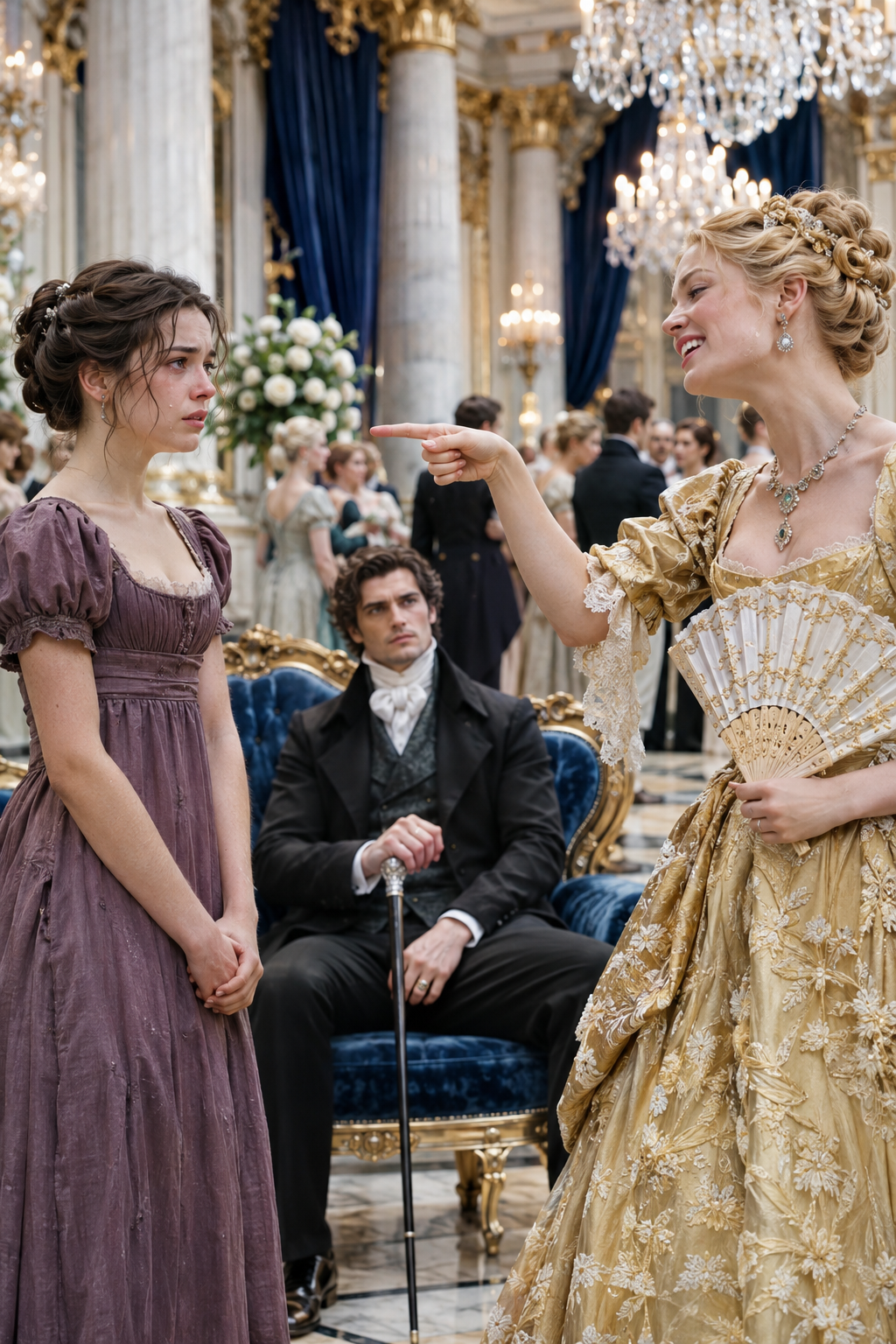
“Go sit beside the blind duke, Brisa. At least he won’t have to look at you.”
Brisa remained beside the breakfast table as the servants gathered in the dining room. There were twelve of them, standing with their hands folded and their eyes lowered. Mrs. Whitmore, the housekeeper, looked particularly nervous.
Agrippa rose from his chair, supporting himself with his walking stick.
“Mrs. Whitmore, how many rugs are there in the main corridors?”
“Seven, Your Grace.”
“Remove them.”
The housekeeper blinked. “Remove them, sir?”
“Every single one. And open the curtains in the drawing room. There is no reason for the rest of you to live in darkness simply because I cannot see.”
Nobody moved. The servants exchanged uncertain looks, wondering whether they had misunderstood their master’s instructions.
“And for heaven’s sake,” Agrippa continued, “stop whispering. You are employed in a household, not a cemetery.”
Brisa pressed her lips together to hide a smile.
The young maid who had dropped the spoon earlier looked up for the first time.
“Does that mean we may speak normally, Your Grace?”
“I believe that is precisely what I said.”
Within an hour, High Cross began to sound like an entirely different house. Footsteps echoed through the corridors. Windows were opened, furniture was moved, and somewhere downstairs, a servant began humming.
Agrippa sat in his library, looking deeply uncomfortable.
“Are you pleased with yourself, Miss Adams?” he asked when Brisa entered.
“Very much.”
“I can hear practically everything.”
“Isn’t that wonderful?”
“It is extraordinarily irritating.”
“Give it time.”
He shook his head, but the corner of his mouth lifted.
Over the following days, Brisa discovered that beneath Agrippa’s cold manners was a man who possessed an intelligent mind, a surprisingly dry sense of humor, and a terrible fear of depending on others.
He insisted on finding his own way through the house. He memorized the placement of furniture and counted the steps between rooms. Whenever someone attempted to guide him without permission, he became furious.
Brisa learned not to grab his arm or move objects without telling him.
Instead, she offered information and allowed him to decide whether he needed assistance.
One afternoon, she found him standing beside the garden doors.
“Would you care to walk outside?” she asked.
“No.”
“Why not?”
“The garden is uneven.”
“So is life. You seem to have survived that.”
“Your talent for being annoying is remarkable.”
“Thank you.”
After several minutes of arguing, Agrippa finally agreed.
They walked slowly along the garden path. Brisa described the flowers, the neglected fountain, and the enormous oak tree near the eastern wall.
When they reached a bench, Agrippa stopped.
“My mother planted roses here,” he said quietly.
“There are still roses.”
“What color?”
“White. Some pink ones, too.”
He reached toward a nearby flower, and Brisa guided his hand after asking permission.
For a moment, his expression softened.
“I had forgotten their scent.”
Brisa watched him carefully.
It was the first time she understood how much of his former life he had abandoned, not because blindness made those experiences impossible, but because remembering them had become painful.
That evening, she asked Mrs. Whitmore what had happened to him.
The housekeeper hesitated before closing the kitchen door.
“His Grace lost his sight nearly four years ago. There was a terrible carriage accident during a storm.”
“Was anyone else injured?”
Mrs. Whitmore lowered her voice.
“His younger brother, Edward, was killed.”
Brisa felt her heart sink.
“His Grace was driving the carriage. He has blamed himself ever since. Before the accident, High Cross was filled with visitors, music, and laughter. Afterward, he dismissed most of the guests, closed the ballroom, and refused to attend social gatherings.”
“Then why did he attend the ball where we met?”
“His cousin persuaded him. Said it was important for the family’s reputation.”
Brisa finally understood why Agrippa had surrounded himself with silence.
Every joyful sound reminded him of a life he believed he no longer deserved.
But something else was troubling Mrs. Whitmore.
“Miss Adams, there is another matter you should know about. Lord Edmund Graham, the duke’s cousin, has been managing much of the estate since the accident.”
“Does His Grace trust him?”
“He used to.”
The housekeeper glanced toward the door.
“Several families have recently been threatened with eviction. Repairs have been neglected, wages have been reduced, and Lord Edmund claims these decisions were approved by His Grace.”
“Were they?”
“I cannot say. But the duke I once knew would never have allowed children to go hungry while his own dining table remained full.”
Two mornings later, Brisa witnessed the consequences herself.
A woman carrying a small child appeared at the entrance of High Cross. Her dress was worn, and her shoes were covered in mud.
“Please,” she begged the footman. “I must speak to His Grace.”
The footman attempted to send her away, but Brisa intervened.
The woman’s name was Margaret Ellis. Her husband had died during the winter, leaving her with three children and a small rented cottage on the estate.
Lord Edmund had demanded payment she could not afford.
“He says we must leave by Monday,” Margaret explained through tears. “I have nowhere to take my children.”
Brisa brought her into the house and immediately went to Agrippa.
“You have a visitor.”
“I am not receiving visitors.”
“This one cannot afford to wait.”
Agrippa listened as Margaret explained her situation.
When she finished, his expression had changed completely.
“Who authorized your eviction?”
“Lord Edmund, Your Grace. He showed me a document bearing your signature.”
Agrippa’s fingers tightened around his walking stick.
“I have authorized no such thing.”
Margaret began crying again, this time with relief.
“You will remain in your cottage,” he told her. “Mrs. Whitmore will arrange food and firewood until we settle this matter.”
After Margaret departed, Agrippa called for his estate accounts.
His secretary brought several thick books into the library. Brisa spent the afternoon reading them aloud while Agrippa asked questions.
They discovered unexplained expenses, missing payments, and charges for repairs that had never been completed.
The deeper they investigated, the worse the situation became.
Thousands of pounds appeared to have vanished.
Agrippa sat motionless.
“Edmund has been stealing from me.”
“Someone certainly has,” Brisa replied.
“My own cousin.”
She heard the hurt beneath his anger.
“He told me I was fortunate to have him. He said managing the estate would be impossible in my condition.”
“And you believed him?”
“For a time, I believed everything was impossible.”
Agrippa sent for his solicitor and ordered an independent examination of the accounts.
Unfortunately, Edmund learned of the investigation before the solicitor arrived.
He appeared at High Cross the following afternoon, accompanied by a visitor Brisa never expected to see again.
Her aunt.
“Brisa!” Aunt Helena exclaimed, sweeping into the drawing room. “Pack your belongings immediately. You are coming home.”
Brisa stood beside the fireplace.
“I beg your pardon?”
“You have caused enough embarrassment. People are talking about your improper arrangement with the duke.”
Edmund removed his gloves with a pleasant smile.
“My dear cousin, I fear Miss Adams has been taking advantage of your unfortunate circumstances.”
Agrippa remained seated.
“Explain yourself.”
“She has isolated you from your family, interfered with estate matters, and encouraged you to question those who have faithfully served you.”
“Interesting,” Agrippa replied. “I was under the impression that she had encouraged me to leave my isolation.”
Helena stepped forward.
“This girl has always been difficult. Ungrateful, stubborn, and terribly ambitious. I warned her that a gentleman of your position would never consider her suitable company.”
Brisa felt the familiar sting of humiliation.
For years, those words had controlled her.
This time, she refused to lower her head.
“You sent me to him because you thought my presence would be an insult.”
Helena’s face reddened.
“I gave you a home when nobody else wanted you!”
“And reminded me of it every morning.”
Edmund sighed dramatically.
“Surely we need not make this unpleasant. Agrippa, you are vulnerable. You cannot possibly know what this woman does when you are not listening.”
The duke rose.
“And yet I seem perfectly capable of recognizing a thief when I hear one.”
The room fell silent.
Edmund’s smile disappeared.
“You should be careful.”
“Is that a threat?”
“It is advice. If you continue behaving irrationally, certain members of the family may question whether you remain capable of managing your affairs.”
Brisa suddenly understood.
Edmund was not merely defending himself. He intended to use Agrippa’s blindness against him.
Helena grabbed Brisa’s wrist.
“Come with me.”
“Release her,” Agrippa commanded.
His voice was so cold that Helena immediately obeyed.
“Miss Adams is a guest in my home. She will leave when she chooses, not when you demand it.”
Edmund stared at Brisa with open hatred.
“You will regret this.”
He escorted Helena from the room, but before leaving, he turned toward his cousin.
“You were always too trusting, Agrippa. Edward paid the price for that weakness. I hope you have not forgotten.”
Agrippa’s face drained of color.
After the visitors departed, he dismissed everyone and locked himself inside the library.
Brisa waited until evening before knocking.
“Go away.”
“No.”
“I am not in the mood for your arguments.”
“Then I shall sit outside until you are.”
Nearly an hour passed before the door opened.
Agrippa looked exhausted.
“Do you know what happened to my brother?”
“Mrs. Whitmore told me about the accident.”
“She did not tell you everything.”
He returned to his chair, and Brisa sat opposite him.
“Edward wanted to leave a gathering early that night. I insisted we stay longer. By the time we departed, the weather had become dangerous.”
His voice trembled.
“The carriage overturned. When I regained consciousness, I could not see. I called for Edward, but he never answered.”
Brisa remained silent.
“Edmund told me the accident was my fault. He said Edward had begged me to wait until morning. I cannot remember that conversation. Perhaps I refused to listen.”
“You don’t remember?”
“Much of that evening is missing from my memory.”
“And Edmund is the person who told you what happened?”
“Yes.”
Brisa leaned forward.
“Was he there?”
Agrippa frowned.
“He was traveling behind us in another carriage.”
“Then perhaps you should ask someone who was actually traveling with you.”
“The groom disappeared shortly after the accident. Edmund told me he had accepted employment overseas.”
Brisa could not explain why, but she felt certain there was more to the story.
The following morning, she asked Mrs. Whitmore about the missing groom.
His name was Thomas Reed.
“He grew up in the village,” the housekeeper explained. “His sister still lives there.”
Brisa visited the woman that afternoon.
At first, Thomas’s sister refused to discuss him. But when Brisa explained what Edmund had been doing to the estate, her expression changed.
“My brother never went overseas,” she whispered. “Lord Edmund threatened him. Thomas moved north because he feared for his safety.”
“Would he return if he knew the duke needed him?”
The woman considered the question.
“I believe he would.”
A letter was sent immediately.
Meanwhile, Edmund began spreading rumors that Agrippa had become mentally unstable and that Brisa was manipulating him into surrendering his fortune.
Invitations stopped arriving. Several relatives wrote demanding explanations.
Even the duke’s solicitor warned that Edmund might attempt to challenge his authority over the estate.
Agrippa responded by making a decision that surprised everyone.
“Open the ballroom,” he told Mrs. Whitmore.
Brisa stared at him.
“The ballroom?”
“We shall hold a gathering. Invite the neighboring families, the estate tenants, and anyone who wishes to see whether I have lost my mind.”
For the next two weeks, High Cross became a place of constant activity.
Chandeliers were cleaned, musicians were hired, and the gardens were restored. Agrippa reviewed estate business personally, with documents read aloud by his secretary.
Brisa watched his confidence return.
He still became frustrated. He still occasionally withdrew into silence. But he no longer allowed those moments to control his entire life.
One evening, as they walked through the garden, he stopped beside the fountain.
“What will you do when this is over?” he asked.
“I haven’t decided.”
“You could remain here.”
“As your companion?”
He hesitated.
“Would that be so terrible?”
“No. But I would like to have a life that belongs to me.”
Agrippa nodded slowly.
“I understand.”
She wondered whether he truly did.
On the morning of the gathering, Thomas Reed arrived at High Cross.
He was older than Brisa had imagined, with tired eyes and a pronounced limp.
When Agrippa heard his voice, he stood abruptly.
“Thomas?”
“Yes, Your Grace.”
“Why did you leave?”
The man’s eyes filled with tears.
“Because Lord Edmund threatened to accuse me of causing the accident if I told you the truth.”
Agrippa gripped the edge of his desk.
“What truth?”
Thomas swallowed.
“Lord Edward never blamed you, sir. After the accident, he was still alive for a short while. He asked me to help you first.”
Agrippa stopped breathing for a moment.
“He did?”
“Yes, Your Grace. His last concern was for you.”
Thomas reached inside his coat and removed a folded letter.
“Your brother gave me this earlier that evening. He asked me to deliver it to your solicitor the following morning.”
Brisa read the letter aloud.
Edward had discovered that Edmund was diverting money from the family estates. He intended to inform Agrippa and arrange a formal investigation.
The letter also explained why the brothers had been returning home that night. Edward himself had insisted they leave early to discuss the matter privately.
Agrippa covered his face with his hands.
For nearly four years, he had carried a burden built partly from Edmund’s lies.
Thomas stepped closer.
“Your brother loved you, sir. Please don’t let anyone convince you otherwise.”
Agrippa began to cry.
Brisa did not interrupt or offer empty words of comfort. She simply remained beside him until he reached for her hand.
That evening, High Cross welcomed its first large gathering in years.
Edmund arrived confidently, unaware that Thomas had returned.
He was laughing with several gentlemen when Agrippa requested everyone’s attention.
Standing before his guests, the duke explained the missing estate funds and presented the findings of his solicitor.
Edmund attempted to interrupt.
“These accusations are absurd!”
“Then you will welcome a proper investigation,” Agrippa replied.
Thomas stepped forward, and Edmund’s expression changed instantly.
The solicitor produced Edward’s letter, financial records, and statements from several tenants.
Edmund looked toward the guests, searching desperately for support.
Nobody offered it.
“You would disgrace your own family over money?” he demanded.
“No,” Agrippa answered. “You disgraced our family when you chose greed over loyalty.”
Edmund was ordered to leave the estate. The evidence was subsequently handed to the authorities, and legal proceedings began to recover the stolen money.
Helena, who had attended hoping to witness Brisa’s downfall, approached her near the ballroom doors.
“Perhaps we have misunderstood each other,” she said sweetly. “You must visit us soon.”
Brisa studied the woman who had spent years making her feel worthless.
“I forgive you for the things you said to me, Aunt Helena. But forgiveness does not mean I must return to the place where I was mistreated.”
She walked away without waiting for an answer.
Later that evening, Agrippa found Brisa standing near an open window.
“Would you dance with me?”
She looked at him in surprise.
“Are you certain?”
“Not particularly. But I am asking anyway.”
She placed her hand in his.
They moved carefully across the ballroom, following the music. Agrippa missed a step, and Brisa laughed.
“You are enjoying this far too much,” he murmured.
“Immensely.”
When the music ended, he did not release her hand.
“Brisa, I have spent considerable time wondering how to ask you something without making it sound like another arrangement.”
Her heart began beating faster.
“I love you,” he said. “Not because you read to me, or because you helped uncover Edmund’s dishonesty. I love you because when I am with you, I remember that I am still a man capable of giving and receiving happiness.”
She felt tears gathering in her eyes.
“But I will not ask you to exchange one dependent position for another,” he continued. “My solicitor has prepared an agreement providing you with financial independence in recognition of your work here. Whether you remain at High Cross or leave, that money is yours.”
Brisa stared at him.
“You would allow me to leave?”
“I would hate every moment of it. But yes.”
“And what if I wanted to stay?”
His fingers tightened gently around hers.
“Then I would ask whether you might consider becoming my wife.”
Brisa smiled through her tears.
“Only if you promise never to put those dreadful rugs back.”
Agrippa laughed.
“I believe that can be arranged.”
They married the following spring in a small ceremony attended by the servants, neighboring families, and several estate tenants.
Margaret Ellis brought flowers from her garden. Thomas Reed attended as an honored guest. Mrs. Whitmore cried throughout the ceremony and denied it afterward.
In the years that followed, Brisa and Agrippa established a school for children whose families could not afford an education. They also supported practical training for people who had lost their sight, helping them develop skills and find meaningful employment.
Agrippa never regained his vision. His happiness did not depend on a miraculous recovery.
There were difficult days, disagreements, and moments when old fears returned. But he learned to ask for help without shame, and Brisa learned that accepting love did not require surrendering her independence.
One summer afternoon, they sat beneath the old oak tree while children played in the garden.
“Tell me what you see,” Agrippa requested.
Brisa looked toward the house. Its windows were open, servants were talking, and laughter drifted across the lawn.
“I see a beautiful home filled with people who are no longer afraid to be themselves.”
“And its mistress?”
“She is extraordinarily happy.”
“Even though her husband is occasionally difficult?”
“Occasionally?”
He laughed and kissed her hand.
Years earlier, Brisa had been sent to sit beside a blind man because her aunt believed neither of them deserved anything better.
Instead, they had discovered something that all the wealth, beauty, and social standing in that crowded ballroom could never guarantee.
They had found someone who recognized their worth without demanding that they become somebody else.
Brisa had not needed beauty to deserve respect, and Agrippa had not needed sight to live a meaningful life.
What they had needed was the courage to stop believing the cruel things others had taught them about themselves.
And at High Cross, where silence had once been mistaken for peace, the doors remained open, the music continued playing, and no one was ever again asked to hide their happiness.
Years passed, and High Cross became known throughout Yorkshire as a place where nobody was judged by their appearance, wealth, or physical abilities.
Brisa continued working with the estate tenants, making sure families had safe homes, children had access to education, and servants were treated with dignity. She never forgot what it felt like to be unwanted, and she made certain no one under her roof would ever experience the same humiliation.
Agrippa also changed. He became more patient with himself and more willing to trust others. He learned to recognize people by their footsteps and voices, and he could tell when Brisa entered a room long before she spoke.
One morning, he asked her to accompany him to the village.
As they passed the school, a little girl ran toward them.
“Your Grace! Mrs. Graham!”
Brisa knelt to greet her.
“Have you finished your lessons?”
“Yes! I can read a whole story now!”
“Then perhaps you can read one to us next time.”
The girl nodded excitedly before running back to her friends.
Agrippa smiled.
“Do you remember what you said when you first arrived at High Cross?”
“That this house was a cemetery?”
“Something along those lines.”
“I was being polite.”
He laughed.
When they returned home, Brisa found a small package waiting on her desk. Inside was an old photograph of Agrippa and Edward, taken several months before the accident.
On the back, someone had written a sentence in Edward’s handwriting:
“Brothers forever, no matter what life takes from us.”
Brisa carried it to her husband.
He traced the words with his fingertips, then held the photograph close to his chest.
“I spent four years believing I had lost everything that night,” he whispered.
“You lost someone you loved,” Brisa replied. “But you never lost the love he had for you.”
Agrippa reached for her hand.
For a long time, they sat together without speaking.
Outside, children were laughing in the garden. Somewhere in the kitchen, Mrs. Whitmore was arguing with a servant about a missing tray. The sound of a piano drifted from the ballroom.
High Cross was alive.
And Agrippa no longer wished to silence it.
That evening, he asked Brisa to dance once more. She accepted, and they moved slowly across the room as the musicians played.
When the song ended, he kissed her forehead.
“You know,” he said, “I once thought my blindness had taken away my chance at happiness.”
“And now?”
“Now I think I was simply looking for happiness in the wrong places.”
Brisa rested her head against his shoulder.
She had once been the girl nobody wanted at a society ball. He had once been the duke everyone feared. Neither had imagined that one conversation could change the course of their lives.
But it had.
And their story became a reminder that a person’s worth is never decided by the way the world sees them.
Sometimes, the people who are pushed aside are the very ones who bring warmth back into a forgotten home.
Sometimes, the greatest act of courage is allowing yourself to be loved after years of believing you do not deserve it.
And sometimes, the most beautiful things in life are not the things we can see.
They are the things we choose to hear, understand, forgive, and cherish.
At High Cross, the rugs were never replaced.
The windows remained open, the servants spoke freely, and music filled the halls.
Because Agrippa Graham had finally learned that a peaceful home was not one without noise.
It was one where nobody was afraid to live.
The years brought many changes to High Cross, but one thing never changed: Brisa and Agrippa’s promise to make their home a place where everyone mattered.
Their school grew, welcoming children from neighboring villages and providing opportunities for those who had once been overlooked. The estate also became a place where people who had lost their sight could learn practical skills, gain confidence, and build independent lives.
Agrippa took particular pride in the work. Although he could no longer read printed documents with his own eyes, he learned to use other methods to manage his affairs. He listened carefully, asked questions, and made his own decisions.
He no longer allowed anyone to convince him that blindness meant helplessness.
Brisa, meanwhile, became a respected figure throughout the county. Yet she never developed the cold pride she had once encountered among wealthy families. She remembered the frightened young woman who had stood alone in a crowded ballroom, wondering whether she would ever belong anywhere.
One winter evening, a letter arrived from her aunt.
Helena wrote that she had fallen ill and regretted the way she had treated Brisa. She asked whether her niece might visit.
Brisa read the letter twice.
Agrippa sat beside her.
“Do you wish to go?”
“I don’t know. Part of me wants to believe she has changed. Another part remembers everything.”
“You don’t owe anyone your forgiveness simply because they finally regret hurting you.”
Brisa smiled faintly.
“I know. But perhaps I can visit without returning to the life I left behind.”
She eventually went to see Helena. The meeting was uncomfortable, and there were tears, apologies, and long silences. Brisa accepted her aunt’s apology, but she made one thing clear: their relationship would never again be built on fear or obligation.
When she returned to High Cross, Agrippa was waiting in the garden.
“Was everything all right?”
“Not perfect,” she answered. “But I feel lighter.”
He offered his arm.
“Then let us go home.”
That night, Brisa stood by the bedroom window, listening to the wind move through the trees. She thought about the young woman she had once been and the man who had sat alone in a ballroom, convinced that the best years of his life were gone.
Neither had received the future they originally imagined.
They had received something better: a life built on honesty, respect, and the freedom to be themselves.
Agrippa joined her and gently took her hand.
“Are you happy, Brisa?”
She turned toward him.
“More than I ever thought possible.”
He kissed her forehead.
And as music drifted from the ballroom below, they remained together, listening to the sounds of a home that had finally learned how to live again.
The End.