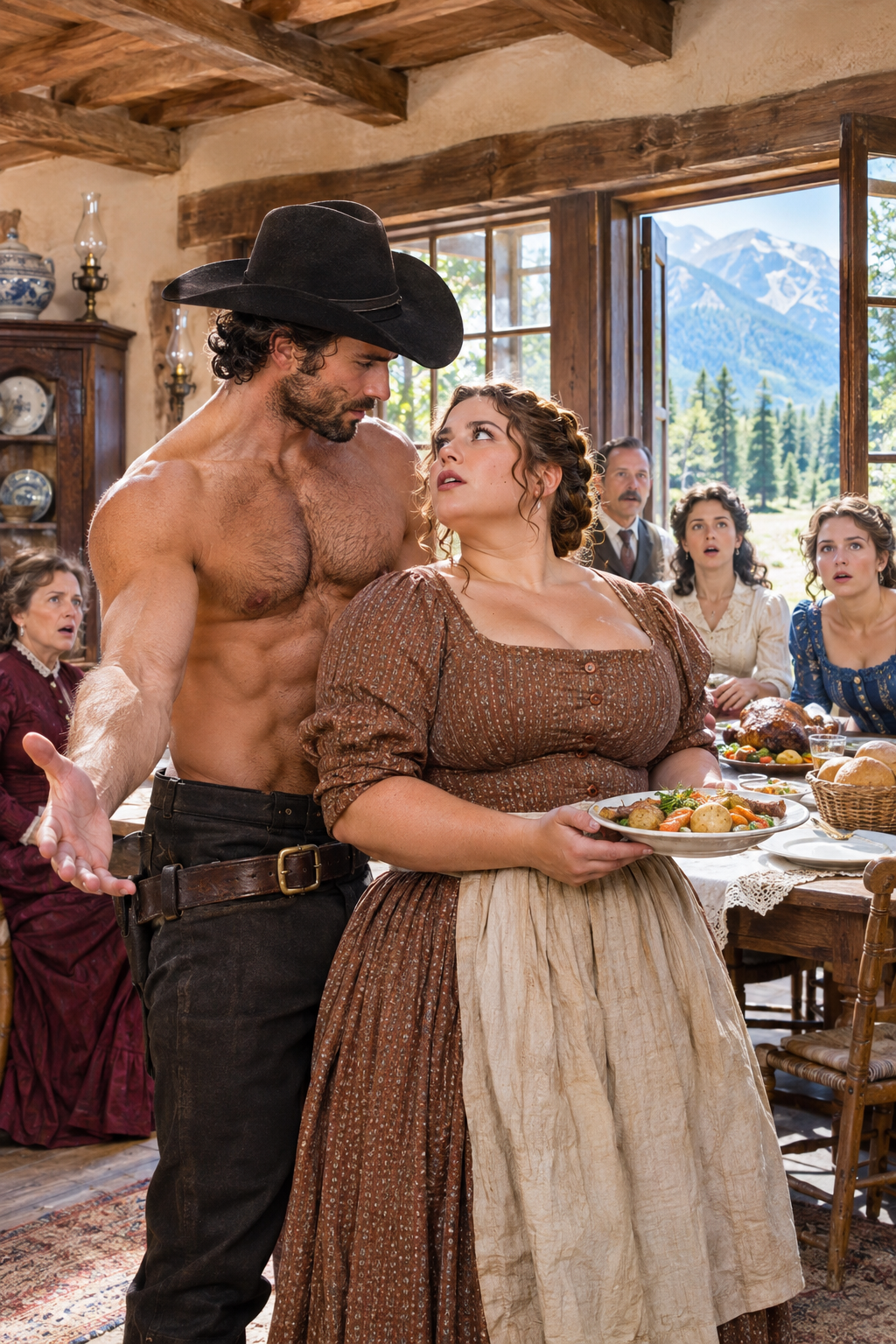
The wealthy rancher had come to court my cousin, but when he saw me carrying the dinner plates, he pushed back his chair and stood up.
“I know exactly what my place has been, Aunt Vera,” I said. “I’ve spent years standing in your kitchen while everyone else sat at your table.”
She looked at me as though I had slapped her. Celia stood near the doorway in her nightgown, watching us with wide eyes.
“You have become remarkably ungrateful,” Aunt Vera replied. “Ever since that man started putting money into your hands, you’ve forgotten everything I’ve done for you.”
“I haven’t forgotten. But remembering your kindness doesn’t mean I must spend the rest of my life paying for it.”
She rose from her chair and folded her arms.
“Silas came here because he was interested in Celia. You knew that perfectly well. Yet you’ve done everything possible to draw his attention away from her.”
I turned toward my cousin, expecting her to agree.
Instead, Celia lowered her eyes.
“I never asked him to choose me over anyone,” I said. “He offered me work. Everything else happened naturally.”
Aunt Vera gave a bitter laugh.
“Do you truly believe a man with his money and standing would marry a woman like you?”
Those words would have destroyed me a month earlier. That night, they still hurt, but something inside me had changed.
“I don’t know whether Silas intends to marry anyone,” I answered. “But I know I deserve to be treated with respect, whether he does or not.”
Aunt Vera’s face turned red.
“Then you may choose. Either you stop this foolish business and return to your duties here, or you find somewhere else to live.”
The kitchen became so quiet that I could hear the clock ticking in the hallway.
I had lived beneath her roof for eleven years. Everything familiar to me was inside that house. My mother’s old quilt, my father’s Bible, the little bedroom beneath the stairs.
Leaving frightened me more than I wanted to admit.
But staying frightened me even more.
“I’ll leave,” I said.
Celia lifted her head sharply.
Aunt Vera stared at me, apparently waiting for me to take back my words.
When I didn’t, she pointed toward the stairs.
“You have until tomorrow morning.”
I went upstairs and closed my bedroom door. Only then did my courage give way to tears.
I sat on the edge of my narrow bed, wondering whether I had just made the greatest mistake of my life. I had some money saved, but not enough to support myself for long. Winter would arrive soon, and Colorado winters were unforgiving.
A gentle knock interrupted my thoughts.
It was Celia.
She entered carrying a small cloth purse.
“Mother doesn’t know I’m here,” she whispered.
She placed the purse beside me.
Inside were several silver coins.
“What’s this?”
“Some of your money. Mother gave it to me to buy fabric for a new dress.”
My stomach tightened.
“She told me it was household money,” Celia continued. “But I saw Mr. Boone give it to her after you delivered those pies.”
I looked at the coins, remembering the mornings I had risen before daylight and the evenings my back had hurt so badly I could hardly straighten it.
“How long has she been doing this?”
Celia’s eyes filled with tears.
“I don’t know. But there’s something else you should know. Mother told Silas you weren’t interested in seeing him outside of work.”
I stared at her.
“When?”
“After his second visit. He asked whether you might accompany him into town sometime. Mother said you were uncomfortable around gentlemen and preferred to stay home.”
Suddenly, several conversations with Silas made sense. His careful invitations, his hesitation whenever he asked something personal, the way he always gave me an opportunity to refuse.
“Why didn’t you tell me?”
Celia sat beside me.
“Because I liked being the pretty one. I liked having gentlemen come to see me. And when Silas started asking about you, I felt jealous.”
Her voice broke.
“But watching Mother tonight made me ashamed.”
For the first time, I saw my cousin not as the fortunate girl who had everything I lacked, but as another woman who had been taught that her value depended upon a man’s attention.
I took her hand.
“Thank you for telling me.”
Before sunrise, I packed my belongings into an old traveling trunk. Everything I owned fit inside it, with room to spare.
Aunt Vera was already downstairs when I entered the kitchen.
She looked at my trunk and then at me.
“You’ll come crawling back before the week is over.”
I placed the house key on the table.
“Goodbye, Aunt Vera.”
She didn’t answer.
Outside, the morning air was cold enough to sting my cheeks. I paid a passing wagon driver to carry my trunk into town, where I hoped to find a room.
My first stop was Mrs. Whitcomb’s boardinghouse.
Mrs. Whitcomb was a widow who had occasionally purchased my apple pies. She listened while I explained that I needed somewhere to stay and a kitchen where I could continue baking.
“There’s a room above my washhouse,” she said. “It isn’t much, and the stove downstairs has seen better days.”
“I don’t need much.”
She studied me for a moment.
“Can you make biscuits?”
“Yes, ma’am.”
“Good ones?”
“The kind that disappear before supper.”
She smiled.
“We might be able to help each other.”
We agreed that I would prepare breakfast biscuits for her boarders in exchange for reduced rent and use of the kitchen.
By noon, I had a room of my own.
The wallpaper was peeling, the window rattled, and the bed was hardly wider than the one I had left behind.
Yet when I closed the door, I felt something I had never experienced before.
Nobody could summon me from the other side.
Two days later, Silas arrived at Aunt Vera’s house to collect his bread.
According to Celia, Aunt Vera told him I had abandoned my responsibilities and left town without explaining where I was going.
He didn’t believe her.
He found me that afternoon at Mrs. Whitcomb’s boardinghouse, carrying a basket of fresh rolls into the dining room.
“Clara?”
I nearly dropped the basket.
“What happened?”
I explained that Aunt Vera and I had disagreed and that I had decided to live independently.
His expression darkened when I told him about the money she had withheld.
“Why didn’t you send word?”
“I didn’t want you to think I expected you to rescue me.”
He removed his hat.
“Clara, asking someone for help isn’t the same as surrendering your independence.”
“I know. But I needed to discover whether I could stand on my own.”
He looked around the modest kitchen, then smiled.
“It appears you’re doing just that.”
He renewed his bread order and asked whether I could supply twice as many pies during the upcoming cattle drive.
Before leaving, he handed me a written agreement listing the quantities, prices, and payment dates.
“Your business deserves to be treated like any other business,” he said.
I held that piece of paper long after he had gone.
Nobody had ever taken my work seriously enough to put its value in writing.
Over the next several weeks, my life became busier than I had imagined possible. Ranch hands recommended my bread to their families. Travelers bought my pies before boarding the stagecoach. Mrs. Whitcomb began serving my cinnamon rolls on Sundays.
For every dollar I earned, I carefully recorded the cost of ingredients and set aside a portion of my profits.
I was exhausted most evenings, but it was a different kind of exhaustion.
My labor was building something that belonged to me.
Silas visited whenever his ranch duties allowed. Sometimes he brought apples from a neighboring orchard. Other times, he simply sat nearby while I worked, telling me stories about his cattle and the trouble his youngest ranch hands managed to find.
One evening, he asked whether I would walk with him after supper.
We followed the road beyond town, where the mountains stood against a golden sky.
“There’s something I’ve been meaning to tell you,” he said.
I waited.
“When I first came to your aunt’s house, I intended to meet Celia because several people had suggested we might make a suitable match.”
My heart sank a little.
“But the moment I saw you, I remembered that evening at the stage station. You had very little food, yet you shared it with a stranger without asking what he could offer you.”
He stopped walking.
“I’d spent years meeting people who knew exactly how much land I owned. You didn’t even ask my name.”
I smiled faintly.
“You looked hungry.”
“I was. And you made me feel like an ordinary man instead of a collection of cattle and property.”
He reached for my hand.
“I haven’t been thinking about Celia for some time, Clara.”
My cheeks grew warm.
Before I could answer, he continued.
“I would like to court you properly, if that’s something you want.”
For years, I had imagined how wonderful it might feel to hear such words. Yet when they finally came, my first reaction was fear.
“What will people say?”
“People have been talking since the day I bought my first ranch. They haven’t managed to run my life yet.”
“And what if you change your mind?”
“Then I suppose you’ll discover I’m a fool. But I have no intention of becoming one.”
I laughed, and the fear inside me loosened.
“I would like that very much.”
He walked me home that evening with my hand resting comfortably in his.
Unfortunately, happiness did not protect us from trouble.
The following Monday, the owner of the general store informed me that he could no longer sell me flour on credit.
I had always settled my account promptly, so I asked what had changed.
He shifted uncomfortably.
“Your aunt came in yesterday. She says you owe her a considerable amount of money and have been avoiding your debts.”
My mouth fell open.
“That’s not true.”
“Perhaps not. But I can’t afford to take chances.”
By the end of the week, two customers had canceled their orders. Another woman asked whether it was true that I had stolen money from Aunt Vera before leaving.
I realized what was happening.
My aunt couldn’t force me to return, so she was trying to destroy the means by which I supported myself.
Then came the worst blow.
Aunt Vera appeared at the boardinghouse carrying a handwritten account of everything she claimed I owed her.
Eleven years of food, clothing, shelter, and other expenses.
The total was more money than I could hope to earn in several years.
“You’ll either settle this debt,” she announced, “or I’ll make certain everyone knows what sort of woman you are.”
Mrs. Whitcomb stood behind me, listening.
I examined the paper.
There was no mention of the thousands of meals I had prepared, the clothes I had washed, or the money Aunt Vera had collected from Silas.
“You’ve counted everything you gave me,” I said. “Where is the account of everything I gave you?”
“You were family. Helping was your duty.”
“Then why wasn’t helping me yours?”
She snatched the paper from my hands.
“You’ll regret speaking to me that way.”
That evening, Silas found me sitting beside the kitchen stove, staring at my account book.
I told him everything.
He offered to speak with the storekeeper and help clear my name.
But I shook my head.
“If you settle this for me, people will say I succeeded because a wealthy man protected me.”
“What do you want to do?”
“I want the truth to come from someone they cannot accuse of being blinded by affection.”
The answer arrived unexpectedly the next morning.
Celia appeared at the boardinghouse carrying a small wooden box.
Her face was pale, and she kept glancing toward the street.
“I took this from Mother’s bedroom,” she said.
Inside were old household account books, receipts, and several letters.
Celia opened one of the books and pointed to a series of entries.
They recorded payments from Silas for my baking, including money I had never received.
Then she handed me a faded envelope.
“This belonged to your father.”
My fingers trembled as I opened it.
The letter was addressed to Aunt Vera. My father had written it shortly before his death, explaining that he had arranged for money to be left for my care.
There were receipts showing that Aunt Vera had received those funds over several years.
I read the letter twice.
All that time, she had told me my parents had left nothing. She had made me believe that every meal I ate was an act of charity.
Yet my father had provided for me as best he could.
I pressed the letter against my chest and cried.
Not because of the money, but because I finally understood that my father had not left me entirely helpless.
Celia knelt beside my chair.
“I’m sorry, Clara. I didn’t know until I found these.”
The following Saturday, Aunt Vera attended a gathering at the Grange, where she had been telling several women about my supposed dishonesty.
I entered with Celia and Mrs. Whitcomb.
Silas came too, but he remained near the back of the room.
Aunt Vera stopped speaking when she saw us.
“What are you doing here?”
“I’ve come to settle the matter of my debt.”
Several people turned toward us.
I placed the account books and my father’s letter on a nearby table.
“You told people I stole from you. You also claimed you supported me entirely at your own expense. These records say otherwise.”
Her face changed.
“Those are private household papers.”
“They concern money intended for my care and wages earned through my work.”
She reached for the books, but Celia stepped between us.
“Mother, please stop.”
Aunt Vera looked at her daughter in disbelief.
Celia explained what she had witnessed and admitted that she had received money earned through my baking.
The room fell silent.
Aunt Vera tried to defend herself, insisting that raising another person’s child had been expensive.
Mrs. Whitcomb answered before I could.
“Then you should have kept an honest account, Vera. And you certainly shouldn’t have taken a grown woman’s wages.”
Aunt Vera looked around for support.
Nobody spoke.
I could have demanded that she repay every dollar immediately. I could have humiliated her further.
Instead, I gathered the papers.
“I want you to withdraw your accusations. I want the wages you withheld returned. And I want you to leave me free to live my own life.”
For several seconds, she said nothing.
Finally, she sank into a chair.
“I never thought you would leave,” she murmured.
Her anger had disappeared, revealing something smaller and sadder beneath it.
“Everything was easier when you were there.”
I looked at her.
“It was easier for you, Aunt Vera. It wasn’t easier for me.”
She began to cry.
I felt sorry for her, but I did not take back my demands.
Within days, she corrected her accusations, and we arranged for the unpaid wages to be returned in installments.
My customers came back. The storekeeper apologized, and several women who had believed the rumors placed new orders.
As winter approached, I rented a small storefront with a kitchen behind it. Above the entrance, a wooden sign read: CLARA HENSLEY’S BAKERY.
On opening morning, Silas arrived before anyone else.
He purchased two loaves of bread, an apple pie, and a cinnamon roll.
Then he placed a small velvet box on the counter.
“I have one more thing I’d like to discuss with the proprietor.”
Inside was a simple gold ring.
“Clara, will you marry me?”
I looked around my bakery. The shelves were filled with bread, the stove was warm, and my account book rested beside the register.
“There’s something you should understand before I answer.”
He raised his eyebrows.
“I intend to keep my bakery.”
“I was hoping you would.”
“And I won’t spend my marriage asking permission to earn money.”
“I wouldn’t want you to.”
I smiled through my tears.
“Then yes, Silas Boone. I’ll marry you.”
We were married the following spring beneath a clear Colorado sky. Celia stood beside me, and Mrs. Whitcomb helped arrange the flowers.
Aunt Vera attended quietly. After the ceremony, she approached me and apologized without offering an excuse.
I accepted her apology, although I knew rebuilding trust would take time.
Marriage did not end my work. My bakery grew, and eventually I employed three women, including a young widow who had been struggling to feed her children.
Every woman received her wages directly. Every hour of work mattered.
Years later, a shy young employee confessed that she hated her appearance and believed nobody would ever love her.
I recognized the sadness in her voice.
I invited her to sit beside me and poured two cups of tea.
“Your worth isn’t something another person gives you,” I told her. “And it isn’t something they can take away simply because they refuse to see it.”
I had spent much of my life believing that kindness meant making myself useful enough to deserve a place in somebody else’s home.
Silas helped me discover that love could exist without humiliation. My bakery taught me that independence was possible. And leaving Aunt Vera’s house taught me that gratitude never requires surrendering your dignity.
I remained the same broad-hipped woman I had always been. My hands still carried the marks of hard work, and flour often covered my dresses.
The difference was that I no longer apologized for occupying space in the world.
Whenever Silas came home, he kissed my forehead, asked about my day, and helped carry supper to the table.
There was always an extra chair for anyone who needed a meal.
And in the home we built together, nobody who prepared the food was ever expected to eat alone in the kitchen.
But there was one final chapter in my relationship with Aunt Vera that I never expected.
Nearly six years after my wedding, Celia arrived at the bakery one afternoon with troubling news.
“Mother is ill, Clara. She can hardly manage the stairs anymore.”
I set down the bread knife.
“Has she seen a doctor?”
“Yes, but she needs someone to look after her. I’ve been doing everything myself, and I don’t know how much longer I can manage.”
For a moment, I remembered the years I had spent caring for that household without a single word of appreciation.
Celia must have noticed my hesitation.
“I’m not asking you to come back,” she said quickly. “I just thought you should know.”
That evening, I discussed the matter with Silas.
“What does your heart tell you?” he asked.
“That I don’t want her to suffer. But I don’t want to become the woman I used to be.”
“Then help her in a way that allows you to remain the woman you are now.”
The following morning, I visited my aunt.
She looked much smaller than I remembered. Her once-perfect hair was untidy, and her hands trembled as she lifted her teacup.
When she saw me, tears gathered in her eyes.
“I suppose you’ve come to see what has become of me.”
“No, Aunt Vera. I’ve come to see how I can help.”
She turned toward the window.
“I don’t deserve your kindness.”
I pulled a chair beside her bed.
“Kindness isn’t something I offer only to people who deserve it. But things cannot go back to the way they were.”
She nodded slowly.
I arranged for a local woman to help with the cooking and cleaning. I paid part of her wages, while Celia covered the rest.
I visited twice a week, bringing fresh bread and occasionally staying for tea.
For the first time in our lives, Aunt Vera and I spoke without orders, accusations, or demands.
One afternoon, she reached beneath her pillow and handed me a small envelope.
Inside was an old photograph of my mother.
“I should have given you this years ago,” she said.
I studied my mother’s familiar smile.
“She was always so kind,” Aunt Vera continued. “People loved her without her ever having to try. I was jealous of her. And when you came to live with me, I suppose I carried some of that bitterness into the way I treated you.”
Her confession hurt, but it also answered a question I had carried for most of my adult life.
“You were a good girl, Clara. I knew it even when I made you believe otherwise.”
I wiped my eyes.
“I wish you had told me that when I was seventeen.”
“So do I.”
She died peacefully the following winter, with Celia holding one hand and me holding the other.
I mourned her, not because our past had suddenly become beautiful, but because we had finally found a little peace before our time together ended.
Celia eventually married a kind schoolteacher and moved into a modest house near town. We remained close, and our children grew up playing together.
My bakery continued to prosper. Years later, when my eldest daughter asked why I still worked despite her father’s wealth, I took her into the kitchen and showed her my first account book.
Its pages were stained with butter, and the handwriting was uneven.
“This was where I began building a life of my own,” I explained.
“But Papa could buy you anything you wanted,” she said.
I smiled.
“Your father has given me many wonderful things. But there are some things money cannot buy, and self-respect is one of them.”
She thought about that for a moment before asking whether she could help me make the morning bread.
I handed her an apron.
By the time Silas and I grew old, the bakery had become a familiar part of the community. Travelers stopped there for warm meals, ranch workers collected their bread, and women who needed employment knew they could knock on my door.
One cold evening, Silas and I sat beside the fireplace while snow covered the fields outside.
He reached for my hand, just as he had at the Grange dance so many years earlier.
“Do you ever think about that stage station?” he asked.
“Often.”
“Best supper I ever had.”
I laughed.
“It was stale bread and a little cheese.”
“Perhaps. But it changed my life.”
I rested my head against his shoulder.
For years, I had believed that meeting Silas was the greatest turning point in my life. As I grew older, however, I understood that something equally important had happened that night in Aunt Vera’s kitchen.
I had finally chosen myself.
Silas had offered me opportunities, affection, and companionship. But the courage to walk away from a life that diminished me had been my own.
If I could speak to the frightened young woman I once was, I would tell her that she did not need to become thinner, prettier, quieter, or more useful to deserve happiness.
She already deserved it.
And I would tell her that forgiveness does not require returning to the place where you were hurt. You can have a generous heart while protecting your dignity. You can love your family without allowing them to control your life.
Most importantly, you should never mistake being needed for being loved.
I spent eleven years making myself indispensable to people who barely noticed my pain. I spent the rest of my life discovering what it meant to be appreciated without having to earn every ounce of affection.
And it all began with a simple act of kindness toward a hungry stranger.
I had shared half my supper with Silas Boone because I believed no person should go hungry while another had food to spare.
In the end, life taught me something just as important.
No person should have to spend their entire life feeding others while starving for kindness themselves.
THE END.